A Boy Spotted an Armed Figure Above the Bikers’ Funeral—His Warning Made 700 Riders Turn at Once
He was nine years old and no one was listening.
Seven hundred men in leather and chains stood with their backs to the threat. Seven hundred tattooed arms folded in grief. Seven hundred pairs of boots pressing into the summer grass of a sun-bleached cemetery in Oakland, California.
Everyone in that crowd had already decided what they were looking at. A mob. A menace. A reason to cross to the other side of Piedmont Avenue. No one looked where the boy was pointing.
No one except her.
A woman who had spent twelve years learning to disappear into silence crouched forty feet above the ground, rifle in hand, watching something no one else in that cemetery had seen.
What happened in the next four minutes changed everything they thought they knew.
—
The summer heat had already turned the asphalt on Piedmont Avenue into something soft and yielding by nine in the morning. But inside Mountain View Cemetery, the air still held a trace of night, cool where the old valley oaks threw their shadows across the winding paths, thick with the smell of cut grass and granite, and the particular stillness that only the places of the dead seemed to carry undisturbed.
Patricia Whitmore walked three paces ahead of her son, the way she always did when she was trying to hold herself together. She wore a simple blue dress and low heels that kept sinking slightly into the soft earth near the older sections of the grounds, and she had given up fighting it somewhere between the iron gate on Piedmont and the gravel path that curved toward the east section where her father had been buried eleven months ago.
She held a small bunch of white carnations pressed against her chest and kept her eyes fixed on the path ahead.
Caleb was nine years old and constitutionally incapable of walking in a straight line. He veered left to read the inscription on a headstone. 1891, he mouthed, not yet old enough to feel anything particular about that number, except that it was very far away. Then he swung right to follow a crow that had settled on a white marble obelisk and sat there regarding him with one slick black eye.
He wore a green t-shirt with printing that had faded to near illegibility across three washing seasons, jeans frayed at both knees, and sneakers he had refused to replace despite his mother’s four separate and increasingly detailed requests that morning.
“Caleb, stay on the path.”
“I am on the path.”
“You’re on someone’s grave.”
He stepped two inches to the left without looking down. “Now I’m on the path.”
She exhaled through her nose and kept walking. She had learned in nine years that arguing with him consumed more energy than it produced. She let him orbit her at his own radius as they moved.
They found the grave in the east section, in the partial shade of an old valley oak whose roots had buckled the surrounding earth into soft, uneven ridges. The headstone was gray granite, simple. Harold Whitmore. 1948 to 2023. Together forever.
A small American flag had been placed in the grass beside it by someone other than her, which meant one of her father’s old friends had come at some point during the week. She crouched and placed the carnations in the stone vase, then pressed her fingers against his name for a long moment. The way you touch something you can’t stop losing.
Caleb stood beside her without speaking. He had been old enough to remember his grandfather’s laugh, a real laugh starting deep in the chest, and the smell of the man’s workshop off the garage, and the way he’d always called him chief, which had made Caleb feel both important and slightly ridiculous in exactly the right proportions.
At nine, he understood in the practical and unsentimental way of children that grief was something you brought to a specific point on a map and left in small increments over many visits.
He put his hand on his mother’s shoulder. She covered it immediately with her own.
They stayed about fifteen minutes. Then Patricia stood, touched his cheek, and they turned to leave.
That was when they heard it.
Not exactly heard. Felt.
A low vibration that rose through the soles of the feet and moved upward through packed earth and stone and root. The way a far-off fault line sends its signal before anything visible breaks. It was less a sound than a presence, something vast and deliberate approaching while it was still beyond the gate.
Caleb turned toward the main entrance before his mother did.
—
The motorcycles came through the gate on Piedmont Avenue in a column that appeared, in his nine-year-old reckoning, to have no beginning and no end. Big American machines, chrome winking hard in the mid-morning sun, engines running at an idle that was nonetheless tremendous. Slow. Purposeful. The way things move when they carry something heavy and know it.
At the head of the procession came a hearse, black and long, and behind it the bikes came two by two, then fanned out as the column reached the wider paths of the cemetery grounds.
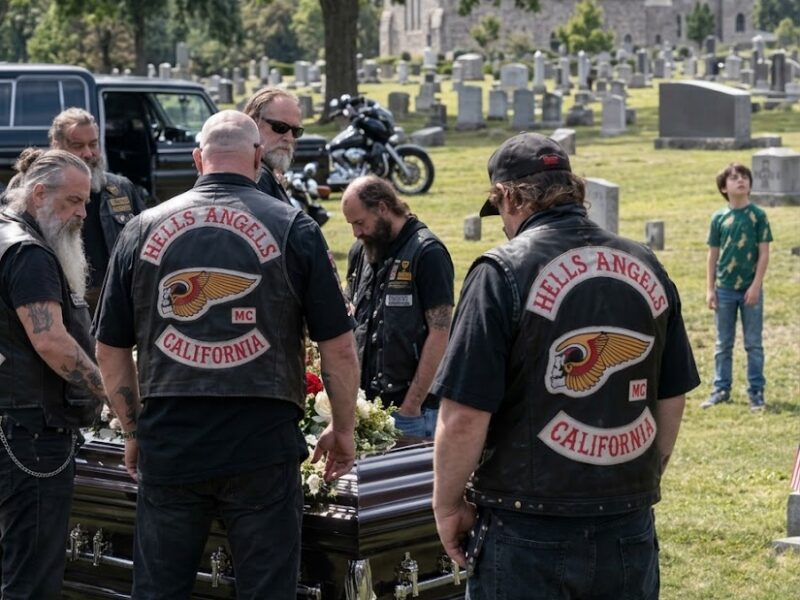
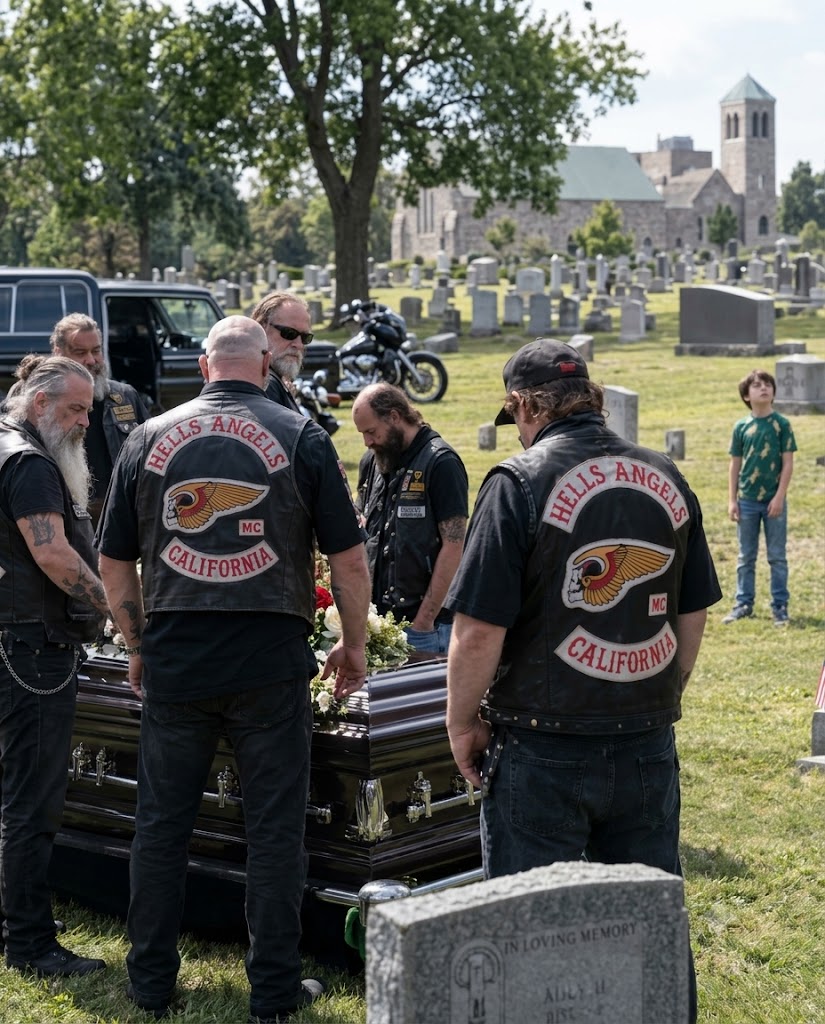
The men who rode them wore black leather vests with a distinctive patch: a winged skull in gold and red. And as the column came closer, Caleb could read the lettering on the nearest backs. Hells Angels across the top. California along the bottom. MC between the wings.
Most of the riders were older men. Gray beards, white beards, faces made by decades outdoors, deeply lined, set firm by weather and time. The largest man near the front of the procession was entirely bald, built like something structural, with heavy ink covering both arms from shoulder to wrist.
Several riders wore dark glasses. One wore a white beard long enough to rest against his chest, and he carried himself with the specific economy of motion of someone who had learned over many years not to waste anything.
They parked and dismounted in near silence. That was the strangest part, the contrast between the thunder of their arrival and the abrupt quiet of their stopping, which was not exactly peaceful but was something close to solemn. Then the engines cut off, all of them within seconds of one another, and the silence that followed had weight.
The casket was removed from the hearse and carried to the prepared grave site by six men who moved with coordinated care. A polished dark wood box with brass fittings, with an arrangement of white and red roses across its lid, the petals bright as signal flags in the noon light.
The very old man, white beard, careful movement, the one with the face that had been a long time earning its expression, moved to the head of the casket and set both hands on its edge and stood that way without moving. The way you stand when you’re trying to hold on to a moment before it passes out of reach.
Patricia had closed her hand around Caleb’s. “Come on,” she said quietly. “Let’s give them their space.”
Caleb didn’t move. He was looking at the ridge above the northern boundary of the cemetery, where the city’s old water tower rose against the flat blue sky. Something had caught his eye up there. A small, precise flash. There and gone. The way a lens or a mirror catches sunlight at exactly the wrong angle for a single instant. A shape where a moment ago there had been none.
He raised his arm and pointed, fully extended, the way his grandfather had taught him to point when you needed someone to see exactly what you were seeing with no room for ambiguity.
“Mom,” he said. “There’s someone up there.”
It was the gesture that carried, not his voice, which was too small to reach across the crowd of men standing in the grass, but the sight of a nine-year-old boy’s arm extended rigid and true, pointing north toward the water tower.
Three of the bikers standing closest to him caught the movement and turned. The men beside them turned, and something moved through the assembled crowd the way a current moves through standing water. A shift, then a ripple, then a wave that traveled outward through the body of men until seven hundred heads were facing the same direction.
Not in fear. That was what struck Deputy Leonard Puit, who was stationed at the edge of the access road near the iron gate, one hand resting on his belt, the other wrapped around a thermos of lukewarm coffee. He had pulled this assignment grudgingly. Cemetery detail for a motorcycle club funeral was not his idea of a productive Tuesday, and he had spent the first forty minutes cataloging the various ways it might go sideways.
Large men. Leather vests. A collective reputation that filled pages in the department’s files. He had positioned himself near the gate with the calculated casualness of someone running a low-grade threat assessment.
But the turn was not fear. What moved through those seven hundred men moved with a quality that Puit recognized distantly from his two years in the reserves a long time ago. The calm pivot of people who have been in proximity to danger often enough that they no longer react with panic, but with a trained and unhurried attention. They turned toward the thing. They looked at it steadily.
Puit set down his thermos. He reached for his radio. His eyes moved to the water tower on the ridge above the north fence. He saw the figure partially concealed behind one of the support struts on the upper platform. Low profile. The way someone trained keeps low. He could not make out gender or features from this distance. What he could make out was the long, unmistakable silhouette of a rifle.
“All units, I’m at Mountain View on Piedmont. I have a possible—”
“Hold on.”
The voice came from two feet to his right, unhurried and low. The very old man with the white beard had left the casket and was standing beside him, squinting upward at the tower with an expression that was assessing rather than alarmed. He was older than Puit had first estimated. Seventy at minimum, maybe well past it. The black leather vest was the same as the others, but worn differently, the way something worn for decades stops being a garment and becomes a surface. He moved with the careful deliberateness of someone carrying accumulated joint damage who had decided decades ago not to make it anyone else’s problem.
“Hold on.” Puit’s voice went flat with incredulity. “Sir, there is someone on that water tower with a rifle aimed at this ceremony.”
“I can see that.” The man’s voice had the texture of something compressed by time. “I’m asking you to hold for a moment.”
“I’m not in a holding situation. I’m in a—”
“She is not pointing at us.”
Puit stopped.
The old man, whose name was Gerald Maddox, though Puit would not know this until later, was still watching the tower with the patient focus of someone who had already done the calculation before opening his mouth. He said it again, quieter. “She is not pointing at us.”
Puit forced himself to reassess the trajectory. The figure on the platform was facing north-northwest. Away from the crowd. Away from the casket. Away from the grave site. The rifle was angled toward the access road that ran along the cemetery’s outer fence and the stretch of Piedmont Avenue visible through the gate.
Something cold moved through him. He looked at the access road. He looked at the gate.
He saw nothing. Not yet.
—
Caleb Whitmore had not been moved from the scene. Patricia had tried twice. Once when the bikers arrived and once when the crowd turned, but both times the situation had changed faster than her ability to respond, and eventually she had simply held him from behind with both hands on his shoulders.
He stood in the partial shade of an oak and watched everything with the unsentimental attention that children sometimes have before they learn which parts of a situation they’re supposed to overlook. He had stopped looking at the water tower. Something had pulled his attention south, toward the main gate, where the street was partly visible through the iron bars.
“Mom,” he said quietly.
“Not now, Caleb.”
“There’s a white van outside the gate.”
She looked. On Piedmont Avenue, just visible through the bars, a white panel van. No markings. Parked against the curb with its engine running. The driver’s window was down. Someone inside was looking in.
She tightened her hands on his shoulders.
Maddox had turned from the tower and was speaking in low tones to a younger member who had come up beside him. Stocky man, dark beard, a scar along his jawline, moving with the contained urgency of someone delivering a message. They spoke for under twenty seconds. Maddox nodded once. He looked at Puit.
“How long have you been with the department?”
“Twenty-four years,” Puit said, too baffled by the question to refuse it.
“Long enough,” Maddox said. “Then you know what a protective overwatch position looks like.” He tilted his chin once toward the tower. “That’s what that is. She’s been covering this ceremony since we came through the gate. Every single man standing here is inside her field of coverage.” He paused. “Which means she is the reason nothing has happened yet.”
Puit said nothing for several seconds. The word she had arrived with its full weight.
“Who is she?” he finally asked.
Maddox was quiet for a moment, watching the casket and the flowers and the circle of men who were, without instruction, spreading their formation outward. The perimeter they assembled every time they sensed something was off. A skill developed over decades that served them in ways law enforcement had never chosen to acknowledge.
“She knew Hawk,” he said. “Raymond Osgood. The man in that casket.” He paused, and this time the pause held grief that had been carried long enough to find its resting form. “Hawk ran a veteran services program out on 35th Avenue. Housing. Referrals. Counseling. Access. Legal aid. Ran it for eleven years out of his own pocket, out of this club’s charity work. No press. No recognition. He didn’t want it.”
He looked at Puit directly. “She came through that program. Different kind of debt than most of the rest of us. Same man she owes it to.”
Puit looked at the men gathered around the casket. He had spent forty minutes watching them as a threat and none of that time watching the street outside, which was where the threat had apparently been the entire time.
“Raymond,” he said carefully. “What did he do before the club?”
Maddox gave him a look that was not unkind but contained a specific patience, the kind you develop when you have spent decades answering a version of the same question.
“Marines,” he said. “Seventy-four to eighty-two. Sheet metal work in Fremont after that. Joined the chapter in ’89. Raised two kids. Buried his wife in this cemetery in 2015, over in the west section.” A pause. “She’s there now. A couple hundred yards from where he’s going.”
Something passed across Puit’s face that he could not fully account for.
“There are things people know about Raymond Osgood,” Maddox said, “and there are things they assume. Those two lists don’t overlap as much as most people think.”
Then he turned and walked back toward the casket, and the crowd separated for him and came back together behind him like water. And Puit stood where he was and looked at the gate and at the tower and at the boy and his mother under the oak tree and tried to account for the distance between the morning he had prepared for and the one he was actually having.
—
The platform on the water tower was eight feet across, and the railing was rust-orange and unreliable, and Diana Slade had been on her stomach on the steel grating since 5:42 that morning, which meant she had lain in forty-degree pre-dawn cold for more than four hours before the temperature climbed to something that stopped being an argument.
She did not mind. She had spent longer than that in worse conditions in places with names that still surfaced in her sleep sometimes, and discomfort of the physical kind—cold steel, wind exposure, the specific ache of holding a static position for hours—was the variety she was least afraid of.
She was thirty-eight years old, 142 pounds, short hair kept military-cropped long after she had stopped being military because it was practical and she had enough things in her life that cost attention without adding hair to the list. She had gray eyes that people sometimes described as cold, which she had stopped correcting, because explaining the difference between cold and careful required a level of patience she didn’t always have available.
There was a faint scar along her left forearm, old enough to have faded to near white, that she never explained to anyone who asked.
From her position on the north platform, she had clear sight lines in three directions: the full interior of Mountain View Cemetery, including the grave site; the access road and the gate; the segment of Piedmont Avenue between the gate and the intersection at Pleasant Valley Road; and the parking zone adjacent to the east wall, where at 11:22 that morning a white panel van had pulled in and idled for twelve minutes before moving to the curb on Piedmont.
She had clocked it on arrival. She had memorized the plate number and written it on her wrist at 11:45 with a felt-tip marker from her vest pocket, and she had used the scope for a clear look at the driver and the front-seat passenger before they angled out of her direct line of sight.
She had not recognized either face. She recognized the posture. She recognized the specific way the passenger held his right arm slightly away from his body, elbow at an angle that suggested weight under the jacket.
She had been at her position for nearly six hours before the first motorcycle came through the gate. In that time she had watched the groundskeepers complete their work and leave, watched three separate families come and go through the east section, watched the deputy arrive forty minutes before the procession, park at the gate, and begin his assessment of the grounds with his eyes tracking the crowd and never once traveling to the street beyond the fence.
Old habit, she thought without judgment. You watch what you expect to find. The hardest part of any field assignment was breaking the expectation long enough to see what was actually there.
She had needed two years and a man with a white beard knocking on her car window to learn that lesson herself. She was not going to waste it.
She keyed the small radio clipped inside her vest. One click. A pause. Two clicks back. Contact confirmed.
She moved her eye back to the scope and tracked the van. It had repositioned to Piedmont. Engine still running. Window down. The passenger was looking through the gate.
Diana breathed out to a count of seven. Her heart rate had been sitting at fifty-two for the last ninety minutes. She knew this because she had learned, in years of operational work and then in years of deliberate reconstruction, to monitor her own body with the detachment of an observer. It had saved her life twice in the field. It had saved her in a different way after, when the things her body did in civilian rooms—the sudden spike, the locked breathing, the exit mapping—had become things she needed to learn to read and name rather than simply survive.
She reached into her chest pocket with her left hand, keeping her right hand on the rifle, and touched the envelope there. Paper soft from handling. The ink on the outside worn to a near blur. She had read the letter inside enough times that she no longer needed to read it. The words were inside her now. But the touch of the envelope was something she still needed. The way you touch a familiar wall in the dark. Not for information, but for orientation.
Raymond had written it two weeks before the cardiac event that had been coming for years and that he had refused to characterize as anything other than inconvenient. She had received it three days after his death, which meant she had no way to reply, which was, she had understood instantly, exactly how he had intended it.
Raymond Osgood had always known how to end a conversation in a way that left you with no good answer.
She had met him eight years ago at the bottom of something she didn’t describe to people who didn’t already know. Two tours overseas. One in Iraq. One in Afghanistan. Three years carrying a rifle in conditions that bore no relation to this flat blue California sky, and then a discharge into a country that had no particular language for what those years had cost her.
Four months sleeping in her car in a parking structure off International Boulevard. Front seat. Doors locked. Windows cracked. Eating from whatever she could stretch the last of her discharge pay into.
Raymond had knocked on the driver’s side window at two in the morning. Wide-shouldered. Unhurried. White beard even then. A voice entirely without performance.
“You okay?”
She had not been okay. He had gotten her a room that night. A warm meal. A legal aid contact in the morning. A referral to the Anchor Point Network on 35th Avenue, which had been running quietly for eleven years at that point on his personal funds and the club’s charity drives.
She had fought him at every step. She was good at making herself unreachable, at converting help into a form of insult, and he had absorbed every bit of resistance without comment and kept showing up. Not dramatically. Not with the vocabulary of transformation. He just kept appearing at the right time with the right practical thing until the wall she had been building ran out of material.
Below her, something changed in the formation. She saw the bikers shift. That precise, distributed movement she had seen once before, forty-five minutes ago, when the boy’s arm had gone up. Now it was different. Subtler. A closing of ranks around the casket. Someone had passed a signal she hadn’t seen pass.
She moved the scope south to the gate. The white van’s passenger door was opening. She tracked immediately, breathing down to six counts, the body dropping into familiar mechanics without effort. One man out. Hands not visible. Moving along the inner fence line. Second man out. The driver. Right hand carrying something against the thigh, close to the seam of his jeans.
She keyed the radio. Three short clicks, then two.
Come on.
She watched the access road. She watched the deputy, who had been focused on her position for the better part of an hour and needed to look somewhere else right now.
Come on.
She saw his head move. Saw him turn toward the gate.
There it was.
Four minutes, maybe less. She settled her breathing and she waited.
—
It was 2:17 in the afternoon on Tuesday, the seventeenth of June, when the two men from the white van came through the main gate on foot. The sun had moved past its peak, and the oak shadows had lengthened across the graves, running dark through the grass, but the heat had not relented. The air sat close and heavy in the way of June afternoons in Oakland, when the bay breeze fails to arrive on schedule.
The burial ceremony had settled into a kind of extended pause. No one had directed it to stop. It simply had, the way a room goes quiet before a door opens, the pressure change arriving before the event itself.
The first man was wide through the shoulders in dark jeans and a light jacket that was wrong for the temperature. The second was lean, with an expression of elaborate blankness, the kind of face you construct when you are concentrating very hard on appearing unconstructed. They came through the gate and moved along the inner fence line toward the access road, staying close to the iron bars, and if you were not specifically watching that line of approach, you might have given them another thirty or forty seconds before registering their entrance.
Deputy Puit was watching. He had moved fifteen feet to the right of his earlier position without being conscious of doing it. The body making tactical decisions ahead of the mind. He had his radio in his hand. Backup had been called and was rolling. Two units from the Piedmont Avenue substation, three minutes out, which was the longest three minutes of his professional life. His other hand rested on his holster. Not drawing yet.
He was running the arithmetic of one deputy, two unknowns with at least one concealed weapon, and seven hundred motorcycle club members who were going to do whatever they were going to do regardless of his preferences. And his job was to ensure the sequence concluded without anyone bleeding on cemetery grounds.
The two men stopped on the access road. They had seen the crowd’s arrangement. The bikers were no longer in the loose cluster of a burial service. They had spread subtly into a formation that looked informal but had geometry behind it. It would not have been legible to someone expecting disorder. To someone who had been trained to read order, it was entirely clear.
One of the men looked up. From this position in the grounds, the water tower was visible above the north fence, and the figure on the upper platform was no longer concealed. Diana had moved from her prone position and was standing—not at full height, not ostentatiously, but upright enough to be seen clearly against the sky. The rifle was in hand, pointed down. The posture was unmistakable to anyone who had encountered it before.
The man who looked up went very still.
Then the sound arrived. A single rifle discharge, clean and enormous in the summer quiet, splitting the air above the access road. Not aimed at a person. Not aimed at anything except a strip of empty gravel to the left of the road, ten feet from the nearest vehicle, far enough from any living thing to carry only one possible meaning.
I am here. I see you. This is what I am choosing not to do to you.
The echo came off the stone church building at the cemetery’s north end and returned half a second later. And then the silence after it was absolute.
The man who had looked up dropped something. A metallic sound as it struck the gravel. He backpedaled three steps. His partner turned and moved toward the gate fast—not quite running, but close to it.
The bikers moved in the same instant. Not outward. Not in aggression. The reverse. They drew inward, every man at the outer edge of the crowd pulling toward the center, creating in seconds a wall of leather and bodies between the casket and the gate. No instruction given. No visible signal. Seven hundred people operating in a language they shared, doing what that language said to do.
Puit was already moving. “Stop. Police.” Badge out, sidearm drawn but angled at the ground, covering the approach line. The man near the gate had slowed, calculating the opening in the fence, the distance to the van, the math of what was in front of him and what was behind.
The math came back wrong. He stopped.
The backup arrived. Two patrol cars from the Piedmont entrance, a third from the east service road. Sirens cut the moment they cleared the gate so as not to escalate a crowd of seven hundred. Four officers out and moving within seconds.
It was over before the moment fully arrived. The two men were on the access road with their hands being secured, and a second firearm was located during the initial sweep of the van, and the radio was running names and coordinates, and the cemetery was entirely still in the kind of silence that follows something that nearly happened and didn’t.
Puit stood in the June heat and looked at the water tower. The figure was already descending. She came down the access ladder on the outside of the structure, methodical, unhurried, rifle secured in its case across her back. She hit the ground at the base of the tower and walked toward the cemetery gate with the long stride of someone who has a destination and no particular urgency about the route.
Puit moved to intercept her. Badge still out, more from habit than intention.
She stopped. She looked at the badge, then at him.
“Diana Slade. Former Army, 75th Ranger Regiment. Two tours. Honorably discharged, 2014. Current California security contractor. License number available on request.” Her voice was even. “I will answer every question you want to ask me in whatever order you want to ask it. Written statement. Whatever you need.” She paused. “But first—” Her eyes moved past him toward the grave site. “I need two minutes.”
He studied her face for a long moment. He looked at the casket, at the old man standing at its head, at the boy and his mother under the oak.
He stepped aside.
She walked through the gate without another word, across the access road and into the cemetery grounds, and the crowd of bikers parted for her. Not dramatically. Not with any theatrical gesture. Simply with the specific respect of people who recognize one of their own, regardless of the surface differences between them.
She walked to the casket and stood before it and looked at the white and red roses for a full minute without speaking.
Gerald Maddox came to stand beside her.
“He told me about you,” the old man said.
“He told me about you, too.”
The bay breeze arrived from the west just then, carrying the smell of the water and the cooling of the late afternoon. The oaks moved with it.
“He said you were the best he’d ever seen,” Maddox said quietly. “In that particular skill. Said you moved like something that had been built specifically for it.”
“He saved my life,” she said. “Not the interesting way. The slow way. The quiet one.” She paused. “Which is the harder one.”
Maddox nodded. He looked at the casket. “Different men here he saved in different ways. Some he kept from the worst decision of their lives. Some he kept alive. Some he kept human.” His voice was very low. “Different debts. Same man.”
They stood in silence for a while. Then Maddox said, “People look at us and the story writes itself before a single fact comes in. Been that way my whole life. Leather and chains and the rest of it, and the verdict is already in before anything happens.” He looked at her directly. “Same thing they do with a woman who carries a rifle. Same mechanism. Same speed.”
He set his hand on the edge of the casket. Holding on.
“The only thing that corrects a wrong story is a true one. And the only way to tell a true one is to keep living it every day, whether anyone is watching or not.” He held her gaze. “Raymond knew that. Lived it for fifty years, quietly. And today, because a nine-year-old boy pointed at the right thing at the right moment, people might start to know it, too.”
—
The processing took the remainder of the afternoon. The two men from the van were later identified as associates of a trafficking network that had been operating in the Fruitvale and San Antonio districts for three years. Raymond Osgood’s Anchor Point program had interfered repeatedly with their recruitment operations in transitional housing facilities, exposing their activity and filing formal reports through legal channels.
Thirty-one reports in four years.
Puit would not learn that number until the following week, when the DA’s office sent the background file. He read it twice. Slowly. He drove back to the station at six in the evening with the incident report half composed in his head and a question that kept interrupting the composing.
How many times in twenty-four years had he positioned himself near the right answer and been looking at the wrong thing?
He stopped trying to calculate. The number didn’t improve anything.
—
The burial was completed quietly in the late afternoon, the crowd returning to the grave once the immediate aftermath had cleared. Someone produced a folded American flag, corners precise, the geometry of the folds clean enough to have been practiced, and placed it on the casket beside the roses.
No one explained why. Puit would find it in the background file. United States Marine Corps. 1974 to 1982. Two tours. Honorably discharged.
The flag had been earned.
Gerald Maddox stood at the grave after most of the others had moved toward their motorcycles. He read the temporary marker that would be replaced within the week by the permanent stone already on order. Then he looked across the cemetery toward the west section, where a different headstone had stood since 2015, and he was very still for a moment with his hands at his sides.
Diana sat on a bench near the east path, in the partial shade of the same valley oak that had sheltered the Whitmore family that morning. Elbows on knees. Hands folded. Eyes on nothing in particular. The posture she took after an operational period. Not decompression exactly. More a kind of accounting. What happened. What could have happened. The distance between those two things and what it had cost to maintain.
She heard footsteps and looked up.
Puit stopped two feet away, notebook in hand, not opened. “Full statement whenever you’re ready,” he said. “Today, tomorrow, written or in person, whatever you prefer.” He paused. “The radio protocol. The clicks. Pre-arranged with a contact in the club?”
“When I confirmed the van’s occupants were armed, I signaled. They passed it internally. That’s why the formation changed when it did.” She met his eyes. “And the warning shot. Inside a ten-foot safety margin on all sides. I have the trajectory documented and will include it in the written report.” A pause. “The alternative was letting them get close enough to the crowd that any response would have been significantly more complicated.”
He absorbed that. He looked at the bench beside her, then at the ground.
“I spent forty minutes watching the wrong thing this morning,” he said.
She didn’t answer. There was nothing he needed from her on that.
“Osgood,” he said. “The background file. What am I going to find?”
She was quiet for a moment.
“Marines. Honorably discharged, 1982. Sheet metal work in Fremont. Club member from ’89. Two kids, both grown. Buried his wife here in 2015.” She looked toward the grave. “Anchor Point Network on 35th Avenue. Established 2013. Veterans housing, legal referral, counseling access. Funded from his personal accounts and the club’s annual charity run. Seventeen consecutive years of charity rides. Three hundred twelve program participants in eleven years. Children’s literacy program through Oakland Unified funded through the same rides. Twenty-two thousand dollars raised in the last year alone.” She paused. “He filed thirty-one formal reports on the trafficking operation in four years. Through legal channels. Every time.”
She paused again. “He never publicized any of it.”
Puit said nothing.
“Three hundred twelve participants,” she said. “I’m number forty-one.”
He removed his hand from his holster slowly, deliberately, the kind of movement that happens in the body before it reaches the conscious mind, and gave her a single nod. Slow. Private. The kind that carries more than nods usually carry.
Then he walked away toward the gate, moving with the gait of someone who has recalibrated something fundamental and is still finding his footing in the new position.
—
Caleb Whitmore had been watching from under the oak tree. His mother had given up on leaving sometime in the last hour and was standing with her arms folded and her eyes on the middle distance, performing the specific stance of a parent who has decided to allow something to happen while keeping the ability to intervene instantly at hand.
Caleb had been holding something in his left hand since they arrived. A single pale wildflower he’d pulled from the base of a plant near his grandfather’s grave, which his mother had noticed and chosen not to address, given everything else. He’d been turning it over in his fingers through all of it. The bikers’ arrival. The seven hundred men turning as one. The crack of the rifle that had made the air ring like a struck bell. The men on the gravel road. The woman coming down from the tower.
He walked toward the casket. The two or three bikers still near the grave stepped back without being asked, the way adults make room for children in spaces that call for it.
Maddox, standing at the head of the grave, looked at the boy without expression.
Caleb stopped in front of the casket. He looked at the flowers for a moment. Then he set the wildflower on the lid, between the red roses and the American flag. Small and pale and slightly wilted from two hours in his fist.
He stood there for a second with his hands at his sides. Then he walked back to his mother, and she put her arm around him and pulled him close.
Maddox watched him go. He said nothing, but something in his face adjusted. Not to softness exactly, but to the specific recognition that happens when the world provides an example of the thing you have been trying to articulate for a long time without finding the words for it.
The bay breeze moved through the oaks one more time. The temperature dropped two degrees. The long California afternoon was beginning its slide toward evening.
Patricia Whitmore held her son’s shoulder and looked at the grave and the flowers and the flag and the pale wildflower her son had added to them, and then briefly at the woman on the bench in the partial shade, who was looking at none of it and somehow seeing all of it.
She did not have language for what she had witnessed today. She was not sure language was the point. Some things carried themselves forward without needing to be explained, and the attempt to explain them was how you lost the part that mattered.
She bent down, and from the grass at her feet she picked up a single white rose petal that had fallen from the casket arrangement at some point during the long afternoon. It lay there, small and curled at its edge, already beginning to dry in the summer heat. She held it between her fingers, the waxy surface of it, the weight of something that was nothing at all. Less than a gram. Less than a sound.
Then she pressed it into the center of her palm and closed her hand around it and straightened and said nothing about it to anyone.
They walked out through the gate on Piedmont Avenue, back toward the car, into the ordinary continuous noise of the city, which was still there the way it always is. Indifferent and moving. Going forward the way everything does after something has happened, whether the thing was witnessed or not.
—
Deputy Puit sat in his patrol car in the parking lot of the Piedmont Avenue substation at 9:47 that night, the incident report open on the laptop mounted to his dash. He had been staring at the same paragraph for eleven minutes.
The background file from the DA’s office sat on the passenger seat beside him, a manila folder thick enough to have its own gravity. He had read it twice. He would read it a third time before he went home.
Thirty-one reports. Four years. A man in a leather vest with a winged skull patch, walking into police stations and district attorney’s offices and transitional housing facilities, filing paperwork that exposed a trafficking network operating in the shadows of his own city. No press conferences. No photo opportunities. No requests for recognition. Just the slow, unglamorous, relentless work of doing the right thing in the right way for as long as it took.
Puit thought about the forty minutes he had spent that morning watching seven hundred men in leather vests and seeing a threat. He thought about the white van he had not seen at all. He thought about the woman on the water tower who had been covering the ceremony since before the first motorcycle came through the gate, and the nine-year-old boy who had pointed at the right thing at the right moment, and the old man with the white beard who had known exactly what he was looking at before anyone else did.
He thought about the distance between what people assume and what people know, and how that distance was often measured in the space between what you expect to find and what is actually there.
He saved the report. He closed the laptop. He started the engine.
—
Diana Slade sat on the tailgate of her truck in the parking lot of the Anchor Point Network on 35th Avenue, the building dark and quiet behind her, the streetlights just coming on. She had changed out of her tactical gear into jeans and a plain gray t-shirt, and her rifle was locked in its case in the cab, and the envelope was still in her chest pocket, pressed against her heart.
She had not read the letter again. She didn’t need to. She knew what it said. She had known what it said since the first time she read it, three days after Raymond Osgood’s heart had finally given out on him, the way he had always said it would, because he had never been a man who did anything dramatically, including dying.
The letter was four paragraphs long. The first paragraph was practical instructions about the Anchor Point Network, who to contact, what to do with the accounts. The second paragraph was about the club, about Gerald Maddox, about the men who would need someone to watch over them now that Hawk was gone. The third paragraph was about her. About what he had seen in her, eight years ago, when he knocked on her car window at two in the morning. About what he had watched her build since then. About what he believed she was capable of.
The fourth paragraph was one sentence.
You were never invisible to me.
She sat on the tailgate and watched the streetlights and thought about the boy. Nine years old, standing in a cemetery, pointing at the right thing at the right moment. She thought about his mother, holding him from behind, trying to protect him from something she couldn’t see. She thought about the seven hundred men who had turned as one, not in fear but in attention, because they had learned a long time ago that the things you don’t look at are the things that hurt you.
She thought about Raymond, who had looked at her when no one else would. Who had seen her when she was trying to be invisible. Who had kept showing up, with the right practical thing at the right time, until she ran out of material for the wall she had been building.
She reached into her pocket and touched the envelope one more time.
Then she got off the tailgate and walked to the driver’s side door and got in and started the engine and drove home.
—
The story did not make the news. That was the first thing Puit noticed, in the days that followed. There was a brief item in the East Bay Times, three paragraphs, buried on page six, about a disturbance at a funeral in Mountain View Cemetery and two men taken into custody in connection with an ongoing investigation. No mention of the water tower. No mention of the woman with the rifle. No mention of the nine-year-old boy who had pointed at the right thing at the right moment.
The Hells Angels did not issue a statement. They did not need to. The men who had been there knew what had happened. The men who hadn’t been there would hear about it, in the way that things are passed down in organizations that have learned to keep their own counsel. The story would travel through the club, and through the veteran community that Raymond Osgood had served for eleven years, and through the transitional housing facilities where his program had operated, and through the legal aid offices where he had filed his thirty-one reports, and through the district attorney’s office where those reports had eventually, slowly, been acted upon.
The story would travel, but it would not be public. That was how Raymond had wanted it. That was how he had lived his entire life.
—
Two weeks after the funeral, Patricia Whitmore received a letter. It was addressed to her son, in care of her address, and it had no return address, but she recognized the handwriting from the card that had been tucked into the flowers at her father’s grave eleven months earlier.
She opened it at the kitchen table, with Caleb at school and the morning light coming through the window over the sink, and she read it twice before she understood what it was.
It was a single page, handwritten, in an old man’s careful script.
Dear Caleb,
You don’t know me, but I was at the funeral where you pointed at the water tower. I saw what you did. I saw you notice something that no one else noticed, and I saw you raise your arm and point, the way your grandfather taught you, because you believed that if you showed people exactly what you were seeing, they would see it too.
You were right.
I am writing to tell you that what you did mattered. Not in a way that will make sense to you now, at nine years old. But in a way that you will understand when you are older, when you have learned that most people spend their whole lives looking at the wrong thing, and that the rarest and most valuable skill a person can have is the ability to see what is actually there.
Your grandfather taught you that. I knew your grandfather. He was a good man. He would have been proud of you.
The woman on the water tower was protecting all of us that day. She was protecting your mother, and you, and the seven hundred men who had come to bury my friend. She was doing it because my friend, whose name was Raymond, saved her life a long time ago, in the slow way, the quiet way, the way that doesn’t make a good story but makes a good life.
You saw her. No one else did. You saw her, and you pointed, and because you pointed, everyone else saw her too. And because everyone else saw her, nothing bad happened that day.
I want you to remember that. When you are older, and the world tries to tell you that what you see doesn’t matter, that what you notice doesn’t matter, that you are too small or too young or too insignificant to make a difference, I want you to remember that you were nine years old, standing in a cemetery, and you pointed at the right thing at the right moment, and it changed everything.
The world is full of people who are trying to be invisible. Some of them are hiding because they are afraid. Some of them are hiding because they have learned that being seen is dangerous. Some of them are hiding because they have been told, over and over, that they don’t matter.
You saw one of them. You saw her when she was trying to be invisible. And by seeing her, you made her visible.
That is the most important thing one person can do for another.
Keep looking, Caleb. Keep pointing. Keep believing that what you see matters.
Sincerely,
Gerald Maddox
Patricia read the letter a third time, and then she folded it carefully and put it back in the envelope and set it on the kitchen table and sat there for a long time, looking at the light coming through the window, thinking about her father, and the boy, and the woman on the water tower, and the old man with the white beard who had taken the time to write a letter to a nine-year-old boy because he understood something that most people never learned.
When Caleb came home from school that afternoon, she gave him the letter. He read it slowly, sounding out the words the way he did when he was concentrating, and when he finished he looked up at her with an expression she couldn’t quite read.
“Mom,” he said. “Who is Gerald Maddox?”
“He was at the funeral,” she said. “He was the old man with the white beard. The one who talked to the police officer.”
Caleb nodded slowly. He looked at the letter again.
“He knew Grandpa?”
“Yes,” she said. “He knew Grandpa.”
Caleb was quiet for a moment. Then he folded the letter carefully, the way he had seen his mother fold important papers, and he put it in his pocket.
“I’m going to keep it,” he said.
“I know,” she said.
He went to his room, and she heard him moving around, and when she checked on him a while later he had taped the letter to the wall above his desk, next to a photograph of his grandfather and a drawing he had made of a crow sitting on a white marble obelisk.
She stood in the doorway and watched him for a moment. He was sitting at his desk, doing his homework, and the afternoon light was coming through the window and falling across the letter on the wall, and she thought about the distance between what people assume and what people know, and about the slow, quiet work of living a true story every day, whether anyone is watching or not.
She closed the door quietly and went back to the kitchen.
—
The Anchor Point Network still operates on 35th Avenue. It is funded now by a combination of private donations and a grant from the county, and it serves more than three hundred veterans a year. There is a plaque on the wall by the entrance, small and unobtrusive, that reads: In memory of Raymond “Hawk” Osgood, who believed that no one should have to be invisible.
Diana Slade runs the program now. She has a small office in the back, with a window that looks out over the parking lot, and a photograph on her desk of a man with a white beard and a wide-shouldered stance and a voice entirely without performance. She still keeps the envelope in her chest pocket. She still touches it sometimes, the way you touch a familiar wall in the dark. Not for information, but for orientation.
She has never told anyone about the day on the water tower. Not the men in the club, who know without being told. Not the veterans who come through the program, who see her and recognize something in her and don’t ask what it is. Not the police officers who occasionally stop by, looking for information or offering it, who have learned over the years that Diana Slade is someone who can be trusted with the things that matter.
She has told one person. A nine-year-old boy, who is now seventeen, who comes by the office sometimes after school, who asked her once, a few years ago, if she was the woman on the water tower. She had looked at him for a long moment. Then she had said yes.
He had nodded, the way he did when he was thinking something through.
“I thought so,” he said. “I wasn’t sure. But I thought so.”
They had sat in silence for a while. Then he had asked her if she had known his grandfather. She had said that she hadn’t, not personally, but that she had known Raymond, who had been friends with his grandfather, and that Raymond had been a good man.
Caleb had nodded again.
“He wrote me a letter,” he said. “Gerald Maddox. After the funeral. I still have it.”
“I know,” she said. “He told me he was going to write it.”
Caleb had looked at her then, with the same unsentimental attention she remembered from the cemetery, the way he had looked at everything that day, before he learned which parts of a situation he was supposed to overlook.
“Why did you do it?” he asked. “Why did you come that day?”
She had thought about the question for a long time. She had thought about Raymond, knocking on her car window at two in the morning. She had thought about the letter in her chest pocket, the four paragraphs and the one sentence that she had never needed to read again. She had thought about the slow, quiet way that one person can save another, and the debt that comes with it, and the way that debt can be paid forward, over and over, in ways that no one ever sees.
“Because someone did it for me,” she said finally. “A long time ago. And I never got to thank him.”
Caleb had nodded, and they had sat in silence for a while longer, and then he had gone home.
—
The water tower on the ridge above Mountain View Cemetery is still there. The city has talked about removing it, replacing it with something newer and more efficient, but the process has been slow, and the tower remains, rust-orange and unreliable, rising against the flat blue California sky.
Diana Slade goes there sometimes. Not often. Only on the anniversary, in June, when the heat has turned the asphalt on Piedmont Avenue into something soft and yielding by nine in the morning, and the air inside the cemetery still holds a trace of night, cool, where the old valley oaks throw their shadows across the winding paths.
She climbs the access ladder on the outside of the structure, methodical, unhurried, and she stands on the upper platform, eight feet across, and she looks out at the cemetery and the access road and the gate and the stretch of Piedmont Avenue between the gate and the intersection at Pleasant Valley Road.
She thinks about the boy who pointed at the right thing at the right moment. She thinks about the seven hundred men who turned as one, not in fear but in attention. She thinks about the old man with the white beard who knew what he was looking at before anyone else did. She thinks about Raymond, who saved her life in the slow way, the quiet way, the way that doesn’t make a good story but makes a good life.
She touches the envelope in her chest pocket.
Then she climbs back down the ladder and walks back to her truck and drives back to the Anchor Point Network, where there is work to do, and people who need help, and a story to keep living, every day, whether anyone is watching or not.
—
The wildflower that Caleb placed on the casket dried and pressed and was eventually mounted in a small frame that hangs on the wall of the Anchor Point Network, next to the photograph of Raymond Osgood and the plaque that bears his name. No one explains why it is there. No one needs to. The men and women who come through the program see it and recognize something in it, the way they recognize something in Diana Slade, the way they recognize something in each other.
It is a small thing. A pale wildflower, slightly wilted, picked from the base of a plant near a grave in Mountain View Cemetery by a nine-year-old boy who was not old enough to understand what he was doing but old enough to do it anyway.
It is a small thing. Less than a gram. Less than a sound.
But it is there. It is still there. And that is the point.
—
The white rose petal that Patricia Whitmore picked up from the grass at her feet that afternoon is still in her jewelry box, pressed between two pieces of wax paper, curled at its edge, the waxy surface of it still faintly visible. She does not take it out often. Only sometimes, when she is thinking about her father, or about the day at the cemetery, or about the woman on the water tower who was looking at none of it and somehow seeing all of it.
She thinks about the distance between what people assume and what people know. She thinks about the slow, quiet work of living a true story every day, whether anyone is watching or not. She thinks about her son, who is seventeen now, who still points at things, who still notices what other people overlook, who still believes that what he sees matters.
She closes the jewelry box and puts it back on the shelf and goes back to her life, which is ordinary and continuous and full of the small, unglamorous, relentless work of doing the right thing in the right way for as long as it takes.
And somewhere, on the ridge above Mountain View Cemetery, the water tower still rises against the flat blue California sky, rust-orange and unreliable, watching over the graves and the paths and the old valley oaks, the way it has for decades.
Watching over the place where a nine-year-old boy pointed at the right thing at the right moment, and seven hundred men turned as one, and a woman who had spent twelve years learning to disappear into silence was seen.
Seen, and recognized, and known.
Which is, in the end, the only thing any of us ever really want.









