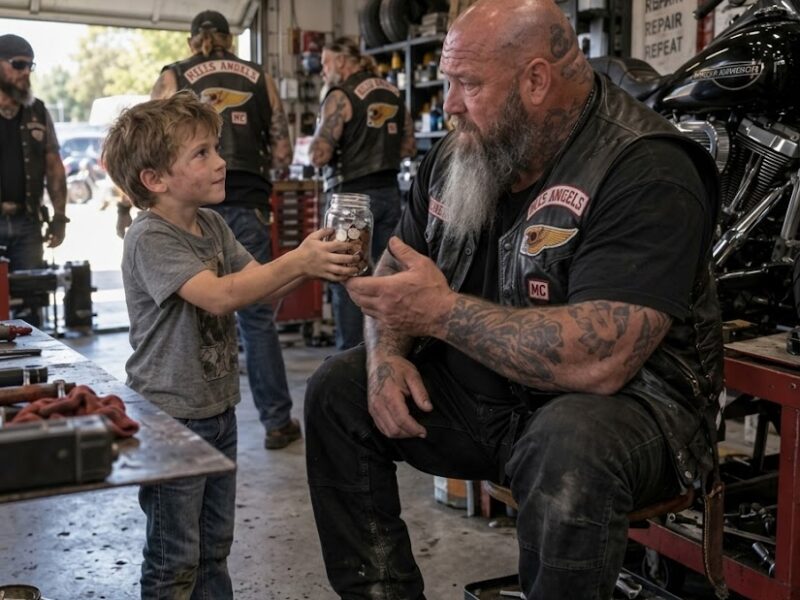
A boy saved his allowance for a year to fix a biker’s bike — and when 700 riders found out, they showed up with something he never expected
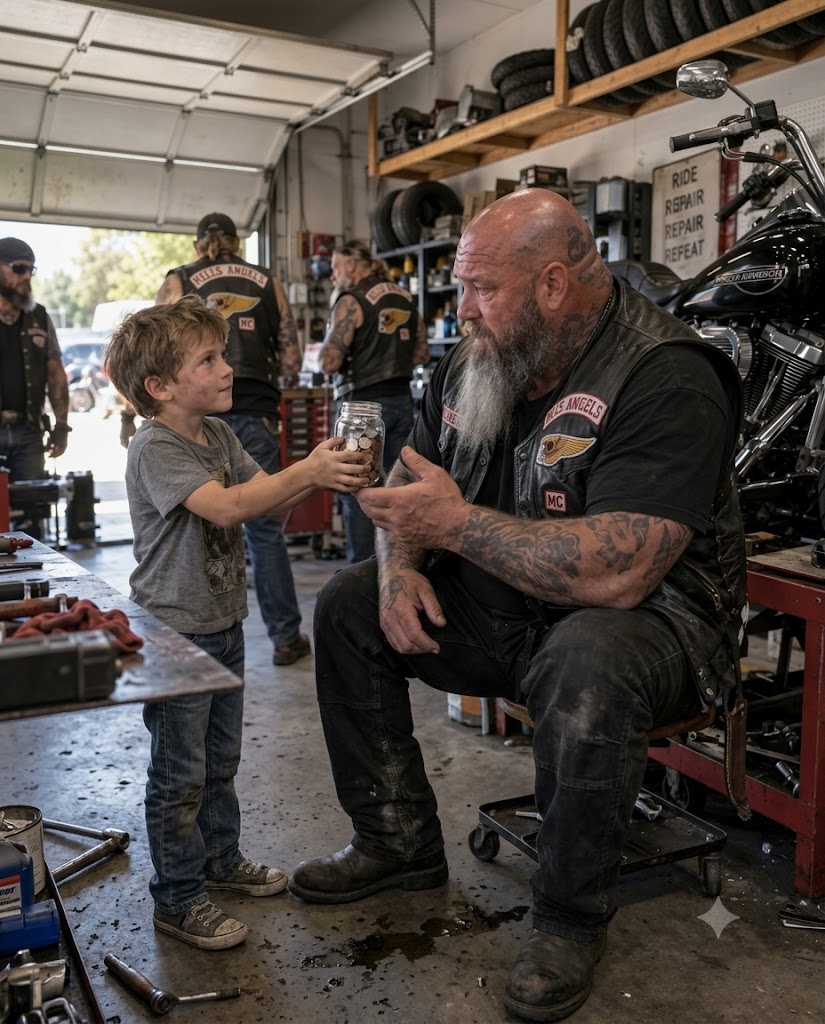
An 11-year-old boy stood frozen in a gravel parking lot staring at 700 motorcycles he had no explanation for.
Six months earlier, his own mother had forbidden him from ever going near these men again.
Now, they filled the road in every direction, engines silent, waiting for him.
Hidden in his closet was a cigar box that had taken him nearly a year to fill.
One dollar, one chore, one skipped birthday party at a time.
All to fix a stranger’s broken motorcycle.
What none of them knew yet was the real reason that motorcycle mattered so much to the man who owned it.
Or how far 700 strangers were about to go to make sure a boy’s sacrifice was never wasted.
William Carter was 11 years old the summer he learned that people could be wrong about almost everything.
Including bikers.
Including fathers.
Including himself.
He lived on Maple Street in a modest ranch house with faded green shutters, three blocks from Percy Priest Elementary.
It was a part of East Nashville where the houses were small but the yards were kept neat out of pride rather than obligation.
His mother, Diane Carter, worked the early shift at a diner off Gallatin Pike.
His father had been gone for two years.
Not dead.
Just gone.
The way some fathers simply stopped showing up one Tuesday and never explained why.
William did not talk about it much.
He had learned, the way children sometimes learn things too early, that some questions did not have answers worth waiting for.
What William had, instead of a father, was a bicycle with a bent kickstand.
A jar of coins he kept under his bed labeled “allowance” in blue marker.
And a habit of noticing things other people walked past.
It was June, the air thick with the kind of humidity that made cicadas scream from every tree, when William noticed the motorcycle.
It was pulled halfway onto the gravel shoulder of Lebanon Pike, tilted at an angle that suggested it hadn’t been parked so much as it had given up.
A man stood beside it, arms crossed, staring at the engine like it had personally betrayed him.
He was big.
Not fat, but built the way men get built from decades of manual work, with forearms like braided rope and a gray beard that reached the collar of his leather vest.
The vest had patches on it, worn and sun-bleached.
The kind William had only ever seen on men his mother called “trouble” under her breath when they passed the clubhouse on Dickerson Road.
William slowed his bike and stopped across the street, mostly out of curiosity.
The way any 11-year-old boy stops to watch anything broken.
“Something wrong with it?” William called out before he could stop himself.
The man looked up, startled, like he hadn’t expected a kid’s voice at all.
His eyes were tired in a way William recognized.
Not sleepy tired, but the kind of tired that lived behind a person’s face all the time.
“Transmission, probably,” the man said.
“Or the clutch. Either way, it’s not cheap, and I’m not exactly flush right now.”
He said it plainly, without self-pity, the way people say true things when they’ve stopped expecting sympathy from strangers.
“You going to get it towed?”
“Can’t afford a tow, either.”
The man almost laughed, but it came out flat.
“Story of my life, kid.”
William didn’t know why he stayed.
Later, he would tell himself it was because his mother always said, “You don’t leave people stranded, not even strangers, especially not strangers.”
But the truth was simpler than that.
The man’s voice had the same tiredness William heard in his mother’s voice on Sunday nights when she thought he was asleep.
When the bills were spread across the kitchen table like a losing hand of cards.
“What’s your name?” William asked.
The man studied him for a second, like he was deciding whether the question deserved an answer.
“Kevin,” he finally said.
“Kevin Mercer.”
“I’m William.”
“You should get home, William. It’s getting dark and your mama’s probably wondering where you are.”
William nodded, but he didn’t leave right away.
He looked at the motorcycle, a Harley-Davidson dulled by years of highway dust, with a faded patch on the gas tank shaped like an eagle.
Something in him, some stubborn ember he couldn’t name, decided that this was not the end of the story.
“How much would it cost?” William asked.
“To fix it, I mean.”
Kevin blinked.
“Why do you care?”
“I don’t know,” William said honestly.
“I just do.”
Kevin exhaled long and slow, the kind of breath men release when the truth is heavier than they want to admit out loud.
“Couple hundred dollars at least. Maybe more if the transmission’s shot.”
William nodded like he was filing the number away somewhere important.
Then he climbed back on his bike and rode home in the fading orange light.
Past the church with the crooked steeple.
Past Mrs. Higgins watering her tomatoes.
Past the corner where the Iron Riders Motorcycle Club kept their clubhouse behind a chain-link fence that most of Nashville treated like a warning sign.
He didn’t tell his mother about Kevin that night.
He wasn’t sure why.
Maybe because he wasn’t sure yet what he intended to do about it.
Maybe because some part of him already understood that what he was about to attempt would sound impossible if said out loud.
That night, William took the jar out from under his bed and counted what was there.
Thirty-four dollars.
He thought about the two hundred Kevin had mentioned, and the number felt as far away as the moon.
He decided right then, in the dim light of his bedroom, that he was going to close that distance one dollar at a time.
Nobody teaches an 11-year-old how to save two hundred dollars.
There’s no manual for it.
No chart in a classroom.
No lesson at Percy Priest Elementary that covers what to do when you’ve decided, quietly and without permission, to fix a stranger’s motorcycle.
William started with what he knew.
His allowance was five dollars a week, paid every Saturday morning by his mother.
She counted out crumpled bills from her apron pocket like she was handing over a small piece of her own exhaustion.
Five dollars a week meant it would take him forty weeks.
Nearly a year.
Assuming he spent nothing else, which for an 11-year-old boy in the summer, surrounded by ice cream trucks and comic books and the siren call of the corner store’s candy aisle, was its own kind of impossible.
He told no one.
Not his best friend, Tyler Brooks, who lived two doors down and would have wanted in on the plan immediately.
Probably suggesting they split the cost and split the credit.
Not his mother, who worked too hard already to be burdened with her son’s strange and stubborn project.
This, William decided, was his to carry.
He went back to see Kevin twice that first week.
Riding his bike to the gravel shoulder on Lebanon Pike, where the motorcycle had finally been hauled away.
Not to a shop, William learned, but to the small garage behind the Iron Riders Clubhouse.
Where Kevin lived in a room above the workshop.
“You’re back,” Kevin said the second time, not quite hiding his surprise.
“I wanted to see how it’s going,” William said.
“It’s not going anywhere. That’s the problem.”
Kevin wiped grease from his hands with a rag that had long since stopped being useful for wiping anything clean.
“Parts cost money. Money I don’t have this month. Rent comes first.”
William nodded slowly, absorbing this new information.
That grown men, even big weathered men with leather vests and eagle patches, worried about rent the same way his mother did.
“Why do you want it fixed so bad anyway?” William asked.
Kevin was quiet for a long moment.
Long enough that William wondered if he’d asked something wrong.
“That bike belonged to my brother,” Kevin finally said.
“He passed a few years back. Heart gave out on him, way too young. I’ve kept that bike running since because riding it is about the only way I still feel like he’s around.”
He said it without drama, the way people describe old wounds that have scarred over but never fully closed.
“Sounds foolish to a kid, probably.”
“It doesn’t,” William said.
And he meant it.
That night William went home and moved his allowance jar to the very back of his closet.
Behind a shoe box of baseball cards he no longer looked at.
He began doing small jobs around the neighborhood.
Raking Mrs. Higgins’ yard for three dollars.
Walking the Delgado family’s aging dog for two dollars a week.
Collecting aluminum cans from the ditch along Lebanon Pike and hauling them to the recycling center in a wagon that squeaked the whole way there.
Progress was slow and unglamorous.
Some weeks he added eight dollars to the jar.
Other weeks, when the temptation of a Saturday movie or a new comic book won out, he added nothing at all.
And lay awake afterward feeling like he had failed some test only he knew he was taking.
By August, he had sixty-one dollars.
By October, ninety-eight.
The jar had migrated from a mason jar to an old cigar box.
Sturdier.
Better suited to holding a secret that kept growing heavier.
His mother noticed eventually, the way mothers notice everything they pretend not to see.
“You’ve stopped asking me for movie money,” Diane Carter said one evening, drying dishes while William did homework at the kitchen table.
“I’m saving up,” William said, which was true if incomplete.
“For what?”
William hesitated.
“Something important.”
Diane studied her son for a long moment.
The same searching look she gave him whenever she suspected he was carrying something too big for his shoulders.
But she didn’t press further.
She had learned in the two years since her husband left that William processed the world in his own time.
And that pushing him rarely helped.
By December, William had visited Kevin nine more times.
He learned about the Iron Riders.
Not the version whispered about at church potlucks, where the club was spoken of like a rumor of danger.
But the real version.
Men who rode in memory of fallen friends.
Who raised money every Thanksgiving for families who couldn’t afford turkeys.
Who scared people mostly because they looked the part and nobody had bothered to look past it.
He learned that Kevin had been a mechanic for twenty-three years before an injury sidelined him.
He learned that the eagle patch on the gas tank had been hand-painted by Kevin’s brother the year before he died.
He learned that grief, like William’s own missing father, was something people carried quietly.
Hoping no one would ask them to explain it.
By February, the cigar box held one hundred fifty-three dollars.
William was close.
And that was exactly when everything started to go wrong.
The trouble began, as trouble often does, with someone else’s judgment.
It was Tyler Brooks who noticed first.
Not the money, but the pattern.
William had stopped coming to the community pool on Saturdays.
He’d stopped buying snacks from the corner store.
He kept disappearing on his bike toward Lebanon Pike, toward the part of town Tyler’s own parents had warned him to avoid.
“Where do you keep going?” Tyler asked one afternoon in February, catching William before he could pedal off again.
William hesitated.
Then, feeling the weight of the secret finally outpacing his ability to carry it alone, told him everything.
Kevin.
The motorcycle.
The brother who had died.
The cigar box hidden behind the baseball cards.
Tyler’s face went from curious to alarmed.
“William, that’s—that’s the biker gang. My dad says those guys are dangerous. He says they deal drugs and stuff.”
“They’re not a gang,” William said, more sharply than he intended.
“Kevin’s not like that. You don’t even know him. I know what everybody says about them. Everybody’s wrong.”
But Tyler, uneasy and well-meaning, did what 11-year-olds sometimes do when they’re frightened for a friend.
He told his mother.
Who told William’s mother.
And by that evening, Diane Carter was standing in William’s doorway with an expression he had never seen on her before.
Not anger, exactly.
But a kind of terrified confusion.
“Is it true?” she asked.
“You’ve been going to the motorcycle clubhouse alone for months?”
William’s stomach dropped.
“Mom, it’s not what you think.”
“What I think,” Diane said, her voice tightening, “is that my 11-year-old son has been sneaking off to see grown men I know nothing about and lying to me about where his allowance has been going.”
“I wasn’t lying. I just didn’t tell you.”
“That’s the same thing, William.”
He tried to explain about Kevin.
About the brother.
About the year of small jobs and sacrificed candy bars and Saturday movies he’d given up.
But the words came out tangled.
And Diane, frightened in the particular way mothers get frightened when their children have quietly stepped into a world they don’t understand, wasn’t ready to hear them yet.
“You are not going back there,” she said.
“I don’t care what your reasons are.”
That night William lay in bed with a cigar box open beside him.
One hundred fifty-three dollars staring back up at him.
Feeling further from finished than he had in months.
It wasn’t the money that hurt.
It was the sense that something true, something he’d built quietly and carefully, dollar by dollar, had been reduced in one conversation to a cautionary tale about strangers and danger.
For three days, William didn’t ride his bike anywhere.
He went to school, came home, did his homework, and said very little.
Diane noticed the silence.
And in the way of parents who love fiercely but sometimes clumsily, began to doubt her own certainty.
On the fourth day, she found him sitting on the back steps with the cigar box in his lap.
“Tell me about him,” she said quietly, sitting down beside her son.
“Kevin. Tell me the whole thing.”
So William did.
Every visit.
Every detail.
The way Kevin’s voice changed when he talked about his brother.
The eagle patch.
The twenty-three years as a mechanic.
The way the whole club fed hungry families every Thanksgiving without ever mentioning it to a newspaper.
Diane listened.
And something in her hardened expression slowly loosened.
“You’ve been saving for a whole year,” she said, not quite a question.
“Almost a year. I’m not done yet. I need forty-seven more dollars.”
Diane was quiet for a long moment.
Looking at her son the way you look at something you suddenly realized you underestimated.
“I still want to meet this man,” she finally said.
“Before you go back there. I need to see for myself.”
It wasn’t full permission.
But it wasn’t a door closing either.
And for the first time in three days, William felt the cigar box grow lighter in his hands.
Diane Carter met Kevin Mercer on a gray Saturday morning in early March.
Standing at the entrance to the Iron Riders clubhouse with her arms crossed and her guard fully raised.
What she found was not what she expected.
Kevin came out to meet her without the vest, dressed in a flannel shirt and work boots.
Looking less like the men from her nightmares and more like the tired, careful man William had described.
He shook her hand, called her “ma’am” without a trace of irony, and spoke about her son with a quiet gratitude that caught her off guard.
“Your boy’s been showing up here for months,” Kevin said.
“Never asked for anything. Never wanted anything from me, either. Just kept coming back to check on an old man’s broken motorcycle like it mattered to him.”
“Why does it matter to you so much?” Diane asked.
“The bike.”
Kevin told her about his brother.
The same story William had already carried home in pieces.
But hearing it directly, in Kevin’s own voice, something shifted in Diane’s understanding.
She saw for the first time not a stereotype in leather, but a grieving man whose loneliness had found an unlikely companion in her son’s stubborn kindness.
“He’s been saving his allowance,” Diane said, “for almost a year. Did you know that?”
Kevin’s jaw tightened.
“I told him not to worry about my problems. He’s a kid.”
“He’s a kid who decided your problem mattered anyway,” Diane said.
“I came here ready to be angry at you. I’m not anymore.”
Diane gave her blessing that day with conditions.
Visits only on weekends.
Always with her knowledge.
Never alone at night.
William agreed to all of it without complaint.
Relieved simply to have his secret finally out in the open, standing in daylight instead of hidden behind baseball cards.
By late March, the cigar box held one hundred eighty-one dollars.
William had picked up two more yards to rake, walked three more neighborhood dogs, and skipped his own birthday party in favor of a smaller gathering.
Quietly redirecting the money his mother would have spent on a party toward the jar instead.
It was Kevin who noticed something was wrong before William did.
“You’re pushing yourself too hard, kid,” Kevin said one Saturday, watching William count out coins on the workshop bench.
“You’ve given up half your childhood for a stranger’s motorcycle.”
“You’re not a stranger,” William said.
“Not anymore.”
Kevin looked at him for a long moment, something unreadable crossing his weathered face.
“I need to tell you something,” he said finally.
“The mechanic gave me the real estimate this week. It’s not two hundred anymore. Prices went up. Parts are harder to find for a bike this old. It’s closer to four hundred.”
The number landed on William like a physical weight.
Four hundred dollars.
Nearly double what he’d been chasing for almost a year.
He did the math instantly, the way children do when disappointment forces sudden fluency with numbers.
At his current pace, it would take almost another full year to close the gap.
William didn’t cry, not in front of Kevin.
But something in his chest went hollow and heavy at once.
“I’m not giving up,” William said, though his voice wavered.
“I know you’re not,” Kevin said.
“But William, listen to me. You’ve already done something most grown men never do. You don’t have to finish this. I mean that. You’ve given me more than money ever could.”
“I want to finish it,” William said.
“I told you I would.”
That night, William sat with his mother at the kitchen table and told her about the new number.
Diane looked at the cigar box, then at her son’s determined, exhausted face, and made a decision of her own.
“I’m going to help,” she said.
“Not by giving you money outright. That’s not the lesson here, and I think you know that. But I know some of the ladies at the diner. I think there’s a way to do this faster and bigger than either of us imagined.”
She didn’t explain further that night.
But three days later, Diane Carter walked into the Iron Riders clubhouse for the second time.
Not to check on her son’s safety, but to ask the club’s president a question that would change everything.
“How many riders do you have in your network altogether? Not just this chapter, but every club you’re connected with across the state.”
The answer was seven hundred.
What Diane proposed was simple.
And it required William to give up the one thing he had guarded most fiercely for nearly a year.
Control of his secret.
“I want to tell them what you did,” Diane said.
“All of it. Every dollar, every Saturday, every dog you walked and every candy bar you didn’t buy. I think people should know.”
William resisted at first.
The whole point, he explained, had been quiet kindness.
Not recognition.
Not a spectacle.
But Kevin, when asked, offered a different perspective.
“Some stories aren’t just yours to keep small,” Kevin told him.
“What you did already changed one man’s life. Let it change more.”
In April, the Iron Riders local chapter president, a broad-shouldered man named Gary Whitfield who had run the club for over a decade, posted William’s story to the club’s regional network.
The real story.
Unembellished.
Exactly as it happened.
An 11-year-old boy who had spent nearly a year of allowance and odd jobs trying to fix a grieving man’s motorcycle simply because he couldn’t stand to see someone stranded.
The story moved through motorcycle clubs across Tennessee.
Then into Kentucky, Georgia, and Alabama.
The way sincerity tends to travel faster than anyone expects it to.
Riders who had never met William Carter, who knew nothing about Maple Street or the diner where his mother worked double shifts, began contributing.
Not because they were asked to replace what he’d saved.
But because his effort had shamed and humbled them into recognizing something they’d stopped expecting from the world.
A child who kept a promise nobody made him make.
On the second Saturday of May, William was asked to come to the Iron Riders clubhouse for what Kevin described only as a small get-together.
He was not prepared for seven hundred motorcycles.
They filled the gravel lot and spilled onto Dickerson Road in every direction.
Engines silent.
Riders standing beside their bikes in a wide, respectful crescent.
Men and women from a dozen different clubs.
Patches from towns William had never heard of.
All gathered because word of a boy’s cigar box had reached them and refused to let go.
Kevin’s motorcycle stood in the center of the lot.
Fully restored.
New transmission.
Polished chrome.
The hand-painted eagle on the gas tank carefully preserved and touched up by a rider who specialized in restoration work.
Beside it sat a check, folded and taped to the handlebars.
Made out not to Kevin, but to William.
For the exact amount his cigar box had still been short.
Two hundred nineteen dollars.
So that his own year of sacrifice would be the thing that finished the job.
Not charity that replaced it.
“We didn’t want to take this away from you,” Gary Whitfield said, kneeling slightly to meet William’s eyes.
“This was always going to be your victory. We just wanted to help you cross the finish line.”
William looked at the crowd.
Seven hundred people who, six months earlier, his own friend’s mother would have crossed the street to avoid.
And felt something settle inside him that he didn’t yet have words for.
It wasn’t pride, exactly.
It was closer to understanding.
That judgment collapses fastest in the presence of proof.
And that he had, without meaning to, provided seven hundred people proof that kindness doesn’t check a person’s leather vest before deciding whether they’re worth trusting.
Kevin started the motorcycle for the first time in nearly a year.
The engine catching on the second try.
And the sound rolled across the lot like something being returned from the dead.
He looked at William, eyes wet in a way he didn’t bother hiding.
“My brother would have liked you,” Kevin said.
“He’d have said you ride with more heart than most grown men ever manage.”
Diane Carter stood at the edge of the crowd watching her son shake hands with men she had once crossed the street to avoid.
And felt something in her own chest loosen.
The last thread of a fear that had never really been about motorcycles at all.
But about the world being unkind to a boy who had already lost too much.
William Carter did not become famous.
Not really.
The story lived mostly in the memory of the people who witnessed it.
Passed between riders at rallies for years afterward.
The way real kindness tends to travel quietly rather than loudly.
But every year afterward, on the anniversary of that Saturday in May, the Iron Riders and their extended network gathered at the same clubhouse.
For what they came to call the Allowance Ride.
A charity run benefiting families who couldn’t afford basic repairs.
Vehicle or otherwise.
Funded in part by a cigar box that had once held nothing but a boy’s stubborn hope.
William kept the cigar box.
He never spent the leftover money on himself.
Instead, every year he added to it again.
Quietly.
The way he’d learned that some kindnesses are meant to be carried forward rather than closed.
—
The summer after the Allowance Ride, William turned twelve.
He still lived on Maple Street.
Still rode a bicycle with a bent kickstand.
Still kept a cigar box in the back of his closet, though now it held something different.
Not coins.
Not bills.
But a folded piece of paper with seven hundred names on it.
Every rider who had shown up that Saturday in May.
Every stranger who had decided a boy’s promise was worth keeping.
He didn’t know what he was going to do with the list yet.
He just knew he wasn’t going to lose it.
Some things you keep because they remind you what people are capable of.
Not the worst of them.
The best.
Kevin came by the house sometimes now.
Not often.
But sometimes.
He’d sit on the back steps with Diane and drink sweet tea from a mason jar while William showed him whatever new project he was working on.
A broken radio.
A model airplane.
A bicycle chain that kept slipping.
“You know,” Kevin said one evening in July, watching William fiddle with the radio’s tangled wires, “you’ve got the hands of a mechanic.”
William looked up.
“Really?”
“Really. You see how things fit together. That’s not something you learn. That’s something you’re born with.”
William thought about that for a long moment.
“Could you teach me?” he asked.
“Teach you what?”
“How to fix things. Real things. Motorcycles and stuff.”
Kevin was quiet for a second.
Then he smiled, the first real smile William had ever seen on his face.
“Yeah, kid. I could teach you.”
And that was how William Carter, age twelve, began spending his Saturdays at the Iron Riders clubhouse.
Not as a visitor.
But as an apprentice.
He learned how to change oil.
How to check brake pads.
How to listen to an engine and hear what it was trying to tell him.
He learned that motorcycles were like people.
They broke down sometimes.
They needed patience.
They needed someone willing to get their hands dirty and not give up when things got hard.
He also learned that the Iron Riders were not what the world thought they were.
They were mechanics and fathers and brothers and sons.
They were men who had lost people and found each other.
They were men who understood, better than most, that the only thing that mattered in the end was whether you showed up for the people you loved.
By the time William turned thirteen, he could rebuild a carburetor from scratch.
By fourteen, he could diagnose a transmission problem just by the sound of the engine.
By fifteen, he was earning real money on weekends, fixing bikes for riders who came from all over Tennessee.
He still kept the cigar box.
Still added to it every year.
Not for himself.
For the next kid who needed it.
Because somewhere along the way, William had figured out something most people never do.
Kindness isn’t a transaction.
It’s a chain.
You pass it on, link by link, and it keeps going long after you’ve forgotten where it started.
The Allowance Ride became a tradition.
Every May, hundreds of riders gathered at the Iron Riders clubhouse.
They raised money for families who couldn’t afford repairs.
They told William’s story to anyone who hadn’t heard it.
And they reminded each other, in a world that often forgot, that small acts of decency could still change everything.
William never met his father again.
Never found out where he went or why he left.
But he stopped wondering about it eventually.
Because he had something better than answers.
He had a mother who loved him.
A mentor who believed in him.
And seven hundred strangers who had taught him that family wasn’t always about blood.
Sometimes it was about showing up.
Sometimes it was about keeping a promise.
Sometimes it was about a boy, a broken motorcycle, and a cigar box full of hope.
The eagle on Kevin’s gas tank was still there, years later.
Faded a little more.
But still flying.
Still watching over the road.
Still reminding everyone who saw it that some things were worth fixing.
Even when they seemed broken beyond repair.
Even when the whole world told you to give up.
Even when you were only eleven years old.
And all you had was a dollar.
And a promise.
And a stubborn belief that kindness still mattered.
—
Diane Carter never remarried.
She worked at the diner for another fifteen years before retiring.
And every May, she stood at the edge of the Iron Riders clubhouse lot, watching her son shake hands with men who had once scared her.
Watching him laugh with riders who had become family.
Watching him grow into a man she was proud of.
“You know,” she said to Kevin one year, both of them leaning against the fence as William helped a young rider fix a stubborn clutch, “I almost didn’t let him go back.”
Kevin nodded.
“I know.”
“I was so scared. I thought I was protecting him.”
“You were,” Kevin said. “That’s what mothers do.”
“But I was wrong about you. About all of this.”
Kevin shrugged.
“Everybody’s wrong sometimes. The trick is being willing to change your mind.”
Diane watched her son for a long moment.
He was twenty-one now.
Tall.
Strong.
Hands stained with grease and a smile that came easy.
“I’m glad he didn’t listen to me,” she said quietly.
“Me too,” Kevin said.
And they stood there together, two people who had once been strangers, bound by a boy who had refused to give up on either of them.
—
The cigar box sat on William’s workbench now.
Not hidden.
Not secret.
Just there.
A reminder of where he’d come from and what he believed in.
Sometimes, when he was working on a particularly stubborn engine, he’d look at it and smile.
Remember the feel of coins dropping in.
The weight of it growing heavier week by week.
The day he’d walked into that gravel lot and seen seven hundred motorcycles waiting for him.
He never spent the money that was left.
Not a single dollar.
Instead, he added to it.
Every year.
Every May.
And when a kid showed up at the clubhouse, nervous and curious and carrying a problem too big for their shoulders, William knew exactly what to do.
He’d listen.
He’d help.
And he’d tell them about the boy who saved his allowance for a year to fix a stranger’s motorcycle.
Not because he wanted credit.
But because he wanted them to know.
Kindness was still worth it.
Even when it took a year.
Even when it cost everything.
Even when no one was watching.
Because someday, someone would be.
And they’d remember.
And they’d pass it on.
The way William had.
The way Kevin had.
The way seven hundred riders had.
Link by link.
Dollar by dollar.
Promise by promise.
The chain kept going.
And it started with a boy.
A broken motorcycle.
And a cigar box full of hope.
That was the story.
That was always the story.
And it was never really about the motorcycle at all.









