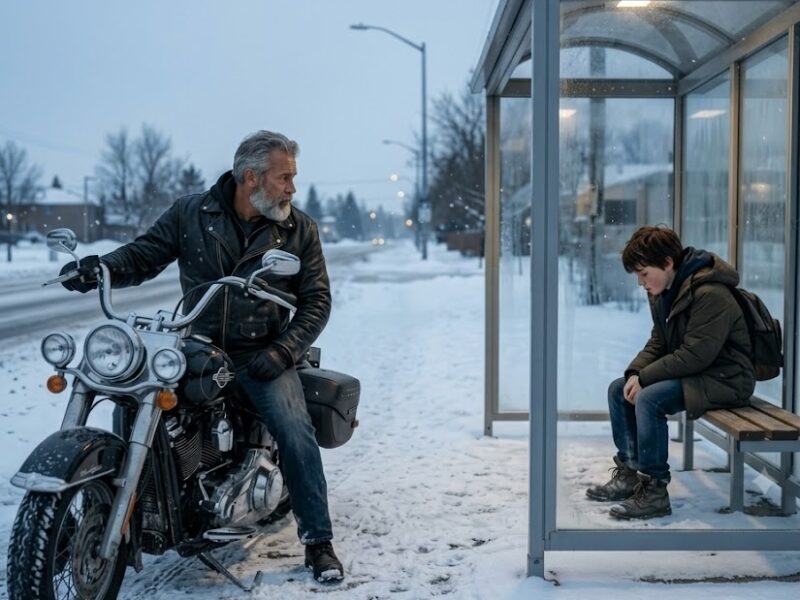
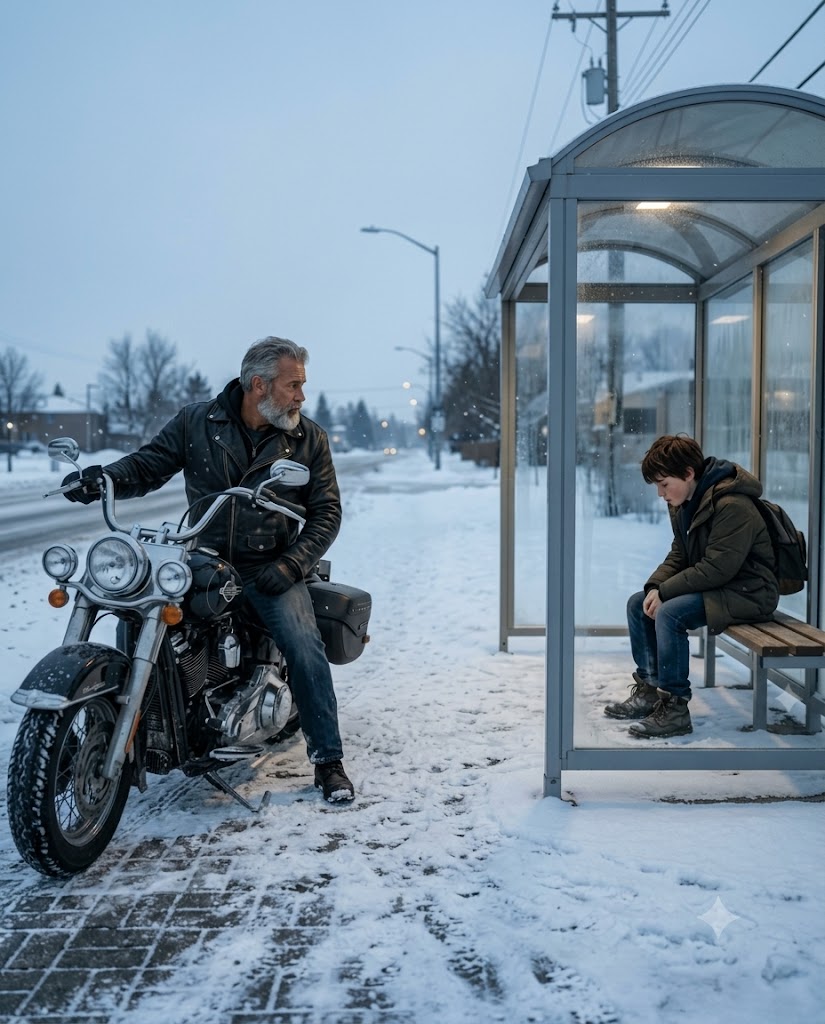
A boy sat alone at the bus stop for three hours. Nobody noticed him. Nobody asked why. Then the driver made one phone call — to a biker.
**Part 1**
Rita Sandoval had been driving the Route 7 bus for 19 years, and in that time she had learned to notice things other people missed.
She was 54 years old, a grandmother of three, with reading glasses on a chain around her neck and a thermos of coffee that never left the console beside her seat.
She knew every stop on her route by heart, knew which regulars would be waiting at which benches at which times of day, knew the rhythms of her little corner of the city the way a musician knows a favorite song.
She noticed when Mrs. Patterson from Maple Street stopped taking the 8:15 bus to her dialysis appointments and found out later the woman had passed away.
She noticed when the teenage girl who rode to the community college every morning started looking thinner and sadder and eventually stopped coming altogether.
She noticed the small changes that told bigger stories, the details that most people drove right past without a second glance.
Today, on a gray Thursday afternoon in November, she noticed the boy.
He was sitting at the bus stop on Franklin Avenue, the one near the abandoned shopping plaza where hardly anyone ever waited anymore.
She had passed that stop three times already on her loop, and each time the boy had been there.
Same spot on the bench. Same hunched posture. Same thin jacket that was not nearly enough for the 40-degree weather.
The first time she passed, she thought he was waiting for someone.
The second time, she thought maybe he had missed his bus and was waiting for the next one.
The third time, three hours after she had first seen him, she knew something was wrong.
He could not have been more than 8 or 9 years old, small for his age, with dark hair that needed cutting and sneakers that looked like they had seen better days.
He was not playing on a phone or reading a book or doing any of the things kids usually did when they were waiting.
He was just sitting there, arms wrapped around himself, staring at nothing.
Rita pulled the bus to the curb, even though no one had signaled for the stop.
She opened the doors and called out to him, keeping her voice friendly and warm the way she did with the kids who rode her bus to school every morning.
She asked if he was okay, asked if he was waiting for someone, asked if he needed a ride somewhere.
The boy looked up at her, and Rita felt her heart crack right down the middle.
His eyes were old. That was the only way she could describe it. Old in a way that no child’s eyes should ever be.
The eyes of someone who had seen too much, carried too much, given up on expecting anything good.
He did not answer her questions, just shook his head slightly and looked back down at his sneakers.
Rita knew she could not force him onto the bus, could not make him talk if he did not want to talk, could not do much of anything except sit there with her doors open, letting the cold air in while a little boy who clearly needed help refused to ask for it.
She made a decision.
She told him her name was Rita, and she drove this bus every day.
She told him she was going to finish her route, which would take about 45 minutes, and then she was going to come back to this stop.
She told him if he was still here when she came back, she was going to sit with him until they figured out what to do.
The boy did not respond, but he did not run away either.
Rita closed the doors and pulled back into traffic, her hands tight on the wheel, her mind racing through possibilities.
She had a phone call to make.
—
Marcus Webb was in the middle of replacing a carburetor when his phone rang.
He was 47 years old, owner of Webb’s Cycle Repair, a one-man shop that had been serving the neighborhood for 15 years.
He was also the vice president of the Steel City Brotherhood MC, a club that had been around since the ’70s and had spent the last two decades transforming itself from a group that caused problems to a group that solved them.
Rita Sandoval was his older sister.
She had raised him after their parents died, had worked double shifts to keep food on the table, had made sure he stayed in school when all his friends were dropping out.
He owed her everything.
And when she called with that tone in her voice, the one that meant something was wrong, he put down his tools and listened.
She told him about the boy, the bus stop on Franklin Avenue, three hours of sitting alone in the cold, the eyes that were too old for his face.
She told him she did not know what to do.
She had thought about calling the police, but what would she tell them? A kid sitting at a bus stop was not a crime.
They would probably just drive by, see nothing obviously wrong, and leave.
And then what would happen to the boy?
Marcus did not hesitate.
He told her to finish her route and go back to that bus stop like she promised.
He told her he would meet her there.
Then he made two more calls.
The first was to Jerome Hawkins, the chapter president, a 52-year-old retired social worker who had spent 20 years in child protective services before burning out and finding a new family in the club.
If anyone would know how to handle this, it was Jerome.
The second was to his wife, Denise, letting her know he might be late for dinner.
She did not ask questions. After 18 years of marriage, she knew the tone in his voice that meant someone needed help.
Marcus wiped the grease off his hands, grabbed his jacket, and headed for his bike.
—
The boy was still there when Rita pulled up for the fourth time.
Same bench, same posture, same thin jacket.
The sun was starting to go down now, and the temperature had dropped another few degrees.
His lips looked slightly blue, and he was shivering in a way that suggested he had been cold for a very long time.
Rita parked the bus at the curb and turned off the engine.
She was technically done with her shift, had already radioed dispatch that she was taking her break.
She climbed down from the driver’s seat and walked over to the bench, moving slowly so she would not spook him.
She sat down on the other end of the bench, leaving plenty of space between them.
She did not say anything at first, just sat there.
The two of them sharing the cold, the silence, the gray November afternoon.
After a few minutes, she pulled out her thermos and poured some coffee into the cup that served as a lid.
She took a sip, then held it out toward the boy.
She asked if he wanted some. It was hot, she said, would warm him up.
He looked at the cup, looked at her, looked back at the cup.
Then he reached out and took it.
He wrapped both hands around it like it was the most precious thing in the world, letting the heat seep into his fingers.
He took a small sip, then another, and something in his posture changed, not much, but enough.
The shoulders came down just a little. The hunching relaxed just a fraction.
Rita did not push, just sat with him, watching the traffic pass, waiting for her brother.
The rumble of a motorcycle announced his arrival a few minutes later.
Then another rumble, and another.
Three bikes pulling into the empty parking lot of the abandoned shopping plaza.
Three riders in leather vests dismounting and walking toward the bus stop.
The boy tensed immediately. His eyes went wide. Darting between the bikers and the street, calculating escape routes.
Rita put a gentle hand on his arm.
She told him these were friends, good people. They were here to help, not to hurt.
The boy did not look convinced, but he did not run.
Marcus approached slowly, the way he would approach a frightened animal.
He was a big man, 6’3″ with broad shoulders and arms covered in tattoos, the kind of person who could look intimidating without trying.
He had learned over the years to make himself smaller when the situation called for it.
He crouched down a few feet from the bench, bringing himself to the boy’s eye level.
He introduced himself, said his name was Marcus, and he was Rita’s brother.
He said he owned a motorcycle shop not far from here, and he had come because Rita was worried about him.
The boy did not respond, just watched him with those old, weary eyes.
Jerome stepped forward next.
He was smaller than Marcus, with gray in his beard and kind eyes behind wire-rimmed glasses.
He had spent two decades working with kids in crisis, and he knew how to read the signs.
The thin jacket that suggested no one had made sure he was dressed for the weather.
The unwashed hair that spoke of neglect.
The way he held himself, pulled in tight, protecting his core, like he expected to be hit.
Jerome had seen this before, too many times.
He introduced himself and asked the boy if he had a name he wanted to share.
Said it was okay if he did not want to tell them.
Said they were just there to make sure he was safe.
The silence stretched out for a long moment.
Then, so quiet they almost missed it, the boy spoke.
His name was Eli. He was 9 years old.
He had been sitting at this bus stop since noon because he did not want to go home.
Jerome nodded like this was the most normal thing in the world.
He asked if Eli could tell them why he did not want to go home.
Eli’s hands tightened around the coffee cup. His jaw clenched.
For a moment it looked like he was going to shut down again, retreat back into that protective silence.
Then he started talking.
The story came out in fragments, scattered and out of order, the way stories do when someone has been holding them inside for too long.
His mother had left two years ago. Just walked out one day and never came back.
His father had been okay at first, sad and angry, but still trying.
Then the drinking started. Then the other stuff.
Then the father who used to read him bedtime stories became someone Eli did not recognize anymore.
He did not give details about what happened at home. Did not need to.
The way he flinched when Marcus shifted his weight said enough.
The way he kept his back to the wall of the bus shelter said enough.
The way he held that coffee cup like a shield said enough.
He had left for school that morning like always.
But when school ended, he could not make himself get on the bus that would take him back to that house.
So he had walked here instead. To this bus stop where nobody waited, and sat down to figure out what to do.
He had been sitting here for six hours.
He had not figured anything out.
Jerome exchanged a look with Marcus. They had both seen this before.
Kids who fell through the cracks. Whose suffering went unnoticed because they were too scared or too proud or too beaten down to ask for help.
Kids who sat alone at bus stops hoping someone would notice them before it was too late.
Someone had noticed this time. Rita had noticed.
And now they were here.
Jerome told Eli that he used to work for an organization that helped kids in situations like his.
He said there were people whose whole job was making sure children were safe, and he knew how to contact them.
He said they could help Eli find somewhere to stay where no one would hurt him.
Eli’s face went pale. He knew what that meant.
Foster care. Being taken away. The unknown.
Which might be even worse than what he already knew.
He said he did not want to go to foster care. He had heard stories.
Kids who got bounced around from house to house, never belonging anywhere.
He would rather just stay at the bus stop.
Jerome did not argue with him. Did not tell him he was wrong to be scared.
Just sat down on the bench next to Rita and said they were not going anywhere.
Whatever happened next, Eli was not going to face it alone.
They sat together as the sun went down and the street lights flickered on.
Marcus went to his bike and came back with a heavy jacket, the spare he kept in his saddlebag for emergencies.
He draped it over Eli’s shoulders without asking permission, and the boy did not pull away.
The jacket was enormous on him, practically a blanket, and for the first time since they had arrived, something that might have been gratitude flickered across his face.
The third rider, a woman named Denise, who had arrived with Marcus and Jerome, came back from the convenience store across the street with hot chocolate and a sandwich.
She was Marcus’s wife, a pediatric nurse who had seen her share of hurt kids over the years.
She handed the food to Eli without making a big deal about it.
Just set it down next to him like it was the most natural thing in the world.
Eli ate like he had not eaten in days. Maybe he had not.
While he ate, Jerome made some phone calls.
He still had contacts in the system. People who owed him favors. People who would take his call even after hours.
He explained the situation in quiet tones, stepping away from the bench so Eli would not hear the details being discussed.
When he came back, his expression was careful. Hopeful, but guarded.
He told Eli that he had talked to some people who wanted to help.
He said there was a place Eli could stay tonight. Not a group home or a foster placement.
Just a safe house run by people Jerome trusted.
He said Eli could sleep there. Get a shower. Have a real meal.
And tomorrow they would figure out the next steps together.
Eli looked at him for a long moment.
Then he looked at Rita. Who had started all of this by noticing a boy at a bus stop.
He looked at Marcus. Who had shown up with his brothers when Rita called.
He looked at Denise. Who had bought him hot chocolate without being asked.
He asked why they cared. He was nobody. Just a kid at a bus stop.
Why did they care what happened to him?
Marcus crouched down again. Meeting his eyes.
He told Eli that he had been a kid at a bus stop once, too.
Different circumstances. Same feeling of being invisible.
Same certainty that nobody would notice if he disappeared.
He told him that someone had noticed him back then. A teacher.
Who had seen past the tough exterior to the scared kid underneath.
That teacher had changed his life. Had given him a reason to keep going.
He told Eli that this was what they did. The club, the brotherhood.
They looked out for people who needed looking out for.
Not because they had to, but because they knew what it felt like to be alone.
And nobody deserved to feel that way. Especially not a 9-year-old kid on a cold November night.
Eli was quiet for a long time. Then he nodded.
—
The safe house was a converted duplex on a quiet street.
Run by a woman named Gloria, who had fostered over 40 kids in the past 20 years.
She was 61 years old, built like someone’s favorite grandmother, with a kitchen that always smelled like fresh cookies and a spare bedroom that was always ready.
Jerome had called ahead, and Gloria was waiting on the porch when they arrived.
She did not make a fuss, did not overwhelm Eli with questions or affection, just welcomed him inside, showed him to a bedroom with clean sheets and a nightlight shaped like a rocket ship, and told him the bathroom was down the hall if he wanted to wash up.
Eli stood in the doorway of the bedroom, looking at the bed like he was not sure it was real.
Gloria had told him to take his time. Said dinner would be ready in about an hour if he was hungry.
Said there was nothing he needed to do tonight except rest.
She left him alone, closing the door softly behind her.
In the living room, Jerome and Marcus talked with Gloria about next steps.
The authorities would need to be contacted. There would be an investigation into Eli’s home situation.
Decisions would need to be made about his father, about custody, about where Eli would end up.
But those were problems for tomorrow.
Tonight, the only thing that mattered was that a 9-year-old boy who had been sitting alone at a bus stop for six hours was finally somewhere warm and safe.
Rita had to get back to the bus depot to clock out.
But she hugged her brother before she left and told him to keep her updated.
She would check on Eli tomorrow, she said. She was not done with this story yet.
Marcus stayed for another hour, sitting in Gloria’s living room, drinking coffee and talking about nothing in particular.
He wanted to be there in case Eli needed something, even if that something was just the knowledge that someone was nearby.
When Eli finally emerged from the bedroom, he was wearing pajamas Gloria had laid out for him, and his hair was damp from the shower.
He looked smaller somehow, younger. The tough exterior stripped away to reveal the child underneath.
He sat down on the couch next to Marcus without saying anything. Just sat there.
Close enough that their shoulders almost touched, staring at the carpet.
After a while, he spoke.
He asked Marcus if he really had been a kid at a bus stop.
Marcus said yes. Different reasons, same loneliness.
He had grown up in a house where the parents were there but not really there.
Too caught up in their own problems to notice their son was drowning.
He had spent a lot of time in places he was not supposed to be, looking for something he could not name.
Eli asked what had happened to him. How he ended up okay.
Marcus thought about it for a moment.
Then he said he was not sure “okay” was the right word.
He said he still carried things from those years. Still had days when the old feelings came back.
But he had found people who helped him. Who showed him he mattered. Who gave him a reason to keep going.
He had built a life, a family, a purpose.
He had taken the pain and turned it into something useful.
He told Eli that the same thing could happen for him.
It would not be easy. The road ahead would be hard. And there would be days when he wanted to give up.
But he was not alone anymore. He had people in his corner now.
And that made all the difference.
Eli was quiet for a long time after that.
Then he leaned against Marcus’s shoulder, just slightly, and closed his eyes.
He was asleep within minutes.
—
The investigation into Eli’s home situation confirmed what everyone already suspected.
The authorities found evidence that made it impossible for Eli to go back.
His father was arrested, charged, and eventually sentenced to time in a facility where he might get the help he needed.
The house where Eli had spent nine years was emptied and sold.
The memories inside it scattered to strangers who would never know what had happened within those walls.
Eli went into foster care. But not the kind he had feared.
Gloria’s safe house became his home. First temporarily, and then permanently when she applied to become his foster mother.
The paperwork took months. Endless forms and interviews and home visits.
But in the end, the system worked the way it was supposed to.
Gloria had never planned to foster another child at her age. She had thought she was done.
That her fostering days were behind her.
But something about Eli, about the way he had arrived at her door with nothing but a borrowed jacket and a belly full of hot chocolate, had changed her mind.
She told him he could stay as long as he needed.
And if he wanted, if he decided he was ready, she would make it permanent.
Eli did not answer right away.
He had learned to be careful with hope, to hold it at arm’s length, so it could not hurt him when it was taken away.
But over the weeks and months that followed, as Gloria proved again and again that she was not going anywhere, he started to let himself believe.
On his 10th birthday, six months after the night at the bus stop, he asked Gloria a question.
He asked if she would adopt him.
Gloria cried for an hour. Happy tears, she told him. The happiest tears of her life.
The Steel City Brotherhood did not disappear from Eli’s life after that first night.
Marcus came by Gloria’s house regularly, teaching Eli how to change a tire, check oil levels, and all the basic maintenance skills that a boy should know.
Jerome checked in every few weeks, making sure the system was treating Eli right, advocating for him when things got complicated.
Rita still drove the Route 7 bus, and every time her route took her past Gloria’s street, she honked twice, and Eli ran to the window to wave.
They showed up for his school events, his birthday parties, his baseball games.
A rotating cast of bikers in leather vests, sitting in folding chairs meant for parents, cheering louder than anyone else when Eli hit his first home run.
He was not invisible anymore.
He had people who saw him, who showed up for him, who made sure he knew he mattered.
And slowly, year by year, the old look in his eyes started to fade, replaced by something younger and brighter and more hopeful.
—
On the one-year anniversary of the night at the bus stop, Eli asked Marcus to take him back there.
He wanted to see it again. Wanted to remember.
They rode together on Marcus’s bike, Eli wearing a helmet that was slightly too big for him, grinning like he had never grinned before.
They pulled up to the bus stop on Franklin Avenue, the one near the abandoned shopping plaza, and Eli climbed off and walked over to the bench.
He stood there for a moment, looking at the spot where he had sat for six hours waiting for someone to notice him.
Then he turned to Marcus with a question.
He asked what would have happened if Rita had not stopped. If she had just driven past like everyone else.
Marcus did not have an answer for that.
The possibilities were too dark to think about, the what-ifs too heavy to hold.
So he just put a hand on Eli’s shoulder and told him the truth.
He said he did not know what would have happened, but he knew what did happen.
Rita noticed. She made a call. And now Eli was here, alive and safe and loved, standing in the exact spot where his life had changed forever.
That was what mattered. Not the what-ifs. The what was.
Eli nodded slowly. Then he smiled, a real smile that reached all the way to his eyes.
He said he was ready to go home now.
And for the first time in his life, he meant it.
—
Eli is 14 now.
He lives with Gloria, who adopted him officially two years after that first night.
He plays baseball in the spring, rides motorcycles with Marcus on weekends, and volunteers at a local food bank because he remembers what it felt like to be hungry.
Rita still drives the Route 7 bus. She still notices things other people miss.
And every November, on the anniversary of the night she stopped at an empty bus stop for a boy who needed help, Eli rides the entire route with her, sitting in the front seat, keeping her company.
He tells her it is his way of saying thank you.
She tells him he already thanked her by becoming the person he is.
Some debts, she says, are paid forward, not back.
Eli is working on paying his forward, one day at a time.









