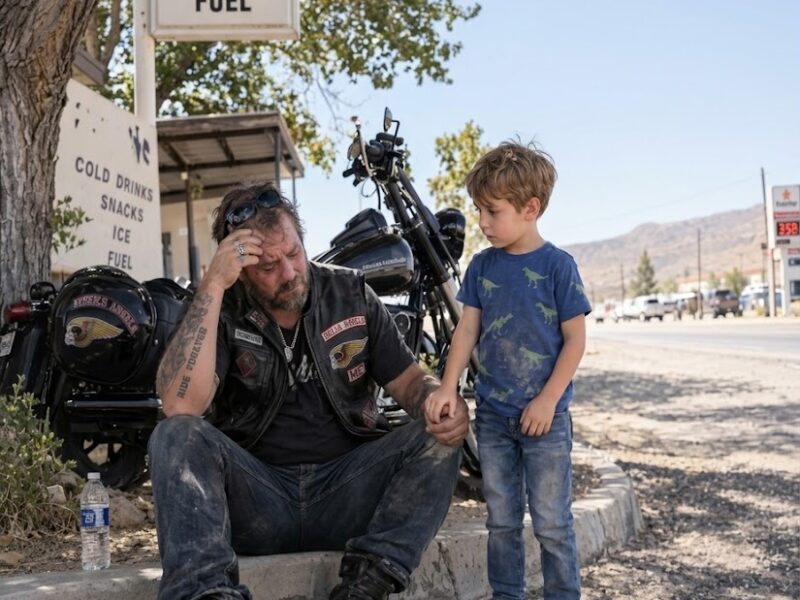
A Boy Pulled a Hells Angel From His Bike Seconds Before an Explosive Device Activated—What 700 Riders Did Next Stunned the Town
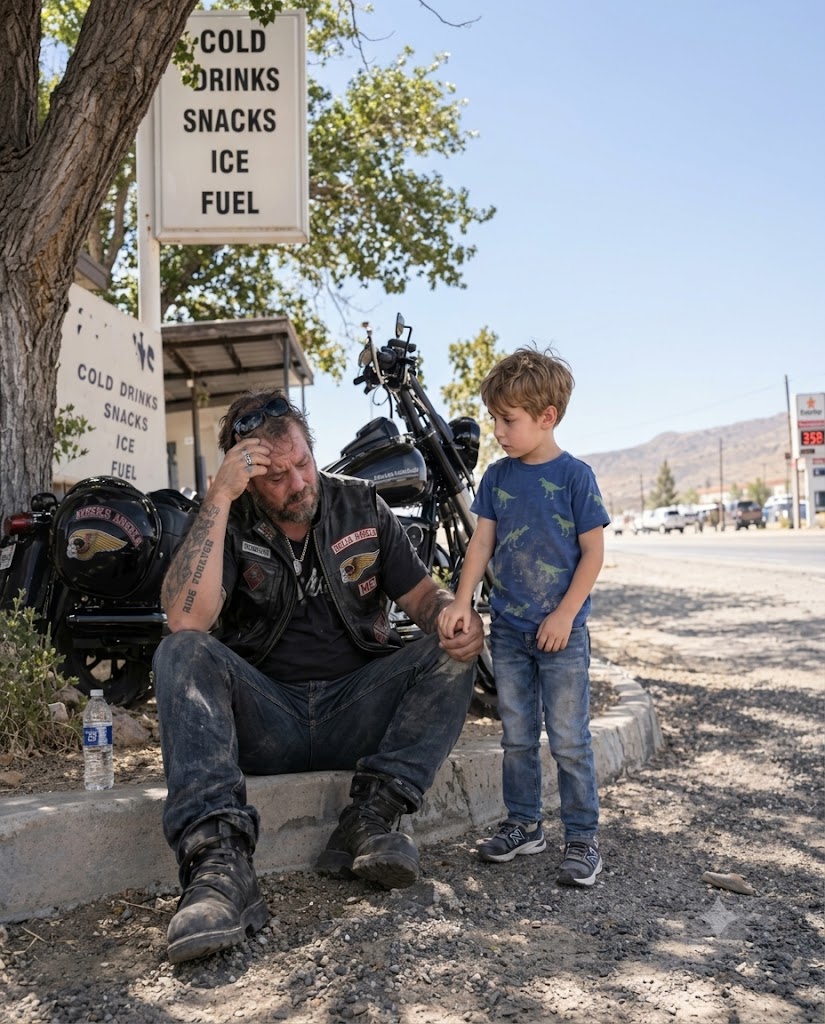
He was five years old and he ran toward the thing every adult in that parking lot had already decided to avoid.
He ran toward the leather. He ran toward the ink wrapped around arms as thick as dock ropes.
He ran toward the man with the skull patch and the beard and the hands that looked like they had broken things.
Every person at that gas station had already made their verdict. The vest said everything they needed to know.
The bomb had been wired under the tank for three hours. The engine was a quarter turn from ignition, and a child with a dinosaur shirt and no concept of fear saw something that twenty-seven years of riding had blinded every adult to.
And what happened in the next ninety seconds changed seven hundred lives forever.
The heat came off the asphalt in visible waves, the kind that made the highway shimmer like a hallucination ten miles out from Barstow.
It was the second Thursday of August, 2019, and the Frontier Gas Station on the corner of Barstow Road and Lenwood Road had been doing business in that desert since 1987, which was long enough for Roy Stanton to have learned with considerable certainty what trouble looked like before it even pulled off the highway.
He heard them before he saw them, the low, rolling thunder of engines that didn’t ask for permission.
Eighteen motorcycles turned off the I-15 southbound and came in formation through the station entrance. Their chrome catching the 102-degree sun and throwing it back in long violent flashes.
Roy stepped out from behind the register and stood in the doorway, arms crossed, watching. He didn’t need to read the patches, though they were right there on their backs, black and white and unmistakable.
He’d lived in Barstow his entire sixty-three years. He’d seen their rides pass through before. He knew what local wisdom said.
Keep your head down. Don’t make eye contact. Wait for them to leave.
The bikes pulled up to the pump stations in clusters. Engines cut. The sudden quiet was its own kind of statement.
Men climbed off. Big men, most of them leathered and road dusty, moving with the easy authority of people who had spent decades not caring what the world thought of them.
Dale Mercer was the last to dismount. He was fifty-one years old, though the mileage on his body read closer to sixty.
Six-two, two hundred thirty pounds of dense, settled weight, built in the particular way of men who have worked outdoors their whole lives rather than in gyms.
His beard was dark, going silver, kept longer than most, and a pair of aviator sunglasses sat pushed up on his forehead above eyes that were a quiet, almost startling gray.
His left arm was sleeved in ink from wrist to shoulder. The tattoos old enough to have that blurred, softened look. Colors faded the way old photographs fade.
On his right forearm, a single phrase in Gothic lettering: “Ride forever.”
His leather cut was worn to the softness of a second skin, the Hells Angels patch on the back, and the Bearager name patch over his right chest, and a diamond-shaped patch above it that Roy didn’t recognize, but which meant something specific to the men who wore it.
Dale walked to the far end of the curb, away from the other riders, and sat down heavily, pressing his right hand against his face.
He’d been off all morning. There was a low, grinding wrongness behind his eyes that he couldn’t name. The kind that came sometimes before nothing happened and sometimes before everything did.
He’d been riding this particular stretch of highway for twenty-six years, and it had always settled something in him. The way certain music settles something.
Today it hadn’t.
He bought a bottle of water from the machine by the entrance, walked back to the curb, set it beside him without opening it, and sat with his head in his hand.
Across the lot, a woman pulled her son close. Dale noticed without looking up. He always noticed.
He’d spent enough years having people move children away from him to recognize that body language from a hundred feet without needing to see the face. A tightened grip, a half step that placed an adult between the child and the perceived threat.
It didn’t sting the way it once had. It was just the world being exactly itself.
The boy’s name was Caleb Whitmore, and he was five years old, and he had not inherited his mother’s caution.
Sandra Whitmore was thirty-eight, red-haired with the kind of tired behind her eyes that comes from working two jobs and raising a child mostly alone since her husband’s accident three years ago.
She’d stopped for gas on her way back from a morning shift in Victorville, and she had her hand firmly around Caleb’s wrist when the bikes pulled in.
But Caleb had a specific relationship with motorcycles, a relationship of pure, uncomplicated reverence, and the Harley parked at the far end of the lot, the big matte black one with chrome accents, was calling to him in a frequency only he could hear.
He pulled free of his mother’s grip. Not defiance, just inevitability.
“Caleb.” Her voice carried the specific frequency of a mother watching something happen without enough arms to stop it.
The man on the curb looked up. He and the boy considered each other for a moment across fifteen feet of hot asphalt.
Caleb was not afraid. He had never been afraid of things that interested him. And everything about this man, the tattoos, the patches, the sheer physical mass of him, was spectacularly interesting.
“Your arm has stuff on it,” Caleb said.
Dale Mercer blinked. “Yeah,” he said. “It does.”
“What’s that one say?” Caleb pointed at the right forearm.
“Ride forever.”
The boy turned this over with great seriousness. “Why?”
The corner of Dale’s mouth moved. Not quite a smile. Something in that direction. “Because sometimes you get tired of standing still.”
Caleb accepted this as philosophically sound. He looked at the bike. “Is that yours?”
“Yeah.”
“It’s really big.”
“It is.”
“Can I touch it?”
Dale looked at him for a moment. Then he looked past him at Sandra Whitmore, frozen twelve feet back, caught between terror and the humiliation of realizing she could not actually prevent a five-year-old from doing what he’d decided to do.
“Not yet,” Dale said. “Maybe ask your mom first.”
Roy Stanton, watching from the doorway, didn’t register it. He was scanning the cluster of bikers, waiting for the thing he already expected, the incident, the argument, the confirmation of everything he’d already decided.
He wasn’t watching the large man at the curb, gently redirecting a curious child toward his frightened mother.
He was looking for something else entirely.
Fifteen minutes passed. The riders finished fueling and gathered near their bikes in the easy, unhurried way of men who had nowhere specific to be on a schedule and knew it.
Frank Aldridge, the chapter president, was a compact man with a gray-streaked goatee, and the careful, measured eyes of someone who’d learned to read situations before they fully developed, a skill that had served him for three decades on the road.
He was checking a route on his phone, half listening to the other men talk, when he noticed that Dale still hadn’t moved toward his bike.
“Mercer.” He crossed the lot. “We’re moving in ten.”
“Yeah.” Dale stood, worked out the stiffness in his back. “Give me a minute.”
Frank studied him with those careful eyes, then nodded and turned back.
Dale walked to his Harley, swung his leg over the seat, settled his weight, reached for the ignition key.
“Don’t.”
The word came from low down below his eyeline with the particular emphasis that only small children and fire alarms can achieve.
He looked down. Caleb Whitmore was standing at the front of the bike, both small fists clenched at his sides, feet planted, looking up at him with an expression of absolute unambiguous seriousness.
Sandra was four feet behind him with her arms half raised.
“Don’t what,” Dale said.
“Don’t start it.” The boy’s jaw was set with the specific conviction of a child who knows something he can’t explain. “It smells.”
“What smells?”
“The bike.” Caleb pointed toward the underside of the fuel tank. “Like when Dad’s car had the thing under it before it made the noise. Mom.” He turned briefly. “Tell him. Tell him about Dad’s car.”
Sandra had gone very still. There was something in the boy’s voice. Not panic, not imagination, but a flat, grounded certainty that moved Dale before his mind had fully processed why.
He climbed off the seat, crouched beside the front wheel, and looked at the underside of the fuel tank.
His body went cold in the August heat.
It was taped to the frame just aft of the tank. Small, approximately the size of a deck of playing cards, wrapped in black electrical tape, chosen specifically to disappear against the flat black frame.
Two leads ran toward the ignition harness. The construction was crude, the work of someone who had learned from a manual or a video rather than from a professional, but the intention was unmistakable to anyone who knew what fire looked like before it started.
Dale straightened slowly.
“Frank.” His voice was very quiet. That was the thing about real emergencies. They took the volume out of you. “Frank, come here.”
Something in Dale’s tone cleared the entire atmosphere of casual conversation. Frank crossed the lot in six steps. Three other riders moved instinctively closer.
Dale didn’t speak. He pointed.
Frank looked. The color in the man’s face went somewhere else entirely.
“Everybody off the bikes,” Frank said, then louder in the tone he used when he wasn’t going to repeat himself. “Everybody off the bikes now.”
There was a beat of confusion, then a wave of motion as the riders responded to the certainty in his voice.
Sandra grabbed Caleb and lifted him and pressed him against her shoulder, and he let her because she was trembling, and he understood without language that she needed to hold him.
Roy Stanton had come out from behind the register at the sound of Frank’s voice. He stood in the doorway watching the bikers move away from their motorcycles, and his face settled into the expression of a man whose prediction appears to be coming true.
Except the prediction he’d made was a different one, and reality was not cooperating with it.
Dale called 911 from twenty feet away from the bike. He gave his name, the address on Barstow Road at Lenwood, a calm and specific description of what he’d found and where.
The dispatcher asked him to repeat the detail about the wiring and he repeated it exactly without embellishment, without panic.
“Sir, I need everyone at least one hundred feet from the vehicle. Units are en route.”
“Copy that,” Dale said, and the phrase came out of him with the muscle memory of a man who had spent years in radio communication with dispatch, years in which the clarity and brevity of your language determined whether someone survived the next three minutes.
Roy Stanton was close enough to hear it. He uncrossed his arms.
The San Bernardino County Sheriff’s Department arrived in eleven minutes. A bomb disposal unit came from Victorville eighteen minutes after that.
By the time the second cruiser turned into the lot, Dale had moved everyone, customers, station employees, riders, to the far side of Barstow Road without raising his voice, without urgency that would tip toward panic.
He had done it by walking from person to person and saying the same thing in the same tone.
“You need to move over there, please.”
People had moved. There was something in the way he said please. It didn’t sound like a request so much as a factual statement about the near future.
Sandra stood on the far side of the road with Caleb on her hip, watching the bomb technicians approach the Harley with their equipment.
Caleb watched with profound interest, his head tracking each new development like a spectator at something genuinely spectacular. He was not frightened. He had no idea yet what he had done.
She found Dale near the road’s edge, watching the technicians work from a distance. She started with, “I’m sorry about,” which was the wrong beginning, and she knew it immediately.
“Your kid did good,” Dale said without looking away from the technicians. “Real good.”
She looked at Caleb on her hip. The boy had turned to look at Dale. He reached down and with the total naturalness of a child who has decided something, put his small hand around one of Dale’s fingers.
Dale looked down at that small hand. Then he looked at the bike, at the cones, at the bomb technician crouching in the heat.
He did not pull his hand away.
The San Bernardino County bomb technician’s name was Marcus Webb, and he’d been doing this work for eleven years, long enough to have developed a professional’s particular relationship with restraint, the discipline of keeping his private reaction separate from his procedural one.
He examined the device with his camera wand for six minutes before he spoke into his radio. And when he spoke, his voice was the flat technical voice of a man who has learned which information matters and which information is noise.
“Confirmed IED. Initiation system wired to the ignition circuit. Detonation on engine start. Time on device consistent with a three-to-five-hour placement window.”
Detective Carol Haynes from the sheriff’s major crimes unit wrote this down and then walked across the road to where Dale Mercer was standing, Caleb’s small hand still loosely around one of his fingers, watching the technicians expand the cordon.
She showed her badge and said she needed to go through some things with him. He said all right and followed her to the partial shade of the cinder block wall, which was the only shade the desert was willing to offer that afternoon.
The interview lasted forty minutes. Haynes was thorough and methodical, asking questions in sequences designed to reveal inconsistency, probing for the place where stories didn’t hold together.
She found none. Dale answered everything directly with the economy of someone who had given statements before, not to police specifically, but in the adjacent professional world of emergency response, where imprecision costs lives and clear language is a discipline you develop or you don’t work there long.
She asked about the forty-eight hours prior. She asked about the last thirty days, his movements, his contacts, any recent disputes.
Then she asked whether he could think of anyone who might want to target him specifically.
The pause that followed was the length of a person deciding which door to open.
“There’s a man named Terrence Grady,” Dale said. “He did six years for involuntary manslaughter at CCI in Tehachapi. Vehicular hit and run at a family campground at Lake Gregory in 2013. He got out eight months ago.”
Haynes wrote the name. “Your connection to that case?”
Dale looked at the coned Harley for a moment. “I testified. Prosecution witness.”
Haynes looked up from her notepad.
Roy Stanton had been pretending to sweep the far edge of the lot near the air pump for twenty minutes. A performance that convinced no one, but that no one had thought to question.
He was within hearing distance when the wind was right. He heard the word testified.
He stopped sweeping.
Later, much later, he would tell his daughter that this was the moment, not the bomb, not the boy, but that word coming out of that man’s mouth in that quiet voice, and the way the detective looked up from her notepad like she’d found something that cost more than she expected.
Inside the station, Sandra had settled Caleb in the cold drink aisle because it was the coolest part of the building, and Caleb had discovered trail mix on the bottom shelf. He was working through his second pack with the focused attention he brought to most things.
“Mom,” he said without looking up from the raisins and peanuts. “Is the man going to be okay?”
Sandra had been watching the same window. “I think so.”
“He was sad before,” Caleb said. “Before the smell, he was already sad about something else.”
She looked at her son. “What do you mean?”
“When I talked to him, he had a different kind of sad. Smaller, like it was from a long time ago.” Caleb ate a cashew. “He’s used to it.”
She didn’t know what to do with this, so she put it in the place where she kept the things Caleb said that she didn’t understand until days afterward.
Outside, Haynes finished her notes and looked at Dale. She told him they would be verifying his whereabouts and running background on all chapter members present.
“I know how it works,” he said. Not rudely, just matter of fact.
“We may also need to speak with members of your chapter individually.”
“Frank Aldridge, chapter president for fourteen years. Start there.” He paused. “He’ll cooperate. We all will.”
Haynes nodded and crossed back toward her partner.
Dale turned toward the street. His Harley sat inside the cordon of orange cones like a thing in a museum, which in a sense it now was, evidence of something.
He knew that bike the way you know the rooms of a house you’ve lived in long enough to navigate in the dark. He knew its sounds in cold morning starts and mountain air and long desert straightaways.
Nine years of that knowing, and someone had reached underneath and wired it to end him.
He sat on the curb again, the same curb from before, his hands hanging between his knees.
He didn’t hear Caleb come back outside. He just felt after a moment the small, warm presence settle beside him on the concrete, close enough that their arms nearly touched.
The boy had his trail mix. He opened it and ate quietly, and watched the technicians work with the same focused interest he gave everything in the world that was new to him.
After a while, Dale said, “You ever seen a bomb truck before?”
“No,” Caleb said. “It’s pretty cool.”
“It is,” Dale said.
They sat in the August heat and the particular quiet of two people who don’t need to fill space with words, and the bomb technicians worked, and the sun moved a degree or two, and Roy Stanton eventually put his broom away and went back inside.
By 3:47 p.m. on that Thursday, the second Thursday of August 2019, the device had been rendered safe, logged, photographed, and transported to the crime lab in San Bernardino.
The FBI field office in Los Angeles had been notified. A bomb placed on a vehicle is federal territory, regardless of local jurisdiction, and two agents in a gray sedan arrived at the Frontier Station at 4:12 p.m., ties loosened against the desert heat.
Detective Haynes walked the agents through the technical findings in the parking lot. The device’s construction was consistent with materials available at hardware retailers and online suppliers.
Components ordered separately and across different vendors produced no flag until assembled. The wiring bore characteristics that a forensic examiner would later describe as functionally competent but not professionally trained.
There were trace materials. There were particulates. There were things that pointed with increasing confidence toward Terrence Grady.
Grady had been released from California Correctional Institution in Tehachapi eight months prior, having served six of a possible twelve years for involuntary manslaughter.
The two people he hadn’t killed that night at the Lake Gregory family campground, a woman and her seven-year-old daughter who survived after being pulled from a burning vehicle before the fuel tank went, had spent the intervening years rebuilding something that resembled a life.
The man who pulled them out had spent those same years riding under the Hells Angels patch, and living with the knowledge that his testimony had saved what remained of their case, and cost him what remained of his standing in certain rooms.
Dale had never spoken about it publicly. He barely spoke about it within the chapter.
Frank Aldridge had known. Frank Aldridge knew most things about the men he rode with.
He came and found Dale at 4:30 in the afternoon when the federal agents had finished their first pass and Dale was standing by the road watching the sun angled toward the Calico Mountains.
Frank put himself beside Dale the way he always had, slightly to his left, close enough to be plainly present, far enough to give a man his air.
“Webb called it a three-to-five-hour placement window,” Frank said.
“Yeah.”
“Which means it was there before we left Victorville.”
“Yeah.”
Frank was quiet for a moment. Then: “Terrence Grady’s been out eight months.”
“I know.”
“He wasn’t going to forgive the testimony.”
“I know that, too.”
Frank turned and looked at him directly. He was fifty-four years old, Frank Aldridge, and he had ridden beside Dale Mercer for twenty-two years, and he understood the topography of this particular silence, what lived in it, what Dale was doing with it.
He let it run its course.
One of the FBI agents was speaking with Detective Haynes nearby, their voices low and professional. Roy Stanton had given up all pretense of work and was sitting in a folding lawn chair near the station entrance, watching everything with the focused attention of a man engaged in revising something he had believed for a long time.
“You know what that detective asked me?” Frank said to no one in particular. “She asked whether chapter members would cooperate voluntarily. I told her we’d waive attorney presence and she looked at me like she thought I was joking.”
He shook his head. “People look at the patch and they stop seeing the person.”
He said it to the road, but the FBI agent nearest them, a man named David Torres, who had turned thirty-two in April, had very good peripheral hearing, and he paused mid-note.
Roy Stanton heard it clearly from twelve feet away.
Frank wasn’t finished. He turned partly toward where Haynes and the agent stood, not addressing them directly, but speaking in a voice that reached them if they were listening.
“People spend so much time looking at the patch,” Frank said, nodding at Dale’s cut, “that they never once think to look at the man wearing it.”
“Dale Mercer has been a Hells Angel for twenty-two years. Before that, seventeen years as a San Bernardino County volunteer firefighter.”
“He pulled those two people out of a burning vehicle because he knew how to do it and because nothing else entered his mind in that moment except getting them out. That’s who he is. That’s always been who he is.”
He glanced at the coned Harley. “The people who put a bomb on his bike, they know that better than anyone. That’s exactly why they put it there.”
Agent Torres had stopped writing. He was simply listening, which was the right thing to do.
Roy Stanton’s hands went still on his knees. He took his cap off. He held it in his lap. He did not put it back on.
The news moved through the biker network the way urgent things always have. Person to person, call to call, the kind of word that doesn’t need to be asked for.
Before nightfall, the first riders were coming in off the I-15. Not in formation, not in force, ones and twos pulling into the Frontier lot with the dust of long miles on their leathers, coming from Victorville and Hesperia and Fontana and Rancho Cucamonga and from places that had required leaving before the news had even finished traveling.
They fueled up and found somewhere to stand and asked for nothing.
By the time the sun finished setting and the desert completed its nightly transformation from oven to cold vault, there were forty-three riders in the Frontier lot.
Roy Stanton carried a case of bottled water from the back room and set it on the curb near the air pump without ceremony or explanation. Several riders nodded at him. He nodded back.
Caleb Whitmore, whose mother had twice attempted to leave and twice found him in the process of migrating back toward Dale’s side, was sitting on the curb with a paper cup of hot chocolate from the convenience machine, watching the riders arrive with the deep, systematic interest he brought to most things in the world.
“Why are they all coming?” he asked.
Dale looked out at the lot, the bikes, the men standing in clusters, the chrome catching the last purple edge of desert light.
“Because one of them almost didn’t make it today,” he said. “And they want to be where he is.”
Caleb processed this. “That’s you.”
“That’s me.”
“Are you glad?”
Dale looked at Frank talking with Agent Torres, at Roy Stanton’s empty lawn chair near the entrance, at the forty-three bikes in a lot that had held eighteen that morning.
“Yeah,” he said. “I’m glad.”
Caleb nodded and drank his hot chocolate and seemed satisfied, as if the conversation had arrived exactly where it needed to.
The days after a near thing have a texture that’s hard to describe to people who haven’t experienced one. Not relief exactly, not the soft, clean landing of a crisis resolved.
Something edgier than that. The world stays slightly too sharp at its edges for a while. Like a volume knob someone turned up half a notch and hasn’t quite returned to where it was.
Dale spent that first night at the Desert Inn on Main Street, three blocks east of Barstow Station, in a room that smelled of industrial air conditioning and old carpet.
He called his daughter in Phoenix and told her nothing was wrong, which was the kind of lie she’d learned not to press.
He sat on the edge of the bed and looked at the wall and thought about three hours. The window in which the device had sat under his fuel tank while he rode two hundred forty miles of open desert, pulled into a station, sat at a curb, and talked with a boy about motorcycle engines and why dinosaurs were better than any other animal that had ever walked the earth.
Three hours. Two hundred forty miles. A five-year-old with trail mix and an inexplicable nose for things that didn’t belong.
Terrence Grady was arrested at his sister’s house in Needles, California, two days later at 6:15 in the morning. The evidence was substantial. The case was referred to federal prosecution. His attorney entered a not guilty plea, which everyone involved understood as the opening of a long process.
Dale gave three more statements. He signed his name to paperwork with the efficiency of someone for whom bureaucratic process is a long familiar inconvenience.
He cooperated with the sheriff’s department, the FBI, and the ATF liaison who came down from Los Angeles on the third day because cooperation was something he had been built for.
Sandra Whitmore brought Caleb to the Desert Inn on the second afternoon. The boy had insisted with the specific moral authority that five-year-olds deploy when they’ve decided something matters.
Sandra had given in because she’d been giving in to that particular quality in him since he was three years old, and it had never yet led somewhere unreasonable.
Caleb was carrying a piece of paper. He’d drawn it the night before, crayon on printer paper, worked over with a seriousness of purpose that had kept him at the kitchen table for forty-five minutes past his bedtime.
It showed a very large man on a very large motorcycle, drawn from a low angle, the way children draw things that impressed them, the perspective instinctively heroic and slightly tilted.
Beside the man, approximately the height of his boot, stood a small figure with curly hair and a shirt covered in green dinosaur shapes.
Caleb held it out to Dale without a word.
Dale took it. He looked at it for a long time, long enough that Sandra looked away, giving him the privacy of it.
“This is good,” he said finally.
Caleb shrugged with the practiced modesty of someone who knows a thing is good and doesn’t need to say so. “You can keep it if you want.”
“I want,” Dale said.
He put it on the nightstand. It was still there when he checked out two days later. He folded it once carefully and placed it in the inner pocket of his cut next to his chest, where he kept his chapter card and a folded receipt from a garage in Flagstaff that had done right by him fourteen years ago.
The things he carried because they meant something he couldn’t fully articulate and didn’t need to.
The ride happened on Saturday. Word had continued moving through the network in ways that didn’t require coordination. Only the shared understanding that something had happened and that its weight demanded presence.
By Friday night, riders were arriving from San Diego and Sacramento, from the Central Valley, from the far corners of a state that is large enough to take an entire day to cross.
The count Frank tracked on his phone reached seven hundred twelve confirmed before he put the phone away.
They staged on Barstow Road at eight in the morning. Two long columns stretching back toward the I-15 on-ramp. Engines warming in the cool desert air.
The mountains to the north were still holding their shadow, the sky the particular shade of early morning clarity that doesn’t survive past nine in August in the Mojave.
They rode in formation down Main Street, past Barstow Station with its converted freight cars, past the outlet shops on Yermo Avenue, past the Desert Dispatch building, past the elementary school on First Street, through the residential grid, slow and measured.
Seven hundred motorcycles producing a sound you felt through the soles of your feet.
Sandra and Caleb stood on the sidewalk at the corner of Main Street and Yermo Avenue. She had found out about the ride through Frank Aldridge’s wife, Tracy, who had sent her the time and location with a text that said only, “Be there if you can.”
She brought Caleb early. He was holding a small American flag that someone had handed him from a hardware store bag, and he stood at the edge of the sidewalk and watched the bikes come.
The first rider passed. He gave Caleb a single nod.
The second rider passed. He gave Caleb a single nod.
It went on like this, one by one, individually, deliberately, for the length of a seven-hundred-motorcycle procession.
Each nod made directly to a five-year-old boy in a dinosaur shirt who had done something that required no patch, no initiation, no accumulated miles on the road, only a set of senses that still worked the way senses are supposed to work before the world teaches you to mistrust what they tell you.
Dale was near the end of the column. He was riding a borrowed Heritage Softail. His Harley was still with the crime lab in San Bernardino, a bike that didn’t fit him exactly right, but ran clean.
He came around the corner onto Main Street and saw Caleb standing at the curb with his small flag, and he eased his lane position toward the edge, bringing his speed down almost to walking pace.
Caleb raised the flag, not dramatically, just a small certain lift, the gesture of a child who has decided that this is the correct thing to do in this moment.
Dale raised two fingers off the handlebars the way riders do. A gesture smaller than a wave and larger than nothing.
Then he rode on.
Roy Stanton had driven over in his pickup that morning before his shift, parked at the Methodist church on Barstow Road, and walked to the corner of Yermo and First Street.
He hadn’t told anyone at the station where he was going. He didn’t know anyone in the crowd that had gathered.
He watched the bikes pass, all of them, seven hundred of them, chrome and leather and long desert miles, a procession that was neither aggressive nor triumphant, but simply and completely present.
The way that people become present for each other when something nearly didn’t happen and the nearly is still audible in the air.
When the last bike cleared the corner and the sound began thinning into distance toward the I-15, Roy Stanton took his cap off. He held it against his chest.
He looked down the empty street for a long while, at the oil marks and the tire traces that seven hundred bikes leave on desert asphalt, at the stillness that settles after a crowd, at the mountains catching the morning light to the north of town.
Then he put his cap back on, walked back to his truck, and drove to the Frontier Station on Barstow Road.
He parked and got out and walked toward the entrance. On his way, he passed the far corner of the lot, the curb, where a man had sat with his head in his hand three days ago, where a small bottle of Pure Life water had been left and forgotten in the rush of everything that followed.
It had been there since Thursday, knocked onto its side by the wind, dusty now, catching the morning light at an angle.
Roy picked it up and dropped it into the trash can by the entrance.
He went inside and started his shift.
—
The federal case against Terrence Grady moved through the system with the particular momentum of cases that have physical evidence, witness testimony, and a defendant who had left a trail of purchases across three counties.
The ATF traced components to a hardware store in Needles, an online supplier in Nevada, and a sporting goods chain in Victorville. The electrical tape matched a roll found in Grady’s sister’s garage.
The timeline held. The motive was clear. The prosecution did not need Dale Mercer to be a hero. They needed him to be a witness, which he had already been once before, and which he understood was a role that did not end when the gavel came down.
Grady’s attorney attempted to introduce the argument that the device was meant as intimidation, not murder. The forensic examiner’s testimony dismantled that in eleven minutes.
A device wired to an ignition circuit is not a warning. It is a conclusion.
Dale attended the trial. He sat in the back row, in a plain shirt, no cut, no patch, nothing that would give the jury a reason to see anything other than a man who had been asked to tell the truth and had done so.
He was on the stand for thirty-eight minutes. He answered every question the same way he had answered Detective Haynes in the shade of the cinder block wall.
Directly. Economically. Without embellishment.
When the prosecutor asked him why he had testified eight years ago, in the case that had put Grady in prison the first time, Dale paused.
“Because two people were still alive who wouldn’t have been if I hadn’t,” he said.
The courtroom was quiet. The judge looked at him over the rim of her glasses. The jury foreman wrote something down.
Grady was convicted on all counts. The sentence was handed down in November. Dale was not in the courtroom for that part. He was on the road, heading east on the I-40, toward a chapter meeting in Kingman.
Frank had told him he didn’t need to be there. Dale had agreed.
Some things you carry with you. Some things you leave where they happened.
The painting stayed in the inner pocket of his cut. He didn’t show it to anyone, not because it was private, but because it was his.
A small square of printer paper, folded once, carrying a large man and a small boy and a motorcycle that had not exploded.
Sometimes, on long rides, when the desert stretched out in front of him and the sound of the engine filled the space where thoughts usually lived, he would think about the boy’s question.
“Why?”
Because sometimes you get tired of standing still.
He had been standing still for eight months. Standing still in the way that men do when they are waiting for something they can’t name.
He hadn’t known what he was waiting for. He hadn’t known that the thing he needed was a five-year-old with trail mix and a dinosaur shirt and a nose for things that didn’t belong.
But the universe has its own mechanics. Its own way of wiring things together.
A bomb under a fuel tank. A child who smelled something wrong. A man who sat with his head in his hand because something was grinding behind his eyes.
Three hours. Two hundred forty miles. Seven hundred riders who came because one of them almost didn’t make it.
The thing about near misses is that they don’t feel like misses. They feel like hits that got redirected. They feel like the universe reaching down and saying, not yet.
Dale Mercer rode. He rode through the winter and into the spring. He rode through the anniversary of the day a boy yanked him off his seat and saved his life.
He rode with the painting in his pocket, and the knowledge that sometimes the smallest voices are the ones that carry the furthest.
Sometimes the thing that saves you is five years old and three feet tall and absolutely certain that something smells wrong.
And sometimes the thing you’ve been waiting for is not a thing at all, but a moment. A nod. A small hand around your finger.
A ride that never ends.
—
Caleb Whitmore started kindergarten that September. He told his teacher that his favorite color was green, like the dinosaurs on his shirt, and that his favorite animal was a motorcycle.
His teacher, who had been teaching for twenty-two years and had learned to ask follow-up questions, asked him why.
“Because they’re loud,” Caleb said. “And because they can be quiet, too. When they need to be.”
She wrote this down in the folder where she kept the things children said that she didn’t understand until later.
Sandra got a second job at a dental office in town, which meant she could drop the overnight shifts at the warehouse. It was less money, but it was more time.
More time to watch Caleb grow. More time to be present for the things that mattered.
She never fully understood what had happened that day at the gas station. She understood the mechanics of it, the bomb, the wiring, the arrest.
But she didn’t understand the other part. The part where her son, who was afraid of the dark and refused to eat anything green, had walked up to a man the size of a small mountain and told him not to start his bike.
She asked him about it once, months later, when they were driving past the Frontier Station on their way to Victorville.
“Caleb,” she said. “Do you remember the man with the motorcycle? The one from the summer?”
“Yeah,” he said. He was looking out the window at the desert, at the scrub brush and the power lines and the long empty stretches of nothing.
“How did you know? About the bike?”
He was quiet for a moment. Then he said, “It smelled like when Dad’s car had the thing.”
“The thing?”
“The thing that made it make the noise. Before the fire.”
Sandra’s hands tightened on the steering wheel. Her husband’s accident had been a car fire. A mechanical failure. He had pulled over when he smelled something wrong, and he had gotten out, and the car had gone up behind him.
He had survived. Barely. But the smell had stayed with him, and apparently, it had stayed with Caleb, too.
“The man was sad,” Caleb said. “Before the smell. He was sad about something from a long time ago.”
“How do you know?”
“I just know.”
She didn’t ask any more questions. Some things you don’t need to understand. Some things you just need to accept.
The thing about children is that they see the world before it gets complicated. Before the world teaches them what to look at and what to ignore.
Caleb saw a man who was sad. He saw a bike that smelled wrong. He saw both things at the same time, and he did something about it.
That was all. That was everything.
—
Roy Stanton retired two years later. He sold the Frontier Station to a chain, which rebranded it and put up new signage and replaced the old pumps with ones that had digital displays and contactless payment.
He didn’t miss it as much as he thought he would. He had spent thirty-two years behind that register, watching people come and go, watching the desert do what the desert does.
He had seen a lot of things in those thirty-two years. He had seen fights and breakdowns and the occasional miracle.
But he had never seen anything like what happened that second Thursday of August.
He thought about it sometimes, when he was sitting on his porch in the evenings, watching the sun go down behind the Calico Mountains.
He thought about the boy and the man and the bomb that didn’t explode. He thought about the seven hundred riders who had come from all over the state to be present for one of their own.
He thought about the way Frank Aldridge had said, “People look at the patch and they stop seeing the person.”
Roy had looked at the patch. He had made his verdict before he even knew what he was looking at.
He had been wrong.
That was the thing about verdicts. You could make them in a second, but it could take years to understand what you’d done.
He had spent thirty-two years looking at people and thinking he knew what he was seeing. He had spent thirty-two years being mostly right.
But mostly right is not the same as always right. And sometimes, mostly right is the same as wrong.
The boy had been right. The boy, who had no experience, no wisdom, no accumulated years of knowing what trouble looked like.
The boy had seen what Roy had missed. The boy had done what Roy had not.
Roy didn’t know if that made the boy a hero. He didn’t know if heroes were even a real thing.
But he knew that the boy had saved a man’s life. He knew that the man had deserved to be saved.
And he knew that sometimes the thing you’re looking for is not the thing you’re seeing.
He put his cap on and went inside.
—
The Barstow Chapter of the Hells Angels held a charity ride every year after that. They called it the Caleb Whitmore Ride, which was a name that made Caleb embarrassed and proud at the same time.
The proceeds went to the San Bernardino County Fire Department’s burn survivor fund. Dale had suggested it. Frank had organized it.
The first year, three hundred riders showed up. The second year, five hundred. The third year, seven hundred and twelve, the same number as the ride that had happened the Saturday after the bomb.
Caleb rode on the back of Dale’s bike that first year. He was six years old, and he held on tight, and he watched the desert go by from behind a pair of goggles that were too big for his face.
He didn’t know what it meant. He didn’t know why people kept coming up to him and shaking his hand and telling him he was a hero.
He just knew that he liked the sound of the engines. He liked the way the wind felt on his face. He liked the way Dale laughed when Caleb asked him questions about the bike.
“What’s that button do?”
“Nothing. It’s just a button.”
“Can I push it?”
“No.”
“What about that one?”
“That one makes us go faster.”
“Can I push that one?”
“No.”
“Why not?”
“Because you’re six.”
“Can I push it when I’m seven?”
“We’ll see.”
They rode through the desert, and the sun went down, and the sky turned orange and pink and purple, and Caleb leaned his head against Dale’s back and closed his eyes.
He didn’t know that he had saved a life. He didn’t know that he had changed seven hundred lives. He didn’t know that he had done something that most adults would never do.
He just knew that he was on a motorcycle, and the man in front of him was his friend, and the world was good.
Sometimes that’s enough. Sometimes that’s everything.
—
Dale Mercer died eleven years later, at the age of sixty-two. He was on his bike, on the I-15, heading south toward Barstow.
It was a clear day. The sun was out. The road was empty.
The truck driver who hit him said he never saw the bike. The investigation found no fault on Dale’s part. It was just one of those things.
The kind of thing that happens. The kind of thing that can’t be predicted or prevented.
The kind of thing that Dale had spent his whole life knowing could happen, and choosing to ride anyway.
The funeral was held at the Methodist church on Barstow Road. Seven hundred riders showed up. They came from all over, from every chapter, from every corner of the state.
Caleb Whitmore was sixteen years old. He stood at the front of the church and read a poem he had written for Dale.
He had never been good at writing. He had never been good at speaking in front of people. But he had wanted to do this. He had needed to do this.
The poem was short. It was simple. It was not very good.
But it was true.
“You told me once that sometimes you get tired of standing still,” Caleb read. “I didn’t know what that meant until now. I didn’t know that you were talking about yourself. I didn’t know that you had been standing still for a long time.”
“You didn’t stay still. You rode. You rode through everything, and you kept riding, and you didn’t stop until you had to.”
“I’m going to keep riding. I’m going to keep going. I’m going to keep moving, because that’s what you taught me.”
“And I’m going to keep this.”
He held up the painting. The one he had drawn when he was five years old. The one Dale had carried in his cut for eleven years.
The colors had faded. The edges were worn. But the image was still clear.
A large man on a large motorcycle. A small boy beside him. A moment that had happened, and would keep happening, as long as someone remembered.
Caleb folded the painting carefully and put it in his pocket. Next to his chest. Where Dale had kept it.
Then he walked outside and got on his bike.
And he rode.
—
The thing about stories is that they don’t end. They just change shape. They move from person to person, from mouth to mouth, from memory to memory.
The story of the boy who yanked a Hells Angel off his seat before the bomb under the tank went off did not end when Dale Mercer died. It did not end when Terrence Grady went back to prison.
It did not end when Roy Stanton retired or when Sandra Whitmore got her second job or when Caleb Whitmore grew up and became a man.
It kept going. It kept moving. It kept riding.
Because that’s what stories do. That’s what people do. That’s what life does.
It keeps going. It keeps moving. It keeps riding.
Forever.
—
Caleb Whitmore became a firefighter. He joined the San Bernardino County Fire Department, the same department Dale had volunteered for, the same department that had come to the Frontier Station that day in August.
He didn’t plan it. He didn’t think about it. He just did it.
He wanted to help people. He wanted to be the kind of person who ran toward the thing everyone else was running away from.
He wanted to be like Dale.
He was twenty-three years old when he graduated from the academy. He was twenty-three years old when he got his first assignment.
He was twenty-three years old when he pulled a woman out of a burning car on the side of the I-15, not far from the Frontier Station, not far from where everything had started.
She was okay. She had a broken arm and some burns, but she was okay. She was alive.
Caleb sat on the side of the road after it was over, watching the paramedics load her into the ambulance. He was shaking. He was covered in soot. He was exhausted.
But he was happy. He was more happy than he had ever been.
Because he had done it. He had run toward the fire. He had pulled someone out. He had saved a life.
He reached into his pocket and pulled out the painting. The one he had drawn when he was five years old. The one he had carried with him every day since he was sixteen.
The colors were almost gone now. The edges were frayed. But the image was still there.
A large man on a large motorcycle. A small boy beside him. A moment that had happened, and would keep happening, as long as someone remembered.
“Thanks, Dale,” Caleb said.
He folded the painting carefully and put it back in his pocket.
Then he stood up and walked toward the truck. There was more work to do.
There was always more work to do. There were always more people to save. There was always more road to ride.
And Caleb Whitmore was going to ride it.
Forever.









