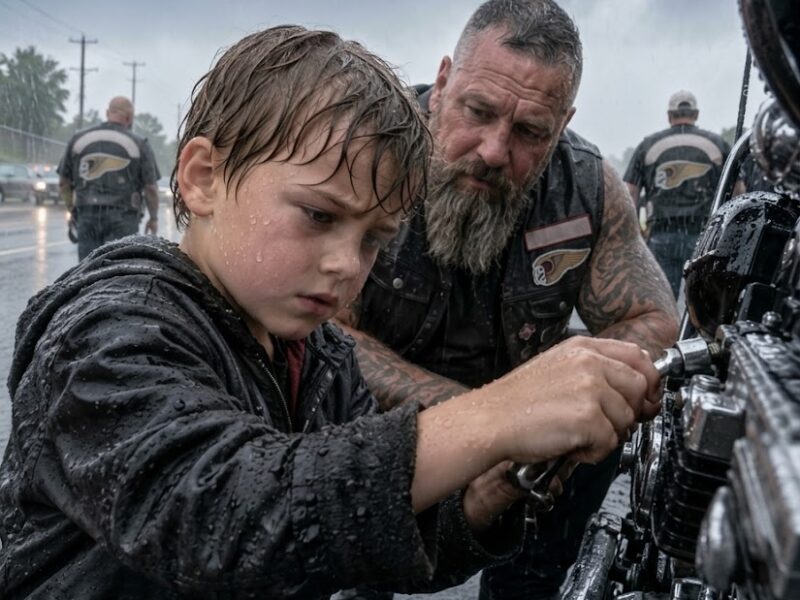
A Boy Helped a Stranded Hells Angel in the Pouring Rain—Days Later, 300 Motorcycles Surrounded His Father’s Garage
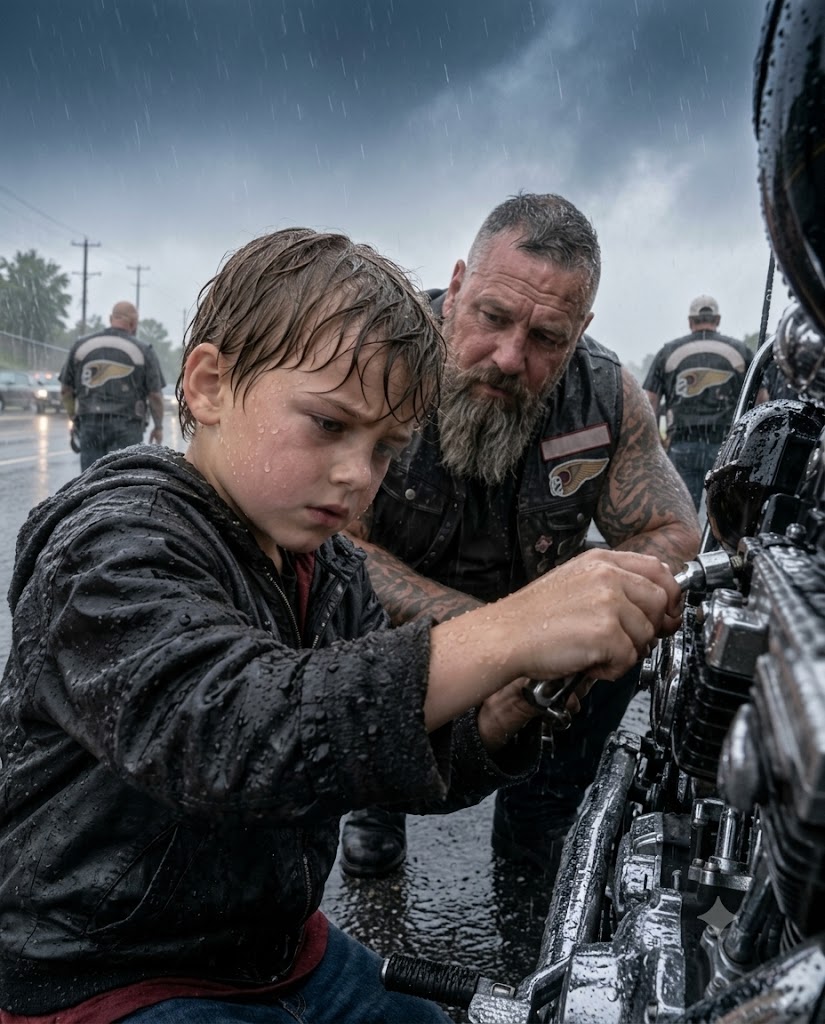
A Boy Fixed a Hells Angel’s Flat Tire in the Rain — 300 Riders Never Forgot It
Rain hammered Route 34 like a judge’s gavel as 11-year-old Ethan Callahan stood frozen at the edge of his garage, staring at a stranger twice his size kneeling beside a wrecked motorcycle. Every warning he’d ever been given screamed at him to go back inside. Leather vest. Tattooed arms. The kind of man his mother crossed the street to avoid.
But something about the way this stranger sat there alone, soaked, forgotten by everyone else who drove past, pulled at him harder than fear did. He didn’t know yet that this one decision—made in the space of a few seconds in the pouring rain—would reach 300 strangers he’d never met and change the way an entire town saw people it had judged for years without ever really looking.
He just knew he couldn’t walk away. Not this time.
Ethan Callahan had learned at 11 years old that the safest place to stand was against a wall. Walls did not ask questions. Walls did not expect you to speak up in class or raise your hand or laugh at the right moment during lunch. Walls simply held still, and Ethan had gotten very good at being like one.
He lived with his mother, Diane, in a small rented house three blocks off Main Street in a town that most of the country only remembered for one week a year. The rest of the time, Sturgis was quiet. Gas stations with faded signs. A diner that served the same meatloaf special every Thursday. A hardware store where his mother worked the register six days a week.
But every August, the town changed. The rumble came first—low and distant, like weather rolling in from the plains. Then the motorcycles arrived by the thousands, and Sturgis turned into something else entirely. Louder. Rougher. In Ethan’s mind, more dangerous.
His father had left when Ethan was six, and the only men who had stayed consistent in his life since then were the ones on television—movies where bikers wore leather vests and scowled at anyone who looked at them too long. Diane never said much about motorcycle riders, but Ethan noticed the way she tensed when the annual rally drew close, the way she reminded him twice as often to stay on their side of town during rally week.
He had absorbed her caution the way children absorb most things—quietly and without question.
That particular August, two days before the rally’s official start, the sky over the Black Hills had turned the color of a bruise. Diane had warned him a storm was coming, the kind that rolled fast off the ridge lines and caught people unprepared. Ethan didn’t mind storms. He liked the sound of rain against the tin roof of the garage behind their house, where he spent most afternoons taking apart old bicycle parts and putting them back together.
Teaching himself how gears worked. How a chain could be tightened. How a flat tire could be patched using nothing but a rubber kit and patience. It was the one thing that made him feel less like a wall and more like a person who could actually fix something.
He was 16 minutes into patching an inner tube when his mother left for a double shift, kissing the top of his head and telling him to lock the door and stay put until she got home. He promised he would. He always did.
The storm arrived earlier than the forecast had predicted. Sheets of rain turned Route 34 into a river of reflected light. Ethan watched it from the garage window, mesmerized by how the world outside seemed to dissolve into gray.
It was nearly 6:00 in the evening when he first heard the sound. Not thunder—something mechanical. A low, sputtering engine noise followed by a heavy metallic thud, like a chain dropped on concrete. He crept to the edge of the garage and looked down the road.
Through the rain, he could make out a shape. A massive black motorcycle tipped at an angle on the shoulder of the road. Its rider standing beside it in a soaked leather vest, staring down at the back wheel with the kind of stillness that Ethan recognized immediately—because it was the same stillness he wore himself when something had gone wrong and there was no one around to help.
Ethan’s stomach tightened. Everything his mother had ever told him, every warning whispered during rally week, rose up at once. Stay away from them. They’re not like us. They’re trouble.
He took a step back into the shadow of the garage, telling himself it wasn’t his problem. That the man would figure it out. That someone else would stop.
He thought about the year before, when a group of riders had stopped at the gas station down the road and one of them—a broad-shouldered man with a shaved head and a chain wallet—had asked Ethan directly whether the vending machine out front was broken. Ethan had been so startled by the question, so certain he was about to be in some kind of danger, that he’d simply nodded and hurried away without answering properly.
He had spent that whole night convinced something terrible might have happened if he’d lingered even a few seconds longer. Though nothing had, in truth, happened at all.
That was the shape his fear usually took—not built from anything he had actually witnessed, but assembled instead from overheard conversations at the diner, from news segments his mother sometimes watched with the volume low, from the general hum of caution that seemed to settle over Sturgis every August like a second kind of weather.
Diane had never told him outright that motorcycle riders were dangerous. She was more careful than that, more measured in the things she said aloud. But children absorb the things left unsaid just as easily as the things spoken. And Ethan had grown up watching his mother’s shoulders tighten every time a pack of engines rolled past their street, watching her hand find his sleeve a little too quickly whenever they crossed paths with riders downtown.
He had learned, without anyone meaning to teach him, that the correct response to that particular kind of stranger was distance.
But no one else stopped.
Cars passed on the far side of the road, slowing just enough to look before speeding on. The man in the leather vest crouched by his back tire, rain running down the back of his neck, and made no move to flag anyone down. He looked, Ethan thought, like someone who had already stopped expecting help.
Thunder cracked somewhere over the hills. Ethan stayed at the garage window a long moment, caught between the wall he had built around himself and something else—a small, insistent voice that sounded a little like curiosity and a little like conscience.
He thought about the inner tube sitting half-patched on his workbench, about the satisfaction of fixing something that was broken. There was a particular kind of quiet that settled over him whenever he worked with his hands, a quiet different from the one he wore at school or around strangers. When he was lining up a patch over a puncture or adjusting the tension on a bicycle chain, the noise in his head—the worry about being noticed, about saying the wrong thing, about standing out—went still.
It was the only time he felt like the version of himself his mother sometimes talked about. The confident, capable boy she said he could be if he just let people see it.
Watching the stranded rider crouched helplessly in the rain, Ethan recognized something oddly familiar in his posture. A person facing a problem with no obvious solution. Waiting for someone—anyone—to notice.
Then, without fully deciding to, he grabbed his patch kit, his father’s old rain slicker from the hook by the door, and stepped out into the storm.
The rain hit harder than Ethan expected, cold enough to sting his cheeks as he jogged down the gravel drive and onto the shoulder of Route 34. Up close, the motorcycle was even bigger than it had looked from the garage—a wide, chrome-heavy machine with saddlebags strapped across the back, water beading off its black paint like it had been waxed for exactly this kind of weather.
The man crouched beside it did not look up right away. He had a thick, gray-flecked beard, forearms lined with faded tattoos, and a leather vest with patches sewn across the back that Ethan didn’t dare read too closely. His name, stitched in small block letters near his collar, read Marcus.
“Sir.” Ethan’s voice came out smaller than he wanted. “Do—do you need help?”
Marcus Doyle looked up slowly, and for a moment neither of them said anything. Ethan braced himself for the kind of gruff dismissal he’d imagined a hundred times in stories. Get out of here, kid.
But instead, Marcus just studied him for a second, rain dripping off the brim of his cap, and let out a short, tired laugh. “Depends,” Marcus said. “You know anything about tire kits? Or are you just here to keep me company while I stand around like an idiot?”
“I know some things,” Ethan said, holding up his patch kit like evidence. “I fix my bike tires all the time.”
“Bicycle tires and motorcycle tires ain’t exactly cousins,” Marcus said. But there was no meanness in it. He nodded toward the flat back wheel. “Hit something in the road a mile back. Steel banding, maybe, off a blown truck tire. Sliced clean through.”
Ethan crouched down next to him, ignoring the rain running in rivulets down his collar. The gash in the tire was long, deeper than anything he’d patched before, but the logic was the same. Find the puncture. Clean the area. Apply the patch. Seal it. Let it cure.
He said as much out loud, half to Marcus and half to himself, working through the steps the way he always did when he was nervous.
Marcus watched him with an expression Ethan couldn’t quite place. Somewhere between amusement and something more careful.
“You always talk yourself through things like that?”
“My mom says it helps me not get scared,” Ethan admitted, and then immediately wished he hadn’t said it, because it felt like admitting weakness to a man built like a door frame.
But Marcus only nodded. “Smart mom.” He reached into one of his saddlebags and pulled out his own kit—a heavier-duty version with a plug tool and a small canister of sealant—and held it out. “This’ll work better than that bicycle patch of yours. You want to try, or you want to just watch an old man do it?”
Ethan hesitated. Every warning his mother had ever given him seemed to whisper at once. A stranger. A biker. Don’t get close.
But the man in front of him wasn’t shouting or threatening. He was simply offering a tool and asking a straightforward question the way any adult might.
“I want to try,” Ethan said.
Marcus knelt beside him and guided him through the process with the patient, unhurried manner of someone who had taught this exact motion to plenty of people before—younger riders, nephews, maybe his own children, though Ethan didn’t ask. He explained why the plug needed to go in at an angle, why rushing the seal would only mean doing the whole job twice, why patience mattered more than strength when it came to fixing things that were broken.
Ethan found himself relaxing into the rhythm of it, the same way he did in the garage at home, his hands finding the motions almost before his mind caught up to them.
For the next 20 minutes, they worked together in the rain. Marcus guiding Ethan’s hands as he pushed the plug tool into the gash, twisted, pulled back, trimmed the excess with a pocketknife Marcus handed over without hesitation.
It should have felt frightening. An 11-year-old boy alone on a dark roadside with a stranger twice his size. But instead it felt oddly ordinary—like fixing a fence or changing a light bulb.
Marcus talked while they worked. Not about anything important. Just idle things. How long he’d been riding. How he’d been heading toward Sturgis a day early to help set up a charity checkpoint for the rally. How his own knees weren’t what they used to be for kneeling on wet gravel.
“You’re not from around here originally?” Ethan asked, more to keep talking than out of real curiosity.
“Nah. Ohio,” Marcus said. “Started riding when I was about your age, actually. Had an uncle who taught me. World looked a lot bigger from the back of a bike.” He glanced sideways at Ethan. “You scared of us bikers? I mean, most folks in these little towns are, come rally week.”
Marcus asked it plainly, without any bitterness in his voice, the way a person might ask about the weather. Ethan got the sense that it was a question he had been asked in one form or another more times than he could count over the years—enough that the sting of it had long since worn smooth.
He told Ethan a little about the checkpoint he was helping run, how his club had been doing the same relief drive every August for almost a decade, collecting donations for local hospitals and fire departments up and down the rally route, mostly without any of the towns they passed through ever hearing about it.
“Reputation’s a strange thing,” Marcus said, working a bit of sealant into the tire’s edge. “Takes about 10 seconds to earn a bad one and about 10 years to shake it, if you’re lucky.”
Ethan didn’t answer right away. The honest answer felt dangerous to say out loud, but something about the rain and the strange intimacy of working side by side on a stranger’s tire loosened his tongue.
“A little,” he admitted. “Everyone says you all cause trouble.”
Marcus was quiet for a moment, working the sealant into place. “Some do,” he said finally. “Some folks cause trouble no matter what they’re riding. A motorcycle, a car, a desk job. But most of the men and women coming through this week? We’re mechanics. Veterans. Nurses. Guys who fix roofs for a living. We just like the wind.”
He tapped the tire once it was sealed. “There. Good as new—or close enough to get me to a real shop.”
Just as he said it, a set of headlights cut through the rain from the north. A second motorcycle, then a third, slowing as they spotted Marcus’s bike on the shoulder. Within a minute, four more riders had pulled over, engines idling, rain streaming off their helmets as they called out to check if Marcus was all right.
Ethan felt his chest tighten again, the old fear rising at the sight of so many leather vests and unfamiliar faces gathered at once. But Marcus straightened up, resting a hand briefly on Ethan’s shoulder, and turned to the others.
“Boys,” he said, loud enough to carry over the rain and the idling engines. “Meet the kid who just saved my night.”
By the time Ethan walked home that night, soaked through and strangely lighter than he’d felt in months, he told himself the encounter was over. A strange, brief crossing of paths that would fade by morning. He did not expect Marcus Doyle to remember his name, let alone his face, once the man rolled on toward whatever checkpoint he was helping set up.
Ethan hung his father’s rain slicker back on its hook, toweled off his hair, and said nothing to his mother when she came home near midnight, exhausted from her shift. He wasn’t sure how to explain it to her, and some part of him suspected she wouldn’t understand—or worse, that she’d be frightened for him in a way that would make him feel foolish for not being frightened himself.
But Sturgis was a small town. And small towns talked.
By the second day of the rally, word had already spread—not through any grand announcement, but through the quiet, effective gossip network of gas station clerks and diner waitresses who had overheard Marcus Doyle telling the story to anyone who’d listen at the charity checkpoint near the edge of town. A kid fixed my tire in the storm. Eleven years old. Out there in the rain by himself, working the plug like he’d done it a hundred times.
The story traveled through the rally crowd the way stories do among people who spend long hours on the road together, with nothing but engine noise and open highway to think. It grew a little in the retelling. Gained details. Became something closer to legend than fact.
Ethan first noticed something had shifted when he walked to the hardware store to bring his mother her forgotten lunch and found two motorcycles parked outside, their riders leaning against the brick wall like they were waiting for someone. One of them—a woman with cropped gray hair and a faded denim vest layered under leather—straightened when she saw him.
“You’re the kid,” she said. It wasn’t a question. “The one who fixed Doyle’s tire out on 34.”
Ethan froze, lunch bag clutched to his chest, unsure whether this was the beginning of trouble or something else entirely. “I—yeah. That was me.”
The woman smiled, an expression that transformed her weathered face entirely. “Name’s Renee. Marcus won’t shut up about you.” She extended a hand, and after a moment’s hesitation, Ethan shook it. Her grip was firm but careful, like she understood exactly how much smaller his hand was than hers.
Word continued to spread over the following two days, and with it came a shift in Ethan’s world that he struggled to reconcile with everything he’d believed. Riders he had never met nodded to him on the street. Someone from the rally organizing committee—a heavyset man named Walter Higgins, who ran a leather goods stall every August—stopped Diane at the hardware store to ask, half joking, whether her son was available to look over a few motorcycles that had developed rattles nobody could diagnose.
Diane came home that evening more confused than upset, though a thread of worry still ran through her voice as she asked Ethan directly what had happened out on Route 34 during the storm.
For the first time, Ethan told her everything. The flat tire. The rain. The decision to leave the garage, despite every warning she’d given him. He watched her face carefully, bracing for anger or fear, and instead found something more complicated. Pride, tangled with the old instinct to protect him from a world she didn’t fully trust.
“You should have told me,” she said quietly. “You went out to a stranger in a storm without telling anyone.”
“I know,” Ethan said. “But he needed help, and nobody else was stopping.”
Diane was silent for a long moment, turning the words over. She had spent years teaching her son caution, teaching him to keep his head down and stay unnoticed, because that was the only way she knew to keep him safe in a town that changed overnight every August. But looking at him now—steadier, more certain of himself than she’d seen him in a long time—she wondered, not for the first time, whether caution and fear had quietly become the same thing in her own mind, and whether she had passed that confusion onto her son without meaning to.
She thought back to her own childhood, growing up two towns over, and the handful of times her own father had spoken about riders passing through during rally season. Always with the same clipped disapproval. Never once with a story to actually back it up. It struck her now how much of what she believed about people had simply been inherited, unexamined, the way a coat gets passed down and worn without anyone asking whether it still fit.
She did not say any of this to Ethan that night. Instead, she simply told him she was proud of him for helping a stranger, and asked him gently to promise to tell her first the next time he felt the pull to do something so brave.
Not everyone in town saw it the way Ethan did.
At school, before the summer break had fully ended, a classmate named Bobby Fenwick had loudly declared that Ethan was an idiot for going anywhere near those criminals, and that he’d probably gotten lucky not to end up robbed or worse. The words stuck with Ethan longer than he wanted them to, needling at the confidence Marcus and Renee and the others had briefly given him.
That night, lying awake, he found himself doubting the whole encounter. Wondering if it had been reckless rather than brave. If his mother’s fear had been the correct response all along. If the friendliness of a few riders was simply an exception to a rule that mostly held true.
He didn’t have long to sit with that doubt.
The following afternoon, as the rally reached its peak and the roar of thousands of engines rolled through Sturgis like a second thunderstorm, Marcus Doyle himself pulled up outside the hardware store, killed his engine, and asked Ethan—right there in front of Bobby Fenwick’s older brother and half the lunch crowd from the diner—if he’d like to come see something the riders had been building all week.
Diane agreed to let Ethan go on the condition that she come along, and Marcus welcomed the request without hesitation, which surprised her more than she let on. They followed his motorcycle in her old sedan to the edge of town, past the fairgrounds where most of the rally’s main events were staged, to a gravel lot beside a low building that Ethan recognized as the volunteer fire station.
What greeted them there stopped Ethan cold.
Motorcycles filled the lot in orderly rows. Chrome and black and deep candy red paint glinting under the afternoon sun. Riders standing beside their machines in small clusters that stretched from the gravel out onto the grass beyond. Renee was there, along with dozens of faces Ethan didn’t recognize. And at the center of it all stood a folding table stacked with cardboard boxes, cases of bottled water, and a hand-painted banner reading: STURGIS COMMUNITY RELIEF DRIVE.
Marcus explained as they walked closer that the riders had spent the week collecting donations at checkpoints along the highway. Money. Supplies. Volunteer hours for the local fire department and a children’s hospital two counties over. It was something the club did every year during the rally—quietly, without much attention from the outside world, because the reputation that preceded them made most towns assume the worst before anyone had a chance to explain otherwise.
“We don’t usually make a big show of it,” Marcus said. “Folks already got their minds made up about who we are. Doesn’t do much good arguing.” He looked at Ethan then, something thoughtful crossing his weathered face. “But you didn’t wait to make up your mind. You just came out into the rain.”
Diane wandered toward the folding table, where a young volunteer was logging donations in a spiral notebook, and found herself reading through pages of contributions. Cash. Boxes of canned food. Gift cards for gas and groceries, destined for families the fire department had flagged as struggling that year.
She had expected—if she was honest with herself—to find some trace of the chaos she’d always associated with rally week. Instead, she found order. Neat handwriting. Careful tallies. A small, hand-lettered sign thanking the Sturgis Volunteer Fire Department for letting them use the lot two years running.
It did not erase every worry she carried about her son growing close to strangers on motorcycles. But it complicated the picture in a way she hadn’t expected. And she found she didn’t mind the complication.
Before Ethan could respond, Renee called out to the gathered riders, raising her voice over the low idle of a dozen engines. She told the story—Ethan’s story—to the crowd, embellishing only slightly. Describing an 11-year-old boy who had left the safety of his garage in the middle of a storm to help a stranger nobody else had bothered to stop for.
As she spoke, more riders drifted closer, until Ethan found himself standing at the center of a half-circle of leather vests and sun-weathered faces. All of them looking at him with an expression he had never once expected from people he’d spent his whole life being warned about.
It was Walter Higgins, the leather goods vendor, who suggested it first—half as a joke, though it caught on faster than anyone anticipated. “We ought to make him an honorary member of the road,” Walter said, grinning. “Kid’s got more backbone than half the grown men out here.”
What followed was not a formal ceremony. Not really. But something that would live in the memory of everyone present far longer than any plaque or patch could have.
Marcus produced a small pin from his vest pocket—a simple metal wheel, the kind riders sometimes traded among themselves as tokens of respect—and pressed it into Ethan’s palm.
“This doesn’t mean you’re one of us,” Marcus said carefully, aware of Diane watching a few feet away. “You’re 11. You’ve got school and your mom and a whole life ahead of you that doesn’t need engines in it if you don’t want. But it means we won’t forget what you did. And you shouldn’t either.”
Ethan closed his fingers around the pin, throat tight, unable to find words that matched the size of what he was feeling. Around him, the gathered riders—probably close to 300 by the time the whole rally caravan rolled through the lot that afternoon, checking in at the relief drive on their way through town—began revving their engines in a slow, rolling wave. Not out of aggression, but celebration. The sound rising like a tide across the gravel lot.
Diane, standing beside her son, felt the vibration of it in her chest and found herself unexpectedly smiling through it rather than flinching.
Renee crouched down beside Ethan a moment later, once the noise had settled, and told him quietly that she hoped he’d remember this feeling the next time somebody tried to tell him what kind of person he was allowed to help. She talked about her own years on the road, how she’d been dismissed more than once for being a woman riding alone, how the assumptions people made about her had stung in ways she still carried even after two decades.
“Most of what people believe about strangers,” she said, “they never bothered to check. You checked. That’s rarer than you’d think, even in grown adults.”
Bobby Fenwick’s older brother, who had trailed along at a distance out of curiosity, stood at the edge of the lot with his arms crossed, watching the scene with an expression that had shifted somewhere between confusion and grudging respect. He would tell his brother about it later that evening, and Bobby—for all his earlier bravado—would find himself oddly quiet on the subject of those criminals for the rest of the summer.
As the sun began to lower over the gravel lot and riders started peeling off toward the fairgrounds for the rally’s closing events, Marcus knelt down to Ethan’s eye level one more time. His voice was low enough that it felt like it was meant for Ethan alone.
“People are going to tell you all your life that you can judge a book by its cover,” he said. “Don’t believe them. You didn’t judge me by mine. Don’t ever start now.”
The rally ended, as it always did, in a matter of days. The engines faded from Main Street. The vendors packed their tents. Sturgis settled back into its familiar, quiet rhythm of gas stations and empty highways.
But something in the town, and in Ethan himself, had shifted in a way that outlasted the noise.
Diane found herself telling the story to co-workers at the hardware store—at first hesitantly, then with a note of pride she hadn’t expected to feel. She kept the small metal wheel-pin Marcus had given her son in a drawer by the register for weeks, taking it out now and then to turn it over in her fingers. Thinking about the years she’d spent teaching Ethan to be cautious, to stay small, to avoid drawing attention to himself in a world she’d never fully trusted.
She began to understand, slowly, that the caution she’d passed down to him had been built more from her own old fears than from anything Ethan needed protecting from. And that the bravest thing he’d ever done was the one time he’d set that caution aside.
Ethan wore the pin on the strap of his backpack when school started again that fall. And though most of his classmates didn’t ask about it, a few did. He found himself telling the story more easily each time—not as a boast, but as something closer to a lesson he was still working out for himself.
His teacher that year, Mrs. Ableman, overheard him telling it once during a lull between classes and later asked if he’d be willing to share it during their unit on personal narrative writing. Ethan hesitated at first, uneasy about standing in front of the class. But he found that once he started talking about the rain and the tire and the strange calm of working with his hands, the old nervousness that usually gripped him in front of other people simply didn’t show up the way it always had before.
Bobby Fenwick never apologized outright. But he stopped repeating his old line about criminals. And once, in a moment Ethan hadn’t expected, asked what it had actually been like out there in the storm, working on a stranger’s tire in the dark.
“Scary,” Ethan told him honestly. “Right up until it wasn’t.”
Marcus Doyle did not disappear from Ethan’s life after that August, though their contact remained occasional. A postcard the following spring from somewhere in Wyoming. A brief visit the next rally season, when Marcus stopped by the hardware store just to see how Ethan and his mother were doing.
Renee, too, kept in touch—sending Diane a small care package one winter when she heard through the rally grapevine that the Callahans had gone through a rough stretch after Diane’s hours at the store were cut. It was a small gesture, but it meant something larger. Proof that the connection formed that rainy evening on Route 34 had not been an isolated exception, but the beginning of something steadier.
The following August, when the rally returned to Sturgis and the engines once again rolled down Main Street in their thousands, Ethan was waiting at the edge of town with his mother. No longer pressed against a wall, but standing in the open. Watching the riders arrive with something closer to recognition than fear.
Marcus found him within the first hour, grinning beneath his gray-flecked beard, and asked if the kid still remembered how to patch a tire.
“Better than you do, probably,” Ethan said.
And Marcus laughed loud enough that a few nearby riders turned to see what the joke was.
Word of the story had continued to travel in the year between rallies, passed along at gas stations and roadside diners across a dozen states, retold at charity checkpoints and clubhouse gatherings until it had become something like local legend among riders who had never even met the boy at the center of it. Some of the details shifted with each retelling, as stories do. But the core of it remained constant.
A boy who could have stayed inside. Who had every reason given to him by the world to stay inside. And who had walked out into the rain instead.
What the 300 riders who eventually heard some version of the story carried away from it was not really about motorcycles or storms or flat tires at all. It was the quieter recognition that the assumptions people carried about each other—bikers about small towns, small towns about bikers, a frightened boy about the world beyond his garage—were rarely as solid as they seemed once someone was willing to step past them.
Ethan had not set out to prove anything. He had simply seen someone who needed help and decided, in the space of a few uncertain seconds, that fear was not a good enough reason to stay behind a wall.
Diane, for her part, changed too—in ways smaller than her son’s, but no less real. She stopped tensing quite so visibly when the engines rolled through town each August. And the following year, she found herself waving—a little self-consciously at first—at a pack of riders passing the hardware store on their way to the fairgrounds. One of them, she was fairly sure, was Renee, though the pack moved too quickly for her to be certain.
It didn’t matter much either way. The gesture had become less about any one rider and more about the kind of town, and the kind of mother, she wanted to be. One willing to let a little uncertainty back into a world she’d spent years trying to make smaller and safer than it actually was.
The pin—the small metal wheel—stayed on Ethan’s backpack through middle school and into high school. It caught the light sometimes when he walked between classes, a tiny glint of chrome against canvas. Most people never asked what it meant. But every now and then, someone would notice it. A new kid. A substitute teacher. A stranger at a gas station who recognized the shape of it and nodded, just once, like they understood something without needing it explained.
And Ethan would remember. The rain. The tire. The man who had every reason to be exactly what the town said he was, and who turned out to be something else entirely.
He would remember the sound of 300 engines revving in a gravel lot, not in anger, but in welcome. He would remember his mother’s face, caught between old fear and new pride. He would remember Marcus kneeling down to his eye level and telling him not to judge a book by its cover.
He would remember that the wall he’d built around himself had never really kept him safe. It had only kept him alone. And that the one time he’d stepped past it—into the rain, toward a stranger, toward something uncertain—he had found a whole world waiting on the other side.
A world that had been there all along. Just waiting for someone to notice.









