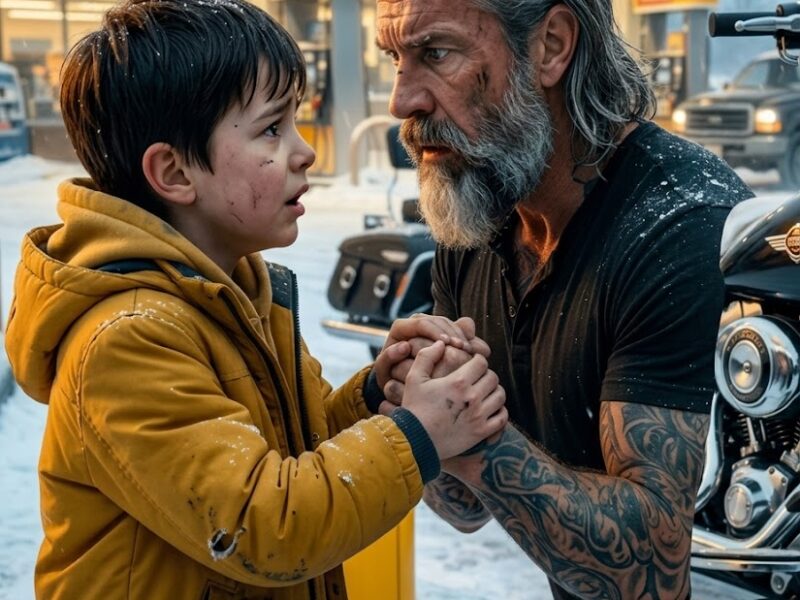
A boy grabbed a biker’s arm at a gas station, screaming, “My sister’s in that truck!” — what happened next stunned the entire state.
Part 1
The August sun beat down on the Love’s Travel Stop just outside Valdosta, Georgia, with the kind of relentless heat that made asphalt shimmer like water and turned chrome into torture.
Dominic “Duke” Hartley stood beside his Road King filling the tank while his brothers from the Iron Guardians MC stretched their legs after two hours of riding.
They were five bikes strong that Saturday afternoon—Duke, Razor, Smokey, Bear, and a younger prospect named Axel—making their annual run from Atlanta to the coast for a veterans charity event.
Duke was forty-eight, a former Army Ranger with gray threading through his dark beard and scars that mapped a life lived hard but lived right.
The Iron Guardians had been riding together for twelve years, known throughout Georgia as the club that showed up when disaster struck, that raised money for children’s hospitals, that treated their patches with the kind of honor that made other clubs nod with respect.
Even law enforcement grudgingly acknowledged they were the good ones.
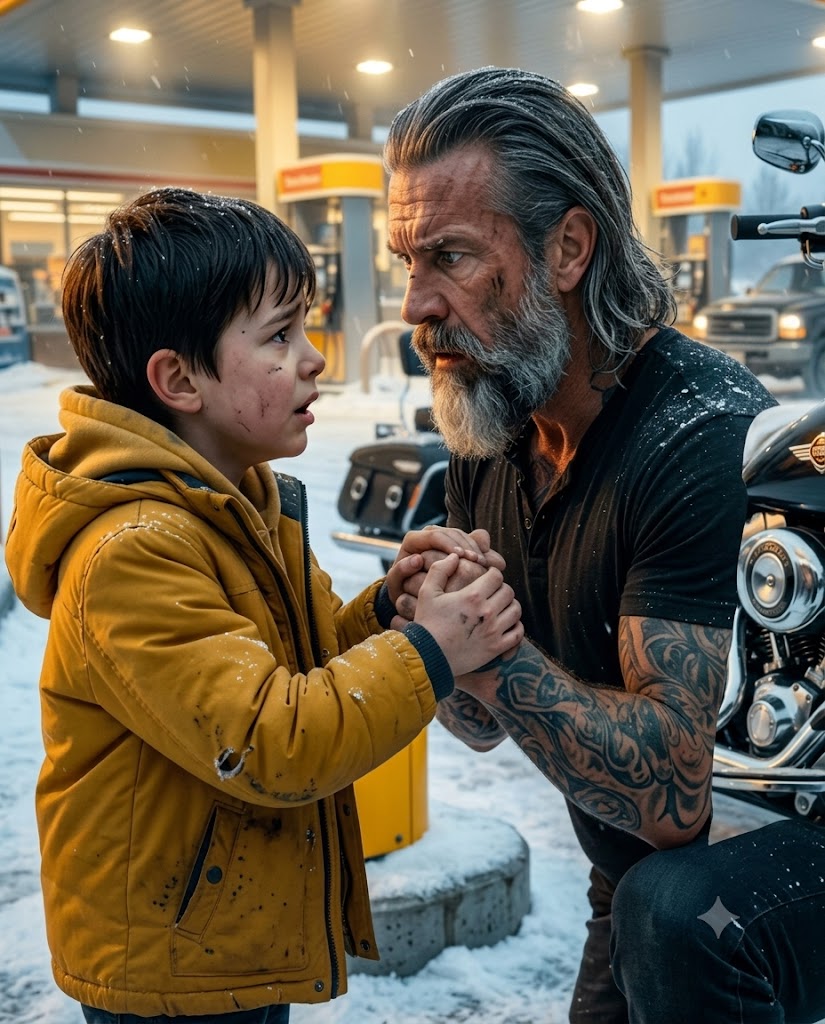
Duke was screwing his gas cap back on when he felt it—small fingers digging into his forearm with surprising strength, nails actually breaking skin through desperation.
He spun to find a boy, maybe nine years old, African-American with close-cropped hair and eyes that were red-rimmed and wild with panic.
The kid was breathing in gasps, his Star Wars T-shirt soaked with sweat that couldn’t all be from the heat, his worn sneakers scuffed like he’d been running.
“My sister’s in that truck!” the boy shouted, his voice cracking with desperation as he pointed toward the exit where an eighteen-wheeler—white cab, unmarked trailer—was merging onto I-75 northbound.
“Please, you have to catch them. They took her. They took Zoe, and nobody believes me.”
Duke’s training kicked in before his conscious mind caught up.
He scanned the truck—Georgia plates, nothing unusual about the rig itself—but there was something in the way it had been parked at the far edge of the lot, away from other trucks.
Something in the way it had pulled out with such hurried purpose.
“Razor,” Duke’s voice carried the command that had once moved soldiers under fire. “That white Kenworth pulling out. Something’s wrong. Get the plates.”
Razor was already moving, pulling out his phone, zooming in on the truck before it disappeared from view.
The boy was still gripping Duke’s arm, tears streaming now, words tumbling out in a torrent of terror.
“We were in the bathroom, me and Zoe, and this man came in. He grabbed her. He had a cloth. She went all limp. And I tried to stop him, but he pushed me down. And he put her in that truck. I saw the back. There were other girls in there. I saw them. They looked scared. And I ran to tell the people inside. But they said I was lying. They said kids make up stories. But I’m not lying. I swear I’m not lying.”
Duke knelt down, bringing himself to the boy’s eye level, his hands firm on small shoulders.
“What’s your name, son?”
“Marcus. Marcus Webb. My sister is Zoe Webb. She’s seven. She’s wearing a purple shirt with a unicorn. She has braids with purple beads. You have to believe me. Please. Nobody believes me.”
Behind Duke, his brothers had formed a protective semicircle, their presence drawing attention from other travelers who were starting to notice the commotion.
Bear, the club’s sergeant-at-arms and the largest of them at six-foot-five and two hundred eighty pounds of solid muscle, was already on his phone.
“Calling Georgia State Patrol,” he said quietly, giving them the plates and description.
Duke studied Marcus’s face and saw no deception, no confusion—just pure terrified certainty.
He’d interrogated enough people in his military career to know the difference between a story and the truth.
And this kid was telling the truth.
“Marcus, where are your parents?”
“My mom’s at work in Atlanta. We were supposed to ride the bus to our aunt’s house in Tallahassee, but we missed it. So we were waiting for the next one. That’s why we were here. I have to call my mom, but my phone died. And the people inside won’t let me use their phone. They think I’m making trouble.”
Duke pulled out his own phone, handed it to Marcus.
“Call your mom. Tell her what happened and tell her you’re with the Iron Guardians MC. That we’re going to get your sister back. And that she needs to meet us at the Georgia State Patrol Post in Valdosta.”
He stood, his mind already working through logistics, probabilities, the cold mathematics of pursuit.
That truck had maybe a three-minute head start, was probably doing seventy on the interstate, which meant it was already five or six miles ahead.
Highway Patrol would respond, but they were scattered thin across hundreds of miles of interstate.
And in trafficking situations, minutes mattered.
Victims got moved to secondary locations, got transported across state lines, disappeared into networks that were designed to make people vanish.
Duke looked at his brothers and saw his own calculation reflected in their faces.
They all knew what they were about to do was technically vigilantism, was probably illegal in a dozen different ways, and could end with them in significant trouble with law enforcement.
But they also knew that sometimes the right thing and the legal thing weren’t the same thing.
And that they joined this club to be the kind of men who acted when action was needed.
“Mount up,” Duke said quietly. “We’re going after that truck.”
Smoky, the club’s voice of reason and a former state trooper himself, stepped forward.
“Duke, if we do this wrong, if we interfere with an active investigation, or if this kid is wrong—”
“He’s not wrong,” Duke interrupted. “Look at him, Smoke. That’s not a kid who’s confused. That’s a kid who saw something terrible and is begging anyone who’ll listen to help his sister. We sit here debating protocol while that truck puts miles between us. And by the time Highway Patrol gets their act together, those girls are gone.”
He turned to Marcus, who was crying into the phone, trying to explain to his mother what had happened, his voice breaking with frustration as she apparently wasn’t understanding or wasn’t believing.
Duke gently took the phone back.
“Mrs. Webb, this is Dominic Hartley. I’m with the Iron Guardians Motorcycle Club, and I’m here with your son, Marcus. I need you to listen very carefully. Marcus just witnessed what he believes was an abduction of his sister. We’ve called Highway Patrol, but we’re also going to pursue the vehicle he identified while we wait for official response. I need you to trust me when I tell you that we will not let anything happen to your son, and we will do everything in our power to get your daughter back. Do you understand?”
The woman on the other end was sobbing, her words barely coherent, but she managed to say yes, managed to say please, managed to say her baby girl’s name like a prayer.
Duke handed the phone back to Marcus.
“Stay on with your mom. We’re going to put you with someone safe here while we go after that truck.”
But Marcus shook his head violently, stepping back.
“No. I’m coming with you. I saw the truck. I can identify it. And if Zoe sees me, she’ll know help is coming. She’ll know I didn’t leave her.”
“Son, it’s too dangerous.”
“I don’t care.” Marcus’s voice carried across the parking lot. “That’s my sister. She’s seven years old and she’s scared and I’m the one who’s supposed to protect her because I’m her big brother and I already failed once. I’m not failing again.”
Duke saw something in that moment that made his decision.
He saw himself at nine years old watching his own younger sister get hurt by their father’s fists.
Feeling that same crushing helplessness.
That same desperate need to protect.
He’d spent his whole adult life trying to make up for the times he couldn’t protect her before she died at sixteen from wounds that weren’t all physical.
“Razor, Marcus rides with you. Axel, you stay here. Coordinate with Highway Patrol when they arrive. Give them our heading and tell them we’re maintaining visual contact only, no engagement.”
He looked at Marcus.
“You do exactly what Razor tells you. You hold on tight and you trust us. Understood?”
Marcus nodded, and seconds later he was strapped into Razor’s backseat, a spare helmet that was far too large wobbling on his small head.
Five Harleys roared to life with a sound like thunder, and they peeled out of that gas station doing things that were absolutely illegal and absolutely necessary.
Duke took point, his Road King’s engine screaming as he pushed eighty, then ninety, weaving through traffic on I-75 north.
Bear was on the phone with Highway Patrol, feeding them real-time updates.
Smoky was running the truck’s plates through connections he still had from his trooper days.
And Marcus, small arms wrapped around Razor’s waist, was scanning the highway ahead with an intensity that no nine-year-old should have to possess.
—
## Part 2
—
They’d been riding maybe eight minutes when Marcus’s voice came through Razor’s helmet comm, shrill with recognition.
“There, that’s it. White truck, see it? That’s the one.”
Duke spotted it—three cars ahead in the right lane, that white Kenworth cab with the unmarked trailer, maintaining steady highway speed like it had nothing to hide.
His gut told him that was intentional, that whoever was driving knew the first rule of smuggling was to never attract attention, to blend in with the thousands of other trucks on American highways.
Duke’s phone buzzed.
A text from Bear: “Plates registered to shell company. Smoky’s contacts say it’s flagged in trafficking database, but no active warrants. GHP says units responding, but twenty minutes out.”
Twenty minutes might as well be forever.
Duke made his decision and accelerated, the Iron Guardians forming up around him.
They weren’t going to stop the truck—that would be kidnapping, assault, a dozen felonies that would land them in prison.
But they were going to make damn sure that truck didn’t disappear, didn’t exit onto some country road, didn’t make it to whatever secondary location was planned.
They were going to be a visible, undeniable presence that forced the driver’s hand.
Duke pulled alongside the cab, matching speed, making eye contact with the driver.
A white male, maybe forty, with the kind of face that was aggressively forgettable.
The man’s expression flickered when he saw the motorcycle club formation around his truck.
Saw five bikers who weren’t backing off.
Saw the way they’d essentially boxed him in.
Bear pulled up on the trailer side.
Smoky dropped back to prevent rear escape.
And Razor stayed centered with Marcus, who was pointing at the truck and shouting, though his words were lost in wind and engine noise.
The truck driver’s face shifted from annoyance to calculation to something that looked like panic.
And that’s when Duke knew, with absolute certainty, that Marcus had been right.
The driver’s hand reached for something—phone, radio, weapon, Duke couldn’t tell.
And then the truck suddenly swerved left, trying to force Duke off the road.
Duke’s Ranger training saved his life.
He braked hard, dropped back, narrowly avoiding the trailer’s rear wheels.
The truck accelerated, pushing eighty-five now, and the chase was on.
They screamed up I-75 at speeds that made other vehicles blur, the Iron Guardians maintaining formation, their engines howling.
Duke could see the driver on his phone now, clearly calling for instructions, for help, for something.
Behind them, the wail of sirens.
Finally—Georgia Highway Patrol, multiple units converging.
The truck driver must have heard them too, because he made a desperate move, cutting across three lanes toward an exit.
Duke followed, the whole formation staying tight.
They hit the exit at seventy, the bikes leaning into curves that would have been suicidal at sane speeds.
The truck’s trailer fishtailed as the driver pushed too hard.
They were on a rural highway now—farmland on both sides—and ahead Duke could see the truck’s brake lights flashing.
The driver was going to try to stop.
Maybe destroy evidence, maybe scatter and run.
But he didn’t account for the fact that five motorcycles could stop a lot faster than an eighteen-wheeler.
The Iron Guardians formed a barrier across the road.
And when the truck screeched to a halt fifty feet away, they were already off their bikes, using them as cover.
Bear on the phone, giving Highway Patrol their exact location.
The truck’s door opened and the driver jumped down, his hands raised in surrender, but his eyes were scanning for escape routes.
“On the ground, hands behind your head. Do it now.” Duke’s command voice carried all the authority of his Ranger days.
The man hesitated, and Bear took three massive strides forward, his sheer size making further resistance pointless.
The driver dropped.
Behind them, four Georgia State Patrol cruisers roared up, officers emerging with weapons drawn.
And for a terrifying second, Duke thought they might be treated as threats, as another danger to manage.
But the lead trooper—a woman with sergeant stripes and gray hair—took in the scene with experienced eyes.
Saw five bikers maintaining defensive positions.
Saw a man on the ground who looked guilty as hell.
Saw a small boy climbing off a motorcycle and running toward the truck trailer screaming his sister’s name.
“Someone open that trailer,” the sergeant commanded. “Now.”
Bear had bolt cutters from his saddlebag—tools of the trade for bikers who sometimes had to deal with chains and locks in emergency situations.
He cut through the padlock and pulled open the trailer doors.
And what they found inside made even these hardened men’s stomachs turn.
Six girls, ages approximately seven to fifteen, zip-tied and gagged, sitting on the floor of a trailer that had been modified with basic ventilation but nothing else.
And there, in the front corner, was a little girl in a purple unicorn shirt with braids and purple beads.
The moment she saw Marcus, her eyes went wide with recognition and relief.
The sergeant was already calling for EMTs, for FBI, for the specialized units that dealt with human trafficking.
Troopers were reading the driver his rights while securing the scene.
And Duke stood there watching Marcus hug his sister while both of them sobbed.
Watching the other five girls being freed and covered with emergency blankets.
And he felt something crack open in his chest.
Grief for his own sister he’d never been able to save.
And gratitude that today, right now, they’d saved these girls.
The sergeant approached Duke, her expression unreadable.
“That was the most reckless, dangerous, technically illegal chase I’ve seen in twenty years on this job.”
Duke nodded, accepting whatever was coming.
But then her face softened.
“It was also the bravest damn thing I’ve seen in just as long. Those girls would have been gone in another hour, moved to a different vehicle, scattered across three states. Your club just broke open a trafficking network we’ve been chasing for two years.”
She extended her hand.
“Thank you.”
Duke shook it, his voice rough.
“Thank Marcus. He’s the one who saw, who knew, who refused to let it go.”
—
## Part 3
—
Over the next three hours, as FBI agents arrived and EMTs checked each girl, and Marcus’s mother drove down from Atlanta crying so hard she could barely speak, the full picture emerged.
The truck driver was part of a network that moved victims from Florida up through Georgia to buyers in Tennessee and Kentucky.
The girls had been grabbed from various locations—parks, bus stops, one even from her own front yard—over the past week.
Marcus and Zoe had been waiting at that gas station for their bus, and when Zoe went to use the restroom, the trafficker saw his opportunity.
He hadn’t counted on Zoe’s brother following them, seeing everything, and refusing to let the adults’ dismissiveness stop him from saving his sister.
By evening, the story had hit every news outlet in the state.
“Motorcycle Club Saves Six Girls in Highway Chase” dominated headlines, and suddenly the Iron Guardians’ phone was ringing non-stop.
Other clubs calling to offer support.
Citizens wanting to donate to their veterans charity.
Law enforcement agencies requesting they help with community outreach.
But Duke didn’t care about any of that.
What mattered was watching Marcus hold Zoe’s hand in the back of an ambulance while their mother held them both.
Watching the other five girls be reunited with their families who’d been frantically searching.
Watching the FBI agent tell him that the intelligence gathered from this bust would help recover dozens more victims.
That night, at their hotel in Valdosta, with the charity ride postponed by mutual agreement, Duke sat with Marcus on the curb outside while the boy’s mother and sister slept inside.
“You did good today, kid,” Duke said quietly. “You saw something wrong and you didn’t stop until someone listened.”
Marcus was tracing patterns on the pavement with his finger.
“Everyone thought I was lying. The people at the gas station, they looked at me like I was making trouble. Like I was just some kid with too much imagination.”
“I know that feeling,” Duke said. “But you kept trying. That’s courage. Not being fearless, but being scared to death and doing the right thing anyway.”
He pulled off his Iron Guardians vest—the one he’d worn for twelve years, the one that bore patches from every major ride and charity event and moment that mattered.
He held it out to Marcus.
“This is too big for you now, but you hold on to it. When you’re older, if you want to ride with us, you’ll have a place. Because today, you embodied everything this club stands for. Protecting the vulnerable, standing up when it’s easier to look away. Being the kind of man who takes action when action is needed.”
Marcus took the vest with reverence, holding it like the precious thing it was.
“I just wanted my sister back.”
“And because of you, five other families got their daughters back too.”
—
## Part 4
—
Three months later, Duke stood in a community center in Atlanta watching Marcus accept an award from the Georgia State Patrol for his role in breaking up the trafficking network.
The boy wore a suit that was clearly borrowed and shoes that were definitely too big.
But he stood tall at that podium and told his story.
Told how nobody believed him until someone finally did.
Told how his sister was in therapy now but was going to be okay.
Told how the other five girls were all home and healing.
Zoe sat in the front row with her mother, wearing a new purple shirt with a unicorn, her braids redone with purple beads.
And when Marcus looked at her, she smiled at him with the kind of love and trust that only siblings share.
The Iron Guardians sat in the back row—five men in leather who’d done nothing more than believe a nine-year-old boy and then refused to let him down.
They didn’t want recognition or awards or media attention.
They wanted to ride, to serve, to be the kind of men who showed up when others needed them.
After the ceremony, Marcus ran over to them, still wearing that too-big vest over his suit, and Duke knelt down to his level.
“You keeping that safe?”
“Every day,” Marcus promised. “I keep it in my room where I can see it. It reminds me that someone believed me.”
“Always trust what you see with your own eyes,” Duke said. “Even when the whole world tells you you’re wrong. If you know you’re seeing truth, you stand on it. You understand?”
Marcus nodded, and then he hugged Duke with the fierce gratitude of a child who’d been saved by a stranger who’d become something more.
—
## Part 5
—
The story of Marcus Webb and the Iron Guardians became legend in Georgia.
A tale told in truck stops and police stations and motorcycle clubs across the state.
It became a training case study at the FBI Academy for how civilian intervention could break major cases.
It became a reminder to 911 dispatchers and gas station attendants and adults everywhere to listen when children report something wrong.
Because sometimes they’re seeing things adults have learned to ignore.
Marcus grew up knowing that his voice mattered.
That his observations had value.
That he’d saved his sister and five other girls because he refused to be silenced.
Zoe grew up knowing her brother loved her enough to grab a stranger’s arm and demand help.
Knowing that sometimes heroes don’t look like what movies tell you they should look like.
And Duke rode on year after year with his brothers beside him, carrying in his heart the knowledge that his own sister’s death hadn’t been for nothing.
That he’d spent his life since then trying to be the protector he couldn’t be for her.
And that one August afternoon at a Georgia gas station, he’d finally gotten it right.
The Iron Guardians still do that charity ride every year.
Still raise money for veterans and children’s hospitals.
Still show up when disaster strikes.
But they added something new to their mission statement: “We listen when others ignore. We act when others hesitate. We protect the vulnerable because that’s what honor demands.”
And in the front pocket of Duke’s vest, tucked beside his own club patch, is a school photo of a little girl in a purple unicorn shirt with braids and purple beads.
A reminder that sometimes the most important rides aren’t the ones to the coast or the mountains, but the ones that start when a nine-year-old boy grabs your arm and says, “My sister’s in that truck.”
And you choose to believe him.
—
## Part 6: The Ripple Effect
—
Six months after the rescue, the FBI contacted Duke with news that would change everything.
The driver they’d caught had been a low-level courier, but the intelligence gathered from his phone and the truck’s GPS had led to something much bigger.
A network spanning four states.
Twenty-three arrests.
And forty-one children recovered—children who’d been taken from playgrounds, bus stops, and front yards over the past three years.
Duke sat in his living room in Atlanta, staring at the email on his phone, and felt tears he hadn’t shed in years roll down his cheeks.
Forty-one children.
Forty-one families.
Because a nine-year-old boy refused to be ignored.
Because five bikers refused to look away.
He called Marcus that night.
“Hey, kid. You remember what I told you about courage?”
“Yeah. Being scared and doing the right thing anyway.”
“Well, I wanted you to know something. Because of what you did that day—because you grabbed my arm and wouldn’t let go—forty-one other kids are home with their families tonight.”
There was a long silence on the phone.
Then, in a small voice: “Really?”
“Really. You didn’t just save your sister. You saved all of them.”
Marcus was quiet for another moment, and Duke could hear him sniffling.
“I’m glad I didn’t stop when they didn’t believe me.”
“Me too, kid. Me too.”
—
## Part 7: The Second Annual Ride
—
The Iron Guardians’ charity ride had become something bigger than they’d ever imagined.
What had started as five bikes heading to the coast for a veterans event had transformed into a three-day rally with hundreds of riders from clubs across the Southeast.
They called it the “Guardian Run”—a charity ride that raised money for children’s hospitals and trafficking survivor programs.
And every year, at the starting point in Atlanta, a small ceremony was held.
Marcus stood at the front of the crowd at the second annual ride, now ten years old, wearing his too-big vest over a new T-shirt that said “Believe Kids.”
Zoe stood beside him, holding his hand.
Their mother stood behind them, watching her children with tears in her eyes.
Duke handed Marcus the microphone.
“Say what you want to say, kid.”
Marcus looked out at the sea of leather and chrome and faces.
“I just wanted to tell everyone that you don’t have to be big to do something important. You don’t have to be a grown-up to be brave. You just have to see something wrong and not stop until someone listens.”
He paused, looking down at his sister.
“I almost stopped. When the people at the gas station didn’t believe me, I almost gave up. But then I saw Duke and his friends, and I thought—maybe they’ll believe me. Maybe someone will help.”
He looked up at the crowd.
“And they did. So if there’s anyone out there who feels like nobody’s listening—don’t stop. Keep finding people who will. There are good people out there. Sometimes they just look a little scary.”
The crowd erupted in applause, and Duke put his hand on Marcus’s shoulder, his eyes glistening.
—
## Part 8: The Wall of Names
—
Years passed.
Marcus graduated from high school and went to college, studying criminal justice.
Zoe went to therapy and got better, eventually becoming a counselor herself, helping other children who’d experienced trauma.
The Iron Guardians continued their work, growing older but never slowing down.
And in the lobby of the Georgia Bureau of Investigation headquarters, a wall was dedicated to civilian heroes who’d helped break major cases.
At the center of that wall, in a place of honor, was a photograph of a nine-year-old boy pointing at a truck.
Below it, a plaque:
“Marcus Webb. Because he spoke, forty-one children came home. Because someone listened, a network was dismantled. Because one person believed, countless lives were saved.”
Duke visited that wall once a year, on the anniversary of the chase.
He’d stand there, looking at the photograph of Marcus, remembering that day at the gas station.
Remembering the desperation in the boy’s eyes.
Remembering the way his small fingers had dug into Duke’s arm.
Remembering the moment he’d decided to believe.
And he’d think about his own sister—the one he couldn’t save—and he’d whisper, “This one’s for you.”
—
## Part 9: The Legacy Continues
—
When Duke was sixty-two, he finally hung up his helmet.
His hands weren’t as steady as they used to be, and his eyes weren’t as sharp.
But he still rode—just slower, and always at the back of the pack, watching over the younger members.
Marcus was twenty-four now, a rookie police officer in Atlanta.
He’d married his college girlfriend and was expecting his first child.
And when he’d graduated from the police academy, Duke had been there, front row, wearing his Iron Guardians vest with pride.
“You know,” Marcus had said at the ceremony, “I never would have become a cop if it wasn’t for that day at the gas station. I want to be the kind of person who believes kids when they say something’s wrong.”
Duke had just nodded, too choked up to speak.
The club had changed over the years.
New members, new missions, new challenges.
But the core remained the same.
They listened when others ignored.
They acted when others hesitated.
They protected the vulnerable.
And they never, ever stopped believing.
—
## Part 10: Full Circle
—
On a sweltering August afternoon, twenty years after the rescue that had made him famous, Marcus Webb found himself at a gas station outside Valdosta.
He was off-duty, driving his family down to Florida for a vacation.
His daughter, Zoe—named after the sister he’d saved—was playing on the sidewalk while his wife filled the tank.
And then he heard it.
A small voice, desperate and scared.
“Help! Please, someone help! My friend’s in that car!”
Marcus spun.
A little boy, maybe seven years old, was running toward him, tears streaming down his face.
“That car, the blue one! My friend got in but she didn’t want to and there was a man and she was crying!”
Marcus looked at the blue sedan pulling out of the parking lot.
Looked at the terrified child beside him.
And he made a decision.
He pulled out his phone and called 911, giving them the description and plates.
Then he knelt down to the boy’s level.
“I believe you,” he said. “And I’m going to help you. What’s your name?”
“Tyler.”
“Okay, Tyler. Tell me everything you saw.”
—
Two hours later, a blue sedan was pulled over on I-75.
A child was recovered, safe.
A suspect was arrested.
And Marcus Webb stood in a gas station parking lot, holding his own daughter in his arms, thinking about how one moment of belief could change everything.
He called Duke that night.
“Hey, old man. I wanted to tell you something.”
“What’s up, kid?”
“A kid grabbed my arm today at a gas station. Told me his friend was in trouble. And I believed him.”
Silence on the line.
Then, a voice rough with emotion: “Good job, Marcus. Good job.”
“I learned from the best.”
—
## Part 11: The Final Chapter
—
Duke Hartley died peacefully in his sleep at seventy-eight years old.
His funeral was attended by hundreds—bikers, police officers, FBI agents, and a family named Webb who sat in the front row.
Marcus gave the eulogy.
He talked about the day a nine-year-old boy grabbed a stranger’s arm.
He talked about the chase that had changed his life.
He talked about the man who’d believed him when everyone else didn’t.
And then he walked to the coffin and placed something inside.
An Iron Guardians vest.
The one Duke had given him twenty years ago.
The one Marcus had worn every year to the Guardian Run.
The one that had reminded him, every single day, that heroes don’t always wear badges.
Sometimes they wear leather and ride to the sound of thunder.
—
The Iron Guardians continued on.
New leaders, new members, same mission.
The Guardian Run grew bigger every year.
The wall of names at GBI headquarters got more names.
And the story of Marcus Webb and Duke Hartley became legend—passed down from generation to generation of bikers and cops and children who needed to know that their voices mattered.
Because sometimes the most unlikely heroes are exactly who someone needs when every second counts.
Because sometimes all it takes is one person willing to listen.
Because sometimes—just sometimes—a nine-year-old boy grabbing your arm at a gas station can change the world.
—
*Tell us in the comments: What would you have done in that gas station parking lot? Would you have believed Marcus when everyone else dismissed him? Would you have had the courage to chase that truck knowing the risks?*
*Your answer might surprise you.*
*But stories like this remind us that everyday heroes are everywhere, and sometimes the only thing standing between tragedy and rescue is one person willing to listen, to believe, and to act when every second counts









