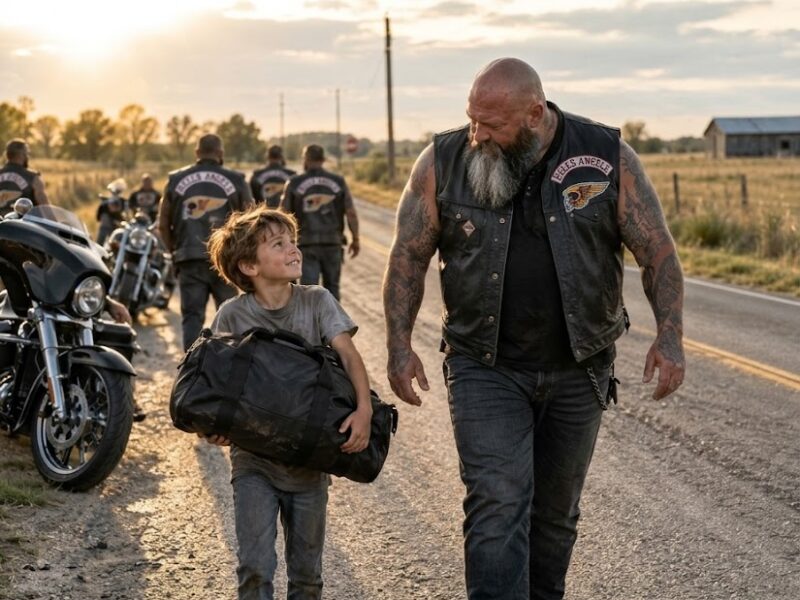
A boy carried an injured motorcyclist’s bag for a kilometer. Then 400 motorcyclists showed up to thank him.
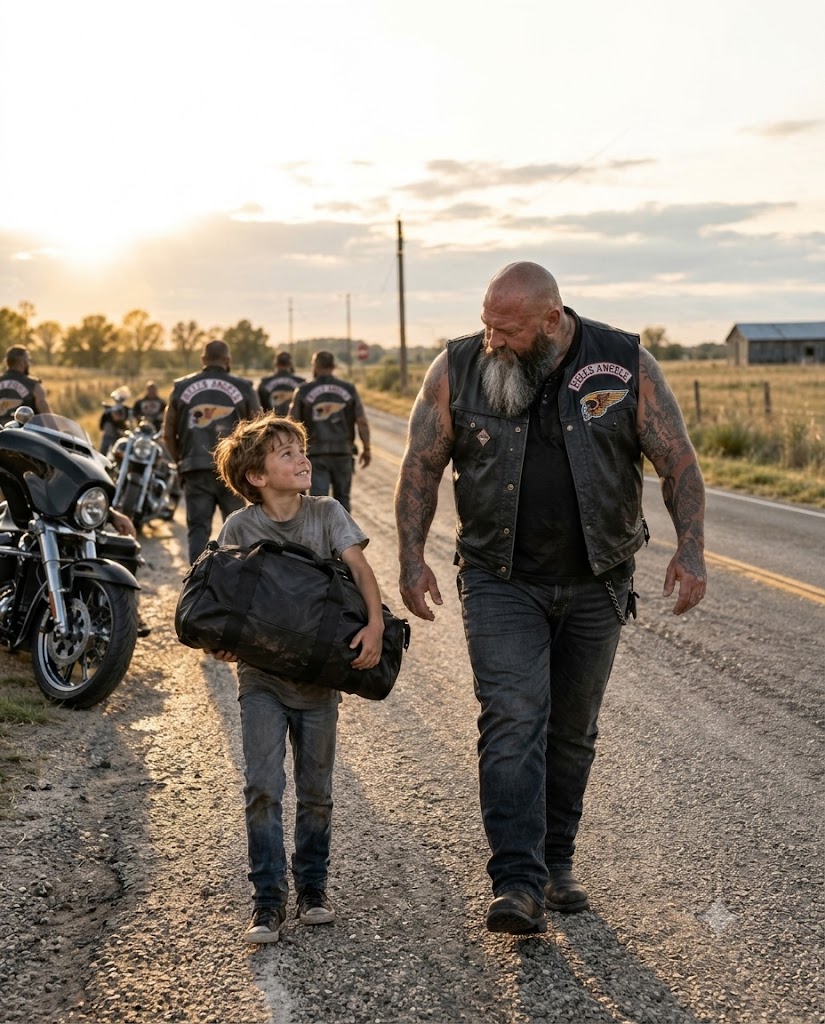
The sun over Springfield, Missouri, had a way of making the cracked asphalt on Farm Road 182 shimmer like water by nine in the morning, and ten-year-old Ryan Holloway was already sweating through his T-shirt.
He walked the same mile-and-a-half stretch every day that summer, from the trailer he shared with his mother to his grandmother’s porch, his too-big sneakers slapping a rhythm against the road, a paperback about sharks in his mostly empty backpack.
His mother, Elizabeth, had picked up extra shifts at the diner off Highway 60, so the walk was his time to think, mostly about his father, who had been gone eight months now, not dead, just quietly and without explanation gone.
The road smelled like cut grass and diesel from the trucks rumbling toward the co-op, and Ryan had learned to cross to the far side whenever he heard the distant thunder of motorcycle engines, just like his grandmother had taught him.
“You stay clear of them,” she’d said more than once, her Bible on the kitchen table and a deep suspicion in her heart. “They’re trouble, every one of them.”
That particular Tuesday in July started like any other, the heat thick and wet, the sky a hard, cloudless blue.
He was maybe half a mile down the road, kicking a rock ahead of him with the toe of his sneaker, when he heard it—not engines, but a groan, low and human and pained.
A motorcycle lay on its side in the gravel shoulder, its front wheel still spinning slowly, and a few feet away a man was lying on his back, one leg twisted at an angle that made Ryan’s stomach turn.
Every warning Ryan had ever heard screamed at him to run, but something in the man’s voice, something desperate and human, stopped him cold. He crept closer, close enough to see the gray beard, the faded tattoos, the leather vest patched with symbols he didn’t recognize.
“Hey,” Ryan said, his voice smaller than he meant it to be. “Are you okay?”
The man’s eyes opened, bloodshot and unfocused for a second before they found the boy and sharpened. “Kid,” he rasped, “you got a phone?”
Ryan shook his head, embarrassed. His mother couldn’t afford one for him yet.
“Figures,” the man muttered, not unkindly, and let his head fall back against the gravel. “Okay. Listen, there’s a gas station maybe a mile back the way you came. Can you run there? Tell them James is hurt on 182, then tell them to call 911.”
Ryan nodded, already turning to go, when the man’s hand shot out—not fast, not threatening, just urgent—and caught the strap of a scuffed leather saddlebag that had come loose from the bike in the fall.
“Take this,” James said. “Please, don’t leave it out here.”
The bag was heavier than it looked, the leather worn soft with years of handling, a brass buckle tarnished from weather and time. “I’ll be right back,” Ryan promised, and then he ran.
The gas station was farther than Ryan remembered, or maybe it only felt that way because he was running, the July heat pressing down on him like a hand. By the time the faded Conoco sign came into view, his lungs burned and his legs had gone rubbery.
He burst through the door so suddenly that the bell above it clattered against the glass, and the woman behind the counter, a heavy-set woman named Donna Prescott who’d worked that register for eleven years, looked up sharply.
“There’s a man hurt,” Ryan gasped, doubling over. “On Farm Road 182. His name is James. His motorcycle is wrecked, his leg is bad.”
Donna didn’t waste time asking questions. She grabbed the phone and dialed 911 while pressing a bottle of water into Ryan’s hands. “You did good, sweetheart,” she said, already relaying the location to the dispatcher. “You did real good.”
Ryan sat on the curb, the saddlebag clutched against his chest, and when Donna came to sit beside him, she studied the bag in his lap. “That’s a road bag,” she said. “Bikers carry those. He asked you to grab it?”
“He said not to leave it,” Ryan said. “He seemed real worried about it.”
Donna’s expression softened. “Ambulance is coming. You want to walk back with me, make sure he’s not alone till they get there?”
Ryan thought about his grandmother’s warnings, then he thought about the man’s hand shooting out to grab a bag instead of his own injured leg, and he nodded.
They walked back together, and when they reached James, he was conscious but pale, his breathing shallow and controlled in the deliberate way of someone trying not to panic.
“You came back,” James said when he saw Ryan, and something in his voice broke a little, like he hadn’t quite believed it would happen.
“Told you I would,” Ryan said, kneeling beside him and setting the bag down within reach, though not letting go of the strap entirely.
James extended a trembling hand. “James Kowalski.”
“Ryan Holloway.”
“You know what’s in that bag?” James asked, and when Ryan shook his head, the man let out a breath that was half laugh, half wince. “My whole life, more or less. Twenty-two years riding with the same club. Every patch I ever earned. The photos of my boy, he’s grown now, lives in Denver, doesn’t call much, but I keep his picture anyway.”
He fumbled at the buckle until Ryan reached over and helped him work it loose. Inside, wrapped in a faded bandana, was a small brass medallion, worn nearly smooth, engraved with a set of wings and the words BROTHERHOOD FOREVER.
“That belonged to a man named Frank Delgado,” James said. “Best friend I ever had. Rode with him fifteen years before cancer took him. That medallion’s the only thing of his I’ve got left.”
Ryan looked at the small brass object in his palm and understood for the first time the true weight of what he’d carried—not just leather and metal, but grief and memory.
“You didn’t have to come back for me,” James said quietly. “Lot of folks wouldn’t have. Lot of folks look at a man like me and cross the street.”
“My grandma says bikers are trouble,” Ryan admitted, because it felt wrong to lie to a man who’d just handed him his grief without flinching.
James let out a short, pained laugh. “Your grandma’s not entirely wrong, kid. Some of us are trouble. But most of us just found a family on two wheels because the one we were born into didn’t work out so good.”
In the distance, sirens began to wail, and beneath them Ryan heard something else—a low, distant rumble like far-off thunder on a clear day that made the hair on his arms stand up.
The ambulance arrived before the source of the rumble became clear, and as the paramedics lifted the gurney, James called out to Ryan, his voice tight with pain but firm. “Hang on to it. Please, just hang on to it till someone comes for it. Don’t let it go to lost and found.”
“I promise,” Ryan said, and meant it with the kind of solemnity only a child can bring to a promise unclouded by the compromises adults learn to make.
As the ambulance pulled away, the rumble grew louder, resolving itself into the unmistakable sound of motorcycle engines—not one or two, but many, a chorus of them vibrating through the ground before the bikes themselves came into view.
“That’ll be his club,” Donna said, her hand finding Ryan’s shoulder. “Word travels fast on the road. Bikers got their own network, faster than the news sometimes.”
The first riders came around the bend within minutes, three men on heavy cruisers, leather vests marked with patches, expressions grim beneath their helmets. One of them, a broad man with a shaved head and a gray goatee, swung off his bike and approached with quick, urgent steps.
“Where is he?” the man asked. “James, where’d they take him?”
“Cox Medical,” Donna said. “Ambulance just left. Leg’s broken, but he’s stable.”
The man exhaled, some of the tension leaving his shoulders, and it was only then that he seemed to notice Ryan standing quietly beside Donna with the saddlebag clutched against his chest.
“You the one who found him?”
Ryan nodded, suddenly nervous under the man’s scrutiny. “This is Ryan,” Donna said. “He ran a mile to the station to call it in, then walked back to sit with James till the ambulance came.”
The man’s expression shifted—surprise, then something gentler. “That’s James’s bag. He asked me to hold on to it. Told me not to let it go to lost and found. I promised.”
The biker extended a roughened, scarred hand and shook Ryan’s small one with a gravity that made the gesture feel bigger than it was. “Name’s Marcus Webb. I run with James, been riding together going on fifteen years.”
He looked at the bag again, something unreadable crossing his face. “You know what’s in there?”
“Some of it,” Ryan said. “He showed me the medallion. Frank’s medallion.”
Something shifted visibly in Marcus’s expression—surprise, and beneath it a kind of quiet respect that Ryan didn’t fully understand yet.
More bikes were arriving now, pulling onto the shoulder in twos and threes, engines idling down to silence as riders swung off and gathered around, murmuring questions, piecing together what had happened.
Ryan felt small among them, dozens of leather-clad figures, tattooed and weathered, some of them exactly the kind of men his grandmother had warned him about. But nobody looked at him the way he’d expected.
Instead, words seemed to spread through the gathering crowd like a current, each rider turning to look at him with something between curiosity and gratitude, murmuring to one another and nodding in his direction.
An older woman dismounted from a bike near the back of the group, silver-haired and weathered, with kind eyes and a leather vest as worn as any of the men’s. She approached Ryan directly, crouching slightly to meet his eye level.
“You’re the boy who stayed with him,” she said. It wasn’t a question.
“Yes, ma’am.”
“Most people wouldn’t have,” she said. “Most people see us coming and they cross the street. You know that?”
Ryan thought of his grandmother again, of the countless times he’d done exactly that. “I know. I almost did, too. Until I heard him. He sounded scared, like a regular person.”
The woman’s eyes glistened, and she reached out to squeeze Ryan’s shoulder. “We are regular people, sweetheart. We just happen to ride.”
She straightened up and turned to Marcus. “We need to get his bike secured, and somebody needs to call Denise. Let her know before she hears it secondhand.”
Marcus nodded, already pulling out his phone, and Ryan watched the machinery of this community move into action around him—practical, coordinated, urgent in the way families are urgent when one of their own is hurt.
He didn’t fully understand yet what he’d stumbled into. He only knew that the fear he’d carried down Farm Road 182 for years, every time he heard the distant thunder of engines, had quietly and completely disappeared.
Three days passed before Ryan saw James again. His mother, Elizabeth, had been horrified and then tearfully proud when she heard the story—horrified that her son had approached a stranger on the roadside, proud that he’d stayed to help.
“I should have taught you different,” she told him that night, sitting on the edge of his bed. “Your grandma raised me on those same stories, and I never questioned them. But you did something braver than most grown men would have done.”
Ryan didn’t feel brave. He felt mostly like he’d made a promise and kept it, which seemed like the least a person could do. But he carried James’s saddlebag with him everywhere those three days, unwilling to let it out of his sight.
On the fourth day, Marcus Webb showed up at the Holloway trailer in his truck, having tracked down the address through Donna at the gas station. He stood on the small porch, hat in hand, looking uncharacteristically nervous for a man who’d seemed so solid on the roadside.
“James is asking for the boy,” he told Elizabeth. “Doctor says he can have visitors now. Wanted to know if you’d bring him by the hospital. James also”—Marcus hesitated, choosing his words carefully—“he wants Ryan there for something else, something the club’s putting together, if that’s all right with you.”
Elizabeth glanced at Ryan, who was already reaching for his shoes, the saddlebag slung over his shoulder where it had lived for days now.
At Cox Medical Center, James was propped up in bed, his leg elevated and encased in a heavy cast, color returned to his face, though he still looked tired in the particular way of someone healing.
When Ryan walked in, his whole face changed, lit up in a way that made Ryan’s chest tighten with something he didn’t have a word for yet.
“There he is,” James said. “My hero.”
“I’m not a hero,” Ryan said, embarrassed, setting the saddlebag carefully on the bed beside him. “I just did what you asked.”
James studied him for a long moment, the kind of look adults gave when they were deciding how much truth a kid could handle. “Let me tell you something, Ryan. Twenty-two years I’ve been riding. Seen men do incredible things and seen men look the other way when it mattered most. You’re ten years old and you didn’t look away. That’s not nothing.”
He reached for the saddlebag, opening it with hands that were steadier now, and withdrew the brass medallion Ryan had glimpsed days before.
“This belonged to Frank Delgado,” he said again, turning it over in his fingers. “Best man I ever knew. When he was dying, he made me promise the club would never let a debt go unpaid. That if somebody outside the family did something that mattered, we’d make sure they knew what it meant to us.”
He pressed the medallion into Ryan’s palm, closing the boy’s small fingers around it with his own weathered hand. “I can’t take this,” Ryan said, though something in his chest ached at the thought of giving it back.
“Frank would have wanted it to go to somebody who understood what it means to stay when it would be easier to walk away,” James said. “Besides, I’m not giving it away forever. I’m asking you to hold onto it, same way you held onto that bag. Because Saturday, some folks are going to want to say thank you properly.”
Ryan looked down at the medallion in his palm, the worn brass wings catching the fluorescent hospital light, and for the first time since his father left, he felt something settle in his chest that wasn’t quite grief and wasn’t quite fear.
“What’s happening Saturday?” he asked.
James’s smile was tired but genuine. “You’ll see, kid. Just be at the gas station by ten and bring your mama. She’s going to want to see this.”
Saturday morning arrived hot and bright, the sky over Springfield a hard, cloudless blue. Ryan stood at the Conoco station with his mother and grandmother, the latter having come along reluctantly, still uncertain what exactly they’d been summoned for.
At first, they heard nothing but the ordinary sounds of the highway—a passing truck, birds in the fields, the low hum of the gas station’s ice machine.
Then, faint at first, came the sound Ryan had come to recognize instantly. Engines—dozens of them, then hundreds, a rolling thunder that built steadily until it seemed to fill the whole sky.
They came around the bend in formation, row after row of motorcycles, chrome flashing in the sunlight, engines roaring in a chorus that Ryan felt in his chest more than heard with his ears.
His grandmother’s hand tightened involuntarily on his shoulder, old instinct rising, but Ryan didn’t flinch. He stood his ground, watching as the procession slowed and began filling the gas station lot and the road beyond it, bike after bike after bike.
Marcus Webb led the formation, and behind him Ryan spotted faces he recognized from the roadside days before, and hundreds more he didn’t. Riders who’d come from clubs across the state, some from as far as Kansas and Arkansas, because word had traveled through the biker community the way it always did—fast and thorough.
Four hundred riders by the count someone eventually settled on, though Ryan never did get an exact number, and it never seemed to matter.
James was there, too, arriving separately in Marcus’s truck, his casted leg propped awkwardly, but insisting on being present rather than watching from a hospital bed. When the truck door opened and Marcus helped him hobble out on crutches, the assembled riders fell into an unexpected silence, hundreds of engines cutting off in near unison, until the only sound was the Missouri wind moving through the soybean fields.
James made his way, slowly and with visible effort, to where Ryan stood beside his mother, and the crowd parted to let him through, forming a wide half circle around them both.
“Most of you know the story by now,” James said, his voice carrying in the quiet, roughened by pain and emotion in equal measure. “But I wanted you all to meet him properly. This is Ryan Holloway, ten years old. Found me on the side of the road with a busted leg, and every reason in the world to keep walking. Didn’t know me from Adam, didn’t know what we were, what we stood for, probably grew up hearing the same things most folks hear about people who look like us.”
He paused, glancing at Ryan’s grandmother, who had the grace to look faintly embarrassed.
“He stayed anyway, ran a mile for help, and then ran back because he’d made a promise and he wasn’t going to break it.”
A murmur moved through the crowd—approval, warmth, something Ryan could feel more than name.
“Frank Delgado used to say the truest measure of a man wasn’t what he did when people were watching. It was what he did when nobody would have blamed him for walking away.” James’s voice caught, just slightly. “This boy’s ten years old and he already understands that better than most grown men I’ve known. So today, on behalf of every rider standing here and every club represented in this lot, I want to say thank you. Not just from me, but from all of us, because when you helped me, you helped every single person who calls this brotherhood family.”
The crowd began to applaud, then cheer, four hundred voices rising together in the summer heat, and Ryan felt his throat tighten with an emotion too large for his small frame to easily hold. His mother’s hand found his other shoulder, and even his grandmother, he noticed, had tears standing unshed in her eyes, her old certainties crumbling visibly in the face of what stood before her.
Marcus stepped forward then, carrying a small leather vest, clearly new, stitched with a patch that read HONORARY MEMBER beneath a set of wings that echoed the medallion Ryan wore beneath his shirt.
“This doesn’t make you a rider,” Marcus said, helping Ryan into it, the leather stiff and unfamiliar against his shoulders. “You’ve got some years before you’re old enough for that conversation, and your mama gets final say regardless. But it makes you family—officially, permanently family. Any one of these four hundred people, you ever need anything, anything at all, you call and we come. That’s not a metaphor, kid. That’s a promise, same as the one you kept for James.”
Ryan looked out at the sea of riders—weathered faces and worn leather, people his grandmother had taught him to fear and cross the street from—and understood with a clarity that would stay with him long after that summer faded into memory that the family you found wasn’t always the one you were born into, and that sometimes the truest brotherhoods were built not from blood, but from the choice to stay when it would have been easier to walk away.
James put a steadying hand on his shoulder, and together they stood at the center of four hundred riders who had come, engines roaring from across three states, to say a single word to a ten-year-old boy who’d carried a stranger’s bag for a mile.
Thank you.
The engines started again, one by one, building back into their rolling thunder, and this time Ryan didn’t flinch at the sound. He felt it instead the way he imagined James must have felt it every day for twenty-two years—not as a warning, but as a welcome.
—
The weeks that followed the gathering at the Conoco station passed in a blur of small-town attention that Ryan neither sought nor understood. A reporter from the Springfield News-Leader came out to the trailer and took a photograph of Ryan wearing the honorary vest, the brass medallion visible at his throat, and the story ran on a Sunday, picked up by a wire service and reprinted in papers as far away as Chicago and Denver. Elizabeth Holloway taped the clipping to the refrigerator door, and Ryan’s grandmother, who had spent a lifetime believing the worst of anyone in leather, framed a copy and hung it in her kitchen beside the Bible, a quiet admission she never put into words.
The trailer park where the Holloways lived had never seen so much traffic. Neighbors who had never spoken two words to Elizabeth suddenly wanted to know all about “the little boy who saved the biker,” and Ryan found himself the subject of a kind of attention that made him want to hide in his room with his paperback about sharks and wait for it to blow over. It did not blow over, not entirely, but it changed shape, settling into something quieter and more durable than celebrity.
The first package arrived eight days after the gathering, a padded envelope with no return address, postmarked from Joplin. Inside was a note scrawled on lined paper in a hand that shook with age, from a woman who signed herself only as Margaret, who wrote that she had lost her own son to a motorcycle accident on Highway 60 in 2009 and had spent every year since cursing the sight of bikes on the road. She had read about Ryan in the paper, she wrote, and she had wept for the first time in years, not from grief but from something that felt almost like relief. “I don’t know if I’ll ever stop being angry at the road,” she wrote. “But I think I can stop being angry at the people on it. Thank you for that.”
Elizabeth read the letter aloud at the kitchen table, her voice steady until the last line, when it broke. Ryan didn’t fully understand what the letter meant, only that it mattered, and he asked his mother if he could keep it. She gave him a shoebox from the top of her closet, and into that box went the letter from Margaret, and the newspaper clipping, and the photograph of Ryan and James and Marcus that the reporter had taken. The box became, without anyone deciding it would, a record of a summer that had changed the shape of Ryan Holloway’s life in ways he was too young to name.
The second thing that happened was Marcus Webb showing up at the trailer on a Thursday evening in late July with a duffel bag and a proposition. Elizabeth was working the late shift, so Ryan’s grandmother was sitting on the porch in her rocking chair, her suspicion of the man in the leather vest now worn down to something closer to resignation. Marcus sat on the steps, hat in hand, and explained that the club wanted to do something for the Holloways, something practical, something that wouldn’t feel like charity.
“The boy walked a mile in the heat to help a stranger,” Marcus said. “His mama works doubles to keep the lights on. That’s not right, not when we’ve got forty guys who’d give their left arm to say thank you and mean it.”
What the club had in mind, Marcus explained, was a fund. Not a handout, he was careful to say, but something the members had voted on at their monthly meeting, a pot of money collected from riders across three states who had heard the story and wanted in. The number, when he finally said it out loud, was seven thousand dollars. Enough to cover the trailer’s back rent, enough to fix the transmission on Elizabeth’s aging sedan, enough to set aside for whatever came next.
Ryan’s grandmother sat very still in her rocking chair and looked at Marcus Webb for a long moment, and then she did something Ryan had never seen her do. She cried. Not the quiet, dignified tears of a woman who kept her emotions on a short leash, but the open, unashamed weeping of someone whose oldest certainties had cracked down the middle and let in a light she had spent years refusing to see.
“I raised my daughter to cross the street when she heard engines,” she said, wiping her eyes with the back of her hand. “And I raised her boy the same way. I was wrong. I was wrong for thirty years, and I am sorry.”
Marcus didn’t say anything for a while. Then he said, “Ma’am, I’ve been riding since I was seventeen years old, and I’ve been judged for it every day since. I don’t hold it against you. Most folks never get the chance to find out they were wrong about something. You got that chance. That’s more than most.”
Elizabeth came home that night to find her mother and Marcus Webb sitting on the porch like old friends, and when Ryan told her about the fund, she sat down hard on the kitchen chair and put her face in her hands. When she looked up, she was crying too, and Ryan, who had seen his mother cry only twice in his life, both times when his father left, felt something loosen in his chest that had been tight for eight months.
The money was a beginning, not an end. The back rent got paid, and the transmission got fixed, and Elizabeth stopped working doubles for the first time since Ryan’s father had gone, which meant she was home in the evenings, which meant there was dinner at the table and a voice in the kitchen and the sound of his mother laughing at something on the television, a laugh Ryan hadn’t heard in so long he had forgotten what it sounded like.
But the thing that mattered most, the thing that would stay with Ryan long after the seven thousand dollars had been spent and forgotten, arrived on a Saturday in early August, when Marcus Webb pulled up to the trailer in his truck and told Ryan to get in.
“Where are we going?” Ryan asked, sliding onto the bench seat beside Marcus, the honorary vest over his T-shirt despite the heat.
“James is getting out of the hospital today,” Marcus said. “Club’s throwing him a welcome-home party at the chapter house. He asked for you special.”
The chapter house turned out to be a low, sprawling building on the edge of town, its walls covered in photographs and patches and hand-painted signs, its parking lot already filling with motorcycles by the time Marcus and Ryan arrived. Inside, the place smelled like coffee and engine oil and something cooking in a back room, and there were men and women everywhere, most of them in leather, most of them turning to look when Ryan walked in.
James was there, propped in a corner with his casted leg on a stool, and when he saw Ryan his face did the thing it had done in the hospital, that thing that made Ryan’s chest tighten with an emotion he still didn’t have a word for.
“There’s my boy,” James said, and the words landed in Ryan’s chest like a stone dropped into still water, sending ripples out in every direction.
Ryan crossed the room and sat down beside him, and for a while neither of them said anything, just watched the party move around them—Marcus arguing with a woman about something on the grill, a man with a gray ponytail showing a group of teenagers how to clean a carburetor, a little girl about Ryan’s age running between the tables with a slice of cake in each hand.
“You know what the hardest part of the last month was?” James said finally, his voice low enough that only Ryan could hear. “It wasn’t the leg. Legs heal. It was lying in that hospital bed thinking about how close I came to never meeting you. If my bike had gone down half a mile later, or if you’d crossed the road like your grandma taught you, or if you’d run for help and not come back—any one of those things and we’d never have met. You understand what I’m telling you?”
Ryan nodded, though he wasn’t sure he did.
“What I’m telling you,” James said, “is that the whole thing was a coin flip. Every important thing in life is a coin flip. The only thing you control is what you do when the coin’s in the air. You chose to stay. That’s the whole story. Everything else—the four hundred bikes, the seven thousand dollars, the vest, the medallion—all of that is just what happens when a ten-year-old boy makes the right choice on a coin flip.”
He reached over and tapped the medallion where it hung at Ryan’s throat. “Frank Delgado would have liked you. He’d have liked you a lot. He was a man who never met a stranger he wouldn’t help, and he died believing the world was mostly good, mostly kind, mostly worth the trouble. I stopped believing that somewhere along the way. I’m starting to believe it again. That’s on you.”
Ryan sat with that for a moment, the weight of it settling into him the way the medallion had settled against his chest. Then he said the thing he had been thinking for weeks but hadn’t known how to say.
“My dad left,” he said. “Eight months ago. He just—left. And I used to think maybe it was because of me, maybe I did something, maybe if I’d been better he would have stayed. But then I found you on the road, and you asked me to hold onto your bag, and you trusted me, and I thought—maybe I’m not the reason people leave. Maybe people leave for their own reasons and it doesn’t have anything to do with me.”
James didn’t say anything for a long moment. Then he put his hand on Ryan’s shoulder, the same steadying hand he had put there at the gas station, and he said, “Your dad leaving had nothing to do with you. Nothing. You hear me? You were ten years old and you were worth staying for, and if he couldn’t see that, that’s his loss, not yours. You understand?”
Ryan nodded, and this time he did understand, at least a little.
The party went on around them, the noise and the laughter and the smell of cooking food and the rumble of engines in the parking lot, and Ryan sat in the middle of it with James’s hand on his shoulder and the medallion at his throat and the honorary vest on his back, and for the first time in eight months he felt like he was exactly where he was supposed to be.
The summer faded into fall, and the attention died down, and Ryan went back to school with a new vest in his closet and a new understanding of the world that he couldn’t have explained to anyone if he’d tried. His mother kept the day job at the diner and picked up a second one at a hardware store on weekends, but the doubles were over, and there was food in the refrigerator and a light on in the kitchen when Ryan got home from school, and the silence at the dinner table had been replaced by something that sounded almost like conversation.
The trailer park was the same, and Farm Road 182 was the same, and the soybean fields still shimmered gold-green under the Missouri sun, and Ryan still walked the mile and a half to his grandmother’s porch every afternoon, his too-big sneakers slapping a rhythm against the road.
But something had changed, and the change was this. When he heard the distant thunder of motorcycle engines on Highway 60, he didn’t cross to the far side of the road. He stood his ground and lifted a hand, and more often than not the lead rider would lift a hand back, and Ryan would watch the bikes disappear around the bend and feel something that wasn’t fear and wasn’t quite belonging but was somewhere in between.
He wore the medallion every day, and when kids at school asked about it, he told them the truth, or as much of the truth as a ten-year-old could tell. He told them about the man on the road and the bag and the promise, and most of them didn’t believe him, but one or two did, and those one or two started to look at the world a little differently, and that, Ryan thought, was probably the point.
The letter from Margaret went into the shoebox with the clipping and the photograph, and as the years went by the shoebox filled up with other things—a certificate from the school for perfect attendance, a photograph of Ryan and his mother at a Fourth of July picnic, a birthday card signed by forty bikers whose names Ryan could never quite keep straight but whose faces he never forgot.
He kept the shoebox under his bed, and sometimes when the house was quiet and his mother was asleep and the only sound was the wind in the soybean fields, he would take it out and look at the things inside and remember the summer he was ten, the summer he made a choice on a coin flip and the coin landed right, the summer four hundred strangers on motorcycles came to a small Missouri gas station to thank a boy who chose not to look away.
James Kowalski lived another eleven years, long enough to see Ryan graduate from high school and enlist in the Army and come home from his first deployment with a new set of scars and a new understanding of what it meant to stay when it would have been easier to walk away. James died in his sleep on a Tuesday in October, and at his funeral there were four hundred motorcycles parked in a line outside the church, and Ryan Holloway, twenty-one years old and wearing the brass medallion on a leather cord beneath his dress uniform, stood at the front of the crowd and said the words James had said to him on a cracked country road when he was ten years old and didn’t know what any of it meant.
“The truest measure of a man isn’t what he does when people are watching,” Ryan said, his voice steady. “It’s what he does when nobody would have blamed him for walking away.”
And then he said the other thing, the thing he had carried with him for eleven years, the thing that had started on a hot July Tuesday when a boy froze on an empty road staring at a man bleeding out in the gravel.
“Thank you,” Ryan said, to the four hundred riders and the hundred more who had come since, to the family he had found on two wheels, to the man who had trusted him with a bag and a medallion and a promise. “Thank you for teaching me what it means to stay.”
The engines started again, one by one, building back into their rolling thunder, and Ryan Holloway didn’t flinch at the sound. He felt it instead the way he had learned to feel it—not as a warning, but as a welcome, not as the end of something, but as the beginning of everything that came after.









