A Boy Asked the Hells Angels, “Will You Be My Friends?”—50 Bikers Came to School
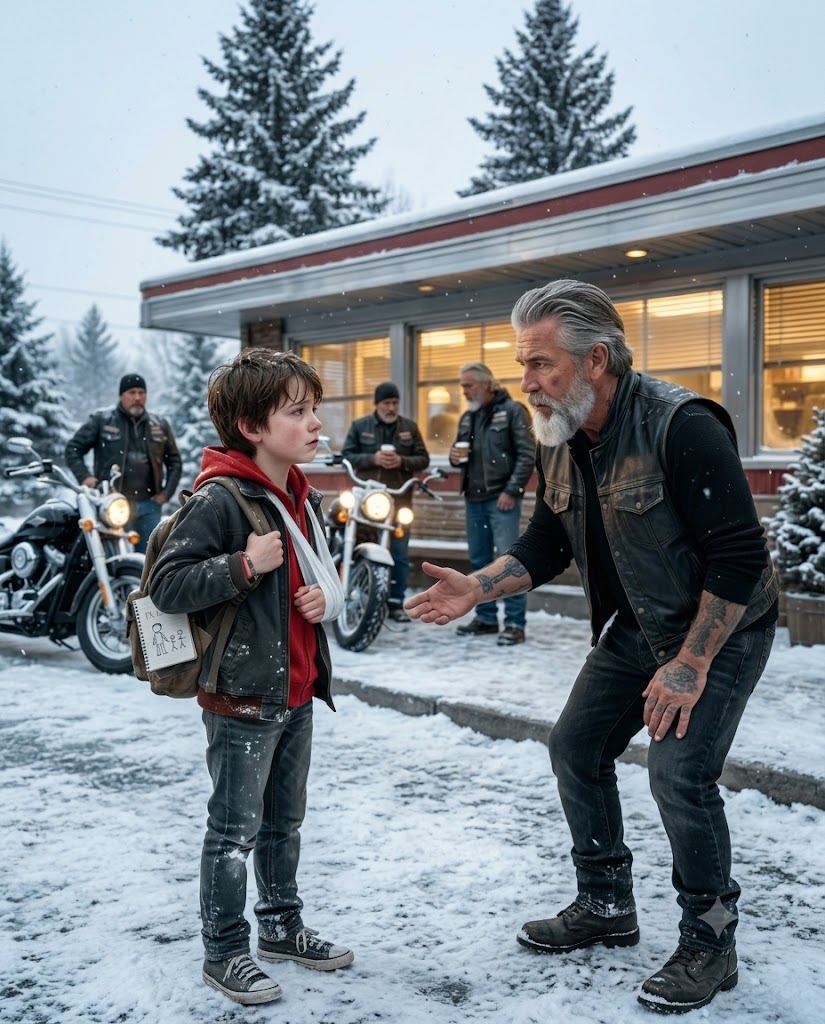
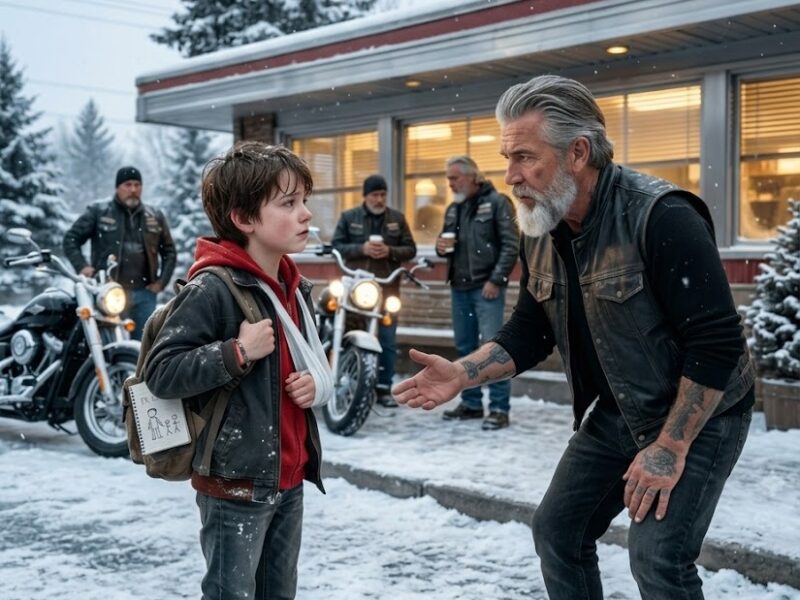
The late afternoon sun cast long shadows across the parking lot of Mel’s Diner, where six Harley-Davidsons sat in a neat row, their chrome gleaming like polished steel under the amber light. Inside, Lester Sanders nursed his third cup of coffee, listening to his brothers argue about the best route through the mountains for their upcoming run. At sixty-two, Lester carried his history in the gray beard that reached his chest and the faded tattoos mapping his arms—a serpent coiled around old scars, names of brothers lost, dates that mattered once.
Then he saw the kid. A small figure was crossing the parking lot with a determined stride that didn’t match his size, maybe ten years old, wearing a faded blue hoodie despite the warm weather. His right arm was wrapped in a cast covered with scribbled signatures that looked more like obligations than genuine friendship. The boy’s sneakers were held together with duct tape.
Lester watched through the window as the kid stopped about fifteen feet from their table, clearly terrified but rooted to the spot. The other bikers noticed too, their conversation dying out.
“You lost, kid?” called out Chad, a mountain of a man whose nickname needed no explanation. The boy flinched but didn’t run. His voice came out barely above a whisper.
“I need to ask you something.”
Lester pushed back his chair and stood, the screech of metal on concrete making the boy jump. He walked over slowly, the way you’d approach a skittish animal. Up close, he could see the kid was trembling. Dark circles ringed his eyes, and his good hand was clenched so tight the knuckles had gone white.
“What’s your name, son?”
“Timmy. Timmy Johnson.”
“All right, Timmy. I’m Lester. What’s on your mind?”
The words came out in a rush, like the boy had rehearsed them a hundred times. “My school has this thing called Friendship Day next week. You’re supposed to bring a friend to school with you for the day. Someone who means something to you.” His voice cracked. “I don’t have anyone. I was wondering if—if maybe you guys could be my friends. Just for one day.”
The silence that followed felt like it lasted an hour. One of the younger members snorted, but Lester shot him a look that could freeze fire. He crouched down to the boy’s eye level, his knees protesting the movement.
“That’s a brave thing to ask, Timmy. But I need you to tell me the truth about something.” He gestured to the cast. “How’d you really break that arm?”
Timmy’s face went pale. His eyes darted to the ground. “I fell off my bike.”
“Try again.”
The boy’s lips started to quiver. Lester could see him fighting back tears with everything he had. “There are these older kids. They mess with me at school, push me around, take my lunch money, call me names. Three weeks ago, they did something to my bike. I don’t know what, but when I was riding home, the front wheel just came off. I went flying over the handlebars.” He touched the cast gently. “The doctor said I was lucky I didn’t break my neck.”
Chad muttered something under his breath that would have made a sailor blush. Another member, a woman named Hawk with a shaved head and piercing green eyes, leaned forward.
“Did you tell anyone? Your parents? Teachers?”
“My mom works two jobs. She’s never home. And the teachers—” He shrugged helplessly. “They say kids will be kids. That I need to toughen up.”
Lester felt something tighten in his chest. He’d been that kid once, a lifetime ago. Different town, different circumstances, same helpless anger. He straightened up and turned to his crew. They were all watching him, waiting. In the club, Lester’s word was law. But this wasn’t a club decision. This was something else entirely.
“You got a piece of paper, Timmy?”
The boy nodded quickly, pulling a crumpled notebook page from his pocket along with a pencil. His hand shook as he wrote down his address in careful, childish letters. He held it out to Lester like an offering.
Lester took it, folded it carefully, and tucked it into his vest pocket. “I can’t make you any promises right now, but I’ll tell you this. What you’re going through, it ends. One way or another, it ends.” He placed a heavy hand on the boy’s good shoulder. “You get yourself home safe. And Timmy, keep your head up. You’re tougher than you think.”
The boy looked up at him with eyes that held too much pain for someone so young, but also something new—a flicker of hope that hadn’t been there before. He nodded once, then turned and walked away, his steps just a little steadier than when he’d arrived.
As Timmy disappeared around the corner, Chad spoke first. “Boss, we can’t just—”
“We can, and we will.” Lester’s voice was quiet but absolute. “Meeting at the clubhouse tonight. Eight sharp. Spread the word to the other chapters. We’ve got planning to do.”
Hawk smiled—the kind of smile that said she’d been waiting for someone to say exactly that. “What are we planning?”
Lester watched the empty corner where the boy had vanished, then pulled out the folded paper and looked at the address written in that careful, hopeful handwriting. “We’re going to show a kid what real friendship looks like.”
—
The clubhouse smelled like motor oil, leather, and decades of history. By 8:15, the room was packed. Word had traveled fast. Members from three neighboring chapters had made the ride, some traveling over a hundred miles. Lester stood at the front, Timmy’s address still folded in his pocket like a sacred contract.
“Most of you know why you’re here,” he began, his voice cutting through the murmur of conversations. “Some of you are wondering if I’ve lost my mind.” A few chuckles rippled through the crowd. “Three hours ago, a ten-year-old kid with a broken arm asked us to be his friends. He wanted us there for one school day because he’s got nobody else.”
He let that sink in before continuing. “His arm wasn’t broken in any accident. Someone sabotaged his bike. He’s being terrorized, and every adult in his life has failed him.”
Greg, a veteran member with a scar running down his cheek, raised his hand. “With all respect, Lester, this ain’t our world. Schools, kids, administration. We go rolling in there, we might make things worse for him.”
“That’s exactly why we do this,” Lester replied. “No colors that’ll scare people. No attitude. We show up. We stand with him. And we leave. Clean and respectful.” He pulled out a notebook. “But first, I need to understand what we’re walking into.”
Hawk stepped forward, her laptop already open. “I did some digging. Lincoln Elementary, east side of town. Friendship Day is this Friday. Parents and community members are invited to attend with students. It’s actually in their official policy. Guests are welcome if they register in advance.”
“Then we register,” Lester said simply. “By the book.”
The planning took two hours—routes drawn on napkins, rules established with handshakes. They’d roll in at dawn. Clean, respectful, nothing that could spook parents or give administrators ammunition to shut them down. Most importantly, they’d ask Timmy’s mother for permission before proceeding with anything.
As the meeting wrapped up, members pledged to participate. What started as six bikers at a diner had grown to fifty volunteers. Some had been bullied as kids. Others had children of their own. All of them understood that this was about something bigger than a school event.
—
The next morning arrived cold and clear. Before sunrise, the motorcycles gathered at a truck stop outside town, their engines rumbling like distant thunder. Lester led the convoy through quiet streets as the sun painted the sky orange and pink.
When they reached the address Timmy had written down, he felt his heart sink a little. The apartment building was barely holding itself together. Broken windows were patched with cardboard. The parking lot was more pothole than pavement. This was the kind of place where people worked themselves to death and still couldn’t get ahead.
Lester knocked softly on unit 2B. The door opened a crack, held by a chain lock, and a woman’s exhausted face peered out. She couldn’t have been older than thirty-five. Life had carved deep lines around eyes that should have still been young.
“Mrs. Johnson, my name is Lester Sanders. I met your son yesterday.”
The door closed. Lester heard the chain slide free. Then it opened fully. Sarah Johnson stood there in a waitress uniform, her name tag crooked, her eyes suspicious and scared.
“What do you want with Timmy?”
Lester removed his sunglasses, making sure she could see his eyes. “Your son asked us for help, ma’am. He told us about Friendship Day at school, about not having anyone to bring. We’d like to be there for him—with your permission.”
She looked past him at the sea of motorcycles and leather-clad riders filling the parking lot. “You’re Hells Angels.”
“Yes, ma’am. I know how this looks, but your boy deserves to walk into that school with his head held high. We’re here because your boy deserves to walk into that school with his head held high just once.”
Sarah’s eyes filled with tears. “He told me he fell off his bike. He made me promise not to call the school. Said it would make things worse.” Her voice broke. “I believed him because I had to—because I’m working sixteen-hour days just to keep us fed, and I can’t afford to lose another job fighting with administrators who don’t care.”
“You’re not alone anymore,” Hawk said, stepping forward. “Not today.”
Sarah turned and called into the apartment. “Timmy, come here, baby.”
The boy appeared in dinosaur pajamas, his cast looking even more battered in the morning light. When he saw the bikers through the doorway, his jaw dropped.
“You came.”
Lester knelt down. “Told you I don’t make promises lightly. You ready to go to school?”
Timmy looked at his mother, who was crying openly now. She pulled him into a fierce hug, then wiped her eyes and nodded. “Go get dressed. Fast.”
Ten minutes later, Timmy emerged wearing his cleanest jeans and a shirt his mother had ironed. Lester walked him to a sidecar attached to his bike, borrowed specifically for this occasion. The boy climbed in, his eyes wide with wonder and terror mixed together.
“Everyone good?” Lester called out.
Fifty voices responded as one. “Good.”
The engines roared to life in perfect synchronization as they pulled out of the parking lot. Sarah Johnson stood in the doorway, hand pressed to her mouth, watching her son ride away, surrounded by an army of unlikely guardians.
The school was three miles away. With every block, Timmy sat up a little straighter. People on the street stopped and stared. Some pulled out phones to record. By the time they reached Lincoln Elementary, the boy who had walked alone for so long was leading a thunder that could be heard across the entire town.
Lester looked down at Timmy as they pulled into the school parking lot. “Ready?”
The boy nodded. And there wasn’t fear in his eyes anymore. There was something else entirely—something that looked like courage.
—
The rumble died as fifty engines cut off in unison. The sudden silence felt louder than the roar that preceded it. Parents clutching coffee cups froze mid-step. Kids with backpacks stopped on the sidewalk, mouths hanging open. A crossing guard’s whistle fell from her lips.
Lester helped Timmy out of the sidecar, and the boy’s legs wobbled slightly as his feet hit the pavement. All around them, bikers dismounted with military precision, forming two lines that created a path from the parking lot to the school entrance. They stood with arms crossed, faces neutral, saying nothing. The message was clear without a single word being spoken.
Vice Principal Brighton was the first administrator to rush outside, his tie flapping as he jogged across the lot. “What’s going on here? You can’t just—”
Lester stepped forward, pulling an envelope from his jacket. “Good morning, sir. We’re here as registered guests for Friendship Day. All the proper forms were submitted electronically last night. You should have received confirmation.”
Brighton snatched the envelope, his hands shaking as he read. Inside was a perfectly formatted letter explaining their presence, contact information for their club’s community outreach coordinator, and a liability waiver. Everything was technically correct.
“This is highly irregular,” Brighton stammered.
“Is it against policy?” Hawk asked, her tone respectful but firm.
Brighton opened his mouth, then closed it. Other staff members had gathered behind him, including Principal Lewis, a stern woman in her fifties who looked like she’d seen everything. She took the letter from Brighton, read it carefully, then looked at Timmy, standing small but determined between these giants.
“Mr. Johnson,” she said slowly. “Are these your guests?”
“Yes, ma’am.” Timmy’s voice was stronger than it had been in months.
Lewis’s eyes swept across the assembled bikers, then back to the letter. She could call the police, create a scene, and probably have every news station in the state descending on her school by noon. Or she could follow her own policy and allow registered guests to participate.
“They stay outside,” she finally said. “School grounds only. No entering the building unless specifically invited for the assembly.”
“Understood and agreed,” Lester replied.
As Lewis and her staff retreated inside to figure out their next move, the parking lot remained frozen in this strange tableau. Then the school bell rang, breaking the spell. Students began moving again, but everything had changed.
Timmy started walking toward the entrance. The bikers didn’t follow. They simply maintained their positions—a wall of silent solidarity. Kids who normally shoved past Timmy now gave him a wide berth. The three boys who had sabotaged his bike—Jake, Marcus, and Devon—stood near the flagpole, their faces drained of color. As Timmy passed them, Jake took a step back and tripped over his own feet. No one laughed. Marcus stared at the ground. Devon looked like he might cry.
Inside the building, the atmosphere crackled with whispered conversations. Timmy walked to his locker. No one knocked his books from his hands. No one called him names. The invisible weight he’d carried for months felt lighter with every step.
In first period, Mrs. Patterson couldn’t focus on the lesson plan. She kept glancing at Timmy, then at the window where the bikers were visible, standing like statues in the morning sun. Finally, she set down her chalk.
“Timmy, would you like to tell us about your friends?”
Every head turned. Timmy felt his face flush, but he thought about Lester kneeling down to his level, about Hawk’s kind smile, about his mother’s tears that morning. He stood up.
“There are people who showed up when nobody else would,” he said simply.
A girl named Maya, who sat in the back and usually never spoke, raised her hand. “That’s really cool, Timmy.”
By lunch, three news vans had parked across the street. Reporters were interviewing parents, filming the bikers, trying to understand the story. Social media was exploding with photos and videos. Some comments praised the bikers’ compassion. Others questioned their motives.
But inside the school, something more important was happening. Kids were talking to Timmy. The bikers hadn’t said a threatening word all day. Kids were talking to Timmy because they suddenly saw him—really saw him—as someone worth knowing, someone brave enough to ask for help and lucky enough to receive it.
During the Friendship Day assembly in the gymnasium, Principal Lewis invited one guest from each student to come forward and say a few words. When it was Timmy’s turn, Lester was escorted inside by Brighton, who looked like he was walking a tiger on a leash.
Lester took the microphone, looked out at hundreds of young faces, and spoke in a voice that carried no threat—only truth.
“I don’t know most of you, and you don’t know me. But I know this: every single person in this room deserves to feel safe, to have friends, to come to school without fear.” He paused, his eyes finding Jake, Marcus, and Devon in the crowd. They squirmed under his gaze. “And when someone’s hurting, it’s on all of us to notice. Teachers who look away. Parents who don’t ask questions. Kids who laugh along. Because ignoring pain doesn’t make it go away. It just makes it grow.”
The gymnasium was dead silent. Some kids were nodding. A few teachers looked uncomfortable. Principal Lewis’s expression was unreadable.
Lester handed the microphone back and placed a hand on Timmy’s shoulder. “This young man had more courage in asking for help than most adults show in a lifetime. I’m proud to call him my friend.”
As they walked out together, applause started—tentative at first, then growing stronger. Not everyone clapped, but enough did that Timmy felt it wash over him like a wave.
Outside, as the final bell rang and students poured out of the building, the bikers prepared to leave. They’d kept their promise. But as Timmy gave Lester a hug that the old biker returned with surprising gentleness, both of them knew this wasn’t over. It was only beginning.
—
The school board meeting was scheduled for Tuesday evening, but by Monday afternoon, the pressure had become unbearable. Videos of Lester’s speech had gone viral, accumulating millions of views. Parents were demanding answers. Local news stations were running features with titles like “When Angels Wear Leather” and “The Bikers Who Changed Everything.” Principal Lewis knew she could no longer sweep this under the rug.
She started by pulling students aside individually—those who’d witnessed Timmy being bullied, those who’d stayed silent, and finally the ones whose guilt was written across their faces. It took less than two hours for the truth to unravel.
A sixth grader named Sophie broke first, tears streaming as she described watching Jake and his friends mess with Timmy’s bike after school. Another student provided photos he’d been too scared to share before. Two days later, Jake’s parents sat in Lewis’s office, their faces ashen as she presented the evidence. Marcus’s father, a lawyer, tried to argue that boys would be boys, but his voice faltered when Lewis showed him the hospital report detailing Timmy’s injuries. Devon’s mother simply cried.
“This isn’t going away,” Lewis said firmly. “The district is implementing a formal investigation. But before lawyers and policies take over, these boys need to face what they’ve done directly.”
The next afternoon, Timmy walked into the gymnasium with his mother on one side and Lester on the other. The school had invited them to a restorative justice meeting—a concept Hawk had suggested when Lewis called, asking for guidance. The three boys sat across from them, flanked by their parents and a mediator.
Jake spoke first, his voice barely audible. “I’m sorry. We thought it was funny. We didn’t think you’d actually get hurt that bad.” He looked up, eyes red. “I was wrong. Really wrong.”
Marcus nodded quickly. “We were jerks. I don’t know why we picked on you. Maybe because nobody stopped us before.”
Devon couldn’t speak at first. His mother put a hand on his back, and he choked out, “I’m sorry, Timmy. I’ll do whatever it takes to make it right.”
Timmy sat quietly, his mother’s hand clasped in his. Part of him wanted to yell at them, to make them feel even a fraction of what he’d felt. But another part—the part that had learned something from Lester’s quiet strength—understood that hurt people often hurt others.
“You broke my arm,” Timmy said finally. “But that’s not the worst part. The worst part was feeling invisible, like I didn’t matter.” He looked at each of them. “I accept your apology. But you need to mean it, and you need to do better.”
The mediator outlined consequences: community service, mandatory counseling, and a joint project to repair Timmy’s bicycle under supervision. The boys agreed immediately. Their parents looked relieved, grateful this wasn’t ending in lawsuits or criminal charges. Though everyone understood those options remained on the table.
As they filed out, Jake approached Timmy one more time. “That speech your friend gave—the biker guy. It really messed me up. In a good way, I think. He was right. I should have noticed when people were hurting.” He extended his hand. “I’ll do better.”
Timmy shook it. The gesture felt strange but necessary.
—
The weeks that followed brought changes that spread like ripples. Teachers who’d once looked the other way now attended training sessions on recognizing warning signs. Protocols were written, policies revised. Lester and Hawk began visiting monthly to speak about their community outreach programs, sharing their own stories of redemption and second chances.
Maya, the girl who’d called Timmy cool, started sitting with him at lunch. Others joined them—kids who’d felt alone in their own ways. The table that had always been empty now buzzed with conversation and laughter.
The bikers kept their promise, too. Every Saturday, Lester showed up at Timmy’s apartment with breakfast, and they’d work on the bike together in the parking lot. Other club members started mentoring at-risk youth across the region, partnering with schools and community centers. What began as one act of kindness rippled outward, touching lives none of them had expected.
Half a year later, the town organized a community appreciation day. The event filled the park with families, food trucks, and live music. Timmy stood on a small stage—no longer the broken boy in a cast, but a confident kid with genuine friends and a support system that extended far beyond leather jackets.
Mayor Phillips handed him the microphone. “I think everyone here wants to hear from the young man who started all this.”
Timmy looked out at the crowd—his mom beaming in the front row, Maya and his friends cheering, teachers nodding with pride. Then his eyes found Lester standing off to the side with his arms crossed, that same steady presence that had changed everything.
“I used to think being brave meant not being scared,” Timmy said. “But Lester taught me that being brave means asking for help when you need it. It means standing up even when you’re shaking inside.” He paused, his voice growing stronger. “A lot of kids are still invisible, still scared, still waiting for someone to notice. Don’t ignore them. Don’t wait for bikers to show up before you care. Be the person who shows up first.”
The crowd erupted in applause, but Lester and his brothers were already heading toward their bikes. They never stayed for recognition. That wasn’t why they did this. But as they mounted up, Lester caught Timmy’s eye and gave him a single nod—the kind that said, “You’ve got this now, kid.”
The engines roared to life, and fifty motorcycles rolled out of the park in formation, disappearing down the highway toward whatever came next. But in that small town, in that school, and in the heart of one boy who’d found his courage, their presence would echo for years to come.
Timmy watched them go, his hand raised in a wave that held everything he couldn’t put into words. His mom wrapped an arm around his shoulders, and Maya appeared at his other side, grinning.
“That,” she said, “was the coolest story ever.”
Timmy smiled—because she was right, and because it was his story, written not by staying silent, but by finding his voice when it mattered most.
The crumpled notebook page with his address, once a desperate offering to strangers, now sat framed on his bedroom wall—a reminder that sometimes the bravest thing you can do is ask, and sometimes the most unexpected people are the ones who answer.









