
A boss doused a Black worker in champagne and accused her of stealing diamonds—then froze when she touched her necklace: a $40 million pendant.
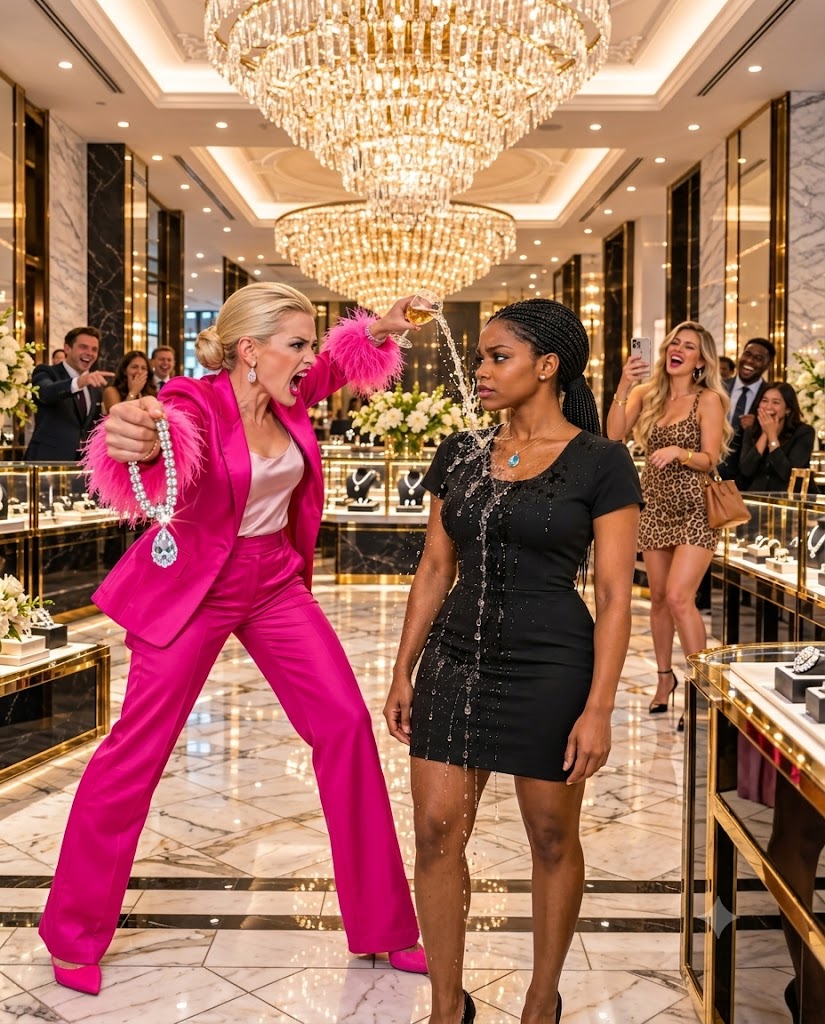
The champagne came without warning—a cold, stinging wave that soaked through Imani’s blouse and dripped from her chin onto the marble floor of Maison LaVey. Marguerite LaVey stood behind the counter, her hand still wrapped around the empty crystal flute, her smile as sharp as the diamonds glittering in the display cases around them. “I should tell you to sit down,” Marguerite said, her voice silk wrapped around steel. “Yeah,” Imani whispered, her grandmother’s pendant burning against her chest like a brand. “Imani, take that little trinket off. It cheapens my counter.”
The store smelled of jasmine and old money, the kind of place where a single sale could cover a year’s rent but one mistake could bury you forever. Imani’s grandmother had warned her about places like this—places where people looked at you and saw only what they wanted to take. “It was my grandmother’s, Ms. LaVey,” she said, her voice steady even as champagne pooled in the hollow of her collarbone. Marguerite laughed, a sound like breaking glass. “Grant, bring out the teardrop. Our buyer arrives at eight.”
Grant appeared from the back room, a thin man with nervous hands and eyes that never quite met anyone’s gaze. He carried a black velvet tray, the kind that held things worth more than most people’s houses. The teardrop necklace sparkled under the gallery lights—two million dollars of flawless white diamond suspended on a platinum chain so delicate it seemed to float. Marguerite’s daughter Sienna watched from the corner, her phone clutched in her manicured fingers, already recording. “Bye, Mom. Big night,” she said, and slipped out the door.
The vault door stood open behind the counter, its steel face reflecting the chandelier like a dark mirror. Grant returned from the vault, his face pale. “Marguerite, the teardrop is gone.” The words landed like a stone in still water. “Gone? That necklace is worth two million dollars. Who closed the vault last night?” Marguerite’s eyes swung toward Imani like a hawk spotting prey. “Imani did. She had the last key.”
“I locked it at nine,” Imani said, her heart hammering against her ribs. “The teardrop was in its case. I checked it twice.” Marguerite stepped closer, her heels clicking against the marble like a countdown. “Women like you always check twice. That is how you know where everything is.” She turned to Grant, her voice dropping to a razor’s edge. “Grant. Her bag. Now.”
The purse was small, a thrifted leather thing Imani had bought at a consignment shop on Ventura Boulevard. Grant dumped it onto the counter with trembling hands—a lipstick, a bus pass, a worn wallet, and a thick book. Marguerite picked up the book, her eyebrows rising. “A gemology guide? Planning your next job, Imani?” The music from the store’s hidden speakers seemed to swell, some classical piece that felt like a funeral march.
“I study at night,” Imani said, her voice cracking despite herself. “I am going to be a gemologist.” Marguerite laughed again, that awful breaking-glass sound. “Then you should know glass when you see it. Take it off.” She pointed at the pendant around Imani’s neck—the blue stone that had belonged to her grandmother, that had been cut by her great-grandfather Samuel’s own hands. “Collateral until my necklace comes back.”
“No, ma’am,” Imani said, her hand closing around the pendant. “This one stays with me.” Marguerite’s eyes narrowed. “As your accuracy is still in question, I have to search your purse. I hope you understand.” She didn’t wait for an answer. “Everyone, this is what happens when you hire out of charity. Come out here, Imani. You love diamonds so much. Let us see if your hands stay clean.”
The store had filled with clients—women in designer dresses, men in tailored suits, all of them watching with the hungry eyes of people who had never known what it meant to be accused. Marguerite emptied a velvet pouch onto the floor, dozens of loose diamonds scattering across the white marble like fallen stars. “Pick up every single stone. On your knees. If one goes missing, we will know who took it.”
Imani’s knees hit the floor with a crack that echoed through the silent store. She could feel their eyes on her—the clients, the security guard, Grant’s nervous flutter, Marguerite’s cold satisfaction. Her fingers trembled as she reached for the first diamond, a small brilliant-cut stone that winked up at her like it was laughing. “She did not take anything,” a voice said from the back. Talia, the store’s other employee, stepped forward. “I was here when she locked up.”
Marguerite turned on her like a snake. “Then you can leave with her. You are fired, Talia. Grant, show them the service door. My front door is for clients.” The service door was metal and gray and led to an alley that smelled of garbage and rain. Imani stumbled through it, her blouse still wet with champagne, her knees aching from the marble floor. Talia followed, her face white with shock.
“You searched my bag, my book, and my grandmother’s necklace,” Imani said, her voice barely a whisper. Marguerite’s voice floated through the closing door like poison. “You looked everywhere, Ms. LaVey. Except in the right place.” The door slammed shut. “THE SERVICE DOOR. NOT THAT ONE,” Marguerite’s voice shrieked from inside, but it was too late.
Outside, the rain had started—a soft California drizzle that felt like the sky was crying for her. Talia pulled off her coat and wrapped it around Imani’s shaking shoulders. “Here. Take my coat. You are shaking.” Imani looked at her, this woman she barely knew, who had just lost her job for telling the truth. “Thalia, you lost your job because of me.” Talia shook her head. “I lost it because she was wrong. I filmed all of it. Every single word. Keep it safe. Please do not post it yet.”
“Why would we wait?” Imani asked, clutching the phone Talia pressed into her hands. “Because someone in that store knows exactly where the teardrop is. Let them get comfortable.” The rain fell harder, washing the champagne from Imani’s skin but not the shame. She walked home through streets that felt foreign now, past coffee shops and laundromats and the tiny apartment where her grandmother waited.
“Oh, look at you, soaked through. What happened at that store?” Nana’s voice was warm as fresh bread, her hands already reaching for a towel. Imani collapsed into the worn armchair, the one that smelled of lavender and old books. “She thinks I took her necklace, Nana.” Nana’s eyes, clouded with age but sharp as ever, fixed on the pendant around Imani’s neck. “And what did she say about yours?” Imani’s voice broke. “She called it glass.”
Nana laughed—a full, rich sound that filled the tiny apartment and pushed back against the rain. “Glass? Your great-grandfather Samuel would have laughed out loud.” She reached out and touched the pendant, her fingers tracing the blue stone with the reverence of memory. “Samuel cut that stone with his own hands. It carried our family through every hard year. Never let anybody tell you what it is worth, sweetheart. You already know.”
The next morning, Maison LaVey opened its doors to the gray Los Angeles light, and Marguerite LaVey discovered that the world had shifted beneath her feet. Grant stood in her office, his face the color of old paper. “Marguerite, you need to see this. This morning, before we opened.” He held out his phone, and there it was—security footage showing Sienna, her leopard dress unmistakable, walking past the counter at 6:47 a.m. with a velvet pouch in her hand.
“Sienna,” Marguerite breathed. “She used your code. Do I tell the insurance company?” Grant asked. Marguerite’s eyes hardened. “You tell them nothing. Ice cold. Delete it.” Grant’s hands trembled. “Then I want to take the blame.” Marguerite laughed, that awful sound again. “Twenty clients watched me accuse her. That story’s already true. The insurance pays two million. And Renata Voss comes to our gala on Saturday.” She straightened her jacket, her reflection in the window a study in composure. “Good. Now there is only one story.”
Sienna appeared in the doorway, her phone in hand. “Mom, I heard. Did they catch her?” Marguerite didn’t turn around. “Sit down, Sienna. And never touch my vault again.” Sienna laughed, a younger, crueler version of her mother’s sound. “Relax, Mom. Somebody else is paying for it. A customer posted it. Four million views. They are calling you a thief.”
Across town, in a coffee shop that smelled of burnt espresso and desperation, Imani sat across from Talia and watched the video play on a stranger’s phone. “Let them watch, Talia,” Imani said, her voice hollow. “She says you were dishonest. She filed an insurance claim with your name on it.” The words hit Imani like another wave of champagne. “My name? On a two-million-dollar claim?”
A shadow fell across the table. Imani looked up into the face of a woman who seemed carved from the same marble as Maison LaVey’s floors—elegant, ageless, with eyes that missed nothing. “Forgive me. I am looking for the woman in the video. The one with the blue stone.” Imani’s hand flew to her pendant. “That is me. My name is Renata Voss. I run the Voss and Hart auction house.”
Renata Voss sat down without being invited, her gaze fixed on the pendant. “May I see it?” Imani hesitated, then lifted the chain over her head. The blue stone caught the coffee shop’s fluorescent lights and seemed to glow from within. “You came all this way for a piece of glass?” Renata’s fingers closed around the pendant with the practiced touch of an expert. “With respect, ma’am. I do not think it is glass. Natural blue diamond. Fancy vivid, eleven carats. This is the Ashby Blue. It vanished from every record sixty years ago.”
The coffee shop seemed to recede, the noise fading to a distant hum. “It never vanished,” Imani whispered. “It was on my grandmother’s neck. Then mine.” Renata turned the stone over in her hands, her expression unreadable. “How much is it worth? At auction?” Imani asked. Renata looked up, her eyes meeting Imani’s with something that might have been respect. “Forty million dollars. Perhaps more.”
“Forty million?” Talia’s voice was barely a breath. “And she made you kneel for her diamonds.” Renata handed the pendant back, her fingers brushing Imani’s. “Your certificate, I assume it is not for sale.” Imani shook her head, the chain warm in her palm. “It is not for sale. It never was.”
Renata leaned back in her chair, her posture shifting from curiosity to calculation. “Marguerite LaVey wants my house to partner with her store. I am the guest of honor at her gala on Saturday.” Imani looked at the pendant in her hands, at the blue stone that had traveled through generations of her family. “Then I would like to be there. Not for revenge. For my name.”
The days between that coffee shop and the gala passed in a blur of legal documents and whispered conversations. The insurance adjuster called Imani three times, each conversation more pointed than the last. “The insurance adjuster will not pay without a signed statement from Imani,” Talia reported, her phone pressed to her ear. “Then we get her signature. She will need the money.”
Marguerite LaVey arrived at Imani’s apartment building on a Thursday afternoon, her Mercedes parked illegally at the curb. She climbed the stairs in her designer heels, her face a mask of controlled fury. “I came for my last paycheck, Ms. LaVey,” Imani said, blocking the doorway. Marguerite pulled an envelope from her purse. “Here is ten thousand. Sign this statement and I will not press charges.”
Imani looked at the envelope, at the woman who had made her kneel on a marble floor. “I will not sign a lie. Not for ten thousand. Not for ten million.” Marguerite’s smile curdled. “Everyone has a price, Imani.” She pulled a small bottle from her purse—champagne, the same brand she had poured on Imani’s head. Before Imani could react, Marguerite uncorked it and flung the contents into her face. “Oops. Now it matches your reputation.”
The champagne dripped from Imani’s chin as Marguerite descended the stairs, her heels clicking a triumphant rhythm. “Ms. LaVey,” Imani called out, her voice steady. “Saturday night, your gala, I will be coming in through the front door.” Marguerite paused at the bottom of the stairs. “You will never set foot through my front door again.”
The gala was held at the Beverly Wilshire, a hotel that gleamed like a jewel box against the Los Angeles night. Marguerite had spared no expense—crystal chandeliers, a string quartet playing something elegant and forgettable, waiters circulating with champagne that cost more per bottle than most people’s monthly rent. Renata Voss arrived at seven, her presence commanding attention even before she spoke. “Renata Voss is bringing a stone to present at my gala,” Marguerite announced to the room. “So, we finally get the partnership.”
Grant pulled Marguerite aside, his face pale. “Margie, we could still tell the insurance company the truth before Saturday.” Marguerite’s smile didn’t waver. “One more word, Grant, and you join Imani on the sidewalk.”
At eight o’clock, the doors opened and Imani walked in. She wore a simple black dress, her grandmother’s pendant around her neck, Talia at her side like a shield. The room fell silent. “If that woman shows up tonight, she does not get past this door,” Marguerite hissed to her security. “She would not dare, Mom,” Sienna said, but her voice lacked conviction.
Marguerite stepped to the podium, her smile wide and false. “Welcome to Maison LaVey. This week, we survived a thief in our own house.” The audience applauded. “And tonight, we welcome the great Renata Voss.” Renata stepped forward, her gaze sweeping the room. “Guards. Ms. Voss. I am so sorry. That woman is a thief,” Marguerite said, pointing at Imani.
Renata’s voice cut through the room like a blade. “That woman is my guest, Ms. LaVey. You wanted to know which stone I would present tonight. It is around her neck.” The room gasped. “That? I held it in my hand. It is glass,” Marguerite said, her voice rising. Renata smiled. “A natural blue diamond. Eleven carats. The Ashby Blue.” The string quartet stopped playing. Someone dropped a champagne flute. “Swarovski,” someone whispered.
“So, she owns a stone,” Marguerite said, recovering. “That does not tell us where my necklace went.” Grant stepped forward, his face pale but determined. “I can tell you exactly where it went. You told me to delete the security footage, Margie. I kept a copy.” He held up his phone, and the video played on the ballroom’s massive screen—Sienna in her leopard dress, the velvet pouch in her hand, the vault door closing behind her.
“Grant, turn that off,” Marguerite shrieked. “That could be anybody.” Renata’s voice was ice. “Same leopard dress, Sienna. You walked right past my counter that morning.” She turned to Marguerite. “Ms. LaVey, you emptied my client’s bag in front of your clients. Maybe empty one more. Open the bag, Sienna.”
Sienna’s face crumpled. “Mom told me to keep quiet. She said Imani would take the blame. And the insurance would pay.” Marguerite grabbed her daughter’s arm. “Sienna, stop talking.” Renata stepped forward, her voice carrying to every corner of the ballroom. “Voss and Hart will never partner with a house that searches the innocent and hides the guilty. Your insurer will be hearing from my lawyers tonight.”
The room erupted. Marguerite stood frozen, her empire crumbling around her. Imani stepped forward, her voice quiet but clear. “Ms. LaVey.” Marguerite turned, her eyes wild. “Imani, please come back. Double pay.” Imani shook her head. “I do not want my job back. Please apologize to Talia. She lost hers for telling the truth.”
Talia stepped forward, her chin lifted. “Talia, I am so sorry. I was wrong.” Talia nodded. “Thank you. I appreciate that.” Renata placed a hand on Imani’s shoulder. “Imani, Voss and Hart needs a gemologist who knows what a thing is worth before anyone tells her. The job is yours.” Imani smiled. “I accept if Talia comes with me.”
The applause started slowly, then built to a roar. Marguerite stood alone at the podium, her carefully constructed world reduced to rubble. “Thirty years gone in one week,” she whispered to no one.
Six months later, Imani sat behind a glass desk at Voss and Hart, the Los Angeles skyline glittering through the window behind her. Talia worked at the desk next to hers, their laughter echoing through the auction house’s halls. “I start Monday at Voss and Hart,” Talia had said when Renata offered her the job. “Imani asked for me.” Renata had smiled. “She asked for you? After everything?”
The bell above the front door chimed. “Imani, your first customer is waiting outside.” Imani looked up from the gemology report she was reviewing. “Then let her in. Through the front door.” The woman who entered was older than Imani remembered, her shoulders bowed under the weight of shame. “I did not think I would be welcome here,” Marguerite LaVey said, her voice barely a whisper.
“Everyone is welcome here, Mrs. LaVey. Please, sit.” Marguerite sat, her hands trembling as she placed a small velvet box on the desk. “It was my mother’s. I have to sell it. I always assumed it was worth nothing.” She looked up, her eyes wet. “Why are you being kind to me?”
Imani opened the box, revealing a small diamond ring that caught the light like a captured star. “My grandmother taught me never to let anyone tell you what something is worth. That goes for people, too.” She looked at Marguerite, at the woman who had poured champagne on her head and made her kneel on a marble floor. “Samuel would be so proud of you, Imani,” Nana had said when Imani told her about the new job.
Imani smiled, thinking of her great-grandfather, of the stone he had cut with his own hands, of the family it had carried through every hard year. “He would say he told us so,” she said. “Some things cannot be priced. Mostly the people who wear them.”
Marguerite laughed—a real laugh this time, not the breaking-glass sound Imani remembered. It was the laugh of someone who had lost everything and discovered, in the losing, what actually mattered. The diamond ring sat on the desk between them, a small thing worth more than money. Outside, the Los Angeles sun was setting, painting the sky in shades of gold and rose.
Imani touched the pendant around her neck—the Ashby Blue, the stone that had traveled through generations, that had been called glass by a woman who knew nothing of its worth. It had been her grandmother’s. Then hers. And someday, it would belong to someone else, someone who would need to be reminded that the truest things are never the ones that can be appraised.
The bell above the door chimed again. A new customer, a young woman with nervous hands and a small velvet box. “I heard you’re the one to see,” she said. Imani smiled. “Come in. Through the front door. Everyone is welcome here.”
And the pendant caught the light, blue and brilliant, a stone that had waited sixty years to be seen for what it was—not glass, never glass, but something that carried the weight of generations, the memory of hands that had cut it, the love of a grandmother who had known its worth all along. Some things cannot be priced. Mostly the people who wear them.









