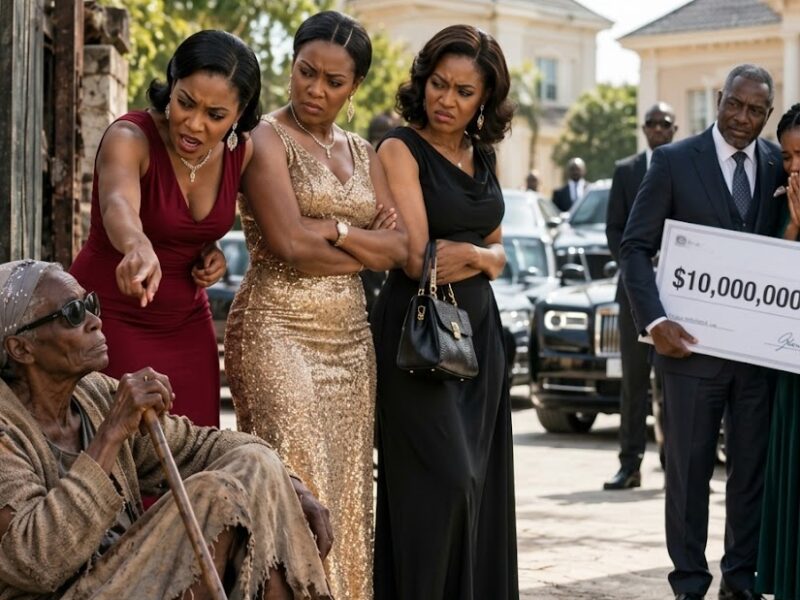
A Blind Mother Tested Her Three Daughters-in-Law With Her Late Son’s Fortune—Only the Family Outcast Chose Her
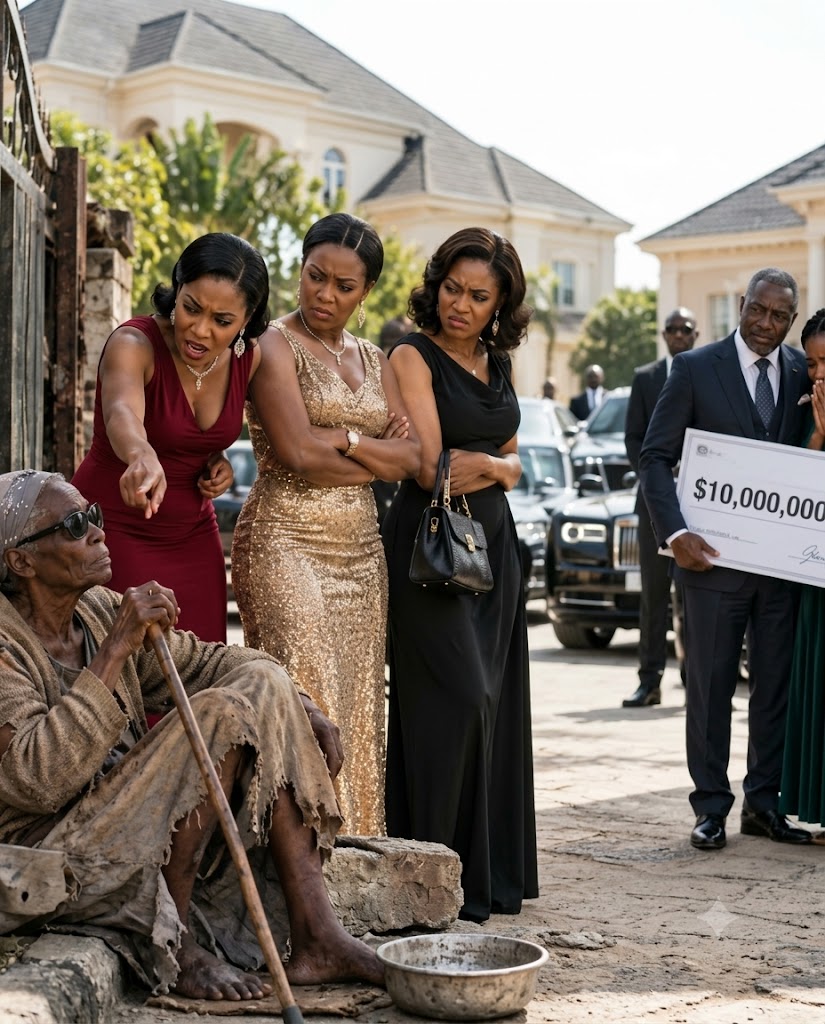
The wind came hard off Grand Avenue at 10:47 that morning, hot and dusty, lifting receipts, wrappers, and red bougainvillea petals into the air outside St. Catherine’s Medical Center in Phoenix, Arizona.
An old woman sat alone on the concrete bench beside the bus stop.
Dark glasses covered her eyes, a white cane resting between her knees.
Her name was Miriam Colanso, though almost everyone in the Southwest knew the Colono name long before they knew her face.
For 38 years, Colono Meridian Group had moved coffee, medicine, machinery, and refrigerated food across Arizona, New Mexico, and into neighboring states.
Miriam had helped build it beside her late husband, one truck at a time.
Now at 72, she could no longer see the trucks that carried their blue and silver logo.
Diabetes had taken most of her sight six years earlier.
What it had not taken was her memory.
Beside her sat an old brown leather document bag with a broken brass clasp.
It did not look important.
That was deliberate.
A black SUV slowed near the curb.
The driver stepped out, but Miriam lifted one hand before he could approach.
He stopped across the road inside a parked sedan with tinted windows.
Her attorney, Joseph Maryuki, checked the time and said nothing.
The first SUV door opened.
High heels struck the pavement.
Miriam recognized the sound before the perfume reached her.
Celestine Colono, wife of Miriam’s eldest son, Baraka, always wore heels that announced her arrival half a room before she spoke.
Celestine had spent the morning at St. Catherine’s visiting a private dermatologist.
She was not supposed to know Miriam would be there.
Another gust came.
Miriam loosened the document bag with two fingers.
Papers burst across the pavement.
“Oh,” she cried, reaching blindly toward the sound.
“Please, please, someone help me. Those papers belong to my son.”
Celestine stopped.
One sheet slapped against the tire of the SUV.
Another spun beneath the bench.
A cream envelope skidded across the pavement and struck the pointed toe of Celestine’s shoe.
She bent to pick it up.
Across the front were three typed lines.
Estate of Elias Colono, beneficiary.
Cash value: $3,850,000.
Celestine’s breathing changed.
Miriam heard it.
“Is everything there?” the old woman asked.
“Yes, Mother Miriam,” Celestine said after a pause.
Her voice had become unusually soft.
“It is only paperwork.”
“Thank God. My hands are not as quick as they used to be.”
Celestine gathered the pages.
She placed most of them into the bag.
Then she turned slightly away, shielded by the open SUV door, and raised her phone.
One photograph, then another.
She lifted a page that carried a red reference number and the words “surviving spouse.”
Her eyes moved quickly across it.
At the bottom was a name the family had not spoken at Miriam’s dining table in nearly three years.
Nema Wanjeru Colono.
Celestine looked toward Miriam.
The old woman’s face remained tilted toward the road.
Celestine folded the page once and slid it beneath the leather cover of her tablet.
“Did the wind take anything far?” Miriam asked.
“No, I found everything.”
“You are certain?”
Celestine pressed the tablet against her side completely.
Miriam’s fingers settled around the white cane.
“Thank you, my daughter.”
Celestine leaned down and kissed the air near Miriam’s cheek.
“You should not sit here alone. Phoenix is not safe for someone who cannot see.”
The words hung between them.
Miriam smiled faintly.
“You would be surprised what a person can see after losing her eyes.”
Celestine gave a nervous laugh, climbed into the SUV and left.
Only after the engine faded did Joseph cross the road.
“You heard?” Miriam asked.
“Every word. And the missing page. Page eight. Exactly as you expected.”
Miriam’s thumb moved over the scratched leather of the document bag.
“I hoped I was wrong.”
Joseph did not answer.
She turned her face toward the warmth of the sun.
“Call no one yet. Miriam, not yet. One person taking a page can be greed. Two people hiding the same truth becomes a system.”
Joseph looked at the white cane beside her, then at the traffic moving beyond the curb.
“And if the third person refuses to come?”
Miriam’s hand tightened.
“Then I will deserve that too.”
Three years earlier, before the white cane became part of Miriam’s body, before her youngest son’s name became something people lowered their voices to say, Elias Colono had been the one person in the family who could make her laugh during a board meeting.
He was 36, stubborn, impatient, and irritatingly unwilling to treat money with the reverence his older brothers gave it.
Baraka, the eldest, liked expansion plans, acquisition targets, and photographs beside state senators.
Camo, the middle son, liked systems, numbers, and quiet authority.
Elias liked people.
At company depots, he knew mechanics by name.
At Christmas, he took his children to eat with warehouse staff before attending the family dinner.
When a driver died on Interstate 10, Elias stayed at the widow’s house until dawn because he did not want the company’s condolence envelope to arrive before a human being did.
Miriam had loved that about him.
It was also the reason he fought with his brothers.
Elias married Nema Weru when he was 31.
She was not from one of the families Miriam’s friends considered suitable.
Nema’s father had taught mathematics in a public high school in Flagstaff.
Her mother had run a small tailoring shop.
Nema herself worked in compliance for a regional microfinance institution.
She was quiet in large rooms and sharp in small ones.
She did not laugh when powerful men expected laughter.
She did not flatter Miriam.
In the beginning, Miriam distrusted that.
Then she slowly began to value it.
For four years, Nema and Elias seemed to build the kind of marriage that made other people either hopeful or annoyed.
They argued about curtains, household budgets, work travel, and whether their son Teemo should be allowed to sleep with a toy truck in his bed.
They also respected each other in public, which Miriam noticed more than romance.
Then Elias died.
It happened on a rainy Tuesday near Sedona.
His vehicle hydroplaned on the highway after he left a supplier audit.
The driver survived.
Elias did not.
Grief entered the Colono family like smoke.
It got into everything.
For the first week, nobody spoke about shares or trusts or signatures.
Nema barely ate.
She slept in Elias’s shirt and sat beside the window until the sky changed color.
Miriam stayed near her whenever she could.
Sometimes they held hands without speaking.
Then, 12 days after the funeral, Nema asked for a private meeting.
She brought a blue folder.
Inside were transaction reports Elias had been reviewing before his death.
Nearly $700,000 had moved from the employee pension reserve through an intermediary company called Havala Strategic Services.
The intermediary had charged consulting fees, then routed portions of the money into a property vehicle linked to Baraka’s longtime associate.
Nema did not accuse Baraka directly.
She said the transfers needed to be investigated.
Baraka exploded.
“How long did you wait after burying my brother before you started searching for money?”
Nema went white.
“I did not search for money. Elias left these in our home office.”
“You work in compliance. You know exactly how to make innocent documents look suspicious.”
Camo said little.
Celestine sat beside Baraka, one hand on his arm.
Her face carried the patient sadness of someone watching an unpleasant guest behave badly.
Miriam still remembered Nema’s eyes turning toward her, not pleading, waiting.
Miriam could have stopped the room.
She could have said, “We investigate first.”
She could have told Baraka to sit down.
Instead, she looked at the family she had left, imagined headlines about stolen pension funds two weeks after her son’s burial, imagined lenders becoming nervous, employees whispering, clients calling competitors, and the company she and her husband had built beginning to crack under grief and scandal.
So, she said the sentence she would spend three years regretting.
“Nema, this is not the time.”
Nema stared at her.
“When will be the time?”
“We are grieving.”
“So am I.”
“No one said you are not.”
“Then why am I the only one being treated as if I brought a weapon into this room?”
Baraka stood.
“Because you did.”
Miriam should have stopped him.
She did not.
The next weeks became uglier.
Lawyers appeared.
Questions about Elias’s private accounts turned into questions about Nema’s motives.
A rumor spread that Elias had been considering separation, though no evidence supported it.
Another rumor said Nema had pressured him to rewrite his will.
Celestine repeated neither rumor directly, but she always seemed to be in the room when one began.
Then the original copy of Elias’s updated beneficiary instruction could not be found.
The family office produced an older document that placed most of his shares into a family holding structure for his son Teemo with management controlled by the surviving brothers until the boy turned 25.
Nema retained their home and a modest insurance payment.
She protested.
Baraka called the protest proof of greed.
One evening, after another argument, security refused Nema entry to the Colono family residence in Scottsdale.
She stood at the gate with six-year-old Teemo holding her hand.
Miriam was inside.
She knew she did not come out.
That was the part she could never forgive in herself.
By morning, Nema had packed two suitcases and left Phoenix for several months.
When she returned, she rented a two-bedroom apartment in South Phoenix and took a job at a legal aid center that helped widows, dismissed workers, and families fighting inheritance disputes.
She stopped calling Miriam mother.
Eventually, she stopped calling at all.
The Colono family told itself the matter was finished.
It was not.
Six months before Miriam sat beside Grand Avenue with the old document bag, a retired company accountant named Peter Gthon requested a private meeting.
He was 68 and had worked beside Miriam’s late husband in the days when the office had only two rooms.
He arrived carrying a flash drive and the nervous posture of a man who had postponed courage too long.
“I should have come sooner,” he told her.
Miriam was already almost completely blind by then.
Joseph sat beside her and read each file aloud.
There were email backups, scanned approvals, reconciliation notes.
A memo Elias had sent to Peter two days before his death asking him to preserve transaction records outside the main server.
Most important was a scanned copy of Elias’s updated estate instruction.
Signed and witnessed 11 months before the accident.
It named Nema as the direct beneficiary of a significant portion of Elias’s personal Colono Meridian shares, several investment accounts, and accrued dividends.
Teemo’s trust was separate.
Nema’s inheritance was never supposed to disappear into it.
The scanned document did not prove who had removed the original, but it proved the family had been living inside a lie.
Miriam listened without interrupting until Joseph reached the last page.
Then she asked only one question.
“How much would her share be worth today?”
Joseph calculated over the next two days.
With accumulated dividends, asset appreciation, and money that should have been distributed from Elias’s estate, the amount was slightly above $3,850,000.
Miriam did not sleep that night.
Money was not what kept her awake.
The gate was.
Nema and little Teemo standing outside it while Miriam remained inside.
The next morning, she told Joseph she wanted an independent forensic review.
Quietly, no family office staff, no Baraka, no Camo.
The review uncovered something worse.
The original beneficiary file had been checked out from the estate archive three days after Nema presented the pension documents.
The access log carried the credentials of a junior administrator who had resigned one month later and relocated to Dubai.
That administrator had reported directly to Celestine during a temporary family office restructuring.
Still, Miriam wanted more than records.
She wanted to know what the people closest to her would do when they believed nobody could see them.
That was how the bench outside St. Catherine’s became part of the plan.
Celestine was first.
The next person arrived at 1:18 in the afternoon.
Grace Colono, Camo’s wife, did not wear heels.
Miriam heard flat shoes stop on the pavement and a sharp intake of breath.
“Mama Miriam.”
“Grace.”
Miriam turned her face toward the voice.
“I thought that was you.”
“What are you doing here alone?”
“Joseph had to step away. I am waiting for the driver.”
Grace looked around.
“In this heat?”
“I have survived worse than Phoenix sunshine.”
Grace laughed, but the laugh carried worry.
Unlike Celestine, she had always been gentle with Miriam in practical ways.
She remembered medication schedules, cut fruit into pieces small enough for Miriam to handle, and never moved furniture without warning her.
Yet Grace also had a flaw Miriam had watched grow over the years.
She avoided conflict until avoidance itself became a kind of dishonesty.
The wind came again.
This time, Miriam did not have to force the bag open much.
Papers slid over the bench and scattered around Grace’s feet.
“Oh no,” Miriam said.
“Please, my daughter, those documents are important.”
“I have them.”
Grace crouched immediately.
She collected the first pages without reading.
Then she saw the estate heading.
Her hands slowed.
One page showed the current value of Nema’s entitlement.
Another carried an internal note stating that restoration of the original beneficiary instruction could trigger examination of past estate handling by the directors.
Grace stood still for several seconds.
Miriam waited.
“Mama,” Grace said carefully.
“Where did you get these?”
“Joseph said they were old family documents.”
“Have Baraka and Camo seen them?”
“I do not know.”
Grace looked toward the road, then back at the papers.
Miriam could hear each sheet touch the next.
“What do they say?” Miriam asked.
Grace swallowed.
“Mostly estate records.”
“Anything about Elias?”
“Yes.”
“And Nema?”
Another pause.
“A little.”
Miriam tilted her head.
“Read it to me.”
Grace’s breath caught.
For a moment, Miriam thought she might do it.
She thought Grace might choose discomfort over silence.
Instead, Grace folded the page behind another one.
“It is legal language, Mama. Joseph should explain it properly.”
“Does it say Nema is owed something?”
Grace rubbed her thumb across the edge of the paper.
“I cannot tell. I do not want to misread it.”
That answer hurt more than Celestine’s lie.
Celestine wanted something.
Grace was afraid of something.
Fear could do damage just as efficiently.
“Put everything back,” Miriam said.
Grace did almost.
She separated the page describing the potential board review and slid it beneath a hospital brochure on the bench.
Not into her handbag, not stolen, hidden, as though postponing the truth made her innocent.
Grace sat beside Miriam afterward and held her hand.
“You should come home with me.”
“I will soon.”
“Do not sit here with important papers.”
“Why?”
“Because people may take advantage.”
Miriam turned her blind eyes toward her.
“Yes,” she said.
“They may.”
Grace left 20 minutes later.
Joseph crossed the road again.
He retrieved the page from beneath the brochure.
“She did not take it,” he said.
“No, that matters. So does hiding it.”
Joseph sat beside her.
“You are testing people who are afraid of consequences.”
Miriam’s jaw tightened.
“Nema faced consequences alone because the rest of us were afraid.”
The lawyer had no answer to that.
At 4:00, the heat softened.
Shadows from the jacaranda trees lengthened across the pavement.
Miriam had been sitting there for nearly six hours.
Her back hurt.
Her feet had swollen inside her shoes.
Joseph had tried twice to end the experiment.
She refused.
At 4:26, a city bus stopped across the road.
Passengers stepped down.
Miriam heard coins, doors, footsteps, a child whining about juice, a driver calling the next route.
Then a voice she had not heard in person for almost three years said, “Excuse me, can you hold this for one second?”
Miriam stopped breathing.
“Nema.”
Joseph saw her crossing the road carrying a canvas tote, a folder under one arm, and a small paper bag from the pharmacy.
Her hair was braided back.
There was no jewelry except her wedding ring, which she still wore on a thin chain around her neck rather than on her finger.
She was not coming for Miriam.
Joseph had arranged nothing.
St. Catherine’s happened to be one of the hospitals where Nema’s legal aid center assisted families with medical debt disputes.
That coincidence was the first thing all day Miriam had not planned.
Nema reached the pavement just as a bus roared past.
The wind lifted the documents again.
This time it truly was accidental.
The bag tipped from the bench.
Sheets flew everywhere.
Miriam flinched at the sound.
Before Joseph could move, Nema dropped her tote and chased the nearest pages.
“Ma’am, stay where you are,” she called.
“Do not step into the road.”
Miriam’s throat tightened.
Nema collected one sheet from beneath a parked motorcycle, another from the gutter, three more near the bus stop sign.
She came back breathing harder and crouched in front of Miriam.
“Your bag is open.”
“Yes,” Miriam lowered her voice.
“My fingers are clumsy today. I will put them back.”
Nema began arranging the pages by the printed numbers in the lower corners.
One. Two. Three. Four.
She stopped.
Her eyes found the estate heading.
Then Elias’s name.
The color left her face.
Miriam could not see it, but Joseph could.
Nema’s fingers trembled once.
She sat back on her heels.
For several seconds, traffic became the only sound.
Miriam forced herself not to say her name.
Nema turned the page over without reading further.
She stacked it beneath the others.
Then she reached the cream envelope, Estate of Elias Colono.
Her thumb rested over the name.
The envelope was not sealed.
Inside was a bank valuation statement showing the current worth of the inheritance.
Nema could have opened it with one finger.
She did not.
Instead, she placed it flat on top of the stack and began counting page numbers again.
Seven. Nine.
She frowned.
“Ma’am, yes, you are missing page eight.”
Miriam’s heart struck hard against her ribs.
“Are you sure?”
“The pages are numbered. Seven goes directly to nine.”
“Perhaps the wind carried it. I checked near the road.”
Nema stood and searched again.
She looked beneath the bench, around the tree, inside the gutter, under a newspaper stand.
Nothing.
When she returned, she kept the documents pressed against her chest so the wind could not take them again.
“I am sorry. One page is gone.”
“Did you read the others?”
Nema’s face hardened slightly.
“No, you saw the name. I saw enough to know they are private.”
“What if they concern a lot of money?” Miriam asked.
Nema’s eyes moved to the cream envelope.
“That makes them more private, not less.”
Miriam looked down at her own hands.
“What if the person who owned that money is dead?”
Nema was quiet for so long that Joseph leaned forward inside the car.
Then she said, “Then the living should be even more careful with what belongs to him.”
The words cut straight through Miriam.
She gripped the cane so hard her knuckles widened.
Nema tied the bag closed with a spare hair ribbon from her wrist.
“There, it should hold until you get home.”
“Thank you.”
“You should not carry important documents in a broken bag.”
“I have been told I am stubborn.”
“That usually means someone has already given you good advice.”
For one impossible second, Miriam almost laughed.
It sounded like something Elias would have said.
Nema picked up her tote.
Then she froze.
Miriam had turned slightly toward her, and the afternoon light caught the silver pin on the old woman’s dress, a tiny bird with one wing raised.
Elias had given that pin to Miriam on her 60th birthday.
Nema knew it.
Her eyes moved from the pin to the white cane, then to the shape of Miriam’s mouth.
“Mrs. Colono.”
Miriam could not lie.
“Yes.”
The pharmacy bag slipped slightly in Nema’s hand.
Neither woman spoke.
Cars moved behind them.
Someone laughed near the hospital gate.
A street vendor called out the price of mango slices.
The world continued as if three years had not just entered one square meter of pavement.
Nema took one step back.
“You knew it was me?”
“Not at first.”
“When did you know?”
“When you told me not to step into the road.”
Nema’s mouth tightened.
Miriam stood carefully.
“Nema.”
“No.”
The word was not loud.
It stopped her anyway.
Nema looked at the document bag.
“Was this arranged?”
Miriam could not answer quickly enough.
Nema understood.
“You were testing me.”
“I was testing more than you.”
“That does not make it better.”
“I know.”
“Do you?”
Nema’s voice stayed controlled, which made it sharper.
“Three years ago, I brought documents into your house because Elias asked me to protect something he thought was wrong. Your family called me greedy. I lost my husband, my home, my place in that family, and nearly my reputation. Now you sit by a road with his name scattered in the dust to see whether I will steal a paper.”
Miriam lowered her head.
Joseph opened the car door but stayed where he was.
“I deserved that,” Miriam said.
“This is not about what you deserve.”
“No, it is about what you deserved and did not receive.”
Nema stared at her.
Miriam reached into the bag, found the cream envelope by touch, and held it out.
Nema did not take it.
“What is that?”
“The reason I asked Joseph to reopen Elias’s estate.”
Nema’s face changed.
“Reopen?”
“We found a scanned copy of an instruction that should have been in the original file.”
Nema’s fingers curled around the strap of her tote.
Miriam continued.
“It names you directly.”
Nema did not move.
“How much?” she asked.
“That is not the first question.”
“It is mine.”
Miriam swallowed.
“More than $3,850,000 at current value, including distributions you never received.”
Nema laughed once.
There was no joy in it.
“Three million. And suddenly everyone believes me.”
“No.”
Miriam lifted her face.
“Suddenly I have evidence that I should have demanded before I judged you.”
Nema looked toward the hospital entrance.
“I have a client waiting.”
“Please come to the house tomorrow.”
“No.”
“To Joseph’s office then.”
“No, Nema. I spent years learning how not to need that family to call me back.”
“I am not asking you to need us.”
“Then what are you asking?”
Miriam’s voice broke for the first time.
“For one chance to put the truth on a table where everyone can see it.”
Nema looked at the dark glasses covering Miriam’s eyes.
The irony landed between them.
“Everyone can see it.”
Finally, Nema said, “One meeting at Joseph’s office. Not your house.”
Miriam nodded.
“And Teemo stays out of it.”
“Yes.”
“No one uses my son as emotional leverage.”
“Yes.”
“And if this becomes another performance about family honor, I walk out.”
Miriam held the envelope against her chest.
“You should.”
Nema left without taking the envelope.
That night, Celestine did not sleep either.
At 6:12 p.m., she had sent the photographs from Miriam’s documents to Baraka with one message.
“We have a problem.”
Baraka called immediately.
“Where did you get this?”
“Your mother had the file outside St. Catherine’s.”
“Why?”
“She said Joseph gave it to her.”
“Does she know what it says?”
“She is blind.”
“Baraka, that was not my question.”
Celestine went quiet.
Baraka had become harder since Elias died.
Not cruel in obvious ways.
He still paid school fees for cousins, attended funerals, and donated to church projects.
But the company had become the center of his identity.
He believed protecting Colono Meridian justified pressure that once would have embarrassed him.
“What did you take?” he asked.
“Only one page.”
“Celestine.”
“It had the estate reference in Nema’s name. I needed time to understand what Mother knows.”
“You stole from my mother.”
“I protected us.”
“Send me a picture of the page.”
Celestine did.
There was silence on the line.
Then Baraka whispered.
“This cannot exist.”
“It does.”
“Where is the rest?”
“With your mother.”
Baraka paced his study.
“The old scan should have been useless without the original.”
Celestine’s stomach dropped.
“Old scan.”
Baraka stopped breathing.
She stood very still in her dressing room.
“What old scan?”
“Forget I said that.”
“No, Celestine. You told me three years ago the document Nema described never existed.”
“It was never properly filed.”
“That is different.”
“Do not start developing a conscience because you saw a number on a page.”
Celestine stared at herself in the mirror.
For years, she had told herself Nema was dangerous, ambitious, bitter, too comfortable challenging men who had built more than she understood.
She had repeated those thoughts until they felt like facts.
Now a crack had opened.
“What did you do, Baraka?”
His voice hardened.
“I protected my father’s company during the worst moment in this family’s history.”
“That is not an answer.”
“It is the only one you need tonight.”
He ended the call.
Celestine remained before the mirror, holding page eight.
For the first time, she did not see Nema in her mind.
She saw herself bending beside a blind woman.
Hiding a page she knew was not hers.
The next morning, Joseph’s conference room was prepared before 9.
There was no family crest on the wall, no portrait of Miriam’s husband, no sentimental photograph of Elias.
Miriam had chosen the office for exactly that reason.
Neutral chairs, neutral table, neutral light.
Nema arrived first.
She wore navy trousers and a plain white blouse.
She carried a notebook and nothing else.
Grace came 10 minutes later with Camo.
Her face changed when she saw Nema.
She whispered.
“I did not know you would be here.”
Nema nodded.
“That seems to be a common problem in this family. People not knowing what is happening until it is too late.”
Grace looked down.
Celestine and Baraka arrived together.
Celestine’s handbag was clutched under her arm.
Baraka’s expression was calm enough to be dangerous.
Miriam entered last with Joseph.
No one helped her to the head of the table.
She found the chair herself by touching its back.
When everyone sat, Joseph placed six folders on the table.
Baraka spoke first.
“Mother, if this is about estate housekeeping, I have a board meeting in an hour.”
Miriam folded her hands.
“You can miss it.”
His jaw shifted.
Joseph opened the first folder.
“Six months ago,” he said, “Mrs. Colono authorized an independent review of records connected to the estate of her late son Elias Colono and certain transactions he was examining before his death.”
Celestine looked at Baraka.
Camo leaned forward.
“Without informing the board.”
“This is not a board investigation,” Joseph said.
“It began as a private estate review.”
Grace asked, “Began?”
Joseph looked at Miriam.
She nodded.
He continued.
“The review uncovered a scanned copy of a signed beneficiary instruction witnessed 11 months before Mr. Elias Colono’s death. The instruction differs materially from the version used during estate distribution.”
Nema did not move.
Joseph slid a copy toward her.
She stared at Elias’s signature.
Her hand went to the chain around her neck.
Baraka said, “A scan proves nothing.”
“By itself, correct,” Joseph replied.
“Which is why we investigated further.”
He opened the second folder.
“The family archive access log shows the original estate file was removed three days after Mrs. Nema Colono raised concerns regarding pension reserve transfers. The administrator whose credentials were used resigned four weeks later.”
Celestine’s fingers tightened around her handbag.
Joseph turned toward her.
“That administrator reported to you at the time.”
Celestine’s face drained.
“She reported to the family office.”
“You supervised the family office restructuring for six weeks, long enough to approve her archive permissions.”
Baraka interrupted.
“This is becoming accusatory without evidence.”
Miriam turned toward his voice.
“Then evidence should comfort you.”
Baraka said nothing.
Joseph placed a small audio recorder on the table.
Grace stared at it.
Miriam spoke.
“Yesterday I sat outside St. Catherine’s with copies of these documents.”
Nema’s mouth tightened.
“I allowed the wind to scatter them when certain people passed.”
Camo looked at his wife.
“Grace.”
Grace closed her eyes.
Miriam continued.
“Celestine found page eight. She told me she returned everything.”
Celestine stood.
“You set me up.”
“No, I placed paper on the pavement. You chose what to do with it.”
“You were pretending to be helpless.”
“I am blind, Celestine. That part required no acting.”
The room went silent.
Joseph reached toward the recorder.
Celestine pulled page eight from her handbag and dropped it on the table.
“There. I have it. I was going to return it.”
“When?” Nema asked.
Celestine turned.
“Stay out of this.”
Nema’s face barely changed.
“My dead husband’s name is on the page in your handbag. I think I have earned the right not to stay out of it.”
Celestine opened her mouth, then stopped.
Miriam turned toward Grace.
“You did not take anything.”
Grace’s shoulders sagged.
“No.”
“You hid a page under a hospital brochure.”
Camo stared at her.
“Why?”
Grace’s voice shook.
“Because it said the board could be investigated. I thought if Mama read it immediately, everything would explode before we understood what it meant.”
“You thought hiding it would help.”
“I was scared.”
“Of what?”
Grace looked at her husband.
“Of losing everything we built our lives around.”
Camo leaned back as if she had struck him.
Grace wiped one cheek.
“I know how that sounds.”
Nema spoke quietly.
“I know exactly how it sounds.”
Grace looked at her.
The shame in her face deepened.
Joseph opened the third folder.
“This is where the estate matter meets the pension matter.”
Baraka stood.
“No.”
Miriam turned toward him.
“Sit.”
“I will not sit through an ambush.”
“For three years, Nema lived inside an ambush you helped create.”
His chair scraped the floor as he pushed it back.
Joseph spoke before he could leave.
“We recovered backups of correspondence between Elias Colono and Peter Gthon regarding pension reserve transfers. We also traced Havala Strategic Services to a beneficial owner connected to Felix Oday.”
Camo frowned.
“Felix?”
Baraka did not move.
Felix Oday had been Baraka’s closest business associate for 13 years.
Joseph continued.
“Several payments moved from Havala into a property development vehicle in which Mr. Oday and Mr. Baraka Colono were early investors.”
Camo stood now too.
“Baraka, it was a temporary liquidity structure with pension money. It was restored.”
“That is not the point.”
“It was restored before any employee lost a dollar.”
Nema’s eyes fixed on him.
“Elias found it.”
Baraka looked at her for the first time.
“He found irregular transfers.”
“And you removed his beneficiary document after I brought them here.”
“I did not remove it.”
“Who did?”
Baraka looked toward Celestine.
She stared back at him in disbelief.
“Do not,” she whispered.
He said nothing.
Celestine’s voice rose.
“Do not look at me like that.”
Miriam’s head turned between them.
Celestine pressed both palms onto the table.
“You told me the document was incomplete. You told me Nema was using Elias’s grief over company disagreements to take control of shares that should stay inside the family.”
Baraka’s face hardened.
“Careful.”
“No, you be careful.”
Her eyes filled, but her voice sharpened.
“I called Janet in the archive because you said one file needed to be reviewed before distribution. You told me it was temporary.”
Camo whispered.
“My God.”
Celestine continued, words tumbling now.
“Janet brought me the file. I gave it to Baraka. I never saw it again.”
Nema went completely still.
Baraka pointed at his wife.
“You are panicking and rewriting history.”
Celestine laughed bitterly.
“Three years I defended you. Three years. I told myself Nema was greedy because that was easier than asking why you were so afraid of her documents.”
Baraka’s control finally cracked.
“You think you were innocent? You enjoyed every benefit of keeping those shares consolidated. You pushed to renovate the Lexington property with family funds. You argued Nema should be excluded from foundation events because she made donors uncomfortable. Do not suddenly stand there as a victim.”
Celestine recoiled.
He had told the truth cruelly.
She sank into her chair.
Miriam’s voice was very low.
“Enough.”
Nobody moved.
Joseph slid one final document toward Baraka.
“This is not yet a criminal charging document. It is the preliminary report from the independent forensic team, but the company’s external auditors have been notified. The pension trustees will receive the complete file today. The board’s independent directors have also been informed that an emergency meeting is required.”
Baraka stared at Miriam.
“You went around your own son.”
“I went around the man who taught this family that protecting the company mattered more than telling the truth.”
“You built that company.”
“Yes. For 40 years. You told us it had to survive.”
“And I was wrong whenever I made survival more important than decency.”
The sentence landed heavily because Miriam did not exclude herself.
She turned toward Nema.
“I was wrong before anyone else in this room was punished for being wrong.”
Nema’s eyes filled despite herself.
Miriam removed her dark glasses.
Her eyes were clouded and unfocused.
“I could not see the documents then,” she said.
“But that is not why I failed you. I failed you before I lost my sight.”
Nema looked away.
Miriam’s fingers trembled against the table.
“At the gate, I knew you were outside.”
Nema shut her eyes.
Grace covered her mouth.
Miriam continued.
“Because stopping would have been another form of cowardice. I heard Teemo crying. One of the house staff told me you had two suitcases. I sat in my room and told myself if I came outside, I would devalue further. I let you leave.”
Nema’s voice was almost a whisper.
“I waited 23 minutes.”
Miriam’s breath stopped.
“You knew?”
“I looked at the clock in the gatehouse because I needed something to do besides cry in front of my son. 23 minutes. I thought you would come.”
Miriam bowed her head.
“I am sorry.”
Nema’s hand tightened around her notebook.
“Sorry is not a bridge. It is where someone admits there is a river.”
Miriam nodded slowly.
“Then I will not ask you to cross today.”
Joseph opened a slim black folder and placed it before Nema.
“These are proposed restoration documents,” he said.
“They acknowledge your direct entitlement under Elias’s signed instruction. Subject to court validation of the scanned copy and supporting evidence. The family holding company has agreed through Mrs. Colono’s controlling vote to escrow the disputed shares and accumulated distributions until the court confirms transfer.”
Baraka laughed harshly.
“You cannot bind the company without the board.”
Joseph looked at him.
“The board will vote this afternoon. Three independent directors have already requested your temporary suspension pending the audit.”
Baraka’s face changed.
For the first time, he looked afraid.
Miriam did not enjoy it.
That surprised her.
She had imagined anger would feel like strength when the truth finally came.
Instead, she felt tired.
Celestine whispered, “What happens to me?”
Joseph answered carefully.
“That depends on the investigation. Removing a page from Mrs. Colono’s bag yesterday is documented. Your role in accessing the estate archive three years ago will also be examined. Cooperation matters.”
Celestine stared at page eight on the table.
“I wanted to be the woman who protected this family,” she said.
Nema looked at her.
“From what?”
Celestine’s lips trembled.
“From becoming poor again.”
The answer surprised everyone except Miriam.
Celestine had rarely spoken about her childhood.
Her father had owned three small shops in Kansas City.
When she was 13, a fire destroyed two.
Debt took the third.
For two years, she shared one bedroom with her mother and two sisters in an aunt’s house.
She had once told Miriam she could still remember adults whispering about school fees at night.
Celestine wiped her face angrily.
“When I married Baraka, I promised myself my children would never hear those whispers. Then the company became everything. Shares, properties, the family name. Every time someone threatened it, I felt like I was 13 again, watching smoke come through a shop roof.”
Nema’s voice stayed steady.
“Fear explains why you were afraid. It does not explain why you made me the price.”
Celestine lowered her eyes.
“No,” she said.
“It does not.”
Baraka stared at his wife as if he no longer recognized her.
Camo sat down heavily.
“And me?”
Miriam turned toward him.
“You stayed quiet.”
“I did not know about the file.”
“You knew Nema was being pushed out.”
Camo rubbed both hands over his face.
“I told myself it was between Baraka and her.”
Nema gave him a sad smile.
“Everybody told themselves it belonged to somebody else.”
No one answered.
The meeting lasted another two hours.
There were no dramatic arrests.
No police stormed the room.
Real consequences rarely arrived with music.
They came as signatures, suspensions, audit notices, frozen authorities, legal letters, and the quiet terror of knowing other people would now examine what you had hidden.
Baraka was placed on immediate leave from executive duties that afternoon.
After the independent directors voted 4 to 1, the pension trustees referred the Havala transfers to regulators and demanded full restitution of all fees and gains associated with the transactions.
Felix Oday stopped answering calls by evening.
Three days later, his lawyers contacted investigators.
Celestine returned page eight voluntarily, surrendered communications from the period of the estate restructuring, and agreed to give a formal statement.
She lost her seat on the Colono Foundation board.
Several friends stopped inviting her to events before any court had decided anything.
She discovered quickly that social loyalty could be thinner than the paper she had stolen.
Grace asked to speak with Nema privately before leaving Joseph’s office.
Nema almost refused.
Then she stayed.
Grace sat opposite her, twisting her wedding ring.
“I did not steal your page.”
“I know.”
“I keep wanting to say that as if it makes me better.”
Nema said nothing.
Grace looked down.
“When I saw your name, I knew something was wrong. I knew you had been telling the truth about at least part of what happened. And my first thought was not you. It was what the investigation could do to Camo and the company.”
“That was everyone’s first thought three years ago.”
“I am sorry.”
Nema let the silence remain.
Grace’s eyes filled.
“I do not expect forgiveness.”
“Good.”
Grace looked up.
Nema’s expression softened slightly.
“Because forgiveness demanded too early is just another way of asking the injured person to make everyone comfortable.”
Grace nodded.
“What can I do?”
“Tell the truth when it costs you something.”
Grace took a shaky breath.
“I can start there.”
The court validation of Elias’s beneficiary instruction took four months.
During that time, Nema refused every invitation to return to the Colono residence.
Miriam called twice and left brief messages when Nema did not answer.
She did not call a third time.
Instead, she asked Joseph for updates only on the legal process and Teemo’s school fees, which remained fully funded through his existing trust.
Nema continued working at the legal aid center.
Her colleagues knew something was happening, but not the details.
She still arrived before 8.
She still ate lunch from a plastic container at her desk.
She still argued with hospital billing departments, landlords, pension administrators, and relatives who believed a widow became easier to cheat the moment a funeral ended.
Then one Tuesday morning, Joseph called.
“The court has confirmed the instruction.”
Nema sat very still.
“What does that mean in practical terms?”
“It means the shares transferred to you. The accumulated distributions are yours. The family holding company has also approved restitution for amounts wrongfully withheld from the estate.”
Nema closed her eyes.
“How much?”
Joseph told her.
$3,912,000 in combined value and cash distributions, excluding the shares’ future growth.
For several seconds she heard only the old ceiling fan above her desk.
“That cannot be right.”
“It has been checked six times.”
Nema laughed softly.
Three years earlier, she had sold Elias’s second car to cover legal bills and rent.
Now, a number large enough to buy dozens of such cars sat inside one sentence.
“What am I supposed to do?” she asked.
Joseph’s voice softened.
“Nothing today.”
That answer helped.
The formal transfer took place two weeks later at a bank conference room in Westlands.
Miriam attended.
So did Joseph.
No other family members were invited.
On the table sat a cashier’s check representing the cash portion immediately payable to Nema.
The remainder consisted of shares and investment assets transferred through separate instruments.
The number on the check was large enough that Nema read it three times.
Miriam sat across from her, hands folded around the top of her cane.
Nema looked at her.
“You do understand I did not earn this by picking up papers from a road.”
Miriam’s mouth trembled into the smallest smile.
“Yes, I do. I do not want anyone telling that story.”
“They will not.”
“This is not a reward.”
“No. Say it.”
Miriam took a breath.
“This money is yours because Elias made it yours and because we kept it from you when we should have protected your right to it.”
Nema looked back at the check.
Something in her face loosened.
Not happiness.
Recognition.
For three years, people had spoken about her as if wanting what belonged to her proved greed.
Now the paper on the table did not make her rich in the way everyone imagined.
It restored the shape of a truth she had nearly been forced to doubt.
She signed.
Miriam did not reach for her hand.
That mattered.
Outside the bank, Joseph offered Nema a driver.
She refused and ordered a taxi.
Miriam stood beside the curb listening to traffic.
“Nema?”
“Yes.”
“Are you going to move from your apartment?”
“Yes, eventually.”
“A larger place?”
“Probably.”
Miriam nodded.
“Good.”
Nema almost smiled.
“You were expecting me to say money does not matter.”
“No, I have had money too long to tell foolish lies about it.”
Nema laughed before she could stop herself.
It was the first sound between them that did not hurt.
The investigations continued, and this time nobody inside the Colono family was allowed to control the questions.
Baraka eventually admitted that he had authorized the temporary use of pension reserve funds to complete a property deal, believing the money could be returned before anyone noticed.
When Elias discovered the transfers, Baraka panicked.
After Elias died, he ordered the beneficiary file removed because Nema’s shares would have given her enough voting power to force an outside review.
For years, he had called it protecting the company.
Then during the settlement process, he sat across from a retired driver who had spent 29 years contributing to the pension fund.
The man looked at him and said, “You keep saying nobody lost money. Do you think money was the only thing we put there? We put trust there.”
Baraka had no answer.
The board removed him from executive management for five years.
Regulators required restitution and financial penalties, and he was barred from controlling employee funds.
Colono Meridian appointed an outside chief executive for the first time in its history.
Baraka fought the decision until there was nothing left to fight.
Only then did he begin to understand that what he had protected was not the company.
It was his own position inside it.
Celestine also paid a price.
She lost her foundation seat, surrendered her family office privileges, paid part of Nema’s legal costs from her own assets, and gave investigators a full statement about the estate archive.
One evening, her teenage daughter asked her a question she could not escape.
“If Auntie Nema had taken a paper from Grandma’s bag, what would you have called her?”
Celestine stared at the table.
“A thief.”
“And what were you?”
Celestine’s eyes filled.
“The same.”
Months later, she asked Nema for a private meeting.
She did not ask for forgiveness.
She only admitted the truth.
“I called you greedy because I was afraid of becoming poor again,” she said.
“That fear made me protect things that were never mine.”
Nema stirred her tea.
“Fear explains why you were afraid. It does not excuse making me the price.”
Celestine lowered her head.
“I know that now.”
Grace changed more quietly.
She kept the hospital brochure beneath which she had hidden the page.
Across the front, she wrote one word in black ink: Speak.
Whenever silence began to feel safer than truth, she opened her desk drawer and looked at it.
Nema used part of her restored inheritance to establish the Open Door Initiative, a legal fund for widows and children fighting inheritance disputes.
She chose the name because of the gate where she and Teemo had once waited 23 minutes for Miriam to come outside.
Nearly a year after the day outside St. Catherine’s, Miriam asked Joseph to drive her to Nema’s new office near Upper Hill.
The elevator was broken.
So the 73-year-old woman climbed 32 stairs with one hand on the rail and the other around her white cane.
Nema found her waiting in the hallway, breathing hard.
“You climbed all those stairs?”
“Yes.”
“You could have called.”
“I have called enough in my life when I should have walked.”
Nema said nothing.
Miriam held both hands over the handle of her cane.
“I do not expect you to call me mother again. I do not expect the years between us to disappear because a court corrected some papers. I only came to ask whether there is still a chair somewhere that I am allowed to sit in.”
The office hummed around them.
Phones rang.
A printer started.
Someone laughed in the next room.
Then wood scraped softly across the floor.
Nema pulled a chair from the wall.
“Sit.”
Miriam found it with her hand and lowered herself down.
No one cried.
No one made a speech.
For a while, they simply listened to the ordinary noise of other people’s problems being solved one document at a time.
On the wall beside Nema’s desk hung one sentence from a letter Elias had written before his death.
Respect her enough to let her stand on her own feet.
Below it sat the repaired brown document bag from St. Catherine’s, the same bag whose papers had scattered across the pavement and exposed more than any of them expected.
Visitors sometimes asked Nema about it.
She never told the whole story.
She only said that bag taught my family to read carefully.
One rainy afternoon, a young widow arrived carrying land documents inside a plastic envelope.
Her husband’s brothers had told her she had no right to the family farm.
She looked exhausted and embarrassed.
“I cannot afford a lawyer,” she whispered.
Nema pulled out the chair across from her.
“Sit. Tell me what happened.”
Near reception, Miriam waited quietly for Joseph to collect her.
She heard Nema’s voice through the open door, calm and patient, asking the woman to begin from the beginning.
Miriam smiled.
Once she had believed legacy was the family name painted across trucks moving through the Southwest.
Now she understood it could be smaller than that.
A document returned instead of stolen.
A truth spoken when silence would be easier.
A chair pulled out for someone nobody else wanted to hear.
And a door left open.









