
A Black Waitress Helped a Freezing Stranger After the Hotel Refused Him a Room—She Never Imagined Who Was Kneeling in the Snow Outside
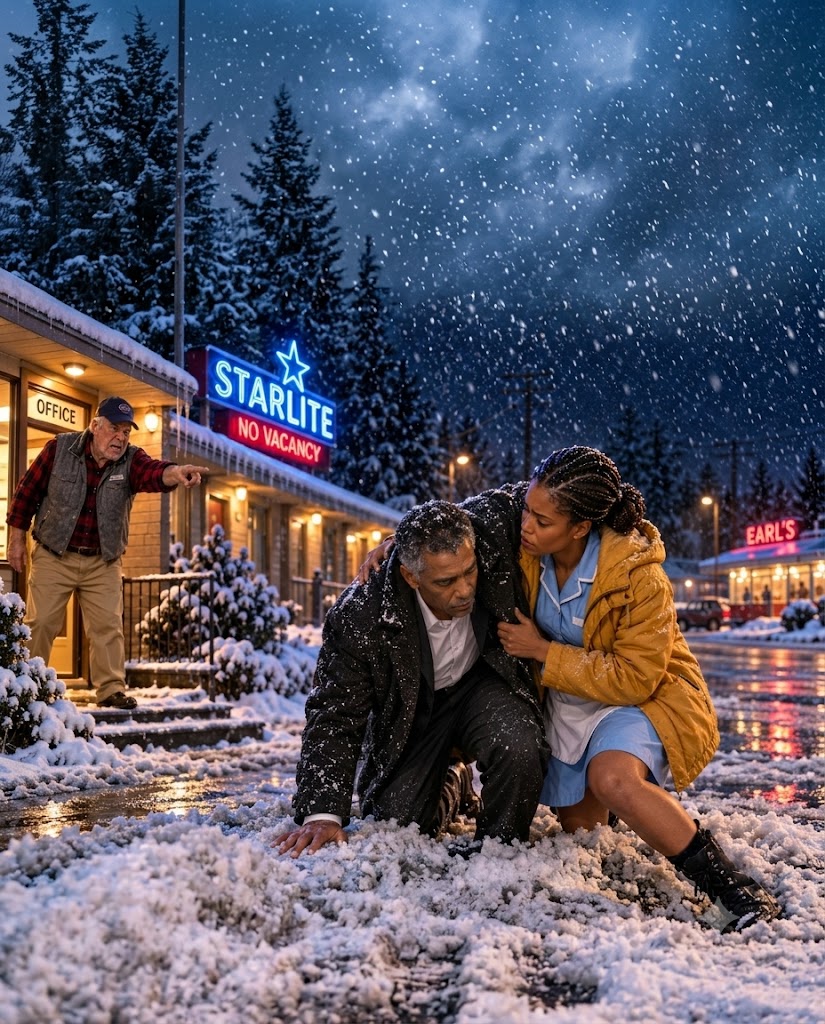
The snow came off Lake Erie like a curtain someone dropped, and by six-twenty the signs on Route 6 were white rectangles with no letters left in them. Calvin Hayes had walked this road exactly once before in his life, nineteen winters ago, and he had promised himself he would never walk it again. He was sixty-one years old, he sat fourteen hours a day, and his doctor had told him to walk one hour every evening with no phone, so he had picked the only hour that mattered.
He did not know that the highway bent where it bent. He walked straight on into the dark, onto a farm road that had no shoulder and no name, and he kept walking for three hours through snow that erased his own footprints behind him.
When he found Route 6 again he was one mile from where he had started, and his hands had stopped obeying him. The diner across the road was dark. The motel sign buzzed orange, and behind the office glass a man sat in a chair with his feet up and a space heater turning toward him like a small obedient sun.
Calvin knocked. The man looked up, looked at him the way you look at weather, and reached over and turned the porch light off.
There is a kind of cold that gets into the hinge of your jaw and stays there, and Calvin felt it settle in as he slid down the doorframe. He remembered a headline he had read that morning about revenue beating forecast by a full point, and he remembered that four hundred million phones were running software his hands had built, and he remembered that none of those four hundred million people could have picked his face out of a crowd.
Somebody opened a door. That was the last clear thought he had before the snow took the edges off everything.
Renee had locked up at nine-thirty, wiped down the counter twice, and counted the drawer twice because the drawer never balanced and Earl blamed the drawer and she blamed Earl. She had eaten nothing since noon, and the bowl of dumplings she had set aside was the only dinner she was going to get. She was thirty-nine and she had been on her feet eleven hours and she was pulling on her coat when she heard the thing at the window, a sound like a branch against glass, except there were no branches on that stretch of Route 6.
She stepped out into the snow and found a man face down in the road, and she stood over him for one full second thinking about every door she had ever knocked on, and then she got her hands under his arms. “Hey. Hey, look at me. Can you stand?” He looked right at her, and his eyes did not focus, and he said nothing at all.
“Arm over my shoulder. Come on up.” She weighed a hundred and twenty pounds and he weighed a hundred and eighty and the snow was already over the curb, and she got him inside because the alternative was leaving a man to die fifty feet from a motel that had a vacancy sign.
She sat him at the counter with his hands toward the old furnace and told him not too close or he would freeze worse when he pulled back. She found a sweater in the back that probably belonged to Earl. She saw the window he had come through and knew what that window cost her. “Will you get in trouble for letting me in?” he asked, and she said, “Hold still, this will sting,” and went to work on his hands.
“What’s your name?”
“Calvin.”
“Calvin what?”
“Just Calvin.”
“Okay, just Calvin. I’m Renee.”
That was the first time the name Calvin Hayes came within three feet of Renee Boon, and neither one of them knew what it was worth, because it wasn’t written anywhere but on a phone she did not look at and in a wallet riding in a car twenty miles away.
Out on the roads that night, state troopers in two counties were looking for a man named Calvin Hayes, and the only person who had found him had no idea who he was. The troopers worked the farm roads past the cannery until five in the morning. They did not work the diner, because nobody at the diner had a reason to call them and nobody at the diner had a phone that was for guests.
“Plows come through around five,” Renee said. “Till then, it’s just us.”
The dumplings were Dot’s recipe, black pepper in the dough the way Dot’s mother had done it, and Calvin ate half the bowl and then set his spoon down and sat there like somebody had taken something from him. “You all right?”
“My mother put black pepper in hers,” he said.
“So did Dot. Earl’s wife. It’s her recipe.”
Renee had not eaten since noon and that bowl was her dinner and she did not mention it, because there are two kinds of people in a storm and she had decided which one she was a long time ago.
He asked who R.K. was, the initials taped over the window, and she told him. Roy Kesler owned the motel. Roy Kesler owned the diner too. Roy wanted Earl gone so he could sell the lot, and Roy had a clause about overnight occupancy, and Roy would turn away Jesus without a credit card, and Jesus would not have one, and then Roy would want two forms of ID.
“You’d already locked up,” Calvin said. “Why’d you come out?”
“You were lying in the road.”
“I was lying at his door first.”
And then she told him about the storm twenty-two years back, when she was nineteen and driving to Toledo with everything she owned in the trunk, and her car went off that road, and she knocked on three doors. The first one was a farmhouse and they turned the porch light off. The second one was the same man in the same chair with the same no-vacancy sign. The third door was Dot Boon, who gave her a bowl of dumplings and a cot in the back and handed her an apron the next morning.
“And you stayed?”
“Twenty-two years. Somebody opened a door for me. I’m just paying the door back.”
Calvin said it before he could weigh it. “Today’s the anniversary. My mother. Nineteen years.” He told her about the flowers, about how for nineteen years he had sent them to Merritt and never once gone with them, and about the journal that wanted a photo and the blurry one from the conference that they would run instead, and about the hour his doctor had given him and the road his mother had walked in the dark for two miles a night for nineteen years.
He did not tell her the rest. He told himself it was because a name is a door too, and once you open it the storm comes in.
At one in the morning Renee said, “It’s one o’clock. Everything’s allowed. Ask me something.”
“You’d already locked up,” he said again, and she laughed at him, and he looked at his hands and said, “Renee, I should tell you my name isn’t just Calvin.”
He got as far as the first letter.
She was carrying his bowl back to the sink when she looked down and saw it on the order slip, because that was the pen she had used and that was the pad she had used and there it was, two letters and a dash, a man’s handwriting getting smaller as it ran out of room.
“That says R,” she said.
“It said R,” he said.
“Who’s R.K.?”
“Roy Kesler. He owns the motel. Owns this building too.”
And that was that, because a letter is not a name and a name is not a man, and Calvin Hayes had spent twenty years paying people to be a step behind him with a wallet, and tonight he could not borrow one phone call.
The state had closed Route 6 at eight. Nothing moved on it until the plow. Calvin knew what the lights meant when they finally came down the road: troopers first, then cameras, and by noon this diner would be on every channel in Ohio.
Megan got there before the troopers did. She stood in the door with snow in her hair and said, “Oh, thank God,” and then she said the rest of it in one breath, two counties and every station in Ohio and the board calling twice to ask who signs if he—
“I’m not dead, Megan.”
“Mr. Hayes, for my report, sir, where’d you spend the night?”
“With a stranger. I’d like to keep it that way.”
“That’s not really how a report works.”
Renee put a cup of coffee down in front of the woman and said, “Write sheltered. He’ll sign it.”
The troopers came and went. Megan took the statement and took the card and stood by the car with her phone against her ear and said, “If you tell me who she is, I’ll have it there by tonight.” She said it like a woman who had signed his name on about four thousand letters. “I can draft this in two minutes.”
“That’s the problem,” Calvin said. “It should take longer.”
He gave her the card. He told her the coat went back on its hook. He told her if the woman asked who he was, tell her. “I should have,” he said, and got in the car and did not look back at the window, because the window had a sign taped over it that said nobody sleeps here and he had slept there anyway, for one hour, on a stool, with a sweater that smelled like a man he had never met.
By Thursday every station in Ohio had said the name Calvin Hayes out loud. Not one of them had a picture of his face.
Walter drove out to the diner on Thursday afternoon with a cardboard box and a coat. He had driven Mr. Calvin Hayes for twenty years and he had never once been asked to explain him, and he stood in the door of Earl’s Diner and said, “Renee? That’s me. He wanted this back on its hook.”
“Who’s he?”
“I’ve driven Mr. Calvin Hayes for twenty years.”
“Hayes. The one the radio’s been on about since Wednesday.”
“You knew?”
“I knew a man named Calvin. And I knew whose name’s on my phone.” She wiped the counter. “I didn’t look it up.”
“Why on earth not?”
“Then I’d be waiting for something.”
Walter said the man would like to fly her to New York, her and Mr. Boon, thank them properly, every expense covered, and Renee said, “I didn’t feed him so I could see New York.” Then she said, “Mister, if he’s looking to help, there’s the matter of Earl,” and Walter said, “That’s ours, not his. He said leave it either way. One phone call, Renee. That man could buy this building before lunch.”
“Then it’d be a trade,” she said. “I didn’t sell him dinner.”
The letter came Thursday night. It was two pages, and the second page was the part that mattered, and she read it standing up with her coat still on.
The first page was an apology and an explanation, the way a man who has spent his life building systems explains a system. The second page was the thing about the flowers and the nineteen years and the road, and the last line said: Your order slip was right. I owe. Friday 6:00. I’m going to walk her road one more time. If your light is on, I’ll come in and order. I’ll bring a wallet.
Renee read it twice and put it in her apron pocket and went back to work, and Earl said, “Well? What’s he say?”
“Friday six o’clock.”
“Friday’s our last night.”
“Then he gets the last bowl.”
Friday the snow held off but the cold came down like a lid. Roy Kesler walked into the diner at a quarter to six with a clipboard and a ring of keys and said, “Don’t mind me. Inventory before I take the keys,” and Renee said, “You’re tagging the seat I’m sitting in,” and Roy said, “Finish your coffee. Still mine at midnight.”
At six o’clock exactly the door opened and a man came through it like everybody else, in a coat that fit and boots that did not, and he stood in the middle of Earl’s Diner and looked around at a room that was not empty because word had gotten around Merit. There was not an empty stool. There were men from the cannery who had never once been in this diner at six in the evening, and there was a woman from the post office, and there was Dot Boon’s sister, who was eighty-one and had been driven over by her grandson.
“License in the window,” Calvin said. “Card behind it. Cash in the long part. How much is a bowl of soup out here?”
“Sixty-seven dollars,” Renee said, and did not smile.
“I brought four hundred.”
“Then you’ll be a good tipper.”
He sat. She brought the bowl. He ate it all, and then he said, “I’m going to walk her road one more time. I’d like to walk it from the gate to the cannery and back, and I’d like to do it at six every night that I’m in this state, and I’d like to pay for what I ate and what I wore and what I broke.”
“Nine dollars and fifty cents,” she said. “One bowl, six-fifty. One coffee, a dollar-fifty. One coat overnight, Earl says fifteen.”
“That’s it.”
“That’s it. And you don’t buy this building. You don’t buy me a building. You don’t send a car. You come through that door like everybody else.”
“Through the door like everybody else.”
“And next time you tell me your name—”
“I told you my name.”
“You told me half.”
Roy Kesler was still standing there with his clipboard, and he had heard the name Calvin L. Hayes come off a driver’s license like a fact, and he had spent three days telling people in this town that he had not turned anybody away, that the porch light was on a timer, that a man in a chair cannot be expected to see everything. He looked at the license. He looked at the room. “This one’s real,” he said.
“Roy,” Renee said, “you didn’t tear it up for a freezing man. Don’t you tear it up for a famous one.”
“Sir,” Roy said, “if you’re interested in the building, the whole lot, I’d sell. Fair price.”
“I don’t buy anything from a man who turns his light off,” Calvin said, and Roy Kesler put his keys back in his pocket, because by morning every rig on the CB would hear about that light, and every trucker on Route 6 would hear about it too, and a man can be a landlord and a monster both and still have to eat breakfast in this town.
“Because of me,” Renee said, when Roy was gone.
“Because of him,” Earl said.
“You wrote you owe me,” Calvin said. “Let’s settle it.”
“Name it.”
“One bowl, six-fifty. One coffee, a dollar-fifty. One coat, fifteen. Nine-fifty. And you don’t buy this building.” He said it again, slower, because he had learned in the last four days that the thing he was best at was the thing he was worst at, and the thing he was worst at was letting a door stay closed. “I’m done sending flowers. I want to open warming houses in small towns. Places to wait out a winter night. Named for my mother. The first one’s here. The old Grange Hall on Main Street. It’s been empty six years.”
“I said don’t buy me a building.”
“It’s my mother’s. Her name goes over the door. It needs a kitchen and somebody who will open the door at 9:40 at night for whoever knocks. It’s a job. Long shifts. You’d hate the paperwork.”
“Earl comes with me.”
“Earl’s dumplings were the whole plan.”
“And I pay rent on the kitchen. Fair rent.”
“Fair to who?”
“To me.”
The room laughed, the way a room laughs when it has been holding its breath since Tuesday, and Renee reached under the counter and came up with a coat and said, “Coat’s on the hook if you need it,” and Calvin said, “I’ve got my own now.”
“Keep walking in here like that, people think you live in Merit.”
“My mother did.”
There are still two doors on Route 6. One has a sign that says vacancy, and the man behind the glass turns his light off at nine-thirty and counts his chairs at midnight. The other never locks when it snows, and only one of them has anybody inside.
The Grange Hall opened the second week of January, and the name over the door was Ruth Hayes, and the woman who unlocked it at 9:40 on the first freezing night of that winter had a bowl of dumplings on the stove and a coat on the hook and a rule about the furnace: not too close, you’ll freeze.
Calvin walked the road every evening at six, gate to cannery, and after a month the men from the night shift started walking with him, and after two months so did the woman from the post office, and by the end of that winter the town had a habit it had not had before, which was a man walking a road in the dark for no reason except that somebody had walked it before him.
The phone call came in March. Renee answered it at the hall, because the hall had a phone and the diner had a phone for guests, and a voice on the other end said, “This is Megan. Mr. Hayes asked me to tell you the profile ran. They used the blurry one.”
“Of course they did.”
“He also asked me to tell you the number. Nine hundred and forty-six.”
“What’s nine hundred and forty-six?”
“People who’ve slept at the hall since January,” Megan said. “He counts. He counts everything. He wanted you to know it started with one.”
Renee stood in the kitchen of the old Grange Hall with the phone against her ear and the black pepper on the counter and the coat on the hook, and she thought about a bowl of dumplings that had been her dinner and a man lying in the road and a porch light turned off across the street.
“Tell him the number’s wrong,” she said. “Tell him it’s nine hundred and forty-seven. The first one was Tuesday. He just didn’t come in the front door.”
She hung up. She turned the porch light on. It was five-forty, and the snow had stopped, and somewhere down Route 6 a man was walking toward a door that never locks, and the whole town knew his name now, and the only thing that had changed about him was that he had finally learned how to come through it like everybody else.









