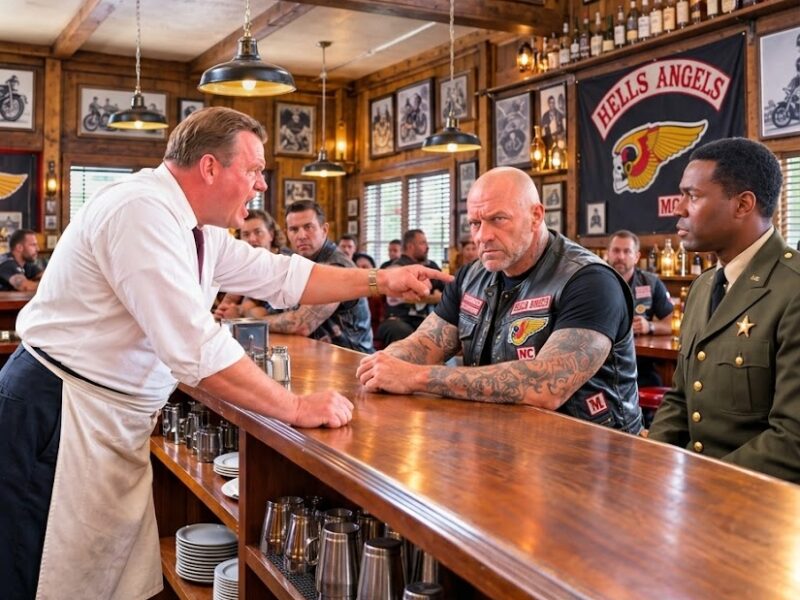
A Black Veteran Was Refused Service at a Texas Diner in 1959—Then a Hells Angels Leader Sat Beside Him
The plate hit the tile and shattered like a promise breaking. Food sprayed across the black-and-white checkerboard floor, gravy bleeding into the grout lines. A man in a pressed service jacket stood frozen by the door, his hands wrapped around his hat like it was the only thing holding him together.
He said nothing. His jaw was tight. His eyes were fixed on some middle distance that wasn’t here, wasn’t now, wasn’t this diner in Caldwell, Texas, on a Tuesday morning in the summer of 1959.
The waitress jabbed a finger toward the back door. Her nail was chipped. Her voice was worse. “Your kind eats out by the trash cans. That’s the way it’s always been and that’s the way it’s going to stay.”
The whole diner kept chewing like nothing was wrong. Forks scraped against plates. A man by the window turned a page of his newspaper with a dry rustle. A couple in the corner kept talking about their boy’s baseball game, something about a curveball that didn’t break right.
Nobody looked up. Nobody said a word. Nobody did a thing.
The soldier gave a small nod—the kind of nod that costs a man something deep and permanent—and he turned toward the door. He’d go around back. He’d knock on the kitchen door. He’d eat his meal standing up, next to the garbage, because that was the price of being born with the wrong skin in the wrong town in the wrong century.
That’s when the door swung open and a big man walked in. Military big. Thick neck. Leather vest with patches that told a story before he ever opened his mouth.
A German Shepherd padded at his heel, ears up, eyes scanning the room like she’d seen everything and trusted none of it. The man set his helmet on the counter with a heavy clunk and looked at the soldier by the back door.
His name was Clay Renfro. He rode with the Hell’s Angels. Road captain. Two tours in the Army before he ever put on a leather vest, and he carried himself like a man who’d been shot at and didn’t scare easy.
He told the cook to cancel his order. He picked up his coffee, black, and carried it straight to that soldier’s table.
What he said next turned a town’s cruelty into something nobody in Caldwell ever forgot.
But to understand what happened—really understand it—you have to go back about ten minutes. Because the beginning matters. The beginning is where the rot sets in. And the beginning is where a man decides whether he’s going to let it spread or cut it out.
The motorcycle came down the main road slow.
People heard it before they saw it. That deep rolling knock of a panhead engine bouncing off the storefronts, rattling windows, setting dogs to barking. By the time the rider pulled up in front of the Blue Star Diner, half the town was already watching him through the glass.
He was a big man. Military big. The kind of big that comes from carrying weight that isn’t just physical—weight that settles into your bones and stays there. Clay Renfro had done two tours in the Army before he ever put on a leather vest, and he carried himself like a man who’d been shot at and didn’t scare easy.
On the back of that vest was a patch. Hell’s Angels. Road Captain. In that part of Texas in the summer of 1959, that patch told people everything they thought they needed to know.
Trouble. Outlaw. Keep your distance.
They didn’t know him. They didn’t want to. They’d already made up their minds before he killed the engine.
Riding behind him in a wooden crate strapped over the saddlebag was a German Shepherd named Dakota. That dog had outgrown the crate more than a year back. Her paws hung over the edge and her ears caught the wind like flags. Clay knew she didn’t fit anymore. He just never had the heart to leave her behind.
She went where he went. That was the whole arrangement. Had been that way for six years.
He shut the engine off. The town got quiet again. He swung his leg over, rolled his shoulders, and lifted Dakota down to the dirt like she weighed nothing. She pressed against his boot and stayed there, a warm weight of loyalty that never asked questions.
Here’s the thing about Clay. He wasn’t looking for anybody. He’d been riding since before dawn, chasing a long stretch of open road toward Houston. All he wanted was coffee and a plate of eggs and maybe a cool floor for the dog.
That’s it. That’s the whole agenda.
He had money in his pocket—thirty-seven dollars, to be exact, folded neat in a silver money clip—and no quarrel with a soul in Caldwell. He pushed open the door of the Blue Star and stepped inside.
A little bell rang over his head. The whole diner did that thing small towns do when a stranger walks in. Everybody looked. Everybody judged. Then everybody pretended they hadn’t.
Clay didn’t pay it any mind. He’d been getting looked at his whole life. First because he was poor. Then because he was young and big and angry. Then because of the patch on his back. You learn to let it roll off, or you drown in it.
He set his helmet down on the counter, pulled out a stool, and sat. Dakota lay down at his feet without being told. A waitress came over.
Thin woman, maybe forty, hair pinned up tight like she was trying to hold herself together. She looked at the dog and wrinkled her nose but didn’t say anything about it.
“What’ll it be?”
“Coffee,” Clay said. “Black. And give me a minute on the food.”
She poured the coffee and walked off. And that’s when Clay noticed the man by the door.
He was standing just inside, holding his hat in both hands. A Black man, maybe late twenties, wearing a service jacket that had been pressed so careful you could have cut bread on the creases. Every button shined. His shoes were polished to a mirror.
This was a man who took pride in how he showed up to the world, and anybody with eyes could see it. He was waiting to be seated. Just waiting. Polite. Patient. Not making a sound.
Clay watched the waitress walk right past him like he was a coat rack. Then she came back around and this time she stopped. Her whole face changed. Hard. Mean.
“You can’t be in here,” she said.
“Ma’am, I’ve got money.” The man’s voice was low and even. “I just want a hot meal. I’ve been traveling.”
“I don’t care what you’ve got. We don’t serve your kind at these tables.” She pointed toward the back. “You want food? You go around to the alley and knock on the kitchen door. Cook will hand you something out by the trash cans. That’s the only way.”
The diner didn’t stop. That’s what got Clay. Nobody looked up. Forks kept scraping. A man by the window kept reading his paper. A couple in the corner kept talking about their boy’s baseball game. It was like this was so ordinary, so expected, that it didn’t even register as cruel.
It was just Tuesday in Caldwell.
And the soldier just stood there. He didn’t argue. He didn’t raise his voice. He’d clearly heard it before, in a hundred towns, and he knew that arguing only made it worse. He gave a small nod and turned toward the door to go around back.
That’s when Clay set his coffee cup down. Not hard. Just a quiet little click on the counter. And something in him decided.
Here’s what you have to understand about Clay Renfro. He’d buried men overseas. Men of every color in the same dirt under the same flag. He’d had a kid from Alabama drag him out of a ditch under fire. A Black kid named Percy who didn’t make it home.
Clay had written that boy’s mother a letter he could barely finish. Three pages, and half of them were smudged with tears he’d never admit to.
So when he saw a veteran in a pressed jacket told to eat by the trash cans, something old and hot moved in his chest. Something that had been waiting a long time to be used.
He stood up off that stool. Clay didn’t say a word to the waitress. He picked up his coffee and looked at the cook behind the pass.
“Cancel my order.”
Loud enough to carry. Loud enough to cut through the scraping forks and the murmured conversation and the whole suffocating weight of that room.
Then he turned and walked straight across the diner toward the soldier.
Now the room noticed. Oh, now they noticed. Forks slowed. Heads turned. Because a Hell’s Angel crossing a crowded floor with purpose in his step is the kind of thing that makes a whole room hold its breath.
Clay caught up to the man just as he reached the door.
“Hold on,” he said. “Don’t go back there.”
The soldier turned. He looked wary. Confused. He didn’t know if this stranger meant to help him or hurt him. In 1959, a man like him had every reason to expect the worst.
“Come on,” Clay said, and he nodded toward an empty table by the front window. “A good table. The best one in the place. Sit with me.”
The man hesitated. “Mister, I don’t want any trouble for you.”
“I know you don’t,” Clay said. “Sit anyway.”
He walked to that table, pulled out a chair, and set his coffee down. Then he snapped his fingers once. Dakota came up off the floor, trotted across the diner, and lay down right beside the table, settling between where the two men’s boots would go.
The soldier stood there a second longer. Then he made his choice. He walked over and sat down across from the biker in the best seat in a diner that had just told him he wasn’t fit to eat at all.
Clay reached a hand across the table. “Clay Renfro.”
The man took it. Firm grip. “Elias Boone.”
“Where do you serve, Elias?”
The whole diner went silent. Dead silent. The man with the newspaper lowered it. The couple in the corner stopped talking. The cook stuck his head out the pass. Forks froze halfway to mouths because everybody in that room understood what was happening.
A white man—and an outlaw, no less—had just sat down as an equal with a Black man they’d all agreed to treat like garbage. He’d done it loud. On purpose. In front of God and everybody.
Elias looked around at all those staring faces. Then he looked back at Clay, and for a second his jaw worked like he might not answer at all.
Finally, he said, “Korea. Second Infantry Division. Three years.” He paused. “Two Bronze Stars.”
Clay nodded slow. “Chosin Reservoir.”
Something flickered in Elias’s eyes. “Surprised you know about Chosin.”
“I know enough to know you earned that jacket about ten times over,” Clay said.
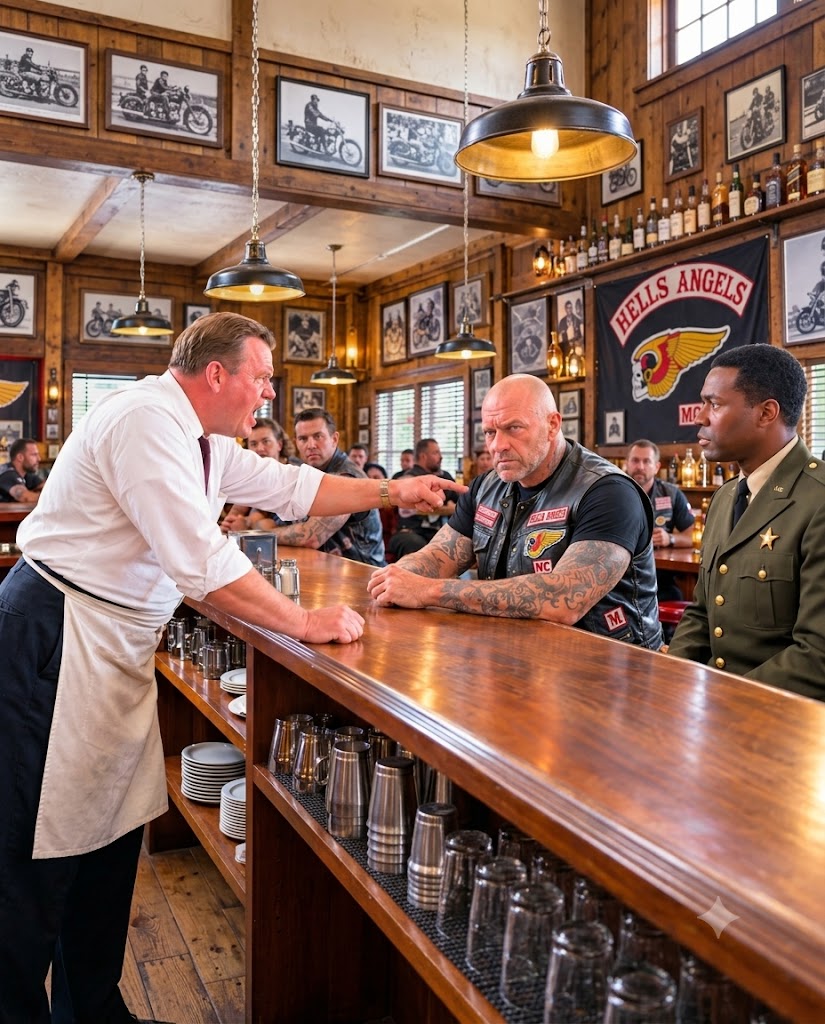
That’s when the manager came out from the back. Heavy-set man with his sleeves rolled up and a face going red. He’d clearly heard the whole thing, and he marched across the floor and planted himself at the end of the table with his fists on his hips.
“We got a problem here,” the manager said. “This man can’t sit at this table. That’s the rule. Been the rule since before you were born. And it ain’t changing today because some drifter rode into town.”
Clay didn’t look up right away. He took a slow sip of his coffee. Then he set the cup down and looked the manager dead in the eye.
When he spoke, he kept his voice calm. Kept it loud. Made sure the whole diner would hear every word.
“This man wore the uniform of the United States of America,” Clay said. “He went to a frozen hell on the other side of the world and he came back with two Bronze Stars pinned to his chest. He bled for this country. He bled for you. For your diner. For the right you’ve got to stand there and be as small as you’re being right now.”
He let that sit.
“So you’ve got two choices. You can bring this soldier the best meal in your kitchen, or you can explain to everybody in this room why a man who fought for your freedom isn’t good enough to eat in your dining room.”
Nobody breathed. The manager’s face went from red to purple. His mouth opened and closed. He looked around at his customers, and I think for the first time in his life he understood that every single one of them was watching to see what he’d do.
Cowards back down when they’re cornered. They call it mercy. They call it keeping the peace. They call it anything but what it is.
“Fine,” the manager spat. “One meal. Then you both get out.”
He stomped back toward the kitchen.
Just like that, it was over. Or at least it felt over. The waitress, looking like she’d swallowed a lemon, brought two plates to the table. Eggs. Ham. Biscuits. The works. She set them down without a word and backed away.
The diner slowly came back to life. The newspaper went back up. The couple started talking again, quieter this time. The storm had passed.
Clay picked up his fork and grinned at Elias. “Dig in. Looks like we won.”
Elias let out a breath he’d been holding for ten minutes. A small, careful smile touched his face. He picked up his biscuit. Dakota thumped her tail against the floor.
For the first time since he’d walked in, Elias Boone looked like a man who’d been allowed—just for a moment—to simply be a man.
“Thank you,” he said quietly. “I don’t know why you did that, but thank you.”
“Eat your eggs, soldier,” Clay said.
That’s where the whole thing should have ended. A good deed. A hot meal. Two strangers who’d remember each other kindly and ride off in opposite directions.
But it didn’t end there. Because while Elias had been sitting down, that manager hadn’t just walked back to the kitchen to sulk. He’d walked back to the telephone on the wall. And he’d made a call.
Elias was halfway through his eggs when the sound came through the window. Tires on gravel. A car door. Then a second one.
He set his fork down slow. Outside, two black-and-white sheriff’s cars had pulled up at an angle across the front of the diner, blocking the motorcycle in. Three men got out. One wore a sheriff’s star. The other two were deputies, and both of them had their hands resting on the butts of their revolvers.
The whole mood of the room changed in a heartbeat. Because here’s what just happened, and I want you to feel it the way those two men felt it. A minute ago, this was about one loudmouth manager and one stubborn biker. A fight about pride. About who could sit where.
Now it wasn’t about pride anymore. Now the law had arrived, and the law in a Texas town in 1959 was not on Elias Boone’s side. It was never going to be on his side.
This wasn’t a question of a meal anymore. This was a question of whether two men walked out of that diner at all.
The bell over the door rang as the sheriff stepped inside. Tall, lean man with gray at his temples and eyes that had seen every kind of trouble a small town could make. He stopped just inside the door and took in the scene. The two plates. The dog. The biker. The soldier. The whole room watching him to find out how this was going to go.
“Somebody call about a disturbance,” the sheriff said. Not a question.
The manager came hustling out of the back. “Right here, Sheriff. This one—” he pointed at Clay “—comes in here throwing his weight around. Won’t follow the rules. Puts that man at my front table like he owns the place. I want them both gone.”
The sheriff looked at Clay for a long moment. Then he looked at the patch on the vest.
“Hell’s Angels,” he said. “You’re a long way from California, son.”
“Just passing through,” Clay said. He hadn’t stood up. He hadn’t reached for anything. He just sat there with his hands flat on the table where everybody could see them. He was too smart to give them a reason. “Stopped for breakfast. That’s all.”
“That’s all,” the sheriff repeated. He walked a few steps closer. One of the deputies drifted off to the side, keeping an angle on Clay. The other stayed by the door.
This was starting to look less like a disturbance call and more like something that could end with a man face down on the floor.
The sheriff crouched down a little, bringing himself closer to Elias’s level. There was nothing kind in it.
“What’s your name, boy?”
Elias looked him in the eye. Did not look away. “Elias Boone, sir.”
“And where do you think you are, Elias Boone?”
“A diner, sir. Eating a meal I paid for.”
“A meal you paid for,” the sheriff said softly. He stood back up. “See, now that’s the problem. Because in Caldwell, that’s not a meal you’re allowed to pay for. And I think you know that. And I think this fella here knows it, too. So what we’ve got is two men deliberately stirring up trouble in a town that was doing just fine before they showed up.”
He turned to his deputies. “Get them both up. We’ll let them cool off downtown.”
“On what charge?” Clay asked. Still calm. Still level.
“Disturbing the peace. Vagrancy. Whatever I write down.” The sheriff’s hand moved to his belt. “Now you can walk out or you can get carried out. Your choice, angel.”
The deputy by Clay’s shoulder reached down and grabbed his arm.
A man like Clay—with his history, with those fists—could have turned that diner into a war in about three seconds. Everybody in the room was braced for it. You could feel it. Dakota lifted her head off the floor and a low sound rolled up out of her chest. The deputy by the door took a nervous step back.
But Clay didn’t swing. Instead, he did something that caught every person in that room off guard.
He looked up at the sheriff and in a steady voice said, “Before you cuff me, Sheriff, I want you to do one thing. I want you to look at that jacket.”
“I’ve seen the jacket.”
“No. Look at it. Second Infantry Division. Chosin Reservoir, winter of 1950. You know what happened at Chosin?”
Clay’s voice stayed quiet, but it had an edge now. The kind of edge that cuts.
“Thirty below zero. Chinese Army came over the hills. Eight divisions of them. Had our boys surrounded ten to one. And the men of the Second Infantry held the line so the rest could get out. Most of them didn’t come home. This man did. He came home with two Bronze Stars, and he came home to a country that tells him to eat by the trash cans.”
Clay looked around the whole room now. Slow. Letting them have it.
“I spent four years in the Army. I know what that jacket costs. And I’m telling you—every one of you—you are not arresting a troublemaker. You are arresting a hero. In front of your wives. In front of your kids. And one day you’re going to have to tell them you did it.”
The room was so quiet you could hear the ceiling fan turning. The sheriff’s jaw tightened.
“Pretty speech. Cuff him.”
But the deputy holding Clay’s arm didn’t move. The sheriff turned.
“Deputy, I gave you an order.”
And here’s where it turned. Because the young deputy—a kid, really, maybe twenty-two—slowly let go of Clay’s arm and straightened up. His face had gone pale.
“Sheriff,” he said, and his voice cracked. “My daddy was at Chosin.”
You could have heard a pin drop.
“My daddy was Second Infantry,” the kid said again, louder this time, like he was convincing himself as much as anybody. “He don’t talk about it. Ever. But I’ve seen his Bronze Star. It’s in a drawer by his bed.”
He looked down at Elias, and something broke open in his young face.
“This man was there with my daddy.”
He shook his head slow. “I ain’t cuffing him. I won’t do it.”
“Deputy, so help me—”
“I quit.”
The kid unpinned the badge off his own chest right there and set it down on the table next to Elias’s plate.
“I ain’t being the man who arrested a soldier for eating breakfast. Not today. Not ever.”
And then the strangest thing happened. An old man stood up from the corner booth. He had to push himself up on a cane, and his hand shook when he did it, but he stood.
“I was at Anzio,” he said to nobody and everybody. “Italy. 1944.”
He looked at Elias and brought his trembling hand up slow to his brow. He saluted him. An old man saluting across a diner floor, tears standing in his eyes.
“Thank you for your service, son.”
Then a woman stood. Then the man with the newspaper folded it and set it down and got to his feet. One by one, all around that diner, people stood up. Not for Clay. Not even against the sheriff. They stood for Elias Boone. For the jacket. For a thing that was bigger than the rule they’d all been hiding behind their whole lives.
Some of them were crying. Some of them couldn’t look him in the eye. But they stood.
The sheriff looked around his town, and he saw that he’d already lost it.
Elias Boone sat in the middle of all of it, in the best seat in the house, with a half-eaten plate of eggs in front of him and a biker’s dog at his feet. He did not know what to do with his hands.
This man who had stood frozen and silent while a waitress sent him to the trash cans now had an entire room on its feet for him. A single tear ran down his face, and he let it. For the first time in a long time, he didn’t have to pretend he was made of stone.
The sheriff stood there a long moment. Then he took his hand off his belt. Whatever he’d come in there to be, he could see there was no room left for it.
He looked at the manager, who had gone white as a sheet.
“Sam,” the sheriff said quietly, “get the man some fresh coffee. His went cold.”
He turned and walked out. The screen door banged shut behind him. The two patrol cars pulled away off the gravel and left the motorcycle sitting free.
For a second, nobody moved. Then the old veteran with the cane started it. He brought his hands together. Clap. Clap.
And then the whole diner was clapping. This strange, ragged, broken-open applause. The manager stood by the kitchen with his head down. The waitress had her apron pressed to her mouth.
Clay leaned across the table, and under all that noise, he said just to Elias, “Told you. Eat your eggs.”
Elias Boone laughed. A real laugh. Wet and surprised. He picked up his fork and ate his breakfast at the front table of the Blue Star Diner, where the light came in through the window and fell across his pressed jacket and his two Bronze Stars and his face that didn’t have to be stone anymore.
They sat there a long time after the plates were clean. Clay told him about Houston. About the road. Elias told him he was headed home to Beaumont to see his mother, that he’d been traveling two days and hadn’t eaten a hot meal the whole way because no place would have him.
He told Clay he’d nearly given up on people. On the whole idea of them. And Clay just nodded because he’d been close to that himself more than once.
When they finally walked out, the manager was waiting by the door. He wouldn’t take Clay’s money. Wouldn’t take a dime. He stood there twisting a rag in his hands and he said, so quiet you almost couldn’t hear it, “I’m sorry.”
He wasn’t saying it to Clay. He was saying it to Elias.
And Elias, who had every right in the world to walk past that man, stopped. He looked at him a long moment. Then he put out his hand.
The manager stared at it like he didn’t believe it was real. Then he took it. That handshake between those two men was a bigger thing than anything else that happened that whole day. Because the biker had won the fight. But Elias Boone, he won something harder. He gave a small man a way back out front.
Clay lifted Dakota back into her too-small crate. Elias ran a hand over the dog’s head.
“You take care of this one,” he said.
“She takes care of me,” Clay said.
He swung his leg over the panhead. Then he stopped and looked at Elias.
“You’re a better man than most I ever served with, Boone. Don’t let a single town in this country tell you different. Not one.”
Elias nodded. He couldn’t quite speak.
Clay kicked the engine over. That deep rolling knock filled the street, and he rode out of Caldwell the same way he’d come in. Slow and easy. With his dog’s ears catching the wind and the whole town watching him through the windows.
Only this time, they weren’t judging. This time, a few of them raised their hands.
You might think that’s the end. Two men. One morning. Then the road takes them their separate ways, and that’s that. For a lot of years, that’s exactly what it was.
Clay kept riding. Elias made it home to Beaumont, to his mother’s cooking and her tears at the door. They didn’t trade addresses. They didn’t make promises. Some meetings aren’t meant to turn into letters. They’re meant to turn into the kind of thing you carry.
But the thing about a morning like that is it doesn’t stay in one town. People talk. The old man with the cane told it at his church. The young deputy who quit, he told it to his daddy—the one who’d been at Chosin—and the two of them sat at the kitchen table and cried about it. The waitress quit the diner that fall and never waited a table again.
The story moved the way true stories do. From mouth to mouth. Down the roads of that part of Texas. Growing a little each time, but keeping its heart.
Elias Boone lived a long life. He married a schoolteacher. Raised four kids. Worked thirty years at the same refinery and never missed a day. Every single year on the anniversary of that morning, he told his children the same story. About the day he nearly gave up on people. About the stranger with the dog who wouldn’t let him.
He’d roll up his sleeve and show them where he still—to his last days—kept that Blue Star Diner matchbook in his wallet. The only souvenir of the day a town decided to be better than it was.
Clay Renfro never told the story to anybody. That wasn’t his way. He didn’t think he’d done anything special. To him, it was simple. You see a soldier, you stand with a soldier. You don’t ask what color his hand is before you shake it. You don’t need a reason to do a thing that’s just plain right.
He rode for another twenty years. When he finally passed, the brothers who buried him found an old photograph tucked in his vest, right over his heart. A picture somebody in that diner had snapped that morning. Two men at a front table. A plate of eggs. A German Shepherd between their boots.
On the back, in Elias Boone’s careful hand, were five words that had found their way to Clay somehow over the years.
You didn’t let me quit.
So here’s what I want you to take with you. When this whole thing started, a man in a pressed jacket stood frozen while a room full of people decided he wasn’t worth looking at. He was ready to walk out the back and eat by the trash cans because that was the price of living in that time. He’d paid it a thousand times before.
Nobody in that diner lifted a finger. Not one.
And it only took one. One stranger who had every reason to keep his head down and ride on through. One man who stood up off a stool and crossed a room and pulled out a chair.
He didn’t give a speech about courage. He didn’t carry a power you could measure in muscle, though Lord knows he had plenty of that. What he had was simpler, and it’s the rarest thing there is.
He had the nerve to sit down. To say—out loud, where everybody could hear it—this man is my equal, and I will eat beside him, and you will have to come through me if you think otherwise.
That’s the whole thing. That’s the power that no fist can match. The power to look at a frozen room and a frozen rule and a frozen town and decide that today it thaws.
The power to pull out a chair.
So the next time you see somebody standing frozen by a door, waiting to be sent out back, remember Clay Renfro and his dog and his cold cup of coffee. You don’t have to give a speech. You don’t have to win a fight. You just have to cross the room and pull out the chair and sit down beside them.
Because sometimes that’s all it takes to turn a town’s cruelty into something nobody ever forgets.









