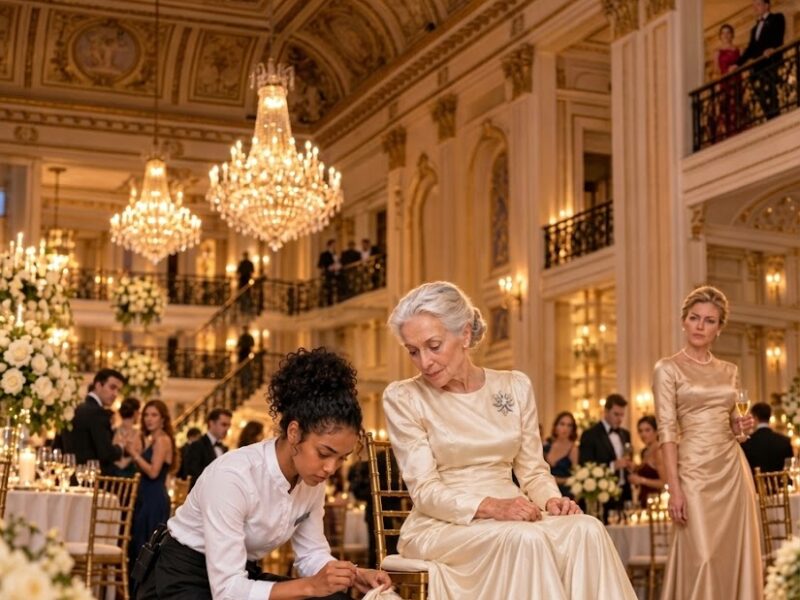
A Black Girl Quietly Repaired an Elderly Woman’s Torn Dress at a Luxury Wedding—Minutes Later, She Discovered the Woman Was Someone Nobody Dared to Ignore
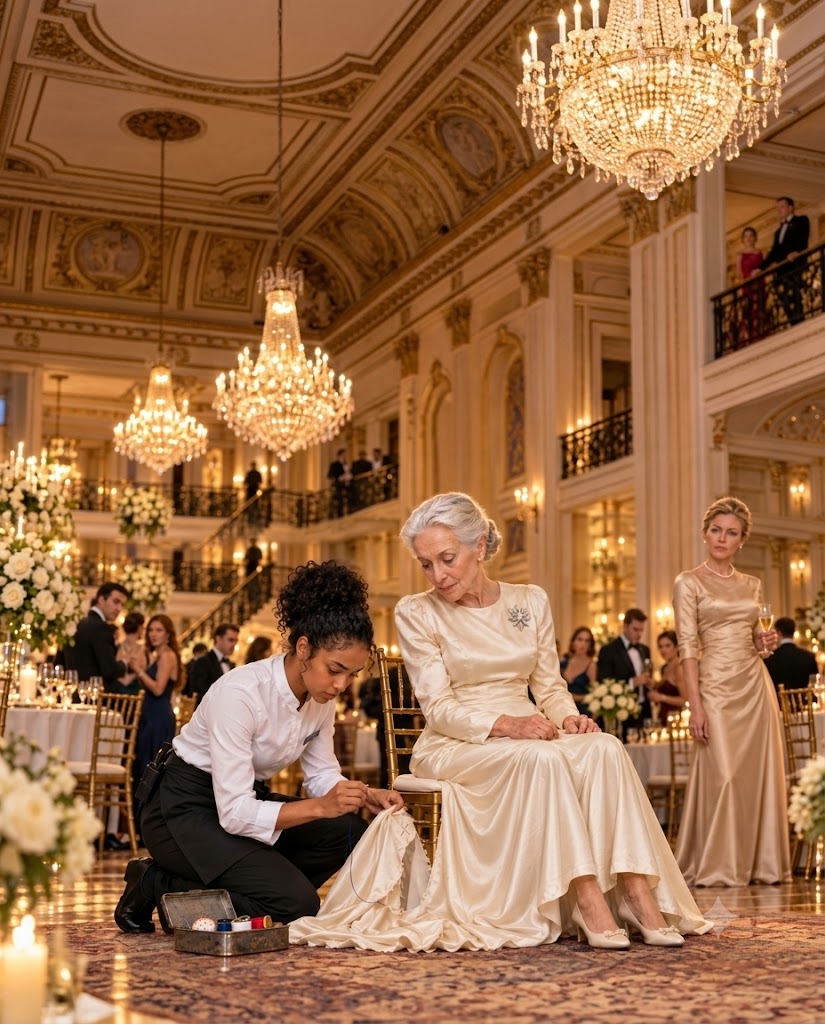
**Part 1**
The rain came down in sheets against the windshield of a 1998 Honda Civic that had seen better days — much better days — and Willa Dawson gripped the steering wheel like it owed her money. Her good shoes, the only pair without scuffs on the toes, were soaked through from the walk across the Briarwood Estate parking lot, and her uniform apron still smelled like champagne and somebody else’s expensive perfume. She’d been called a thief tonight. In front of three hundred people. In front of cameras.
The engine wouldn’t turn over. Of course it wouldn’t.
She sat there in the dark, rain hammering the roof, and thought about the look on Mrs. Whitmore’s face when she’d accused her — that curled lip, that practiced disgust, like Willa was something stuck to the bottom of those designer heels. The brooch. The old woman’s brooch. It had slipped into her apron pocket somehow, and when she’d tried to return it, she’d been called a criminal.
Her phone buzzed. Magnolia Gardens. The nursing home.
“We’ve got a bed reserved at the other facility. Payment due Friday.”
Three thousand eight hundred and sixty dollars. She had twelve dollars and forty-seven cents in her checking account and a car that wouldn’t start.
Willa pressed her forehead against the steering wheel and tried to remember how to breathe.
—
She’d been six years old the first time her grandmother taught her the blue stitch.
“Always hide one blue stitch, baby,” Grandma Rose had said, her hands steady and sure even then, guiding Willa’s small fingers through the fabric. “So the work knows whose hands made it. A good stitch don’t brag. It just holds.”
Willa had carried that lesson through every alteration, every emergency hem, every bridesmaid’s dress that split five minutes before the ceremony. She’d carried it through cosmetology school for a semester before the money ran out, through two years of community college night classes she couldn’t finish, through every shift at Belmont Catering where she was furniture — invisible, silent, disposable.
And now here she was. Twenty-six years old, unemployed, sitting in a dead car in the rain with a grandmother three hours away who was about to be moved to a facility Willa couldn’t afford to visit.
Her phone buzzed again. Danny. The server who’d told her to take the brooch.
“Did you do it? Did you get the money?”
She didn’t answer.
—
The wedding had been beautiful. Willa could admit that, even now. Briarwood Estate sat on forty acres of manicured lawns and old oaks draped in Spanish moss, the kind of place that charged more for a single chair rental than Willa made in a week. The ballroom sparkled with ten thousand fairy lights, and the flowers — peonies and garden roses in blush and ivory — probably cost more than her car.
She’d worked hundreds of events like this one. Rich folks tearing their clothes same as everybody else. They just cried louder when it happened.
But this wedding had been different.
The bride, Brooke Whitmore, had been kind. Nervous, sure — she’d been nervous for a year, her mother said — but kind. She’d thanked Willa for fixing Danny’s button. She’d smiled at her like she was a person.
And the old woman in the ivory dress. The one with the cane and the shaking hands and the eyes that saw everything.
That’s her brooch.
Willa closed her eyes and remembered the feel of the fabric between her fingers, the silk so old it whispered instead of rustled. The dress had been exquisite — hand-rolled hems, French seams, a zipper that had been taken in by someone who didn’t understand the integrity of the original work. The old woman had watched her sew with those sharp, knowing eyes, and for a moment — just a moment — Willa had felt seen.
Nobody ever asked my name.
She’d told Mrs. Whitmore that, at the end. After everything. And the woman had looked at her like she was speaking a language she’d forgotten she knew.
—
The knock on her window made her jump so hard she hit her head on the rearview mirror.
A security guard. Of course. Because this night hadn’t been humiliating enough.
“Ma’am, you can’t park here. This is private property.”
“My car won’t start.” Willa’s voice came out steadier than she felt. “I’m waiting for a tow.”
The guard — his name tag said Marcus — looked at her car, then at her apron, then at her face. Something shifted in his expression.
“You’re the one from the ballroom. The server.”
“I was the server.” She couldn’t keep the bitterness out of her voice. “I got fired.”
Marcus was quiet for a moment. The rain kept falling.
“I saw the video,” he said finally. “My cousin sent it to me. It’s already got fifty thousand views.”
Fifty thousand people watching her be called a thief. Fifty thousand people watching that brooch get yanked from her hands, watching Mrs. Whitmore’s triumphant smirk, watching her be escorted out like a criminal.
“Great,” Willa said. “Maybe I’ll go viral.”
Marcus didn’t laugh. He looked at her for a long moment, then pulled something from his pocket — a business card, slightly damp from the rain.
“My sister runs a tailoring shop over in Decatur. She’s always looking for good help. Tell her Marcus sent you.”
Willa took the card. It felt like the first kind thing that had happened all night.
“Thank you,” she said. “Really.”
“Don’t thank me yet.” Marcus stepped back from the window. “Tow truck’s probably an hour out. You want to wait in the security office? It’s dry.”
She should have said yes. Should have been practical, grateful, sensible.
But something made her look at her phone instead — at the text from Danny, still unanswered — and make a decision she couldn’t quite explain.
“I need to make a call first,” she said. “But thank you. For seeing me.”
Marcus nodded once, like he understood something she hadn’t said, and disappeared back into the rain.
—
The phone rang four times before her grandmother picked up.
“Hello? Who’s calling this late? Is it morning already?”
“It’s night, Grandma. It’s me. It’s Willa.”
“Willa.” Grandma Rose’s voice softened immediately. “My Willa. You sound wet, baby.”
“It’s raining, and my car won’t start.”
“That car’s older than I am. What happened? Your voice is shaking.”
Willa closed her eyes. In the background, she could hear the soft sounds of Magnolia Gardens — the night nurse’s squeaky shoes, the distant hum of the television in the common room, the quiet that wasn’t quite quiet.
“I lost my job tonight, Grandma.”
“Lord. What did you do?”
“I gave something back. Something that wasn’t mine.”
“And they fired you for that? For being honest?”
“They said I stole it. Right in front of everybody. They were filming me.” Willa’s voice cracked. “I did the right thing, Grandma. Why does it feel like losing?”
There was a long pause. When Grandma Rose spoke again, her voice was gentle but firm — the voice she’d used when Willa was six and had broken a needle and cried because she thought she’d ruined everything.
“Right thing don’t always pay on Friday, baby. But it pays.”
“I don’t know how I’m going to pay Friday now. I really don’t.”
“Hush. We’ll figure it out. We always do.” Grandma Rose’s voice shifted. “Now, tell me one good thing from tonight. Just one.”
Willa thought about it. The rain. The brooch. The old woman’s eyes.
“There was a lady. Old like you. I fixed her dress.”
“Was it pretty?”
“So pretty. And there was a red stitch hidden inside, like your blue one.”
“Red, huh?” Something in Grandma Rose’s voice changed — interest, maybe, or recognition. “Blue’s a whisper, baby. Red’s a name. A woman who hides red in her seams, she’s somebody.”
“She said she was just a retired seamstress.”
“Mhm. So am I. And look how much trouble I am.”
Willa laughed despite herself. “Yeah, you really are.”
“You want me to sing you that song? The rainy one?”
“Yeah, Grandma. Please.”
And there, in a dead car in a parking lot she wasn’t supposed to be in, Willa let her grandmother’s voice wash over her — the same song she’d sung when Willa was small and scared of thunderstorms, the same melody that had carried her through every hard night of her life.
“You only need a little light to make it through the night…”
When the song ended, Grandma Rose was quiet for a moment.
“Somebody’s looking for you tonight, baby. I can feel it.”
—
The tow truck arrived forty-five minutes later. Willa rode in the cab next to a man named Ed who didn’t ask questions and didn’t seem to recognize her from the video that was apparently spreading across social media like wildfire.
By the time she got home — a one-bedroom apartment in a complex called Oak Ridge that had neither oaks nor ridges — it was almost midnight. She stripped off her damp uniform, hung it over the shower rod to dry, and collapsed onto her mattress.
Her phone buzzed one more time.
Danny: “Hey. I know tonight was rough. But I meant what I said. That pin’s worth ten times your debt. Easy. Nobody would ever know.”
Willa stared at the message for a long time.
I’d know.
She didn’t send it. She just set the phone face-down on her nightstand and closed her eyes.
Tomorrow she’d figure out what came next. Tomorrow she’d call Marcus’s sister. Tomorrow she’d find a way to pay Grandma Rose’s bill before Friday.
Tomorrow.
—
**Part 2**
The video went viral overnight.
By the time Willa woke up — later than she’d meant to, her phone blaring an alarm she didn’t remember setting — her name was trending on Twitter in Atlanta, and her face was plastered across every local news station.
“Local server accused of stealing at luxury wedding” — that was the headline on Channel 2.
“Bride’s mother defends decision to remove ‘thief'” — that was Channel 5.
And then, scattered among the outrage and the think-pieces and the hot takes, there were the videos. Dozens of them. Different angles, different perspectives, all capturing the same moment: Willa being accused, Willa being dismissed, Willa being escorted out into the rain.
Fifty thousand views had become two million.
Willa sat on the edge of her mattress and watched herself get humiliated over and over again, and felt something strange crystallizing in her chest. It wasn’t anger. It wasn’t shame.
It was exhaustion.
Her phone rang. She almost didn’t answer.
“Willa Dawson?”
“Yes?”
“This is Gail Mercer. From Belmont Catering.”
Willa’s grip tightened on the phone. “I thought I was fired.”
“You are. That’s not why I’m calling.” A pause. “The video’s gotten a lot of attention. There’s a reporter from the AJC who wants to talk to you. I told her I’d pass along the message.”
“Why?”
Another pause, longer this time. “Because I saw what happened on that terrace, Willa. I saw Mrs. Whitmore step on that dress. And I didn’t say anything.”
Willa remembered. The heel. The tearing fabric. The old woman falling.
“And now?”
“And now I’ve had a long night of thinking about what I’ve kept my head down for. Twenty years, Willa. Twenty years of keeping my mouth shut while good people got blamed for things they didn’t do.” Gail’s voice cracked. “I’m not saying I can fix this. But I’m saying I’m done being quiet.”
—
The reporter’s name was Jasmine Okonkwo, and she met Willa at a coffee shop in Decatur two hours later. She had a recorder, a notebook, and the kind of focused intensity that made Willa feel like she was being X-rayed.
“I’m going to be honest with you,” Jasmine said. “This story’s blowing up because of the racial dynamics. Black server, white wealthy family, public humiliation. People see what they want to see.”
“I didn’t do anything wrong.”
“I believe you. But that’s not the point.” Jasmine leaned forward. “The point is that this is a story about power. About who gets believed and who doesn’t. And I want to tell it right.”
Willa thought about the brooch. The old woman. The red stitch hidden in the seam of a dress that had cost more than her annual rent.
“There was another woman there,” she said slowly. “An older lady. The groom’s grandmother. She was the one who lost the brooch.”
“The one in the ivory dress?”
“Yeah. She was…” Willa paused, trying to find the right words. “She saw me. Not like a server. Like a person. We talked while I fixed her dress.”
“What did you talk about?”
“Stitches. Fabric. How to hide a signature.” Willa smiled despite herself. “She told me I was wasting my hands on trays.”
Jasmine’s pen stopped moving. “Do you know who she was?”
“Just a retired seamstress. That’s what she said.”
“Did she tell you her name?”
“No. But she had this dress — this beautiful, old dress — with a red stitch hidden in the seam. My grandma does the same thing, but with blue. It’s a way of signing your work.”
Jasmine was quiet for a moment. Then she pulled out her phone and started typing.
“What are you doing?”
“Checking something.” She scrolled for a minute, then looked up with an expression Willa couldn’t read. “Did this woman happen to have a cane?”
“Yeah. How did you—”
“And she was the groom’s grandmother? Grant’s grandmother?”
“That’s what she said.”
Jasmine set her phone down carefully, like it might explode.
“Willa, I think I know who you met last night. And if I’m right, this story just got a lot more interesting.”
—
The old woman’s name was Vivian Hale.
It took Jasmine three hours to confirm it, and by the time she called Willa back, she’d already confirmed it with two different sources and a 1987 profile in Atlanta Magazine.
“Vivian Hale founded Hale House sixty years ago,” Jasmine said, her voice buzzing with excitement. “She was one of the most celebrated wedding dress designers in the country. Her gowns were worn by governors’ wives, senators’ daughters, celebrities. And then, about thirty years ago, she just… disappeared.”
“Disappeared?”
“Retired. Completely. Moved somewhere private. The company kept going — her designs are still sold under the Hale House name, still cost a fortune — but nobody’s seen her face in decades. She’s basically a legend in the fashion world.”
Willa thought about the old woman’s shaking hands. The way she’d watched Willa sew with those sharp, knowing eyes. The red stitch hidden in the seam of an eighty-thousand-dollar dress.
“Did she really design that wedding dress?”
“She designed every dress that comes out of Hale House. At least, she used to. Nobody knew she was still working.” Jasmine’s voice softened. “Willa, you fixed Vivian Hale’s dress. You talked to her about stitches. You’re the only person in that ballroom who treated her like a human being.”
“I didn’t know who she was.”
“That’s exactly the point.”
—
The story ran three days later. Jasmine called it “The Invisible Woman” and it started like this:
“On Saturday night, a young Black server was accused of stealing a brooch from a grandmother at a luxury wedding in Buckhead. She was called a thief, escorted out of the venue, and publicly humiliated. What nobody knew — what nobody could have known — was that the grandmother was Vivian Hale, the reclusive founder of Hale House, one of the most prestigious wedding dress ateliers in the country. And what happened next would change everything.”
Willa read the article four times. Then she called her grandmother.
“You’re famous, baby,” Grandma Rose said, her voice warm with pride. “I always knew those hands wouldn’t stay on trays.”
“I didn’t do anything, Grandma. I just fixed a dress.”
“You did the right thing. That’s more than most folks ever do.”
Willa thought about Mrs. Whitmore. About the way she’d looked at her — not as a person, but as a problem to be solved, a stain to be removed.
“I don’t want to be famous for being humiliated.”
“Then don’t be.” Grandma Rose’s voice was gentle but firm. “Be famous for being the girl who fixed the dress. Be famous for being the girl who walked back into that ballroom and did what needed to be done. That’s the real story, baby. That’s the story you tell.”
—
**Part 3**
The phone call came on Thursday morning.
Willa was at the tailoring shop Marcus’s sister ran in Decatur — a tiny place called Threads with a hand-painted sign and a cat named Needle who slept in the window. She’d been there for two days, helping with alterations, trying to remember what it felt like to work with her hands instead of her feet.
“Willa Dawson?”
“This is she.”
“This is Brooke Whitmore.”
Willa almost dropped the phone.
“I’m sorry — who?”
“Brooke Whitmore. The bride. From Saturday.” A pause. “I know this is strange. I got your number from Gail. I wanted to call sooner, but my mother…”
“Your mother accused me of stealing.”
“I know. I’m so sorry. That’s why I’m calling.” Brooke’s voice was shaking. “I’ve been trying to figure out how to fix this. The video, the news, everything. My mother won’t apologize. She keeps saying she was protecting the guests, protecting the wedding. But I saw what happened on that terrace. I saw her heel on that dress.”
“You saw it?”
“I didn’t understand it at the time. But when I watched the video… I recognized the angle. The timing. She stepped back to move the grandmother out of the photo, and she tore the dress.” Brooke’s voice cracked. “She knew it was her fault. She blamed you anyway.”
Willa was quiet for a moment. In the window, Needle the cat stretched and yawned.
“Why are you telling me this?”
“Because I want to make it right. I don’t know how yet, but I want to try.” A pause. “Also, there’s someone who wants to meet you. She’s been asking about you since Saturday night.”
“Who?”
“Vivian Hale. My husband’s grandmother. She saw the article. She wants to see you.”
—
The Hale House atelier sat in a converted warehouse in the West End, a neighborhood that had once been industrial and was now caught somewhere between gentrification and survival. Willa parked her car — it had started that morning, miraculously — and stood outside the door for a full minute before she knocked.
The woman who answered was not what she expected.
Vivian Hale was small and sharp and ancient, her white hair pulled back in a careful bun, her eyes as bright and knowing as they’d been at the wedding. She held a cane in one hand and a cup of tea in the other, and she looked at Willa like she’d been expecting her for years.
“You’re late.”
“I didn’t know I was coming.”
“You knew.” Vivian turned and walked into the atelier, not looking back. “Come. We have work to do.”
The atelier was a cathedral of fabric. Bolts of silk and satin and lace lined the walls, organized by color and weight and purpose. Dress forms stood in various stages of completion, draped in half-finished gowns that caught the light like stained glass. And in the center of it all, a massive cutting table covered in patterns and pins and the tools of a lifetime of creation.
“Sit,” Vivian said, gesturing to a stool. “I’ve been reading about you.”
“I’m sorry.”
“Don’t be. It’s a good story.” Vivian settled into a chair across from her. “A young woman, trained by her grandmother, forced to leave school to care for her family. Working as furniture at a wedding, treated like a thief, and yet — still willing to fix a torn dress for a stranger who had been nothing but kind to her.” She tilted her head. “You’re either very brave or very foolish.”
“Maybe both.”
“Good. The best people usually are.” Vivian set down her tea. “I told you at the wedding that you were wasting your hands on trays. I meant it. Those hands are the hands of a seamstress — a real one. Somebody who understands the fabric, respects the work, signs the stitch.”
Willa thought about the blue stitch her grandmother had taught her. The way it felt to hide a piece of yourself in every piece you made.
“My grandma taught me.”
“Your grandma sounds like a wise woman.”
“She is.”
“Then she’ll understand what I’m about to offer you.” Vivian leaned forward. “I want you to be my apprentice.”
Willa’s mouth opened, then closed. “What?”
“My hands shake too much to sew anymore. I’ve been designing, but I can’t do the work. And I’ve been looking for someone — someone who understands that a dress is not just fabric and thread, it’s a promise. A promise to hold someone up on the most important day of their life.” Vivian’s eyes were bright. “You made that promise on Saturday night, even when you had no reason to. That’s not just skill, Willa. That’s character.”
“I can’t afford—”
“I’ll pay you.” Vivian named a number that made Willa’s heart stop. “And your grandmother’s bill — I heard about that. Magnolia Gardens, is it? I’ll cover it. Consider it a signing bonus.”
“Why?”
“Because I’ve been the old woman by the kitchen door, Willa. I’ve been the one nobody saw, nobody noticed, nobody believed. And I’ve been waiting thirty years for someone to remind me what it feels like to be seen.”
—
**Part 4**
Three thousand eight hundred and sixty dollars.
Willa paid the bill on Friday morning. She walked into Magnolia Gardens with a cashier’s check and a heart that felt lighter than it had in months. The administrator looked at the check, then at Willa, then at the check again.
“This is the full amount.”
“It is.”
“All at once?”
“All at once.”
The administrator smiled. “Your grandmother’s been telling everyone you’re famous. Something about a wedding?”
“She’s always been proud of me.”
“She talks about you every day. Every single day. The other residents are probably tired of hearing it, but I never get tired of listening.” The administrator’s voice softened. “You’re lucky to have her.”
“I know.”
—
Grandma Rose was sitting by the window when Willa walked in, a half-finished quilt spread across her lap and her eyes fixed on the garden outside. She didn’t turn around, but Willa knew she’d heard her footsteps.
“You’re early,” Grandma Rose said. “I haven’t even had breakfast.”
“It’s noon, Grandma.”
“Is it? Well. Time moves different when you’re old.” Grandma Rose finally turned, and her face broke into a smile so wide it made Willa’s heart ache. “There she is. My famous girl.”
“I’m not famous.”
“You’re on the news. That’s famous.” Grandma Rose patted the chair beside her. “Sit. Tell me everything.”
Willa told her. About the video. About Jasmine’s article. About Mrs. Whitmore’s heel and Gail’s confession and the way the world had seemed to tilt overnight. She told her about Brooke’s phone call, about the atelier in the West End, about Vivian Hale’s shaking hands and bright eyes and impossible offer.
“She wants me to be her apprentice, Grandma. Can you believe it? Vivian Hale. The Vivian Hale. She wants to teach me everything she knows.”
Grandma Rose was quiet for a moment. Then she reached out and took Willa’s hands in her own — the same hands that had taught her the blue stitch, the same fingers that had guided her through every first stitch and last hem and everything in between.
“Show me,” Grandma Rose said. “Show me what you did.”
Willa pulled the tin from her bag — the old tin with the dents and the needles and the threads and the blue stitch she’d carried with her for twenty years. She opened it and laid it on the bed between them.
“There’s a new stitch,” she said. “Vivian gave it to me. The red one.”
Grandma Rose picked up the tin. She turned it over in her hands, examining it like it was a treasure she hadn’t seen in years.
“Red and blue,” she said softly. “In the same tin.”
“Red is hers. Blue is mine.”
“Red’s a name, baby. I told you that.” Grandma Rose smiled. “A woman who hides red in her seams, she’s somebody. And now you’re the one carrying it.”
“She said the hands are the signature. Not the thread.”
“Smart woman.” Grandma Rose set the tin down carefully. “You know, I always wondered what would happen to my stitch when I was gone. I thought it would just… disappear. Get lost in some old dress nobody remembered.”
“It won’t disappear. It’ll be in every dress I make for the rest of my life.”
“And the red?”
“The red, too.” Willa squeezed her grandmother’s hands. “I’m going to sign every dress with both. Red and blue. So the work knows whose hands made it.”
“Both of us.”
“Both of us.”
Grandma Rose’s eyes filled with tears — the good kind, the kind that comes from a place of overwhelming pride — and she pulled Willa into a hug that smelled like lavender and old fabric and home.
“You’ve made me so proud, baby. So proud.”
“I love you, Grandma.”
“I love you too, Willa. My Willa. The girl who fixed the dress.”
—
**Part 5**
The Hale House atelier became Willa’s second home.
She spent every day there — early mornings, late nights, learning the way Vivian had learned sixty years ago, from the ground up. She learned the difference between silk and satin, between a French seam and a flat-felled seam, between a dress that looks good and a dress that feels like it was made for you.
Vivian was a demanding teacher. She didn’t tolerate shortcuts, didn’t accept “good enough,” didn’t let Willa get away with anything less than her best. But she was also patient in a way that Willa hadn’t expected, always willing to explain, to demonstrate, to show her the way.
“Your grandmother taught you well,” Vivian said one afternoon, watching Willa finish a bodice. “The fundamentals are all there. What you need now is practice.”
“I’ve been sewing for twenty years.”
“You’ve been sewing for twenty years,” Vivian agreed. “But you’ve been working on cheap fabric and cheap thread and cheap expectations. Now you’re working on silk. It’s a different animal.”
“I know.”
“Do you? Then show me.”
Willa showed her. She spent three weeks on her first Hale House dress — a simple evening gown in midnight blue that took every skill she had and then some. When it was finished, Vivian examined it with her usual sharpness, turning it inside out, checking every seam, every hem, every hidden stitch.
“Show me the signature,” she said.
Willa turned the dress inside out one more time and pointed to the hem. There, hidden in the fold where no one would ever see it, were two stitches — one blue, one red.
“Red and blue,” Vivian said softly.
“Red and blue.”
“Your grandmother would be proud.”
“She is proud.” Willa smiled. “She tells everyone at the nursing home that she taught me everything I know. Which is true.”
“Not everything.”
“No. But the most important things.”
—
The second story ran a month later.
Jasmine called it “Red and Blue” and it started like this:
“Three months ago, Willa Dawson was called a thief at a wedding she wasn’t even supposed to be at. Today, she’s the newest apprentice at Hale House, learning from the legendary Vivian Hale herself. And the dress she just finished — the first dress she ever made with silk — carries two signatures hidden in its hem. One blue. One red. Because Willa carries her grandmother’s legacy and Vivian’s together, one stitch at a time.”
The article was shared thousands of times. The video of Willa being called a thief was still online — still showing up in feeds, still sparking outrage — but now it was accompanied by something else. Something better.
People were calling her brave. People were calling her inspiring. People were calling her the kind of person the world needed more of.
Willa didn’t feel brave. She didn’t feel inspiring.
She just felt like herself.
—
The wedding was in June.
Not Brooke’s wedding — that had already happened, in the middle of everything, and Willa had watched from the sidelines as Brooke and Grant danced for the first time as husband and wife. It had been a beautiful moment, a redemption of sorts, and Willa had felt something shift in her chest as she watched.
But this wedding was different.
This wedding was Grandma Rose’s.
She’d been talking about it for months — a small ceremony at Magnolia Gardens, just family and friends and the other residents. She wanted to marry the man she’d been seeing for two years, a retired carpenter named Harold who made her laugh and brought her flowers every Sunday.
Willa made the dress. Of course she made the dress.
She spent six weeks on it, choosing the fabric carefully — a soft ivory silk that matched Grandma Rose’s eyes — and cutting the pattern with precision that would have made Vivian proud. She sewed every stitch by hand, just like she’d been taught, and when it was finished, she turned it inside out one more time and added the signatures.
Blue, for Grandma Rose.
Red, for Vivian.
Both, for Willa.
—
The ceremony was small and simple and perfect.
Grandma Rose walked down the aisle on Willa’s arm, her face bright with joy and her ivory dress trailing behind her like a dream. Harold waited at the front, tears streaming down his face, and when he saw her, he said something that made everyone laugh: “You look like an angel. An old angel. But an angel.”
“You’re not so bad yourself,” Grandma Rose said.
And then they were married — two people who had found each other late in life, two people who had decided that love was worth the wait — and Willa stood beside them and cried and laughed and felt her heart expand in a way she hadn’t known was possible.
—
After the ceremony, Willa sat with her grandmother in the garden. The sun was setting over the trees, painting everything in gold, and Grandma Rose’s dress glowed in the light like it was lit from within.
“Thank you for this,” Grandma Rose said. “The dress. The wedding. Everything.”
“You don’t have to thank me.”
“I know. But I want to.” Grandma Rose reached out and took Willa’s hand. “You know, when I was your age, I never thought I’d make it this far. I thought I’d be alone forever. I thought I’d be forgotten.”
“You could never be forgotten.”
“Maybe not. But I thought so.” Grandma Rose smiled. “And then you came along. My Willa. My girl. You made me remember that I wasn’t just an old woman in a nursing home. I was a seamstress. I was a teacher. I was somebody.”
“You’re still somebody.”
“I know. Because you showed me.” Grandma Rose squeezed her hand. “You showed me that the blue stitch matters. That the work matters. That the hands that make it matter.”
Willa thought about the tin — the old tin with the dents and the needles and the threads and the stitches. She thought about the way it had traveled with her from place to place, from job to job, from failure to failure. She thought about the way it had always reminded her of who she was and what she came from.
“I’ll keep sewing,” she said. “I’ll keep hiding the blue stitch. I’ll keep signing the work.”
“And the red?”
“Red and blue. Together. From now on.”
Grandma Rose nodded. “That’s right. That’s exactly right.”
They sat in the garden for a long time, watching the sun go down, and Willa felt like she finally understood something she’d been trying to understand for years.
The good stitch don’t brag. It just holds.
—
**Epilogue**
Two years later, Willa Dawson opened her own tailoring shop in a small space in Decatur. She called it Blue and Red, and the sign above the door was hand-painted in the colors of her two signatures.
She specialized in wedding dresses. She specialized in second chances. She specialized in working with people who had been told their whole lives that they were nobody.
And every single dress she made — every gown, every bodice, every hem — carried two stitches hidden in the seam.
One blue.
One red.
—
The last time Willa saw Mrs. Whitmore was at a charity gala three years later. The woman had come — of course she had come, she was on the board of every charity in Atlanta — and she had stopped when she saw Willa across the room.
Willa didn’t stop. She didn’t smile. She didn’t forgive.
But she didn’t need to.
She had her grandmother’s blue stitch. She had Vivian’s red stitch. She had the tin in her bag and the work in her hands and a life she had built from the wreckage of a single night.
And that, she realized, was enough.
—
The old tin sat on her workbench now, the dents and scratches worn smooth by decades of use. Inside were the needles and the threads and the memories — the blue stitch from her grandmother, the red stitch from Vivian, the lifetime of work that had made her who she was.
Willa opened it sometimes just to look. Just to remember.
“A good stitch don’t brag,” she would say to herself, quoting her grandmother. “It just holds.”
And then she’d pick up her needle and get back to work.
Because that was the thing about stitches. They held. Through everything. Through anything.
And so did she.
—
**THE END**









