A Black Girl Brought Breakfast to a Lonely Old Man for Months—Then a Helicopter Landed Outside Her Home
“Sir, when was the last time you ate?”
“I don’t remember.”
“I’ll be back tomorrow. 6:30. I’ll bring you something hot.”
“You don’t have to.”
“I know.”
She only had twelve dollars left in her purse. Her grandmother’s heart medication was almost out, and the refrigerator was nearly empty.
And still, she cooked breakfast for him.
“Lena! Lena, we have nothing left. Grandma needs her medicine. And you’re out here giving our last bit of food to a stranger?”
“He has no one, Terrence. No one. If I don’t feed him, who will?”
She was fired for being late. The neighbors called her a traitor. Even her own family begged her to stop.
She didn’t stop.
Five months. Every single morning.
Then one morning, a helicopter landed in her neighborhood, and the person it came to find turned out to be her.
But before the helicopter, before the cameras, before any of that, there was just an alarm clock.
4:45 a.m. Every single day.
Lena’s phone buzzed against the nightstand, its screen cracked, one corner held together with a strip of tape. She reached for it with her eyes still closed.
Same alarm. Same darkness. Same tired body dragging itself out of bed.
Her bedroom was small. The floral wallpaper was peeling at the edges, curling away from the wall like it was tired too.
A culinary school brochure was taped to the closet door. Johnson & Wales was circled in red marker, the ink pressed so hard it had nearly torn the paper.
Next to it was a sticky note in her handwriting. “$22,000. Keep going.”
Below that was an older note, the ink slightly faded. “They said no twice. Try again.”
She got dressed in the dark. Quiet. Careful.
Doris, her grandmother, was still asleep down the hall. Lena could hear the faint hum of the oxygen machine beside her bed, steady as a heartbeat she was trying to protect.
She slipped on her mother’s gold bracelet. Thin. Delicate. A little tarnished near the clasp.
She touched it for a second, like a prayer. She never left the house without it.
Her mother died when Lena was nine. A car accident, on the way home from her third job, at eleven o’clock at night on a stretch of highway the city had stopped lighting years ago.
A tire blew. The guardrail hadn’t been replaced in over a decade.
Lena didn’t talk about it much. But every morning, she touched that bracelet. Every single morning.
The kitchen was small, with old linoleum curling at the corners and a gas stove with four burners. One of them hadn’t worked in two years.
She turned on the three that did and started cooking.
Grits. Scrambled eggs. A few sausage links. Butter crackling in the pan until the whole room smelled like Sunday.
She hummed while she cooked, low and soft. “His Eye Is on the Sparrow,” the way Doris used to hum it when Lena was little and afraid of thunder.
For a moment, the kitchen filled with butter and coffee and something that almost felt like everything was okay.
She plated Doris’s breakfast, covered it with foil, and left a note on the table. “Took your meds out. Appointment at 2:00. Love you, baby.”
Under it, she left a reminder for herself. “Call pharmacy. They shorted the heart pills again.”
Third time in four months.
She ate standing up, leaning against the counter, scrolling her phone. Then she opened her bank app.
$1,243.06.
Six months ago, that number had been $3,800.
Then Doris’s blood pressure spiked, and she spent three days in the hospital. Then the heart medication went up to $180 a month, with no generic available. Then the insurance company denied the follow-up cardiology appointment.
“Not medically necessary,” they said. For a 74-year-old woman with a heart condition.
Lena appealed. Denied. She appealed again. Still waiting.
She did the math the way she did every morning. At this rate, culinary school was three years away. Maybe four.
She put the phone down. She didn’t cry. She rinsed her plate, picked up her keys, and walked out into the dark.
The Griddle was a no-frills breakfast diner six blocks from her house. Lena had worked there for two years.
Prep shift. First one in, last one noticed.
Earl Davis, the owner, was a decent enough man. Decent in the way people are decent when they never actively hurt you, but never actively help you, either.
He paid her $11.50 an hour. No benefits. No raises.
She prepped biscuit dough, chopped onions, and portioned bacon into neat little stacks. Same routine, same station, same silence.
But here’s what nobody at the Griddle talked about.
Six months earlier, Lena had quietly changed the biscuit recipe. She adjusted the buttermilk ratio. Added a touch of honey. Switched to a higher-fat butter.
Small changes. Invisible to anyone who wasn’t watching.
Biscuit orders tripled.
Earl noticed. He hand-lettered a sign and hung it in the front window. “Earl’s Famous Buttermilk Biscuits.”
He never asked Lena. He never credited her. He never even said thank you.
And last month, the head cook position opened up.
Lena asked for it. Straight. Direct. Polite.
Earl rubbed the back of his neck and looked at the floor. “Look, Lena, you’re great back here. But the kitchen is front-facing now. Customers are used to a certain look. I’ve got to think about the business.”
He hired Brad Wallace instead.
Twenty-four years old. White. Six months of cooking school. A kid who couldn’t tell kosher salt from table salt.
Lena trained him. Two full weeks. She taught him her systems, her timings, her shortcuts.
She was still making $11.50.
Her coworker Nina leaned over the prep table one morning and lowered her voice. “You still saving for that school?”
“Trying.”
Nina shook her head. “Girl, you cook better than half the chefs on TV. It ain’t fair.”
Lena smiled. She didn’t answer, because there was nothing to say that wouldn’t sound like complaining, and she had never let herself complain.
She stuffed her tips into her apron pocket. Fourteen dollars in cash.
That night she drove home and found Doris at the kitchen table, three open envelopes spread out in front of her.
Doris tried to slide them under a magazine when she heard the door. Too slow.
Medical bills.
“I told you I’d handle it,” Doris said.
“Grandma.”
One word. That’s all Lena said. But it carried everything. I see the bills. I know you can’t pay them. I know it’s on me. And I’ll figure it out.
Doris looked at her. Really looked. “You look tired, baby.”
“I’m fine.”
“You’re always fine. That’s the problem.”
Doris paused. Her voice dropped so low Lena almost missed it.
“Your mama was fine, too. Right up until she wasn’t.”
The room went still.
The house was falling apart around them. A leak in the hallway ceiling, with a bucket underneath already half full. The living room window sealed with plastic sheeting and duct tape.
A crocheted blanket lay folded on the couch, made by Doris years ago. Threadbare now, but still there.
This house was loved. But love doesn’t fix a roof.
That evening, Lena sat on the porch with her tea going cold in her hands. She looked across the street, and that’s when she really saw him.
The smallest house on the block. A porch light flickering on and off, on and off, like it couldn’t decide whether to give up.
And a man, old, white, alone, sitting in a wooden chair and staring at nothing.
But what Lena didn’t know yet, what nobody on Belmont Street knew, was that the man in that chair had once built an empire and lost everything that made it matter.
She had seen him before. He sat out there every morning.
But it wasn’t until the rain that she actually looked.
His name, not that anyone knew it, was Edmund. No last name offered. No backstory. Just an old white man who had moved into the smallest house on Belmont Street five months earlier.
He paid cash. No furniture was delivered. No family visited. No explanation was given.
He sat on his porch every morning at 6:15. Same wooden chair. Same pressed shirt, buttoned to the collar. Same stillness.
He didn’t wave at anyone. Nobody waved at him.
And the neighborhood noticed.
Patty Cole, Lena’s neighbor, ran an informal daycare out of her living room and knew everybody’s business. She said it plainly over the fence one afternoon.
“That old man? White man moves into this neighborhood, pays cash, no furniture? Girl, you know what that means.”
“Maybe he’s just—”
“First it’s one. Then it’s a coffee shop with eight-dollar lattes. Then the rent goes up, and we’re all gone. I seen it happen on 4th Street. I seen it happen on Graham Avenue. I ain’t watching it happen here.”
Patty wasn’t paranoid. She was experienced.
Gentrification had already swallowed three Black neighborhoods in Charlotte in the last decade. Belmont Street was cheap because nobody had ever invested in it. And a white stranger paying cash for a rental was a signal, whether he meant it to be or not.
Terrence took it even further.
He pulled Lena aside one evening by her car. “Why’s he even living over here? Ain’t no old white man just ends up on Belmont Street.”
He lowered his voice.
“And I don’t need to see you carrying plates over there like it’s 1955, Lena.”
He didn’t finish the thought. He didn’t have to.
The image of a Black woman serving a white man carried a weight that neither of them could pretend away.
Lena didn’t argue. But she watched Edmund from her porch, and she noticed things other people didn’t.
His hands shook when he lifted his coffee mug. His clothes were clean, but they hung loose on him, like the clothes of a man who had once been bigger.
He sat outside even when it was cold. Even when it rained. He never went anywhere.
Nobody ever came.
She thought, “He’s not a developer. He’s just alone. And I know what alone looks like.”
But she kept her distance.
Until the Thursday everything changed.
Late October, Charlotte got hit with a cold, heavy rainstorm, the kind that floods the gutters and turns the sky black by three in the afternoon. The wind bent the trees sideways. The streets emptied fast.
Lena came home from her ride-share shift around six, soaked and exhausted.
It had been a bad shift. One passenger took a single look at her face, checked the app twice, canceled the ride, and walked away.
She sat in the car for thirty seconds before swiping to the next request.
Now she pulled up to her house and turned off the engine. She glanced across the street.
Edmund was still on the porch.
Not in his chair. On the steps, slumped against the railing. His shirt was soaked through. His head hung low. He wasn’t moving.
Her stomach dropped.
“Oh God. Is he dead?”
She ran across the street, through the rain, up his steps.
“Sir? Sir, are you okay?”
He wasn’t dead, but he was barely conscious. His eyes were glassy. His lips were dry and cracked. His skin had gone gray.
He looked up at her slowly, like it cost him everything, and said very quietly, “I forgot to eat today.”
A pause.
“Yesterday, too, I think.”
She touched his forehead. Cold. Not feverish. Just cold, and weak, and empty.
She looked through the front window. The house was dark inside.
“Do you have anyone I can call?”
He shook his head. Slowly. Finally.
“Nobody.”
She had every reason to walk away.
A Black woman, alone, entering a white stranger’s house at night in the rain. Terrence’s voice in her head. Patty’s warnings. A lifetime of lessons that said protect yourself first, because nobody else will.
She grabbed his arm and helped him up.
He was tall, but light. Frighteningly light, like something had been eating him from the inside for a long time.
She walked him through the front door.
Inside, the house was almost empty. A folding table. Two chairs. A small TV, unplugged, sitting on the floor.
The kitchen was worse. One can of soup on the counter. A loaf of bread, stale and hard. A single mug in the dish rack.
And above the kitchen table hung the one thing that didn’t belong.
A small oil painting of a lavender field. Delicate. Beautiful. Set in an expensive gilded frame that probably cost more than the rent on this entire house.
Lena noticed it. But she didn’t ask. Not now.
She sat Edmund at the table. She heated the soup, found a clean glass, and filled it with water.
She watched him eat slowly, his hands trembling around the spoon.
When he finished, he looked up at her.
“Thank you.”
His voice was formal and careful, the voice of a man used to saying those words to people who worked for him, not to strangers who actually meant it.
“When’s the last time somebody cooked you a real meal?” she asked.
He didn’t answer. He just looked at the empty bowl.
Lena stood up and wiped her hands on her wet jeans.
“I’ll be back tomorrow morning. 6:30. Don’t argue with me.”
He didn’t argue.
And she kept that promise every single morning for five months.
But what happened during those five months would test her in ways she never imagined.
What started as a leftover plate became something neither of them expected. And what Edmund didn’t realize was that Lena wasn’t just feeding him. She was cooking for him.
There’s a difference. And he, of all people, should have known that.
But before the twist, before the helicopter, Lena was about to lose almost everything.
Morning one.
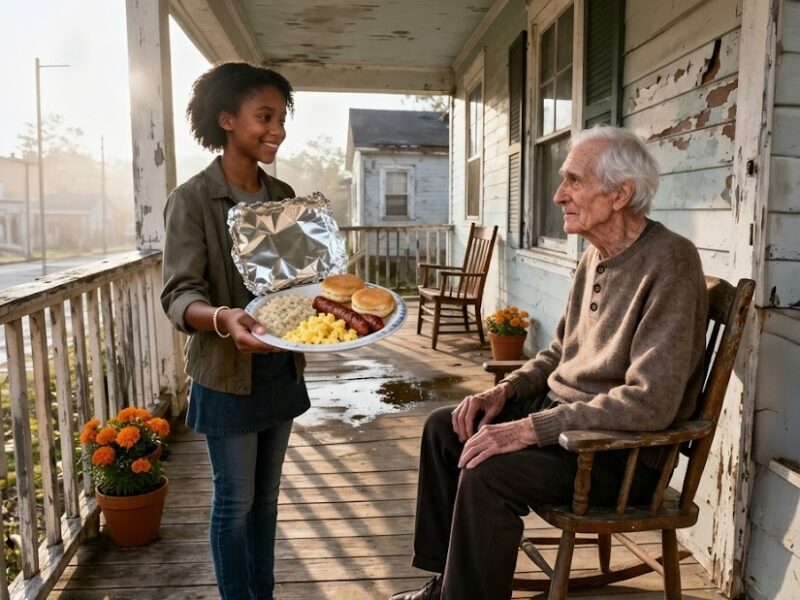
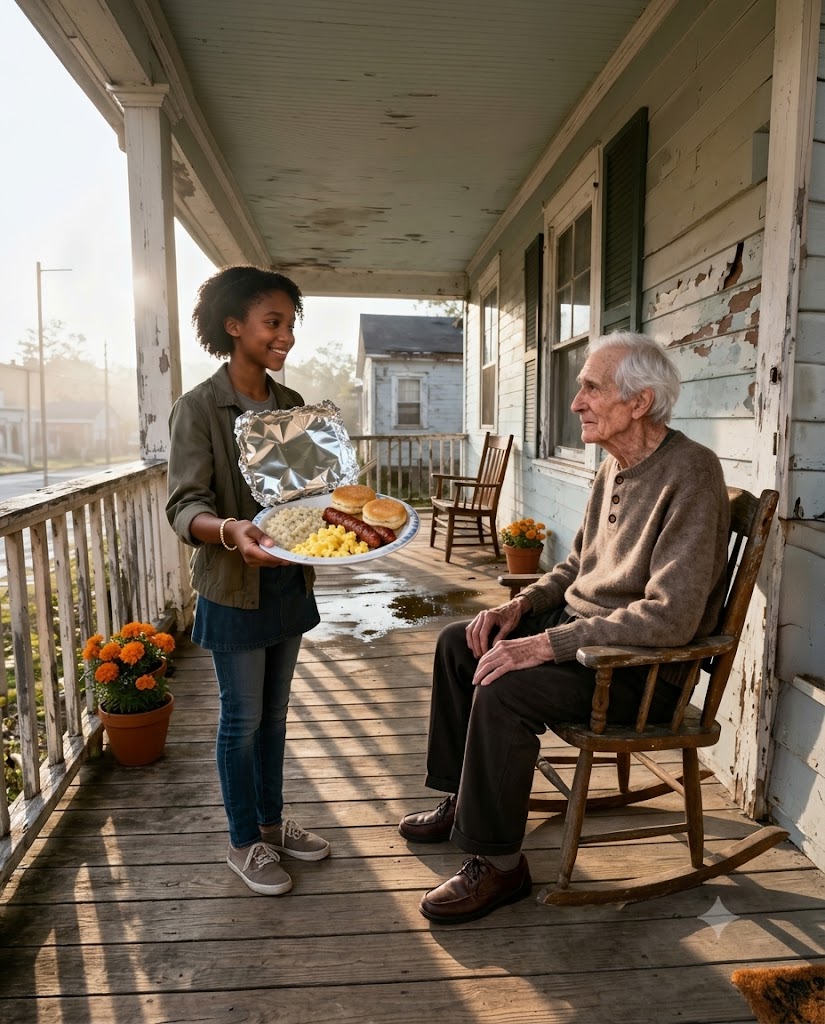
Lena crossed the street at 6:20 a.m. carrying a foil-covered plate. Grits with cheddar and cracked pepper. Scrambled eggs. Two sausage links.
Edmund opened the door before she could knock. He had been watching from the window.
“You didn’t have to do this.”
“I know.”
She left. No small talk. No questions. Just a plate and a promise kept.
Morning four.
Edmund was waiting on the porch. A different shirt, ironed and buttoned to the collar. He had been expecting her.
He took the first bite and paused.
“The grits yesterday. You used sharp cheddar. Not mild.”
Lena blinked. “Yeah. How’d you know?”
“I can taste the difference.”
She looked at him.
Most people couldn’t tell sharp from mild in a bowl of grits. But this man had identified it from memory, from yesterday’s plate.
She filed it away. She didn’t push.
Morning nine.
Sweet potato biscuits. Doris’s recipe, the one Doris swore had been handed down from her own grandmother.
Edmund took one bite and closed his eyes. He didn’t speak for a long time.
When he opened them, they were wet.
“My wife would have loved these.”
Lena didn’t push. She just sat with him on the porch for five minutes. Quiet. No pressure.
Then she left.
Morning fifteen.
They started talking. Not much. Small pieces.
He asked about her job. She told him about Earl. About the biscuit recipe he had taken for himself. About Brad Wallace getting the promotion she had trained him for.
Edmund’s face darkened.
“The man who took your recipe got promoted over you?”
Lena shrugged. “You know how it goes, Mr. Edmund.”
He held her gaze. “No, actually, I don’t. Tell me.”
For the first time, she told someone the whole thing.
And for the first time, someone got angry on her behalf. Not polite anger. Real anger. The kind that tightens the jaw and quiets the voice.
“That’s wrong,” he said simply, like a verdict.
She didn’t know what to say. Nobody had ever called it that out loud.
The visits got longer. Lena started arriving earlier and staying later.
She began bringing two plates, one for Edmund and one for herself. They ate together on the porch in the morning light, with coffee steam curling up between them and the neighborhood waking up around them.
Edmund opened up in fragments. Never the full picture.
He mentioned the business but never named it. He mentioned Ruth, his wife, with a grief so heavy it bent his voice.
“I built something,” he said once. “It got away from me.”
He asked about her dreams. She pulled up the Johnson & Wales brochure on her phone. She told him about the two rejections, and about the interview where they asked about her fine dining background but never asked her to cook a single dish.
Edmund’s eyes went hard.
“They didn’t ask you to cook? For a culinary program?”
“It’s fine.”
“It isn’t fine. And don’t say that again.”
He taught her how to fold an omelet properly. A wrist flick, not a spatula flick.
She brought him Doris’s peach cobbler one evening. He ate three servings.
She caught him waiting on the porch at 6:10 one morning, five minutes before she usually arrived, pretending he hadn’t been watching for her.
And one morning, when she reached across the table to hand him a napkin, she noticed his cufflinks up close.
Gold. Ornate. A sweeping letter C engraved in a style that looked almost like a logo.
“Those are real pretty,” she said. “Family heirloom?”
Edmund looked down at them. Something flickered across his face, pride and pain at the same time.
“Something like that.”
He buttoned his sleeve over them. Subject closed.
Lena clocked it. She didn’t push. But she remembered.
Then one night, everything almost ended.
2:00 a.m.
A crash from across the street. Glass breaking.
Lena bolted upright in bed, her heart already racing. She didn’t stop for shoes. She ran across the street barefoot, in her pajamas, over wet pavement and cold gravel.
The front door was unlocked.
Edmund was on the kitchen floor. A shattered water glass lay beside him. His face was gray. His left hand hung limp at his side.
He was trying to speak, but the words came out wrong. Slurred. Broken.
Stroke.
Lena dropped to her knees and pulled out her phone. She called 911.
She held his head off the cold floor with one hand and pressed the phone to her ear with the other.
“Stay with me, Mr. Edmund. Don’t you close your eyes. I swear to God, if you die on this kitchen floor, I will never forgive you.”
The ambulance came fast. The EMTs took over, and their voices turned crisp and calm and impossibly far away.
At the hospital, a nurse looked at Lena over the top of a clipboard. “Are you family?”
“I’m his neighbor.”
“Then I’m sorry. You can’t go in.”
Lena sat down in the hallway. A plastic chair. Bare feet. Still in her pajamas.
She didn’t leave. She sat there all night, watching the clock above the nurses’ station crawl from three to four to five.
She touched her mother’s bracelet once, then twice, then more times than she could count.
Morning came. Edmund woke up.
The first thing he saw was Lena, asleep in that plastic chair, head tilted against the wall, bare feet on the cold hospital floor.
He watched her for a moment before she stirred.
She opened her eyes. He said quietly, “You stayed.”
“Where else would I go?”
The doctor said it was a minor stroke. A warning. He needed monitoring, medication, and better nutrition.
Lena added it to her list. One more person to take care of.
She didn’t complain. She never complained.
But that night in the hospital cost her.
She arrived at the Griddle three hours late. Third time that month.
Earl was standing by the register with his arms crossed.
“Lena, I like you. But I can’t keep someone who just disappears.”
She tried to explain. The hospital. The emergency. The old man who almost died on his kitchen floor.
Earl cut her off. “That’s not my problem. I need someone I can count on.”
Fired.
She walked out. She didn’t slam the door. She didn’t cry.
She sat in her car for five minutes, staring at the steering wheel. Then she drove home.
$11.50 an hour had barely been enough. Now it was nothing.
She checked her bank account. $840.
Doris’s heart medication was $180 this month. The electric bill was overdue. The roof was still leaking.
That night, she sat on her porch doing math she couldn’t make work, no matter how she moved the numbers around.
For the first time, she thought about not going across the street tomorrow.
At 6:15 a.m., she was at his door.
Grits. Eggs. Biscuits made from the last of the flour.
Edmund took one look at her face. “What happened?”
“I got fired.”
Silence.
“Because of me?”
She shook her head. “Because of me. I chose to stay at that hospital. I’d choose it again.”
He looked at her for a long time. He cleared his throat. He didn’t say anything.
But his eyes, those deep-set blue eyes, were full of something she couldn’t name yet. Something like a decision being made.
She had nothing left. And that was when he tried to give her everything.
But what she did next shocked him more than anything in his seventy-nine years.
And the worst wasn’t over. Not even close.
One week after losing her job, Lena came home from a ride-share shift to find Doris on the kitchen floor.
Eyes closed. Breathing shallow. The blood pressure monitor on the table was flashing red.
198 over 112.
“Grandma. Grandma, can you hear me?”
Doris’s eyes fluttered. She tried to speak. She couldn’t.
Ambulance. The second time in a month Lena had ridden in the back of one.
She held Doris’s hand the whole way, counting her breaths and whispering the same thing over and over.
“I’m here. I’m right here. Don’t leave me.”
The ER waiting room. Six hours.
Lena watched patients who had arrived after Doris get called in first. She went to the front desk twice.
“My grandmother has been waiting six hours. She has a heart condition. Her blood pressure was almost 200.”
The nurse barely looked up. “We’re prioritizing by severity.”
Doris sat clutching her chest in a plastic chair. When they finally called her name, Lena nearly collapsed with relief.
The doctor was direct. “Her heart is under significant strain. She needs consistent monitoring. If she doesn’t have reliable home care, we need to discuss assisted living options.”
Assisted living.
Lena heard those two words like a knife.
They meant, “You can’t take care of her.” They meant, “We’re going to take your grandmother away because you’re too broke to keep her safe.”
She nodded politely and said thank you, because that is what you do when someone hands you the worst news of your life in a calm voice.
Two days at Doris’s bedside. Two days she didn’t cross the street.
For the first time in five months, Edmund’s porch was empty at 6:28 a.m. No plate. No knock. No Lena.
He sat in his chair and stared at the street.
He didn’t eat.
When Doris came home, Lena was running on fumes. She brought Edmund his plate the next morning with shaking hands and dark circles under her eyes.
She was ten pounds lighter than the month before.
He could see it. All of it. The exhaustion. The fear. The wire holding her together getting thinner every day.
He reached into his pocket and pulled out a folded check. He slid it across the table.
$5,000, made out to Lena Mitchell. In the memo line, he had written, “For the biscuits.”
Lena stared at it.
$5,000. That was four months of Doris’s heart medication. That was the roof fixed. That was a semester closer to school.
Her hand moved toward it. Instinct. Survival.
Then she pushed it back.
“I can’t take that.”
“Why not?”
“Because that’s not why I did it. I’m not your help, Mr. Edmund. I’m not your cook. I’m your neighbor. And the day I take money for being decent is the day I stop being decent.”
Edmund looked at her. Something shifted in his face.
Not surprise. Something deeper. Like he was seeing something he hadn’t seen in a very long time.
He put the check away and nodded slowly.
“You remind me of someone.”
He didn’t say who.
Later that week, Lena helped Edmund carry groceries inside. She had been doing his shopping on Saturdays, adding it to her own list and paying with money she didn’t really have.
As they unpacked the bags in the kitchen, a small card slipped out of his shirt pocket and landed on the counter.
Lena picked it up.
Thick. Cream-colored. Embossed.
It read: Callaway Provisions International. Edmund R. Callaway. Chairman Emeritus.
The same ornate C as his cufflinks.
She handed it back. “You dropped this.”
Edmund took it quickly, almost nervously. “Old card. Doesn’t mean anything anymore.”
That night, Lena lay in bed and couldn’t sleep. She picked up her phone, typed “Callaway Provisions” into the search bar, and waited for the page to load.
Her eyes went wide.
A corporate photo. A man in a dark suit, twenty years younger, but unmistakable. The same deep-set blue eyes. The same jawline. The same hands.
She read the first line.
“Callaway Provisions International, founded in 1982 by Edmund R. Callaway, is a global leader in hospitality and food service with operations in 28 countries.”
She dropped the phone on the bed.
“Oh my God.”
The man she had been feeding grits with her last handful of flour. The man who sat on a sagging porch in a $600-a-month rental. The man who forgot to eat was worth $4.8 billion.
And just like that, the old man on the porch wasn’t just an old man anymore.
But what Lena did next is what separates this story from every other story you’ve ever heard.
She knew who he was now. And she didn’t say a word.
And then his son showed up.
The next morning, Lena stood in her kitchen with shaking hands.
She knew everything now. The hotels. The restaurants. The culinary institute. The billions.
She could confront him. She could demand answers. She could tell Terrence and prove she wasn’t wasting food on a nobody.
Instead, she wrapped the plate in foil, walked across the street, knocked on the door, and sat on the porch.
She let him talk about the marigolds he had planted along the railing. She let him tell her these might be her best biscuits yet.
She didn’t say a word about Callaway Provisions.
Her decision was simple. “I didn’t start this because of who he is. I’m not going to change because of it, either.”
Three days later, a black SUV pulled onto Belmont Street. Tinted windows. Engine off.
It parked right in front of Edmund’s house.
The door opened. A man stepped out. Late forties. Expensive suit. Cold eyes.
He walked up to Edmund’s front door and pounded on it with a closed fist.
Lena was on her porch. She watched.
Something was wrong.
Edmund opened the door. The man pushed past him and went inside. Through the window, Lena heard raised voices.
She couldn’t make out the words. But the tone was clear. Accusation. Anger. Control.
She crossed the street without thinking. She just went.
She knocked. The door swung open under her hand.
Inside, the man stood over Edmund at the kitchen table, pointing a finger in his face.
Edmund looked small. Smaller than she had ever seen him, shrunk into himself like a man who had forgotten how to fight back.
The man turned to Lena. He looked her up and down, slow and deliberate.
“Who the hell are you?”
“I’m his neighbor.”
“His neighbor?” A cruel half laugh. He turned to Edmund. “This is what you’ve been doing, Dad? Hiding in this dump? Letting some random girl play nurse?”
He looked back at Lena.
“She’s probably after your money. You know that, right? They always are.”
“They.”
The word hung in the room like smoke.
Edmund stood up. Slowly.
His hands were trembling. Not from weakness this time. From rage.
“Get out of my house.”
“Dad—”
“Get out. You don’t get to walk in here and talk about the only person who’s given a damn about me in eighteen months. You didn’t call. You didn’t visit. You didn’t even look. She did. Every single morning.”
He took a breath that shook.
“So get out of my house, Scott. And don’t come back until you learn what she already knows. That people matter more than money.”
Scott laughed. He slammed the door behind him.
The SUV peeled away from the curb, tires hissing on the wet street.
Lena stood by the counter, quiet, her hands gripping the edge.
Edmund sat back down. He looked at her.
“I’m sorry you heard that.”
“Are you okay?”
“Sit down. Eat breakfast.”
They ate in silence. But something had shifted.
She had protected him. He had defended her. They weren’t just neighbors anymore.
But Scott Callaway wasn’t done. And what he did next turned the entire neighborhood against Lena.
What Lena didn’t know was that Scott made a phone call from that SUV.
And what happened after that call would be the hardest thing she had ever faced. Harder than losing her job. Harder than the hospital. Harder than the empty fridge.
Because this time, the attack came from her own people.
Scott didn’t call the police. He did something worse.
He called a real estate contact, someone involved in buying properties in gentrifying Charlotte neighborhoods, and told them to look into Belmont Street.
Within days, an unfamiliar car began cruising the block.
A man in a polo shirt stepped out. He took photos of houses. He measured lot sizes. He wrote things down on a clipboard.
Then he drove away.
Patty Cole saw it from her window. And she connected the dots. Wrong. But understandably.
“It’s that old man. I told y’all. First him, now the developers. He’s a scout. And Lena’s been helping him map the whole block.”
The rumor spread fast.
Within a week, the entire neighborhood believed Lena was helping Edmund, a white outsider, sell their homes out from under them.
People stopped speaking to her.
The woman at the corner store wouldn’t make eye contact. A neighbor crossed the street to avoid her.
Someone left a note in Doris’s mailbox. One word. Block letters.
“TRAITOR.”
Doris found it. She threw it away before Lena got home.
But Lena saw it in the trash. She pulled it out and read it. She folded it carefully and put it in her pocket.
She didn’t say a word.
Terrence came by that night. He didn’t yell. That was worse.
He just stood on the porch and said, “I can’t defend you anymore, Lena. Everybody on this block thinks you’re helping that man take our homes. I don’t believe it. But I can’t fight the whole street.”
He left.
Lena sat on the porch alone. No one waved. No one stopped.
She was invisible in the place she had lived her entire life.
She had lost her job. Her grandmother was barely stable. Her savings were gone. And now her own community, the only safety net she had ever known, had cut her loose.
5:00 a.m.
She was awake. She hadn’t slept.
The plate was on the counter. Grits. Eggs. Biscuits, made from ingredients Doris had bought because Lena had no money left.
She stared at it.
For the first time in five months, she didn’t want to cross the street. Not because of Edmund. Because of what it was costing her.
Everything. It was costing her everything.
She picked up the plate. She put it down. She picked it up again.
She walked across the street and knocked.
Edmund opened the door. He took one look at her face, the swollen eyes, the exhaustion, the weight of a woman carrying more than any person should.
“You don’t have to keep doing this.”
“I know.”
She handed him the plate and sat on the porch.
He asked the question quietly.
“Why? After everything, why do you keep coming?”
She didn’t answer right away. She looked at the street, at the houses, at the neighbors who used to wave and didn’t anymore.
Then she said, “Because if I stop being kind just because it’s hard, then what was it worth when it was easy?”
Edmund was quiet for a long time.
The morning light caught his cufflinks. The gold C glinted.
Then he said, “Lena, there’s something I need to tell you.”
He told her everything.
Callaway Provisions International. Fifty years of building it, starting with a single diner in Roanoke, Virginia. Hotels. Restaurants. A culinary institute. A supply chain that fed millions of people every day.
His wife, Ruth, the reason he had built all of it.
The cancer that took her eighteen months ago. The grief that swallowed him whole.
His children, Scott and Diane, who sided with the board during a restructuring dispute and froze him out of his own company. He stepped down rather than fight his own kids in a courtroom.
He didn’t disappear because he was poor. He disappeared because he was broken.
He gave away the mansion. He gave away the cars. He kept only two things: the cufflinks Ruth had given him on their twentieth anniversary, and the painting she bought in Provence on their honeymoon.
He chose Belmont Street because it reminded him of the neighborhood where he grew up poor. He wanted to remember what food tasted like before it became a business.
“And then you showed up,” he said, “with a plate of grits and a backbone made of steel.”
Lena listened to every word. Then she said, “I already knew.”
Edmund blinked. “You knew?”
“The business card. Three weeks ago. I looked it up.”
He stared at her. “And you didn’t say anything?”
“Wasn’t my business.”
She paused, and then she smiled, small and tired.
“You’re still the same man who forgot to eat. And honestly, my whole life, people find out one thing about me and decide they know my whole story. I wasn’t going to do that to you.”
Edmund didn’t speak for a long time. When he did, his voice was rough.
“That might be the most generous thing anyone has ever said to me.”
A knock at the door.
A man in a dark suit stood on the porch. British accent. Silver at the temples. Graham Ashford, Edmund’s former chief of staff.
He had been searching for Edmund for months. He looked like he hadn’t slept in most of them.
The news was bad.
Callaway Provisions was collapsing. The board’s expansion had hemorrhaged money. The stock was down thirty percent. Three flagship restaurants had closed. The Callaway Culinary Institute was about to be sold to a private equity firm.
“Sir, the board meets in ten days. If you don’t return, the institute is gone. Ruth’s foundation loses its largest donor.”
Graham hesitated.
“And one more thing. The developers sniffing around Belmont Street. I traced it back to Scott. Your son made a call, sir. He’s trying to force your hand by threatening this neighborhood.”
Edmund’s face went white, then red. His hands trembled.
He looked at the lavender painting above the table. He looked at his cufflinks. He looked at Lena.
“I’ll go back,” he said. “On one condition.”
“Name it,” Graham said.
Edmund didn’t take his eyes off Lena.
And what he said next was the reason a helicopter would land on Belmont Street three days later.
Edmund Callaway was about to walk back into a $4.8 billion empire. But he wasn’t going alone.
He laid it out slowly and deliberately, the way a man who built an empire from nothing speaks when he means every single word.
“First. A full culinary scholarship at the Callaway Culinary Institute. Room and board. The best instructors in the country. Any school that interviews a cook without asking her to cook doesn’t deserve you.”
He held up a hand before she could speak.
“When you graduate, a guaranteed placement at any Callaway restaurant, or seed capital to open your own.”
Lena started shaking her head. Edmund raised his hand again.
“I’m not done.”
“Second. A new initiative under the Callaway Foundation. The Ruth Callaway Community Kitchen. A culinary training center built right here in this neighborhood. Free cooking classes. Job placement. A commercial kitchen that local entrepreneurs can use to launch their own food businesses.”
His voice softened.
“Named after my wife.”
“Third. You, as its first director. Not now. After your training. But designed around your philosophy. Food as care. Cooking as dignity. The kitchen as the place where people are seen. The doors that were closed to you, you’re going to open them for everyone who comes after.”
“Fourth.”
His jaw tightened.
“I’m going to kill the Belmont Street development. Personally. My son made that call to punish me. He used your neighborhood as leverage. That ends now.”
Lena was gripping the edge of the table. Her knuckles had gone pale.
“Why me?”
Edmund leaned forward.
“Because in fifty years of building restaurants, I forgot what cooking is for. You reminded me. Every morning, with a plate of food you couldn’t afford. That isn’t something you teach. That’s character. And I will not let it go to waste.”
She said what she had been holding back, the thing that had been sitting on her chest since the moment she searched his name.
“If I take this, people will talk. They’ll say I played you from the start. A Black girl from Belmont Street getting a golden ticket from a rich old white man. You know how that story gets told.”
Edmund held her gaze.
“Then let the food prove them wrong. Every single plate.”
A beat. Her voice cracked.
“My grandma. The medical bills. Her heart medication. The roof. Can I—”
“Already handled. Graham has the details. A home health aide starts next week. Not insurance. Not a claim to fight. Direct care. Your grandmother will be taken care of. I promise you that.”
Lena broke.
She put her face in her hands and cried. Full, deep, heaving sobs. Not pretty tears. Not movie tears.
The kind of tears you hold back for months, maybe years, that come out all at once when someone finally says, “I see you.”
Edmund didn’t hug her. He wasn’t a hugger. He just sat across the table and waited.
When she finally lifted her head, he pushed a napkin toward her. Same gesture. Same quiet kindness.
She laughed through the tears.
“You and your napkins.”
He almost smiled. Almost.
But before the helicopter came, Edmund had one more thing to do.
He asked Graham to set up a meeting. Not at his house. At Patty Cole’s living room, that evening.
Thirty people showed up. Arms crossed. Suspicious. Angry.
Edmund stood in front of them in his pressed shirt, his hands steady for the first time in months.
He told them who he was. He told them what Scott had done, the phone call, the developers, the manipulation.
“No one is selling their homes. Not now. Not ever. Not while I’m breathing.”
Then he told them about Lena.
Every morning. Every plate. The hospital night in her pajamas. The firing. The empty fridge. The bills she couldn’t pay. The check she refused.
“This girl lost her job, her savings, and your respect because she was kind to me. She didn’t know who I was. She didn’t want anything from me. She just saw a hungry person and fed him. And you punished her for it.”
Silence.
Patty Cole put her hand over her mouth. Terrence stared at the floor.
“You should be proud of her. I’ve run a company with ten thousand employees. I have never, not once, met anyone with her character.”
Lena wasn’t there. She had no idea any of this was happening.
She was at home with Doris, heating soup on the stove, humming under her breath.
Three days later. Tuesday. 9:00 a.m.
Lena stood on her front porch with Doris beside her, wrapped in a blanket. Terrence was on the sidewalk, arms crossed, trying to look unbothered and failing.
The sound came first. A low, deep thrum that rattled the windowpanes.
Then the wind. Then the shadow.
A helicopter. White. Sleek. The Callaway Provisions logo on its side, that same gold C, descended over Belmont Street and settled into the vacant lot two houses down.
Kids came running from every direction. Patty Cole stepped onto her porch with her phone raised, recording. Curtains moved in every window on the block.
Graham Ashford stepped out first, in a navy suit.
Then Edmund. A tailored charcoal suit. Standing straight. His cufflinks caught the morning sun, and the gold C blazed.
He walked straight to Lena and extended his hand.
Not a hug. A handshake. Business partner to business partner.
“Ms. Mitchell. Are you ready?”
Lena looked at Doris. Doris nodded, tears falling.
“Go, baby. Your mama’s watching.”
She looked at Terrence. He was crying, and he didn’t try to hide it.
“I take it back. Everything I said.”
She looked at Patty. Patty lowered her phone and mouthed two words. “I’m sorry.”
Lena took Edmund’s hand and shook it.
“I’m ready.”
She walked toward the helicopter in her nicest dress, the one she hadn’t worn since her mother’s funeral. Her mother’s gold bracelet was on her wrist. Her hair was natural, full, unapologetic.
She paused at the door and turned around.
The whole block was watching. The same neighbors who had stopped speaking to her. The same street that had called her a traitor.
She lifted her hand in a simple wave. No speech. No performance. Just a girl from Belmont Street saying goodbye to the life she had known.
She stepped in. The door closed.
The helicopter lifted off, over the rooftops, over the church steeple, over the Griddle, over the pharmacy that had shorted Doris’s heart pills, over the school that had rejected her twice.
Patty Cole whispered, “Lord have mercy.”
Doris clutched her blanket and said to no one in particular, “I told her. I always told her. A plate of food is a prayer you can eat.”
The helicopter disappeared into the sky. But this wasn’t the end. This was the beginning.
And what happened next didn’t just change Lena’s life. It changed the entire neighborhood.
Within six months, Belmont Street didn’t just look different. It felt different.
And it all started with a plate of breakfast.
Ten days after Edmund walked back into the boardroom, the Callaway board learned what it feels like to be wrong.
He stood at the head of the long glass table in a charcoal suit and let them talk for twenty minutes. Then he opened a folder.
“You sold three restaurants to chase numbers. You tried to sell a school to chase more. And you froze out the man who built the company, because you assumed he was finished.”
He looked down the table at his son. Scott wouldn’t meet his eyes.
“The institute is not for sale. The foundation stays funded. And anyone who ever uses a neighborhood as a bargaining chip again will answer to me.”
The vote wasn’t close. The chairman emeritus took his seat back, and the stock rose four percent before lunch.
But Edmund didn’t celebrate. He went back to his hotel room, took off Ruth’s cufflinks, set them carefully on the nightstand, and whispered to the empty room, “I did it for you. And for a girl with a plate of grits.”
Lena walked into the Callaway Culinary Institute in New York wearing a white chef’s coat for the first time in her life.
She was the youngest student in her cohort and one of three Black students in a class of forty. The gap wasn’t talent. It was access.
Other students talked about internships at Michelin-starred restaurants, summers in Tuscany, parents who were sommeliers, and weekend brunches in the Hamptons.
Lena’s reference point was a gas stove with one broken burner and a grandmother who measured ingredients with her palm.
But she was the one the instructors watched.
Her palate was instinctive. Her flavors came from a place they couldn’t teach. Memory. Survival. Love handed down through generations of women who fed families with almost nothing and made it taste like everything.
One afternoon, Chef Helen Stroud gave the class an assignment. “Cook a dish that tells a story.”
Every student went elaborate. Truffle risotto. Seared foie gras. Deconstructed lemon tarts with edible flowers.
Lena made sweet potato biscuits. Doris’s recipe.
She added one thing: a drizzle of sorghum syrup, the way her great-grandmother used to make them, back when refined sugar was a luxury.
The room went silent when they tasted them.
Chef Stroud set down her fork.
“This is the best thing anyone has cooked in this kitchen in five years.”
She looked around the room.
“And most of you don’t even know what sorghum is. Think about that.”
Lena thought about Edmund on the porch, eyes closed, tasting that first biscuit. She thought about the Johnson & Wales interviewers who never asked her to cook.
She was exactly where she was supposed to be.
Back in Charlotte, construction began on the Ruth Callaway Community Kitchen.
A converted warehouse three blocks from Belmont Street. An industrial kitchen. A teaching space. A dining area with long wooden tables.
The Callaway Foundation funded the entire build. $2.5 million.
Edmund oversaw the design personally. He insisted on a plaque by the entrance.
“Good food is how we tell people they matter.”
On opening day, the neighborhood turned out. Families. Kids. Elderly residents who hadn’t left their houses in months.
Free cooking classes launched. Basic nutrition. Knife skills. Southern comfort food. Baking.
A job placement program partnered with twelve restaurants across the Charlotte area.
Within three months, the kitchen had served more than 4,000 meals. Eight graduates were placed in restaurant jobs. Two launched small catering businesses out of the commercial kitchen.
Carolyn Burke, a regional TV news anchor, ran a feature on the kitchen. She interviewed Lena by video from New York and Edmund in person.
She asked him why he had chosen this neighborhood.
He said, “Because someone here reminded me that the most important meal is the one you cook for someone else.”
The ripple effect spread further than anyone expected.
Doris’s health improved with a home health aide, a woman from the neighborhood named Gloria Hampton. Gloria and Doris became fast friends.
Every Saturday, they both showed up at the community kitchen. Doris taught her recipes to young mothers. Her sweet potato biscuits. Her peach cobbler. Her collard greens, cooked low and slow.
Recipes she had carried in her memory for fifty years, finally written down, finally shared, finally credited to the woman who created them.
Terrence enrolled in the kitchen’s job training program. He discovered he was good. Really good. He landed an apprenticeship at a restaurant downtown, and then he called Lena.
“I owe you an apology. A real one.”
She laughed. “You owe me a plate of food. We’ll call it even.”
Patty Cole organized a monthly Belmont Street block dinner. Neighbors cooking for each other, rotating from house to house. It started small and grew to fifty people.
The local paper ran a headline. “The Street That Feeds Itself.”
Edmund blocked the development personally. He bought the vacant lot where the helicopter had landed and donated it to the city.
It became the park the neighborhood had been promised back in 2018 and never received.
He established the Doris Mitchell Scholarship Fund. Ten full scholarships a year for underserved aspiring chefs. No fine dining experience required.
The application asked for one thing. Cook something that tells your story. Record it. Send it in.
That was it.
He kept his rental on Belmont Street. He visited once a month and sat on the porch. The marigolds were still blooming.
Year one. The numbers told the story.
162 graduates. 83 placed in jobs. 14 launched their own food businesses. 22,000 meals served.
The very first meal served on opening day had been a plate of grits, scrambled eggs, and sweet potato biscuits, cooked by Lena Mitchell and served to Edmund Callaway.
He had sat at a folding table in the middle of the kitchen, surrounded by neighbors. He ate every bite.
“Still using sharp cheddar?”
“Always.”
A year later, Lena came home.
And what she did on her first morning back was exactly what you’d expect. And exactly what makes this story impossible to forget.
She graduated at the top of her class. The Callaway Culinary Institute, first in her cohort.
Three Callaway restaurants offered her positions. New York. Chicago. Atlanta.
She turned them all down.
She was going home. To Charlotte. To Belmont Street.
Edmund’s seed capital, $250,000, went into her own restaurant. A Southern comfort food spot, five blocks from her grandmother’s house.
She called it Doris’s Table.
The menu was unlike any restaurant menu you’ve ever seen. Every recipe was credited by name.
Doris’s sweet potato biscuits. Patty’s peach cobbler. Gloria’s collard greens.
Each dish traced back to the woman who created it. The women whose hands had fed families for generations without anyone writing their names down.
No more invisible hands. No more “Earl’s Famous Biscuits.”
She hired from the neighborhood. Women from Belmont Street. Graduates of the community kitchen program. Women who looked like her, cooked like her, dreamed like her.
She arrived home late at night. The house looked different. The roof was fixed. The window was replaced. The porch was freshly painted.
But the crocheted blanket was still on the couch. Threadbare. Perfect.
Doris refused to throw it away. “That blanket raised you,” she said. “It stays.”
Lena slept in her old bed.
The culinary school brochure was still taped to the closet door.
She peeled off both sticky notes. “$22,000. Keep going.” And “They said no twice. Try again.”
She tucked them into her wallet. She would keep them forever. Not as pain. As proof.
6:15 a.m.
Doris’s kitchen. The same gas stove with the one burner that didn’t work.
Lena refused to fix it. Some things you don’t change, because changing them would erase the story of how you got here.
She cooked. Grits with sharp cheddar. Scrambled eggs. Sweet potato biscuits. The same recipe. The same kitchen.
The same humming. “His Eye Is on the Sparrow.”
She wrapped the plate in foil and walked across the street. Her hair was natural. Her mother’s bracelet was on her wrist.
Edmund’s house. Marigolds in bloom along the porch railing. The wooden chair, empty, waiting.
She knocked.
The door opened. Edmund stood there, older and thinner, but upright. A pressed shirt. Gold cufflinks.
He looked at the plate. He looked at her.
“You’re late.”
“It’s 6:20.”
“Some things don’t change, Mr. Edmund.”
She sat on the porch. He opened the foil.
They ate together the same way they always had. No cameras. No helicopters. No audience.
Just a plate of food between two people who had saved each other.
The lavender painting was visible through the window behind them.
Lena was wearing her mother’s bracelet. Edmund was wearing Ruth’s cufflinks.
Neither of them was alone anymore.
Anybody can be kind when it’s easy. When people clap for you and it costs you nothing.
But what happens when being kind costs you your job, your savings, your friends? When the people you love tell you to stop? When your whole neighborhood turns against you?
That’s when you find out whether your kindness is real, or whether it was just for show.
And most people quit. That’s not an insult. It’s just how hard it is. When helping someone else is pulling you under, it’s human nature to let go.
But the people who don’t let go, the ones who keep showing up with a plate of food even when their own fridge is empty, are among the rarest people on earth.
The world doesn’t deserve them. But it desperately needs them.
So here’s the question. If being kind got hard tomorrow, if it cost you something real, would you keep going, or would you stop?
Be honest with yourself. The answer will tell you who you really are.
Because if you stop being kind just because it’s hard, then what was it worth when it was easy?









