
A billionaire’s son humiliated a single mother on Steve Harvey’s stage — and Steve didn’t just kick him out. He made sure everyone knew why.
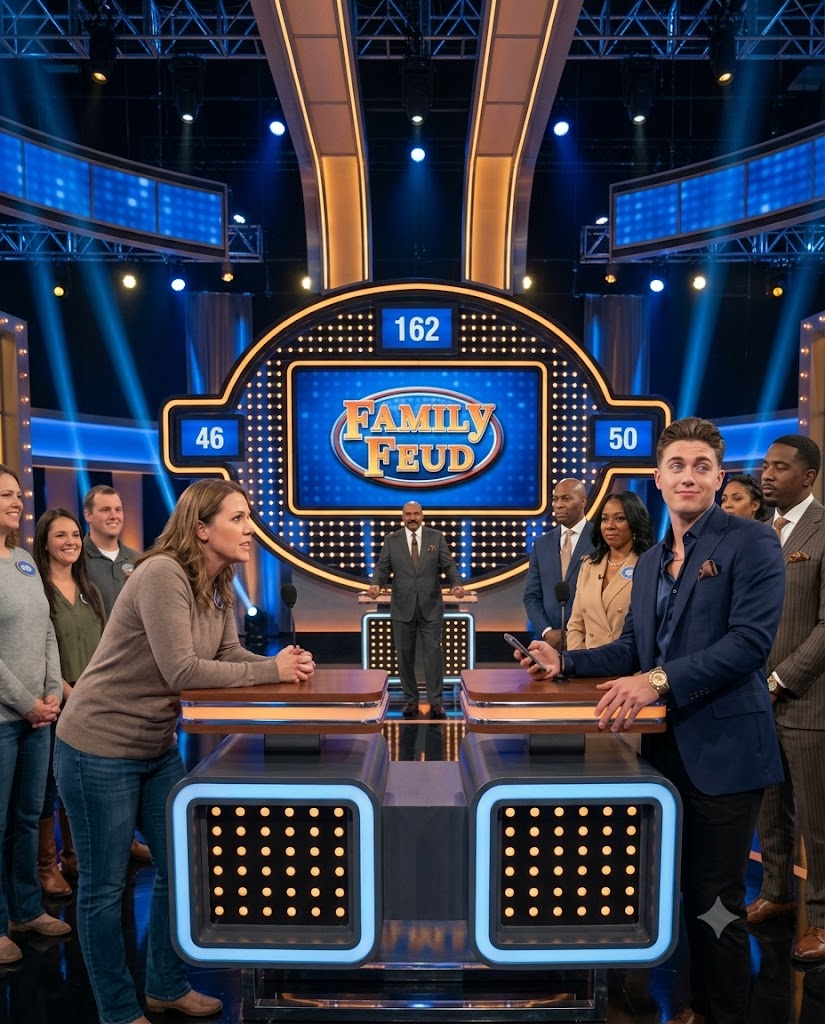
Part 1
The studio lights in Atlanta were too bright for a Tuesday afternoon, but Linda Majors had learned to smile through worse. She stood behind the podium on the Family Feud stage, 61 years old, wearing a navy blouse her daughter had picked out, waving at a crowd that felt like family even though she had never met a single one of them.
She looked like someone’s favorite aunt because she was someone’s favorite aunt.
What nobody in that room knew, what nobody in her own family knew, was that Linda Majors had been carrying a secret for 25 years, a secret that sat in her chest every single morning when she woke up and every night when the room went quiet. It was the kind of secret you never tell your children, your partner, or your closest friend because you are terrified of what happens if you do.
Steve Harvey was about to have no words at all.
Before we go further, if stories like this move you, like this video so more people can find it. Subscribe and hit the bell. We find the moments that matter.
Now, let’s go back to where this really began.
Linda Majors was from Columbus, Ohio, and she had worked as a school cafeteria manager for 23 years. She made the best sweet potato pie in her neighborhood, and everyone would tell you this unprompted.
She was loud in a warm way. She gave the kind of hugs that made strangers feel like family.
Her daughter Keisha had nominated the family for Family Feud as a birthday gift. The Majors family, Linda, Keisha, Keisha’s husband Darnell, Linda’s sister Paulette, and Paulette’s teenage son Marcus, drove down to Atlanta together in a rented van singing the whole way.
It felt like a celebration, and it was. It just wasn’t going to be the celebration any of them expected.
Twenty-five years ago, Linda Majors was 36 years old, recently divorced, and pregnant. The man who made her pregnant disappeared before she could tell him. She had a 6-year-old daughter at home, Keisha, and a job that barely covered rent.
She was not in a position to raise another child alone. She sat with that truth for 8 months. She prayed about it. She cried about it. And then, 2 weeks after giving birth to a healthy boy she held for 40 minutes, she signed the adoption papers.
Those 40 minutes were the part she never talked about. She had replayed them 10,000 times. The weight of him, the way he gripped her finger without knowing it was her finger, without knowing anything at all yet.
She memorized the shape of his ears. She counted his eyelashes. She told him his full name, James Michael Majors, so that even if no one ever said it again, he would have heard it at least once from the person who gave it to him.
She named him something before she gave him up. She called him James after her father. The agency told her she didn’t have to name him. She said she knew, but she wanted him to have something from her, even if it was just a name that might get changed the moment the paperwork cleared.
She never told Keisha. She never told her sister. She built a wall around that part of her life and became the woman everyone in her neighborhood knew, generous, funny, unbreakable. And for 25 years, she was all of those things. She was also quietly, permanently heartbroken.
Every year on the date he was born, February 11th, she lit a candle at her kitchen table after Keisha was asleep. She didn’t pray out loud. She just sat with the flame and thought about how old he would be now. Seven? 13? 20? 25?
She wondered if he looked like her. She wondered if he was kind.
The Majors family was having a great time. They won the first round against the Brennan family from Louisville. Keisha got the crowd going with a dance move nobody was ready for. Steve Harvey gave her a look that said he was both impressed and mildly concerned.
Marcus, the teenage nephew, buzzed in so fast on one answer that he nearly knocked the podium over. Linda was in the middle of it all, laughing, cheering, fully alive in the moment. She was not thinking about the past. She was not thinking about James.
She was thinking about whether they could hit the big money in fast money, and whether her sweet potato pie would taste even better when she was a game show winner.
Steve asked Linda what she did for a living. She told him about the cafeteria. He asked if she could cook. The audience had not even finished laughing at her response before she was already listing seven dishes by name.
Steve held up both hands in surrender. The crowd loved her. She was exactly the kind of person this show was built for, present, warm, completely herself.
There was something beautiful and a little heartbreaking about watching her in those early minutes knowing what was coming. She was so free. She had no idea that the thing she had carried quietly for 25 years was about to step into the light, and that the light was going to be so much kinder than she ever let herself imagine.
Then a producer walked up to Steve Harvey during a commercial break. He leaned in. He listened. His expression changed just slightly. A small shift in the eyes that only a camera catches, and only in replay, once everyone knows what’s about to happen.
He nodded slowly. He looked at Linda. He looked back at the producer. He said quietly enough that the mics almost missed it, “You sure?”
The producer nodded. Steve Harvey took a breath. He straightened his jacket. He walked back out onto the stage. The audience was chatting, settling back in after the break. The Majors family was laughing about something Marcus said. Linda was fixing her lipstick in a tiny mirror.
Steve Harvey walked to the center of the stage and didn’t say anything for a moment. That’s how you know something is wrong or something is right. Either way, something is happening.
“I need everybody to settle down for just a second,” Steve said. “We’re going to pause the game. Families, I need you to bear with me. Something has come to our attention that well, I’ve been doing the show for a long time. I’ve never done what I’m about to do right now.”
The studio went quiet. Not politely quiet, genuinely, completely, holding your breath quiet. Steve walked toward Linda specifically. Not the whole family, her.
“Linda, I need you to stay right where you are. Can you do that for me?”
Linda laughed nervously, looked at Keisha, looked back at Steve. “Steve, you’re scaring me.”
“I don’t mean to scare you. I just I need you to trust me, okay?”
Linda nodded slowly. Her smile was still there, but it was wobbling at the edges. Steve turned toward the back of the stage. He spoke into his mic. Not to Linda, not to the audience, to someone who wasn’t in the room yet.
“You can come in now.”
The door opened. A man walked in. He was tall, maybe 6 ft. He was wearing a simple gray button-down shirt. He was 31 years old, though you might guess a little older. There was something careful in the way he moved, like someone who had practiced staying calm in situations where calm is difficult.
His name was Marcus James Carter. He went by Marcus. He chose that middle name himself when he turned 18 and found the one document from his adoption file that showed what his birth mother had called him. James.
He built a middle name out of it and kept it close the way people keep things that are not fully theirs, but not fully gone, either. He had been standing behind that door for 11 minutes.
He told the producers afterward that those 11 minutes were the longest of his life. He could hear the muffled sound of the studio, the audience, the music, the faint rhythm of Steve Harvey’s voice. And he stood in a beige hallway under fluorescent lights and breathed slowly and thought about all the years it took to get to this specific hallway, this specific door.
He thought about his adoptive mom, Diane, who had cried when he told her he found Linda. Not sad tears, proud ones. She had told him, “Go, meet her. You deserve the whole picture.”
He thought about that. The whole picture.
He walked toward the stage. Linda saw him. She didn’t know who he was yet. He was just a tall man in a gray shirt walking through a door. Her brain was trying to place him. Did she know this person? Was this a celebrity guest? A producer?
And then, and nobody on the production team could fully explain how this happens, how the body knows before the mind does, Linda’s hand went to her mouth. Her knees went. Keisha caught her.
“Oh god. Oh god. Oh my god.”
She was shaking, full body shaking the way people do when something they have kept locked up for 25 years suddenly walks through a door in a gray shirt in a television studio in Atlanta.
Marcus Carter grew up in Cincinnati with a good family. His adoptive parents, Diane and Robert Carter, were loving, steady, present. He had a good childhood. He will say this clearly and without hesitation because he is someone who believes in telling the whole truth, even when the whole truth is complicated.
But there is a thing that happens to adopted children. Not all of them, not in the same way, but often, where a part of you lives in the question of where you came from. Who are you? Who do you look like? What did your birth mother’s laugh sound like? Was she funny? Was she kind?
Marcus spent his 20s quietly searching. He used public records, DNA ancestry sites, adoption reunion registries. He hit walls. He found partial records. He sent letters to an agency that told him his birth mother had not registered for contact.
Then, 6 months ago, a DNA match came through. A distant cousin, a thread he followed carefully and slowly until it led him to a name, Linda Majors, Columbus, Ohio.
He didn’t call her. He didn’t show up at her door. He is not that kind of person. Instead, he contacted the Family Feud production team. He had seen that her family was going to appear on the show through a local news mention, and he asked carefully, respectfully, if there was any way, any way at all.
The production team verified everything. They confirmed the match through adoption records. They called Linda’s daughter, Keisha, because they needed someone in the family to know, and Keisha, to her credit, did not faint, though she says it was close.
Keisha has described those 4 weeks as the strangest of her life. She sat across from her mother at Sunday dinners. She watched Linda laugh at TV shows and water her plants and complain about the neighbor who never returns her casserole dishes.
And the whole time, Keisha was sitting on a secret that her mother had carried alone for 25 years. She said later, “I kept almost telling her. Three times I almost said, ‘Mama, somebody is coming to find you.’ But I did not want to take that moment away from her. I wanted her to have it exactly as it happened.”
And then they kept the secret for 4 weeks while they filmed the episode.
Steve Harvey gave them space. This is the part people forget to mention when they talk about this episode. How Steve stepped back. He didn’t narrate. He didn’t make it a segment. He just quietly handed them a microphone and stood close enough to be there and far enough away to let it be theirs.
Marcus sat across from Linda. Keisha was holding her mother’s hand so hard her knuckles were pale.
“I’m not here because I needed something,” Marcus said. “I have a good life. I have a mom and a dad who love me. I just I needed to know that you were okay. And I wanted you to know that I’m okay.”
Linda could not speak for almost 30 seconds. The audience waited. Nobody coughed. Nobody moved.
“I named you James,” Linda said. “I don’t know if anyone ever told you that. James, after my daddy. I only had you for 40 minutes and I talked to you the whole time. I told you I was sorry. I told you I was going to spend the rest of my life hoping you were okay.”
“I know about the name,” Marcus said. “That’s why I kept it. That’s why it’s my middle name.”
Linda broke completely at that. Not the polished tears of television, real, ugly, relieved crying. The crying of someone who has been holding their breath for a quarter century and finally, finally exhales.
Marcus leaned forward and hugged her. It was not an awkward hug. It was not a polite hug. It was the hug of someone who has imagined this moment 10,000 times and practiced staying calm right up until the moment arrives. And then the calm went out the window. Because he was also crying now, and that surprised him.
The audience did something unusual in that moment. Strangers reached for strangers. People who came to watch a game show and cheer for points were now holding each other by the hand. A woman in the third row was pressing her palm flat against her chest like she was trying to keep something inside it. An older man near the back had taken off his glasses and was wiping them slowly, not because they were dirty, but because he needed something to do with his hands.
Twenty-five years of silence, and it ended like this. In the warmest, most crowded room imaginable, surrounded by people who did not know Linda Majors at all and would do anything for her right now.
Steve Harvey spoke quietly to camera. “I want everybody watching this at home right now to understand what you’re seeing. This woman made the hardest decision a mother can make. She made it out of love, and love, 25 years later, found its way back.”
Of all the people in that studio, Keisha was the one flying without instruments. She knew Marcus was coming. The production team told her 4 weeks ago. But knowing something intellectually and then watching your mother collapse into the arms of the brother you never knew you had are two completely different experiences.
She laughed and cried at the same time. She kept saying, “I have a brother.” under her breath like she was checking whether it was real.
Marcus, once he and Linda finally separated, turned to Keisha. “You’re the one who nominated your family for this show. I saw the interview clip online. You did this. You brought us here.”
“I was just trying to win $20,000,” Keisha said, laughing through tears. “I did not sign up for all of this.”
The audience laughed. It was the best kind of laugh. The one that comes after you’ve been holding your heart in your hands for 10 minutes straight.
Steve took the mic back. His eyes were red. He had stopped trying to pretend otherwise.
“I have been hosting this show for a long time. People ask me all the time, ‘What’s the best part of the job?’ And I always say the families. I always say it’s the families. But I want to go on record right now and say I have never, not once in all these years, seen anything like what just happened in this room. This wasn’t a game show moment. This was a life moment. And we all got to be here for it.”
The episode aired 3 months after taping. In those 3 months, Linda and Marcus had already met three more times. Once in Columbus, once in Cincinnati, once in Atlanta, where Keisha insisted on cooking for everyone.
That Atlanta dinner lasted 6 hours. Nobody planned for it to last 6 hours. But Marcus started asking Linda about her childhood, and Linda started asking Marcus about his, and somewhere between the cornbread and the second round of sweet potato pie, they discovered they had both been afraid of the same thing their whole lives. That the other person had moved on so completely that there was no room left for this.
There was room. There was so much room.
Marcus brought his wife, Tara, and their two kids, a 4-year-old girl named Ava and a 7-year-old boy named Elijah. When Ava climbed into Linda’s lap 20 minutes after meeting her, Linda held her like someone getting back something she thought she’d lost forever.
Linda finally told the rest of the family, her sister Paulette, cousins, her church. She had dreaded this for decades. Imagined judgment, imagined rejection, imagined people looking at her differently. What she got instead was a room full of people saying they loved her and they understood.
What she got was her pastor saying quietly, “Secrets kept to protect ourselves become chains. Secrets released become bridges.”
She wrote that down. She put it on her refrigerator.
The clip of Marcus walking through the door hit 40 million views in 5 days. Not because it was dramatic, though it was, but because it was true. In an era of manufactured emotion and scripted surprises, something about the rawness of Linda’s reaction, the way her hand went to her mouth before her brain caught up, told people, “This is real. This is what real looks like.”
Letters came. Thousands of them. To the show, to the production team, to a fan email address someone set up for Linda because her actual inbox became unmanageable. Letters from birth mothers who had never told a soul. Letters from adopted adults who were still searching. Letters from adoptive parents who sat with their kids and watched the clip and talked about it afterward.
One letter came from a woman in Tucson who said she had been estranged from her daughter for 11 years, and that watching Linda and Marcus convinced her to pick up the phone. She said the call lasted 4 hours.
Marcus did an interview with a podcast about adoption and identity 6 months after the episode aired. He said something in that conversation that circulated widely.
“I didn’t go looking for Linda because something was missing. I went looking because I wanted to add something. I wanted to add the full picture. I had a great family. I wanted an even bigger one. That’s allowed. Wanting more love is allowed.”
He also said this. “Don’t wait for a TV show. If you’re searching for someone, keep going. The records exist. The tools exist, and the people you’re looking for are often out there hoping you’ll find them. They just don’t know how to say that yet.”
Linda started speaking at adoption support groups in Ohio. Not as an expert, she says this every time, as someone who knows what the wait feels like. She says the same thing at the end of every talk.
“I thought keeping that secret was protecting my family, but secrets don’t protect people. They just make you carry the weight alone. The day I stopped carrying it alone was the day I could breathe again. And the breathing, honey, the breathing is everything.”
Linda’s story is not just a reunion story. It’s a story about what happens when we confuse secrecy with protection. When we assume that the people who love us can’t handle our truth. And in doing so, we rob them of the chance to prove us wrong.
Marcus’ story is not just an adoption story. It’s a story about searching for wholeness, not because you’re broken, but because you’re human. And humans reach toward the people they came from.
And Steve Harvey’s role in this, the decision to stop a game show, to trust an instinct, to step back and let two people have a moment on live television without turning it into content. That’s a story about what a platform is actually for. He could have played it up. He could have milked every second for drama. Instead, he handed them the mic and got out of the way. That restraint, that choosing of people over performance, is its own kind of wisdom. And it is rarer than it should be.
Think about the people in your own life who are carrying something heavy and alone. The aunt who goes quiet every February. The old friend who changed the subject once and you let her. The parent who has a box in the closet they’ve never explained.
Sometimes the most powerful thing you can do is not a grand gesture. It’s simply making it safe for someone to put down what they’ve been holding. You don’t need a TV show. You don’t need a perfect moment. You just need to open a door.
The game never finished, by the way. The Majors family were brought back 3 weeks later for a re-taping with a guaranteed prize regardless of the outcome. The show’s producers said it was the easiest decision they ever made.
Linda won the fast money round. Of course she did. She donated half of it to a local adoption support charity in Columbus. Marcus matched her donation. They did it together.
Forty minutes. That’s how long Linda held her son before she gave him up. Twenty-five years. That’s how long she carried it alone. And one door opening in a TV studio in Atlanta. That’s all it took to end the silence.
Some secrets need to stay private. Some do not. Some are waiting for the right moment, the right door, the right person to finally say, “You can put that down now. You’ve carried it long enough.”
If this story touched something in you, a memory, a question, a name you haven’t said out loud in a while, that’s not an accident. Stories find us when we need them. If this story moved you, don’t let it end here. Like this video. It helps this story reach someone who needs it today. Subscribe and turn on notifications. We tell the stories that stay with you. Drop a comment. What would you do if someone you lost came back? Share this with someone who believes in second chances.









