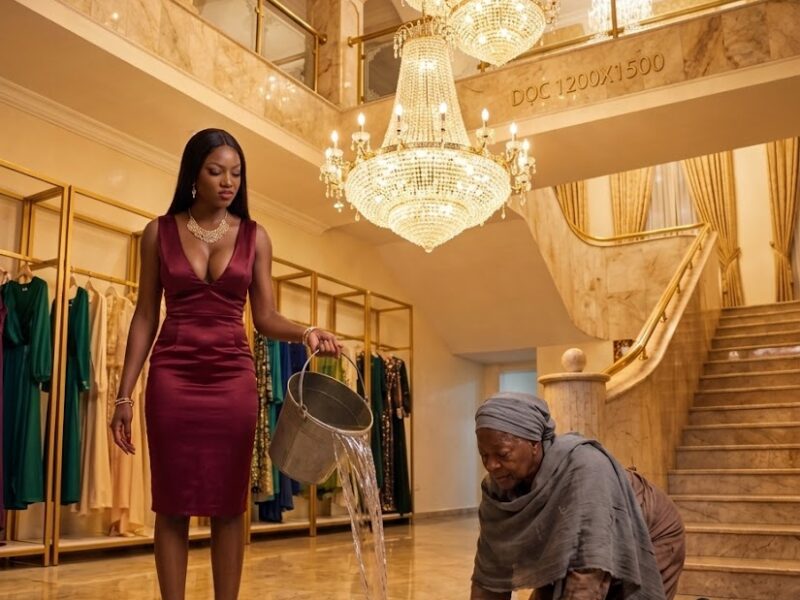
A billionaire’s mother disguised herself as a homeless beggar to test her son’s fiancée — and what happened next changed everything.
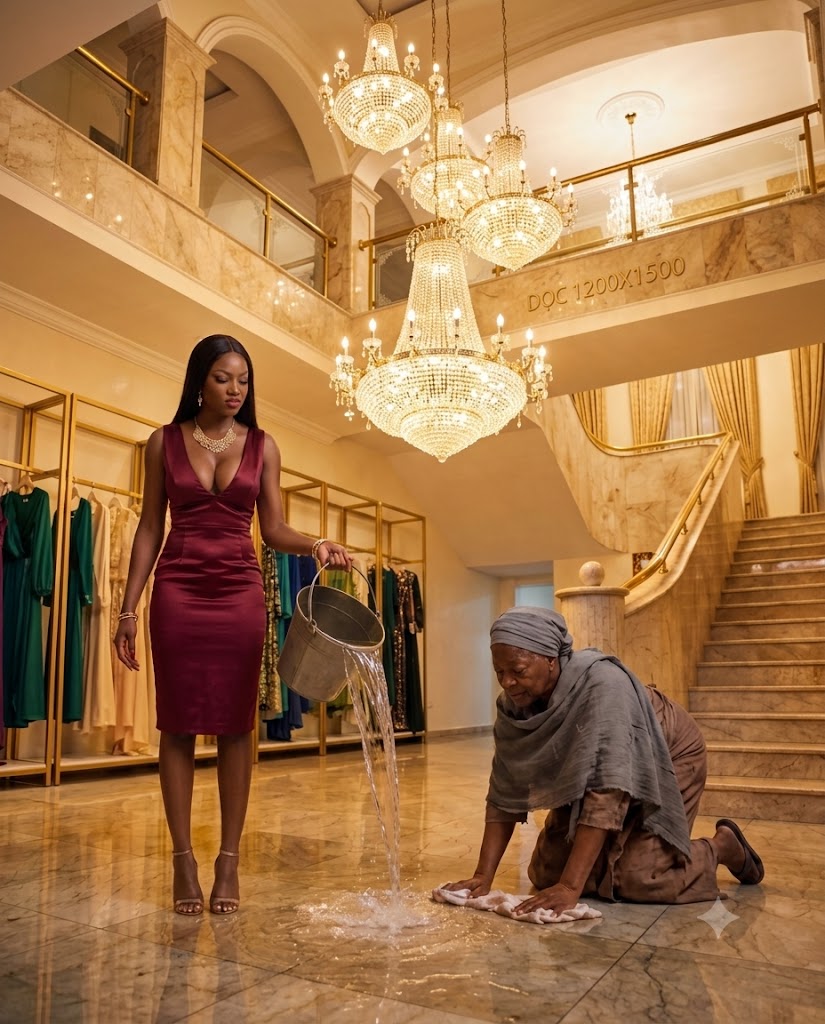
The rain came down hard on the windshield, turning the city lights into smeared watercolors of gold and red.
Detective Mara Vance killed the wipers and let the silence fill the car.
She had spent twenty-two years reading people, and tonight, the woman in the back seat had finally stopped pretending to be someone else.
“Say it again,” Mara said, her voice flat.
The woman in the back seat, still wearing a designer gown worth more than Mara’s monthly mortgage, leaned forward until her face caught the glow of the dash.
“I said,” the woman whispered, “that the beggar you’ve been watching for three weeks is the majority shareholder of this entire hotel chain.”
Mara looked at the file on the passenger seat, at the photograph of the old woman in rags, the one who had been standing outside the service entrance of the Grand Meridian every night like a ghost who had forgotten how to haunt.
“And you’re telling me,” Mara said slowly, “that this same woman paid cash for a penthouse suite under a fake name, and she’s been running background checks on her own son’s fiancée from a room two floors above the lobby?”
The woman in the back seat smiled, but it wasn’t a warm smile.
It was the smile of someone who had just set fire to a bridge and was waiting to see who would try to cross it anyway.
“You wanted the truth,” the woman said. “I’m giving it to you. But the truth has a price. And the price is that you stop looking at me like I’m the criminal here.”
Mara turned the key in the ignition.
“Lady,” she said, “I haven’t decided who the criminal is yet. But I do know one thing. When a mother goes undercover to test her son’s fiancée, somebody is about to lose everything. And it’s never the person holding the money.”
The car pulled into the storm.
The city of Oakwood Heights didn’t look like a place where secrets lived.
It looked like a postcard, all manicured lawns and white picket fences and driveways that gleamed after the rain like polished teeth.
But Oakwood Heights had a graveyard at its center, and in that graveyard, there was a mausoleum with a name carved above the door that didn’t match any of the names in the town records.
The name was Adaeze.
And the woman who owned that name had been dead for twenty years, according to the paperwork.
But paperwork, as Mara Vance knew, was just another kind of costume.
The engagement dinner was set for seven o’clock at the Grand Meridian, in the ballroom with the chandeliers that cost more than the cars parked outside.
Vanessa Cole had been planning it for months.
She had chosen the flowers herself, white roses and orchids, because white meant purity and orchids meant luxury.
She had chosen the menu, filet mignon and lobster bisque, because Obinna’s mother was old money and old money didn’t eat anything you could find in a grocery store.
And she had chosen her dress, a red gown that hugged her body like it had been painted on, because red meant power, and Vanessa Cole was done pretending she didn’t want any.
She stood in front of the mirror now, touching up her lipstick, and she didn’t notice the old woman in the doorway until the old woman spoke.
“You look beautiful, my daughter.”
Vanessa spun around.
The woman was small, bent, wrapped in a shawl that had been patched so many times it looked more like a map than a garment.
Her face was lined with years and weather, and her eyes were dark and bright, like two stones at the bottom of a river.
“Who are you?” Vanessa demanded. “How did you get in here?”
The old woman smiled, and her smile was gentle, but there was something behind it that made Vanessa’s skin crawl.
“I came to see my son,” the old woman said. “He is marrying you, yes? So that makes you my daughter too.”
Vanessa’s mouth opened, then closed.
“You’re—you’re Madam Adaeze?”
“I am.”
“But you’re—” Vanessa stopped herself, but the word was already hanging in the air between them.
“Poor?” the old woman finished for her. “Homeless? A beggar?”
Vanessa’s cheeks flushed.
“I didn’t mean—”
“You did,” the old woman said. “And that is all right. I have been called worse. But I did not come here to talk about what I am. I came here to ask you something.”
Vanessa crossed her arms.
“What?”
The old woman stepped closer, and her voice dropped to a whisper.
“Do you love my son?”
Vanessa blinked.
“Of course I do.”
“Then why,” the old woman said, “did you pay a man named Tony to forge the papers for your boutique? Why did you use my son’s money to cover debts you never told him about? And why,” she said, her voice still soft, “did you tell Tony that once you signed the marriage license, the whole family would be yours?”
Vanessa’s face went white.
“I don’t know what you’re talking about.”
The old woman reached into her shawl and pulled out a small, black recorder.
“Would you like to hear it?” she asked. “I have it all. Every word. Every plan. Every secret you thought was safe.”
Vanessa’s hand shot out, but the old woman was faster.
She tucked the recorder back into her shawl and stepped away.
“Three weeks,” the old woman said. “I have been watching you for three weeks. I have been hungry, and cold, and treated like dirt, but I have learned more about you than any background check could ever teach me. And now,” she said, “I am going to ask you one more time. Do you love my son?”
Vanessa’s eyes were wild.
“You—you tricked me. This was all a trick.”
“No,” the old woman said. “This was a test. And you failed.”
She turned and walked toward the door.
“Wait!” Vanessa called after her. “What are you going to do?”
The old woman paused, her hand on the doorknob.
“I am going to do what I should have done three weeks ago,” she said. “I am going to tell my son the truth. And then,” she added, “I am going to watch him walk away from you.”
The door closed behind her with a soft click.
Vanessa stood alone in the room, her heart pounding, her mind racing.
And then she did what any cornered animal does.
She reached for her phone.
—
Obinna Adaeze was not a man who got angry easily.
He had learned patience from his father, who had built a sewing machine business from nothing and never raised his voice, not even when the machines broke, not even when the customers yelled.
He had learned kindness from his mother, who had always said that money shows a person’s taste, and taste, she said, was not about what you bought, but about how you treated people.
But tonight, standing in the ballroom of the Grand Meridian, watching his fiancée smile and laugh with the guests, Obinna felt something cold settle in his chest.
His mother had not arrived yet.
She had said she would come in her own way, and Obinna had learned long ago not to question his mother’s ways.
But there was something in the air tonight, something that felt like a storm about to break.
He saw Tony first.
Tony was Vanessa’s business partner, a tall man with a slick smile and eyes that never stayed in one place for too long.
He was standing near the bar, talking to one of the waiters, and when he saw Obinna looking at him, he raised his glass and smiled.
Obinna did not smile back.
Then he saw his mother.
She was standing in the doorway, and she was still wearing the rags.
The guests were staring, some with confusion, some with disgust, and one woman actually gasped and pulled her child closer.
Vanessa saw her too, and her face went through a series of expressions so fast that Obinna almost missed them.
First, fear.
Then, anger.
Then, the mask.
“Obinna, my love,” Vanessa said, her voice bright and brittle, “why is this woman here? Someone should call security.”
Obinna did not answer.
He was watching his mother, who was watching him.
And in her eyes, he saw something he had never seen before.
He saw disappointment.
—
The old woman walked into the ballroom like she owned it.
She walked past the guests, past the champagne tower, past the ice sculpture of a swan that was already melting, and she stopped in front of Vanessa.
“Madam,” she said, and her voice was quiet but it carried, “I was invited.”
Vanessa’s smile was frozen.
“Invited? By who? The gate dog?”
There was nervous laughter from the guests, but it died quickly when the old woman did not flinch.
“I was invited,” the old woman said, “by the same person who has been feeding me for three weeks. The same person who gave me her last meal when I had nothing. The same person who is standing right there.”
She pointed at Amara.
Amara was standing near the kitchen door, her eyes wide, her hands clutching a tray of canapés.
Vanessa followed her gaze, and her face twisted.
“Her? You were invited by her? She’s nobody. She’s a food seller. She lost her stall because she’s a thief.”
The old woman shook her head.
“No,” she said. “She lost her stall because you took it from her. You stole the envelope from your own desk. You accused her of theft. You called the authorities. And you did it all because you were afraid.”
Vanessa’s voice rose.
“Afraid of what? Afraid of a beggar and a food seller? Don’t be ridiculous.”
“You were afraid,” the old woman said, “because you knew that if anyone looked too closely at you, they would see the truth. And the truth, my daughter, is that you are not who you say you are.”
The ballroom was silent now.
Obinna stepped forward.
“Mama,” he said, “what is this? What are you talking about?”
The old woman turned to him, and for a moment, she looked tired, and sad, and old.
“My son,” she said, “I am sorry. I should have told you sooner. But I had to know. I had to see for myself what kind of woman you were bringing into our family.”
She reached into her shawl and pulled out the recorder.
“I have proof,” she said. “Recordings. Documents. Everything you need to see who Vanessa Cole really is.”
Vanessa lunged for the recorder, but Obinna caught her arm.
“Let her speak,” he said.
His voice was cold, and Vanessa stopped struggling.
The old woman pressed play.
And the ballroom filled with Vanessa’s voice.
—
“You cannot keep coming here. If Obinna sees you—”
“Obinna sees nothing. That is his talent.”
“How is the wedding of the century?”
“Three weeks to the engagement, the wedding follows quickly.”
“And then?”
“Then the day I sign as his wife, this whole family becomes mine. Every last cent.”
“You think you can just walk in here and take everything?”
“I will expose your dirty secrets to the whole world. By the time I am done with you, you will have nothing left.”
“And the old woman? They say the mother controls the family shares.”
“She is old, Tony. Old things get replaced. I will send her to the village with a nurse and a Bible.”
“You are wasting time. The boutique creditors are calling me now, and the papers we forged for the shop will not sleep forever.”
“Then I will hurry love along. A man marries faster when there is a baby coming, even a baby that does not exist.”
“You are wicked. That is why I love you.”
“Love? Tony, we are not lovers. We are partners. Lovers are for fools like Obinna.”
The recording stopped.
The silence that followed was louder than any scream.
—
Vanessa’s face was pale, her eyes darting around the room like a trapped animal.
“That’s—that’s not real. That’s a fake. She made it up. She’s trying to destroy me.”
The old woman shook her head.
“I did not make it up,” she said. “You did. Every word. Every plan. Every lie.”
She turned to Obinna.
“My son,” she said, “I wore rags for three weeks. I slept in the rain. I begged for bread. All so I could see what kind of woman you were about to marry. And I saw. I saw everything.”
Obinna’s face was unreadable.
He looked at Vanessa, and for a long moment, he said nothing.
Then he spoke.
“You wanted to send my mother to the village,” he said. “You wanted to take my family’s money. You wanted to use me.”
Vanessa’s eyes filled with tears.
“Obinna, please. I love you. I made mistakes, but I love you.”
“You swore on everything, Vanessa,” he said. “That was always your talent.”
He turned to his mother.
“The engagement is finished,” he said.
The ballroom erupted.
Some people gasped, some people applauded, and some people just stood there, frozen, like they had just seen a car crash and couldn’t look away.
Vanessa’s tears were real now, but no one was watching her anymore.
They were watching the old woman in rags, who had just brought a billion-dollar empire to its knees with a recorder and a shawl.
—
The applause lasted for nearly a minute.
When it finally died down, Obinna walked over to his mother.
“You wore rags for three weeks,” he said. “You walked the streets. You let people treat you like dirt. And you told me nothing.”
The old woman looked up at him.
“If I had told you,” she said, “you would have defended her. Love defends first and acts later.”
Obinna’s jaw tightened.
“Then let it. It was my life. My choice. My mistake to make.”
“I know,” his mother said. “And I am sorry. But I had to protect you. Even from yourself.”
Obinna looked at her for a long moment.
Then he turned and walked out of the ballroom.
“Obinna,” his mother called after him. “Obinna!”
But he was already gone.
—
Mara Vance was waiting in the parking lot when Obinna walked out.
She had been watching the ballroom through the windows, and she had seen everything.
“You’re Obinna Adaeze?” she asked.
Obinna stopped.
“Who are you?”
“Detective Mara Vance. I’ve been investigating your fiancée for three weeks.”
Obinna’s eyes narrowed.
“You knew?”
“I suspected,” Mara said. “But I needed proof. Your mother gave it to me.”
She held up her phone.
“The police are on their way. Tony was arrested at the airport an hour ago. They found forged documents in his luggage. Vanessa is next.”
Obinna looked at her, and for the first time that night, he looked tired.
“I didn’t know,” he said. “I didn’t know any of it.”
“I know,” Mara said. “That’s the thing about secrets. They always come out. It’s just a matter of when.”
She handed him a card.
“If you need to talk to someone,” she said, “call me.”
Obinna took the card, but he didn’t look at it.
He was looking at the sky, at the storm clouds that were finally starting to break, at the first sliver of moonlight that was cutting through the dark.
“I need to find Amara,” he said.
—
Amara was still in the ballroom when Obinna found her.
She was sitting on a bench near the kitchen, her tray of canapés untouched, her eyes red from crying.
“Amara,” Obinna said.
She looked up.
“Mr. Obinna. I’m so sorry. I didn’t know your mother was—I didn’t know any of it.”
“I know,” he said. “And I’m the one who should be sorry. I brought Vanessa here. I brought her into your life. And she hurt you.”
Amara shook her head.
“You didn’t slap me,” she said. “She did. Carry only your own load.”
Obinna sat down next to her.
“The beggar you fed all these weeks,” he said. “That woman was my mother.”
Amara’s eyes widened.
“Madam Adaeze? She was your mother?”
“In rags, in the rain, testing all of us like school children. I can’t even look at her.”
Amara was quiet for a moment.
Then she said, “Then I am glad, sir.”
Obinna stared at her.
“Glad? She deceived you, too.”
“She came to me hungry, and I fed her,” Amara said. “Not because she was rich. Because she was hungry. Whoever she was, my hands did the right thing. Deceive me like that every day.”
Obinna was silent.
One sentence.
One sentence from a girl with a broken stall, and his anger had nowhere left to stand.
“Your mother wore rags in the rain for three weeks,” Amara said. “Not to control your life. To guard it.”
Obinna looked at her, and something in his chest shifted.
“You’re right,” he said. “She did.”
He stood up and held out his hand.
“Come with me,” he said. “There’s someone I want you to meet.”
—
Madam Adaeze was sitting alone in the ballroom when they found her.
The guests had all gone home, and the staff were cleaning up, and the ice sculpture of the swan had melted into a puddle on the floor.
“Madam,” Amara said.
The old woman looked up.
“My daughter,” she said. “I am sorry. I should have told you who I was. But I needed to know who you were.”
Amara knelt down in front of her.
“I forgive you,” she said. “I did not know. But I forgive you.”
Madam Adaeze reached out and touched her face.
“The woman you fed does not accept kneeling from the woman who fed her,” she said. “Stand up, my daughter.”
Amara stood.
“The shawl,” she said. “You kept it?”
Madam Adaeze smiled.
“I built my first fortune with a needle, Amara. I know gifted hands when I see their stitches. And I return what I borrowed.”
She reached into her bag and pulled out a folder.
“Your designs,” she said. “I had them appraised. They are worth more than you think.”
Amara’s hands trembled as she took the folder.
“They are just dreams, madam.”
“You gave me your last meal,” Madam Adaeze said. “Let me give you your first atelier.”
Amara’s eyes filled with tears.
“Madam, I do not know what to say.”
“Say nothing,” Madam Adaeze said. “Sew.”
—
The atelier opened three months later.
It was a small shop on a quiet street, with a big window and a sign that said “Amara’s Designs” in gold letters.
On the opening day, Obinna showed up with flowers.
“Miss Amara,” he said. “Your opening day. My mother sent flowers. These ones are from me.”
Amara laughed.
“Jollof on Tuesdays, flowers on openings. You are becoming predictable, Mr. Obinna.”
“Then let me be predictable forever,” he said. “Amara, I am not asking with a ring. I am asking with time. May I walk this new road beside you? Slowly, honestly, with no tests?”
Amara looked at him, and her smile was soft.
“Slowly and honestly is the only way I walk, Obinna.”
The crowd cheered.
And Madam Adaeze, standing in the back of the shop, wiped a tear from her eye.
—
“My children,” she said, when the applause had died down. “I wore rags for three weeks and learned what fifty years of silk never taught me. Wealth can buy attention. Beauty can buy admiration. But kindness buys nothing. It only gives. And somehow, it is the only thing that always comes back.”
She raised her glass.
“Every heart is revealed in time.”
The crowd cheered again.
And somewhere in the city, in a jail cell, Vanessa Cole sat alone, staring at the wall, wondering how she had lost everything to a beggar in a shawl.









