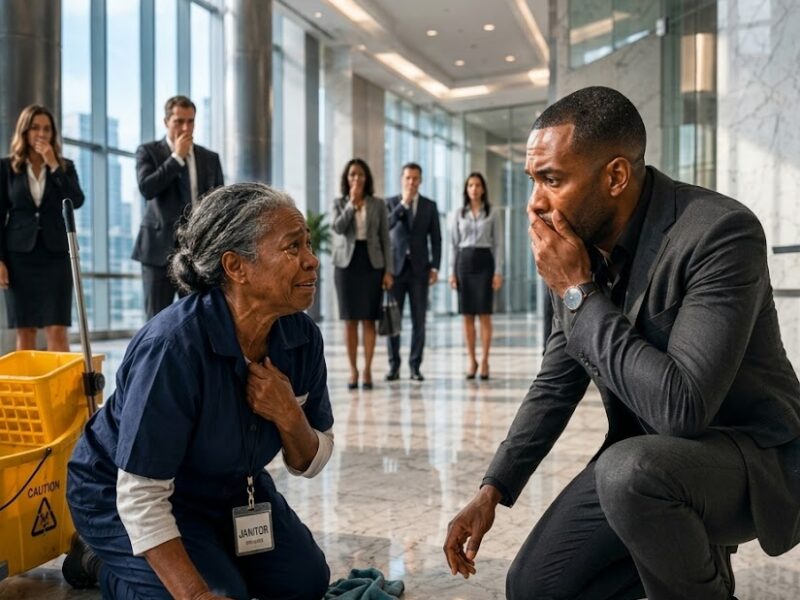
A Billionaire’s Missing Mother Worked as His Janitor for Three Years—Then He Finally Saw Her Face
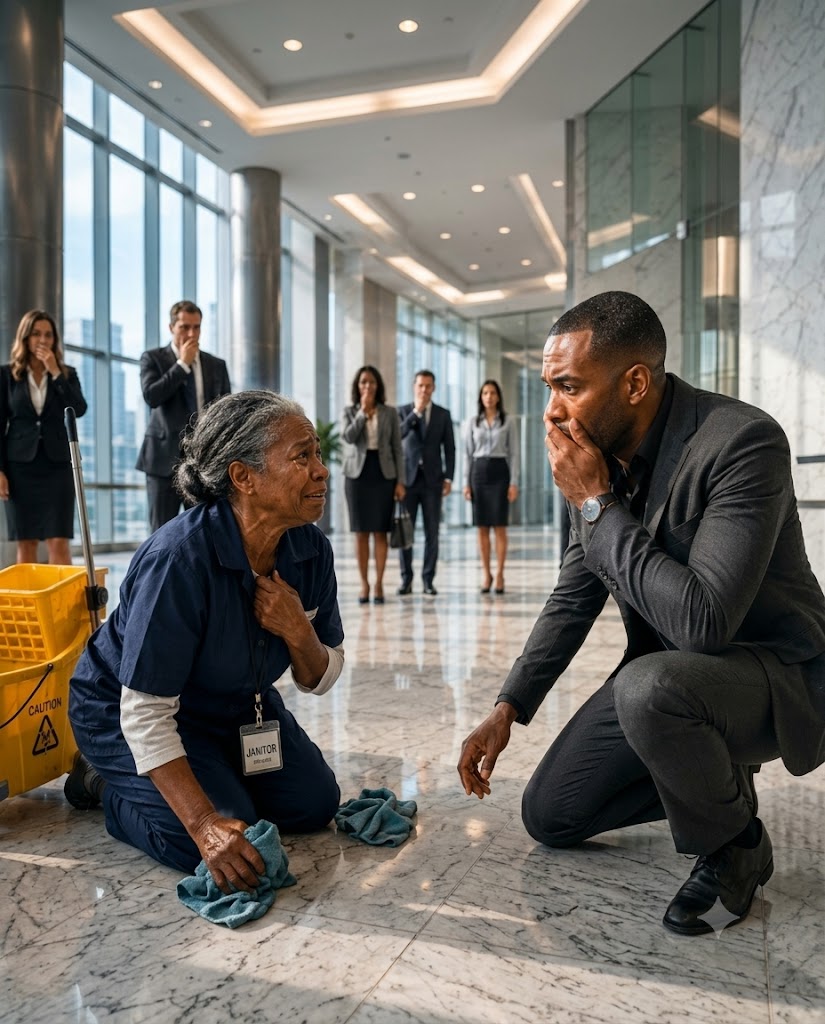
The elevator doors opened onto the 38th floor at 10:47 p.m., and Nora Callaway stepped out into darkness that lasted exactly one second before the motion sensors caught her.
Panel by panel, the lights came on down the corridor, triggered by nothing but her own movement, her own presence, her own quiet footsteps on marble that had been polished by someone else just hours before.
She was 65 years old, wearing a navy blue uniform with a name badge that read only “Nora” because she had given the cleaning company only half her name three years ago, and she was standing in the hallway of her son’s company.
Her son, who had built Mercer Capital Tower from a rented room with bad carpet and a secondhand desk into a 42-floor monument to everything he had become.
Her son, who had no idea she was here.
Her son, whose office she had cleaned every night for three years without him ever once seeing her face.
—
The first night she had ridden that elevator alone, she had stood still in the hallway and let the lights find her, one panel at a time, like a woman walking into a church.
She had made her way down the hall methodically, cleaning the conference room first, then the kitchen, then the executive restrooms, working the way she had done everything in her life—thoroughly, without fanfare, in a way that left no mess for the next person to manage.
At the end of the hallway was a glass-walled corner office with his name on the door, and she had looked through the glass at a large desk, a shelf of books, a row of framed photographs.
One of them, smaller than the rest, was a woman holding a boy of about three, the woman smiling, the boy with his arms out to the sides as if he had just discovered that this was something arms could do.
She knew that photograph because she had taken it herself in the backyard of the house in Milwaukee on a Saturday in September, 27 years ago.
She had given it to him when he opened his first office, and now it was on the shelf behind his desk, and he had no idea that the woman in the photograph was the same woman who emptied his trash every night.
—
James Callaway’s mornings began the same way every day.
Alarm at 5:45, coffee by 6:10, car to the building by 7, even though the building opened at 6:30 and he owned the company.
His assistant Priya had learned not to schedule anything before 7:15 because those first 15 minutes were his—not for calls, not for emails, not for anything except standing at the window on the 38th floor with his coffee and looking at the city below him and remembering that he had built this.
He needed that reminder, not because he was forgetful, but because the maintenance of something large required a constant, quiet accounting of why it was worth maintaining.
On a Tuesday morning in April, he dismissed the Sunday reminder without looking at it.
His thumb moved before his eye had fully focused on the screen, and the notification vanished—the 31st consecutive dismissal of a reminder he had set three years ago after a conversation with a mentor who had told him that the relationships you do not schedule are the ones that disappear.
He had agreed at the time.
He had made the reminder.
He had not made the call.
His mother was fine.
He knew she was fine because the transfer went through on the first of every month, $2,000 into an account he had opened in her name, reliable and quiet and without a voice attached.
He knew she was fine because if she were not fine, someone would have called him.
He knew she was fine in the way a person knows something they have decided not to examine too closely—not because they are careless, but because examining it would require them to sit still, and they have run out of still.
—
Three years earlier, on a Tuesday in March, Nora Callaway had walked into a commercial cleaning company’s hiring office on West Madison Street and given them only half her name.
The office was nothing fancy—a folding table, two plastic chairs, a wall calendar two months behind—and the man behind the table was named Gerald, and he had 14 positions to fill before the end of the week.
He asked her name.
She said, “Nora Arlene.”
He waited.
She did not continue.
He wrote it down.
She was 62 years old then, and she had been a school librarian for 26 years in Milwaukee, Wisconsin—the kind of librarian who remembered which students came back for the same shelves again and again and quietly set books aside for them before they asked.
She had a savings account with a balance that wasn’t nothing.
She owned her car outright.
What she did not have as of the previous month was a place to live.
Her landlord had sold the building, and she had 30 days, and she had not called her son.
She had a phone number for him, had it memorized, had been calling it since he was 16 and had a voice that was starting to go deep in a way that surprised him every time.
She had not dialed it in the three weeks since the eviction notice arrived.
She had thought about it every morning.
She had put the phone down every morning and found something else to do.
James Callaway did not need to know she had nowhere to go—that was what she told herself.
What she meant was that she did not want to become a problem for him to solve.
So she drove to Chicago with two suitcases and a box of books, found a rooming house in Rogers Park with a shared kitchen and a window that faced the alley, and walked into Gerald’s office on a Tuesday and gave him a name that was almost hers.
—
She was placed on the crew assigned to Mercer Capital Tower.
She had not asked for the assignment, but when she saw the name on the schedule posted on the wall, she stood in front of it for a long time.
Gerald appeared at her elbow and asked if there was a problem.
She said no.
She picked up her work gloves and went to find her cart.
The first night, she rode the elevator to the 38th floor alone, and the doors opened onto a hallway that was dark until she stepped out, and then the motion sensors came on panel by panel, triggered by her movement.
She was the only reason those lights turned on at this hour.
She stood still for a moment and let them find her.
She made her way down the hall, cleaning methodically, and at the end of the hallway was a glass-walled corner office with his name on the door.
She looked through the glass at a large desk, a shelf of books, a row of framed photographs, and one of them smaller than the rest was a woman holding a boy of about three.
She knew that photograph.
She had taken it herself.
She opened the door, emptied his trash, wiped the desk, straightened the books by an inch, replaced the trash bag, turned off the light, and closed the door behind her.
She stood in the hallway for a moment before pushing her cart toward the elevator.
At the far end of the hall, the stairwell door was propped open for ventilation, and from somewhere below, she heard the sound of footsteps—someone moving through the building, steady, unhurried, familiar in a way she could not explain and did not try to.
She did not know that James had forgotten his phone in the building and come back at nearly midnight to retrieve it.
She did not know he had passed through the lobby and into the elevator before she heard his footsteps.
She did not know he had gone back to his office, found the phone on the window sill, and left again without looking down the hall.
What she knew was the sound of footsteps moving through a place where her son worked, and her body going still, and her breath going quiet, and herself pressing her cart gently against the wall, and waiting without knowing why she was waiting, only that she was not ready to be found yet.
The footsteps stopped.
Then the elevator opened and closed.
The building went quiet again.
She let out a breath, pushed her cart to the elevator, and pressed the button for the lower floors.
In the right-hand pocket of her uniform, folded in thirds, was a yellow sticky note she had found in his trash that evening.
She had not read what it said.
She had recognized the handwriting—the particular way the T was crossed slightly too high, the way the Y dropped below the line with a small curl at the bottom.
She had known that handwriting since it was the alphabet written in pencil in a first-grade workbook.
She had not taken it to read it.
She had taken it because it was his, and she was not ready to throw away the only piece of him she had touched today.
—
The Clear View Services breakroom was in the basement, one floor below the loading dock.
It had a microwave bolted to the wall, a round table with four mismatched chairs, a bulletin board with the month’s schedule pinned crookedly, and a single window that looked out at the concrete base of the building next door.
At 2 in the morning, it was the quietest room in Chicago.
Raymond Okafor, 62, had been cleaning buildings for 18 years—first a hospital in Gary, Indiana, then a hotel in Evanston, then commercial properties in the Loop for the past nine.
He was the kind of man who kept a small radio in his locker and knew everyone on the crew by name within the first week.
He had noticed Norah immediately, the way she held her mop—not wrong, but like someone whose hands were used to something that required more precision.
The grip of a person trained for detail work.
The grip of a librarian.
He had asked her in their second week what she had done before.
She said she had worked in a school.
He nodded and did not push.
On a Wednesday night in early May, six weeks into Norah’s time at the building, they were both in the breakroom at the same time, which only happened when the elevator on the east bank was slow.
Raymond was eating a sandwich he had brought from home.
Norah was sitting with a cup of tea she wasn’t drinking, her hands wrapped around the mug, her eyes somewhere that wasn’t the room.
“You look like you’re somewhere else,” Raymond said.
She came back. “I was thinking about—” She considered this. “A long commute,” she said finally.
He looked at her over his sandwich.
She had the precise manner of someone who had spent decades choosing words carefully because words had weight in the rooms where she worked.
“My daughter doesn’t call either,” he said. “I mean that as solidarity, not as pity.”
Norah looked at him.
She didn’t say anything for a moment.
Then: “How do you manage it?”
He shrugged. “I know where she is. I know she’s all right. That helps more than people think.”
He finished the last quarter of his sandwich.
“I used to want her to call. Now I just want her to be well. You get there eventually.”
Norah looked down at her tea. “I think I’m somewhere in the middle.”
He nodded.
He did not ask what she meant.
—
She had not told anyone on the crew why she was here.
She had not told anyone she had a son who worked 38 floors above them.
She had not told anyone that the corner office she cleaned every night contained on a shelf behind the desk a small photograph of her holding a boy of three—a photograph she had not touched in 27 years.
What she had told them was that she was from Milwaukee, that she had worked in a school, and that she had moved to Chicago for a change.
These things were true.
They were also the parts of the truth that could be said in a breakroom without collapsing the conversation under their own weight.
She thought about the day she had packed the car.
It had been a Thursday—she knew because Thursday was the day she always changed the linens, and she had changed them that morning, out of habit, not out of need.
The bed would be slept in by a stranger within 30 days.
She had changed the linens anyway.
She had driven the five hours from Milwaukee to Chicago in the kind of focused silence she used when she did not want to think.
She had found the rooming house in Rogers Park through a listing on a community board—$220 a week, shared kitchen, no lease required.
She had paid the first two weeks in cash.
The room had a narrow bed, a single window, a dresser with a drawer that stuck, and a shelf above the closet where she had lined up the books she could not bring herself to leave.
She could have called James from the highway.
She had thought about it every 20 miles.
She had imagined his voice—efficient at first, then concerned, then organizing.
There are options. Mom, let me make some calls.
He would fix it the way he fixed things—efficiently, without sitting still long enough to know what it cost her.
And she would have let him because she always let him.
And then she would have lived in whatever he arranged and felt like a problem he had solved rather than a person he had chosen.
She did not call.
—
Delia Watkins was the night supervisor, 58 years old, steady as a building permit.
She managed the 32-person crew with an authority that asked nothing of its firmness.
She had noticed Norah the first week—not because Norah did anything wrong, but because the pace of her work on the upper floors was different from the pace she used everywhere else.
On the 38th floor, she slowed down.
It was not laziness.
It was the opposite of laziness.
It was the deliberate attention of someone who needed to be thorough because the work mattered in a way she couldn’t explain to anyone and hadn’t tried.
Delia had said nothing for six weeks.
On a Wednesday in May, she fell into step beside Norah at the elevator and said quietly, “You all right?”—not as an opener to a conversation, but as a real question.
Norah said, “I’m all right.”
Delia looked at her for a moment.
Then she nodded and stepped back as the elevator opened.
She got in and pressed the button for the 14th floor.
She did not ask again that night or any night after, but something in the way she managed the schedule shifted slightly.
Norah’s assignment to the 38th floor became a standing thing—consistent, unquestioned.
Delia did not announce this.
She did not explain it.
She simply arranged it because she had been doing this work for 11 years, and she could tell the difference between someone working a building and someone keeping watch in one.
—
Three weeks later, as Norah was finishing the 38th floor and stepping into the elevator with her cart, the doors began to close and then opened again.
James stepped in—still in his coat, returning for something, his umbrella, she would later note in her small book.
He held the door and stepped aside to let her cart pass.
He did not look at her.
He pressed 38.
She pressed the lobby level.
They rode in silence.
At 38, the doors opened and he stepped off.
She kept her face toward the back corner of the elevator until the doors closed.
She breathed out slowly.
She rode down alone.
In the breakroom, she took out the small notebook she carried in her bag—a narrow composition notebook, the kind with the black and white marble cover, the kind she had kept for notes at every library where she had ever worked—and she wrote the date and a single line.
He forgot his umbrella. It rained. I watched him run to his car. He is still the boy who ran through puddles.
She closed the notebook.
She put it back in her bag.
She finished her tea.
Raymond had gone back to the upper floors.
The breakroom was empty.
She sat for a moment in the quiet and let herself have it—the fact of his face three feet from hers, the familiar way his shoulders settled when he was focused on something, the sound of his voice on the phone she had heard for a moment through the stairwell door last month.
Close enough to be real.
Far enough to be safe.
For now, this was enough.
For now, she could manage it.
She picked up her bag and went back to work.
—
In the second year, James began to notice things he could not explain.
It started with the books.
He had a shelf behind his desk—two rows of reference texts, a few things he was working through, some volumes he kept because they had been given to him by people he respected, and he did not know what else to do with objects that carried that kind of weight.
He was not particularly orderly about them.
He set things where they landed and did not give the arrangement much thought, except that the books were always ordered.
Not dramatically, not alphabetically, not by color or size or some obvious system he could identify, but aligned—spines even, slight gaps between volumes consistent with each other, like someone had straightened them so carefully and so regularly that the order had become the baseline.
He had assumed this was the cleaning service.
That was what you paid a cleaning service for.
He had not thought about it further.
Then one morning, he walked in and noticed the angle of his desk lamp.
He hadn’t touched it.
He had not mentioned to anyone that he preferred it angled 15 degrees toward the window rather than straight overhead.
He had worked that out years ago and simply moved it when it wasn’t right—the adjustment automatic, unspoken—but it was already at exactly that angle.
Had been now that he thought about it, every morning for as long as he could remember.
He mentioned it to Priya when she arrived for their morning briefing.
She looked mildly puzzled. “The cleaning crew, probably. Do you want me to ask someone not to touch it?”
“No,” he said. “No, I’m not bothered. I was just curious.”
He dropped it.
He had a 9 a.m. and two calls in the afternoon and a site visit at 4:30.
He did not have time to be curious about a lamp.
But the feeling didn’t leave.
Something in the office was paying attention to him in a way that a standard cleaning contract didn’t account for.
The coffee ring on the left side of the desk—always wiped from exactly the right angle, so the surface came clean without streaking.
The small photo on the shelf, which he had noticed was sometimes slightly shifted and was always correct again by morning.
He could not have said what correct meant for a photograph, only that there was a position in which it sat that felt right, and it was always in that position.
He was not a superstitious man.
He was not given to noticing things that did not have a purpose.
But this was building into something that did not have a name yet.
—
Victor came to find him at 11:30, something he had been doing more often in the past two months.
He sat across from James and said, still in his casual manner, that he had met with Patricia Ashmore the day before.
Ashmore was the second board member Victor had mentioned in recent weeks.
Two meetings with two board members in two weeks—separate meetings, not mentioned to James beforehand.
James said he hadn’t known Patricia had questions.
Victor said, “She’s got some concerns about the quarterly trends. Nothing that can’t be addressed.”
James said, “You can send me her questions and I’ll respond directly.”
Victor said pleasantly, “Already handled it.”
James nodded.
He looked at his desk.
Victor left two minutes later—still pleasant, still easy, still carrying the particular energy of a man who has concluded a conversation he was always going to win.
James sat for a moment.
He picked up his phone and called Marcus Webb.
Marcus was his attorney and his closest friend since law school—a man of considerable intelligence and considerable patience who had learned over 17 years that James’s instincts were worth listening to even when he couldn’t explain them.
Marcus listened to the summary of the board meetings and said, “That’s two separate conversations with two board members in under two weeks, not disclosed to you, described as routine. That is not routine.”
James said, “I know.”
“Do you want me to look into it?”
James said, “Not yet. Let me see if it develops.”
He hung up.
He stared at the city for a moment.
Then he went back to work.
—
That night, on the 38th floor, Norah moved through the office with more than her usual care.
Something in the building felt different—a residue of tension in the air that she could not source, only sense.
She had been a librarian long enough to know that a room holds something of what happened in it.
She did not know what had happened in this room today.
She knew only that the air was tight.
She cleaned methodically.
When she reached the desk, she found a sticky note tucked under the edge of the laptop—not in the trash, not discarded, just set aside.
She lifted it with two fingers to wipe under it.
The area code was 414—Milwaukee.
She recognized it immediately.
It was her own phone number, written in his handwriting, the T crossed too high, the Y curling below the line.
Below the number in smaller letters: call back.
The sticky note was three weeks old.
The corner was soft from handling.
He had picked it up and put it down more than once.
She stood with it in her hand for a moment.
The breakroom was 12 floors below her.
Raymond was on the 19th floor.
Delia was on the 22nd.
She was alone on 38.
She set the note back where she found it—tucked under the edge of the laptop, exactly as she had found it.
She wiped around it.
She replaced the trash bag.
She straightened the lamp to its correct angle.
She did not allow herself to stay longer than usual.
She collected her cart and walked to the elevator.
On the ride down, she pressed her back against the wall and closed her eyes for the 42nd descent.
He had her number.
He had written it down and picked it up again and set it aside.
Three weeks.
A sticky note that still existed on a desk was a reminder that had not yet become a choice.
She understood this.
She had not called him either.
She walked through the service entrance and into the night.
On the sidewalk, she stopped.
The air was cold.
The street was empty in the way only Chicago streets are empty at 2 in the morning—which is to say, not quite.
In her bag, the notebook.
She reached in and found it by touch and held it for a moment without opening it.
Then she let it go and kept walking toward the bus stop.
Two blocks away in the underground garage, James’s car sat untouched in its reserved spot.
He had stayed late again.
He would be there until midnight.
They were in the same building at this hour.
They had been in the same building at this hour for over a year.
The gap between them had nothing to do with distance.
—
It was Priya who asked the question first, though she didn’t know she was asking it.
She came into James’s office on a Wednesday morning in the third year with a list of items for the facilities review and mentioned almost as an aside that the cleaning contract with Clear View was up for renewal in 60 days and facilities wanted to know if there were any service concerns before they resigned.
James said there were no concerns.
He thought about this for a moment and then said, “Actually, can you get me the crew assignment records from Clear View? I want to see who’s been assigned to this floor.”
Priya looked at him.
This was an unusual request.
The cleaning crew was managed by Clear View, not by Mercer Capital.
James had never asked about individual crew assignments in the 11 years she had worked for him.
“Is there an issue?” she asked.
“No issue,” he said. “I’m curious.”
She sent the request to Greg Tolman in building facilities.
Greg called James directly, which was also unusual.
He said he would see what he could get from Clear View, but individual crew records weren’t typically shared with tenants.
James said he understood and asked Greg to try anyway.
The records arrived by email two days later—a general crew manifest, names, assigned floors, shift schedules.
James opened it at his desk and scrolled down.
He was looking for something he couldn’t name.
Something in the unusual consistency of his office’s upkeep—the lamp, the books, the coffee ring, the photograph that didn’t fit a standard service rotation.
Most cleaning crews rotated floors.
He knew this because Priya had mentioned it once years ago, explaining why it sometimes felt like different people had cleaned the same space in different weeks.
His floor had not rotated.
He could tell from the manifest.
The notation for floors 36 through 38, all three years of the contract, showed a single entry: N. Arlene.
He stared at the name.
It took three full seconds—which is a long time when you are holding something still in your hands.
Nora Arlene.
His mother’s first name and middle name.
No last name on file.
A blank where the last name should have been on a form that required one.
He set the manifest down on the desk.
He picked it up again.
He read it again.
Same name.
Same floor.
Three years.
He sat very still.
His mother’s name was Nora Arlene Callaway.
She had gone by Nora since before he was born.
Her middle name, Arlene, was her grandmother’s name.
She had told him this once in a kitchen in Milwaukee on a Sunday afternoon when she was teaching him to make her grandmother’s biscuits, which she made every Christmas, and which he had not eaten in four years because he had not been to Milwaukee in four years.
He did not know what to do with this information.
He did not know what to do with the shape of a thought that said: Your mother may have been cleaning your office for three years without you knowing she was here.
He did not go down to the basement.
He did not call the cleaning company.
He set the manifest on the corner of his desk and looked at the city.
Twenty minutes later, his office door opened and Priya appeared with an expression that told him the news before she did.
“Victor has filed a petition with the board,” she said. “Formal, through his attorney. Leadership review vote requested within 30 days.”
She handed him the legal notice.
He took it.
He looked at the manifest on his desk.
He looked at the notice in his hand.
Two pieces of paper.
One held the possibility that his mother had been invisible in his building for three years.
The other held proof that his business partner had been quietly working against him for at least as long.
He put both pieces of paper on the desk.
He called Marcus.
—
Marcus said without preamble, “Tell me everything.”
James told him—the board meetings Victor hadn’t disclosed, the lunches, the pattern over the past eight months, the formal petition.
Marcus listened without interrupting.
When James finished, he said, “I’ll file a response by end of day. In the meantime, I need everything—the meeting records, any communications Victor sent to Row or Ashmore that you have access to, anything in writing.”
James said he would have Priya compile it.
He paused.
He looked at the crew manifest.
“One more thing,” he said.
He told Marcus about the name N. Arlene, the blank last name, the three-year assignment on his floor.
There was a silence on the other end.
“You think it’s her?” Marcus said.
“I don’t know. Have you called her?”
James looked at the corner of his desk where the sticky note had been for three weeks.
He had moved it to his desk drawer two days ago.
He had not called.
“No,” he said.
“James, I know if she’s in this building,” Marcus said carefully, “you need to know before anyone else makes it an issue.”
James said, “I know.”
He did not say that he was sitting at his desk, unable to make himself pick up the phone to call a woman who might be 40 floors below him right now.
He did not say that finding out would change something he was not ready to have changed.
He hung up.
He called Greg Tolman back.
“The woman assigned to the 38th floor,” he said. “N. Arlene. No last name on file. How long has she been on this floor?”
Greg’s keyboard.
A pause.
“Three years, sir. She came in with the original contract. She’s been on your floor the whole time.”
James said, “Thank you.”
He hung up.
He sat with the two pieces of paper on his desk until Priya knocked at 5:00 to confirm the end-of-day schedule.
He told her to go home.
He would be staying late.
He did not go to the basement.
He did not go to the supply floor.
He sat in his office and worked through the board petition files until 9:00.
And then he went to the window and looked at the city and thought about a woman who had applied for a cleaning job using half her name and been assigned to his floor for three years.
He thought about 31 Sundays.
He thought about the sticky note in his drawer.
He thought: Tomorrow. I’ll figure out the rest of it tomorrow.
He picked up his coat and his bag.
He walked to the elevator.
At the end of the hall behind him, the door to the supply closet was slightly ajar.
He did not look back.
In the supply closet, on a narrow shelf beside the chemical storage, was a small composition notebook with a black and white marble cover.
Inside it, three years of dates and small observations in handwriting that a first-grade teacher had once praised for being particularly clear.
It was sitting three feet from where he had walked.
He did not know it existed.
The elevator arrived.
He stepped in.
The doors closed.
In the stairwell below, Norah Callaway began her shift.
—
Norah’s back had been giving out since February.
It was the cart, specifically—the motion of pulling it backward over a threshold, the slight jerk required when the wheels caught on the uneven strip between hallway tile and office carpet.
She had learned to anticipate it, to shift her weight before the pull so her lower spine didn’t bear the full force.
But anticipating it every night for three years had created its own problem.
The muscles that were supposed to protect the vertebrae had been working overtime for too long and were beginning to protest.
She kept two ibuprofen in her right-hand pocket.
She took them at midnight, at the halfway point of her shift, with whatever was left in her water bottle.
She did not mention it to anyone.
Delia noticed anyway.
“You’re moving different,” Delia said in the breakroom on a Thursday night in March.
“I’m fine.”
“That’s not what I said.”
Delia sat down across from her.
“I can reassign you to 12 through 18. Same hours, same pay. The equipment is lighter down there.”
Norah looked at her. “I want to stay on the upper floors.”
Delia’s expression did not change.
It was the expression of a woman who had heard this answer before, in this exact form, from this exact person, and had already decided what she would do with it.
She nodded once and went back to her coffee.
She did not reassign Norah, but starting the following week, she arranged it so that Norah’s cart was always preloaded and waiting at the elevator, with the heavy floor-polishing equipment already removed and stowed separately.
No explanation given.
Norah accepted this without commenting on it, which was the only language available to both of them in this circumstance.
—
The notebook had been filling slowly for three years.
Not every night—some nights there was nothing worth recording—but most nights there was something.
A Post-it note with a phone number in a 414 area code.
The title of a book she’d seen him carry two floors in his briefcase before it appeared on the shelf.
The name of a company on a document she’d moved off a chair.
She didn’t read the document, only the letterhead.
Dates and observations in the precise, minimal handwriting of someone trained to catalog things accurately.
She kept the notebook in her bag during her shift and in the nightstand drawer in her room in Rogers Park during the day.
It was not a diary.
It had no emotions in it.
It recorded events the way a library log records checkouts—what, when, by whom, in what condition.
She had started it out of habit.
She did not think about why she was keeping it.
She did not think about what she would do with it.
In March of the third year, James added a photograph to his office shelf.
She noticed it on a Wednesday night—a framed print larger than the others, recently placed on the far right end of the row.
A man and a woman at a dinner event somewhere.
The man was James, and the woman was someone she did not recognize.
Dark hair, serious expression, the kind of posture that came from knowing that people were watching.
Norah stood in front of the shelf for a moment.
She noted the photograph in the book.
New photo. Dinner event. Woman, dark hair, unknown.
She did not move the photograph.
She adjusted the lamp beside it so the new frame wasn’t partially in shadow.
—
Raymond found her on the 30th floor one evening and asked, with his particular gentleness, how she was doing.
She told him she was well.
He told her his daughter had sent him a birthday card that year, which was more than usual.
“Did it help?” Norah asked.
“More than I thought it would,” he said. “I keep it in my locker. I look at it sometimes. It’s a stupid card—one of those with a cartoon on the front. But she picked it up and put a stamp on it and thought of me.”
He shrugged. “That’s something.”
Norah thought about James’s desk drawer.
The sticky note.
The 414 area code written in the handwriting she would know anywhere.
“It’s something,” she agreed.
—
At the end of April, her back went out fully for the first time.
Not on the upper floors—she had braced herself too hard for that kind of failure in front of the elevator banks—but in the supply closet, bending for a bottle of floor cleaner on the bottom shelf.
Something in her lower back seized in a way that was different from the usual protest.
She straightened up very slowly.
She stood against the shelving for five minutes.
She finished her shift in the breakroom after she took the last of her ibuprofen and sat with her eyes closed for 10 minutes.
Raymond came in and looked at her and did not ask.
He microwaved something, set it in front of her, and said, “Eat. You look like you’ve been awake since yesterday.”
She ate.
It was soup from a can, too salty, heated unevenly.
She ate all of it.
She had a doctor’s appointment on Friday, which she had made two months ago for an unrelated reason.
She would mention the back.
She would hear what she already suspected: the work was becoming too much for her body.
She would have to make a decision before too long about how much longer she could sustain this particular method of proximity.
She had not thought past that.
She was still thinking about the photo on the shelf, about the woman with dark hair and a serious expression standing beside her son at a dinner somewhere, about whether this was a woman who knew James well enough to know about Milwaukee, about the house with the oak trees, about the biscuits made on Christmas morning.
About whether he had told anyone about her.
About whether she was still on his shelf in the way she needed to be, or whether she had slowly become something else—a duty, an entry in an account, a name on a reminder he dismissed every Sunday morning without looking at it.
She thought about all of this and then she put it away, because thinking about it too long made the room small in a way she could not afford.
On the bus home, she took out the notebook and wrote the date.
She wrote: Back pain today. Worse. Make decisions soon.
She closed the book.
She watched the city go past the window.
She was 65 years old and she was doing this because she did not know how to be farther away from him than this.
It was not a sustainable answer.
She had always known it was not a sustainable answer.
She had told herself she would figure out the rest of it in time.
She had not figured it out.
The bus stopped at Howard.
She got off and walked the two blocks to the rooming house.
In her room, she sat on the edge of the bed and took off her shoes and rubbed her feet the way she had done at the end of every shift since the beginning.
Then she lay down and looked at the ceiling and let herself think for exactly three minutes about a boy who ran through puddles.
Then she closed her eyes and slept.
—
The board petition changed things in a way James hadn’t anticipated.
Not the legal weight of it—Marcus had that handled, had filed a response within 48 hours and was already building the counter-case.
What changed was the quality of James’s attention.
For the first time in years, he found himself looking at things he had stopped looking at.
He stayed late four nights in a row.
He reviewed files he had trusted to process on their own.
He pulled communications he hadn’t opened.
He made calls he had been putting off.
He was, for the first time in a long time, present in a way that went beyond the hours logged and the transactions completed.
On the fourth night—a Tuesday in late May—he was at his desk at 1:30 in the morning reviewing a set of financial projections when he heard it.
The sound he had heard before, the first night he had stayed late enough.
The sound he had tried to locate in his chest and hadn’t been able to name.
The soft squeak of rubber wheels on marble.
The faint rattle of spray bottles in a plastic caddy.
Someone working at the end of the hall.
He set the projections down.
He walked to the glass wall of his office and looked down the corridor.
At the far end, a woman was pushing a cleaning cart toward the elevator.
Her back was to him—navy blue uniform, short gray hair.
She moved at the particular pace of someone who has done a thing so many times that the pace itself has become a form of knowing.
He knew that pace.
He had known it his whole life.
It was the pace of a woman moving through a kitchen, a library, a school room—always at the same tempo, never urgent, always completely present.
He walked out of his office.
He walked down the hall.
The elevator doors were closing.
He reached the button and pressed it.
He waited.
The elevator returned.
He stepped in and pressed the button for 36.
The doors opened.
He stepped out into a quiet floor.
Desks, darkened monitors, the hum of ventilation.
At the far end of the hallway, a light under a door.
He walked toward it.
Delia Watkins was at a supply station near the east stairwell, restocking a cart from the storage shelves.
She looked up when she heard him—not surprised, exactly, but alert in the way a professional is alert when someone unexpected appears in their workspace.
He said, “There was a woman on 38. Short hair, about 65. Where is she?”
Delia looked at him for a long moment.
He could see her weighing something.
He didn’t know what she was weighing, only that she was doing it carefully.
“Supply closet,” she said. “End of the hall.”
He walked past her without another word.
The hallway was dim.
His footsteps were the only sound.
At the end, a door with a plastic handle and a cleaning company sticker.
He stopped in front of it.
He stood there for five seconds.
Then he opened it.
—
The supply closet was narrow, shelved floor to ceiling on both sides—cleaning solutions, replacement bags, extra mop heads, rolls of paper towel, a folding step stool.
In the middle of the room, on an overturned bucket, sat a woman in a navy blue uniform with short gray hair and a name badge that read: Nora.
No last name.
She looked up at him.
She had his eyes.
She had always had his eyes—the same dark brown, the same tendency to go still when they were thinking.
He had always found this fact about himself vaguely embarrassing, that something as particular as the way he looked when he was concentrating had come from her.
She did not pretend not to know him.
She did not pretend anything.
She looked at him the way she had always looked at him when he was in trouble—directly, waiting to see how much of it he was going to acknowledge before he needed help.
He said, “How long?”
She said, “Three years.”
He sat down on the floor of the supply closet across from her.
There was nowhere else to sit.
He put his back against the shelving and looked at her.
“You cleaned my office,” he said.
“Every night,” she said.
He closed his eyes.
He opened them.
He looked at the ceiling of the supply closet, which was the kind of ceiling that supply closets have—unfinished, a bare fluorescent tube, a pipe running along the top edge.
He looked at it for a while.
“I found your name in the crew manifest,” he said. “N. Arlene. No last name.”
“I know what I wrote on the form.”
“Why didn’t you tell them your last name?”
She was quiet for a moment. “Because then someone might have asked questions I wasn’t ready to answer.”
“Like what?”
“Like why the owner’s mother is applying for a janitor position at her son’s firm.”
He looked at her.
“Why did you?”
She looked at her hands in her lap.
They were the hands he had known all his life—the hands that had made his breakfast and signed his permission slips and held his textbooks out to him like an offering every September.
They looked older than he had let himself imagine.
“I needed to be near you,” she said. “I didn’t know how to ask for that. I was afraid that if I called you, you would fix it. Find me a place to live, set something up, and then I would be a problem that was solved rather than a person who was there.”
She paused.
“I thought this was better. I could be near you without being in your way.”
He said, “You cleaned my office floor for three years.”
“I know.”
“That’s not being in my way.”
She looked at him and did not say anything.
He stayed on the floor of the supply closet for 10 minutes.
She stayed on the overturned bucket.
At some point, without planning it, he asked how long her lease had run out, and she told him—the eviction notice, the rooming house in Rogers Park, the drive from Milwaukee.
He listened to all of it.
When she finished, he was quiet for a moment.
Then he said, “There’s something happening with the company. I need to deal with it this week.”
He stood up and looked at her.
“When it’s done, you and I are going to have a real conversation. Not in a supply closet.”
She said, “That seems fair.”
He said, “You’re not going back to Rogers Park tonight.”
“I have a car,” she said.
“James.”
He said, “Norah Arlene.”
She looked at him.
“You drove five hours from Milwaukee and got a job cleaning my building because you didn’t want to bother me. I am the one who should be embarrassed right now, not you. Get your bag.”
She got her bag.
—
In the elevator on the way to the lobby, she looked at his reflection in the mirrored panel above the floor display.
He was looking at his phone already, back at work, thumb moving across the screen, expression focused, running through the next thing.
She had watched him do this for three years through a glass wall.
Watching it from inside the elevator was different—smaller, more real.
She said, “You still do that thing with your jaw when you’re working.”
He looked up. “What thing?”
“You clench it on the left side. You’ve done it since you were 12.”
He looked at her reflection.
He unclenched his jaw.
Then, without intending to, he almost smiled—the particular almost-smile she had seen 10,000 times, the one that meant he was caught and knew it and didn’t fully mind.
“Stop noticing things,” he said.
“I’ve been doing it for 65 years,” she said. “I’m not going to stop now.”
The elevator opened at the lobby.
He held the door.
She walked through first.
—
He drove her to Rogers Park that night and did not go in.
She told him she was fine, that she needed sleep, that they would talk properly in the morning.
He said he would pick her up at 8.
She said that was too early.
He said 8:30.
She said fine.
He sat in the car for 15 minutes after she went through the front door of the rooming house.
The building was the kind of old Chicago building that had been converted from something else—you could tell by the shape of the windows and the slightly wrong height of the ceilings.
The room she had described as hers faced the alley.
He could see light in the window.
He drove back to the penthouse.
He did not sleep.
At 8:30, he was parked in front of the rooming house.
She came out at 8:40 with a bag over her shoulder and a coat she had brought for mornings like this one—cold for May, the lake still holding the tail end of winter.
She got in the passenger seat and looked at the city through the windshield.
He drove to a diner on Clark Street that had been there since 1981 and had the particular confidence of a place that had outlasted every trend by not acknowledging trends existed.
They got a booth in the back.
He ordered coffee.
She ordered tea.
He said, “Tell me everything.”
—
She told him—from the eviction notice on a Thursday she had been changing the linens out of habit, to the drive to the rooming house, to the application.
The fact that the Clear View assignment was not something she had requested.
The first night on the 38th floor.
The 11 minutes in the supply closet before she started her shift.
He listened to all of it without interrupting.
This was not natural for him.
He was a man who processed information by asking questions, who moved through a conversation by narrowing it toward action.
He made himself be still.
When she finished, the tea had gone cold.
He flagged the server for a fresh cup.
He said, “Why didn’t you call me when the lease ended?”
She said, “I thought about it.”
“But you didn’t.”
“No.”
“Why?”
She wrapped her hands around the new cup of tea.
“Because you would have fixed it,” she said. “And I needed—I needed something more than fixed. I needed to see you. To be somewhere near you. Not because I was in crisis, just because you’re my son and I am 65 years old and I haven’t seen your face properly in four years.”
She paused.
“I knew you would help. That wasn’t the question. The question was whether you would stop long enough to know I was there.”
He looked at her.
He did not say I would have stopped.
He didn’t know if it was true.
And she was not a woman who found comfort in things that might not be true.
Instead, he said, “I’m sorry. I should have called.”
She said, “I should have called, too.”
They sat with that for a moment.
“31 Sundays,” he said.
She looked at him. “What?”
“I had a reminder on my phone. Sunday call. I dismissed it 31 times in a row.”
He sat down his coffee.
“I told myself next week. Every time. 31 next weeks.”
She was quiet.
Then: “I had the number memorized. I dialed it twice in my head on the drive from Milwaukee. Never touched the actual phone.”
He said, “We’re both idiots.”
She said, “You more than me. I came all the way to Chicago.”
He almost smiled again.
Then his phone buzzed.
He looked at it—Marcus.
He held up one finger and she nodded, and he stepped outside.
Marcus said, “I need you to listen carefully. If your mother was in that building for three years, she may have seen things. That makes her a witness. I need to know what she observed.”
James said, “She kept a notebook.”
There was a pause.
“Tell me about the notebook,” Marcus said.
“She said she kept it out of habit. She’s a librarian. She records things.”
Another pause.
“Where is it?”
“She has it.”
“James, I need to see that notebook today. There’s a name in it she might have written down without knowing what it meant. Victor Harlon had access to this building. He was in your office on multiple occasions. If she logged anything—anything at all—about his movements on that floor, that’s material.”
James stood on the sidewalk in the morning cold.
He looked through the diner window at his mother, who was drinking her tea and looking out at the street with the patient, unhurried manner of a woman who has decided that this hour is enough, and she is going to be entirely in it.
He went back inside.
He sat down.
“Marcus wants to see your notebook,” he said.
She looked at him. “My notebook?”
“He’s my attorney. He’s trying to help me with the board situation. He thinks you may have recorded something useful without knowing it.”
She considered this.
She set down her tea.
She said, “I’ll need to get it from my room.”
He said, “We have time.”
—
They finished breakfast.
He paid.
They drove to Rogers Park, went up to her room—narrow bed, books on a shelf above the closet, a window looking out at the alley—and she took the notebook from the nightstand drawer.
She held it for a moment before she handed it to him.
He looked at the cover—black and white marble, the kind from any office supply store, the kind she had been using for notebook logs since before he was born.
“Thank you,” he said.
She said, “I didn’t write it for this.”
“I know.”
“I wrote it because it happened. And things that happened should be recorded. That’s what I believe.”
She looked at the notebook in his hand.
“Whatever is useful in there, you can have. But tell your attorney that the rest of it belongs to me.”
He said he would.
He called Marcus from the car.
Marcus said to bring it in that afternoon.
On the drive to Marcus’s office, Norah sat in the passenger seat and watched the city move past.
She had not been in a car with her son in four years.
The last time she had sat in the same seat in a different car, and they had driven to the airport so he could catch a flight to New York for something she could no longer remember.
She remembered the airport more clearly than the reason—the departures door, the way he had hugged her, real, not brief, before he went inside.
She had stood outside until the automatic doors closed and then she had stood there a moment longer and then she had driven back to Milwaukee alone.
She did not say any of this.
She watched the city.
He said, without taking his eyes off the road, “I’m going to want you to stay somewhere you’re not paying $220 a week.”
She said, “I’m not moving in with you.”
He said, “I have a guest room.”
She said, “I know. You told me about it when you bought the place. I have not forgotten a single thing you’ve told me in 43 years.”
He said, “Then you know the guest room has its own bathroom.”
She said, “James.”
He said, “It’s a real bathroom. Not a shared one down the hall.”
She said, “Finally,” with the particular resignation of a woman who knows she has already lost an argument, “we’ll discuss it after the board thing.”
He said, “Fair.”
They drove in silence for a while.
The city moved past.
She watched it.
He said, “I’m going to fix this.”
She said, “I know you are.”
He said, “And then we’re going to figure the rest of it out.”
She said, “Yes.”
He said quietly, “I missed you.”
She looked at him.
He was still watching the road.
His jaw was tight on the left side again, the way it got when he was feeling something he hadn’t given himself permission to say.
She said, “I missed you, too. That’s why I came.”
He nodded.
He drove.
The city opened up around them, wide and bright in the May morning.
And for the first time in four years, they were in the same place at the same time, going somewhere together.
—
Marcus Webb’s office was on the 15th floor of a building on North Wacker with a view of the river and enough legal volumes on the shelves to qualify as a secondary library.
He greeted Norah at the door with the particular warmth of someone who had heard about her for years without expecting to meet her this way.
He shook her hand.
He said, “I’ve heard a lot about you.”
She said, “I know. James talks when he’s nervous.”
Marcus looked at James.
James said, “Shall we start?”
They sat at the conference table—the three of them, plus the notebook, which Norah had set in the center like a neutral party.
Marcus opened it to the first page and began reading.
He was quiet for a long time.
The first entry was a date, March of three years ago, and a single line: First night. Elevator to 38. Hall lights triggered by motion. Had to remember to move.
The handwriting was clear and consistent—the librarian’s handwriting, the kind trained for legibility because you are always writing for someone else to read.
Marcus turned pages.
The entries were spare—dates, small observations, names when they appeared.
Some entries were only a few words.
Some were a paragraph.
None were emotional.
He turned to a page roughly 14 months in.
He read it.
He turned back.
He read the adjacent page.
He looked up.
“This entry,” he said, and turned the notebook so Norah could see the page he was pointing to.
You wrote: V. Harlon, 38th floor, after hours, 8:47 p.m., removed papers from printer area near shredder. Left one piece on top of machine, appeared unshredded. Placed in cleaning bag by accident. Realized it wasn’t trash, set aside.
He flipped forward two entries.
And here: Folded document found in supply closet on shelf. Brought in case needed. Filed with other items.
He looked at Norah.
“Do you still have that document?”
She opened her bag.
She took out a manila envelope.
Inside the envelope were several papers, folded or taped—three years of things she had set aside on instinct.
She had not read most of them.
She had only kept what felt important without knowing why.
The second item in the envelope was a sheet of paper, originally torn, then carefully taped along the tear with the translucent tape she used to repair damaged books.
She had done it neatly.
The page was intact and legible.
Marcus took it.
He read it.
He read it again.
He set it on the table and looked at James.
“This is a memo,” he said, “from Victor Harlon to Duncan Row and Patricia Ashmore, dated 14 months ago. It lays out a strategy for removing you from the managing partner role. It references specific metrics. It outlines a timeline. It was supposed to be shredded.”
He paused.
“It wasn’t.”
James looked at the memo.
He read it once, from top to bottom.
Then he set it down.
Fourteen months.
Victor had been building this case for 14 months—well before any formal communication, well before James had any reason to believe the partnership was under stress.
The memo described James’s declining operational focus, his emotional unavailability, his increasing difficulty managing complex stakeholder relationships.
The language was careful and clinical and utterly wrong.
“He was doing this while we were shaking hands at the quarterly meeting,” James said.
“Yes,” Marcus said.
Norah watched her son’s face.
She recognized the expression.
She had seen it once before, when he was seven years old and his father had left without explanation, and James had come home from school and asked where dad was.
He had the same expression now—not grief, exactly, but the particular stillness of someone in the process of revising their understanding of reality.
She did not reach across the table and take his hand.
He was 43 years old and in a professional setting, and she understood the difference.
Instead, she said, “The tape is from the supply closet. I carry a roll. I’ve patched a few things over the years. Torn permission slips, damaged library materials. Old habit.”
Marcus looked at her.
“The tape is what kept this document intact.”
“I thought it might be needed,” she said.
“I wasn’t sure by whom.”
“You held on to this for 14 months.”
“I hold on to things,” she said. “It’s what librarians do.”
He nodded slowly.
He looked at the memo again.
He pulled out a legal pad and began writing notes.
He said, without looking up, “This is potentially the evidence that changes the entire board proceeding. Victor’s petition argues that James has been declining for months. This memo predates the claimed decline by over a year and shows the narrative was constructed, not observed.”
He looked up.
“That’s bad faith. That’s a violation of the partnership agreement’s duty of loyalty clause.”
James said, “What does that mean?”
“Practically, it means the board vote, if it goes against you, is tainted by a partner acting in bad faith. It means the petition was filed under false pretenses. It means Victor’s standing in this matter is compromised.”
Marcus picked up the memo.
“And it means we have something to present at the hearing.”
—
He began sorting through the other materials in the envelope.
More notes, more dates, more small items Norah had set aside on instinct.
A business card.
A partial email printout—not sensitive, but with Victor’s name on a chain.
A hotel receipt from the building lobby’s concierge desk left on the elevator.
Victor’s name.
“A trail,” Marcus said quietly.
“I didn’t know it was a trail,” Norah said. “I just recorded what I saw.”
“That is exactly what a trail is,” Marcus said.
James sat back in his chair.
He looked at his mother—this woman who had applied for a cleaning job under half her name and spent three years watching his building with the attention she had given to every institution she had ever worked in.
He thought about the lamp, the books, the photograph facing the desk, the coffee ring wiped from the left side of the desk every single night.
He thought about the supply closet and the overturned bucket and the fact that she had sat there and said I was hoping for a little more time, with the exact tone she had used when he was 17 and she was driving him to a college fair in Madison and he had asked to stop for a burger and she had said not with the time we have.
She had always been managing time.
He had always been the one running over it.
—
Victor called at 4:37.
James answered on the second ring.
Victor said pleasantly, “I think you know where this is going. It doesn’t have to be a fight. You could walk away with your full stake—no haircut, no dispute—and let the firm move forward under new management. That’s a fair offer.”
James said, “I’ll see you at the board hearing.”
He hung up.
He looked at his mother.
She was reading the first few pages of the memo, the ones he hadn’t protested.
She sat it down and looked at him.
He said, “I need you to testify.”
She said, “What do you need me to say?”
“The truth,” he said. “Just what you saw, what you recorded, where the document came from.”
She looked at him steadily.
“Will they trust it, coming from me?”
He said, “They will after Marcus explains what it is and why it matters. But you’ll need to be there.”
She said, “Then I’ll be there.”
She folded her hands on the conference table and looked at Marcus.
She said, “What do you need me to prepare?”
Marcus said, “I need a statement. Chronological. What you observed, when you observed it, and how the document came to be in your possession.”
She said, “I’ll write it tonight.”
“Can you have it to me by tomorrow morning?”
She said, “I can have it to you by 9.”
Marcus said, “9 is fine.”
She said, “8:30 is better. I’ve never missed a deadline.”
Marcus looked at James.
James said nothing, but the thing that happened to his face was not quite a smile and was not quite pride, but was very close to both.
—
They left the office at 6:00.
On the sidewalk, the May evening had warmed by a few degrees.
Norah put her hands in her coat pockets and looked up at the river reflected in the glass of the building across the street.
James stood beside her.
He said, “Guest room.”
She said, “I’ll think about it.”
He said, “It has a window that doesn’t face an alley.”
She said, “That is a strong argument.”
He hailed a cab.
They got in.
The city moved around them—enormous and fast and indifferent in the way cities are.
And they sat together in the back of a cab in the early evening and were, for the first time in a very long time, in the same place, going somewhere together, with something between them that was not a glass wall.
—
Victor moved the board vote up to 48 hours.
The notification came through his attorney at 9:15 Thursday morning—a formal request to advance the hearing to the following Friday, citing a clause in the partnership agreement that allowed either partner to request an expedited review in cases of urgent operational concern.
His attorney’s letter used the word urgent three times.
It used the word declining four times.
Marcus called James at 9:20 and said, “He knows you’re building a defense. He wants to get in front of it before you have time to prepare.”
James said, “We have 48 hours.”
Marcus said, “Then we work through the night if we have to.”
They did.
Marcus filed a counter-motion requesting that the board suspend the expedited timeline pending review of the new evidence.
The board agreed to hear both arguments at the Friday session, with the understanding that the evidence question and the leadership question would be considered simultaneously.
It was not the outcome Marcus had wanted, but it was workable.
Norah delivered her written statement to Marcus’s office at 8:32 Friday morning.
It was three and a half pages, handwritten in the clear librarian’s handwriting, dated and organized chronologically.
Marcus read it while she sat in the conference room across from him.
When he finished, he said, “This is exactly right.”
He said it with the tone of someone who has read many documents and knows exactly which ones will matter.
—
That evening, James’s penthouse was quieter than it usually was when he was preparing for something high-stakes.
Usually, there were files spread across the table, calls going in and out, Priya sending updates until 10:00.
Tonight there were files on the table—there were always files—but there were also two plates and a pot of something on the stove.
Norah had been in the kitchen for an hour.
He had given her the guest room two nights ago.
She had arrived with one bag and spent 20 minutes looking at the shelves.
He had books there, too—different from the office shelves, the kind of books a person keeps in a place they actually live.
And then she had made the bed with the precision of someone who understood that making a bed properly was an act of respect for the person who would sleep in it.
She had been moving through the penthouse since then with the same quality of attention she brought to everything—noticing what was present, what was missing, what needed adjustment.
She had not rearranged his things.
She had not touched the books.
She had simply been there, in the rooms of his life, which was all she had ever wanted.
At 7:00, she put dinner on the table.
He closed the files.
They ate.
For the first 20 minutes, they talked about the hearing.
She asked what she needed to know.
He explained the structure of the board session.
She asked about Victor’s likely arguments.
She absorbed it the way she absorbed everything—without anxiety, with patience, with the particular calm of someone who has read enough stories to know that this one was not over yet.
Then she said, “When you were in business school, I drove to Evanston once. It was November. I didn’t tell you I was coming.”
He looked at her.
He didn’t remember this.
“You had finals. I knew you were stressed because you always got quiet when you were stressed. Stressed, you’ve done that since you were nine. You stop calling when you’re overwhelmed. You think if you don’t talk about it, it won’t catch up with you.”
She looked at her plate.
“I drove up on a Wednesday. I parked across from the building and sat in the car for two hours. I didn’t knock. I thought, if he’s this close to finishing, the last thing he needs is his mother appearing. So I drove home.”
He was quiet for a long moment.
“You drove from Milwaukee to Evanston and didn’t knock.”
“I did not knock and drove home. Four and a half hours each way.”
She picked up her fork again.
“It seemed like the right thing to do at the time.”
He said, “That is the most you thing I have ever heard.”
She said, “I know.”
He said, “You could have just knocked.”
She said, “I know that, too.”
They ate in silence for a while.
Not an uncomfortable silence.
The kind of silence that has weight in it, that has texture, the kind that means there is too much to say and the dinner table is the right place to let some of it rest without saying it yet.
He said, “I’m going to win tomorrow.”
She said, “I know.”
He said, “Not because of the evidence. I mean, the evidence will help, but that’s not why.”
She looked at him.
He said, “I’m going to win because I actually know what I’m doing. I built this company. I know every deal, every client, every contract. Victor built a case around the idea that I’ve lost focus. But the reason I looked unfocused for the past few months was because I wasn’t paying attention to the right things. I was paying attention to the wrong things and ignoring the right ones.”
He looked at the table.
“And now I know the difference.”
She said quietly, “That’s the most grown-up thing you’ve ever said to me.”
He looked up at her.
She had the expression she had when she meant something—completely, not warmth exactly, but the thing underneath warmth, the thing that warmth is made of.
His phone buzzed.
Victor.
He declined the call.
After dinner, he opened his laptop.
She went to the guest room and took out her own notebook—not the one Marcus had photocopied for the case files, a fresh one, also black and white marble cover—and began writing.
Not about the hearing.
About the dinner.
About the pot of something on the stove and the files on the table and the particular way her son had looked when he said the most grown-up thing he had ever said to her.
In the morning, she would testify.
In the morning, everything would move fast and clinical and require all the precision she had.
But tonight, she wanted to record this.
The city outside the window.
The dinner that lasted 90 minutes.
The fact of being in his home.
She wrote it down.
She always wrote things down.
It was the only way she knew to make sure they stayed.
She closed the notebook at 11 p.m. and turned off the light.
In the room next door, James sat at the table with his files for another hour.
At midnight, he closed the laptop and walked to the window.
The city was what it always was—lights and traffic and the particular sound of Chicago at this hour, which is not silence, but the low continuous hum of something that never fully stops.
He stood there for a while.
Then he went to his phone and opened the reminder settings.
He created a new recurring event.
Tuesday dinner. Thursday dinner.
He set it to repeat every week, indefinitely.
He did not show it to anyone.
He went to bed.
In the morning, they would go to the hearing together.
—
The boardroom on the 37th floor had 12 chairs arranged around a long table with a view of the river.
James knew every angle of that room—had sat in every chair at some point, had run the projector from the far end, had taken phone calls in the corner by the credenza.
He had never walked into it accompanied by his mother.
He walked in accompanied by his mother.
The board members were already seated—Duncan Row, Patricia Ashmore, and two others, Gerald Ford (no relation, a point Gerald had made at every introduction for 23 years) and Lin Sato.
Victor was across the table with his attorney, Martin Drexler—a man of careful suits and careful words, who had a reputation for making things look inevitable that were not.
James sat with Marcus on his left.
Norah sat beside Marcus at the table, but slightly back from it—a witness’s position, not a principal’s.
Drexler opened by presenting Victor’s case.
The metrics: a declined deal in the first quarter, two client meetings where James had been demonstrably unprepared, a pattern of delayed responses to board communications over the past eight months.
He framed it as a performance concern.
He used the word threshold three times and the word accountability twice.
The language was precise and chosen to land without echoing—the kind of language you use when you want to sound concerned rather than aggressive.
He did not mention the memo.
He did not know the memo existed.
—
Marcus presented his counter.
He did not begin with the memo.
He began with James.
He said, “My client built this firm 11 years ago with $40,000 in personal savings and a leased office with a broken thermostat. He has managed every significant contract, every client relationship, every capital structure decision in this firm’s history. What you will hear described as declining performance is in fact eight months of a man dealing with a personal situation that had no effect on firm operations, as the revenue numbers for that period confirm.”
He slid a one-page summary to each board member.
“The metrics cited are selective. These are the complete metrics.”
Duncan Row looked at the sheet.
He said, “This doesn’t address the board communications issue.”
Marcus said, “No, it doesn’t. James did take longer than usual to respond to certain communications during that period. He acknowledges that.”
He paused.
“What he did not know at the time was that the urgency of those communications had been manufactured.”
He put the memo on the table.
He said, “This is a memo from Victor Harlon to two members of this board—Mr. Row and Ms. Ashmore—dated 14 months ago. It outlines a strategy for removing James Callaway from the managing partner role. It predates every metric cited in the petition. The concerns described in Mr. Drexler’s presentation were not observed and then reported. They were anticipated and then created.”
He looked at Row and Ashmore.
“This memo places both of you in a conflict of interest in this proceeding.”
Row’s face did not change.
Ashmore’s did.
Drexler said, “That document’s chain of custody is questionable at best. Where did it come from?”
Marcus said, “From the cleaning crew’s night supervisor for the 38th floor. She found it in the printer area near the shredder 14 months ago, realized it had not been shredded, and retained it.”
He looked at Drexler.
“Under the impression it might someday be needed.”
Drexler said, “A cleaning worker’s personal files are not a recognized evidentiary standard.”
James said, “May I speak to the board chair?”
Gerald Ford nodded.
James said, “You’ve heard about performance metrics. I want to talk about something else.”
He looked at the board members.
“The woman seated at this table is my mother. Her name is Nora Callaway. For the past three years, she has been employed by the cleaning company contracted to service this building. She was assigned to the 38th floor. She cleaned my office every night for three years without telling me she was there.”
He paused.
“She kept a notebook. She is a librarian. She records things. That notebook contains three years of observations—including the date she retrieved the memo you now have in front of you from the area near the building’s paper shredder.”
Row said, “Why should this board take the word of a woman who worked here under an incomplete name?”
James said, “Because she spent three years in this building watching what the rest of us were too busy to notice. And she wrote it down because that is what she does. She keeps things. She kept every piece of paper, every observation, every date. For three years, she paid attention in this building with more consistency and more accuracy than anyone else on this floor.”
He looked at Row.
“I would suggest that her credibility is not the question before this board.”
The room was quiet.
—
Marcus then presented Norah’s written statement—the chronology, the observations, the account of how the memo had come to be in her possession.
Gerald Ford read it.
Lin Sato read it twice.
Ashmore read it and set it down and looked at her hands.
Drexler made three more arguments.
Marcus answered all three.
The process took 90 minutes.
The board voted at 2:00.
Gerald Ford: for James.
Lin Sato: for James.
Patricia Ashmore: for James.
Duncan Row: for Victor.
The final member, a woman named Harriet Bloom, who had been on the board for six years and had said almost nothing during the entire proceeding, voted last.
She said, “For James.”
She said it without elaboration and with the manner of someone who had made up her mind before the meeting began.
Four to two.
Victor’s petition was denied.
His counsel noted the result on the record.
Drexler began to gather his papers with the careful efficiency of someone concluding a meeting he had expected to go differently.
Marcus said, “There’s one additional matter. Under section 143 of the partnership agreement, a partner found to have acted in bad faith in a formal proceeding is subject to mandatory buyout at a valuation set by independent audit.”
He looked at Victor.
“We will be invoking that clause.”
Victor said—for the first time in the meeting—something that was not composed.
“That’s a fishing interpretation.”
Marcus said pleasantly, “Your attorney can read the clause. It’s quite clear.”
Victor looked at James.
James looked back at him.
He did not say anything.
He had nothing left to say to Victor Harlon.
He had spent 11 years building something with this man.
And the 11 years were real.
The work had been real.
The partnership had been real.
The results had been real.
And all of it was still true.
And also, Victor had done what he had done.
And those two things were now going to live in the same space for the rest of James’s life.
He was not going to try to resolve that in a boardroom.
He stood up.
He put on his jacket.
He looked at his mother.
She was already gathering her bag.
She did not look at Victor.
She did not look at anyone in particular.
She looked at James and nodded once—the way she had always nodded when something difficult was finished and the next thing needed to start.
They walked out of the boardroom together.
—
In the hallway, Marcus clapped James once on the shoulder and said he would handle the buyout valuation process.
James thanked him.
Marcus turned to Norah and said, “Ms. Callaway, your statement was exceptional.”
She said, “I had good material to work with.”
Marcus said, “You had three years of it.”
She said, “Exactly.”
In the elevator, they rode down in silence.
At the lobby, James held the door and they walked out into the May afternoon—into the bright and ordinary air of Chicago in the middle of the day.
On the sidewalk outside the building, Norah put on her coat.
James looked at the building, at the name on the glass above the entrance—the same name that was on the 42nd-floor company registry, the same name that was on every contract and every deal and every piece of paper he had signed for 11 years.
He looked at his mother.
She said, “Where are you going?”
He said, “Nowhere in particular.”
She said, “Then we have time for coffee.”
He said, “We have time for anything you want.”
She looked at him for a moment.
Then she put her hand through his arm the way she had done when he was small and they were crossing a street, and they walked away from the building together—into the city, into the rest of the afternoon, into whatever came next.
—
Two weeks after the board hearing, the guest room in James’s penthouse had acquired a shelf of books.
Not the same books from Rogers Park—he had arranged for those to be moved, all of them, including the ones she had left behind in a box under the bed in the rooming house that the previous tenant before Norah had also left behind and she had not been able to give away.
The shelf in the guest room was now a proper shelf—not the closet rod she had used in Rogers Park, but a real shelf at reading height, with good light and a small lamp that she had found in his storage closet and asked if she could use.
He said yes.
She asked if he was sure.
He said yes.
She installed it herself.
She was not a guest.
She had not decided yet what she was, exactly, in the terms available to her.
She was this: mother, in his apartment.
She was learning the city from a new vantage point—not from the basement service entrance, not from the bus on Howard Street at 6:00 a.m., but from the 43rd floor, from a window that looked west toward the park and the lake beyond it in the early morning light that she had not seen from up this high before.
Victor Harlon’s stake was being valued by the independent auditor Marcus had appointed.
The process would take 8 to 12 weeks.
James had stopped tracking it.
He trusted Marcus.
He was doing other things.
—
He restructured the board.
He brought in an independent ethics adviser—a woman named Dr. Carol Sims, who had spent 20 years in corporate governance and had the particular manner of someone who had seen every form of institutional misbehavior and had stopped being surprised by it without becoming cynical about it.
The restructuring was not dramatic.
James didn’t need dramatic.
He needed things to work the way they were supposed to work.
He also, for the first time, had a conversation with the whole crew—not with the cleaning company, with the people.
Greg Tolman arranged it: a 20-minute meeting in the basement breakroom at the end of the day shift’s overlap with the start of the night crew’s arrival.
Twelve people, mismatched chairs, the same microwave that had been there for years.
James had coffee.
He said, “I’ve worked in this building for 11 years. I don’t know most of your names. I’m going to fix that.”
He went around the room.
He learned 12 names.
He wrote them down.
He gave the list to Priya and asked her to put it somewhere he would see it.
He found Delia Watkins at the end of the meeting and thanked her.
She said, “For what?”
“For knowing where my mother was.”
Delia said, “I didn’t know the whole story.”
He said, “You knew enough to cover for her.”
She looked at him.
“She was doing something good,” Delia said. “I wasn’t going to interfere with that.”
He confirmed Clear View’s contract renewal before the end of the week.
—
On a Wednesday morning, 11 days after the hearing, he went to the supply floor.
He was alone.
He found the supply closet at the end of the hall—the one with the plastic handle and the Clear View sticker.
He opened it.
The overturned bucket was still there.
He stood in the doorway for a moment and looked at it.
He was not going to be dramatic about this, either.
He picked up the bucket and brought it to the facilities office and asked Greg to replace it with a proper stool.
Greg looked at him.
James said, “Someone used to sit on it.”
Greg did not ask who.
The stool arrived the next day.
—
In his office, he moved the small photograph.
Not to put it away—he moved it forward on the shelf, from the back row to the front, where it was no longer behind the larger frames.
The woman and the boy.
The backyard in Milwaukee.
The Saturday in September, 27 years ago, when she had set the camera on the fence post and used the timer and run to get to him before it went off, and she was still running when the shutter clicked.
And that was why she was smiling—not at the camera, but at the fact of getting there in time.
He looked at it for a while.
Then he went back to work.
—
On a Thursday, three weeks after the hearing, Norah came to the office during the day for the first time.
Not to clean.
Through the main lobby, with the visitor badge that Priya had printed, which read: Norah Callaway.
She came at noon, when she knew he had a break between calls, and she took the elevator to 38.
He was at his desk when she appeared in the doorway.
She knocked on the glass the way people knock when the door is already open—lightly, to announce, not to request.
He looked up.
She said, “I was in the neighborhood.”
He said, “You live here.”
She said, “Precisely.”
She came in and looked around the office—the first time she had been in it with the lights on, in the daytime, with him present.
It looked different.
Smaller than it had through the glass at midnight.
The desk was larger.
The window was larger.
The city was something else entirely at noon, when you could see it clearly instead of as a pattern of lights.
She looked at the shelf.
She saw the small photograph in its new position—moved forward, visible now.
He was watching her.
She said carefully, “You moved it.”
He said, “I did.”
She looked at it for another moment.
She did not say anything more about it.
She walked to the corner of the office near the window, where a small upholstered chair had appeared sometime in the past week.
She had not been sure exactly when, because she had not been here to see it placed.
It was a good chair—properly made, with the kind of seat height that was comfortable for someone her height.
She sat down.
She looked at the city.
The view from the chair and the view from the desk were the same city from two different angles.
She had been looking at this city from street level, from service entrances, from bus windows, from the sidewalk outside at 6:00 in the morning.
This was the first time she had looked at it from up here, in daylight, in a chair that was placed with her in mind.
She said, “It’s smaller than it looks from outside the glass.”
He said, “You looked through the glass.”
She said, “Every night for three years.”
He said, “I know. I found the notebook entry.”
She looked at him. “Which one?”
He said, “December 4th, year one.”
She was quiet for a moment.
She knew the entry.
She had written it on the bus home at 6:00 in the morning, in the particular soft focus that comes after a long night and a moment you want to hold.
He said, “He forgot his umbrella. It rained. I watched him run to his car. He is still the boy who ran through puddles.”
She did not look away.
He did not look away either.
He said, “You were not invisible, Mom. I was just not paying attention. That is different. And I am sorry.”
She said, “I know.”
He said, “Those are not the same.”
She said, “I know. You told me that last week. I believed you then, too.”
He looked at his desk.
He picked up his coffee.
He said, “I set two reminders on my phone.”
She said, “Tuesday and Thursday dinners.”
He looked at her. “You changed it.”
She said, “You had it on Tuesday only. That seemed insufficient.”
He said, “So you went into my phone.”
She said, “You left it on the kitchen counter.”
He said, “That’s still going into someone’s phone.”
She said, “I’m your mother. There is a different standard.”
He looked at her for a moment.
She was sitting in the chair in the corner of his office with her hands in her lap and her back straight and the city behind her, and she looked like herself—completely, without concealment, without a uniform, without a name badge with only half her name.
He said, “You’re coming in through the front door from now on.”
She said, “I know.”
He said, “The badge has your full name on it.”
She said, “I noticed that.”
He said, “Priya printed it.”
She said, “Tell her thank you.”
He said, “I will.”
—
She reached into her bag and took out a book—she always had one, this had been true since before he could read—and she opened it and settled into the chair the way she settled into things: completely, without hurry, as if she had been there for a while already and intended to stay.
He turned back to his desk.
He had calls at 2 and 3 and a site visit at 4:30.
The afternoon was full in the way his afternoons always were.
But the office was different now.
Not because anything had changed in the room.
The desk was the same.
The shelf was the same.
The photograph was slightly relocated.
But the chair in the corner was occupied.
He worked.
She read.
At some point, she looked up and said, without turning from the window, “You need to call Marcus about the valuation timeline.”
He said, “I called him this morning.”
She said, “Good.”
She went back to her book.
He went back to his work.
The city moved outside—enormous and indifferent and full of people who would never know any of this.
The three years.
The overturned bucket.
The notebook entries.
The December morning she had watched him run through the rain.
The city did not need to know.
It only needed to hold what was happening in it, which it did the way cities always do—without comment, without ceremony, without any particular acknowledgment that something had been found.
She was in the office with him.
He knew she was there.
That was everything.
That was, in the end, the only thing that had ever needed to happen.
—
If you’ve ever had someone in your life who showed up quietly, in the only way they knew how, leave them a message.
Tell them you noticed.









