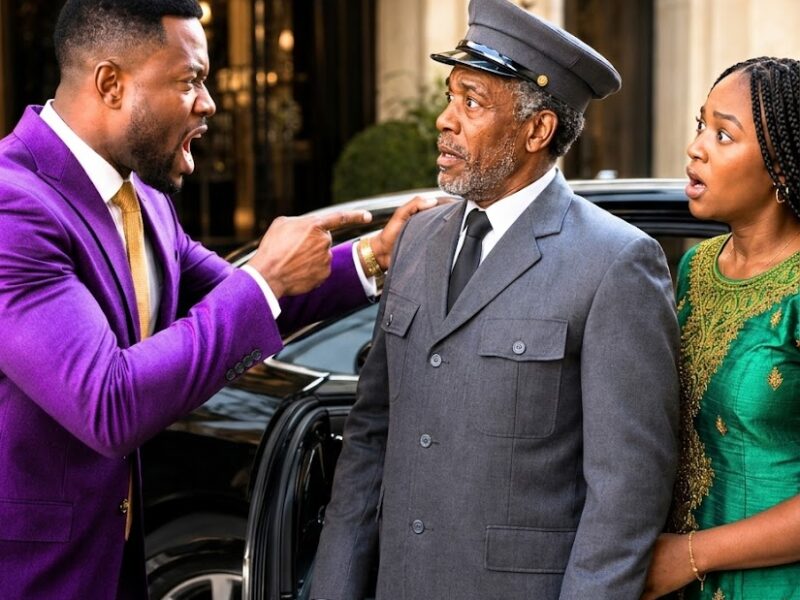
A billionaire’s future father-in-law pretended to be his driver to test his daughter’s fiancé. He had no idea the young man was about to turn the tables on him.
**Part 1**
The rain hadn’t stopped for three days straight in Atlanta, and neither had the knot in Abena Boateng’s stomach.
She stood in the marble foyer of her father’s Buckhead mansion, phone pressed to her ear, heart hammering against her ribs like it was trying to escape.
“Papa, he proposed. Yaw wants to marry me before the year ends.”
The silence on the other end stretched long enough to feel like a verdict.
Finally, her father’s voice came through—low, measured, the same tone he used when closing a billion-dollar deal. “A billionaire wants to marry my daughter. Tell me, what do you really know about this man?”
Abena closed her eyes. She’d rehearsed this conversation a hundred times, but standing here now, with the chandelier casting shadows across the imported Italian tile, she felt like a child again.
“I know his heart, Papa. Please, just trust me on this one.”
Another pause. She could picture him—Kojo Boateng, sixty-two years old, silver-haired, built like a retired boxer who’d never quite stopped fighting. He’d built Boateng Logistics from a single truck into a nine-figure empire, and he’d done it by trusting no one.
“Trust,” he repeated, as if tasting the word for poison. “I trusted a man once. He stole eight years from me before I caught him.”
“Yaw isn’t Mr. Asante, Papa.”
“No. He’s something I haven’t figured out yet.”
The line clicked dead.
Abena stared at her phone, the screen already dimming. Outside, the Atlanta skyline glowed through sheets of rain, indifferent to the fact that her entire future had just been reduced to a question mark.
She didn’t know that three miles away, in a modest apartment near the Fulton County line, her father was already making calls.
Not as her father.
As no one at all.
—
“For my daughter. Only for my daughter.”
Kojo Boateng whispered the words like a prayer as he studied his reflection in the bathroom mirror. Gone was the tailored Brioni suit, the Rolex, the handcrafted Italian shoes. In their place: a plain navy jacket from a department store, a Timex watch, and scuffed leather boots that had seen better days.
He’d spent two weeks preparing for this.
A new identity. A new backstory. A new name.
Kwabena Assa—his own middle name and his mother’s maiden name, close enough to remember who he was, far enough to fool anyone who wasn’t looking too hard.
The irony wasn’t lost on him. He’d spent thirty years building a company by seeing what others missed. Now he was betting everything on being invisible.
His phone buzzed. A text from his assistant: *Driver position confirmed. Start tomorrow. 6 AM.*
Kojo—no, *Kwabena*—exhaled slowly.
“Forgive me, Abena. This is the only way I know to protect you.”
—
The black Mercedes S-Class pulled up to the Buckhead mansion at exactly 5:47 AM.
Yaw Mensah stood on the front steps, phone pressed to his ear, jaw tight. He was thirty-four years old, handsome in that way that made magazine editors fight over covers, and rich enough that he’d never had to wait for anything in his life.
Today, he was waiting.
“I need the new driver ready in ten minutes. I have no patience for delays today.”
The agency had promised someone reliable. Someone invisible. Someone who understood that a man of his stature didn’t have time for pleasantries.
When the driver finally appeared—a stocky man in his early sixties, moving with quiet efficiency—Yaw felt a flicker of irritation. He’d specifically requested someone younger. Someone who wouldn’t keel over on the highway.
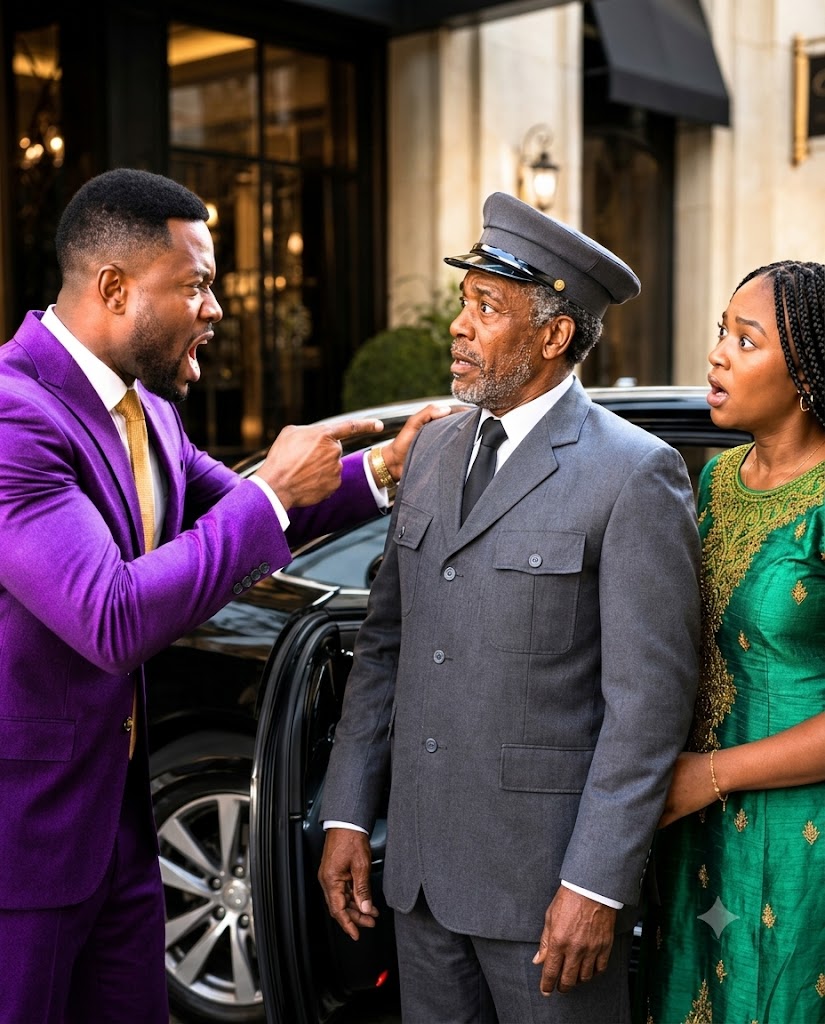
“You’re the new driver? Mr. Boateng does not wait for anyone. Understood?”
The man nodded, eyes downcast. “Understood, sir.”
Yaw didn’t bother with introductions. He slid into the back seat, already pulling up documents on his tablet. “Airport, now. I cannot miss this investor meeting.”
The Mercedes pulled smoothly onto Peachtree Road, and Yaw allowed himself a moment of satisfaction.
The deal he was closing today would add another hundred million to his portfolio. And once he married Abena—once he had access to the Boateng empire—he’d never have to answer to anyone again.
“Long day ahead, sir?”
Yaw’s head snapped up. The driver was watching him in the rearview mirror, expression unreadable.
“Just drive. I did not hire you for conversation.”
“Yes, sir.”
The silence that followed should have been comforting. Instead, Yaw felt something prickling at the back of his neck—the sensation of being studied by someone who had no business studying him.
He dismissed it.
He had more important things to think about.
—
The investor meeting ran four hours longer than scheduled.
By the time Yaw emerged from the glass tower downtown, the Atlanta sun had already begun its slow descent, painting the skyline in shades of orange and gold. His driver was exactly where he’d left him—standing beside the Mercedes, waiting.
“Do you know how long this will take?”
“No, sir.”
Yaw sighed, yanking open the door before the driver could reach it. “Just get in. I have another meeting in an hour.”
As they pulled away from the curb, Yaw’s phone buzzed with a text from Abena: *How did it go?*
He typed back: *Successful. But your father still won’t return my calls.*
Three dots appeared, then disappeared. Then appeared again.
*He’s just protective. Give him time.*
Yaw’s jaw tightened. Time was the one thing he couldn’t afford. The Boateng fortune was the key to everything—the final piece of a puzzle he’d been assembling for years.
And Kojo Boateng was the lock that refused to turn.
—
Three weeks passed.
Three weeks of Yaw treating his driver like furniture—barking orders, ignoring pleasantries, never once asking the man’s name.
Three weeks of Kwabena Assa watching everything.
The late-night phone calls Yaw took in the back seat, voice dropping to a murmur when he thought no one was listening.
The way he spoke to Abena—gentle, patient, the perfect suitor—and the way he spoke to waiters, assistants, anyone he deemed beneath him.
The documents he reviewed with a man named Marcus, documents that never seemed to make it to any official office.
Kwabena said nothing.
He simply watched.
And on the twenty-second day, he finally spoke.
—
The rain had returned, drumming against the roof of the Mercedes as they sat parked outside Yaw’s penthouse. It was past midnight—another late night, another meeting that had run too long.
Yaw was in the back seat, loosening his tie, exhaustion etched into every line of his face.
“You’re still here,” he said, finally noticing that his driver hadn’t left. “It’s past midnight.”
Kwabena turned slightly, his voice calm. “A driver waits as long as his employer needs him, sir. About the rain yesterday—I was out of line. A tired man says many things he does not mean. I have forgotten it already.”
Yaw blinked.
He’d been harsh yesterday. Crueler than usual. The investor meeting had fallen through, and he’d taken it out on the one person who couldn’t fight back.
And yet here this man was—this nameless, invisible man—apologizing to *him*.
“What is your name?” Yaw asked, surprising himself. “I realize I never asked.”
“Kwabena Assa.”
“Just Kwabena?”
“Just Kwabena.”
Yaw nodded slowly, something shifting behind his eyes. “Good morning, my brother. Have a good day.”
It was the closest thing to kindness Kwabena had ever heard from the man.
He filed it away.
And kept watching.
—
The documents arrived two days later.
Kwabena had been tasked with delivering a package to Yaw’s office—some contracts the businessman needed for a lunch meeting. He placed them on the desk as instructed, then lingered.
“Is there something else?” Yaw asked, not looking up from his phone.
“These arrived this morning, sir. I placed them on your desk myself.”
“I can see that.”
Kwabena paused at the door. “A driver sees more than people realize, sir.”
Yaw’s head snapped up. “What did you say?”
“Nothing, sir. Just an observation.”
The silence that followed was heavy, charged with something Kwabena couldn’t name.
Then Yaw laughed—a short, sharp sound with no humor in it.
“A driver sees more than people realize,” he repeated. “I’ll keep that in mind.”
Kwabena left without another word.
But the seed had been planted.
—
One week later, Yaw called him into the office.
Not the penthouse. Not the car. The actual office—the corner suite on the forty-second floor with floor-to-ceiling windows overlooking the city.
“I need your opinion,” Yaw said, and the words seemed to cost him something.
“Sir?”
“On a business matter. Someone I trust. Someone who’s been with me for years.” Yaw’s jaw tightened. “If this quarter is bad again, the board will start asking questions I cannot answer.”
Kwabena stood perfectly still. “Forgive my asking, sir. Is the company in real trouble?”
Yaw stared at him for a long moment. Then, to Kwabena’s surprise, he answered.
“My father built this from a single truck. I inherited debts he never told anyone about. I am trying not to be the one who loses it all.”
“May I speak freely, sir?”
Yaw gestured for him to continue.
“That is a heavy thing to carry alone, sir. Everyone sees the suit, the car, the office. No one asks if the man inside is drowning.”
Something flickered in Yaw’s eyes—something that looked almost like vulnerability.
“I ask, sir. Even if it is not my place.”
The silence stretched between them like a wire.
Then Yaw exhaled, long and slow. “Thank you, Kwabena. I mean that.”
He turned toward the window, staring out at the city below.
“What would you do? If this were your company?”
Kwabena considered the question carefully. He’d spent his entire career making decisions exactly like this one—weighing risks, reading people, trusting his instincts.
“I would trust fewer people with the numbers, sir. Trouble hides best where no one is checking.”
Yaw turned back, eyebrows raised. “That is surprisingly sound advice, Kwabena.”
“I have lived a long life, sir. I have learned to watch closely.”
He paused at the door.
“Now, why would a man hide papers after everyone has gone home?”
—
The words hung in the air like smoke.
Yaw’s face went still. “What did you say?”
Kwabena met his gaze. “I saw him, sir. Your finance man. Hiding papers after hours. And I heard him say, ‘No one suspects a thing.'”
The color drained from Yaw’s face.
“Show me. I need to see this with my own eyes before I believe it.”
“The finance archive room, sir. That is where he goes after hours.”
Yaw didn’t hesitate. He was already moving toward the door, his earlier exhaustion replaced by something sharper—something colder.
“Let’s go.”
—
They found the evidence together.
Eight years of skimmed contracts. Eight years of falsified records. Eight years of Asante, the man Yaw had trusted with everything, slowly bleeding the company dry.
Yaw stood in the archive room, staring at the proof of his own blindness, and for the first time since Kwabena had known him, he looked small.
“Eight years,” he whispered. “Eight years. I trusted this man with everything my father built.”
Kwabena said nothing.
There was nothing to say.
—
The confrontation happened the next morning.
Asante was called into Yaw’s office, his expression shifting from confusion to panic to cold resignation as the documents were spread across the desk.
“Explain these numbers, Asante. Explain them now.”
“Sir, there must be some misunderstanding. Let me explain—”
“Eight years of skimmed contracts. Eight years of lies. Do not insult me with excuses.”
Asante’s shoulders sagged. “It started small. A little here, a little there. I told myself I would stop.”
“Security will escort you out. The board will hear everything by morning.”
When the door closed behind Asante, Yaw turned to Kwabena—who had watched the entire exchange from the corner, silent and still.
“You saved this company, Kwabena. I do not know how to repay that.”
“You owe me nothing, sir. Watching out for people is simply what I do.”
Yaw studied him for a long moment. “Sometimes I forget you are just my driver. You carry yourself like someone who has led men before.”
“Perhaps, sir. Perhaps soon you will understand why.”
The words were a promise.
And Kwabena intended to keep it.
—
**Part 2**
The engagement party was held at the Boateng estate on a warm Saturday evening in late September.
Abena had spent weeks planning every detail—the white roses imported from Ecuador, the string quartet playing softly on the terrace, the guest list carefully curated to include everyone who mattered and no one who didn’t.
She wanted everything perfect.
She wanted her father there.
But Kojo Boateng had been strangely absent for months now—traveling, he said, on business. He called occasionally, always brief, always guarded. He’d agreed to attend the party, but only if she promised not to ask questions.
“Papa would have loved seeing me like this,” Abena whispered to Yaw as they stood together at the entrance, greeting guests.
Yaw squeezed her hand. “He’s here. Somewhere. I saw his car pull up earlier.”
Abena’s heart leaped. She scanned the crowd, searching for the familiar silver hair, the broad shoulders, the commanding presence that had dominated every room she’d ever seen him enter.
But she didn’t see him.
Not yet.
—
The party was in full swing when the applause started.
Abena had just finished her welcome speech—a graceful, heartfelt tribute to love and family and second chances—when the clapping began. She turned, expecting to see Yaw or perhaps her maid of honor.
Instead, she saw her driver.
Kwabena.
Standing at the edge of the terrace, still in his uniform, clapping slowly.
“What are you doing here?” Abena asked, confused. “The staff entrance is—”
And then she saw his eyes.
*Papa?*
The word left her mouth before she could stop it.
The man who had been her driver for nearly six months—the man who had fetched her coffee, driven her to meetings, listened to her worries about Yaw—smiled.
“Forgive me, daughter. I have not been entirely honest with either of you.”
The terrace went silent.
“You were never just a driver,” Abena whispered, tears already streaming down her face. “Were you?”
Kojo Boateng straightened his shoulders—and suddenly he wasn’t Kwabena anymore. He was the titan who had built an empire, the father who had terrified suitors and doted on his only child.
“I am Kojo Boateng,” he said, his voice carrying across the stunned crowd. “And yes, Abena’s father.”
He turned to Yaw, who stood frozen beside his daughter.
“I became your driver because I feared what kind of man would marry my daughter. I needed to see your heart when you thought no one important was watching.”
Yaw opened his mouth, but no words came.
“The rain, the late nights, all of it. I saw everything. I saw a man who was cruel when he was breaking and gentle when he was healed.”
Kojo stepped closer, his gaze unwavering.
“That is a man worth trusting.”
—
The applause that followed was thunderous.
Abena threw herself into her father’s arms, laughing and crying and hitting his chest all at once.
“You did all this for me? Papa, you are impossible.”
Kojo held her tight. “I only ever wanted to know you would be safe. Now I know.”
Yaw approached slowly, his face a mixture of shame and relief.
“Sir, I owe you more than an apology. I owe you my honesty—always, from this day forward.”
Kojo studied him for a long moment. Then he extended his hand.
“Then you have already passed the only test that mattered.”
They shook.
The crowd erupted again.
—
Later that night, after the guests had gone and the string quartet had packed up their instruments, Yaw found Kojo on the terrace, staring out at the city lights.
“Whatever comes,” Yaw said quietly, “I will always let you and your father see exactly who I am.”
Kojo turned, a small smile playing at his lips.
“That is all I ever wanted, Yaw.”
He paused.
“Just that.”
—
The wedding was held three months later at a small chapel in Savannah.
Abena wore her mother’s dress. Kojo walked her down the aisle, his eyes glistening with tears he refused to let fall.
And when the minister asked if anyone objected, the silence was broken only by the sound of birds singing outside the stained-glass windows.
—
At the reception, Kojo stood to give a toast.
He raised his glass, looking out at the gathered faces—family, friends, business associates, all of them watching the man who had once pretended to be a driver.
“A man’s character is not shown in his boardroom,” he said, his voice steady. “It is shown in how he treats the ones who serve him.”
He turned to Yaw.
“You passed the test. But more than that—you earned my trust. Not because you were perfect. Because you were real.”
He raised his glass higher.
“To my daughter. To my new son. And to the truth that sometimes, the most important meetings happen when no one is watching.”
The room erupted in cheers.
And somewhere in the back, a man who had once hidden papers after hours sat in a prison cell, wondering how one driver had brought down eight years of lies.
—
The rain hadn’t stopped for three days straight in Atlanta.
But for the first time in months, Kojo Boateng didn’t feel like he was drowning.
He sat in his study, staring at a photograph of his late wife—Abena’s mother—and smiled.
“She chose well,” he whispered. “Our daughter chose well.”
Outside, the storm continued.
But inside, the sun was finally breaking through.









