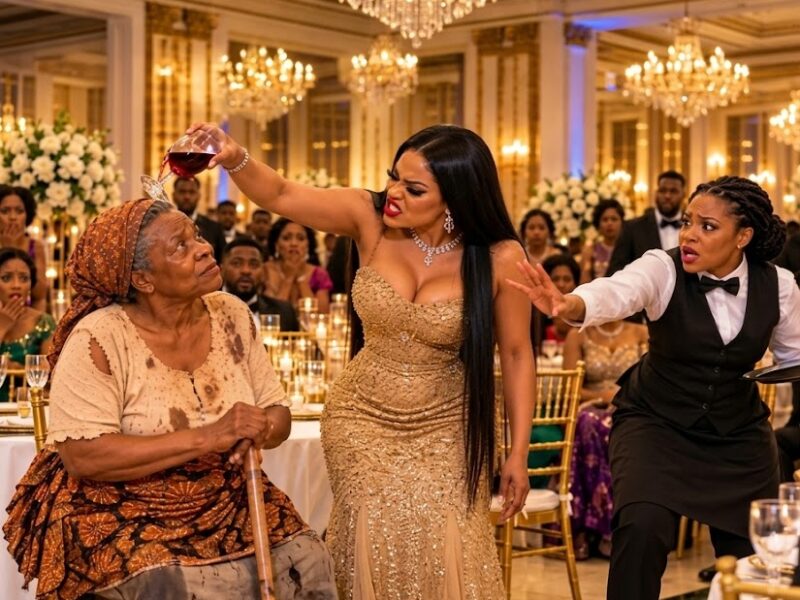
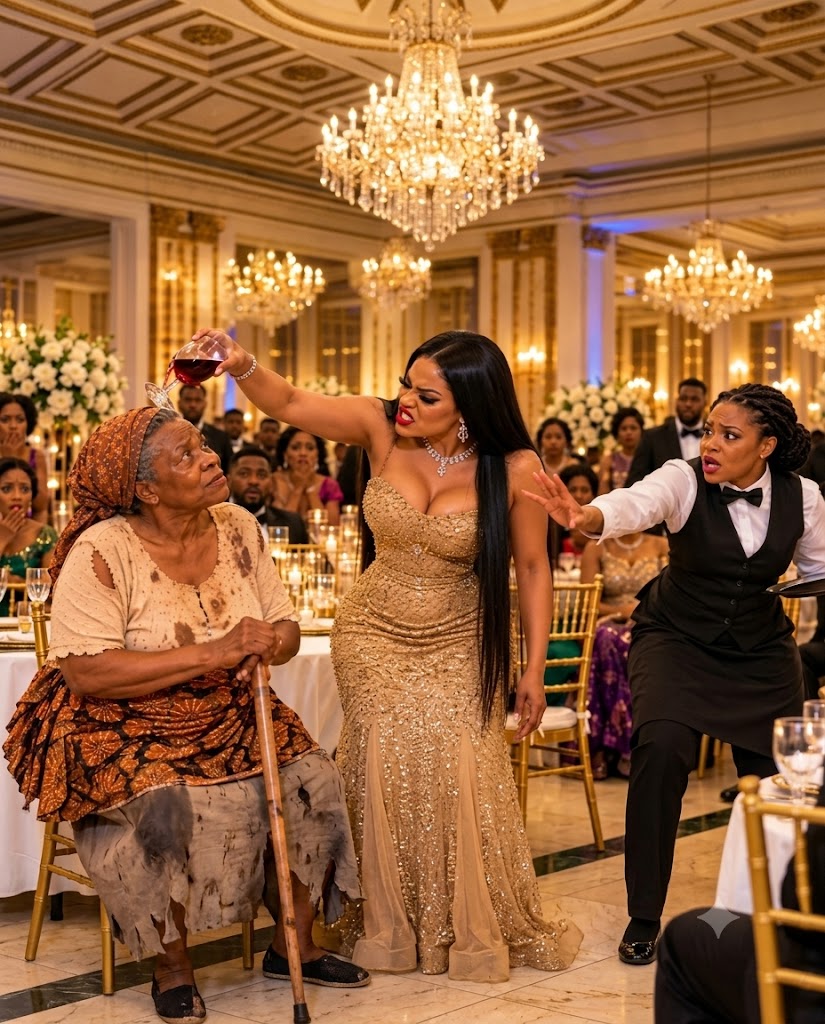
A billionaire threw away his fortune, dressed as a homeless man, and sat on the street for one reason — to find out if anyone would ever love him for real.
## PART 1
“Lock her up. She poisoned my husband.”
The words cracked through the precinct like a whip, and every officer in the room turned to look at the woman pointing a trembling finger at the girl in handcuffs.
Amarachi Okoro sat rigid on the metal bench, her wrists bound, her cheap waitress uniform still smelling of spilled wine from the gala two nights ago.
“Detective, please. I didn’t do it.”
The detective, a heavyset man named Morrison with twenty-three years on the force, rubbed his temples like he was trying to erase the headache forming behind his eyes.
“The car just drove itself, Amarachi?” He tossed a folder onto the table between them. “Because that’s what the evidence says. A vehicle registered in your name, found three blocks from the victim’s home, with his blood on the bumper.”
“I told you I wasn’t there.”
“You want me to believe that?”
The woman who had accused her—Tiana Adeleke, stepmother to the victim and wife of the family patriarch—let out a sound that was half laugh, half snarl.
“I was with her for three months,” Tiana said, her designer heels clicking against the linoleum as she paced. “She was like my own daughter. And this is how she repays me?”
“Mrs. Adeleke, please—”
“You gold-digging rat.” Tiana spun toward Amarachi, her manicured finger stabbing the air. “Crawling out of the gutter. How dare you even look at him?”
“That’s enough, Tiana.”
Every head in the room swiveled toward the doorway.
Daniel Adeleke stood there, six-foot-two of controlled fury, his jaw set like carved granite, his eyes fixed on his stepmother with an intensity that made the fluorescent lights seem dim.
“You know me,” Amarachi whispered, and for the first time since they’d brought her in, her voice cracked. “Daniel. You know me.”
“I’ve been fighting for her life,” Tiana said, her voice rising. “And it was you. It was always you.”
“Daniel.” Amarachi’s voice was barely audible now. “Please.”
Daniel didn’t look at her. He looked at Detective Morrison.
“Inspector. Do your job.”
“We are doing all we can, Mr. Adeleke.”
The words hung in the air like smoke, and nobody in the room believed them.
—
Three hours earlier, Amarachi had been standing in the break room of Adeleke Towers, her hands wrapped around a cup of lukewarm coffee, staring at the front-page news on her phone.
**BILLIONAIRE HEIR FIGHTS FOR LIFE AFTER HIT-AND-RUN**
The photo showed Daniel Adeleke—the real Daniel, not the man who called himself “Dan the driver”—lying in a hospital bed, tubes snaking from his nose, his handsome face swollen and bruised.
She had dropped her coffee.
She had run.
And now she was here, in a police station that smelled like bleach and despair, being accused of trying to kill the man she had been falling in love with for three months.
“The victim’s heart stopped twice,” the doctor had said, his voice flat and clinical. “It’s in God’s hands now.”
“Please, doctor.” Tiana had clutched the doctor’s white coat like a drowning woman. “She is my mother. Save her life.”
Wait.
Amarachi’s mind snagged on the words like a thread on a nail.
*She is my mother.*
But the victim was Daniel Adeleke. The heir. The son.
Not Tiana’s mother.
*What?*
“We will do everything we can,” the doctor said. “Don’t worry.”
The memory fractured, and Amarachi was back in the interrogation room, the metal bench cold beneath her, the handcuffs biting into her wrists.
“I want a lawyer,” she said.
Detective Morrison leaned back in his chair. “That’s your right. But let me tell you something, Miss Okoro. Running from a crime scene doesn’t look good. Having the victim’s blood on your car doesn’t look good. And having a motive—”
“I don’t have a motive.”
“Don’t you?” Morrison slid a photograph across the table. “This is you and Daniel Adeleke at a charity gala three weeks ago. You were fired that night. For defending a homeless woman. And then, miraculously, you get a job at his family’s company. A job you never applied for.”
Amarachi’s throat tightened.
“Who got you that job, Miss Okoro?”
“I don’t know.”
“You don’t know.”
“I swear. I just got a letter. It said I was selected. I needed the money. My mother—”
“Your mother is on dialysis. We know.” Morrison’s voice softened, just a fraction. “We also know you’ve been seen with Daniel Adeleke. Privately. Multiple times. What were you doing with him?”
The question landed like a slap.
What had she been doing with him?
Falling in love, that’s what.
But she couldn’t say that. Not here. Not now.
“I was getting to know him,” she said carefully. “He introduced himself as a driver. I didn’t know who he really was until—”
“Until when?”
“Until I found out.”
“And how did you find out?”
Amarachi closed her eyes.
She remembered the moment with perfect clarity. Three days ago. Daniel had taken her to dinner at a small Italian place on the Lower East Side, the kind of restaurant where the owner knew his name and the waiters pretended not to notice when he ordered the cheapest thing on the menu.
“I have something to tell you,” he’d said, his dark eyes nervous in a way she’d never seen before.
“What is it?”
“I’m not a driver.”
She had laughed. “What are you, then?”
“I’m—” He had taken her hand across the table. “I’m the CEO of Adeleke Group. My name is Daniel Adeleke. And I’ve been lying to you because I wanted to know if you’d love me for me. Not for my money. Not for my name. Just… me.”
She had stared at him for a long time.
Then she had pulled her hand away.
“You lied to me.”
“I know.”
“For three months.”
“I know.”
“Every day. Every single day, you lied.”
“Amarachi—”
“Don’t.” She had stood up, her chair scraping against the floor. “Don’t you dare.”
She had walked out.
And now she was here, accused of trying to kill him.
“Miss Okoro.” Detective Morrison’s voice pulled her back. “I’m going to ask you one more time. Where were you last night between eleven p.m. and two a.m.?”
Amarachi opened her eyes.
“I was at my mother’s dialysis appointment,” she said. “Then I went home. I was in bed by midnight.”
“Can anyone confirm that?”
“My brother. My mother. The nurses at Mount Sinai.”
Morrison made a note. “We’ll check.”
“You do that.”
“And the car?”
“What car?”
“The car registered in your name. A 2019 Honda Civic. Found three blocks from the victim’s home. With his blood on the bumper.”
Amarachi’s blood ran cold.
“I don’t own a car.”
“DMV says you do.”
“Then the DMV is wrong.”
Morrison slid another photograph across the table. “This is the car. Do you recognize it?”
She looked at the photo.
And her heart stopped.
Because she did recognize it.
It was the same car she had seen in Daniel’s garage three weeks ago. The one he said belonged to his stepmother.
“That’s not my car,” she whispered.
“But the registration says it is.”
“I’ve never seen that car in my life.”
“Then how do you explain this?”
Morrison slid a third photograph across the table.
This one showed her—or someone who looked exactly like her—standing next to the car, holding a gas can.
The timestamp read: *Last night. 11:47 p.m.*
“That’s not me.”
“It looks like you.”
“It’s not me.”
“Then who is it?”
Amarachi stared at the photograph, her mind racing.
The woman in the photo had her face. Her hair. Her build.
But it wasn’t her.
She knew it wasn’t her.
Because she had been at the hospital.
She had been with her mother.
She had been—
“Wait.” She looked up. “Who took this photo?”
Morrison shrugged. “Anonymous tip.”
“Anonymous.”
“We get those all the time.”
“Detective, I’m telling you. That’s not me. Someone is trying to frame me.”
“Who would want to frame you?”
Amarachi thought about Tiana. About the way Tiana had looked at her at the gala. About the way Tiana had said, *You gold-digging rat.*
About the way Tiana had smiled when Daniel wasn’t looking.
“I think I know,” she said.
—
The interview room door opened, and a man in a gray suit walked in.
He was tall, silver-haired, with the kind of face that had seen too much and trusted too little.
“Detective Morrison,” he said. “I’m here to represent Miss Okoro.”
Morrison’s eyebrows rose. “And you are?”
“Charles Whitmore. Attorney at law.”
Amarachi had never seen this man before in her life.
“I didn’t call a lawyer,” she said.
“No,” Whitmore agreed. “You didn’t.”
He sat down beside her, opened his briefcase, and pulled out a single sheet of paper.
“This is a court order,” he said. “Releasing you into my custody pending further investigation.”
Morrison’s jaw tightened. “On whose authority?”
“Judge Patterson. As of”—Whitmore checked his watch—”twenty minutes ago.”
“That’s impossible.”
“Nothing is impossible when you have the right connections, Detective.”
Morrison stared at him for a long moment. Then he stood up.
“Fine. She’s free to go. But don’t leave the state, Miss Okoro. We’re not done here.”
“I understand.”
The handcuffs came off. Amarachi rubbed her wrists, the skin raw and red.
“Come with me,” Whitmore said.
She followed him out of the interrogation room, down a hallway that smelled like old coffee and despair, through a set of double doors, and into the night.
A black SUV waited at the curb, its engine idling.
“Who are you?” Amarachi asked.
Whitmore opened the back door. “Get in.”
“I’m not going anywhere until you tell me who you are.”
“I’m the person who’s going to keep you out of prison.”
“That’s not an answer.”
Whitmore sighed. “Get in the car, Miss Okoro. There’s someone who wants to meet you.”
“Who?”
“All in good time.”
Amarachi looked at the SUV. Looked at Whitmore. Looked back at the police station behind her.
She could go back inside. Demand a real lawyer. Take her chances with the system.
Or she could get in the car.
“I’m not going to hurt you,” Whitmore said, as if reading her mind. “If I wanted you in prison, I would have left you in there.”
That was true.
She got in the car.
The door closed behind her, and the SUV pulled away from the curb, its headlights cutting through the darkness.
—
The car drove for twenty minutes, weaving through the streets of Manhattan, past the glittering towers of the financial district, past the quiet brownstones of the Upper East Side, until it stopped in front of a building that Amarachi had only ever seen in photographs.
The Adeleke Foundation.
“We’re here,” Whitmore said.
“Why?”
“You’ll see.”
He led her inside, through a lobby that looked like something out of a magazine, past a security desk where two guards nodded at Whitmore like they knew him, and into an elevator that took them to the top floor.
The doors opened onto a private office.
And sitting behind the desk was a woman Amarachi had never expected to see again.
Mama Precious.
Except she wasn’t dressed like a beggar anymore.
She was wearing a black silk dress that probably cost more than Amarachi’s entire apartment, and her gray hair was styled into an elegant bun, and her eyes—those same sharp, knowing eyes—were fixed on Amarachi with an intensity that made her want to step back.
“Hello, Amarachi,” Mama Precious said.
“What is this?”
“Sit down.”
“I don’t—”
“Sit down, my dear.”
Amarachi sat.
Mama Precious looked at Whitmore. “Leave us.”
Whitmore nodded and left, closing the door behind him.
The room was silent for a long moment.
Then Mama Precious spoke.
“You’re probably wondering what’s going on.”
“That’s an understatement.”
“I owe you an explanation.”
“You think?”
Mama Precious smiled. “I like you, Amarachi. I liked you the moment you gave me your last five hundred dollars. Do you remember that?”
“Of course I remember.”
“Good. Because that moment—that single moment of kindness—changed everything.”
“I don’t understand.”
Mama Precious leaned forward, her hands folded on the desk.
“My name is not Mama Precious,” she said. “My name is Florence Adeleke. And I am Daniel’s grandmother.”
The words hit Amarachi like a physical blow.
“You’re—”
“Yes.”
“But you were—you were homeless. You were begging. You—”
“I was testing you.”
“Testing me?”
“Testing everyone.” Florence’s voice hardened. “My family is full of vultures, Amarachi. People who smile to my face and plot behind my back. People who want my money. People who want my company. People who want my grandson.”
“Daniel?”
“He’s the prize, you see. The heir. The future. And everyone—every single person in my family—sees him as a means to an end.”
Amarachi’s mind was spinning.
“The gala—”
“Was a setup. I wanted to see who would treat a homeless woman with dignity. Who would defend her when no one else would. Who would give her their last dollar.”
“Me.”
“You.” Florence’s eyes softened. “And Daniel. He was watching, you know. He saw what you did. He saw how you stood up for me. How you lost your job for me. He was already interested in you before that night—he’d seen you at the waitress station, laughing with your friends, and he thought you were beautiful. But after the gala? After he saw your heart? He was determined to know you.”
“The job at Adeleke Towers—”
“Was my idea. I wanted you close. I wanted to see if you were real. If your kindness was genuine.”
“It was.”
“I know.”
“And Daniel—he introduced himself as a driver—”
“I told him to.”
Amarachi stared at her.
“You told him to?”
“I told him to hide his identity. To see if you would love him for who he was, not for what he had. And you did. You fell in love with a man who drove a Range Rover. You fell in love with his laugh. His jokes. His kindness. You didn’t know he was worth five hundred billion dollars.”
Amarachi felt tears stinging her eyes.
“But then I found out the truth,” she whispered. “And I left him.”
“I know. He called me. He was devastated.”
“He lied to me.”
“He was following my orders.”
“That doesn’t make it right.”
“No,” Florence agreed. “It doesn’t. But I hope you can understand why I did it.”
Amarachi was silent.
“You’re right to be angry,” Florence said. “You’re right to feel betrayed. But I need you to listen to me now, because what I’m about to tell you is more important than anything else.”
“What?”
Florence’s face grew serious.
“Daniel was attacked last night. Someone tried to kill him. And I believe—I know—that the person who tried to kill him is someone in my family.”
“The police said it was a hit-and-run. They said the car was registered to me.”
“The car was registered to you. But you didn’t drive it. Someone else did. Someone who wanted to frame you.”
“Who?”
“I don’t know yet. But I’m going to find out.”
“How?”
Florence reached into a drawer and pulled out a small device—a USB drive.
“This,” she said, “is the key.”
“What is it?”
“Evidence. Recordings. Photographs. Everything I’ve been gathering for the past six months.”
“Six months?”
“I’ve known for a while that someone in my family was planning to move against me. Against Daniel. Against everything I’ve built. I just didn’t know who.”
“And now?”
“Now I have a suspect.”
“Who?”
Florence looked at her.
“I need you to trust me, Amarachi. Can you do that?”
Amarachi thought about Daniel, lying in a hospital bed.
She thought about Tiana, pointing her finger.
She thought about the photograph of a woman who looked exactly like her, standing next to a car she’d never seen.
“I can try,” she said.
“Good.” Florence stood up. “Because we have a lot of work to do. And not much time.”
—
## PART 2
The hospital room was quiet except for the steady beep of the heart monitor.
Daniel Adeleke lay in the bed, his face still swollen, his body still broken.
But his eyes were open.
And when Amarachi walked in, he smiled.
“You came.”
She stood in the doorway, her heart hammering in her chest.
“I almost didn’t.”
“I know.”
“You lied to me.”
“I know.”
“For three months.”
“I know.”
She walked to his bedside. Looked down at him.
“Why?”
“Because I was afraid.”
“Afraid of what?”
“Afraid that if you knew who I was, you’d only see the money. The name. The power. I didn’t want that. I wanted you to see me.”
“I did see you. I saw Dan the driver. I saw his laugh. His bad jokes. His kindness. I fell in love with him.”
“I know.”
“And then I found out he didn’t exist.”
“He does exist. He’s me. Just… with a different name.”
“That’s not the same thing.”
“No,” he admitted. “It’s not.”
She sat down in the chair beside his bed.
“The police think I tried to kill you.”
“I know. I told them it was impossible.”
“You did?”
“Of course I did. I told them you were with me that night. That you never left my side.”
“You were unconscious.”
“I told them before. When they first brought me in. I said, ‘The woman you’re looking for—Amarachi—she’s not the one. She would never hurt me.'”
Amarachi felt something loosen in her chest.
“Why?”
“Because I love you.”
The words hung in the air.
“You love me?”
“Yes.”
“Even though I walked out on you?”
“Even though.”
“Even though I refused to take your calls?”
“Even though.”
“Even though I—”
“Amarachi.” He reached for her hand. “I don’t care about any of that. I only care about you.”
She looked at his hand. At his bruised knuckles. At the IV line snaking from his arm.
“Your grandmother told me everything,” she said.
“About the test?”
“About all of it. The gala. The job. The—”
“She told me she was going to tell you. I didn’t know if she actually would.”
“She did.”
“And?”
“And I understand why she did it. I don’t like it. But I understand.”
“That’s more than I deserve.”
“Probably.”
He laughed, then winced.
“Don’t make me laugh. It hurts.”
“Then stop being funny.”
“I’m not funny. I’m a billionaire who pretended to be a driver. That’s not funny. That’s pathetic.”
“It’s a little funny.”
“A little.”
She smiled.
It was the first time she had smiled in days.
—
The door opened, and Florence walked in.
“How are you feeling?” she asked Daniel.
“Like I got hit by a car.”
“You did get hit by a car.”
“Right. That’s why it hurts.”
Florence turned to Amarachi. “We have a problem.”
“What kind of problem?”
“The police found another car. A black sedan. Registered to a shell company.”
“What does that mean?”
“It means someone tried to cover their tracks. But they didn’t do a very good job.”
“Whose car is it?”
“We don’t know yet. But we’re getting close.”
Daniel struggled to sit up. “Grandmother—”
“Lie down.”
“I want to help.”
“You can help by staying alive.”
“I’m serious.”
“So am I.” Florence’s voice was sharp. “Someone tried to kill you, Daniel. I’m not going to let them try again.”
“Who?”
“That’s what we’re going to find out.”
—
Three days later, Amarachi was back at her apartment, staring at her phone.
The news had broken that morning: **BILLIONAIRE HEIR ATTACKED. SUSPECT STILL AT LARGE.**
But the article wasn’t about Daniel.
It was about Tiana Adeleke.
**TIANA ADELEKE ARRESTED IN CONNECTION WITH HIT-AND-RUN**
Amarachi read the article three times.
Tiana had been arrested. Tiana had been charged. Tiana had been caught on camera, driving the black sedan, three blocks from the scene.
The photograph on the news website showed Tiana in handcuffs, her face contorted with rage, being led into a police car.
And standing beside her, watching with a smile that was almost imperceptible, was Florence Adeleke.
—
“It was her all along,” Amarachi said.
She was sitting in Florence’s office, the USB drive between them.
“Yes.”
“How did you know?”
“I didn’t. Not at first.” Florence leaned back in her chair. “But I had my suspicions. Tiana was always… ambitious. She married my son for his money. She never loved him. And when he died—”
“The accident.”
“The accident.” Florence’s voice grew cold. “I never believed it was an accident. The brakes failed. The car went off the bridge. My son died. His wife died. And Tiana? Tiana inherited everything.”
“Everything?”
“Not everything. I made sure of that. But enough. Enough to keep her comfortable. Enough to keep her quiet.”
“Until now.”
“Until now.”
“What changed?”
“Daniel.”
“Daniel?”
“He grew up. He became the CEO. He started asking questions. Questions about the accident. Questions about the money. Questions about Tiana.”
“And she panicked.”
“She panicked. And she decided to eliminate the problem.”
“So she tried to kill Daniel.”
“Yes.”
“And frame me.”
“Yes.”
“But why me?”
Florence smiled. “Because you’re the one thing she couldn’t control. You’re the one person Daniel actually loved. And Tiana—Tiana can’t stand losing.”
Amarachi was silent for a moment.
“What happens now?”
“Now?” Florence stood up. “Now we make sure she never hurts anyone again.”
—
The trial lasted three weeks.
The evidence was overwhelming. The security footage. The shell company. The car registered in Amarachi’s name. The photograph of a woman who looked like Amarachi, standing next to the car, holding a gas can.
The woman in the photograph wasn’t Amarachi.
It was Tiana, wearing a wig and makeup designed to make her look like Amarachi.
The jury deliberated for four hours.
The verdict was guilty.
Tiana Adeleke was sentenced to twenty-five years to life.
And as she was led out of the courtroom, she turned to Amarachi and said, “You think you’ve won. But you haven’t. You’ll never be one of us.”
Amarachi looked at her.
“I don’t want to be one of you,” she said.
—
## PART 3
Six months later, Amarachi stood in front of the mirror in a white dress.
“You look beautiful,” her mother said.
Amarachi smiled. “You’re biased.”
“I’m your mother. I’m allowed to be biased.”
The wedding was small. Just family. Just friends.
Just the people who mattered.
Daniel stood at the altar, his eyes shining as Amarachi walked down the aisle.
“You’re late,” he whispered.
“I’m always late.”
“I know. I don’t care.”
She laughed.
The ceremony was short. The vows were simple.
But when Daniel said, “I promise to love you. To honor you. To never lie to you again,” Amarachi believed him.
And when Amarachi said, “I promise to trust you. To stand by you. To always give my last five hundred dollars to a stranger in need,” Daniel laughed.
And the whole church laughed with him.
—
At the reception, Florence took Amarachi aside.
“I have something for you,” she said.
“What is it?”
She handed her a small box.
Amarachi opened it.
Inside was a ring.
Not a diamond ring. Not a gold ring.
A simple silver band.
“This was mine,” Florence said. “My husband gave it to me when we were young. Before the money. Before the power. Before everything.”
“It’s beautiful.”
“I want you to have it.”
“Florence—”
“I’m not going to be around forever, Amarachi. I need to know that Daniel is in good hands. That the family is in good hands. That everything I’ve built—everything I’ve fought for—will be protected.”
“It will be.”
“I know.” Florence smiled. “That’s why I chose you.”
—
That night, Amarachi and Daniel stood on the balcony of their new home, looking out at the city.
“Can I ask you something?” Amarachi said.
“Anything.”
“When you were pretending to be a driver—when you were pretending to be Dan—did you ever think about telling me the truth?”
“Every single day.”
“Why didn’t you?”
“Because I was afraid.”
“Afraid of what?”
“Afraid that you’d leave.”
She turned to look at him.
“I did leave.”
“I know.”
“But I came back.”
“I know.”
“Because I love you.”
“I know.”
She kissed him.
And the city glittered below them, and the sky stretched above them, and the future—the uncertain, terrifying, beautiful future—waited for them both.
—
## PART 4
The letter arrived on a Tuesday.
Amarachi found it in the mailbox, mixed in with the bills and the junk mail and the wedding invitations that were still coming three months after the ceremony.
The return address was a prison.
She opened it with trembling hands.
*Dear Amarachi,*
*I know you don’t want to hear from me. I know you probably hate me. And you have every right to. But I need you to know the truth.*
*I didn’t want to kill Daniel.*
*I wanted to kill Florence.*
The letter fell from her hands.
—
She showed it to Daniel that night.
He read it twice.
Then he called his grandmother.
—
Florence arrived at their apartment within the hour.
“What does it say?” she asked.
Daniel handed her the letter.
Florence read it in silence.
Then she sat down.
“I knew,” she said.
“You knew?”
“I knew she wanted to kill me. I’ve known for years. That’s why I started gathering evidence. That’s why I hired Whitmore. That’s why I set up the test.”
“The test?”
“The gala. The homeless disguise. The—”
“Wait.” Amarachi held up her hand. “You knew Tiana was trying to kill you. And you didn’t tell anyone?”
“I told Whitmore. I told my security team. But I didn’t have proof. Not enough to go to the police.”
“So you waited.”
“I waited.”
“And Daniel almost died.”
Florence’s face crumpled.
“I know. I know. I never meant for that to happen. I thought—I thought she was after me. I didn’t think she’d go after Daniel.”
“But she did.”
“She did.”
“And you didn’t warn him.”
“I didn’t know.”
“You didn’t know?”
“I didn’t know she was going to try to kill him. If I had—”
“You would have done what?”
Florence was silent.
“Florence.” Daniel’s voice was calm, but there was steel underneath it. “Did you know?”
“No.”
“Did you suspect?”
“I—”
“Did you suspect?”
Florence looked at him.
“I suspected,” she whispered. “I suspected something. But I didn’t know what. I didn’t know when. I didn’t know how.”
“And you didn’t tell me.”
“I didn’t want to scare you.”
“I’m a grown man, Grandmother. I don’t need to be protected.”
“You’re my grandson. I’ll always want to protect you.”
Daniel was silent for a long moment.
Then he said, “I forgive you.”
Florence looked up.
“What?”
“I forgive you. For not telling me. For trying to protect me. For everything.”
“Daniel—”
“You’re my grandmother. You’re the only family I have left. And I love you. But you have to promise me something.”
“What?”
“No more secrets. No more tests. No more lies.”
Florence nodded.
“No more,” she said.
And she meant it.
—
## PART 5
The second letter arrived a month later.
This time, Amarachi didn’t open it alone.
She waited until Daniel came home, until they were sitting together on the couch, until the city lights were flickering outside their window.
Then she opened it.
*Dear Amarachi,*
*I’m dying.*
*The doctors say I have six months. Maybe less. The cancer is in my lungs, my liver, my bones. There’s nothing they can do.*
*I’m not telling you this because I want your pity. I’m telling you because I want you to know the truth.*
*The truth is, I was always jealous of you.*
*You had everything I wanted. Daniel’s love. Florence’s respect. A family that actually cared about you. I had nothing. I married into wealth, but I was never truly part of the family. I was always the outsider. The gold-digger. The woman who married the son for his money.*
*And I hated you for it.*
*I hated you because you were everything I wasn’t. Kind. Generous. Honest. You gave your last five hundred dollars to a stranger. I would never have done that. I would never have given anything to anyone.*
*That’s why I tried to frame you. That’s why I tried to destroy you. Because I couldn’t stand the thought of you having what I never had.*
*I’m sorry.*
*I know that doesn’t mean anything. I know sorry doesn’t undo what I did. But I want you to know—I want you to know that I regret it. Every single day.*
*I hope you can forgive me.*
*I don’t expect you to. But I hope.*
*Tiana*
Amarachi read the letter twice.
Then she handed it to Daniel.
He read it in silence.
Then he said, “What do you want to do?”
She thought about it.
“I want to forgive her,” she said.
“You do?”
“Not for her. For me. I don’t want to carry this anger anymore. I don’t want to be the kind of person who holds grudges. I want to be free.”
Daniel took her hand.
“Then let’s be free,” he said.
—
They visited Tiana in prison three weeks later.
The woman who sat across from them was not the same woman who had stood in the police station, pointing her finger, screaming accusations.
She was thinner. Paler. Her hair was gone, lost to the chemotherapy that wasn’t working.
But her eyes—her eyes were the same.
“Why did you come?” she asked.
“Because I wanted to tell you something,” Amarachi said.
“What?”
“I forgive you.”
Tiana stared at her.
“You—”
“I forgive you. For trying to frame me. For trying to kill Daniel. For everything.”
“I don’t—”
“I’m not doing this for you. I’m doing this for me. I don’t want to be angry anymore. I don’t want to be bitter. I want to move on with my life. And I can’t do that if I’m holding onto hate.”
Tiana’s eyes filled with tears.
“I don’t deserve this.”
“No,” Amarachi agreed. “You don’t.”
“Then why?”
“Because that’s who I am.”
Tiana looked at Daniel.
“And you?”
“I’m here because she’s here,” Daniel said. “And because I want to be the kind of man who forgives. The kind of man my parents would have been proud of.”
“I killed your parents,” Tiana whispered.
Daniel’s face went pale.
“What?”
“The accident. The brake failure. It wasn’t an accident. I—I paid someone. I paid someone to cut the brakes.”
The room was silent.
“You killed my parents,” Daniel said.
“Yes.”
“Why?”
“Because I wanted the money. I wanted the power. I wanted everything.”
“And you thought killing them would get you that?”
“I was young. I was stupid. I didn’t think—”
“You didn’t think.”
“No.”
Daniel stood up.
He walked to the window.
He stood there for a long time.
Then he turned around.
“I forgive you,” he said.
Tiana stared at him.
“What?”
“I forgive you.”
“How can you—”
“Because I’m not going to let you destroy me. I’m not going to let you take one more thing from me. My parents are gone. But I’m still here. And I’m going to live my life. I’m going to be happy. And I’m not going to let you—or anyone else—take that away from me.”
He walked back to the table.
He took Amarachi’s hand.
And he said, “Let’s go home.”
—
The car ride was silent.
Amarachi watched the city pass by outside the window—the glittering towers, the crowded streets, the people who had no idea what had just happened.
“Are you okay?” she asked.
“No,” Daniel said. “But I will be.”
She squeezed his hand.
“Together?”
“Together.”
—
## EPILOGUE
The foundation was called the Adeleke Foundation for Kindness.
Its mission was simple: to help the homeless, the hungry, the forgotten.
To give people a second chance.
On the day of the foundation’s opening, Amarachi stood at the podium, looking out at the crowd of people who had gathered to celebrate.
“I was a waitress,” she said. “I had nothing. But I had a mother who taught me that kindness costs nothing and means everything. I had a father who died trying to help others. And I had a grandmother—not by blood, but by choice—who taught me that the truest test of a person’s character is how they treat those who have nothing.”
She looked at Florence, sitting in the front row, tears streaming down her face.
“I gave my last five hundred dollars to a stranger,” Amarachi said. “And it changed my life.”
She looked at Daniel, standing at the back of the room, smiling.
“I found love,” she said. “I found family. I found a purpose.”
She looked at the crowd.
“And now, I want to give that same chance to others.”
The applause was thunderous.
And as Amarachi stepped down from the podium, as Daniel wrapped his arms around her, as Florence pressed a kiss to her cheek, she thought about the strange, winding road that had brought her here.
From the streets of Lagos to the towers of New York.
From a waitress to a wife.
From nothing to everything.
And she knew, with every fiber of her being, that she would never forget where she came from.
Because that was the true test.
Not of love.
Not of money.
But of character.
—
**THE END**









