
A Billionaire Returned Home After 12 Years—Then Found His Parents Begging Outside His Uncle’s Mansion
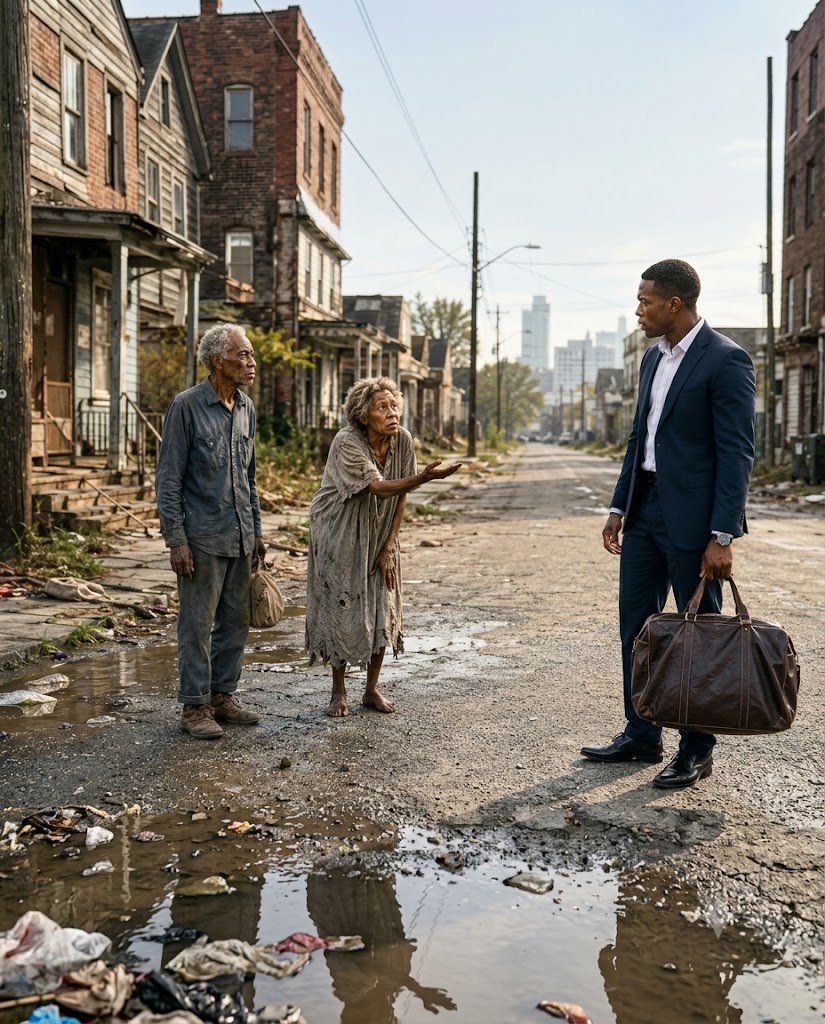
The message came through at 11:47 p.m. on a Tuesday, four sentences from a woman he barely remembered, and Jim Callaway read it three times before he started packing.
*I saw your father and mother on Route 9. Please come check on them when you can.*
No explanation. No follow-up call. Just those words glowing on his phone screen while he stood in his Charlotte penthouse, still wearing the tie from a board meeting that had run until midnight.
He left a red-eye to Lexington and then drove three hours south in a rented SUV, his tie loosened and the radio off, reading the mile markers the way a man reads a clock when he’s not sure what time it is anymore.
—
Twelve years since he’d seen this road.
It still looked the same, two lanes cutting through green hills, the kind of green that only happened in eastern Kentucky in late summer when everything was thick with heat and there was no escaping any of it.
He had left Harland County at twenty-eight with a duffel bag and a business plan his father said was either very smart or very stupid, and he wasn’t sure which.
He came back at forty with a company worth four hundred million dollars and a message he still hadn’t figured out how to interpret.
The family home was on Birchwood Road, three miles past the gas station where he used to buy ice cream with his grandfather.
He turned at the corner and drove up the hill.
—
The house had been repainted white now, where it used to be the color of old brick.
New shutters. The lawn was cut and edged. There was a second vehicle in the driveway, a late-model truck he didn’t recognize.
Jim parked and sat for a moment, looking at a house he had grown up in and no longer recognized.
The front door opened before he reached the porch.
Jimmy Dale Callaway was standing at the threshold, his father’s younger brother, fifty-eight years old, built like a man who had once done hard physical work and now mostly watched television about it.
He spread his arms.
“Hell of a surprise. Come in. Come in.”
—
Jim shook his uncle’s hand.
Dale’s grip was firm in the way men grip hands when they want to convey control.
Jim stepped inside and looked around.
The walls had been painted. The kitchen had been redone with tile and new counters that his parents had never owned.
There were photographs on the walls. Dale’s family. A vacation somewhere with a beach. None of his parents.
“Where are they?” Jim said.
Dale settled into a chair, easy, unhurried.
“That’s actually a happy story. Earl and Ruth, you know how they’d been talking about wanting a change of scenery. They moved in with your cousin Bonnie up in Corbin. Better for your dad’s knees, less upkeep. They were ready to let this place go.”
—
Jim looked around the living room.
“They let this place go to you?”
“I bought it fair and square,” Dale said.
He kept his voice pleasant.
“Your dad couldn’t keep up with it and didn’t want the hassle of dealing with strangers. Made sense for the family to keep it in the family.”
He leaned back.
“They’re doing real well up in Corbin. Bonnie takes good care of them.”
“What’s Bonnie’s address?”
“I’d give her a heads up first. Earl has good days and bad days, Jimmy. He gets confused sometimes. You showing up without warning might upset him.”
—
Dale pulled out his phone in a gesture of helpfulness.
“Let me call her. Set something up.”
“I’ll call myself.”
Jim looked at the driveway.
“Where’s Dad’s truck? The blue Ford.”
A small pause. Almost nothing. But Jim caught it.
“Traded that in a while back,” Dale said. “Wasn’t running right. Earl didn’t need it up in Corbin anyway.”
Jim nodded as if this made sense.
He looked at a wall where a framed photograph of his parents’ wedding had once hung. Thirty years on that wall, in that spot, and he could picture it perfectly.
The hook was still there. The photograph was not.
—
“I got a message from Loretta Sims,” Jim said. “She said she saw my parents on Route 9.”
Dale shook his head with the practiced patience of a man who had used this expression before.
“Loretta is a sweet woman, but she’s always been a worrier. Your parents are fine. I just spoke to Bonnie last week.”
He stood.
“You want coffee? Margaret made a fresh pot?”
“I’m good.”
Jim moved toward the door.
“I’ll drive up to Corbin. You can text me Bonnie’s number.”
“Sure thing.”
—
Dale followed him to the porch. Still pleasant. Still easy.
“It’s real good to see you, Jimmy. Your folks talk about you all the time.”
Jim drove back down Birchwood Road and turned onto Route 9, heading north toward Corbin.
He drove for ten minutes with the air conditioning running and the radio still off.
He told himself the explanation made sense. Earl’s knees were bad. The house needed upkeep. Bonnie was family.
He told himself Loretta Sims was a worrier.
He told himself a lot of things that sounded reasonable, and none of them quieted the thing at the back of his mind that had been there since he read her message three nights ago.
—
Then he came around a long bend and saw the intersection ahead.
A tree to the right, some shade in the August heat. Two figures. One seated, one standing.
And something about the way the seated figure was holding himself, the particular stillness of a man who had learned to take up as little space as possible, made Jim’s foot come off the gas before his brain had finished processing what his eyes were seeing.
He slowed. He looked. He slowed more.
He pulled over.
—
Jim got out of the car. The heat hit him immediately.
August in eastern Kentucky. The air dense and still.
He stood on the shoulder of Route 9 and looked at the two figures under the tree, maybe thirty yards ahead, and something in his chest began to move in the wrong direction.
The man in the chair was old. That was the first thing. Old and thin in the way men got thin when they weren’t eating enough.
And he was wearing a short-sleeved work shirt that Jim knew. Not a shirt like it, but that shirt. The dark blue cotton one with the button missing on the chest pocket that his father had been wearing since before Jim left for Charlotte.
He was holding a cardboard sign at knee level.
—
The woman beside him was standing with a paper plate in front of her, handwritten words on it in black marker, shielding her eyes with one hand to watch the cars go by.
Jim walked toward them and the world went very quiet.
He was twenty feet away when the man in the chair looked up. Not at Jim specifically, just the instinct of someone who had spent enough time at a roadside to notice movement.
For a moment, neither of them moved.
Jim watched his father’s face go through something that wasn’t surprise exactly, something slower, something more like a man who has been holding a thing for a very long time and has just felt the weight of it change.
“Jimmy.”
Earl Callaway said it, not a shout, not a cry, just that name in his father’s voice, quiet and undecorated.
—
Jim walked the rest of the way.
He stopped in front of his father’s chair and looked at the sign.
*Veteran. Need help. God bless.*
The letters were careful. His father had always had careful handwriting, the kind of man who wrote things like he meant them.
Jim crouched down so they were at eye level.
“Dad.”
His voice came out even. He didn’t know how.
Earl looked at him for a moment.
“You shouldn’t be here. You’ve got work.”
“I’m here,” Jim said.
—
Ruth Callaway sat down her paper plate and walked around the chair and pressed her hand to her son’s face the way she used to when he was a boy and had come home from somewhere hard.
She didn’t say anything.
Jim stood up and held her, and she was so much smaller than he remembered. Or maybe he hadn’t remembered right.
And she was trembling slightly, but her grip was steady.
“Come on,” Jim said. “There’s a diner two miles back. We’re going.”
Earl stood slowly, joints stiff, and Jim put a hand under his elbow without being asked about it.
—
He folded the lawn chair and put it in the back of the SUV.
His parents got in the back seat.
Jim drove.
At the diner, Jim ordered coffee and two full plates of food and watched his parents eat.
His father ate the way a man eats who has been worrying about where the next meal comes from. Steadily. Without rushing, without waste.
His mother ate more slowly and kept glancing at Jim as if making sure he was still there.
When the edge came off the hunger, Jim put his hands around his coffee cup and looked at his father.
“Tell me.”
—
Earl chewed, swallowed, set down his fork.
“How much did Loretta tell you?”
“Four sentences. She said she saw you on Route 9 and I should come check.”
Earl nodded.
“Good woman, Loretta.”
He was quiet for a moment.
“We’ve been out of the house seven months. The last two we were at the Route 9 motel. Basic rooms, week by week. Then the money ran out and they let us go.”
He picked up his fork again.
“We’ve been at the intersection three weeks. Enough for food and a couple nights at the church shelter.”
—
Jim kept his expression neutral. He had learned this in board meetings, how to hold your face still when someone tells you something that requires a response you’re not ready to give yet.
“Dale told us,” Earl continued, “that you’d been having a rough patch. That the business wasn’t doing as well as it used to. That you’d cut back on what you were sending.”
He looked at his plate.
“A couple years ago, the monthly amount dropped. Dale said it was your instructions. Then it stopped coming through altogether.”
Jim sat down his coffee.
“Dad, I have never missed a transfer. Not once in ten years.”
—
Ruth looked up.
Earl looked at him. Really looked. The way he used to when Jim was seventeen and said something his father was deciding whether to believe.
Then he nodded once. A very small motion. The way a man nods when he hears something that confirms what he already suspected but hadn’t let himself fully believe.
“I figured,” Earl said quietly.
“Eventually.”
“Why didn’t you call me?”
A long pause. Ruth answered. Not Earl.
—
“Dale told us you’d moved on, Jim. That you had a lot going on. That you knew about the arrangement and thought it was best.”
She looked at her hands.
“He used your name when he said it. Said you talked about it.”
Jim said nothing for a moment.
Outside the diner window, a truck went by on Route 9.
“He lied,” Jim said. “About everything.”
Ruth nodded.
Earl picked up his fork again.
“I wasn’t sure you’d come,” he said. Not an accusation. Just a fact stated plainly, the way Earl Callaway had always stated facts.
“I came,” Jim said. “And I’m not going anywhere.”
—
He paid the check and drove his parents to the Holiday Inn in town and got them the best room available.
He went to the front desk and put down his card and told them whatever his parents needed for the next two weeks, whatever it was, they should charge it.
The woman at the desk nodded without asking questions.
Upstairs, Ruth sat on the bed and looked around the room slowly. She touched the pillow. She looked at the television and the window and the bathroom door.
Jim watched her do this and understood something about the seven months that had passed.
Earl sat in the armchair by the window. He looked out at the parking lot for a moment. Then he looked at Jim.
—
“There’s something I need you to take me to get,” he said. “Tomorrow morning. There’s a storage unit on Sycamore Lane.”
He paused.
“I’ve got a box there. I’ve been keeping it safe for two years.”
Another pause.
“I think you’re going to need what’s in it.”
Jim looked at his father. The man who had taught him how to change a tire and how to read a contract and how to look a person in the eye when you were telling the truth.
He was sitting in a Holiday Inn armchair in borrowed clothes, having spent three weeks at a roadside intersection.
And he was still the most self-possessed man Jim had ever known.
“We’ll go first thing,” Jim said.
—
The storage unit was at the back of a facility on Sycamore Lane. Third row. Unit 47.
Earl had the padlock combination memorized. He knelt carefully in front of the door, worked the dial, and pulled.
Jim stood behind him and didn’t offer help until it was needed.
Inside: lawn chairs stacked against one wall, two boxes of household items, a plastic bin of Ruth’s books.
And on the metal shelf in the corner, a gray metal lock box about the size of a toolbox with a combination lock on the clasp.
Earl lifted it with both hands and carried it to the car.
—
Jim drove them back to the hotel.
They sat at the small table in the hotel room, Jim and Earl across from each other, Ruth on the bed behind them.
Earl worked the combination on the lock box and opened it.
Inside, sorted into labeled envelopes and a smaller Ziploc bag, was two years of careful documentation.
“Started in the fall, two years ago,” Earl said. “When the monthly amount dropped the second time and Dale’s explanation didn’t line up.”
He set the contents on the table one by one.
“I didn’t say anything to him. Just started writing things down.”
—
The first envelope held twelve months of bank statements.
Not Earl’s personal account, which Dale controlled, but a small savings account Earl had opened quietly at a credit union in town, using his Social Security and a utility bill, funded with the small amounts he’d managed to set aside over two years.
The statements showed every deposit Earl had made from what Dale gave him, every withdrawal, every time there wasn’t enough.
The second envelope held the estate planning papers Dale had brought to the hospital.
Jim read through them carefully. Power of attorney. Financial. Broad. Durable.
*Earl Callaway, Grantor. Dale Callaway, Agent.*
The notary seal at the bottom. *Sandra Ogle, Harland County.* With a date from three years ago.
“Walk me through this,” Jim said.
—
Earl folded his hands on the table.
“After my knee surgery, I was four days in and they had me on heavy painkillers. Oxycodone. I think Dale came on the third day, said there was paperwork that needed to be handled for estate planning, to avoid probate later. Said it was standard.”
He paused.
“I was not in a condition to read carefully. I trusted him. He’s been my brother for fifty-eight years.”
Jim kept his voice level.
“What happened after?”
“When I got home and the medication wore off, I asked him for a copy. He kept putting it off. Said he had it in order, not to worry.”
—
Earl looked at his hands.
“About six months later, Loretta mentioned she’d heard someone was doing work on the house. I drove by and saw Dale’s truck in the driveway and lumber on the porch.”
He stopped.
“I went in and asked him what was happening. He said he’d bought it. Said I’d authorized the sale as part of the arrangement.”
A long pause.
“He had papers. He showed me papers. My name was on them.”
Jim looked at the statement in front of him.
—
The third envelope held a handwritten journal. A small composition notebook, Earl’s careful print on every line.
Dates. Amounts. Conversations.
A record kept by a man who wasn’t confused, who wasn’t declining, who had understood exactly what was happening to him, and had been building a case against his brother, the only way available to him.
“You kept all of this,” Jim said.
“I kept everything I could get my hands on.”
Earl looked at him.
“I didn’t know if you were coming. I didn’t know if I’d have a way to reach you, but I wanted there to be something.”
He paused.
“Just in case.”
—
Ruth spoke from the bed.
“Tell him the rest, Earl.”
A moment of silence.
Earl picked up the small Ziploc bag. Inside was a laminated card, his Social Security card, his VA identification, his discharge papers.
“Dale got access to my bank account through the POA. He said he set up the direct deposits from your transfers into an account he controlled. He’d give us a monthly amount. First it was twelve hundred, then eight hundred, then four.”
He set the bag down.
“He told us it was what you could afford to send.”
—
Jim did the math in his head.
Four thousand five hundred a month. Ten years. Five hundred forty thousand dollars total.
He looked at the bank statements in front of him, the deposits to his parents. He calculated quickly.
Less than one hundred thousand in ten years. Less than eighteen percent.
“Where is the rest?” he said, though he already knew.
Earl opened the last envelope. It held a single page, a printout from the county assessor’s website.
The family home on Birchwood Road.
Sale date: twenty-two months ago.
Buyer: Callaway Property Holdings LLC.
Price: two hundred ten thousand dollars.
—
Jim had grown up in that house. He knew what the comps in that area looked like. He had checked the week he came back, from the car, on his phone.
Fair market value: three hundred eighty thousand.
“He sold it to himself,” Jim said.
“At a discount,” Earl said.
Ruth said, “He told us you knew. He said you thought it was better this way, that you and Dale had talked about it and agreed this was the cleanest solution.”
Her voice was even, but Jim heard what was beneath it. The years of silence she’d maintained because Dale had put Jim’s name on the lie.
—
“I almost wrote to you twice. I started letters.”
Jim looked at his mother.
“What stopped you?”
She was quiet for a moment.
“Dale said you had a lot going on, that you were busy building something important. He said you didn’t want to hear about the small troubles back home.”
She paused.
“I didn’t want to be a problem for you.”
The room was very quiet.
Jim looked at his father’s journal, at the composition notebook and the careful handwriting, page after page of dates and amounts and one-sided conversations with a brother who had stolen everything that wasn’t nailed down and some things that were.
Two years of notes. Two years of a man preparing for a reckoning he wasn’t sure would ever come.
—
“You’re not a problem,” Jim said. “You were never a problem.”
He picked up the power of attorney and looked at it again. Something about it kept pulling at him. Not the content, but the form. The notary’s seal. The date.
He pulled out his phone and took a photograph of the document, then a second photograph, closer, on the notary’s information.
“I need to make some calls,” he said. “First thing tomorrow, we’re going to see a lawyer.”
Earl looked at him.
“What kind?”
“The kind that handles what Dale did,” Jim said. “And Dad—”
He paused.
“You did good, keeping all of this. You did exactly right.”
—
Earl looked at the lock box on the table for a moment. Then he looked at Jim.
“I knew you’d come back eventually,” he said. “I just didn’t know when.”
He reached over and closed the lock box.
“Glad it was before the weather turned outside.”
It was still August, still the same green Kentucky hills. In the parking lot of a Holiday Inn, with a metal box full of two years of careful evidence on the table between them, Jim Callaway began to understand the shape of what he was going to have to do.
—
Jim drove to Birchwood Road alone the next morning.
He had left his parents at the hotel with coffee and a room service order and instructions not to go anywhere. And he’d said it gently, but he meant it.
He didn’t know how Dale would react when he saw Jim coming.
He parked in the driveway. Dale’s truck was there. Jim walked up the porch steps and knocked.
The door opened in thirty seconds. Dale had been up. He was dressed, coffee in hand, already arranged into his version of himself. The reasonable man. The capable younger brother who had taken on a burden nobody else wanted.
“Jimmy,” he said.
The warmth in his voice was calibrated exactly right.
“Can I come in?” Jim said.
“Of course.”
—
Dale stepped back.
Jim walked into the living room and stood. He didn’t sit.
Dale seemed to notice this and settled into his armchair instead, holding his mug, watching Jim with the kind of ease that took practice.
“I found my parents,” Jim said.
“I know Bonnie called. They weren’t with Bonnie.”
Jim said, “I found them on Route 9. At the intersection with the tree. My father was in a lawn chair with a cardboard sign.”
Dale set down his mug. His face moved through something brief, a calculation, a reset, and landed on concern.
“My God, Jim, I had no idea it had gotten to that point. I was cutting back on their monthly amount because you stopped the transfers for nearly three months last year, and I assumed—”
“I have never missed a transfer,” Jim said. “Not once in ten years.”
—
Silence.
“I have the transfer confirmations from my bank going back to 2014,” Jim said. “Every month, without exception. Would you like me to forward them to you?”
Dale looked at him. The ease was still there, but it had gone slightly stiff at the edges, the way expensive fabric looks when it gets wet.
“There may have been some banking delays,” he said. “Some months, the timing—”
“Where’s the money, Dale?”
“It was used for their care. This house had upkeep costs. Your father’s medical expenses.”
“I looked up Earl’s medical records,” Jim said. That wasn’t true yet, but the rhythm of the conversation was clarifying things. “He had one knee surgery three years ago. His bills were covered by his VA benefits.”
He let that sit.
“So tell me again about the medical expenses.”
—
Dale stood up. He was taller than Jim had remembered. Or maybe it was the room, the familiarity of the space.
“I managed your parents’ affairs for ten years,” he said, his voice dropping into something cooler. “I gave up time and energy that no one has thanked me for. If the accounting isn’t what you expected, that’s a conversation we can have. But I don’t appreciate the tone.”
“What happened to the house?”
“Your father authorized—”
“He authorized a power of attorney when he was on oxycodone after surgery,” Jim said. “He has a copy of what he signed. He also has two years of journals documenting every conversation he had with you and every dollar that came through that arrangement.”
Dale’s jaw moved slightly. Jim watched it.
—
“I’d like copies of every document related to the home sale,” Jim said. “The POA, the purchase agreement, all of it.”
“Those are private financial records.”
“Then I’ll get a lawyer.”
“If you want to go through official channels, get yourself a lawyer.”
“I will.”
Jim moved toward the door. He stopped at the threshold and turned back.
The house was wrong in every detail. His parents’ walls, his parents’ floors. Dale’s furniture, Dale’s photographs. Dale’s renovation, paid for with money that had been meant for the people it was taken from.
“Dale,” he said. Quietly. “Whatever you think you set up here, whatever you think is documented and airtight, I want you to understand that I’m not going back to Charlotte.”
—
Dale looked at him. The ease was gone now. What was underneath it wasn’t panic exactly. It was the expression of a man who had been calculating odds for a long time and has just received new information.
“Have a safe drive,” Dale said.
Jim drove back to town. He sat in the hotel parking lot for a moment with the engine off, his hands still on the wheel.
He was angry in the way he sometimes got angry in negotiations. Not hot, not unfocused, but very clear, the way a lens gets clear when you stop trying to make it focus and just let it settle.
He knew what came next. He had known since yesterday.
He took out his phone and called Charlotte.
His assistant answered on the second ring.
“Clear my calendar for two weeks,” he said. “And I need the name of the best elder law attorney in Harland County. Someone who handles financial abuse cases. I need a meeting today.”
—
Patricia Hayes had practiced elder law in Harland County for twenty-one years.
Her office was on the second floor of a building above a hardware store, and the walls were lined with the kind of books that actually get read.
She was fifty-one, with short gray hair and reading glasses that she took off and put on repeatedly while Jim talked.
She did not interrupt him once.
When he finished, she sat down her glasses and looked at the documents he’d spread on her desk. The power of attorney. Earl’s journal. The printout of the home sale. The bank statements from Earl’s credit union account.
“How long has this been going on?” she asked.
“At least ten years,” Jim said. “That’s how long I’ve been sending forty-five hundred a month.”
“So the total transferred to Dale Callaway over that period would be five hundred forty thousand dollars.”
—
Patricia nodded slowly.
“And what your parents actually received?”
“Based on Earl’s records, roughly ninety-six thousand. A fraction under eighteen percent.”
She picked up the power of attorney again and read it carefully. She read the full document, not quickly, turning the pages with methodical attention.
Jim watched her and said nothing.
When she was done, she sat it down and picked up her glasses and her phone.
“I need to verify something,” she said.
She dialed and waited, the phone pressed to her ear.
“Yes, this is Patricia Hayes. I’m an attorney in Harland. I need to check a notary registry entry. Can you confirm the status of a commission for a Sandra Ogle, Harland County?”
—
She waited, wrote something on her notepad, waited again.
“Could you confirm when that commission expired and the date of death on file?”
She wrote again.
“Thank you.”
She hung up and looked at Jim.
“Sandra Ogle was a notary in Harland County,” Patricia said. “She died fourteen months before the date on that power of attorney.”
Jim stared at her.
“What?”
“The notary stamp on this document belongs to a woman who was dead when it was supposedly signed.”
She set the notepad down.
“Which means the power of attorney is fraudulent on its face. The signature is forged, the notarization is fabricated, and every legal action Dale Callaway took using this document—the bank access, the home sale—had no legal basis whatsoever.”
—
Jim sat with this for a moment. The scope of it was larger than he’d thought, and he had already thought it was large.
“So the home sale,” he said.
“Void. His LLC had no valid authority to purchase that property. The transaction would be unwound.”
“And the money?”
“That’s civil fraud. Potentially criminal. Elder financial abuse in Kentucky is a Class C felony when the victim is over sixty years old. The amounts you’re describing push it into Class B territory.”
Patricia made a few notes.
“I want to file for discovery immediately. We’ll subpoena his personal accounts and the LLC’s records. I’m also going to file an emergency motion to have the POA declared void due to fraud.”
“Can you file today?”
“I can file this afternoon.”
—
She gathered the documents carefully.
“I’ll need the originals of everything you brought me, and I’ll need you to bring your father in tomorrow for a statement.”
“He’ll come,” Jim said.
“One more thing.”
Patricia looked at him over her glasses.
“You said Dale told your father you knew about the arrangement, that you’d approved the home sale.”
“He used my name,” Jim said. “My father believed him because he had no reason not to.”
Patricia nodded.
“That’s material to this case. It’s not just financial fraud. Dale weaponized your identity to keep your parents from reaching out to you. That adds additional exposure for him.”
She paused.
“How are they holding up?”
—
Jim thought about his father in the hotel armchair, about his mother pressing her hand to his face.
“They’re getting better,” he said. “They’re tough.”
“Good.”
Patricia stood and extended her hand.
“Mr. Callaway, I’ve been practicing this kind of law for twenty years. I’ve seen a lot of these cases. What your uncle did to your parents is as clear an example of elder financial abuse as I’ve encountered.”
She shook his hand.
“We’re going to take it apart piece by piece.”
—
Jim drove back to the hotel with the late afternoon light coming through the windshield.
He sat with his parents for two hours. No talk of lawyers or documents or what came next.
Ruth made tea with the small kettle in the room, and they sat on the narrow couch, and Jim let his father talk about the years, the small things, the neighbor down the street who still kept chickens, the way the hills looked in October.
He listened to every word.
That night, alone in his own room, he pulled out his laptop and logged into his company’s financial system.
Ten years of transfers, in order, to the routing and account number Dale had provided in year two when he consolidated the arrangement.
Every one of them confirmed. Every one of them cleared.
—
He wrote a number on a notepad.
**$540,000.**
Then below it: **$96,000.**
Then a third line: **$444,000.**
He looked at that number for a long time.
Then he closed the laptop and called it a night, because tomorrow they would begin.
—
The subpoenas went out on a Wednesday.
By Friday, Patricia had her first batch of bank records. She called Jim into her office that afternoon and spread the printed statements across her desk.
“His personal accounts and the LLC,” she said, pointing. “It took Dale about eighteen months from the beginning to fully consolidate access to your transfers. In year one, he was giving your parents roughly two thousand a month. By year three, it dropped to fourteen hundred. By year six, eight hundred. In the last two years, before they lost the house, four hundred per month, with months where nothing came at all.”
Jim looked at the statements. The deposits were clear, timestamped, consistent. His transfers arriving. Dale’s account growing.
“Where did it go?” Jim asked.
—
Patricia turned to a second set of pages.
“Two vehicles. A 2021 Silverado and a 2019 Ford F-250. Cash purchases. A cabin on Laurel Lake, purchased in year four for one hundred eighty-two thousand dollars. A complete home renovation of the Birchwood Road property—materials, labor, fixtures—which he built through his own contracting business. To himself.”
She paused.
“Annual vacations to Florida. A fishing boat.”
Jim kept his face even. He had learned years ago that anger, when you needed to function, was a thing you put somewhere else temporarily. You could feel it later. Right now it was information.
“He also,” Patricia continued, “was making small withdrawals using a signature card he’d filed under the POA. Checks drawn on an account in Earl’s name for reimbursements, maintenance, insurance, supplies. Amounts between three hundred and nine hundred dollars, issued monthly, made out to Dale Callaway Contracting.”
—
She sat down the page.
“None of these reimbursements were for actual services rendered to your parents.”
Jim looked at her.
“How much total?”
“The checks alone, over the course of the arrangement, total about forty-seven thousand dollars in addition to the transfers he kept.”
She paused.
“The full number we’re documenting—the difference between what you sent and what your parents received, plus the fraudulent check scheme—is approaching five hundred thousand dollars.”
Jim sat with that for a moment.
“What about the house sale?” he said.
—
“Callaway Property Holdings LLC purchased the Birchwood Road property for two hundred ten thousand dollars. Comparable sales in that area in that year were between three hundred fifty thousand and four hundred thousand. Dale’s LLC paid fifty-eight percent of fair market value.”
Patricia picked up another document.
“I’ve hired a certified appraiser to document the actual value. We’ll use that in our motion to unwind the sale.”
“How does that work?”
“Since the POA was fraudulent, the LLC had no legal authority to purchase the property. In Kentucky, a property transfer based on a void power of attorney can be challenged in probate court. The sale can be declared void and the property returned to the estate, which means effectively to Earl and Ruth.”
She paused.
“It won’t be quick. These things take time. But the legal foundation is solid.”
—
That evening, Jim went back to the hotel.
His parents had been to the diner down the road for dinner, and Ruth was settled in front of the television when he came in. Earl was at the small table reading a newspaper someone had left in the lobby.
He looked up when Jim sat down.
“Found everything you needed?” Earl asked.
“More than enough,” Jim said.
Earl set down the paper.
“He bought a boat.”
He said it wasn’t a question.
Jim looked at him.
“I saw him put a trailer hitch on his truck about four years ago. Mentioned something about getting a boat, then stopped mentioning it.”
Earl looked at the window.
“I didn’t let myself think about it too hard at the time.”
—
“He bought a boat,” Jim said. “And a cabin on Laurel Lake.”
Earl was quiet for a moment.
“Then I built that house on Birchwood in 1989. Your mother and I poured the concrete for the back porch ourselves.”
He looked at his hands. A foreman’s hands. Thick and capable. Still capable.
“I thought it would be there for a long time after us.”
“The sale is being challenged,” Jim said. “Patricia says we have strong grounds to unwind it.”
Earl looked at him.
“Does it matter? Getting it back.”
Jim thought about it. It did matter. It mattered in ways that weren’t just legal.
“Yes,” he said.
Earl nodded. He picked up his newspaper again.
—
Ruth had fallen asleep in the armchair. She did that easily now, tired in a way Jim hadn’t seen before.
He sat across from his father in the small hotel room and thought about a man keeping a journal for two years, a composition notebook full of careful handwriting, waiting for someone to come back.
“Dad,” Jim said.
Earl looked up.
“He’s going to push back. When he realizes how much we have on him, he’s going to try something.”
Earl said, “I know.”
“I want you to be careful. Don’t answer the door if he comes by. Don’t take his calls.”
“All right.”
“And if something happens, if he contacts you, call me immediately.”
—
Earl held his gaze.
“Jimmy,” he said it with the weight of someone who had been managing difficult things alone for a long time. “I’ve been watching for him since before you came back. I’ll be all right.”
On Friday of the following week, Patricia called Jim at seven in the morning.
He answered before the second ring.
“He filed,” she said.
Jim waited.
“Emergency petition in family court. Dale Callaway is requesting that Earl be declared mentally incompetent and that Dale be appointed as his permanent legal guardian.”
—
Patricia had the filing on her desk by eight. Jim was in her office by eight-thirty.
“Walk me through it,” he said.
She spread the documents flat.
“Dale’s petition claims Earl has been demonstrating signs of cognitive decline for two years. Disorientation, memory confusion, inability to manage basic decisions. He submitted a physician’s letter and two witness affidavits.”
Jim picked up the physician’s letter. He read it twice.
“This doctor didn’t examine my father.”
“No,” Patricia said. “The letter states the assessment was conducted by phone, based on a reported history provided by Dale Callaway.”
She paused.
“The doctor is in Louisville. He has a license, but his practice has had two complaints filed against it in the last three years. Neither complaint led to action, but his record is not clean.”
—
“And the witnesses?”
Patricia held up the first affidavit.
“A man named Gary Britton, who states he observed Earl confused and disoriented at a local grocery store on multiple occasions.”
She set it down.
“Mr. Britton has been a business associate of Dale Callaway for twelve years.”
“And the second?”
“A woman named Brenda Shaw. She states she observed Earl unable to recall basic information during a church function last spring.”
Patricia looked at Jim.
“Brenda Shaw moved to Tennessee eight months ago. She cannot have attended a church function in Harland County last spring.”
—
Jim looked at both affidavits.
“He fabricated them. Or knowingly submitted statements he had reason to know were false.”
“Which, for the purposes of the petition, is the same thing.”
She set the papers down and leaned forward.
“Jim, I want to be clear about the stakes here. If this petition succeeds, if a court appoints Dale as Earl’s legal guardian, he gains formal legal authority over your father’s affairs. That would potentially neutralize everything we’ve built. It could take years to undo, and during that time, Dale would have the law behind him.”
Jim was quiet for a moment.
“What do we do?”
—
“We file a counter-response immediately. We document that Earl has not been evaluated by a qualified neurologist, that the witnesses are unreliable, and that the timing of this petition—filed shortly after Jim Callaway returned and began investigating—is not coincidental.”
She paused.
“Most importantly, we need Earl’s primary care physician.”
“Dr. Marlow.”
“Jim said. He’s been Earl’s doctor for fifteen years. I’ll reach out to him today.”
“We need a neurological assessment. A real one. Conducted by a qualified professional who has examined your father in person. If Dr. Marlow has no record of cognitive decline in fifteen years of treatment, that alone is a significant counter.”
“He won’t,” Jim said. “My father is as sharp as he’s ever been.”
“I know,” Patricia said. “I’ve spoken with him. But the court doesn’t know that yet. The petition puts the burden on us to demonstrate it.”
—
Jim stood.
“When’s the hearing?”
“They’ve requested an expedited timeline. Given the circumstances, likely within ten to fourteen days.”
She gathered the papers.
“I want you to move your parents to a different location. Not another hotel. Somewhere Dale doesn’t know about. A friend of mine has a rental property on the east side of town. Nothing fancy, but it’s clean and off his radar.”
Jim thought about his father telling him he’d be all right. He thought about Dale showing up uninvited.
“I’ll talk to them tonight.”
—
That evening, he sat with Earl and Ruth at the hotel and laid it out plainly.
He told them what Dale had filed. He told them what it meant. He told them about the forged witness statements and the phone-based physician’s letter.
Ruth listened with her hands folded in her lap. When Jim finished, she said simply, “He never changes.”
Earl was quiet for longer.
Jim watched his father’s face go through something. Not fear, but a kind of focused clarity. The same expression he used to have when something at the mine needed to be solved and there was no one else to solve it.
“He’s trying to take the last thing,” Earl said. “My name.”
“He won’t get it,” Jim said.
—
“Then I’ll go to court,” Earl said.
He said it the way he said most things. Flat. Final. Not requiring confirmation.
“I’ll go to court and I’ll say what I know. If that’s what it takes.”
Jim arranged for his parents to move to Patricia’s contact’s rental the following morning.
He helped his mother pack her small bag and his father carry the lock box.
At the door of the new place, a small house on a quiet street, Earl turned and looked at Jim.
“You don’t have to stay in Harland for all of this,” he said. “You have a business to run.”
“The business can wait,” Jim said.
Earl held his gaze for a moment. Then nodded. The same small nod Jim had seen on Route 9, the one that meant something real.
“All right,” he said.
He went inside.
—
Dr. Marlow’s assessment came back five days later.
Fifteen years of treatment. No documented cognitive decline. No diagnosis of memory impairment. No neurological referrals.
Earl Callaway had elevated blood pressure, managed by medication, arthritis in his knees, and was otherwise, in the doctor’s professional judgment, alert, oriented, and fully capable of managing his personal affairs.
Patricia attached the assessment to the counter-response and filed it that afternoon.
Two days later, Jim got a call from his father.
Earl’s voice was level, but Jim caught something underneath it when he said, “Dale came by.”
—
Jim drove to the rental house and found his father sitting in an armchair near the window. His hands resting on the arms of the chair. The posture of someone who has just handled something difficult and is giving himself a moment before reporting it.
Ruth was in the kitchen. The door between them was open.
“How bad?” Jim said.
“Sit down first,” Earl said.
Jim sat on the couch across from him.
Earl reached to the side table and picked up his phone. It was an older model Jim had given him three years ago on a trip he’d made to Charlotte, the only visit during all twelve years.
And Earl held it with the particular care of someone who had recently learned to trust a piece of technology.
“Your mother showed me how to use the voice recorder,” Earl said. “About two weeks ago, after Dale filed the petition.”
—
He turned the phone over in his hands.
“I figured if he was willing to make up witnesses and fake a doctor’s letter, he’d eventually come in person to try something.”
He looked at Jim.
“I was right about when. Just not about what.”
He set the phone down on the table between them and pressed play.
Dale’s voice, clear and unhurried. The voice Jim had heard a hundred times growing up.
*”Earl, I know Jimmy’s got you stirred up. I know he’s been filling your head with things about all of this, but I want you to think about what you’re doing. You’re going to get up in front of a judge and say things about your own brother after everything I’ve done for you and Ruth.”*
—
Earl’s voice, level and unrevealing.
*”I’m listening, Dale.”*
*”If you go through with this, I’m going to have to make sure the judge hears every story about your memory problems. And there are plenty of people willing to say what they’ve seen. You know that.”*
A pause.
*”This doesn’t have to go that way. If you sign a statement, just a statement saying you authorized the arrangements we made together, that you were aware of the home sale, that you and I agreed on how to manage things, it all goes away. Jim takes his lawsuit and his lawyers and goes back to Charlotte, and you and Ruth go back to normal.”*
Earl’s voice.
*”I’ll think about it.”*
*”You do that.”*
Footsteps on the porch. The soft click of a door.
—
Jim sat with the recording for a long time after it ended.
He was aware of his own breathing, of the sound of water running in the kitchen, of the ordinary sounds of an ordinary afternoon in a small house on a quiet street.
“He came to threaten you,” Jim said.
“He came to offer me a way out,” Earl said. “Or what he thought would look like one.”
He looked at the phone.
“I don’t scare easily anymore, Jimmy. When you’ve sat at an intersection with a cardboard sign for three weeks, the things that used to seem frightening get smaller.”
He reached over and picked up the phone.
“I kept the recorder running until I heard his truck leave the driveway. Wanted to make sure it was clean.”
—
Jim looked at his father.
Seventy-two years old. Bad knees. Blood pressure medication. Two years of careful documentation in a metal lock box.
And now this. Sitting in an armchair with a phone in his hand, having just recorded his brother attempting witness tampering, as calm as if it were any other Tuesday.
“You were ready for him,” Jim said.
“I’ve been ready for him for two years,” Earl said. “I just needed you here first.”
Jim called Patricia from the front porch. She answered immediately.
He described the recording, and she asked him to bring the phone to her office that afternoon.
He drove over with Earl’s phone, and she listened to the entire recording twice while making notes.
—
“Witness tampering,” she said when it was done. She said it quietly, the way a person states a fact they’ve been looking for. “He directly threatened to present false testimony if Earl didn’t sign a false statement. That’s a criminal act, separate from and in addition to everything else.”
She looked at Jim.
“I’m filing this as evidence immediately, and I’m calling the Harland County Prosecutor’s Office.”
“How does this affect the hearing?”
“It accelerates it,” she said. “When a judge sees that a petitioner is actively attempting to coerce the respondent’s testimony before the hearing, it changes the character of the proceeding.”
She was already pulling up documents on her screen.
“I’m going to request an emergency priority hearing. Given this recording, I expect the court will grant it.”
She looked up.
“Jim, this was smart of your father. The recording is clean. It’s direct, and it’s unambiguous. Your uncle just handed us everything we needed.”
—
Jim drove back to the rental house, which was beginning to feel like somewhere you could actually be, and sat with his parents through dinner.
Ruth had found herbs at the grocery store and made soup, the first meal she had cooked since this had all begun. And the smell of it filled the small house in a way that made Jim understand something about what it meant to have walls and a kitchen and a stove that worked and nobody coming through the door uninvited.
After dinner, Earl pushed back from the table and looked at his son.
“When’s the hearing?”
“Patricia is filing for emergency priority tonight,” Jim said. “She thinks within the week.”
Earl nodded. He looked at his soup bowl, then at Jim.
“I’ve been thinking about what I want to say.”
—
“You don’t have to prepare a speech,” Jim said. “Patricia will guide you through the testimony.”
“I know,” Earl said. “But I’ve been thinking anyway.”
He picked up his water glass.
“I spent forty years as a foreman. Part of the job was explaining problems to people who hadn’t seen them yet. Telling them exactly what you observed, exactly when you observed it, why it matters.”
He set the glass down.
“I know how to do that.”
“I know you do,” Jim said.
“So I’m not worried about the hearing,” Earl said. “I’m just ready for it to be done.”
He looked at the window. Outside was dark now. The Kentucky hills invisible beyond the glass.
“I want to sit somewhere that’s ours again without wondering what comes next.”
“Soon,” Jim said. “After Thursday.”
—
Patricia called the next morning. The hearing was set. The judge had reviewed the filing and the recording. Thursday at nine.
“Jim,” Patricia said before she hung up, “we’re ready.”
The Harland County Courthouse on a Thursday morning.
Jim sat beside his parents at the respondent’s table. Patricia was to Jim’s left, her files organized in two neat stacks, a yellow legal pad turned to a clean page.
At the adjacent table, Dale Callaway sat with his attorney, a man named Greer, who practiced estate law out of a Lexington office and had the appearance of someone who charged by the hour and expected to be paid.
The judge was a woman named Constance Farley. She had been on the family court bench for eleven years.
She looked at the filing in front of her, then at both tables, then at Earl Callaway specifically, the way a judge looks at someone when she is forming a first impression and knows it.
—
Patricia spoke first.
She laid out the case methodically, the way she had told Jim she would. Not dramatically, not with speed, but with precision.
The power of attorney, dated and notarized by a woman who had been dead for fourteen months when the document was supposedly signed. She submitted the notary registry records and Sandra Ogle’s death certificate as Exhibit A.
The financial records followed. Jim’s transfer history. Dale’s account deposits. The distribution to Earl and Ruth. The gap between what came in and what came out. Exhibits B through F.
Then the recording.
Patricia played it through the courtroom speakers.
Dale’s voice was clear.
*”If you go through with this, I’m going to have to make sure the judge hears every story about your memory problems. And there are plenty of people willing to say what they’ve seen.”*
—
The room was very quiet through all of it.
Greer objected to the recording on procedural grounds. The judge denied the objection, noting that Kentucky’s one-party consent law made the recording admissible.
Then Earl Callaway took the stand.
He walked to the witness box without help, though Jim noticed the slight stiffness in his right knee.
He sat down, adjusted the microphone, and looked at Judge Farley with the straightforward attention of a man who had nothing to hide and knew it.
Patricia walked him through the timeline. The surgery. The paperwork. The months of reduced payments. The day he realized the house had been sold.
She asked him to describe his record-keeping.
—
Earl opened his copy of the composition notebook. He had brought his own, the original, which Patricia had scanned and submitted as Exhibit G.
And he cited specific dates and amounts from memory, and then confirmed them against the written record.
His recall was precise. His manner was composed. He did not embellish, and he did not stumble.
Greer cross-examined. He asked Earl about the medications he’d been taking, about certain dates, whether he recalled specific conversations.
Earl answered each question directly, either with a confirmed memory or with, “I don’t recall the specific date, but the record shows—” and then citing the exact entry.
After fifteen minutes, Greer had not found a single inconsistency.
—
Judge Farley leaned forward.
“Mr. Callaway,” she said. “Do you understand why you’re here today?”
Earl looked at her.
“Yes, Your Honor. My brother is trying to finish taking what he started. And I kept records.”
A quiet settled over the room.
Judge Farley looked at Earl for a moment longer, then made a note.
Dale’s attorney called the physician who had written the letter. Patricia cross-examined him.
She asked how many times he had personally examined Earl Callaway. The answer was zero.
She asked on what basis the physician had characterized Earl as showing signs of cognitive decline. The answer was a telephone conversation with Dale Callaway lasting approximately fifteen minutes.
She asked whether the physician had reviewed Earl’s fifteen years of medical records from Dr. Marlow’s practice before drafting the letter.
He had not.
—
Patricia submitted Dr. Marlow’s assessment as Exhibit H. Fifteen years. No cognitive issues documented. Full neurological clearance.
The physician sat quietly and did not look at Dale Callaway.
Greer called the first witness, affiant Gary Britton. He was present in the gallery.
Patricia asked him under oath to describe his relationship with Dale Callaway. After some deflection, he acknowledged they had done business together.
Patricia submitted records of three financial transactions between Dale’s LLC and a business entity connected to Gary Britton.
No further questions.
The second affiant, Brenda Shaw, was not present. Patricia submitted documentation of her Tennessee address and the date of her relocation, eight months prior to the church function she claimed to have attended.
Greer asked for a brief recess. The judge granted fifteen minutes.
—
Jim watched Dale during the recess.
His uncle sat at his table looking at his hands.
Margaret, who had come to the courthouse alone and sat in the gallery three rows back from everyone, had moved during the break to a seat near the door.
Jim noticed this. Patricia noticed it, too.
When the session resumed, Greer stood.
“Your Honor, my client wishes to withdraw the petition.”
Judge Farley looked at him over her glasses.
“Counsel, you are withdrawing an emergency guardianship petition that was supported by fabricated witness testimony, a letter from a physician who never examined the respondent, and a power of attorney notarized by a person who was deceased when the document was signed.”
She paused.
“I’m not inclined to simply accept a withdrawal and move on.”
—
“Your Honor, I am denying the petition,” she said.
“I am also declaring the power of attorney submitted as the foundational document of this case to be fraudulent and void. Any action taken under that document, including the transfer of property to Callaway Property Holdings LLC, is subject to challenge in probate court.”
She looked at the clerk.
“I’m also referring this matter to the Harland County Prosecutor’s Office for review of potential criminal violations, including fraud in the execution of a legal document, elder financial abuse under KRS 209.990, and witness tampering.”
She closed the folder in front of her.
“Court is adjourned.”
—
Jim stood. He put his hand on his father’s shoulder.
Earl was looking at the judge’s bench, not at his brother, not at anything in particular. Just the middle distance of a man who has reached the end of something very long.
Patricia was gathering her papers when she touched Jim’s arm.
“The prosecutor called before we came in,” she said quietly. “They were watching the hearing. They want to talk to Margaret.”
Across the room, Margaret Callaway was already at the door.
—
Margaret Callaway sat across from the prosecutor’s investigator on a Tuesday morning with her attorney beside her and her hands folded on the table.
She had been cooperative from the first call. Her attorney had negotiated limited immunity in exchange for her full testimony, and Margaret had not hesitated.
She talked for three hours.
She confirmed everything. When Dale first began diverting the transfers. How he had set up the account access. How he had explained it to her as just borrowing what Jimmy sends until he gets his head on straight and starts managing things properly himself.
She confirmed the home purchase. Dale had told her it was a legal arrangement, but she had been present when he drafted the POA, and she knew the notary stamp was not obtained from Sandra Ogle, because Sandra Ogle had been dead for over a year.
—
Dale had acquired the stamp through a contact she didn’t know the name of. She had never asked.
She confirmed the fabricated witness statements. Dale had called Gary Britton and offered him a favor in exchange for the affidavit. Brenda Shaw’s signature, Margaret believed, had been copied from a different document. She had not been involved in that part, but had seen the papers on Dale’s desk.
She said, “I knew it was wrong from the beginning. But he told me Earl and Ruth were fine, and I let myself believe him because it was easier.”
She pressed her lips together.
“I should have called Jim years ago.”
—
Dale was arrested on a Friday.
Four counts: elder financial abuse, fraud in the execution of a legal instrument, theft by deception, and witness tampering.
He was transported to the Harland County Detention Center and held on bond.
The property challenge went through probate court over the following months.
Since the POA had been declared void, Callaway Property Holdings LLC had no valid basis for the purchase. The court ordered the transaction unwound.
The Birchwood Road house was returned to Earl and Ruth’s ownership and subsequently listed for sale at fair market value. Patricia’s appraiser set the price at three hundred ninety thousand dollars.
It sold in six weeks.
—
The proceeds, after costs and fees, went into a trust Patricia established for Earl and Ruth Callaway.
Combined with the restitution order that came down six months after Dale’s arrest, the total was substantial.
Dale’s attorney negotiated a plea agreement. Forty-eight months, with eligibility for parole after twenty-four.
The restitution order stood at five hundred forty thousand dollars, to be paid from the sale of his lake cabin and the proceeds from the truck sales and whatever could be recovered from his accounts.
It would not cover everything. It never does.
But the judge was clear in sentencing that the order was binding and enforceable.
—
When Jim told his parents about the sentence, they were sitting in the rental house kitchen. It was September now, the hills outside beginning to turn.
Earl listened to the full number, forty-eight months, parole at twenty-four, and nodded once.
Ruth looked out the window for a moment. Then she said, “Will Margaret be charged?”
“She cooperated,” Jim said. “The immunity agreement covered her.”
Ruth nodded. She looked at the table.
“She knew,” she said. Not with anger, just with the particular sadness of someone who has had time to understand that harm comes in more than one form. “She knew the whole time and she stayed quiet.”
“She did,” Jim said.
—
They sat with that for a while.
The kitchen was warm. Outside, a crow moved through the yard.
Earl said, “What happens to the house on Birchwood?”
“It’s sold,” Jim said. “The proceeds are in the trust. It’s yours and Mom’s.”
Earl was quiet for a moment. Then he said, “Good. I don’t want it back.”
He said it without bitterness, just as a fact.
“It’s not the house anymore. It stopped being the house when he painted it.”
Jim looked at his father. He thought about the porch they had poured in 1989, and the hook on the wall where the photograph used to hang, and the blue Ford truck that was gone.
He thought about things that couldn’t be recovered.
He thought about the things that could.
—
“I want to show you something,” Jim said. “This weekend. Can you and Mom take a drive to Concord, North Carolina?”
Ruth said, “It’s not far. Three and a half hours.”
Earl and Ruth exchanged a look, the kind of look people exchange when they’ve been together long enough that a look contains a whole conversation.
Then Ruth said, “What’s in Concord?”
“I’ll show you when we get there,” Jim said.
—
He drove them down on a Saturday morning.
They left before eight, and the hills of eastern Kentucky gave way to the foothills of North Carolina by midday.
Jim drove, and his parents sat in the back and talked intermittently about small things. A neighbor they’d once had. A diner near the old house that made good apple pie. Whether Ruth still had the recipe she used to make for Christmas.
Jim listened to all of it and said nothing, because it was enough to hear it.
They arrived in Concord at half past noon.
The house was on Maple Creek Lane. It was not large. Three bedrooms, a yard with a fence, a garage wide enough for one car and whatever else Earl decided he needed to keep in it.
The neighborhood was quiet, the kind of quiet that came from trees rather than distance.
And when Jim pulled into the driveway and turned off the engine, the first thing anyone heard was birds.
—
He got out and walked around to the back passenger door and opened it.
His parents got out slowly, the way people got out of cars who still weren’t entirely sure that what was happening was real.
Ruth stood in the driveway and looked at the front of the house. She was doing the thing she did when she was processing something without saying it yet. Reading the details. Taking in the windows and the porch and the flower beds that someone had planted along the front walk.
Earl looked at the porch. It was a proper porch, deep and covered, running the full width of the front of the house, with two chairs already on it. The kind of chairs designed to be sat in for long periods of time.
He looked at the porch for a while.
“Come see the inside,” Jim said.
—
He used the key and opened the front door.
The house smelled like fresh paint and the particular warmth of a building that has been closed up and is now open for the first time.
The floors were wood. The ceilings were high enough. The kitchen was at the back, with a window above the sink that looked out on the yard.
Ruth walked into the kitchen and stopped.
She stood at the sink and looked out the window at the grass and the fence and the oak tree in the far corner.
She put her hand on the edge of the sink.
“It has a window above the sink,” she said.
“I know,” Jim said. “You mentioned it once, years ago. You said you’d always wanted that.”
—
She turned to look at him. Her eyes were full, but she didn’t cry.
She just nodded. The particular nod of a woman who has been asking for small things for a long time and has received one of them at last.
Earl had gone through to the back and out the sliding glass door. Jim found him on the back porch, looking at the yard.
There was an afternoon light coming over the fence from the west, the kind that landed flat and golden across the grass.
Jim stood beside him.
Earl said, “Is this ours?”
“Not for us. Not for you two. Ours.”
The distinction was not lost on Jim.
“Yes,” he said. “And I’m twenty minutes away.”
—
Earl was quiet for a moment. He looked at the yard, at the fence line, at the oak tree.
“Good drainage,” he said. “Good soil, too. Probably you could grow things here.”
He turned and looked at Jim.
“I might do that. If I’m going to be here anyway.”
“You can do whatever you want,” Jim said.
Earl nodded. He looked at the yard for another moment. Then he walked to the two chairs on the back porch and sat down in one.
He rested his forearms on the armrests. He looked out at the yard the way a man looks at something when he is deciding to be still.
Jim pulled the other chair a few feet over and sat beside him.
—
They sat for a while.
The birds were still going. Somewhere down the street, a lawn mower ran for a few minutes and then stopped.
Ruth appeared at the sliding door, looked at them both, and went back inside, comfortable enough in the house already to move through it without asking permission.
Jim heard her opening cabinets, taking stock of the kitchen.
He thought about Route 9. He thought about a cardboard sign that said, *Veteran. Need help.*
He thought about a composition notebook full of careful handwriting and a padlocked metal box that had sat in a storage unit for two years, waiting for someone to come back and open it.
He thought about twelve years and the things that happened in them. What he had built. What he had assumed. What he had gotten wrong.
—
He was not going to call it guilt, because guilt was the wrong shape for what he was carrying.
It was more like a reckoning. He had provided when he should have been present, and distance had made that mistake invisible until it wasn’t.
That was something you lived with and adjusted for. That was something you changed.
“I’m going to come down more often,” he said. “Not to check on things. Just to be here.”
Earl looked at him.
“I’d like that,” he said.
Nothing more. No performance of forgiveness, no speech about the years lost. Just *I’d like that.*
In Earl’s particular language, that was everything.
—
The afternoon light moved across the yard.
Ruth came to the door.
“There’s a grocery store two blocks down,” she said. “I can see the sign from the kitchen window. I’m going to need someone to drive me.”
“I’ll drive you,” Jim said.
He stood. Earl stayed in his chair.
He looked west, where the light was now lower and going golden. He watched it for a while.
His hands rested on the armrests of the chair, and his feet were flat on the porch floor, and he was not waiting for anything to happen.
He was simply there.
—
Jim paused at the door. He looked at his father from behind. The white hair, the broad shoulders that had carried forty years of hard work and then two years of something harder.
Earl Callaway, sitting on a porch that faced west. Present and safe.
“Dad,” Jim said.
Earl turned slightly.
“There’s one more thing,” Jim said. “Mom told me she has letters she wrote that she never sent.”
“I know about the letters,” Earl said.
“I want to read them,” Jim said. “All of them.”
Earl looked at him for a moment. Then he turned back to the yard.
“She’ll like that,” he said.
—
Inside, Ruth was collecting her coat and purse. She looked up when Jim came in and handed him the grocery list she’d already written in her careful teacher’s handwriting.
Milk. Coffee. Bread. And some specific items he hadn’t heard of that she said she needed for a recipe.
He took the list and tucked it in his pocket.
At the front door, she stopped and looked back at the house, just for a second. The way you look at something you’re starting to trust.
Then she went out to the car.
Jim followed.
And whatever came next, it would come with all three of them in the same room.
—
*If you know what it means to be far from the people you love, leave a comment below.*









