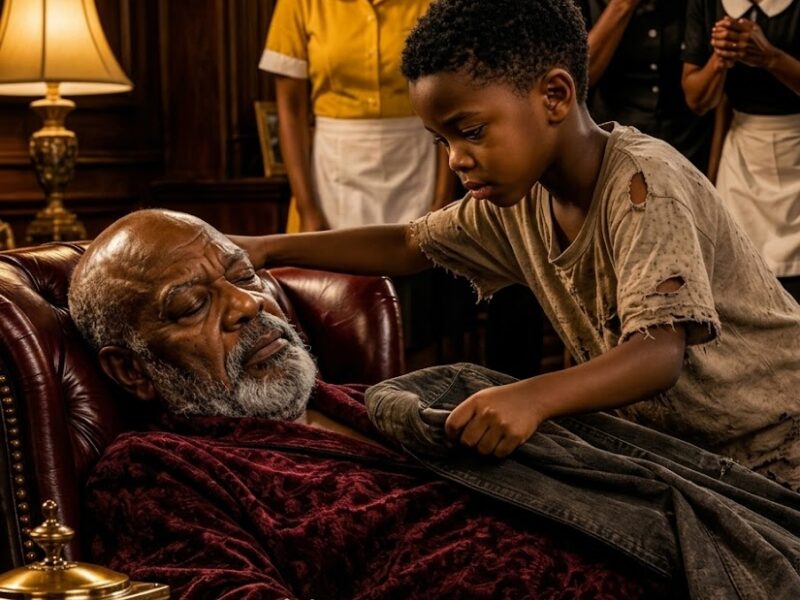
A billionaire pretended to be asleep to test a poor widow’s son—but what the 7-year-old boy did next left him completely stunned.
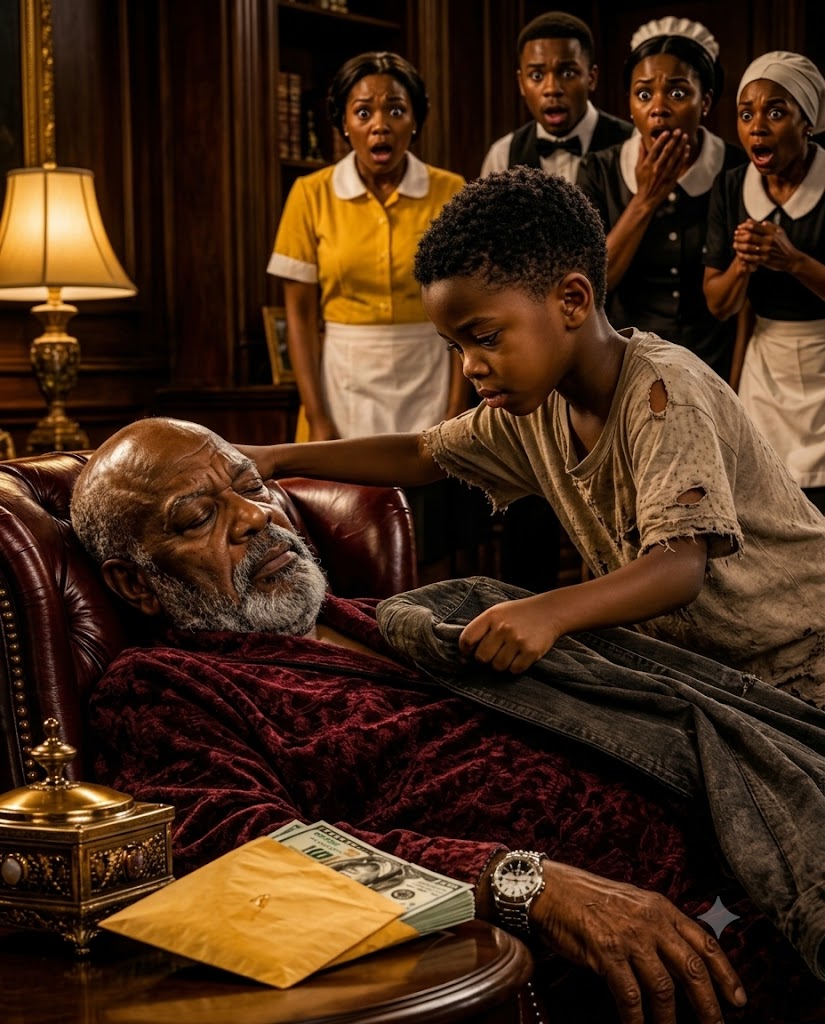
Walter Hargrove was not asleep.
His eyes were closed, and his breathing was slow and heavy.
His frail body sagged deep into the burgundy velvet of his favorite armchair.
To anyone watching, he looked like a tired, harmless old man drifting into an afternoon nap.
But behind his eyelids, Walter was wide awake.
His mind was sharp, calculating, and waiting.
It was a game he played often.
He was seventy-five years old, and he was one of the richest men in Atlanta.
He owned hotels, shipping lines, and software companies.
He had everything a man could dream of, except the one thing money could not buy.
Trust.
Over the years, Walter had grown bitter.
His children rarely visited, and when they did, they only wanted to talk about his will.
His business partners smiled to his face and sharpened their knives the moment he turned around.
Even his old household staff had stolen from him.
Silver spoons, cash from his wallet, bottles of rare wine.
Walter had come to believe that every human being on earth was greedy.
If you gave a person the chance to take something without getting caught, he was sure they would take it.
Today, he was going to prove that theory one more time.
Outside the heavy oak doors of the library, the rain hammered the tall windows like pebbles thrown by an angry hand.
Inside, the fire crackled and the room smelled of leather and old books.
Walter had set the stage perfectly.
On the small mahogany table beside his hand lay a thick envelope.
It was open.
Inside was a stack of crisp hundred-dollar bills, five thousand dollars in all.
The cash was spilling out of the envelope, as if a forgetful old man had left it behind.
It was enough to change a poor family’s life for a month.
Walter waited.
Then he heard the door handle turn.
A young woman named Grace Miller stepped inside.
She was his newest maid, and she had worked in the Hargrove mansion for only three weeks.
She was in her late twenties, but her face looked older.
Dark circles sat under her eyes, the kind that come from sleepless nights and constant worry.
Grace was a widow.
Walter knew this from her background check.
Her husband had died in a factory accident two years earlier and left her with nothing but debt and a seven-year-old son named Danny.
Today was Saturday, and the schools were closed for emergency storm repairs.
Grace had no money for a babysitter.
She had begged the head housekeeper, Mrs. Bishop, to let her bring the boy to work, promising he would be quiet as a mouse.
Mrs. Bishop had agreed, but only after a warning.
If Mr. Hargrove ever saw the child, both of them would be out on the street.
Walter heard Grace’s soft footsteps, followed by a second set that was lighter still.
“Stay right here, Danny,” Grace whispered.
Her voice shook with fear.
“Sit in that corner on the rug. Don’t move, don’t touch anything, and don’t make a sound.”
“Mr. Hargrove is sleeping in that chair.”
“If you wake him up, Mommy loses her job, and we won’t have a place to sleep tonight. Do you understand?”
“Yes, Mommy,” a small voice answered.
Behind his closed eyes, Walter felt a flicker of curiosity.
The boy did not sound mischievous.
He sounded scared.
“I have to go polish the silver in the dining room,” Grace whispered quickly.
“I’ll be back in ten minutes. Please, Danny, be good.”
“I promise.”
The door clicked shut.
Now it was just the billionaire and the boy.
For a long time, nothing happened.
The only sounds were the fire and the grandfather clock in the corner.
Tick, tock.
Tick, tock.
Walter kept his breathing steady, but every nerve in his body was listening.
He expected the boy to start playing.
He expected the crash of a vase or the shuffle of small feet exploring the room.
Kids were curious, he had always assumed, and poor kids were hungry for everything they didn’t have.
But Danny didn’t move.
Five minutes passed.
Walter’s neck began to cramp from holding the same position, but he didn’t break character.
Then he heard it.
The soft rustle of clothing.
The boy was standing up.
Walter tensed.
Here we go, he thought. The little thief is making his move.
The footsteps came closer, slow and hesitant.
Walter knew exactly what the boy was looking at.
The envelope.
Five thousand dollars sat inches from his relaxed hand, and a seven-year-old would understand what that kind of money could buy.
Toys, candy, a month of dinners.
Walter pictured how it would go.
The boy would snatch the cash and stuff it in his pocket.
Walter would open his eyes, catch him red-handed, and fire the mother on the spot.
One more lesson learned.
Never trust anyone.
The footsteps stopped right beside his chair.
He could almost feel the child’s breath.
He waited for the rustle of paper.
He waited for the grab.
It never came.
Instead, something small and cold touched his arm.
It was a light touch, barely the weight of a feather.
Walter fought the urge to flinch.
What is he doing? he wondered. Checking to see if I’m dead?
The hand pulled away, and the boy let out a heavy sigh.
“Mr. Hargrove?” Danny whispered.
It was so quiet that the rain nearly swallowed it.
Walter didn’t answer.
He let out a soft, fake snore.
Then came a sound that confused him.
It wasn’t the crinkle of money.
It was a zipper.
Is he getting comfortable? Walter thought, his mind racing. Is he going to take a nap too?
Then something warm settled over his knees.
It was the boy’s jacket.
It was a thin, cheap windbreaker, still damp from the rain, and Danny was tucking it around the old man’s legs like a blanket.
The library was drafty.
The big windows let in a chill that the fire could not beat, and Walter hadn’t even noticed that his hands were cold.
“You’re cold,” Danny murmured to the sleeping man.
“Mommy says people who are sick shouldn’t get cold.”
Walter’s heart skipped.
This was not part of the script.
The boy wasn’t looking at the money.
He was looking at him.
Then Walter heard a scrape on the tabletop.
Ah, he thought. Now that he’s lulled me, he takes the cash.
But the money didn’t leave.
Walter heard paper sliding across wood, and nothing more.
He risked opening his left eye, just a hair, a slit hidden behind his lashes.
What he saw hit him like a punch.
Danny stood beside the table, a scrawny kid with messy hair and secondhand clothes.
His shoes were worn through at the toes.
But his face held a serious, intense focus.
The envelope had been hanging dangerously off the table’s edge.
Danny had simply nudged it back toward the lamp so it wouldn’t fall.
Then he noticed something else.
A small leather notebook had slipped from Walter’s lap earlier and lay on the floor by his foot.
Danny bent down, picked it up, and brushed the cover clean with his sleeve.
He set it gently on the table beside the cash.
“Safe now,” he whispered.
Then he walked back to his corner of the rug, sat down, and hugged his knees to his chest.
He was shivering.
He had given his only jacket to a billionaire, and now he was the one who was cold.
Walter lay perfectly still, and for the first time in twenty years his mind went blank.
He had set a trap for a rat, and he had caught a dove.
The cynicism that had grown in his heart like a stone wall suddenly had a small crack in it.
Why didn’t he take it? Walter thought. They’re poor. I know they’re poor. His mother’s shoes have holes in the soles.
Before he could make sense of it, the library door flew open.
Grace rushed in, breathless and pale.
She had run all the way from the dining room.
She saw Danny in the corner, shivering without his jacket.
Then she saw the armchair.
Her son’s cheap, damp jacket was draped across the knees of a billionaire’s tailored trousers.
And the envelope of cash sat right there on the table.
Her hands flew to her mouth.
She thought the worst.
She thought Danny had bothered the master, or worse, tried to steal and cover it up.
“Danny!” she hissed, sharp with panic.
She grabbed his arm and pulled him to his feet.
“What did you do? Why is your coat on him? Did you touch that money?”
Danny looked up at her with huge eyes.
“No, Mommy. He was shivering. I just wanted to keep him warm.”
“And the envelope was falling, so I fixed it.”
“Oh, God,” Grace whispered, tears rising.
“He’s going to wake up, and we’re ruined. I told you not to move.”
She began frantically yanking the jacket off Walter’s legs, her hands shaking so badly that she nearly knocked over the lamp.
“I’m sorry,” she whispered to the sleeping man, who she thought could not hear her.
“I’m so sorry. Please don’t wake up. Please.”
Walter felt the jacket pulled away.
He felt her terror, and it rolled off her like heat.
She wasn’t afraid of a monster in a story.
She was afraid of him.
She was afraid of the man with more money than anyone needed, whose staff trembled so badly that a child’s kindness looked like a crime.
In that moment, Walter understood something he had avoided for twenty years.
He had become the monster.
He decided it was time to wake up.
He let out a loud, theatrical groan and shifted in his chair.
Grace froze.
She pulled Danny against her chest and backed toward the door like a deer in oncoming headlights.
Walter blinked at the ceiling, then slowly lowered his gaze to the terrified woman and the small boy.
He put on his grumpiest scowl, bushy gray eyebrows drawing together.
“What is all this noise?” he grumbled, his voice gravelly and harsh.
“Can a man not get any rest in his own house?”
“I’m so sorry, Mr. Hargrove,” Grace stammered, bowing her head.
“This is my son. The schools were closed, and I had no one to watch him.”
“We’re leaving right now. Please, sir, don’t fire me. I’ll take him outside, and he won’t bother you again.”
“Please. I need this job.”
Walter stared at them.
He looked at the envelope.
It sat exactly where Danny had pushed it.
He looked at the boy, who was trembling now, not from the cold but from fear of an angry old man.
Walter sat up straighter and picked up the envelope.
He tapped it against his palm.
Grace squeezed her eyes shut, sure he was about to accuse them.
“Boy,” Walter boomed.
Danny peeked out from behind his mother’s leg.
“Yes, sir?”
“Come here.”
Grace tightened her grip on his shoulder.
“Sir, he didn’t mean to…”
“I said, come here.”
Danny stepped away from his mother.
He walked slowly toward the armchair, small hands shaking, and stopped right in front of the old man’s knees.
Walter leaned forward until his face was inches from the boy’s.
He searched those young eyes for a lie, for the greed he was so certain lived in everyone.
“Did you put your jacket on me?”
Danny swallowed hard.
“Yes, sir.”
“Why?” Walter pressed. “I’m a stranger, and I’m rich. I have a closet full of cashmere coats upstairs.”
“Why would you give me yours?”
Danny looked down at his worn-out shoes, then back up.
“Because you looked cold, sir.”
“And Mommy says when somebody’s cold, you give them a blanket, even if they’re rich.”
“Cold is cold.”
Walter stared at him.
Cold is cold.
It was such a simple truth, and it had slipped past him for most of his life.
He glanced at Grace.
She was holding her breath.
“What’s your name, son?” he asked, his voice softening just a fraction.
“Danny, sir.”
Walter nodded slowly.
He looked at the envelope in his hand, then at the open door.
A plan began to form.
The test wasn’t over.
In fact, it had just begun.
The boy had passed the first level, honesty.
But Walter needed to know whether this was a fluke or whether the boy truly had a heart of gold.
He shoved the envelope into his inside jacket pocket.
“You woke me up,” he grunted, slipping back into his grumpy role.
“I hate being woken up.”
Grace let out a small sob.
“We’re leaving, sir.”
“No,” Walter said sharply.
“We’re leaving, sir,” she repeated, grabbing Danny’s hand and turning for the door.
“Stop.”
His voice cracked across the room like a whip.
Grace froze.
She turned back slowly, her face drained of color.
“I didn’t say you could go.”
Walter pointed a trembling finger at the armchair.
“Look at that.”
She looked.
On the burgundy velvet sat a small, dark, damp spot where Danny’s wet jacket had rested.
“My chair,” Walter said, his voice dripping with fake outrage.
“That is imported Italian velvet, two hundred dollars a yard. Now it’s ruined.”
“I’ll dry it, sir,” Grace stammered. “I’ll get a towel right now.”
“Water stains velvet,” Walter lied.
He rose, leaning on his cane, and loomed over her.
“You can’t just dry it. It has to be professionally restored.”
“That will cost five hundred dollars.”
He watched them closely.
This was the second part of the test.
He wanted to see whether the mother would turn on her child, whether she would scream at the boy for costing her money she didn’t have.
He wanted to see whether pressure could break their bond.
Grace looked at the stain, then at Walter.
Tears streamed down her face.
“Mr. Hargrove, please. I don’t have five hundred dollars. I haven’t even been paid for this month yet.”
“Take it out of my wages. I’ll work for free.”
“Just please, don’t hurt my boy.”
Walter’s eyes narrowed.
She was offering to work for nothing.
That was rare.
But he wasn’t finished.
He turned to Danny.
“And you? You caused this damage. What do you have to say for yourself?”
Danny stepped forward.
He wasn’t crying.
His small face was grave.
He reached into his pocket.
“I don’t have five hundred dollars,” he said softly.
“But I have this.”
He pulled out his hand and opened his fingers.
In the center of his palm sat a tiny, battered toy car.
It was missing a wheel, and the red paint was chipped down to bare metal.
To anyone else, it was junk.
But the way Danny held it, it might as well have been a diamond.
“This is Fast Eddie,” he explained.
“He’s the fastest car in the world. He was my daddy’s, before he went to heaven.”
“Mommy gave him to me.”
Grace gasped.
“Danny, no. You don’t have to.”
“It’s okay, Mommy,” the boy said bravely.
He looked up at the billionaire.
“You can have Fast Eddie for the chair. He’s my best friend.”
“But you’re mad, and I don’t want you to be mad at Mommy.”
He reached out and set the broken toy car on the polished mahogany table, right beside the leather notebook.
Walter stared at it.
He suddenly couldn’t breathe.
The library felt very small.
In his pocket sat five thousand dollars.
On the table sat a three-wheeled toy.
This boy was offering his most precious possession to pay for a mistake that had been an act of kindness.
He was giving up the last piece of his father to save his mother’s job.
And something in Walter’s chest, frozen for decades, cracked wide open.
The pain was sharp and immediate.
This child, who owned nothing, was richer than Walter would ever be.
Walter had millions, and he would never sacrifice his favorite possession for anyone.
The silence stretched.
The rain kept pounding the glass.
Walter picked up Fast Eddie with a trembling hand.
“You would give me this,” he whispered, “for a wet chair?”
“Yes, sir,” Danny said.
“Is it enough?”
Walter closed his eyes.
He thought of his own children.
They only called when they wanted a new sports car or a lake house.
They never gave him anything.
They only took.
“Yes,” he whispered, opening his eyes, now wet.
“Yes, Danny. It’s enough. It is more than enough.”
He sank back into his chair.
The act was over.
He couldn’t play the villain anymore.
He felt tired, and not from age but from the weight of his own guilt.
“Grace,” he said, and his voice had changed completely.
It was the voice of a lonely old man.
“Sit down.”
“Sir?” Grace looked confused.
“Please,” Walter said softly. “Just sit. Stop looking at me like I’m going to eat you.”
She perched on the edge of the sofa and pulled Danny onto her lap.
Walter turned the little car over in his fingers and spun the remaining wheels with his thumb.
“I have a confession,” he said, staring at the floor.
“The chair isn’t ruined. It’s just water. It’ll be dry in an hour.”
Grace let out a breath she’d been holding for what felt like years.
“Oh, thank God.”
“And,” Walter continued, lifting intense eyes to hers, “I wasn’t asleep.”
Her eyes went wide.
“You weren’t?”
“No. I was pretending.”
“I left that money out on purpose. I wanted to see if you would steal it. I wanted to catch you.”
Grace pulled her son tighter.
She looked hurt.
“You tested us,” she said quietly. “Like we were lab rats.”
“Yes,” Walter admitted. “I’m a bitter old man, Grace.”
“I thought everyone was a thief. I thought everyone had a price.”
He pointed a shaking finger at Danny.
“But him.”
His voice broke.
“He didn’t take the money. He covered me up, because he thought I was cold.”
“And then he offered me his father’s car.”
Walter wiped a tear from his cheek.
He didn’t care that his maid was watching.
“I lost my way a long time ago,” he whispered.
“I have all this money, and I’m poor. You have nothing, and you raised a king.”
He stood and walked to the fireplace and drew a deep breath.
Then he turned back.
“The test is over,” he said. “And you passed. Both of you.”
He pulled the thick envelope from his pocket and held it out to her.
“Take this.”
Grace shook her head hard.
“No, sir. I don’t want your money. I just want to work and earn my keep.”
“Take it,” Walter insisted.
“It isn’t charity. It’s a bonus. It’s payment for the lesson your son just taught me.”
She hesitated.
She looked at the cash, then at Danny’s worn-out shoes.
“Please,” Walter said gently.
“Buy the boy a warm coat. Buy him new shoes. Buy yourself a bed that doesn’t hurt your back.”
Her hand trembled as she took the envelope.
“Thank you, Mr. Hargrove. Thank you.”
“Don’t thank me yet,” he said.
For the first time in years, a small, real smile touched his lips.
“I have a business proposition for you, Danny.”
Danny’s eyes brightened.
“For me?”
“For you.” Walter held up the toy car. “I’m keeping Fast Eddie.”
“You gave him to me as payment, so he’s mine now.”
Danny’s face fell, just slightly, but he nodded.
“Okay. A deal’s a deal.”
“But,” Walter went on, “I can’t drive a car with three wheels.”
“I need a mechanic. Someone to help me fix things around here.”
“Someone to help me fix myself.”
He lowered himself to one knee, a painful move for his old joints, until he was eye level with the seven-year-old.
“How would you like to come here every day after school, Danny?”
“You can sit in the library and do your homework. And you can teach this grumpy old man how to be kind again.”
“In exchange, I’ll pay for your schooling, all the way through college.”
“Deal?”
Danny looked at his mother.
Grace was crying openly now, both hands over her mouth.
She nodded.
Danny turned back and flashed a gap-toothed grin.
“Deal,” he said, and held out his small hand.
Walter Hargrove, the billionaire who trusted no one, took that hand and shook it.
The rain outside kept falling.
But inside the library, for the first time in a very long time, the room felt warm.
Ten years passed.
The Hargrove mansion was no longer a dark, silent place.
The heavy curtains stayed open, and sunlight poured across the floors.
The garden, once overgrown and thorny, bloomed with bright flowers.
And every evening, a boy sat in the library with a math book, while an old man in a burgundy chair pretended he wasn’t helping with the homework.
Fast Eddie sat on the side table beside the lamp.
Walter had polished the little car until the red paint shone.
He had even paid a jeweler to replace the missing wheel with a tiny piece of solid gold.
He never told Danny.
He just watched him grow, one year at a time, into a tall young man with a good heart and a steady hand.
And somewhere in those ten years, Walter Hargrove quietly changed his will.
On a warm Sunday afternoon, the library was full of people.
It was not a party.
It was a gathering of lawyers, executives, and one tall young man named Danny.
Danny was seventeen now, handsome in a crisp dark suit.
He stood at the window, watching his mother arrange flowers in the garden below.
Grace didn’t look tired anymore.
She ran the Hargrove Foundation now, steering millions of dollars a year toward families who had nowhere else to turn.
The room was quiet because the attorney was about to read the last will and testament of Walter Hargrove.
Walter had passed away peacefully three days earlier.
He had died in the burgundy armchair, the same one where the test had happened ten years before.
On the far side of the room sat his three children, Colin, Tessa, and Jake.
They kept checking their watches.
They whispered about selling the house and splitting the fortune.
They didn’t look sad.
They looked hungry.
The attorney, Mr. Callahan, cleared his throat and adjusted his glasses.
“To my children,” he read, “I leave the trust funds established for you at birth.”
“You have never visited me without asking for money, so I assume money is all you want.”
“You have your millions. Enjoy them.”
The three of them grumbled, but they looked satisfied.
They stood to leave, not caring to hear the rest.
“Wait,” Mr. Callahan said. “There is more.”
They turned around.
“To the rest of my estate, my companies, this house, my investments, and my personal savings, I leave everything to the one person who gave me something when I had nothing.”
The room went still.
“Who?” Colin demanded. “We’re his family.”
Mr. Callahan lowered the page.
“He leaves it all to Danny.”
The room erupted.
Colin pointed a shaking finger across the carpet.
“The maid’s son? This is a joke. He tricked our father.”
Danny said nothing.
He stood with one hand in his pocket, rubbing something small with his thumb.
Mr. Callahan raised a hand for silence.
“Mr. Hargrove left a letter. He asked me to read it aloud.”
He unfolded a handwritten page.
“To my children and to the world,” he read.
“You measure wealth in gold and property. You will say I have lost my mind. You are wrong. I am paying a debt.”
“Ten years ago, on a rainy Saturday, I was a beggar of the spirit. I was cold, lonely, and empty.”
“A seven-year-old boy saw me shivering. He did not see a billionaire. He saw a human being.”
“He covered me with his only jacket. He protected my money when he could have taken it.”
“But the real debt was paid when he handed me his most precious possession, a broken toy car, to save his mother from my anger.”
“He gave me everything he had and expected nothing back.”
“He saved me from dying a bitter, hateful man. He gave me ten years of laughter, noise, and love.”
“So I leave him my money. It is a small trade, because he gave me back my soul.”
Mr. Callahan folded the letter.
Then he reached into his briefcase and took out a small velvet box.
“Danny, Mr. Hargrove wanted you to have this.”
Danny opened the lid.
On a cushion of white silk sat the old toy car.
Fast Eddie.
The paint had been restored to a bright, glossy red, and the missing wheel had been replaced with a tiny disk of solid gold.
Tears ran down Danny’s face.
He didn’t care about the mansion.
He didn’t care about the billions or the shouting.
He missed the grumpy old man who used to check his math homework and pretend he wasn’t smiling.
His mother crossed the room and wrapped her arms around him.
“He was a good man, Danny,” she whispered.
“He was,” Danny said. “He just needed a jacket.”
The three siblings stormed out, swearing they would sue.
But they knew they would lose.
The will was airtight.
When the house finally emptied, Danny walked over to the empty armchair.
He set the little car on the side table, right beside the lamp.
“Safe now,” he whispered.
The same words he had said ten years ago.
Years later, on another night just as cold, rain would soak that same long driveway again.
And three figures would climb the hill with nothing left to give.
The storm that night was not just weather.
It was a verdict.
Rain fell in sheets, cold and merciless, drumming on the old stone walls of the Hargrove mansion.
The wind howled across the valley like something searching for the way home.
Inside, the house was warm and quiet, and it smelled of leather, beeswax, and memories.
Danny stood before the floor-to-ceiling glass wall of the grand study.
He was almost thirty now, the master of the house, the keeper of Walter Hargrove’s legacy.
But some nights he still felt like a boy wearing shoes too big for him.
He didn’t know why he was standing at the window.
Maybe he sensed it.
Maybe the air itself had changed.
Then lightning split the sky and lit the iron gates at the bottom of the hill, and Danny stopped breathing.
His hand tightened on the velvet curtain until his knuckles went white.
“No,” he whispered to the empty room. “It can’t be.”
Three figures were trudging up the long, winding drive.
They bent into the wind with their heads down, beaten by the storm.
He knew those walks.
He knew the slump of those shoulders.
It was Colin, Tessa, and Jake.
The golden children, who had left five years ago with their noses in the air and their pockets stuffed with millions.
Danny’s heart didn’t swell with pride.
It broke.
He remembered Colin as he used to be, tall and imposing in suits that cost more than a car, smelling of cologne and arrogance.
He remembered Tessa, the queen of Buckhead society, who wouldn’t walk across a lawn for fear of ruining her heels.
He remembered Jake, the wild youngest, who laughed at everything and respected nothing.
But the next flash of lightning showed him the truth.
Colin wasn’t imposing anymore.
He was stooped and limping, gray hair plastered to his skull.
Tessa clutched a thin trench coat around herself and shook so hard that Danny could see it from fifty yards away.
They looked small.
They looked like lost children in a dark forest.
A deep wave of pity rolled through him.
These were Walter’s children.
This was the family that should have been his.
He spun around.
“Mrs. Kemper! Mrs. Kemper, come quick!”
The study doors flew open, and the head housekeeper hurried in.
She had served the Hargrove family for forty years.
She saw his face and went pale.
“What is it, sir? The roof?”
“It’s them,” Danny said, pointing. “The children. They’re walking up the drive.”
“They’re freezing, Mrs. Kemper. Look at them.”
She rushed to the glass and gasped.
“Dear Lord. Master Colin looks like a drifter.”
“Don’t stare,” Danny said, already moving. “Get the coats.”
“The heavy wool ones from the mudroom, and every blanket you can carry.”
“Run. Don’t let them take another step in this cold without something warm.”
She didn’t ask a single question.
She saw the tears standing in his eyes, and she ran.
Danny stayed at the window with his forehead against the cold glass.
He watched the housekeeper’s small figure sprint into the storm.
He watched her reach them.
He watched Colin stop dead as a blanket settled over his shoulders.
He watched Tessa collapse into the old woman’s arms, sobbing.
Danny closed his eyes, and one tear slid down his cheek.
He knew why they were here.
Not out of love.
The world had chewed them up and spit them out, and they had nowhere left to go.
And standing alone in the dark, Danny made the hardest decision of his life.
He loved them.
He loved them so much that he knew he couldn’t save them with a check.
If he handed them money, he would only feed the sickness that had ruined them.
It would be like pouring whiskey for a man who was already drowning in it.
“Walter,” he whispered to the ceiling. “You asked me to save them.”
“I didn’t know how back then. I think I do now.”
It was a dangerous plan, born of fierce, aching love.
He would have to break his own heart to heal theirs.
He would have to become a mirror, to show them what they had become, and then, slowly and tenderly, show them what they could be.
He wiped his face and straightened his spine.
He put on the mask of the master of the house.
Ten minutes later, the heavy oak doors groaned open.
They spilled into the foyer, dripping and shivering, wrapped in wool coats and clutching them like life rafts.
The silence in the hall was deafening.
The grandfather clock ticked.
Tick.
Tick.
Tick.
Danny stood at the top of the short staircase, young, strong, and warm.
They looked old, worn, and shattered.
Colin was old enough to be his father, yet he stood there trembling like a scolded child.
“Danny,” Colin said.
His voice sounded like a rusty gate that hadn’t been opened in years.
He was looking up at the boy he had once ignored, the one he used to call the charity case.
“Colin,” Danny said softly.
He didn’t come down the stairs.
If he got any closer, he would hug them, and the lesson would be lost.
“Thank you for the coats,” Tessa whimpered. “We were so cold.”
“You looked cold,” Danny said, his voice steady and gentle.
Jake stepped forward.
His face was gaunt, and his eyes were rimmed with red.
“We need to talk. Man to man.”
“We can talk,” Danny said. “Come to the fire.”
They huddled around the library fireplace, steam rising from their damp clothes.
Danny ordered hot tea and soup.
He watched them eat like wolves, ravenous and desperate, and every table manner they had ever learned was gone.
It broke him a little more.
When the bowls were empty, Colin cleared his throat.
He tried to summon a scrap of his old arrogance, but it was like trying to light a wet match.
“We’ve had some bad luck,” he began, staring at the empty bowl.
“The market. Bad investments. People we trusted. They robbed us blind.”
“You’re broke,” Danny said.
It wasn’t a question.
“We’re ruined,” Tessa whispered, tears leaking down her face.
“They took the house in Buckhead. They took the cars. They took my jewelry, Danny.”
“We spent the last of our cash on the cab ride to the gate,” Jake said.
He looked up, eyes hungry.
“We need a loan. Not a handout, just a bridge. Four million, five at most, just to get us liquid again.”
“We know the estate is worth billions.”
“You owe us. You were Dad’s favorite. You got everything that should have been ours.”
Danny looked at the three faces waiting for his answer.
He saw the desperation.
But underneath it, he saw something else.
Entitlement.
They didn’t want to change.
They just wanted the pain to stop.
He remembered the promise he had made at Walter’s bedside.
Teach them, Danny. I failed them. I gave them everything and taught them nothing.
He took a long breath.
He pictured himself reaching into his chest and cutting out his own heart.
“No,” he said.
The word hung in the air, heavy and final.
Colin blinked. “What did you say?”
“I said no. I won’t give you a loan.”
“You can’t be serious,” Jake said, jumping to his feet, fists clenched.
“You’re sitting on a mountain of gold our father built, and you’d let us starve?”
“If I give you money,” Danny said, looking him straight in the eye, “you’ll be back here in a year, colder and wetter than you are tonight.”
“Money isn’t your cure, Jake. It’s your disease.”
“So you’re throwing us back into the storm,” Tessa cried.
“No,” Danny said gently. “I’m not turning you out. I’m inviting you in.”
He walked toward them.
“You have nowhere to go. You have no friends left. I know that.”
“So here’s my offer. You can live here. You’ll have warm beds, hot meals, and a roof.”
“Thank you, Danny,” Colin breathed, his shoulders dropping. “We knew you’d be reasonable.”
Danny raised a hand.
“But you won’t be guests. You’ll be staff.”
The room went dead silent.
“Excuse me?” Colin said, his face draining of color.
“You’ll work,” Danny said. “Tessa, Mrs. Kemper is getting older. She needs help with the cleaning and the laundry.”
“Jake, the grounds are a mess and the cars need care. You’ll be the driver and the groundskeeper.”
“And me?” Colin whispered, horrified.
“I need a personal assistant,” Danny said. “Someone to manage my calendar, carry my files, and bring me my coffee.”
“That will be you.”
“Servants,” Jake spat, as if the word were poison. “You want to make us servants in our own childhood home.”
“You want to humiliate us.”
“I want to save you,” Danny said.
And for the first time, his voice trembled.
“I want to teach you what a dollar feels like when you’ve earned it.”
“I want you to know what dignity feels like.”
“That’s the offer. Take it, or the door is right there.”
They looked at the fire.
They looked at the rain lashing the glass.
They looked at each other.
They had no choice.
“We accept,” Colin said, his voice hollow.
Danny turned away to hide his tears.
So he never saw Colin’s face.
It wasn’t humility.
It was hatred, cold and patient.
The game had begun.
The first month was a war of silence.
The siblings drifted through the mansion like ghosts, doing their chores with bitter slowness.
Tessa wept as she polished the silver, leaving teardrops on the forks.
Jake pushed the lawn mower as if he were trying to murder the grass.
But Colin was different.
Colin was dangerous.
He was the eldest, and he had once run a company with two thousand employees.
He knew how to hide what he felt.
He understood quickly that fighting Danny head-on was pointless.
He would have to outsmart him.
One night, in the cramped servants’ quarters that smelled of bleach and damp wool, Colin gathered his brother and sister close.
“Stop crying, Tessa,” he hissed. “And stop sulking, Jake. You’re playing right into his hands.”
“I hate him,” Jake growled, rubbing his blistered palms.
“He strolls around like a king while I weed his rose beds. I’d like to wring his neck.”
“No,” Colin whispered, his eyes gleaming. “We’re not going to hurt him.”
“We’re going to rob him.”
Tessa gasped. “Rob him?”
“He’s a naive kid,” Colin said, a thin, cruel smile spreading across his face.
“He thinks he’s teaching us a lesson. I’ll teach him one.”
“I’ll become the perfect servant. I’ll make myself indispensable. I’ll make him trust me, even love me.”
“And when he opens his heart, he’ll open his vault.”
“I’ll get the transfer codes for the foundation’s accounts, and we’ll take ten million dollars and vanish.”
“Can you do it?” Jake asked, hope lighting his tired eyes.
“Watch me,” Colin said.
The next morning, he was up before dawn.
He ironed Danny’s newspaper.
He brewed the coffee exactly how Danny liked it, black with a pinch of cinnamon.
When Danny walked into the study, Colin was waiting in a crisp, cheap suit with the day’s schedule in his hands.
“Good morning, sir,” he said, bowing his head slightly.
“I took the liberty of rearranging your afternoon. Traffic on Peachtree will be brutal, so I moved the meeting to the sunroom.”
Danny paused.
He searched Colin’s face for sarcasm, for anger.
But the mask was flawless.
“Thank you, Colin,” Danny said quietly.
For weeks, Colin played his part to perfection.
He was efficient and humble.
He smiled when he was handed the dullest tasks and apologized when he slipped.
But Danny wasn’t playing a game of power.
He was playing a game of love.
And love was a weapon Colin had no idea how to fight.
Danny didn’t treat him like a servant.
He treated him like a lost treasure he was patiently polishing.
The change didn’t come all at once.
It came in small, sharp moments that chipped at the stone around Colin’s heart.
One morning, Colin was carrying a heavy tray of antique crystal across the dining room.
It was Walter’s favorite set.
His toe caught the edge of the rug.
Crash.
The sound was explosive.
Thousands of dollars of crystal burst across the hardwood.
Colin froze.
His blood ran cold.
He stood trembling, waiting for the screaming.
He waited for Danny to storm in, fire him, and humiliate him.
That’s exactly what Colin would have done.
Danny came running.
He saw the glass.
He saw Colin shaking.
And he didn’t look at the glass at all.
He looked at Colin’s hands.
“Don’t move,” Danny said, rushing forward.
“I’ll pay for it,” Colin stammered. “I’ll work it off. Please don’t fire me.”
Danny dropped to his knees in the shards.
“Colin, stop. Are you cut? Did you hurt yourself?”
He took Colin’s hands gently and turned them over, checking for scratches.
Colin stopped breathing.
The young master was kneeling in broken glass, examining an old man’s wrinkled fingers.
“The glasses,” Colin whispered.
“It’s just glass,” Danny said, looking up with a sincerity that burned.
“Are you okay?”
A lump rose in Colin’s throat so large he couldn’t speak.
He pulled his hands away.
“I’m fine,” he choked. “I’ll clean it up.”
“We’ll clean it up,” Danny said, and he picked up the dustpan.
Colin watched the young man sweep and felt a crack run through his mask.
Why is he doing this? he thought. Why doesn’t he hate me?
A week later, the foundation held a board meeting.
High-powered bankers and lawyers in expensive suits sat around a long mahogany table.
They were sharks, and they smelled blood.
They wanted to carve off a piece of Walter’s legacy and sell it cheap.
Colin stood in the back, pouring water, trying to be invisible.
He felt small.
Men who used to work for him now didn’t even glance his way.
One of the bankers, a smooth man named Preston, sneered at Danny.
“Look, kid, you don’t understand corporate structuring. Your benefactor is dead. The old ways are gone.”
“Just sign the papers.”
Danny sat quietly.
Then he turned his chair.
“Colin,” he said.
The room fell silent.
Colin froze with the pitcher in his hand.
“Yes, sir?”
“Come here, please.”
Colin walked to the head of the table.
Danny looked around at the bankers.
“Gentlemen, I think you’ve forgotten who’s in the room.”
“This is Colin Hargrove. He built the logistics arm of this company before I was old enough to read.”
“He knows more about this business in his little finger than the rest of you know combined.”
Danny stood and pulled out the empty chair beside him.
“Colin, sit. Read this proposal. Tell me if they’re lying to me.”
Colin stared at the chair.
He looked at the bankers, whose mouths hung open.
He looked at Danny.
Danny wasn’t mocking him.
He was looking at Colin with complete trust.
Danny was giving him back his name.
Colin sat.
His hands shook, but he picked up the document and read.
The old sharp mind, asleep for years, snapped awake.
“They’re undervaluing the assets by forty percent,” Colin said, his voice gaining strength.
“And the tax liability on page four is structured to bleed the foundation dry.”
Danny smiled, a proud, beaming smile.
“Thank you, Colin. Gentlemen, you can show yourselves out.”
That night, Colin lay awake staring at the ceiling.
I hate him, he told himself. I’m going to rob him.
But the words tasted like ashes.
He remembered Danny kneeling in the glass.
He remembered the chair pulled out at the head of the table.
He remembered the pride on that young face.
Colin turned over and buried his face in the pillow.
He was supposed to be the villain in this story.
But every time he tried to be bad, Danny hit him with kindness.
It was torture.
It was the most beautiful torture in the world.
And on the old man’s side table in the library, a little red car with one golden wheel sat quietly beside the lamp, waiting.
Danny saw it all.
He watched the anger drain from Colin’s face.
He watched the softness creep back into his eyes.
Danny knew the plan was working.
But the final test hadn’t come yet.
The fire that would fuse the broken pieces together was waiting at a construction site on the edge of town.
It was a Tuesday, gray and windy.
The sky hung low and heavy, the color of a bruised plum.
Danny asked Colin to ride along to the east side of the city.
The foundation was renovating an old, crumbling warehouse into a shelter for homeless families.
“I want you to oversee the budget, Colin,” Danny said in the car.
“You have an eye for detail that I don’t.”
Colin sat in the passenger seat with a clipboard crushed in his fists.
His inner war had reached a fever pitch.
He had the codes now.
He had found them scribbled in a notebook on Danny’s desk the day before, and he had memorized every digit.
He could make the transfer tonight.
Ten million dollars.
He could wake Jake and Tessa, and they could be across the border by morning.
Do it, the old Colin whispered. He humiliated you. He made you a servant.
Don’t, the new Colin whispered back. He trusts you. He’s the only person who has ever looked at you without wanting something.
They pulled up to the site.
It was chaos.
Drills whined, hammers clanged against steel, and dust hung in the air like a thick, choking fog.
They put on hard hats and walked into the skeleton of the building.
Above them rose a massive scaffold, three stories high, stacked with heavy timber beams meant for the new roof.
“It’s going to be beautiful, Colin,” Danny said, sweeping a hand across the open space, his eyes shining with that wonderful, maddening hope of his.
“Picture the families. Warm beds, hot food, just like what you gave us when…”
He stopped and corrected himself with a small smile.
“Just like what I was given, once, when I came in out of the rain.”
Colin stared at the concrete.
Guilt stabbed him in the chest, hot and sharp.
“Danny, I…”
“Yes, Colin?”
Danny turned to him, smiling.
Colin opened his mouth to confess.
He wanted to tell him everything.
He wanted to beg for forgiveness before he had even committed the crime.
He wanted to shout, Run from me. I’m a snake.
Snap.
A sound like a gunshot cracked overhead.
It was the sound of metal giving way.
A steel cable, rusted and exhausted, had failed three floors up.
“Look out!” a worker screamed from the balcony.
Colin looked up.
Time slowed.
He saw the cable whipping through the air like an angry snake.
He saw a stack of timber beams, each weighing hundreds of pounds, begin to tilt.
They were sliding.
They were falling.
And they were falling straight at him.
Colin couldn’t move.
Fear had locked his legs in place.
He stared at the death coming for him and thought, This is it. This is justice.
I lived as a thief. I’ll die as one.
He squeezed his eyes shut.
Then something slammed into his side like a linebacker.
“Colin!”
It was a scream of pure desperation.
Danny had thrown himself at him.
He hadn’t hesitated.
He hadn’t weighed the risk or thought about his billions or his future.
He had seen his brother in danger, and he had launched.
The impact sent Colin flying out of the danger zone.
He rolled across the concrete, scraping his palms raw, and the clipboard skittered away into the dust.
Crash.
Thud.
Crunch.
The ground shook.
The beams smashed into the slab exactly where Colin had been standing a split second before.
The roar was deafening, a symphony of destruction.
A cloud of dust billowed up and blinded everyone.
Then came silence, a ringing, terrible silence.
“Danny?” Colin coughed, waving the dust away.
“Danny!”
He scrambled onto his hands and knees.
Danny lay near the edge of the pile, not moving.
One of the beams had caught his leg.
His trousers were torn, and blood was soaking through the fabric, turning the gray dust to red mud.
His face was pale and powdered with ash.
“No, no, no!” Colin cried.
He crawled over the debris, ignoring the splinters biting into his knees, and grabbed the young man’s shoulders.
“Danny, wake up. Please, God, wake up.”
Danny groaned.
His eyelids fluttered open.
He grimaced and dragged in a breath through clenched teeth.
“Colin,” he wheezed.
“I’m here. Don’t move. I’m getting help.”
Colin was crying now, tears carving tracks through the dust on his cheeks.
“Somebody call 911! Somebody help us!”
Danny reached up with a shaking hand and caught Colin’s sleeve.
His grip was weak.
“Colin,” he whispered. “Are you… are you hurt?”
Colin stopped screaming.
He looked down at the young man.
Danny’s leg was broken.
He was bleeding.
He was in agony.
And his only question was whether Colin was hurt.
Something inside Colin shattered.
The last wall of pride, greed, and bitterness exploded and turned to dust, just like the building around them.
He collapsed onto Danny’s chest and buried his face in the filthy shirt.
He sobbed like a child.
He sobbed like a man whose soul was being torn open so the light could finally get in.
“Why?” he cried into Danny’s chest.
“Why did you save me? You stupid, stupid boy. You should have let me die.”
“Colin…”
“I’m a thief!” Colin blurted, the words pouring out in a flood of shame.
“I’m a liar, Danny. Don’t you understand? I have the codes.”
“I was going to take the money tonight. Ten million dollars. I was going to rob you and leave you with nothing.”
“I hated you. I’ve lied to you every single day.”
He grabbed Danny’s collar and shook him, gently, helplessly.
“I’m a monster. I’m a snake. Why would you save a monster?”
Workers were running toward them now, shouting.
Colin didn’t hear a word.
He only saw Danny.
Danny looked up at him.
Pain was carved into his face, and sweat beaded on his forehead.
But his eyes were clear.
They were calm.
They were filled with a deep, almost frightening love.
“Colin,” he whispered. “Look at me.”
Colin shook his head, unable to meet his gaze.
“Look at me,” Danny said softly.
Colin looked.
“I know,” Danny said.
The whole world seemed to stop spinning.
“What?” Colin breathed.
“I know,” Danny said again, a faint smile on his bloodied lips.
“I knew about the plan. I overheard you and Jake in the kitchen the first week.”
“I knew you wanted the codes. I knew you hated me.”
Colin pulled back, horrified.
“You knew? For months? And you let me stay in your house? You…”
His voice cracked.
“You saved my life.”
“I never wanted to save you from the police, Colin,” Danny said, his voice fading as shock began to set in.
“I wanted to save you from yourself.”
He lifted a trembling, dusty hand and touched Colin’s tear-streaked cheek.
“I wanted to love you until you couldn’t stand being a thief anymore.”
“I wanted to show you what Walter found.”
“Love isn’t a feeling, Colin. Love is a sacrifice.”
“I risked my life today because you’re worth saving. You’re my brother.”
Colin stared at him.
In that moment, he saw the whole shape of Danny’s plan.
The patience.
The kindness.
The silence.
It had never been weakness.
It was a strength greater than anything Colin had ever known.
It was a love that didn’t just forgive a debt.
It paid it.
Colin took Danny’s hand and pressed it to his forehead.
“You win,” he sobbed. “You win, Danny. I surrender.”
“I don’t want the money. I don’t want any of it.”
“I just want to become the man you think I am.”
The ambulance arrived, and the chaos took over.
But the real work had already been done.
At the ER, a police officer came to ask about the “thief” Colin had been shouting about in his delirium.
Danny, lying in a hospital bed with his leg in a cast, sent him away.
“There’s no thief here,” he said firmly, looking straight at Colin.
“Only my partner.”
Tessa and Jake came to the hospital once.
They stood in the doorway and watched Colin spoon soup to Danny, gently, patiently, with a look of pure devotion.
They saw a peace on Colin’s face they had never seen before.
“He’s bewitched you,” Jake sneered, uncomfortable in the holiness of the room.
“Come on, Colin. We can still find a way to get that money.”
Colin looked at his brother.
He looked at the greed that used to be his own reflection.
He felt no anger.
Only pity.
“I’m already rich, Jake,” he said quietly. “I have something you can’t steal.”
“You’ve lost your mind,” Tessa snapped.
“We’re leaving. At least he paid us something for all that maid work.”
“Jake and I will start over on our own. Anything is better than living off a man who fooled our father to get his fortune.”
“Goodbye, Colin.”
“Goodbye,” Colin said.
He felt sad for them, but he let them go.
They had to walk their own road.
They had to find their own rainstorm.
Colin stayed.
He didn’t just stay in the house.
He became part of its foundation.
He worked harder than he ever had as a CEO, but now he came home with a light heart.
He and Danny rebuilt the Hargrove fortune together, not by hoarding gold, but by helping the people who needed it most.
The warehouse on the east side opened that winter.
On opening day, a line of families stood outside in the cold, and a young man on crutches shook every hand.
As for Tessa and Jake, life turned out to be a harder teacher.
They drifted for years, chasing shadows and easy money.
Eventually, they found their own way.
But they always looked back at the mansion on the hill with a mix of regret and wonder.
They understood too late that the work Danny had offered them was never a punishment.
It was a privilege.
Years passed, and one evening Colin and Danny sat by the same fire where it had all begun.
Danny’s hair had touched gray at the temples.
“We did good work, Colin,” he said quietly, his voice a little faint.
“We did,” Colin said, holding his brother’s hand. “You taught me well.”
“No,” Danny said, shaking his head. “You taught yourself.”
“I just held up the mirror. You were the one brave enough to follow what you saw.”
He smiled toward the empty armchair.
“One soul won. I’m sure Walter is glad, wherever he is.”
“And I believe the others will come home someday, too.”
Danny grew into a different kind of billionaire.
He didn’t build walls.
He built schools.
He didn’t hoard his money.
He used it to fix what was broken, the same way he had once tried to fix a ruined chair.
And whenever reporters asked him the secret of his success, Danny would smile and slip a small red toy car out of his pocket.
The paint was bright and glossy, and one of its wheels glinted gold.
“I didn’t buy my success,” he would say.
“I bought it with kindness.”
“True wealth isn’t what you carry in your pockets.”
“It’s what you carry in your heart.”
And then he would set Fast Eddie gently on the table beside him.
“Safe now.”









