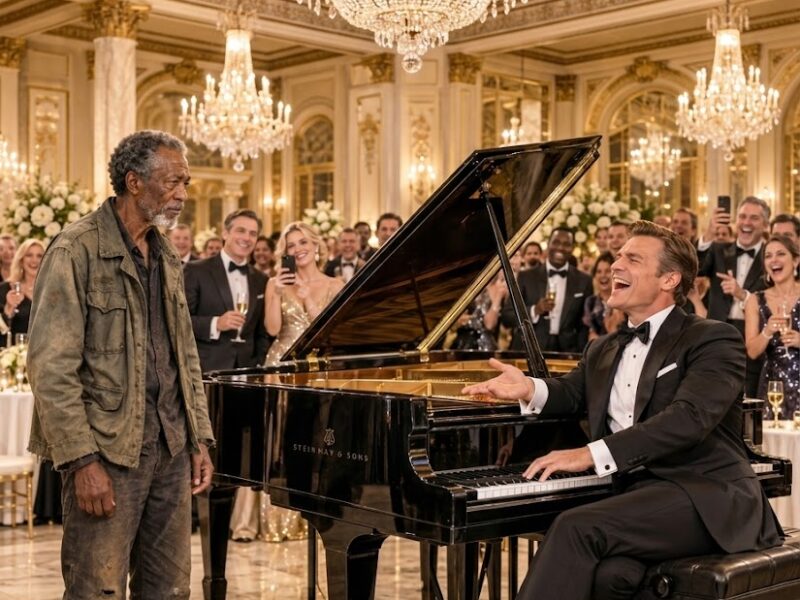
A Billionaire Mocked a Homeless Veteran Who Offered to Play Piano for Food—Then the First Note Silenced the Room
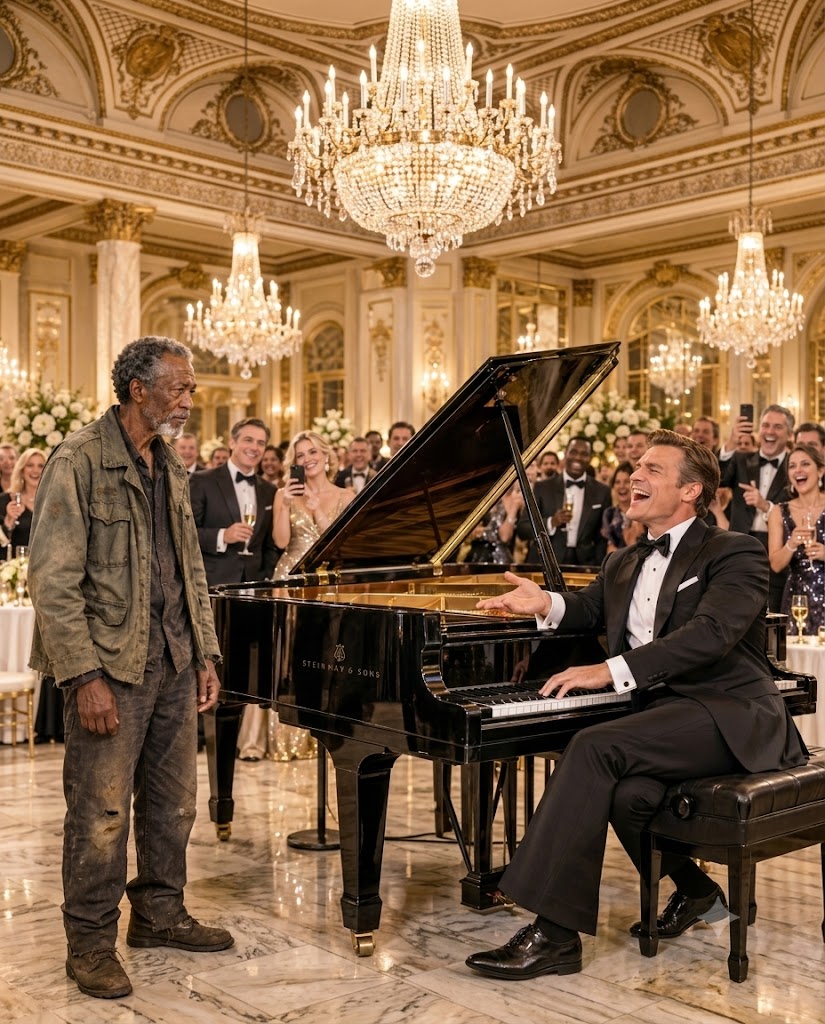
“Get your filthy hands off my piano. Are you deaf, old man? I said get away from it.”
Colton Ashworth straightened the cuffs of his Tom Ford jacket.
“I said get away from it.”
Byron Pierce steadied himself. His voice came out quiet.
“Sir, I’m very hungry. Could I play something on the piano in exchange for a meal?”
Laughter rolled through the ballroom.
“You play?” Colton sneered. “What could a man like you possibly know about piano?”
He ripped the jacket off Byron’s shoulders and ground his Oxford shoe into the faded fabric.
“People who crawl out of the gutter don’t make music. They beg for scraps.”
The guests laughed. Someone raised a phone.
But not one of them knew that the man in front of them owned the most gifted pair of hands in a generation.
And when they finally heard those hands, every person in that room would regret the laughter.
Have you ever watched someone get humiliated in front of hundreds of people, and known the whole room was seconds away from the lesson of its life?
Then stay with me, because I’m about to take you back to the beginning.
Back to the morning Byron Pierce woke up under a bridge.
Six hours before the gala, Byron woke beneath the Morrison Street Bridge.
The concrete was cold against his spine.
November wind cut through the gaps in the overpass, carrying the salt-and-rot smell of Charleston Harbor.
He pulled his knees to his chest and pressed his back against the support column.
A shopping cart with a broken wheel sat three feet away.
Everything he owned fit inside it.
A wool blanket from the VA. A water bottle. A razor he hadn’t used in four days. A military rucksack with a torn strap.
He was fifty-two years old and six foot one, thin enough that his collarbones pressed sharp ridges into his undershirt.
His hair had gone salt-and-pepper years ago, cropped close to the scalp out of habit.
Military habit. The kind that outlasts everything else.
A scar ran from his left temple down to his cheekbone, pale raised tissue against dark skin, the kind that made strangers look away on the bus.
His jaw was square and stubbled with four days of growth.
His eyes were deep brown, set far back in their sockets, and they carried a steadiness that didn’t match the rest of him.
The torn clothes. The grime. The smell of a man who hadn’t showered in three days.
His hands were large, with long fingers.
The span from pinky to thumb could cover a tenth, a full octave plus two notes.
Hands built for Rachmaninoff.
But the calluses on his palms came from pushing shopping carts now, not pressing ivory.
His nails were rimmed with dirt, and his knuckles cracked every morning in the cold.
He reached into the rucksack and pulled out a photograph.
It was laminated and creased down the middle from years of folding and unfolding.
In the picture, a young man in a black tuxedo sat at a concert grand on a lit stage.
His back was straight. His fingers were a blur over the keys.
Behind him, three thousand seats stretched away into darkness.
One word was printed on the program resting on the music stand.
Carnegie.
October 14th, twenty years ago.
The young man in the photograph was him.
Byron Pierce had graduated first in his class at Juilliard at twenty-three.
By twenty-five, he was performing Rachmaninoff’s Second Piano Concerto with the New York Philharmonic.
By twenty-eight, he had a Grammy nomination for Best Instrumental Solo.
By thirty, he had played for three sitting presidents at the White House.
Once, at a state dinner, a foreign ambassador wept openly during a Chopin ballade.
Critics called him the Ghost of Carnegie Hall, because his pianissimo was so quiet that audiences held their breath, unsure whether the music was still happening or whether they were only imagining it.
Then September 11th happened.
Byron enlisted the week the towers fell.
Infantry.
Not because he was brave. Because the music suddenly felt small.
He did two tours in Afghanistan.
He played piano in mess halls, in bombed-out schools, in a church basement in Kandahar where the roof had been blown off and the stars came through the rafters.
His squad called him Maestro.
He called them brothers.
On March 9th of his second tour, a roadside bomb detonated under their convoy on Highway 1 outside Jalalabad.
Four vehicles. Eleven men.
Byron was in the third truck.
The blast threw him thirty feet into a ditch.
Shrapnel caught his left temple and tore a trench down to the cheekbone.
When he woke three days later at Landstuhl Regional Medical Center in Germany, a nurse with kind eyes told him he was the only survivor.
Eleven men, gone in a sound louder than any fortissimo he had ever played.
He came home to a country that pinned a Purple Heart to his chest and forgot his name by the next morning.
The nightmares started within a week.
He would wake screaming at two in the morning, hands clawing the sheets, hearing the blast on a loop that never ended.
His wife, Denise, held him through the first year.
The second year, she moved to the guest room.
The third year, she left a note on the kitchen counter and took their daughter to her mother’s house in Savannah.
The note said, “I love you, but I can’t watch you disappear.”
He lost the house six months later.
Then the car.
Then the storage unit holding his tuxedos, his awards, and every page of his sheet music.
Twenty years of a career, locked in a ten-by-ten box that was auctioned off over two hundred dollars in unpaid rent.
He hadn’t touched a piano in twelve years.
Not because his hands didn’t work.
They did.
But every time he sat at a bench and set his fingers on the keys, his right hand began to shake.
A fine, constant tremor that started at the wrist and ran out to the fingertips.
The doctors at the VA had a name for it. A stress-induced tremor.
His body remembered what his mind kept trying to bury.
The last time he had really played was in a schoolhouse in Jalalabad, for a circle of Afghan children who laughed and clapped at a silly tune he made up on a battered upright.
The next morning, three of those children were gone, lost to a strike two blocks north.
The report was four pages long.
He read it eleven times.
So the hands that once made three thousand people weep at Carnegie Hall now shook too hard to hold a coffee cup steady.
Twelve years on the streets had taught him things Juilliard never did.
Which diners threw out bread before midnight.
Which churches left their basement doors unlocked on Tuesdays.
Which cops would let a veteran sleep on a park bench, and which ones would kick his cart into the gutter and tell him to move along.
Grace Harbor, the shelter on Broad Street, had been his anchor for three years.
A cot near the back wall. A shower every other day. A hot meal if he made it before the line closed at seven.
And in the storage room behind the kitchen, shoved against a wall beneath a window that didn’t seal, an old Yamaha upright with a chipped middle C and a sticky sustain pedal.
Some nights, after the lights went out and the coughs and mutterings settled into silence, Byron would push open that storage room door.
He would sit at the Yamaha and place his fingers on the keys.
His right hand would tremble.
He’d press one note, then another, slow and fragile, like a man learning to walk again after a shattered spine.
He never played more than a few minutes.
He never played loud enough for anyone to hear through the door.
And he never played a complete piece. Only fragments. Phrases.
The ghost of a melody that used to fill concert halls.
But last Tuesday, a notice went up on the shelter’s front door, printed on county letterhead.
Grace Harbor would close at the end of the month.
Funding pulled. Building condemned.
Forty-three residents had thirty days to find somewhere else to exist.
Byron stood on the sidewalk that afternoon, staring at the notice taped to the glass.
Behind him, across the street, the Belmont Grand Hotel rose sixteen stories into the gray Charleston sky.
Valets in white gloves parked Bentleys and black SUVs beneath a portico draped in white lights.
A banner hung between two marble columns.
Ashworth Arts Foundation Annual Charity Gala. Tonight.
Through the lobby’s floor-to-ceiling windows, Byron could see workers rolling a massive object across the polished floor on padded wheels.
Four men guided it.
Even from sixty feet away, through glass and street noise and the distance of twenty lost years, Byron knew exactly what it was.
A Steinway Model D concert grand.
Nine feet long. Ebony finish.
The same model he had played at Carnegie Hall.
His fingers twitched inside his coat pockets.
And for the first time in twelve years, they didn’t shake.
At 6:45 that evening, a convoy of three black Cadillac Escalades pulled up to the Belmont Grand’s main entrance.
Valets scrambled.
A hotel manager in a gray suit rushed through the revolving doors, adjusting his tie as he came.
The middle SUV’s door opened.
Colton Ashworth stepped out.
Forty-five years old, six feet even, the kind of lean that comes from a personal trainer at five a.m. and a chef who measures protein by the gram.
His tan never faded, because it came from a booth and not the sun.
His dark brown hair was swept back with the kind of hold that cost four hundred dollars every two weeks at a salon on King Street.
Not a strand out of place.
His jaw was clean-shaven, his teeth professionally whitened, and his smile, when he used it, only ever reached one side of his mouth.
A permanent half smirk. The expression of a man who believed every room he entered already belonged to him.
He wore a black Tom Ford suit, tailored so precisely that the fabric didn’t crease when he moved.
White shirt, no tie, top two buttons open. A studied casualness that probably cost more than Byron’s last year of rent.
A burgundy pocket square rose from his breast pocket in a perfect puff fold.
On his left wrist sat a Patek Philippe Grand Complication that caught the light from the portico chandeliers.
Two hundred fifty thousand dollars, worn like a bracelet.
He rotated it absently as he walked, the way some men fidget with a wedding ring.
Except Colton’s wedding ring was on the other hand, and he never touched it.
His cologne arrived before he did.
Warm, heavy, expensive. The kind of scent that announced ownership of the air around him.
Two bodyguards flanked him.
A personal assistant trailed three steps behind, phone pressed to her ear, relaying instructions to someone inside.
A photographer from Charleston magazine jogged alongside, snapping frames.
Colton acknowledged none of them.
He crossed the lobby like a man walking through his own living room.
Colton Ashworth had built Ashworth Dynamics from a college dorm room into a fourteen-billion-dollar defense technology company in nineteen years.
Forbes had put him on the cover twice.
Bloomberg called him a visionary.
His employees called him other things, but only in parking lots and private texts.
He had once fired a senior engineer on a company livestream for questioning a deadline, telling the man to pack his desk while four thousand employees watched.
He had been filmed slapping a waiter at a Charleston restaurant for spilling water on his shoes.
The video got two million views.
His publicist called it “a moment of frustration.”
Colton called the waiter “the help” in a follow-up interview and never apologized.
Tonight was his night.
The Ashworth Arts Foundation Annual Gala.
Three hundred guests at five thousand dollars a plate.
Senators. Tech executives. Old Charleston money. And a row of journalists lined up along the back wall.
The cause was arts education for underprivileged youth.
A cause Colton cared about the way he cared about his pocket square.
It looked good. It matched the suit.
The centerpiece of the evening stood on the ballroom stage under a single spotlight.
A Steinway Model D concert grand, ebony finish, nine feet of handbuilt perfection shipped from the factory in Queens specifically for tonight.
Value: two point three million dollars.
Colton had mentioned the price four times in pre-event interviews.
He would mention it again tonight. Probably twice.
The plan was simple.
Julian Cross, a concert pianist with three albums and a residency at Lincoln Center, would perform a forty-minute set.
Donors would be moved. Checkbooks would open.
Colton would give a speech about giving back.
Photographers would capture all of it.
But at 6:52, Colton’s assistant approached him in the VIP lounge.
She held her phone like it was a live grenade.
“Mr. Ashworth, Julian’s flight out of LaGuardia is grounded. Weather delay. He isn’t coming.”
Colton set his whiskey down.
The glass hit the table harder than necessary.
“What do you mean, he isn’t coming?”
“The airline said…”
“I don’t care what the airline said.”
His voice stayed low, which was worse than shouting.
“I care that I have three hundred people in that ballroom, twelve journalists, and an empty stage with a two-million-dollar piano nobody is going to play.”
His assistant opened her mouth, then closed it.
Colton stood and smoothed his jacket.
He walked to the ballroom door and looked out across the sea of round tables, white tablecloths, and champagne flutes catching the light.
The Steinway sat under its spotlight like an altar, waiting for a priest.
No performer. No centerpiece. No moment for the cameras.
His jaw tightened.
He turned to the nearest hotel employee, a young woman carrying a tray of canapés.
“You.” He snapped his fingers. “Get your manager. Now.”
She froze.
“Tell him that if this evening falls apart, I will make sure every travel site in the country knows this hotel can’t handle a simple event.”
The woman flinched and hurried away.
Colton looked back at the empty stage.
The Steinway gleamed. Silent. Waiting.
He didn’t know it yet, but the performer he needed was standing sixty feet away, on the other side of the lobby windows.
Wearing a torn military jacket.
Holding a laminated photograph.
And staring at the very same piano.
Byron hadn’t planned to go inside.
He had walked around to the rear of the Belmont Grand the way he walked to the rear of every restaurant, looking for the dumpsters.
The kitchen entrance was a steel door propped open with a rubber wedge.
Steam poured out of it, along with the clatter of plates and shouted orders.
Two cooks stood by the door smoking, their aprons stained, too busy arguing about a football game to notice a thin man in a torn military jacket slip past them into the corridor.
The service hallway was narrow, lit by buzzing fluorescent tubes.
Byron moved along the wall past stacked crates of wine and towers of folded napkins.
He wasn’t looking for the ballroom.
He was looking for the kitchen’s discard bin. Day-old bread. Bruised fruit. Anything the staff would throw out after the event.
Then he heard it.
Not music. Not yet.
Just a single note, struck by accident, as someone bumped the piano while adjusting a microphone stand on stage.
One note. Concert pitch. A, 440 hertz.
The sound traveled through the service door, down the hallway, and hit Byron in the sternum like a bullet.
He stopped walking.
His feet turned before his brain gave permission.
He pushed through a swinging door marked Staff Only and stepped into the back of the ballroom.
The room opened up before him like a cathedral.
Thirty-foot ceilings. Crystal chandeliers the size of small cars.
Three hundred guests at round tables draped in white linen.
Women in gowns that cost more than his last apartment. Men in watches that cost more than his last car.
The air smelled of orchids, perfume, and seared beef.
Somewhere above, a string quartet played softly from a balcony.
And there, center stage, under a single spotlight, sat the Steinway.
Ebony finish gleaming like still water.
Eighty-eight keys, the lid propped at full stick, exposing the gold-painted frame and the strings stretched taut inside like the ribs of some magnificent animal.
Byron’s breath caught.
His fingers curled at his sides.
He hadn’t been this close to a concert grand in twelve years.
He walked toward it.
Not fast. Not slow.
The way a man walks toward something he has dreamed about every night for a decade.
Past the tables. Past the guests who didn’t see him, because people like Byron had been invisible to people like them for his entire time on the street.
Past a waiter who glanced at him, frowned, but kept moving.
He reached the edge of the stage. Three steps up.
The Steinway was ten feet away.
The spotlight made the keys glow white.
Byron climbed the steps.
His combat boots, laced with twine because the original laces had snapped two winters ago, left faint dirt marks on the polished wood.
He reached the piano and extended his right hand.
His fingers hovered one inch above the keys.
They didn’t shake.
“What the hell is this?”
The voice cut through the string quartet like a knife through silk.
Every head in the room turned.
A kitchen porter stood at the service door, pointing.
“Sir, that man just walked in through the back. I think he’s one of the homeless guys from across the street.”
Colton Ashworth set down his whiskey.
He looked at the stage.
His eyes traveled from Byron’s cracked boots to his filthy trousers, to his torn M-65 field jacket, to the rucksack hanging off one shoulder.
A homeless man, standing beside his two-point-three-million-dollar Steinway, on his stage, at his gala, in front of his guests.
Colton picked up a wireless microphone from his table and walked toward the stage.
His bodyguard moved to intercept Byron, but Colton waved him off.
He wanted to do this himself.
“Ladies and gentlemen,” Colton said, and his voice filled the ballroom. “It appears we have an uninvited guest.”
He climbed the steps and stopped five feet from Byron.
“Tell me something, friend. Do you know where you are?”
Byron lowered his hand from the keys.
“Yes, sir.”
“Do you know what this instrument is?”
“It’s a Steinway Model D concert grand,” Byron said. “Built in Queens, I’d guess.”
Something flickered in Colton’s eyes.
He hadn’t expected that answer.
But he recovered fast.
“Well, look at that. The rat from the gutter knows his piano brands.”
He turned to the crowd.
Laughter rippled through the tables.
“Tell me, did you crawl in through the kitchen looking for leftovers? Because this isn’t a soup kitchen. And that” — he pointed at the Steinway — “is not a trash can for you to dig through.”
Byron’s jaw tightened.
He had heard worse. He had heard worse from men who had meant it more.
But he had not heard it in a room like this, with the smell of orchids in the air and three hundred faces turned toward him like he was something that had crawled out from under a rock.
“Sir,” he said, “I’m very hungry. I was wondering if I could play something on the piano in exchange for a meal.”
The laughter stopped.
The room went quiet.
Colton stared at him for three full seconds.
Then he reached forward, grabbed the collar of Byron’s jacket, and ripped it off his shoulders.
The seam tore. Buttons skittered across the stage floor.
Colton held the jacket up for the audience to see.
Faded olive drab. Frayed cuffs. A unit patch worn so smooth the insignia was barely readable.
He dropped it on the floor and pressed his Oxford shoe into the fabric.
“You play this piano?”
He ground his heel down.
“What does a man like you know about music? People who crawl out of the gutter don’t make art. They beg. That’s what you do, isn’t it? You beg.”
He turned to the crowd and spread his arms.
“Who wants to watch the street performer earn his dinner?”
Applause.
Laughter.
Someone whistled.
Three hundred people clapping for a man’s humiliation like it was the evening’s entertainment.
Byron looked down at his jacket on the floor.
The laminated photograph had slipped out of the rucksack pocket and landed face up on the stage.
Carnegie Hall. The young man in the tuxedo.
Nobody looked at it.
Nobody picked it up.
Byron stared at the shoe print on the fabric, at the unit patch pressed flat under Italian leather.
The room was still laughing.
He closed his eyes, and the ballroom disappeared.
He was in Jalalabad again.
March 8th. The day before the blast.
A schoolhouse with half a roof and no windows.
Fourteen children sat cross-legged on the concrete, wrapped in blankets too thin for the Afghan winter.
An old upright piano, dragged from a bombed-out hotel, stood against the far wall.
Most of the keys stuck. The sustain pedal was gone.
But Byron sat down and played.
He made up a tune on the spot. Something bouncy and silly, built on a repeating phrase the children could clap along to.
They laughed.
A girl in the front row, maybe six years old, stood up and danced.
She spun in circles with her arms out, her blanket trailing behind her like a cape.
Sergeant Rawlings leaned against the door frame with his rifle across his chest, grinning.
“Maestro,” he said, “you play like the gods are talking through your hands. Don’t ever let anybody silence that.”
The next morning, Rawlings was gone.
The girl was gone.
Eleven men and three children, erased by a pressure plate and two hundred pounds of fertilizer.
Byron opened his eyes.
The ballroom came back.
The chandeliers. The laughter. The shoe print on his jacket.
He looked at his right hand.
Still. Perfectly still.
For the first time in twelve years, the tremor was gone.
Not suppressed. Not managed. Gone.
As if the hand had decided on its own that it was finished shaking.
Byron bent down and picked up his jacket.
He folded it the way a soldier folds a flag.
He set it on the chair beside the piano bench, then picked up the photograph and placed it on top.
He turned to Colton.
“Give me three minutes.”
The voice was low and steady, the voice of a man who had survived things this room couldn’t imagine.
“If I can’t play, I’ll walk out and never come back.”
Colton’s smirk widened.
He turned to the audience, arms spread.
“The street performer wants three minutes on my piano. Shall we let the beggar have his little show?”
The crowd cheered.
Someone shouted, “Let him play!”
Not out of kindness. The way people shout at a circus act.
Colton waved his bodyguards back.
“Three minutes,” he said. “Then you disappear.”
Byron sat down on the bench.
He adjusted the height and placed both hands on the keys.
The Steinway was warm under his fingers, as if it had been waiting for him.
The first note was wrong.
Byron’s index finger struck the F-sharp a fraction too hard.
The sound came out brittle and metallic, a cracked bell in a cathedral.
It bounced off the ballroom walls and died somewhere in the chandelier crystals above.
Colton snorted.
A woman at the nearest table covered her mouth, stifling a laugh.
Two men in the back exchanged glances and shook their heads.
A server whispered to another server, “This is going to be embarrassing.”
Byron’s right hand trembled once.
A single vibration that ran from his wrist to his fingertips, and then stopped, like a shudder passing through a bridge cable before it pulls taut.
He closed his eyes.
He inhaled through his nose, held it, and let it go.
The second note came.
A B-flat. Soft. Clean.
It floated up from the Steinway like smoke from a candle, so different from the first note that the people at the nearest tables blinked, confused, as if a different person had played it.
Then a third note, a D.
Then an F.
The opening phrase of Chopin’s Ballade No. 1 in G minor.
Four notes descending like footsteps on a marble staircase, each one placed with the precision of a surgeon setting a bone.
The room didn’t notice yet.
They were still smirking, still holding up their phones, still waiting for the failure they’d been promised.
Byron played the phrase again.
Slower. Quieter.
So quiet that guests at the back tables had to stop talking to hear it.
So quiet that the string quartet on the balcony lowered their bows and leaned over the railing to listen.
The Chopin unfolded like a letter being opened, careful and deliberate, each note revealing the next, the way a sentence reveals its meaning only at the period.
Then his left hand joined.
The bass notes dropped into the lower register like stones into deep water.
The harmony thickened.
The melody in the right hand began to move, not fast, not yet, but with a fluidity that hadn’t been there ten seconds earlier.
Byron’s fingers were remembering.
Not his mind. His fingers.
The muscle memory of ten thousand hours of practice, of a hundred concerts, of a lifetime spent speaking a language his mouth never learned but his hands had mastered completely.
The smirking stopped at the closest tables first.
Guests set down their champagne flutes.
A woman in an emerald gown leaned forward.
The man beside her uncrossed his arms.
A phone screen went dark. Then another.
The middle tables went quiet next.
Conversations died mid-sentence.
Forks paused above plates.
Heads turned toward the stage slowly, the way sunflowers track the sun.
Not because anyone told them to.
Because the music made it impossible to look anywhere else.
Then the back tables.
The journalists lowered their pens.
A photographer forgot to press the shutter.
Within thirty seconds of the left hand joining, the ballroom was silent.
Byron opened the development section.
The ballade shifted from its quiet introduction into the first storm.
His right hand climbed three octaves in a cascade of arpeggios that rippled up the keyboard like wind tearing across open water.
His left hand hammered out a bass ostinato, the same three notes repeating, driving, relentless, a heartbeat accelerating toward something it couldn’t stop.
The Steinway’s hammers struck the strings with a force that vibrated through the stage floor and into the marble beneath.
A waiter in the center aisle stopped walking.
His tray of champagne tilted.
A flute slid toward the edge.
He didn’t notice.
The room was beyond silence now.
It had entered the territory of collective disbelief.
Three hundred people realizing, all at once and with sickening clarity, that they had made a terrible mistake.
Colton Ashworth stood at the edge of the stage.
The microphone dangled from his right hand.
His smirk had calcified into something that wasn’t a smirk anymore, a frozen mask his face hadn’t figured out how to take off.
His eyes moved from Byron’s hands to the keyboard to the audience and back again.
This wasn’t supposed to happen.
The homeless man was supposed to stumble through a few clumsy notes and slink away while everyone laughed.
That was the only reason Colton had allowed it.
Entertainment. A joke.
This was not a joke.
Byron played the way a river moves through a canyon.
Not around the rock, but through it, carving new channels with each phrase.
The ballade built and receded, built and receded, each wave cresting higher than the last.
His body began to move with the music.
His shoulders swayed. His head tilted back. His eyes stayed closed.
The scar on his temple caught the spotlight and threw a thin line of shadow across his cheekbone.
His cracked boots worked the pedals, sustain and soft, with the instinct of a man who had done it ten thousand times before.
A woman at table six began to cry.
Not dramatically. Quietly, tears running down her face while her hands stayed folded in her lap.
Her husband reached for her arm.
She shook her head without looking at him.
Then Byron shifted.
The Chopin faded.
A breath.
Two beats of silence.
The room held its breath with him.
And Rachmaninoff’s Piano Concerto No. 2 erupted from the Steinway like a dam breaking.
The opening chords hit the ballroom like a physical force.
Eight notes in the bass register. Deep, massive, resonant, building like church bells ringing in sequence, each one louder than the last.
Byron’s entire upper body leaned into the keyboard.
His shoulders hunched forward. His forearms corded with tension.
The Steinway’s frame shuddered.
The strings inside vibrated so hard that the air above the soundboard shimmered the way heat rises off summer asphalt.
This was the piece.
The one he had played at Carnegie Hall twenty years ago.
The one that made three thousand people rise to their feet.
The one a foreign ambassador had wept through at a White House state dinner.
The one critics wrote about for months.
Pierce doesn’t play Rachmaninoff. He channels him. He becomes the conduit through which the music passes, and what emerges is not performance but confession.
Twenty years later, the confession had only grown deeper.
It was all coming back.
Every phrase. Every dynamic marking. Every rubato he had perfected in a practice room at Juilliard when he was twenty-three and believed the world was a place where talent mattered.
His hands moved with an authority that twelve years of homelessness and silence hadn’t touched.
Because that knowledge lived deeper than memory.
It lived in the tendons. In the joints. In the microscopic architecture of muscle fiber that rebuilds itself around the thing it loves.
The second movement arrived like dawn after a storm.
The melody, one of the most beautiful in all of Western music, sang out from the upper register, pure and aching, a single voice calling across an empty landscape.
The left hand arpeggiated the harmony beneath it, a shimmering carpet of sound that held the melody the way water holds a boat.
Byron played at pianissimo.
The Ghost of Carnegie Hall.
So quiet that the audience stopped breathing, because their own breath was louder than the music.
Someone in the audience whispered, “Oh my God.”
It was the only sound in the room besides the piano.
A veteran at table fourteen, sixty-three years old, silver-haired, wearing a Navy lapel pin, recognized the piece.
He had heard it once before, not live, but on a CD his daughter had given him for Christmas two decades earlier.
He hadn’t known the pianist’s name then.
He knew it now.
He stood up from his chair, slowly, deliberately.
He placed his right hand against his temple in a salute.
Tears ran openly down his face.
He held the position.
His wife tugged at his sleeve.
He didn’t move.
A second veteran, younger, at a table near the bar, wearing an Army service ribbon on his lapel, saw the salute and understood.
He stood and saluted.
Then a third man near the back, no visible insignia, but the posture unmistakable, rose and raised his hand.
Three veterans saluting while a homeless pianist played Rachmaninoff on a billionaire’s Steinway.
The third movement hit like a freight train.
Byron attacked the keyboard with a ferocity that pressed the nearest guests back in their chairs.
Octave passages thundered up and down the register.
His hands crossed and leaped and hammered.
The Steinway roared.
Sound filled the ballroom the way floodwater fills a basement, rising, unstoppable, finding every corner and crack.
The chandelier crystals trembled and clinked against each other.
Byron was half standing now, his thighs pressed against the bench, his upper body driving down into the keys.
Sweat ran from his temples and dropped onto the ivory.
Tears mixed with the sweat.
His face carried something beyond pain or joy, something ancient, something that doesn’t have a word in English.
Every note held twelve years of silence.
Every chord held eleven brothers.
Every whispered pianissimo carried the name of a six-year-old girl spinning in circles in a schoolhouse in Jalalabad, her blanket trailing behind her like a cape.
The final passage came, a massive cascading sequence of chords that builds and builds and builds until the pianist has nothing left.
Byron gave it everything.
His right hand leaped across four octaves.
His left hammered the bass with the force of a man driving nails.
The Steinway’s lid rattled on its prop.
A champagne flute on the nearest table vibrated off the edge and shattered on the marble floor.
Nobody flinched.
Nobody breathed.
The last chord.
Byron’s hands came down with his full weight.
The sound was enormous, a wall of overtones that filled the room the way light fills a space when someone throws open every curtain at once.
It held for three seconds. Five. Seven.
The strings inside the Steinway sang on, long and shimmering, fading so slowly that nobody could tell exactly when the music ended and the silence began.
Then it was over.
Byron’s hands slid from the keys.
His arms fell to his sides. His chin dropped to his chest.
He sat motionless, eyes closed, breathing in shallow, ragged gasps.
A drop of sweat, or a tear, fell from his jaw and landed on the back of his left hand.
The ballroom was still.
Three hundred people. Not a cough. Not a shifted chair. Not a rustle.
The silence lasted one second. Two. Three. Four.
An eternity measured in heartbeats.
Then a woman at the front table stood.
She didn’t clap.
She pressed both hands against her heart and stood with her mouth open, unable to speak.
The man beside her rose.
Then their entire table.
Then the table behind them, then the next, like dominoes falling in reverse, rising instead of falling, one cluster after another, and then all at once.
Three hundred people on their feet.
The applause broke like a thunderclap.
Not polite applause. Not charity-gala applause.
The raw, stinging, desperate kind that comes from the center of the chest.
The kind you give because your body needs to release the pressure the music built inside it, and there is no other way.
People shouted.
People wept.
A man at the back pumped his fist in the air.
A woman turned to the stranger beside her and grabbed her arm, shaking her head, saying something that was swallowed by the roar.
The veteran at table fourteen still held his salute.
His wife stood beside him now, hand over her mouth, shoulders shaking.
She had stopped trying to pull him down.
The two other veterans across the room held their salutes steady, chins high, tears streaming.
Byron didn’t open his eyes.
He sat at the Steinway with his hands in his lap and his head bowed.
He was back in the schoolhouse, playing for fourteen children, listening to a girl laugh.
For one moment, just one, everybody was still alive.
The applause was still thundering when Eleanor Whitfield pushed back her chair at the VIP table.
She was seventy-four years old, small, five foot three, with silver hair pulled into a tight bun and gold-framed glasses.
She wore a navy evening gown she’d worn to three previous galas, because she didn’t believe in buying a new dress for every event.
On her right hand was a gold ring etched with a treble clef, the Juilliard faculty ring given to professors with more than thirty years of service.
She had forty-one.
Eleanor hadn’t sat down during the Rachmaninoff.
She had been standing since the second movement, gripping the edge of the table with both hands, knuckles white, mouth slightly open.
The woman beside her had asked if she was all right.
Eleanor hadn’t heard the question.
Because she knew those hands.
She had watched them for four years in a practice room on the third floor of the Juilliard building on West 65th Street.
She had watched them master Chopin at nineteen, wrestle Rachmaninoff at twenty-one, and tame Liszt’s Hungarian Rhapsodies by twenty-three.
She had signed the letter recommending Byron Pierce for his Carnegie Hall debut.
She had been in the audience that night, row C, seat 7.
She had stood and wept that night, too.
And then he had vanished. Enlisted. Gone.
She had written letters.
She had called the VA.
She had contacted his wife, who told her only that Byron was gone, without saying whether that meant lost or something worse.
Eleanor had assumed the worst.
She had grieved.
She had kept a copy of his Carnegie Hall program in her office desk for twenty years.
Now she was walking toward the stage.
The crowd parted.
The applause softened. Not stopping, but quieting, because something was happening that required attention.
Eleanor climbed the three steps.
Her low heels clicked on the polished wood.
She stopped six feet from the piano bench, where Byron still sat with his head bowed and his eyes closed.
“Byron.”
He didn’t move.
“Byron Pierce.”
His eyes opened.
He looked up.
For a moment he didn’t recognize her.
The silver hair. The glasses. The lines that twenty years had drawn.
Then his gaze fell on the ring.
The treble clef. The gold band, worn smooth from four decades of touching piano keys.
His lips moved.
No sound came out.
Then: “Professor Whitfield?”
Eleanor’s composure broke.
Her hand flew to her mouth. Her eyes filled.
“My God,” she said.
Her voice carried through the silent ballroom, because three hundred people had stopped clapping to watch.
“Byron Pierce. I thought you were gone. I thought we had lost you.”
She turned to the audience.
Her voice steadied, the voice of a woman who had commanded lecture halls for forty years.
“I need you to understand something.”
She pointed at Byron without looking at him.
“This man, the man you laughed at, the man whose jacket is lying on that chair because someone tore it off his back, is one of the finest pianists of his generation.
“He graduated first in his class at Juilliard. He was nominated for a Grammy at twenty-eight. He performed for three sitting presidents of the United States.
“The New York Times called him the Ghost of Carnegie Hall, because his pianissimo could make an audience forget to breathe.”
She paused.
Let the words land.
“I have taught piano for fifty years. In that time, I have heard two pairs of hands play like that.
“One belonged to Vladimir Horowitz.”
She turned and looked directly at Colton Ashworth.
“The other belongs to the man you just called a rat from the gutter.”
The silence that followed was not the silence of a room without sound.
It was the silence of three hundred people understanding all at once what they had taken part in.
Colton stood at the edge of the stage.
His face had gone the color of wet concrete.
The wireless microphone slipped from his fingers, hit the floor, and let out a shriek of feedback that made the nearest guests wince.
He didn’t pick it up.
His hands hung at his sides.
His Patek Philippe caught the spotlight and flashed, two hundred fifty thousand dollars on the wrist of a man who had just been stripped of something money couldn’t buy.
Byron stood from the bench.
Slowly, he looked at Colton.
Not with anger. Not with triumph.
With the calm, level gaze of a man who had buried eleven brothers, survived twelve winters under a bridge, and no longer had the capacity to be wounded by someone so small.
“That piano didn’t need someone rich to play it, Mr. Ashworth.”
His voice was quiet.
The room was so silent that every syllable reached the back wall.
“It needed someone who understood what music costs.”
Colton broke eye contact first.
He turned, walked to the side door, and pushed through it without looking back.
Not one person in the ballroom watched him leave.
Every eye was on Byron.
Eleanor didn’t let go of Byron’s hand for a long time.
They stood on the stage while the applause rolled on, wave after wave.
Three hundred people who didn’t want to stop clapping, because stopping meant returning to the reality of what they had allowed to happen in this room twenty minutes earlier.
Eleanor held Byron’s hand in both of hers, the way a teacher holds the hand of a student she thought she had buried.
She looked at him with eyes that said everything her voice couldn’t manage.
It was Byron who spoke first.
“The shelter where I sleep is closing, Professor. End of the month.”
Eleanor’s jaw tightened.
She released his hand and turned to the audience.
“Ladies and gentlemen.”
Her voice cut through the dying applause with the authority of a woman who had commanded Juilliard’s concert hall for four decades.
“I came here tonight to support arts education. I did not expect to find a man I mourned for twelve years, alive and playing Rachmaninoff on this stage. But here we are.”
She paused and adjusted her glasses.
“I am offering Byron Pierce a position, effective immediately, as artist in residence and senior piano instructor at the Charleston Conservatory of Music. Full salary. Faculty housing on campus. A Steinway in his studio.”
She looked at him.
“If he’ll have it.”
Byron’s chin dropped.
His chest shuddered once.
He nodded, because he could not speak.
The applause erupted again, but this time it was different.
Warmer.
The sound of people trying to redeem themselves.
A man at table three stood up. Harrison Wells, founder of a Charleston real estate firm, a man who had bid on everything in the silent auction and won most of it.
“The shelter you mentioned. Grace Harbor, on Broad Street. How much does it need to stay open?”
Eleanor looked at Byron.
Byron answered quietly.
“They told us the funding gap was four hundred thousand dollars.”
Harrison Wells didn’t hesitate.
“I’ll cover half. Two hundred thousand, tonight.”
A woman at the adjacent table raised her hand.
Diana Prescott, whose family name was carved above the entrance of the children’s hospital downtown.
“I’ll match it. Two hundred thousand.”
A third donor stood at the back of the room.
Colby Marsh, a retired federal judge, white-haired and unhurried.
“My foundation will add eight hundred thousand for an expansion. Forty new beds. Veterans only.”
The total pledged in under two minutes was one point two million dollars.
The shelter that was supposed to close at the end of the month would now become the largest veteran-specific housing facility in the state of South Carolina.
Byron stared at the three donors.
His mouth opened.
Nothing came out.
Eleanor put a hand on his shoulder.
“You don’t have to say anything,” she whispered. “The piano said it.”
The video hit the internet before the gala ended.
A guest at table nine had recorded the entire performance on her phone, from the first cracked note to the last standing ovation.
She posted it at 10:47 that night with a single caption.
A billionaire laughed at a homeless veteran. Then the veteran sat down at his piano.
By midnight, it had two million views.
By noon the next day, eight million.
By the end of the week, fourteen million.
The hashtag #ByronPierce trended across the United States for three consecutive days.
#LetHimPlay trended around the world.
News outlets ran the story within hours.
The headline that stuck was simple.
Homeless Veteran Silences Billionaire’s Gala With Piano, and the Internet Can’t Stop Watching.
Then reporters found the rest of the story.
They pulled Colton Ashworth’s history apart like a loose thread.
The waiter-slapping video resurfaced, this time with the waiter’s name and his own account of that night.
Former employees came forward.
Three women from Ashworth Dynamics filed workplace complaints that had once been settled quietly behind confidentiality agreements.
A journalist at the Post and Courier obtained records showing that the Ashworth Arts Foundation had given less than nine percent of its annual revenue to actual arts programs.
The rest went to administrative costs, galas, travel, and the care and feeding of Colton’s personal brand.
Within a week, two defense contractors worth a combined three hundred million dollars cut ties with Ashworth Dynamics, citing reputational concerns.
The board of the Ashworth Arts Foundation voted unanimously to remove Colton as chairman of the organization he had founded.
His wife, Caroline, filed for legal separation on day four.
The filing was public record.
The internet found it within hours.
On day six, Colton issued a written apology through his publicist.
It was three paragraphs long.
It used the word regret twice and the word sorry once.
It did not mention Byron by name.
Nobody shared it.
There is a particular kind of quiet that follows a man who has spent his whole life being the loudest voice in every room.
Colton learned it that week.
His phone, which used to buzz every ninety seconds, went still.
The invitations stopped.
The senators who had posed beside him for photographs found sudden conflicts in their calendars.
He sat in the glass-walled corner office on the fortieth floor of Ashworth Tower, looking down at a city that no longer seemed to belong to him.
His assistant knocked once and set a folded newspaper on his desk.
She didn’t say anything.
She didn’t have to.
On the front page, above the fold, was a photograph of a thin man in a borrowed tuxedo, seated at a piano, eyes closed, a single tear caught in the scar along his cheekbone.
Colton stared at it for a long time.
Then he turned the paper facedown.
But the picture was still there.
It was in every window. On every screen. In every glance from every stranger on the street.
And for the first time in his life, Colton Ashworth understood that there are things you cannot buy back.
Things like a room full of people deciding, all at once, that they have seen exactly who you are.
Byron’s first week at the conservatory was harder than any night under the bridge.
Not because of the work.
Because of the kindness.
Strangers stopped him on the sidewalk to shake his hand.
A woman in a grocery store line burst into tears and hugged him without asking.
A delivery driver pulled his truck over, rolled down the window, and shouted, “Sir, thank you for your service,” and then, after a beat, “and thank you for the music.”
Byron didn’t know where to put it all.
He had spent twelve years learning how to be invisible.
He had no idea how to be seen.
His faculty apartment was small, two rooms and a window that looked out over a courtyard of live oaks hung with Spanish moss.
The first night, he couldn’t sleep in the bed.
It was too soft. Too quiet. Too still.
He dragged the blanket from the VA onto the floor and lay down beside the radiator, listening to the pipes tick.
At three in the morning, he sat up and stared at the ceiling.
There was no wind. No traffic overhead. No cough from the next cot.
Just the silence of a room that belonged to him.
He didn’t know whether he deserved it.
Eleanor found him the next morning on the studio floor, sitting with his back against the Steinway’s leg.
“Byron,” she said gently, “have you slept at all?”
“A little.”
“Have you eaten?”
“I had a banana.”
She set a brown paper bag on the bench.
“Eat. Then we talk.”
He ate a turkey sandwich in silence while she watched.
When he finished, she sat down across from him.
“I looked for you,” she said. “For years. I want you to know that.”
“I know, Professor.”
“I called every VA hospital in the Southeast. I wrote to your commanding officer. I hired a private investigator once, and he found nothing.”
“I wasn’t hard to find,” Byron said. “I just wasn’t anywhere anyone would look.”
Her eyes filled again.
She took off her glasses and wiped them on the hem of her scarf.
“You don’t owe me an explanation.”
“I know. But I’d like to give you one.”
So he told her.
He told her about the convoy and the ditch and the nurse with kind eyes.
He told her about the tremor, and the schoolhouse, and the report he had read eleven times.
He told her about Denise’s note on the kitchen counter, and the little girl in Savannah who would be twenty-six now and probably didn’t remember the sound of his voice.
Eleanor listened without interrupting.
When he finished, the studio was so quiet that they could hear the ticking of the clock above the door.
“Byron,” she said at last, “you didn’t lose your talent. You lost your permission.”
He looked up.
“You stopped believing you were allowed to make something beautiful after you had seen what you saw. That is not a failure of the hands. It’s an injury of the heart. And hearts heal. Slowly. But they do.”
He didn’t answer.
He just looked at the piano.
Then, very softly, he said, “Something happened to my hand, Professor. At the gala. Before I played.”
“I know. I watched it.”
“It stopped shaking. After twelve years. Right when he put his shoe on my jacket. I don’t understand it.”
Eleanor was quiet for a moment.
“I think,” she said, “that for the first time in twelve years, you were more afraid of staying silent than of playing.”
Byron closed his eyes.
He thought about the girl in the blanket.
He thought about Rawlings in the doorway, grinning.
Don’t ever let anyone silence that.
He opened his eyes.
“Then I don’t intend to stay silent again.”
Two weeks later, Grace Harbor reopened its doors with a new sign above the entrance.
It was Harrison Wells who insisted on paying for it, and Judge Marsh who insisted on the wording.
Grace Harbor Veterans’ Home. Nobody sleeps outside in Charleston.
The forty-three residents who had been given thirty days to find somewhere else to exist were each given a key.
Not a cot. A key.
A man named Tobias, who had slept in the bed next to Byron’s for three years and never once said a full sentence, stood on the sidewalk holding the key in his open palm like it might break.
He looked at it for a long time.
Then he looked at Byron and said, in a voice rusty from disuse, “They gave us a door.”
Byron put a hand on his shoulder.
“They gave us a door,” he agreed.
On the night before his first full week of teaching, Byron went back to the shelter one last time.
The closure notice was still taped to the front door.
But someone had written across it in black marker, in letters a foot tall.
SAVED.
He walked to the back room and sat down at the old Yamaha upright with the chipped middle C and the sticky pedal.
He didn’t play Rachmaninoff.
He didn’t play Chopin.
He played the silly little tune he had made up in Jalalabad, the one the children had clapped to, the one the girl had danced to.
He played it softly, the way a man prays when he believes nobody is listening.
Through the thin wall, a cot creaked.
Then another.
The residents were awake.
They didn’t come in.
They simply listened, in the dark, in the quiet, in the shelter that would still be standing at the end of the month because a man had sat down at a piano and reminded three hundred people what it means to hear someone who has lost everything play as if everything still matters.
When the last note faded, Byron lifted his hands from the keys.
He looked at them.
Still. Steady.
He whispered, to nobody and to everybody, “Thank you, Maestro.”
Three months later, the marquee outside the Charleston Music Hall read Byron Pierce Returns. One Night Only.
Twelve hundred seats sold out in three hours and fourteen minutes.
The box office had never seen anything like it.
Scalpers listed tickets at four times face value.
The conservatory’s phone lines crashed twice from media requests.
Byron arrived at the stage door at six in the evening, two hours before curtain.
He wore a new tuxedo, black and simple and perfectly fitted.
Eleanor had insisted on buying it.
Over one shoulder he carried his old military rucksack.
Inside it, folded neatly, was the M-65 jacket with the torn seam and the boot print still faintly visible on the left breast.
He would never wear it on stage.
But he would never leave it behind, either.
Tucked in the front pocket was the laminated photograph, creased down the middle.
The young man at Carnegie. The straight back. The blur of fingers.
He touched the edge of it once, the way you touch a door before you walk through.
The house lights dimmed at eight.
The stage was bare except for a single instrument under a single spotlight.
A Steinway Model D.
Not the same one from the gala. This one belonged to the music hall.
But it was the same model. The same nine feet. The same ebony finish.
Byron walked out from the wings.
The audience stood before he reached the bench.
Twelve hundred people on their feet, applauding a man they hadn’t yet heard play a single note.
He stopped and looked out at the house.
He pressed his lips together and nodded once.
In the front row, fifteen seats had been reserved.
No names on the tickets. No VIP labels.
Just fifteen chairs, occupied by fifteen men and women from Grace Harbor, every one of them wearing the cleanest clothes they owned.
Byron had bought those tickets with his first paycheck from the conservatory.
He hadn’t told Eleanor.
He hadn’t told anyone.
He had walked into the shelter three weeks earlier and handed out the tickets one by one, with nothing more than, “I’d like you to come hear me play.”
Tobias sat in the middle of the row, in a thrift-store blazer, holding his key on a string around his neck.
At the far end sat the veteran from table fourteen, the silver-haired man with the Navy pin, who had asked to be seated with them.
His wife held his hand.
Neither of them said a word.
In the third row, a small woman with silver hair and gold-framed glasses sat with her hands pressed together in her lap.
Eleanor Whitfield had a program on her knee.
It was the same one she had kept in her desk for twenty years.
And somewhere in the back of the house, in a seat he had bought under a different name, sat a man in a plain gray suit with no watch on his wrist.
He had come alone.
He had slipped in after the lights dimmed, and he would slip out before they came up.
Colton Ashworth did not clap.
He only watched, with the stillness of a person finally learning to listen.
Byron sat down at the Steinway.
The applause faded.
Silence filled the hall the way water fills a glass, completely, from the bottom up.
He placed his hands on the keys.
His fingers did not shake.
And as the first note rose into the dark, soft and clean and impossibly quiet, twelve hundred people forgot to breathe.
Because somewhere out there, in every city, under every bridge and behind every door nobody bothers to knock on, there are people with gifts the world has stopped looking for.
All they need is somebody willing to say, Sit down and play.









