
A Billionaire Gave His Girlfriend a Broken Car to Test Her Love—Then She Discovered Its Hidden Past
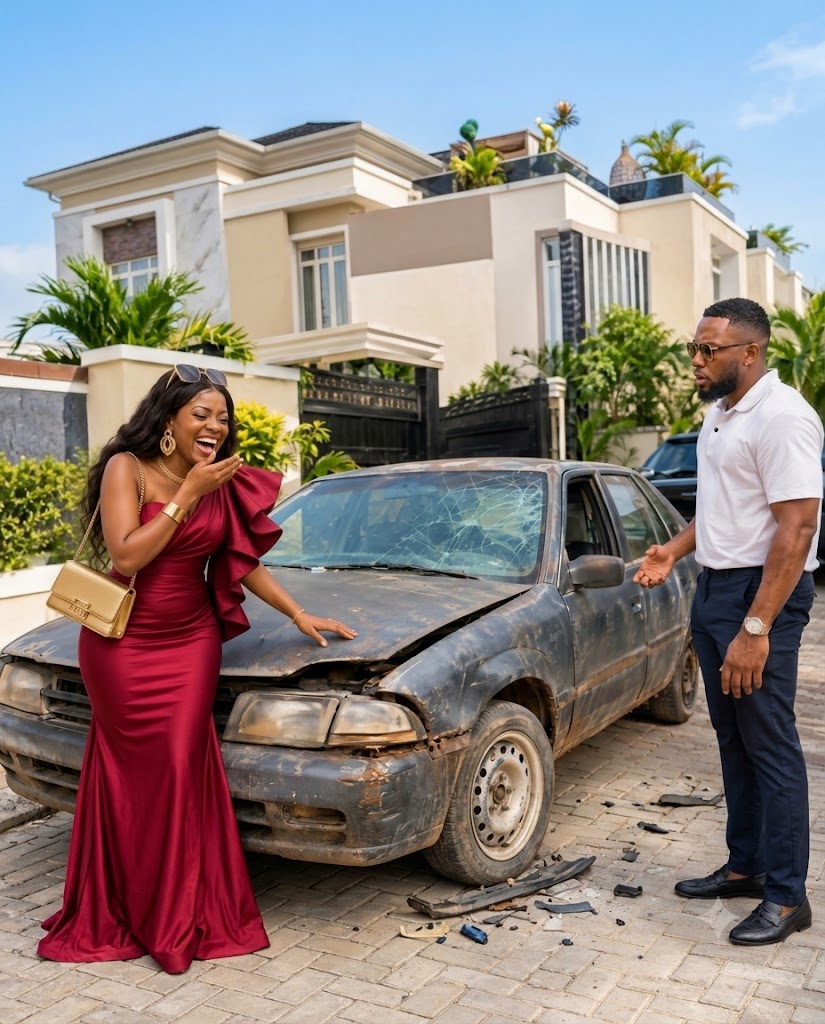
The rain had stopped an hour ago, but the streets of Sugar Land, Texas, still glistened under the pale afternoon light like they’d been polished for company. Kichi Okonkwo stood in the driveway of his gated estate, hands buried in the pockets of his tailored slacks, watching a flatbed truck back slowly toward him. On the truck sat a 2004 Honda Civic, oxidized green paint peeling at the edges, one headlight cracked, the rear bumper held together with duct tape the color of regret. The driver hopped out, handed Kichi a clipboard, and said, “Man, you sure this is the right address? This thing barely made it up the ramp.”
Kichi signed without smiling. “It’s the right address.”
He walked around the car twice, inspecting it the way a surgeon inspects a wound. The engine coughed when the driver started it to roll it off the truck. Gray smoke curled from the tailpipe like a secret trying to escape. Kichi nodded once, tipped the driver twenty dollars, and then stood alone in his driveway with a car that looked like it had survived three divorces and a hurricane. He pulled a single key from his pocket, still warm from his hand, and stared at it. This was not a gift. This was a question.
Roseline arrived an hour later, her rideshare dropping her at the gate because she refused to let any driver see her walk through the main entrance. She wore a cream-colored jumpsuit and heels that clicked against the pavement like a countdown.
The moment her eyes landed on the Civic, her smile evaporated. “What is that?”
Kichi leaned against the garage door, arms crossed. “Your birthday gift.”
She blinked. Then she laughed. Then she stopped laughing. “Wait. You’re serious?”
“I’m serious.”
Roseline walked toward the car as though approaching a stray animal. She peered through the cracked windshield, then stepped back and looked at the mansion behind her, then at the manicured lawns of the Riverstone subdivision, then back at the car. “Kichi. Look at where we are. Look at these houses.”
“I’ve seen them.”
“Do you actually expect me to drive this thing around here?” Her voice climbed. “Do you know what people will say? Everyone will laugh at me.”
Kichi said nothing.
She circled the car again, faster now. “People live here, Kichi. People who drive proper cars. How am I supposed to park that thing in front of these houses? What do you expect me to tell people when they ask me whose car it is?”
“You don’t have to tell them anything.”
“What?”
“It’s a car, Roseline.”
“No.” She shook her head hard. “It’s not just a car. It’s embarrassing. I deserve better than this. I mean it. I thought you understood the kind of life I want.”
Kichi pushed off the garage door and walked toward her slowly. “Is this really what you think I deserve?”
“Nothing.” Her voice cracked. “You’re not even going to explain yourself?”
“What would you like me to explain?”
“You know exactly what I’m talking about.”
“No,” he said. “I don’t.”
“I just can’t believe you’d do this to me.”
“Do what?”
“You know what.”
“No, Roseline. What exactly did I do?”
“You gave me a car that looks like it’s about to fall apart.” She gestured at the Civic like it had insulted her mother. “And you expect me to be grateful? I can’t live like that.”
“Like what?”
“Like someone who has to settle. I won’t settle. Not for a car, not for a house, not for anything.” She threw the key back at him. It hit his chest and clinked against the concrete. “I deserve better.”
Kichi bent down, picked up the key, and slid it into his pocket. “I heard you. That’s all I needed to hear.”
—
Only six weeks earlier, Roseline had been sitting across from Kichi at a quiet rooftop restaurant overlooking the Houston skyline. The evening breeze drifted between softly glowing string lights as she scrolled through pictures on her phone before turning the screen toward him. “This,” she said with a smile, “is exactly what I want for my birthday.”
The photo wasn’t just of a car. It was a sleek, late-model Mercedes-Benz GLE with polished black paint, tinted windows, gleaming alloy wheels, and the kind of presence that made people stop and stare before they even saw who was driving it. Kichi studied the picture without saying much.
“You like this one?”
“I don’t just like it,” she replied. “I love it.” She leaned forward, excitement brightening her face. “It doesn’t have to be this exact color, but it has to look important.” She laughed softly after saying it, almost as if she had revealed a harmless secret. “I want something people notice.”
Kichi smiled. “I thought birthdays were about celebrating, not impressing strangers.”
“They are,” she answered smoothly. “But sometimes they can be both.”
She spoke so naturally that nothing about her answer sounded unusual. To anyone else, it might have seemed like an ordinary conversation between two people planning a birthday gift. But Roseline wasn’t thinking about Houston traffic or weekend outings. Her mind was hundreds of miles away. She was already imagining the journey back to her hometown outside Shreveport, Louisiana.
Every December, people who had left for the cities returned home. Cars lined the dusty roads. Success wasn’t measured only by what someone said. It was measured by what everyone could see. She could already picture herself driving slowly through the familiar streets, windows lowered just enough for people to recognize her before the vehicle rolled to a stop. Neighbors would pause their conversations. Former classmates would suddenly want to know how life in Texas had treated her. She wasn’t chasing the car itself. She was chasing the moment it would create.
“I haven’t been home in a long time,” she told Kichi that evening, her voice quieter now. “This birthday feels different.”
He listened without interrupting.
“I want everyone to see that I finally made something of myself.”
There was no bitterness in her tone, only determination, the kind built over years of imagining the same future until it felt almost inevitable. She had rehearsed that return in her mind countless times, down to the route that would put her in front of the right people first. It wasn’t an impulsive dream. It was a carefully managed performance.
Kichi remained thoughtful. “So,” he asked gently, “the birthday gift is really for your trip home.”
She smiled without hesitation. “You could say that.” She reached across the table and squeezed his hand. “I just want one unforgettable entrance.”
He nodded slowly. Nothing in his face suggested disagreement. Nothing hinted that he had questions she couldn’t hear. He simply looked at her for a long moment before giving a quiet smile that revealed almost nothing at all.
Weeks later, standing beside the rusted Civic outside the estate, Roseline wasn’t just staring at an old broken car. She was staring at the collapse of the homecoming she had spent years designing. And somehow, without saying a single word, Kichi had answered her birthday request with the one gift that felt almost impossibly specific, as though he understood far more about her plan than she had ever intended to reveal. The broken car hadn’t been chosen out of spite. It had been chosen with care.
—
By the time Roseline asked for the luxury SUV, Kichi had already spent weeks wrestling with a quiet feeling he couldn’t explain. It wasn’t loud enough to accuse her of anything, and it certainly wasn’t enough to end a relationship, but it refused to disappear. He wasn’t a man who made life-changing decisions based on rumors or emotion. In business, he’d learned that instinct was valuable only when it pushed you to look closer, not when it convinced you that you already knew the answer. So instead of confronting her, he started paying attention.
The first moment that unsettled him seemed almost too small to matter. One Saturday afternoon, they had driven across Houston for lunch. As they passed the Galleria shopping district, Roseline pointed toward an upscale boutique and smiled. “My cousin owns that place,” she said casually.
Kichi glanced toward the storefront. “Nice.”
A week later, they happened to be in the same neighborhood again. The boutique was hosting a promotional event, and Roseline quickly suggested they leave before the crowd became unbearable. The explanation sounded reasonable. Still, something nudged at him.
A few days afterward, a mutual acquaintance mentioned the boutique in passing and spoke warmly about its owner, a woman whose family name was completely different from the one Roseline had given. It wasn’t proof of anything. Families were complicated. People called close family friends cousins all the time. Yet when Kichi gently asked about it later, her answer changed. The cousin became an aunt. The aunt became a family friend. Then the conversation drifted somewhere else before he could ask another question. He didn’t argue. He simply remembered.
After that, he began noticing other details. Not lies he could identify, but stories that never seemed to settle in exactly the same place twice. A school name mentioned differently. A neighborhood she described one month but avoided the next. A childhood memory that somehow gained new characters each time she told it. Each inconsistency was harmless on its own. Together, they formed a pattern that left him quietly uneasy.
He never searched through her phone. He never followed her. He never questioned her friends. That wasn’t the kind of man he wanted to become. But he also knew that trust couldn’t survive if it depended on pretending not to notice what was right in front of him.
Then came the birthday conversation. Roseline’s excitement over the luxury SUV wasn’t what troubled him. It was the intensity behind it. She didn’t describe freedom. She didn’t talk about comfort or reliability. She talked about being noticed, about making an entrance somewhere everyone would see her. As she described the drive back to Shreveport, Kichi heard something beneath the celebration. A need that felt larger than the gift itself.
That evening, after dropping her home, he remained in his parked car long after the engine had gone quiet. He wasn’t angry. He wasn’t even convinced that anything was truly wrong. He simply reached a decision. He would stop asking questions that could be answered with words. Instead, he would watch what her choices revealed. The old Civic became part of that decision, not because it was cruel, because it stripped away the status she had been counting on and left only one thing for him to measure: her response.
And as he sat alone that night, another memory surfaced. The day they’d met, when Roseline had introduced herself with a story about the life she came from. At the time, he’d accepted every word without hesitation. Looking back, he wondered whether that first conversation was where the unanswered questions had truly begun.
—
Long before Kichi entered her life, Roseline had already made a promise to herself. She was barely fifteen when that promise took shape. The afternoon sun hung heavily over her grandmother’s house outside Shreveport as students poured out of the high school compound. Roseline stood beneath an old pecan tree, clutching a worn backpack whose stitching had begun to unravel, walking home alone the way she did most days.
That afternoon, she overheard two girls from wealthier families whispering. “I heard her parents still owe part of the tuition.”
They didn’t say her name. They didn’t need to. She kept walking as though she hadn’t heard, but the sentence followed her home. That evening, she watched her mother count worn dollar bills across their wooden table. Once, twice, then a sigh. “It still isn’t enough.”
No child enjoys hearing those conversations. Some forget them. She never did. Later, unable to sleep, she stepped outside into the quiet neighborhood and looked toward the larger houses where generators hummed behind fenced compounds. She imagined never hearing another conversation about unpaid bills, never becoming the girl people whispered about again. “I will never be poor again,” she whispered into the dark.
The promise slowly changed shape over the years. It was no longer simply about escaping hardship. It became about never looking vulnerable, never letting anyone see where she truly came from. By the time she moved to Houston as a young woman, Roseline had become remarkably good at studying people, how they dressed, how they spoke, what brands they mentioned. She practiced until confidence became second nature.
Then she met Kichi. Their first conversation happened at a charity networking event where young professionals mingled over refreshments. Roseline arrived wearing a carefully chosen designer dress she had borrowed from a friend, paired with elegant heels purchased secondhand but polished until they looked brand new. Nothing about her appearance invited questions.
When Kichi introduced himself, she returned his smile with effortless confidence. “Are you originally from Houston?” he asked.
She shook her head. “My family owns property outside the city,” she replied casually. “I only moved here because I wanted to build something on my own.”
It sounded believable. Technically, her family did own property, a modest ancestral house in Shreveport. She simply allowed his imagination to replace the details she intentionally left unsaid. As the evening continued, she mentioned vacations she had only seen in photographs, described relatives whose businesses sounded comfortably successful, and spoke with the quiet assurance of someone who had never struggled financially. She rarely told direct lies. Instead, she mastered something more convincing. She carefully edited the truth. Each conversation added another polished layer until the version of herself she presented felt almost as real as the woman beneath it.
Kichi had no reason to doubt her. She never appeared nervous. She never contradicted herself in those early weeks. If anything, her confidence made every story easier to believe. Now, standing in the shadow of the present, that first meeting looked different. Not because Kichi had uncovered the whole truth, but because he could finally see where the performance had begun. And just as that realization settled in, another unfamiliar name surfaced in recent conversations around him, a friend who had started asking surprisingly specific questions about Roseline. Questions that seemed harmless enough at the time, yet would soon take the story in a direction Kichi never imagined.
—
By the time Kichi began looking more carefully at the people around him, one name surfaced more often than any other. Emma. Loyal was the word that always came to mind first. They’d known each other since college at UT Austin, long before business success or luxury cars entered the picture, and Emma was one of the very few people who could walk into Kichi’s home unannounced. Roseline often joked that the two men behaved more like brothers than friends.
One Saturday afternoon, the three of them met at a quiet café after shopping for Roseline’s birthday. The conversation drifted naturally from travel plans to business, then to the upcoming trip Roseline hoped to make back to Shreveport. She spoke about it with familiar excitement. “I’ve already started planning everything,” she said with a grin. “I even know which road I’ll use when I arrive.”
Emma laughed. “You’ve planned the route already? I don’t like surprises.”
“You’ve definitely thought this through.”
She smiled proudly. “More than you know.”
The words passed so casually that no one gave them much attention. Not then. A little later, Kichi excused himself to answer a phone call outside the café. It lasted barely two minutes. When he returned, Emma was looking down at his phone while Roseline quietly slipped hers back into her handbag. Both looked up almost immediately. The conversation resumed without hesitation. Nothing appeared unusual.
Still, something about the timing lingered in Kichi’s mind. Perhaps it was because they both stopped speaking the instant he reached the table. Or perhaps it was because Roseline seemed unusually eager to change the subject. “Have you decided on the restaurant for my birthday dinner?” she asked, smiling brightly. The moment dissolved. Life moved on.
Days later, another small detail appeared. It was almost laughably ordinary. Kichi had called Emma one evening to ask if he wanted to watch a football game together. “I’m stuck in traffic,” Emma replied over the phone. “I’m somewhere on the Katy Freeway. It’ll take forever to get to you.”
“No problem,” Kichi said. “We’ll do it another time.”
An hour later, Kichi stopped at a supermarket near his neighborhood to pick up a few groceries. As he parked, he noticed a familiar SUV pulling away from the lot. He caught only a brief glimpse through the windshield. It looked remarkably like Emma’s. Maybe it wasn’t. The vehicle disappeared before he could be certain. He thought about calling, then decided against it. Traffic changed. Plans changed. People often found themselves on different sides of Houston without explanation. There was no reason to create suspicion where none existed. Yet the feeling returned, not as certainty, as discomfort.
A few evenings afterward, Roseline was scrolling through messages while sitting beside him on the couch. Her phone vibrated. She glanced at the screen. For the briefest instant, her expression tightened. Not fear. Recognition. Almost instinctively, she tilted the phone away before opening the message.
“What is it?” Kichi asked casually.
“Oh, nothing.” She smiled. “My cousin just sent another voice note.”
The answer came quickly, too quickly. Before Kichi could respond, she stood. “I’m going to make some tea. Do you want any?” She walked toward the kitchen, carrying her phone with her. Through the doorway, he heard no voice note playing, only the faint tapping of fingers against the screen. Kichi didn’t follow her. He didn’t ask to see the message. He didn’t accuse her of lying. Instead, he sat quietly, replaying the afternoon at the café, the supermarket parking lot, the hurried smile, the phone turned just slightly away from him. None of it proved anything. Each moment could be explained on its own. Together, however, they formed another pattern, one more entry in the list he was quietly keeping.
As the countdown to Roseline’s long-awaited trip drew closer, the quiet questions Kichi had been carrying were no longer enough. Living inside uncertainty had become its own burden. So he made himself a promise. He would deal only in facts.
A few days later, he called Emma. “Let’s have lunch,” Kichi said.
Emma agreed immediately. They met at a familiar restaurant where they had celebrated promotions years earlier. Nothing about the afternoon felt unusual. They joked about football, laughed over old college memories, and complained about Houston traffic the way old friends always did. Then Kichi casually shifted the conversation. “So, Roseline’s birthday is almost here.”
Emma smiled. “She’s been counting down for weeks. She tells everyone about that Shreveport trip.”
“She certainly does.”
Emma chuckled before reaching for his drink. “Honestly, I’ve never seen someone so determined to make an entrance.”
The words were harmless. Yet something caught Kichi’s attention. Roseline had spoken about that trip only to a small circle of people. Somehow, Emma knew almost every detail. “She’s even picked the route she’ll drive,” Emma added absent-mindedly.
The smile on Kichi’s face remained. Inside, however, a question settled heavily in his mind. He had never discussed that part with Emma, not once. The conversation moved on. Emma never noticed the silence that followed. Kichi did.
Later that evening, he found Roseline in the living room. She was sitting on the floor surrounded by shopping bags, comparing dresses and shoes while making notes inside a small notebook. “Red outfit for Saturday.” She crossed out one line. “Hair appointment Thursday.” Another check mark. Then she paused beside a final entry. “Village trip.” She circled the words twice before closing the notebook the instant she realized Kichi had entered the room.
“You’ve been planning a lot,” he said gently.
She laughed. “I told you this trip matters.”
“I can see that.”
“It has to be perfect.”
She smiled warmly, but beneath the smile, he noticed something different. Urgency, not excitement.
That night, Roseline lay awake, replaying the afternoon. Had she mentioned too much? Had Emma said something he shouldn’t have? For the first time in months, she found herself reviewing conversations instead of enjoying them. The approaching trip no longer felt exciting. It felt dangerously close.
Back in Shreveport, expectations were already growing. Relatives calling to ask when she’d arrive. An aunt proudly telling neighbors her niece from Houston was finally coming home after doing very well for herself. Canceling was impossible. Arriving without the image she’d built felt worse. The performance had lasted too long to collapse now.
A few days later, while setting plates on the table for dinner, Roseline nearly made another mistake. “You know, Emma—” She stopped herself. “Everyone keeps asking when we’re coming.”
The sentence recovered so smoothly that another person might never have noticed. Kichi noticed. He said nothing. He simply added one more observation to the growing list he carried quietly in his mind. None of it proved betrayal. Not yet. But each explanation arrived just a little too quickly. Each coincidence leaned in the same direction. Each correction felt carefully rehearsed.
Meanwhile, Roseline became even more determined. She doubled down on every detail of the image she had created. She confirmed salon appointments. She ordered new clothes. She practiced the confident smile she wanted to wear when she finally drove into Shreveport. If anyone suspected cracks in the story, she intended to seal them before they spread. Neither of them slept well that week. Kichi because the evidence was becoming too consistent to ignore. Roseline because time was running out.
By the weekend, Kichi had reached a quiet conclusion. He finally had enough unanswered questions to ask them aloud. Whether Roseline was ready for those questions or whether fate would force the conversation before either of them wanted it was about to become impossible to avoid.
—
The conversation began more quietly than either of them expected. Kichi waited until evening. The house was still. The television was off. Dinner sat untouched on the dining table, growing colder with every passing minute. Roseline noticed his silence before he spoke.
“Is something wrong?” she asked, setting down her glass of water.
Kichi looked at her for a long moment. Then he nodded. “Yes.” His voice carried no anger, just the flat weight of exhaustion. He pulled out a chair and gestured toward the one across from him. “Sit down.”
She smiled uncertainly. “You’re making me nervous.”
“I think you’ve been nervous for days.”
The smile disappeared. Roseline sat, folding her hands neatly on the table. “What is this about?”
Kichi inhaled slowly. “I’ve spent weeks hoping I was imagining things.”
She frowned. “I don’t understand.”
“I know.” His answer came gently. “You’ve become very good at making sure people don’t.”
The room fell silent. Roseline lowered her eyes for a moment before looking back at him. “If this is about the birthday gift, we already talked about that.”
“No.” He shook his head. “This started long before the car.”
Her fingers tightened around each other. Kichi leaned forward. “You told me your family owned property outside Houston.”
“They do.”
“You told me your cousin owned that boutique.”
She blinked. “I explained that.”
“No.” His voice remained calm. “You changed the story.” Roseline opened her mouth. Closed it again. “You called her your cousin.” A pause. “Then she became your aunt.” Another pause. “Then she became a family friend.”
She forced a laugh. “You’re keeping track of conversations now.”
“I’m keeping track of contradictions.”
Her breathing slowed. She uncrossed her hands and reached for the glass of water, but her fingers trembled just enough for the glass to tap softly against the table before she lifted it. She didn’t drink. She simply held it. “People misspeak. They forget details.”
Kichi’s eyes never left hers. “So why do the details only change when I ask questions?”
The words settled heavily between them. Roseline set the untouched glass back down. “You don’t trust me.”
“I’ve been trying to.”
She looked away. For the first time since the conversation began, she seemed unable to meet his eyes. Kichi continued. “I also know you’ve been planning this Shreveport trip for months.”
She nodded cautiously.
“Yes, you’ve told Emma things you never told me.”
Her head snapped up. “What?”
“He knows which road you plan to use.”
Silence.
“He knows details I never shared.”
Roseline stared at him without speaking. A heartbeat later, she recovered. “I probably mentioned it while we were all talking.”
“You didn’t.”
“You must have forgotten.”
“I remember.”
She stood abruptly. “This is ridiculous. So now I’m being interrogated because your friend remembers a conversation?”
Kichi didn’t move. “I’m asking why every explanation changes after I question it.”
She folded her arms tightly. “I can’t believe this.”
“Can you tell me honestly?” he asked quietly. “What you’ve told me about your family is true.”
Another silence. Longer this time. She looked toward the window, toward the hallway, anywhere except at him. Finally, she answered. “I didn’t think it mattered.”
The sentence barely rose above a whisper. Kichi felt something inside him sink. “It matters.”
“I just—” She stopped. Her confident voice refused to return. “I didn’t want you looking at me differently.”
“So you lied.”
“I adjusted things.”
“You invented a life.”
Tears gathered in her eyes. “I never wanted you to see where I came from.”
“I never asked you to become someone else.”
“I know.” The words broke apart as they left her mouth. “I know.”
For several seconds, neither of them spoke. The only sound was the ceiling fan turning overhead. Kichi looked at the woman he had imagined building a future with. He wasn’t angry. He was grieving someone who perhaps had never really existed. Then he asked the question he had avoided for weeks. And Roseline froze.
Her shoulders stiffened. “What about him?”
Kichi noticed everything. The way her breathing changed. The way her fingers immediately reached for the ring on her right hand. The way she answered a question with another question.
“You’ve been hiding something.”
“No.”
“Look at me.”
She couldn’t. Roseline. When she finally raised her head, tears were already rolling down her face. “It’s not what you think.”
He closed his eyes. Not because the words convinced him, because they didn’t. “What should I think?”
She shook her head desperately. “It just happened.”
Those three words shattered whatever hope remained. She reached across the table, but Kichi quietly pulled his hand away. “How long?”
She covered her face.
“How long?”
Her silence answered before her voice ever could. Kichi stood slowly. Every suspicion he had fought against now stood before him, no longer as fear, but as truth. There was no satisfaction in being right. Only loss.
Roseline sobbed openly now, trying to explain, stopping, beginning again, each sentence collapsing before it could become a complete defense. The performance that had survived for so long had finally run out of places to hide.
Kichi walked toward the door. Just before leaving the room, he stopped without turning around. “This wasn’t only about you.” His voice was steady, but painfully quiet. “It was also about the man I called my brother.”
For the first time that night, Roseline understood that their relationship was no longer the only thing falling apart. Another reckoning was waiting, and that reckoning belonged to Emma.
—
The silence after Roseline walked away settled over the house like dust after a storm. Nothing was broken. No doors had been slammed. No neighbors had gathered. Yet Kichi felt as though an entire life had collapsed around him. There was still one conversation left.
He sent a single message. “Come over. We need to talk.”
Emma arrived just before sunset carrying the same relaxed smile he had worn for years. That history, the trust, the years, the closeness made what came next infinitely harder. Neither man sat immediately. Kichi stood by the window, his back partly turned.
“I already spoke to Roseline.”
The smile faded from Emma’s face. He didn’t ask what had happened. He only lowered his eyes. That small reaction answered more than any denial could. After a long silence, Kichi finally looked at him. “I don’t need another lie.”
Emma swallowed. “I never wanted it to happen like this.”
The words landed with unexpected weight. Less because they were dramatic and more because there was no denial hiding inside them. Kichi let out a slow breath. “How long?”
Emma rubbed both hands together, unable to keep still. “It started months ago.” His voice barely rose above a whisper. “I kept telling myself it would end. I convinced myself she was confused, that she would choose you, that if I stepped away, everything would return to normal.” He shook his head. “I was lying to myself.”
Kichi listened without interrupting. His face remained calm, but inside every sentence reopened a wound he had barely begun to understand.
“And you still came here,” Kichi said quietly. “Still shook my hand. Still sat at my table.”
“There isn’t an excuse.” Emma said, “I betrayed you.” For the first time since entering the house, his composure cracked. “I’ve hated myself for it.”
Kichi believed he meant those words. But regret did not erase choice. Emma nodded slowly, unprompted. “I was jealous.” The confession came without resistance. “I watched everything you touched succeed. Business, respect, the life you were building. I kept asking myself why it always seemed easier for you.” His voice hardened. It was shame, not anger, carrying it now. “When Roseline started talking to me, I should have ended it immediately. Instead, I let my envy convince me that taking something precious from you would somehow make me feel whole.” He laughed bitterly. “It didn’t. It only showed me the kind of man I had become.”
The room fell silent again. Kichi realized the greatest theft hadn’t been Roseline. It was trust. Money could be earned again. Love could someday return. But the effortless confidence with which he’d once called Emma my brother would never come back. He walked to the front door and opened it. There was no anger left in the gesture, only finality.
Emma understood. “So this is goodbye.”
Kichi looked at him for a long moment. “I’ll forgive you one day.” The words surprised even him. “But forgiveness doesn’t rebuild brotherhood. It only helps me stop carrying the weight.”
Emma nodded, tears gathering in his eyes. “I understand.” He stepped outside. Halfway to the gate, he stopped as though hoping Kichi might call him back. He didn’t. The gate closed softly behind him. No violence in the sound, just permanence.
Standing alone in the quiet house, Kichi understood that two betrayals had ended on the same day. One belonged to the woman he had planned to marry. The other belonged to the friend he had once trusted like family. He thought the worst had finally passed. He had no idea that Roseline was still clinging to one last illusion. She believed she had only lost a relationship. She still didn’t know what the old broken car had truly been standing between her and losing.
—
Roseline had almost reached the front gate when she heard Kichi’s voice behind her. “Wait.”
She stopped, but she didn’t turn around immediately. Her shoulders remained stiff, her pride holding her upright. Even after everything that had happened, she had already lost the relationship. In her mind, there was nothing left worth hearing. Slowly, she looked back.
Kichi stood several steps away, holding a small black envelope in one hand. His face showed no satisfaction, only exhaustion. “I wasn’t going to show you this,” he said quietly. “I honestly hoped I’d never have to.”
Roseline folded her arms. “If this is another lecture, save it.”
“It isn’t.” He opened the envelope and removed a thick set of documents. Without saying another word, he placed them on the hood of the old battered Civic she had rejected with such disgust only hours earlier. The evening breeze lifted the top page. Across the front were the words: Certificate of Occupancy.
Her eyes narrowed. She stepped closer despite herself. The property address belonged to one of Houston’s newest luxury estates. The owner section had already been prepared. Only one line remained blank. The beneficiary’s signature.
Roseline stared at it without breathing. Before she could speak, Kichi reached into his jacket pocket and produced another set of keys. Unlike the rusted key she had thrown back at him earlier, these rested inside a polished leather case bearing the emblem of a premium automobile brand. He placed the case beside the documents.
“I ordered a brand new SUV three months ago,” he said. “It was scheduled to arrive two days before your birthday.”
Roseline’s eyes flickered between the leather case and the property papers. Her lips parted, but no words came.
Kichi continued, his voice calm enough to hurt. “The old car was never your birthday gift. It was only one question.” He looked at the weathered vehicle standing a few feet away. “I wanted to know whether you could still stand beside me if for one moment life looked less impressive than you expected.”
The silence that followed seemed endless.
“I told myself,” he continued, “that if you smiled, if you thanked me, if you treated that old car with the same respect you claimed to have for me—” his voice almost broke before he steadied it, “then these would have become yours.” He gently touched the house documents, then the leather key case. “I wanted your real birthday to begin after the test.”
Roseline took an unsteady step backward. Her face drained of color. Her mind replayed the scene she could no longer undo. Her raised voice, her angry words, the disgust on her face, the way she had mocked the car before everyone. She remembered throwing the key back at him. She remembered saying she deserved better. Now every sentence echoed like a hammer striking glass.
“No,” she whispered. “No.”
Her hands trembled as she reached toward the documents. Kichi quietly gathered them before she could touch them. Not to punish her, simply because they no longer belonged between them.
“I didn’t test your love with money,” he said softly. “I tested it with disappointment. And disappointment revealed everything I needed to know.”
Tears finally spilled down Roseline’s cheeks, nothing like the careful tears she used to soften difficult conversations. These came without control. “Kichi, please.”
He slowly shook his head. “The painful part isn’t losing the house. It isn’t losing the SUV. It’s realizing I almost built a future with someone who only loved the future I could buy.”
Those words landed harder than any accusation he had made before. Roseline covered her mouth as sobs escaped despite her effort to suppress them. For the first time since this story began, there was no performance left to protect. Only irreversible loss. Kichi closed the leather case, returned the documents to the envelope, and turned toward the house. He never looked back.
Behind him, Roseline stood frozen beside the broken car she had despised hours earlier, seeing it now as something else entirely: the narrow bridge between the life she’d dreamed about and the life she had just thrown away with her own hands.
She made it as far as the gate before stopping. The leather case. The house documents. His words. They circled endlessly in her mind. For one brief moment, her hand even reached back toward the gate. Then pride stopped her. Walking back now would mean admitting she’d been wrong. That the woman who had spent years controlling every conversation had finally lost control of one. She couldn’t bear that.
She wiped her face, straightened her blouse, and steadied her breathing. By the time she turned around, the tears were gone. So was the vulnerable woman who’d stood frozen beside the car. The mask had returned.
She walked back toward the driveway until Kichi noticed her standing there once more. He waited quietly.
Roseline lifted her chin. “So that’s what this was?” she asked. “A game? You wanted to see whether I’d smile over a piece of junk before giving me something better?”
Kichi didn’t answer.
“There was never a game,” he said softly. “There was only a choice.”
She laughed, though it carried little joy. “No, there was manipulation. If you really loved someone, you wouldn’t humiliate them just to prove a point.” Her words came with the confidence she had always used to regain control of difficult situations. “You tested me. You set a trap. And now you’re acting like the victim.”
Kichi looked at her for a long moment. “I didn’t ask you to love an old car. I asked you to respect the person who gave it.”
Roseline looked away. For the first time, she had no immediate answer. But surrender had never been part of the life she promised herself as a little girl. She took a slow breath. “Keep your house. Keep your SUV. And keep your tests. I’d rather build my own life than spend it wondering what exam you’ll give me next.”
The words sounded strong, almost convincing. Almost. Only the slight tremble in her voice betrayed the effort it took to say them. She picked up her handbag from where she had dropped it earlier. Without another glance at the old car, she started walking toward the estate entrance.
Halfway there, she stopped once more. Not because she wanted him back, because she wanted the last word. Without turning around, she said quietly, “One day you’ll learn that not everyone can be measured by a single moment.”
Kichi answered just as calmly. “And one day you’ll learn that a single moment can reveal everything years of words try to hide.”
She closed her eyes briefly. The sentence struck deeper than she wanted to admit. Still, she refused to let him see it. With one final shake of her head, Roseline walked through the gate and disappeared onto the quiet street beyond. She never looked back.
Kichi remained standing where she had left him. The house suddenly felt much larger than it had that morning. Every suspicion had been confirmed, yet victory was the last thing he felt. There was only the silence left behind when love ends before the future it once promised has the chance to begin.
—
Two years later, life no longer moved at the frantic pace it once had. The silence that had followed Roseline’s departure eventually gave way to something gentler. Not excitement, not revenge, just peace. Kichi had learned that healing rarely arrived in dramatic moments. It came quietly, hidden inside ordinary mornings, unfinished conversations, and days when he suddenly realized he had gone hours without thinking about the past.
His business continued to grow, but he no longer measured success by expensive purchases or public admiration. The people closest to him had become more important than the things surrounding him. One Saturday afternoon, he accepted an invitation to the reopening of a neighborhood library where he had spent countless evenings as a student. It was there that he saw a familiar face.
Goi Ez. She was arranging children’s books on a wooden shelf, smiling as two little girls argued over which story they wanted to borrow first. When she looked up and recognized him, her smile widened naturally. “Kichi.”
He laughed. “Goi.”
Neither of them rushed forward. Neither tried to impress the other. They simply stood there for a moment, surprised by how easily the years disappeared. They talked for nearly an hour, about old classmates, about teachers who had changed their lives, about the neighborhood that somehow looked smaller now than it had when they were young. Not once did Goi ask about his businesses. She never asked what car he drove. She didn’t ask where he lived or what he owned.
Instead, she asked the questions she had always asked. “Are you sleeping enough? Do you still skip breakfast when you’re busy? Do you still believe you can solve every problem by yourself?”
He laughed harder than he had in months. “You still remember all that?”
“I remember the people who mattered,” she replied.
That simple sentence stayed with him long after they left the library together. Over the following months, they met often. Sometimes for coffee, sometimes for long evening walks, sometimes they simply sat on a quiet park bench talking until the street lights came on. There were no performances, no carefully rehearsed stories, no exaggerated versions of themselves. If Goi was running late, she apologized without inventing an excuse. If Kichi was overwhelmed with work, he admitted it instead of pretending everything was under control. The honesty between them felt almost unfamiliar. Not because it was extraordinary, but because it required so little effort.
One rainy evening, months later, they stood together in the kitchen of the modest home they now shared. Outside, rain tapped softly against the windows. Goi stirred a pot of soup while humming an old song her mother used to sing. The electricity flickered for a moment before going out completely. The room fell into darkness. Without complaining, she laughed. “Looks like we’re having a candlelight dinner.”
Kichi found the matches in a nearby drawer and lit a small candle. The tiny flame filled the room with a warm glow. Goi looked at the half-cooked meal and shrugged. “It may not taste perfect, but we’ll survive.” She smiled and handed him a spoon. “Taste it.”
He did. “It needs a little salt.”
She nodded, reached for the salt, and stirred the pot again without embarrassment. No apologies. No pretending it was already perfect. Just two people solving a small problem together. Kichi watched her for a quiet moment. Two years earlier, he had believed trust had to be tested before it could be believed. Now he understood something different. The strongest relationships didn’t demand constant proof. They were built one ordinary day at a time through honesty so natural that neither person felt the need to perform.
Goi carried two steaming bowls to the small dining table and smiled. “Come before it gets cold.”
Kichi pulled out a chair, sat beside her, and reached for her hand before picking up his spoon. Outside, the rain continued to fall. Inside, they shared a simple meal, laughing over soup that still needed just a little more salt. And in that small, unremarkable moment, Kichi finally understood what he had been searching for all along. Not a grand entrance. Not a perfect performance. Just someone who would sit with him in the dark and laugh when the lights went out.









