A Billionaire Found His Janitor Eating Alone in the Rain—Then an Old Photograph Fell From His Pocket
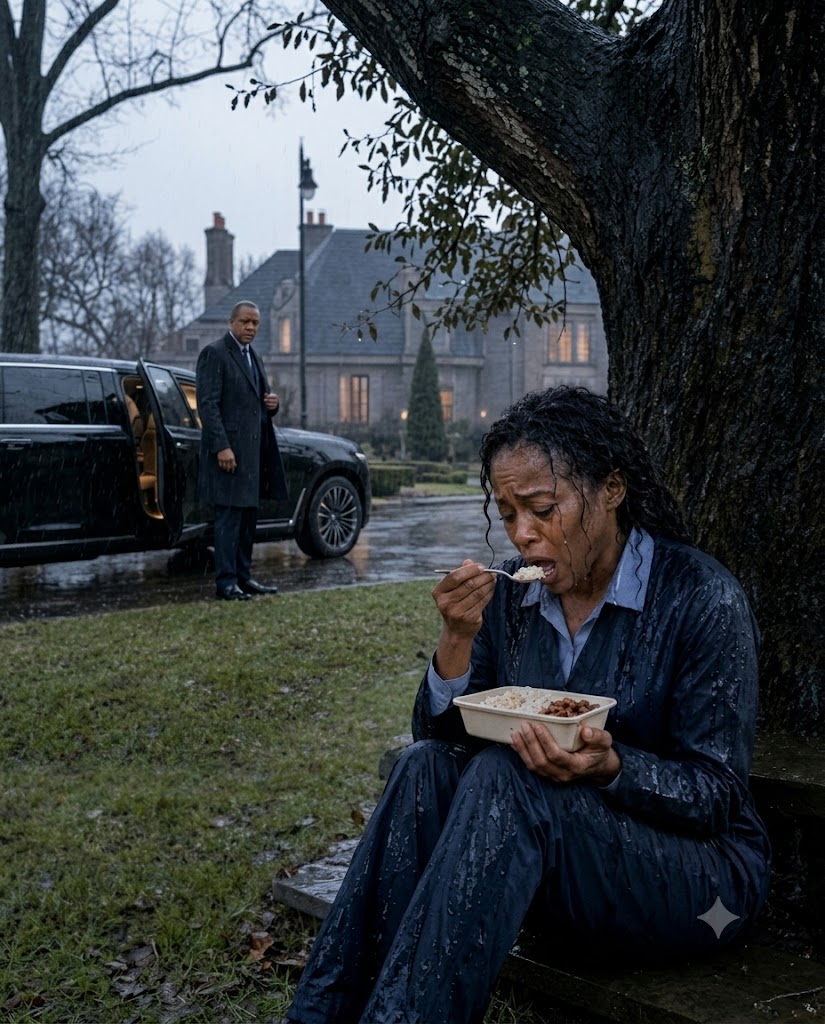
Darius Whitmore had just stepped out of his Suburban in front of his private mansion in Seattle.
The investment meeting that had lasted all afternoon had finally ended, leaving him with nothing but numbers echoing in his skull and a dull ache behind his eyes.
Winter rain lashed his shoulders and covered the car windows in layers of murky water.
He had not even had time to close the car door when his gaze stopped.
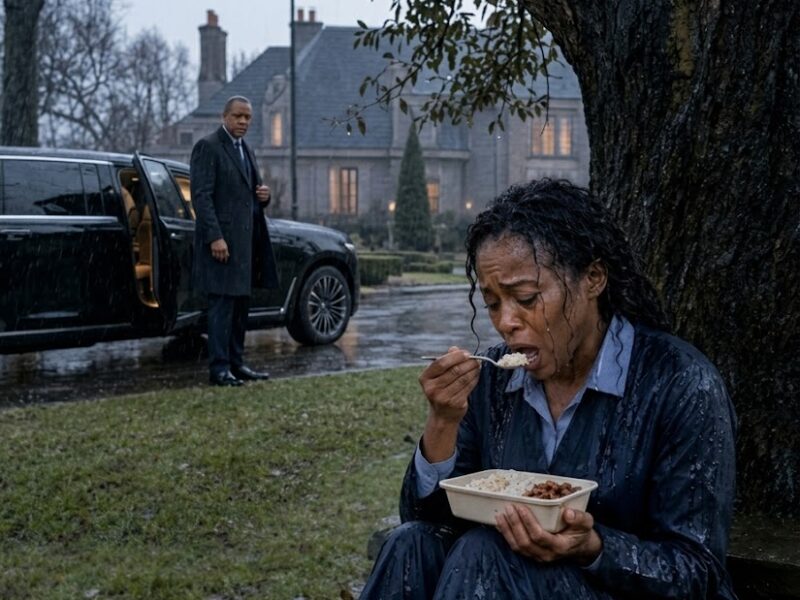
Under the canopy of an old maple tree near the service quarters, a woman was sitting huddled on a stone bench.
Her soaked blue uniform clung tightly to her back, and both hands clutched a cheap lunchbox as if it were the only thing keeping her from collapsing.
At first, Darius thought she had simply chosen to sit outside for some fresh air, a foolish decision in this weather but not an unthinkable one.
A few seconds later, he saw her shoulders trembling.
Not from the cold.
She was crying.
In the unending rain, the woman kept eating in silence, not once looking up for shelter, not once wiping her face.
Darius Whitmore, owner of dozens of highrises across this city, stood motionless beside the Suburban with its door still open.
He did not know her name yet.
Did not know why she had to sit out there.
But what he was about to discover would make the entire empire he had built seem cheaper than the half-eaten lunch in her hands.
Seattle winter rain did not pour down violently like a thunderstorm.
It drizzled, persistent, lingering from morning until night, and no one bothered to notice.
Darius Whitmore sat in the Suburban, his phone wedged between his shoulder and ear, listening to his lawyer talk about the escrow deadline for a deal to acquire an apartment complex in Ballard.
His fingers tapped a rhythm on the leather-wrapped steering wheel.
Numbers, always numbers.
This deal would bring in several more million dollars, maybe more.
Through the water-blurred glass, something moved near the service quarters behind the mansion.
Darius stopped tapping his fingers and narrowed his eyes.
Beneath the old maple tree about fifty feet from the car, a woman sat on the stone bench.
Blue uniform.
Black hair soaked and plastered to her scalp.
Rain streamed down over her.
Not a drizzle, but real rain.
And she was eating something.
What the hell was this?
“Mr. Whitmore, are you still there?” The lawyer’s voice came through the speaker.
“Still here. Let me call you back later.”
He ended the call, sat up straight, and looked through the curtain of rain.
The woman kept eating slowly, deliberately, rainwater running over her face, soaking through her uniform, and she did not move, did not look for shelter.
A wave of irritation rose in Darius’s chest.
The staff breakroom was right there, warm with a heater.
Why was she sitting outside in the middle of a storm like a homeless person?
If clients drove in at this exact moment, what would they think about the way he ran his estate?
Darius reached for the door handle, intending to step out and tell her to go inside.
His hand tightened around the cold metal, but something made him stop.
The woman lifted her face slightly, and even through the rain and the distance, Darius could see it.
Her shoulders were trembling, not from the cold.
Her hand shook as she raised a spoonful of rice to her mouth, and the water on her face was not only rain.
There were tears mixed in it.
She was crying.
Darius’s hand fell away from the door handle.
He leaned back into the seat, a strange feeling crawling down his spine.
Confusion first, then something heavier.
Why was she crying?
And why did she keep eating?
Still forcing herself to swallow each bite while the tears kept falling.
She did not wipe her face.
She just ate with an almost mechanical precision, as if programmed to finish this no matter what was happening.
Darius could not look away.
There was something in the way she sat with her back straight through the tears that tightened his chest.
She finished eating, closed the lid of the lunchbox, and put it into the cloth bag she carried with her.
Then she stood up, smoothed her wet uniform, and walked toward the service door, head held high, steps steady, looking nothing like someone who had just been driven outside to eat in humiliation.
A thought flashed through Darius’s mind, quick and shameful, that he had just looked at her the way he looked at an object in the house rather than a human being.
He swallowed that thought down.
She disappeared behind the service door.
Darius remained alone in the car, rain tapping steadily on the roof, and he felt something crack inside his chest.
Not break, just crack like ice on the surface of a lake when pressure builds from below.
His phone vibrated.
Darius ignored it.
He looked toward the maple tree, toward the empty stone bench, and for the first time in thirty years, Darius felt an emotion he had forgotten how to name.
Shame.
All evening, that image kept returning.
A woman eating in the rain, crying, but not stopping, keeping herself upright through sheer will, while he sat comfortably, dry, only fifty feet away.
Before I continue, I want to speak honestly with you for a moment.
If the image of that woman sitting and eating in the rain also makes your chest tighten a little the way it just did to Darius, leave a like.
That is the smallest way for me to know I am not telling this story alone.
And if you want to stay with me through stories like this, subscribe to the channel right now because there are still so many things ahead that I want to tell you.
Thank you for staying with me.
Now, let us return to Darius on that night.
That night, his glass of whiskey untouched, he looked out at the dark yard.
The twenty-six-room house was frighteningly silent.
His daughter, Aaliyah, twenty-five years old, was on the east coast of the United States, working at an investment fund.
And this year, they had spoken exactly three times, all three about tuition transfers.
His wife, Yolanda, had died six years ago from cancer, and Darius still had not cleared out their shared bedroom.
Her clothes were still hanging in the closet.
He lay down in bed at midnight, unable to sleep.
When he closed his eyes, he saw her, the woman in the rain, shoulders trembling, back straight as she walked away.
Then, without warning, another image overlapped it.
Tacoma, thirty-seven years earlier, his family’s two-room apartment.
Water-stained walls, cockroaches crawling in the kitchen.
Darius at eight years old sitting on the floor doing homework under a desk lamp because the ceiling bulb had burned out and his mother did not have money to replace it.
The door opened.
His mother, Odessa, came in at eleven at night, soaked from head to toe.
She had walked nearly a mile home from the laundry instead of taking the last bus, saving every cent for Darius’s school supplies.
Her uniform looked exactly like the uniform of the woman that afternoon, the same faded blue, the smell of bleach.
Her hands were cracked, bleeding from hours of scrubbing other people’s floors and toilets.
She bent down and kissed her son on the forehead.
“Homework hard, sweetheart?”
“Not really, Mom.”
“All right, keep going, son.”
She dropped onto the floor beside him, too exhausted to make it to the sofa, opened the cold lunchbox she had carried since morning, having had no time to eat all day.
They sat together on the stained tile floor, his mother eating while stroking his hair with her calloused hand, saying, “You are going to go very far, Darius, farther than anything I dare to dream for you. I believe that.”
She had believed it with her entire exhausted body and had worked herself into an early grave to make it true.
Darius opened his eyes in his bedroom, and for the first time since Yolanda’s funeral, he felt tears on his cheeks.
The next morning, rare sunlight slipped through the clouds.
But Darius had barely slept.
He went downstairs, showered, put on his usual suit, and went looking for Evelyn Price, the head housekeeper who had worked for him for fifteen years.
She was rearranging a vase in the hallway, her posture stern, silver hair pinned neatly into a bun.
“Mrs. Price,” his voice tried to remain normal. “I need to ask you something.”
“Yes, Mr. Whitmore.” Evelyn did not look up, her hands still moving quickly as she arranged each flower.
“Yesterday, in the rain, there was a woman in a blue uniform eating lunch under the maple tree. Do you know who she is?”
Evelyn’s hands paused for a very brief beat, almost impossible to notice, then continued working.
“Probably one of the cleaning staff, sir.”
“I know that. I am asking her name.”
“I would need to check the duty schedule to be certain, sir.”
The answer was too smooth, too ready for a woman who managed fourteen staff members in the house and knew every name, every shift by heart.
Darius immediately recognized it as deliberate evasion.
“Mrs. Price, I am asking you a direct question.”
Evelyn set the vase down, turned, and looked straight at him, her face still professionally composed.
“Her name is Renee Carter, sir. She has worked here for nine months, responsible for deep cleaning and laundry.”
“Why was she sitting outside eating in the rain like that yesterday?”
“I am not sure, sir. Employees are free to choose where they take their lunch break.”
She picked up the vase and walked away, leaving Darius standing alone in the hallway, feeling as though he had been brushed aside by someone who worked for him.
The feeling was so unfamiliar that it took him a few seconds to process it.
In fifteen years, Evelyn Price had never behaved that way toward him.
At noon, Darius went out to the back garden, pretending to admire the rose bushes the gardener had planted the previous month, though he had no idea what variety they were.
He stood there loosely holding his phone as if taking pictures, waiting.
At exactly 12:05, the service door opened.
Renee Carter stepped out holding a small plastic container and a reusable water bottle.
The woman was petite, black hair tied neatly at the nape of her neck, the blue uniform hanging loosely over her thin frame.
It was not raining today, but she still walked straight to the stone bench beneath the maple tree, sat alone with her back to the house.
Darius’s shoes crunched on the gravel path as he approached.
Renee heard the footsteps, sprang to her feet, her body stiff, her face going pale.
“Do not stand up.” Darius kept his voice calm. “I do not mean to disturb your lunch.”
“It is no trouble, Mr. Whitmore.” Her voice was quiet, careful, every word weighed.
She remained standing, both hands clasped in front of her stomach.
Up close, Darius saw the details that the previous day’s rain had hidden.
Exhaustion carved deeply into her face.
Dark circles beneath her eyes like bruises, cracked corners of her lips, hands reddened from too much exposure to chemicals.
She might have been only in her late thirties, but looked as if she were in her late forties, worn down by years of work without rest.
“Renee, right?” he asked.
“Yes, sir.”
“I saw you sitting out here eating yesterday in the rain.”
Her body stiffened even more, if that was possible.
“I am sorry if that was inappropriate, Mr. Whitmore. It will not happen again.”
“I did not say it was inappropriate. I am asking why you sat in the rain instead of going into the breakroom.”
Silence.
The kind of silence that lasted long enough to become uncomfortable.
Darius waited, watching emotions flicker across Renee’s face too quickly to grasp.
Fear, certainly, but there was something harder beneath it.
Finally, she spoke, her voice flat as if reporting an objective fact.
“Three weeks ago, you held a fundraiser here. Some guests arrived earlier than expected. At the time, I was eating lunch in the staff break room.”
Darius’s stomach began to twist.
“One of the guests, I think Mrs. Caldwell, said my uniform smelled of cleaning chemicals. She said the smell was unpleasant, that it was not appropriate for staff who worked with chemicals to be near the area where guests were eating because the smell would spread.”
The twisting in his stomach turned into real nausea.
“A few other guests agreed. Someone suggested it would make more sense if I ate outside.”
Renee paused and Darius saw her hand clench and then release.
She said it plainly.
“I reek of bleach like someone who cleans for a living and people in work like mine should understand for themselves where their boundaries are.”
Darius felt as if he had been punched in the chest.
He actually took a step back.
“I did not want to cause trouble for you or your guests, Mr. Whitmore. So since then I have eaten outside. It is actually quite pleasant, fresh air.”
She smiled as she said it.
A small strained empty smile.
The kind of smile people practice to convince themselves that everything is still all right.
Darius’s mouth opened and then closed.
No words came out.
Renee probably took the silence as a sign that the conversation was over because she bent down to pick up her lunchbox.
“I should get back to work, Mr. Whitmore. Thank you for asking.”
“Renee, wait.”
But she had already walked away, back straight, head held high, carrying the same composed bearing as the day before, as if being humiliated inside his own house was an ordinary thing, another injustice to be endured with dignity.
Darius remained beneath the maple tree for five minutes after she left, anger rising in his chest like a solid burning mass directed everywhere at once.
At Vanessa Caldwell and her wealthy friends, at himself for having been blind for so long, at an entire world cruel enough to make a woman eat lunch in the middle of a storm just to avoid being insulted one more time.
He walked into the house, his hands still trembling slightly, and found Evelyn Price in the kitchen while she was reviewing the dinner menu with the chef.
“Mrs. Price, my office right now.”
She excused herself from the chef and followed him into the office.
As soon as the door closed, Darius spun around.
“Why did you not tell me?”
Evelyn’s face remained professionally composed.
“Tell you what, sir?”
“About Renee Carter? About what happened with my guests? About the fact that she has been eating lunch outside for three weeks because she was humiliated in my own house?”
“It was not my place to report it, Mr. Whitmore.”
“You are the head housekeeper of this house. You are responsible for the welfare of the staff. This falls within your duties.”
“I handled it, sir.” Evelyn’s voice remained infuriatingly calm. “I spoke to the staff members who made inappropriate remarks to Miss Carter that day. I reminded everyone that all employees deserve respect. But Miss Carter herself asked me not to make a fuss. She said she preferred sitting outside. I respected that wish.”
“Her wish?” Darius’s voice rose. “She was pushed out of a space she had every right to use just because my guests are classist.”
“Yes, sir. That is correct.” Evelyn looked directly at him for the first time in the conversation, and Darius saw something cold in her eyes. “Your guests are regularly rude to the staff. They make comments. They treat us as if we are invisible or worse, as if we are something beneath them, and you have never noticed because you have never stayed in the room long enough to see it happen. Or perhaps because you do not consider us worth noticing.”
Those words landed like a slap.
Darius’s face burned.
“Miss Carter is not the first person your guests have treated badly, Mr. Whitmore. She is only the most recent. The others have learned to disappear whenever there are guests in the house. They know their place, as Mrs. Caldwell once put it. They have learned not to exist in places where they might offend the pride of the wealthy.”
“Then why do you still work for me if you think I am that terrible?” Darius asked, his voice almost a challenge.
“Because if I quit, who will stand between guests like Mrs. Caldwell and the people cleaning this house?” Evelyn said it without bitterness, simply as a truth she had lived with for years. “And because beneath the indifference, I have always believed you were not cruel, only blind. Yesterday, when you asked about Miss Carter, I hoped you were finally beginning to see.”
She walked toward the door, stopped with her hand on the handle.
“If you truly want to understand Renee Carter, ask her yourself. But do not expect her to trust you immediately. Trust is not something paid for with a monthly salary, sir. So far, she has received exactly one thing from you. A paycheck on time. Nothing else.”
The door closed.
Darius stood alone in the office, feeling as if the floor had just collapsed beneath his feet.
He had thought he knew how to run this estate, thought he was a decent employer, paying full wages, providing basic benefits, not interfering too deeply in the staff’s work.
But he had not seen the things that truly mattered.
Had not seen the cruelty taking place under his own roof.
Had not seen the suffering of the people who worked for him.
Blind to his own complicity in a system that treated Renee Carter and people like her as less than human.
He sat down at his desk, opened his computer, and searched for personnel records he had never bothered to examine closely.
Whitmore Urban Properties did not directly employ the household staff.
The entire cleaning crew, gardeners, drivers were hired through an outside staffing company.
Wages set by that company.
Darius only approving the total annual budget without ever looking at each specific number.
There was no internal reporting channel for household employees to report rude behavior from guests.
There was no clear policy about who was allowed to use which shared spaces in the house.
Everything operated on unspoken habits.
Habits people like Renee were forced to teach themselves in order to survive.
He turned through page after page of old contracts, clauses he had once signed without ever reading closely, simply trusting the lawyer’s signature beneath them.
There was a bitter irony in it.
He had once taken pride in his ability to understand every smallest detail in a real estate purchase agreement worth tens of millions of dollars, able to spot an unfavorable clause hidden among hundreds of pages of legal documents after only a few minutes of scanning.
Yet when it came to the very people who lived and worked under his roof every day, he had never spent even ten minutes learning how they were treated.
He had built an entire empire on meticulous attention, but had allowed that attention to stop exactly where human beings were concerned.
Darius sat in silence, both hands holding his head.
The image of his mother appeared again, not in a dream this time, but as clearly as if she were standing right in front of him.
If Odessa Whitmore had ever worked for a man like him, would he have truly seen her or looked straight through her as if she did not exist?
He wanted to believe he would have been different.
But the truth was, before yesterday, he had lived for thirty years without ever truly seeing anyone wearing a blue uniform in his own house.
He had become exactly the kind of person his mother used to scrub toilets for, the kind of person who saw the uniform instead of the human being.
Three days later, Darius asked human resources to send him Renee Carter’s hiring file using the excuse that he was reviewing procedures with the staffing company.
The file was pitifully thin.
Renee Carter, thirty-nine years old, hired nine months earlier through a domestic staffing agency.
Before that, she had done commercial cleaning at night for several office buildings in the South Lake Union area and worked hourly as a housekeeper for three different families.
Current position, deep cleaning and laundry specialist.
The hourly wage the agency paid her was far below the amount Darius had always assumed he was paying when he approved the annual budget.
There was no separate health insurance beyond the minimum required by Washington labor law.
He kept reading.
Emergency contact, Maya Carter, daughter, sixteen years old.
Current address, a small apartment in the South Park area, south of the city, far from the tree-lined streets where his mansion stood.
Darius typed the address into his phone, looked at the satellite image, rows of low buildings, peeling paint, cracked parking lots.
He knew the area, had once considered buying a parcel nearby for a redevelopment project, then passed because the profit was not attractive enough.
Renee walked or took the bus for nearly an hour every morning to reach his mansion.
And according to a short note in the file, she also took additional commercial cleaning shifts on some evenings during the week through another company.
Two jobs at the same time to cover rent, insurance, and something she was trying to save for Maya’s future.
Nine months working here, and according to the file, she had never taken a sick day, never been late, never filed a single complaint.
That evening, Darius did something he knew he should not do, but could not stop himself.
He drove to South Park.
The neighborhood was nothing like what he had imagined from the satellite image.
Darker, quieter with several street lights burned out, leaving long stretches of darkness.
He found Renee’s apartment building, an old two-story concrete block, parked a short distance away, feeling as though he were intruding on something that did not belong to him.
A light came on in a second-floor apartment behind a thin curtain.
Darius sat in the car, looking up, unsure what he was waiting for.
Then the silhouette of a teenage girl appeared at the window, tall and thin, talking excitedly about something to someone inside.
Renee appeared beside the girl, and even from this distance, Darius could see the change in her face.
The exhaustion disappeared.
She smiled, a real smile, and rubbed her daughter’s head.
The girl pushed her mother’s hand away, laughed loudly, and they both moved out of the window frame.
Darius sat there for another twenty minutes, looking at the lit window, imagining the life taking place inside.
A mother and daughter in a two-bedroom apartment that probably consumed nearly all of her income each month.
A space that might not be completely safe, not properly maintained.
But they had each other.
They had laughter.
They had something Darius had lost many years ago.
He thought of his own daughter, Aaliyah, twenty-five years old, living in a luxury apartment in New York whose rent he paid every month.
She had called him exactly three times this year, all three related to money, a course, a business trip, a small investment she wanted to try.
They had not had a real conversation in more than two years.
Renee’s daughter looked at her mother as if she were her entire world, as if every sacrifice her mother made meant something.
Aaliyah looked at Darius like a walking ATM.
On the way home, Darius passed the very parcel of land his company had considered buying the previous year, now still vacant after the deal fell apart because the return did not meet the board’s expectations.
He remembered crossing the area off the investment list with a single short note, not worth developing.
Now, knowing that Renee and Maya lived only a few blocks away, that note carried an entirely different meaning, colder and crueler than he had ever imagined when he wrote it.
Darius drove home, the crack in his chest widening with every mile.
When he reached the mansion, the house felt emptier than usual.
Twenty-six rooms echoed with silence.
He poured a glass of whiskey and then set it down untouched.
He needed to do something.
But what?
Write Renee a check?
That would feel like an insult, making her feel like an object of pity.
Raise her salary?
Yes, necessary, but still not enough, like putting a bandage over an infected wound and calling it healed.
Darius sat in his office until nearly two in the morning thinking.
One answer kept appearing in his mind, but he pushed it away because it sounded insane.
Something a normal person would not do.
He wanted to understand, truly understand what Renee Carter’s life looked like from the inside.
Not through personnel files, not through a window from a distance.
He needed to know how exhausted a person could become and still keep moving forward.
And that question led him to the only name he could trust to help him carry out that insane idea.
Near two in the morning, Darius called Terrence Cole.
The two had known each other since their first year at the University of Washington when Darius was still sleeping on the dorm room floor because he could not afford a bunk bed and Terrence was the only roommate who had never made him feel small because of it.
Now, Terrence ran Cole Facilities Group, one of the largest commercial cleaning companies in the Puget Sound area.
“Darius, it is two in the morning. Did someone die?” Terrence’s voice was thick with sleep.
“No one died. I need something, and it is going to sound insane.”
“Go ahead.”
“I need you to hire me as a cleaner for one night only under a fake name in one of my own buildings.”
A long silence.
“So, you were right. That does sound insane. Why?”
Darius hesitated.
How could he explain this without sounding as if he had lost his mind?
“There is someone I need to understand. Terrence, her life. I need to see it from the inside. Not through a report or through a car window.”
“This is about a woman.”
“Yes, but not in the way you are thinking. I am not trying to flirt with anyone. I am trying to wake up, Terrence, and I think this is the only way.”
Terrence was silent.
Darius could hear even his friend’s breathing over the phone.
Then Terrence spoke, his voice less sleepy now.
“Do you remember sophomore year when I could not pay rent? You let me sleep on your floor for three straight months. You never told anyone, never made me feel ashamed about it. You just helped because you understood what it felt like to be broke.”
He sighed.
“All right, I will help, but only one night, Darius. This is insane and definitely breaks a few rules, but I will give you one night.”
“That is enough.”
They arranged the details.
Darius would work the Friday night shift at Cascadia Tower, one of the office highrises owned by Whitmore Urban Properties, where Cole Facilities Group held the cleaning contract.
He would go through the company’s normal hiring process under the name Curtis Boone with complete tax documents and legal insurance so no one would get in trouble.
“One condition,” Terrence said before hanging up. “After this, you tell me the whole story. I need to know why a man worth several hundred million dollars wants to scrub toilets for minimum wage.”
“Deal.”
Friday came faster than Darius expected.
All day at the office, he could not focus on anything.
At nine in the evening, he went home, replaced his usual suit with an old pair of jeans and a canvas jacket Terrence had sent over, stood in front of the mirror, and barely recognized the man looking back at him.
When was the last time he wore something that was not designer clothing?
The last time he looked like an ordinary person instead of Darius Whitmore, the real estate tycoon.
When was that?
He could not remember.
He drove to Cascadia Tower, parked in the employee lot, both hands sweating on the steering wheel.
This idea was insane.
If someone recognized him, if this reached the press or his business partners, he would become a laughingstock.
But he still stepped out of the car.
Cascadia Tower looked completely different at night than it did during the day.
The main lobby was empty, fluorescent lights shining down on the marble floor he had personally selected four years earlier when the building was still under construction.
Back then, he had stood in this exact spot, wearing a suit, shaking the architect’s hand, talking about a vision for modernizing downtown.
Now, he stood in the same place again, wearing a canvas jacket, carrying a false name badge, preparing to mop the very marble floor he had once chosen.
There was something both funny and painful in the coincidence, and he was not sure whether he should laugh or cry.
The service elevator took him down to the loading dock where the night cleaning crew was gathering.
Six people, all of them looking exhausted before the shift had even begun.
They glanced at Darius, only as a new temporary worker, not worth paying attention to, except one person.
Renee Carter stood apart from the group, sipping water from the familiar reusable bottle.
When she saw Darius, or rather saw Curtis Boone, she smiled.
A real smile, not the strained kind he had seen beneath the maple tree.
“Hi.” She walked closer. “You are Curtis, the new guy, right?”
“Yeah. First night. A little nervous.”
“Do not worry. You will get used to it.” She glanced toward the supervisor’s office. “The most important thing is to keep a steady pace. Do not try to do everything fast right from the start. These floors will destroy your back if you are not careful. And remember to drink water. This building gets really hot at night. They hate spending money to run the air conditioning.”
Her voice was warm, friendly, completely different from the rigid caution she showed Mr. Whitmore.
With Curtis Boone, she was simply Renee, a person sharing a little kindness with someone else because that was what kind people did.
Something tightened in Darius’s chest.
The shift supervisor, a man named Ray Sutton, whose hiring contract Darius had once approved, but whom he had never met, came out of the small office, looking at the group with undisguised contempt.
“Listen up. We have a heavy workload tonight. There is an inspection team coming Monday. Everything has to be spotless. I do not want to hear anyone complaining about back pain or tired feet. You people are paid to work, so work. Any questions?”
No one spoke.
“Good. Clock in and get started.”
Ray turned and walked away, leaving Darius standing there, his hand tightening around the handle of the supply cart, preparing to step into a night that he knew, even if he could not yet fully imagine it, would be unlike anything he had ever experienced in his life.
For the next four hours, Darius pushed the cleaning cart through seemingly endless hallways, emptied trash from dozens of bins filled with things he did not want to think about, knelt to scrub toilets until his shoulders ached, and his knees felt as though they were about to shatter.
His back throbbed.
Blisters formed on his palms from the broom handle, rubbing constantly.
Sweat soaked through his shirt despite the cold.
Every muscle in his body protested, and the shift was not even halfway over.
Renee moved through the building at twice his speed, never stopping, never slowing down, never uttering a complaint.
She cleaned with the same almost mechanical precision Darius had seen the day she ate lunch in the rain.
Efficient, thorough, putting her entire mind into every movement.
At midnight, they got a fifteen-minute break.
Darius dropped himself into a chair in the empty cafeteria, groaning softly.
Every part of his body hurt.
Renee sat across from him, her breathing barely changed.
“Are you okay?” she asked, her voice genuinely concerned.
“I am about to die. How are you not dead?”
She laughed softly, the laugh tired, but genuine.
“You get used to it. Give it a few weeks.”
“I am not sure I can survive a few weeks.”
“You definitely can. You just need a reason big enough.”
She pulled from her pocket a small photograph, its corners worn.
A teenage girl smiled brightly at the camera.
“This is my daughter, Maya.”
Darius looked at the photograph, pretending he had never seen that face through the window.
“She is beautiful. Looks smart, too.”
Renee’s face lit up when she spoke about her daughter.
The exhaustion disappearing for just a moment.
“She is in eleventh grade. Wants to go into nursing. She is enrolled early at the community college near our home, a program she takes alongside high school to save time and tuition later.”
“Then she really is smart.”
“The associate degree nursing program here with all expenses included costs around fifteen to twenty-four thousand dollars for the whole program. It sounds high, but if she goes straight to a four-year university, that number can easily climb close to seventy thousand, not including room and board.”
Renee said this in the voice of someone who had calculated that number hundreds of times in her head at night when she could not sleep.
“I work here, work for Mr. Whitmore during the day and save every dollar I can.”
Darius clenched his hands beneath the table.
“That is a heavy burden.”
“It is not a burden. It is a purpose.” Renee looked straight at him and Darius saw in her eyes a clarity that made him ashamed of himself. “My ex-husband left eight years ago. He sent child support for the first few months, then stopped completely. Since then, it has just been me and Maya.”
She paused, running her fingers along the edge of the photograph.
“There was a period when I worked two jobs at the same time, cleaning houses during the day, cleaning offices at night just to make enough for rent and keep health insurance. People often say this state has the highest minimum wage in America. Maybe that is true, but highest does not mean enough to live on. Not when the rent for a two-bedroom apartment takes almost everything you earn.”
Darius’s throat tightened.
He knew that number, had read it somewhere in a real estate market report.
The statewide minimum wage was about to pass seventeen dollars an hour, the highest among all the states in the country, while in Seattle itself, where large businesses like his operated, the number was even higher.
But he had never placed those numbers beside the real life of a person who had to live on them.
He also vaguely remembered another statistic.
The national average wage for building cleaning work hovered around seventeen dollars an hour, less than thirty-six thousand dollars a year, a number that could not support a family of two in any major American city, let alone Seattle.
“I am sorry for everything you have had to go through,” Darius said.
And this time he spoke as his true self, even though Renee had no idea.
“You do not need to apologize. It is not your fault.” She smiled, folded the photograph, and put it back into her pocket close to her heart. “What about you, Curtis? Do you have children?”
“One daughter, twenty-five years old, lives in New York.”
“It must be nice having a child nearby to visit.”
Darius thought of Aaliyah, who called only when she needed money, who had never once asked whether he was doing all right.
“Yeah, it is great,” he said, his voice so empty that even he could hear it.
Renee looked at him with tired but perceptive eyes.
“You are lonely, are you not?”
The question hit him like a punch.
It had been a very long time since anyone had dared ask him that directly.
Even longer since the last time someone had looked at him closely enough to notice.
“Yes,” he admitted quietly. “I think so.”
“I could tell because people who carry it inside usually recognize each other, even if no one says it out loud.”
She stood when the break ended, lightly patted his shoulder before returning to her cart.
“Maybe every one of us is holding ourselves together alone in our own way, Curtis. So sometimes being kind to a stranger is the only thing we still have left to hold on to.”
The shift ended at two in the morning.
Darius stood watching Renee walk to the bus stop, waited until she boarded safely before returning to the parking lot, sat in his car for twenty minutes without starting the engine, looking up at his dark house.
He had worked four hours and felt completely beaten down.
Renee had worked nearly twice that long.
Would repeat this tomorrow morning at his house, then return here again tomorrow night, day after day, until her body could not take it anymore, or until Maya graduated, whichever came first.
Over the next three weeks, Darius convinced Terrence to let him come back three more times, each time with the promise that it would be the last.
No one recognized him.
He pushed the cleaning cart, wiped windows, shared the brief breaks with the night crew, listened to them joke, complain about being tired, and quietly grumble about the people upstairs who never noticed they existed.
Night by night, he and Renee gradually talked more.
No longer like employer and employee, but like two people trying to get through long night shifts together.
She told him a little more about Maya, about the fears of a single mother, about the small dream she was trying to protect for her daughter.
Darius listened, moved by a sincerity he had not heard in many years.
But the more he listened, the heavier the burden inside him became.
Renee was trusting someone who did not exist.
She was pouring her heart out to Curtis Boone, while the person actually listening was the very employer who had let her eat lunch in the rain for weeks without even knowing it.
Some nights he lay awake wondering whether he was truly learning to understand or only finding a more subtle way to keep controlling Renee’s story without her knowing.
The question kept circling in his mind with no answer that made him feel any lighter.
On the final night, as he left Cascadia Tower, Darius knew he could not continue lying any longer.
He needed to tell the truth, even if it might destroy everything that had just been built.
The next afternoon, Darius went into the garden to find Renee.
She was sitting on the familiar stone bench under the maple tree, eating a peanut butter sandwich, drinking water from the reusable bottle.
When she saw him approaching, she sprang to her feet, the familiar guardedness immediately returning to her face.
“Mr. Whitmore!”
“Renee, sit down. I want to talk to you for a moment.”
She remained standing, both hands clasped in front of her stomach.
“Yes, sir. Is there a problem with my work?”
“No, your work is excellent. I want to talk about something else.”
Darius took a deep breath.
This was the moment he had feared for days.
“I need to tell you something, and you are going to be angry. You have every right to be angry.”
Renee’s face became wary.
“Sir?”
“Three weeks ago, I worked the night shift at Cascadia Tower under a fake name.”
Darius forced himself to look directly into her eyes.
“Curtis Boone. That was me.”
The color drained from Renee’s face.
The water bottle in her hand nearly fell.
“What?”
“I needed to understand what your life was really like. So, I worked one night beside you. You were kind to me. Told me about Maya, about things you had never told Mr. Whitmore, and I let you do that.”
“You lied to me.”
Renee’s voice did not get louder.
It only became colder, sharper, every word like a blade.
“I told Curtis about my ex-husband, about my fear. When Maya asked for twenty dollars for a field trip and I had to say no. About the nights when I did not know how much longer I could keep going. I thought Curtis understood because he was lonely too. But that was never real. That was my employer in disguise to see how workers behave when he is not there.”
“I did not mean to take advantage of you.” Darius said, his voice breaking. “I only wanted to understand.”
“Understand what? How people live when they have no other choice. You wanted to play the disguised boss to see how workers really behave when you were not standing there watching.”
Tears began to rise in Renee’s eyes, but her voice remained strong.
“Four hours. You put on poor people’s clothes for four hours, then gave yourself the right to think you understood enough to come fix me. I have been juggling two jobs at the same time for eight years since the day my husband walked out of that house. Do you think four hours can stand equal to eight years?”
“I am not trying to fix you. You are the raise, the benefits, all of those things.”
“They are money to compensate for guilt. You felt bad after your little experiment. So now you are throwing money around to feel better.”
She wiped her eyes with the back of her hand, more angry than weak.
“I do not need money to compensate for your guilt, Mr. Whitmore. I just need to be left alone.”
“Renee, please listen to me.”
“No, you listen to me.” She stepped closer, her voice low and tense. “I trusted Curtis. Told him things I had never told anyone. And he was not real. It was you pretending to be poor, deceiving me, taking my trust, and then crushing it. Do you know what that feels like?”
Darius did.
He had felt that exact kind of betrayal when a business partner deceived him years ago, had sworn he would never do the same thing to anyone, and yet now he was standing here, the very person who had done it.
“You are right,” he said quietly. “I violated your trust. I used deception when I should have simply asked you directly. I am sorry, more sorry than for anything I have ever said.”
“Sorry does not fix this.”
Renee picked up her lunchbox with trembling hands.
“I need to get back to work.”
“Renee, wait.”
“It is Miss Carter, Mr. Whitmore.” Her voice hardened completely. “And I would appreciate it very much if you kept your distance from now on.”
She walked away, back straight, even though tears were still on her cheeks.
Darius remained beneath the maple tree, feeling as if he had just destroyed the only genuine thing he had built in many years.
For the next two weeks, Renee barely spoke to Darius beyond the required greetings.
She worked on time flawlessly as always, but the wall between them was so thick that Darius could feel it every time he passed through a hallway where she was cleaning.
He did not blame her.
He simply did not know what to do with the weight of guilt pressing on his chest.
There were evenings when he sat in his office, looking out at the dark garden, trying to imagine what a real apology through action would look like, different from what he had spent his whole life doing, signing a check and considering the problem solved.
But old habits ran deep and were hard to break.
And in the end, he still returned to the only language he knew best, money.
Even though deep inside, he had begun to realize that it might not be enough.
Finally, he decided to do what he should have known would fail.
One afternoon, he prepared an envelope.
Inside was a check large enough to cover Maya’s entire nursing tuition, plus enough extra for Renee to cut back on her night shifts.
He found her in the laundry room where she was folding sheets into neat stacks.
“Renee, do you have a minute?”
She stopped working, not turning around immediately.
“Yes, sir.”
“I have something for you.”
He held out the envelope.
“This is for Maya’s education and so you can have an easier time.”
Renee looked at the envelope as if it were a snake.
She did not take it.
“I will not accept it, sir.”
“Renee, this is not charity. This is something I want to do.”
“I know you want to do it.” She turned fully around, her gaze sharp. “The issue is not what you want. The issue is how I feel receiving it. Do you know what that feels like when someone who once deceived you stands here offering a check to make everything feel easier for himself?”
“I am not trying to make myself feel better.”
“You are, even if you do not realize it.”
Renee’s voice was not loud, but every word was hard as stone.
“If I take your money, who do I become in this story? The poor woman rescued by her rich employer after he felt guilty. I do not want to be that character. My daughter does not need a story like that to grow up with either. She needs to know her mother stood on her own two feet with her own hands.”
Darius was silent, the envelope still in his hand, suddenly feeling strangely heavy.
“You think money can fix everything?” Renee continued, her voice a little softer but no less sharp. “Because for you, money has always been the way to solve problems. But kindness without respect is still a form of power, Mr. Whitmore. You are still deciding what is good for me. Still standing in the position of the giver while I am still the receiver. Whether I am grateful or not does not matter because I do not have the right to refuse without fearing consequences. That is exactly how power works, only wearing a gentler disguise.”
Those words cut deeper into him than any accusation before.
He had thought he was making amends, but in truth he was still repeating the exact same old mistake, only expressing it differently.
He still saw Renee as a problem to solve, a project to complete instead of a human being with the right to decide her own life.
“Then what am I supposed to do?” he asked, his voice almost helpless.
Renee looked at him for a long moment before answering.
“Do not try to save me, Mr. Whitmore. I do not need to be saved. I need a workplace that does not humiliate me because of the smell of chemicals on my uniform. I need fair pay for everyone who works here, not just me because you feel guilty. I need to know that if I report a rude guest, I will not lose my job because of it. That is not pity for me alone. That is fairness for everyone.”
She turned back to the stack of sheets.
“If you truly want to change, fix the system that allowed this to happen in the first place. Do not just try to soothe your own conscience by writing a check for me alone.”
Darius stood there, the envelope still motionless in his hand, feeling as though he had just been slapped awake by the very person he had once thought he was trying to help.
He put the envelope into the inside pocket of his jacket, said nothing more, then left the laundry room.
That evening, he sat in his office, looking at the check spread across the desk, and for the first time understood that the real problem was not Renee Carter.
The problem was the entire way he had run his life for the past thirty years.
The way he viewed the people who worked for him as smoothly functioning tools, paid on time, and needing nothing more.
He had confused paying people fully with treating them kindly, confused personal generosity with systemic fairness.
He thought of his mother once again, of the years she had worked tirelessly for wealthy families in Tacoma, families who had perhaps also thought they treated her kindly simply because they paid her on time.
How many of them had ever wondered whether Odessa Whitmore was allowed to use the bathroom in the house, allowed to sit and eat lunch in the kitchen instead of outside on the porch, treated like a human being instead of a service?
Darius did not know the answer, but for the first time in his life, he truly wanted to find out.
Not for his mother anymore.
She had been gone a long time, but for all the other Renee Carters quietly existing around him, never once seen by him.
The next morning, Darius called a meeting with Evelyn Price, human resources, and his personal lawyer.
Not to discuss any real estate deal, but to discuss how the entire household staff and the commercial cleaning partners of Whitmore Urban Properties were treated.
“I want to change everything,” he said, placing his hand on the table. “Not a small isolated bonus, the entire system.”
For the next three weeks, he worked tirelessly with the lawyers to rewrite the policies.
Base pay for all household employees was raised well above the city minimum accompanied by full health insurance for family members.
No longer stopping at the minimum required by law.
Paid leave policy was expanded including sick leave without fear of losing wages or losing a job.
He established a confidential reporting line independent of the household management so any employee could report rude behavior from guests without fear of retaliation.
The staff breakroom officially became an open space for everyone regardless of job position and a new code of conduct was drafted requiring every guest who came to the house to respect employees as they would respect anyone else.
He also called Terrence asking him to review every commercial cleaning contract between Whitmore Urban Properties and its contractors requiring a higher wage floor for workers in his buildings regardless of which company employed them.
“I cannot fix this entire industry,” he told Terrence over the phone. “But I can fix what is my responsibility.”
Terrence was silent for a moment before answering.
“You know this is going to increase your operating costs significantly, right? Not every shareholder is going to be happy about that.”
“I know, but I own most of the company’s shares. I can take responsibility for this decision.”
Darius looked out the office window down at the traffic moving below.
“There were years when I measured success by the profit number at the end of the quarter. Now I want to measure it by whether the person mopping the floor in my building has enough money to take their child to the doctor. It may sound naive, but I do not care anymore.”
“It does not sound naive,” Terrence said, his voice softening. “It sounds like you finally grew up.”
He did not tell Renee about these changes.
No announcement, no search for thanks.
He simply carried them out quietly because Renee had made it clear she did not need a story.
She needed systemic fairness for everyone.
Two weeks after the new policies took effect, Darius hosted a small dinner for several longtime business partners.
Vanessa Caldwell and her husband, an important investor in several of Darius’s projects, were among the guests.
Dinner went smoothly until one of the servers, a young woman named Danielle, walked past to clear the table.
“Oh my,” Vanessa said without lowering her voice, loud enough for the whole table to hear. “That bleach smell again. I really think you should remind the staff not to use such strong dishwashing liquid near the dining area. Darius, it is not elegant at all.”
Darius set down his wine glass, feeling a cold calm spread through his body, completely different from the hot anger of a few weeks earlier.
“Vanessa, I need you and Robert to leave my house right now.”
The entire table fell silent.
Vanessa blinked.
“Excuse me, what did you say?”
“I said, you need to leave right now.” His voice was not loud, but hard as steel. “You just insulted an employee who was working hard in my house, right in front of her, as if she were not human. I do not allow that to happen here anymore.”
“Darius, surely you cannot be serious. We have many investments together.”
“I am very serious. And if that means we lose our shared investments, then so be it.”
He stood up, opened the dining room door.
“Please.”
Robert Caldwell’s face reddened with anger, pulling his wife to her feet.
“You will regret this, Whitmore. We still have many connections in common, many mutual friends.”
“I do not care.” Darius looked him directly in the eyes. “Get out of my house.”
They left, muttering angrily.
The remaining guests sat in silence, shocked by what they had just witnessed.
Darius did not care about their stares.
He glanced toward the corner of the room where Danielle stood, still holding the tray, and saw a small smile, disbelieving, flicker across her face.
News spread quickly through Seattle’s upper class.
Darius Whitmore had grown soft, overly sensitive about staff, allowing employees to dictate his social life.
He lost two shared investments with the Caldwell family, lost his membership at a prestigious golf club where Robert held great influence, and received no shortage of whispers behind his back at other fundraisers.
He did not care about any of it.
That evening, after all the guests had gone, Evelyn Price found him in his office carrying a cup of hot tea she had made herself, something she had never done in fifteen years.
“I think you need this,” she said, setting the cup of tea on the desk.
Darius looked at her, surprised.
“Thank you, Evelyn.”
She nodded, turned to leave, then stopped at the door.
“I have worked for many wealthy people in my life, Mr. Whitmore. Most of them never changed. You are the first one I have seen truly try.”
She smiled, a rare smile, then closed the door behind her.
Six months passed slowly with no sudden reconciliation, no explosive emotional moment between Darius and Renee.
Only small changes repeated steadily day after day, gradually accumulating into something more reliable than a promise.
Renee began going into the staff break room like everyone else, sitting and eating lunch in the warmth with her co-workers, no longer having to choose between her dignity and the cold rain.
With the new base salary, plus full health insurance for Maya as well, she gradually gave up some of her commercial cleaning night shifts, first one evening a week, then two evenings, until she kept only the job at the mansion.
For the first time in years, she had full evenings at home with her daughter, not having to rush out immediately after dinner to make it to the next shift.
Darius did not try to become close to her.
He had learned that lesson, but he still greeted her every morning by her real name, asked how she was in a brief, sincere way without pretense.
Some afternoons he found Renee sitting on the stone bench beneath the maple tree.
No longer because she had been pushed outside, but simply because she liked the fresh air, as she had once said, only this time it was true rather than a lie to reassure herself.
One afternoon in May, when the weather was unusually bright and sunny, Darius happened to walk through the garden and saw Renee sitting there reading something on her phone with a radiant expression.
He stopped, keeping a polite distance.
“Good news?”
Renee looked up and for the first time since the confrontation in the laundry room, she smiled at him naturally without defensiveness.
“Maya just received her acceptance letter for the official nursing program at the community college. She applied by herself, wrote the essay by herself, did not need anyone’s help.”
“I am very happy for her,” Darius said.
And he truly was happy, not with the kind of polite happiness.
“You must be very proud.”
“Very proud.” Renee put the phone into her pocket. “With the new salary, I calculated that I have saved enough for her first semester without taking out another loan. Six months ago, I did not even dare dream of that.”
She looked at him, her eyes still carrying a little caution, but no longer cold as before.
“I am not saying this to thank you for saving me, Mr. Whitmore. I did this myself, but I acknowledge you cleared the path for me to do it myself instead of standing in my way like before.”
“That is all I ever wanted,” Darius said quietly.
“I am still angry with you about the Curtis Boone thing,” she said it directly without avoiding it. “Maybe I will never completely forget that. But I can see that you changed, not only with me, but with everyone here. That means more to me than any apology.”
It was not complete forgiveness.
Darius understood that and he accepted it because the boundary Renee set was proof that she was protecting her own dignity, something that should never have been threatened in the first place.
Around the same time, Darius began repairing his relationship with Aaliyah.
He called her not to ask about work or transfers, but simply to ask whether she was doing well, how her day had been.
At first, she was so surprised that she remained silent for a long moment before answering.
Gradually, those calls became more frequent, brief, but genuine.
At the end of May, Aaliyah flew back to Seattle to visit him for the first time in nearly three years, not because of family business.
They sat in the office and Darius told his daughter something he had never said.
“I was wrong, Aaliyah. I gave you everything except myself. I thought money could replace being present, and I was wrong.”
Aaliyah looked at him, something softer than the familiar distance shining in her eyes.
“I kept thinking you did not care because you never truly asked me anything. You only asked how much money I needed.”
“I know. I am sorry. I want to do things differently if you give me the chance.”
She nodded slowly and for the first time in many years, they hugged, not because of social formality, but because they both needed it.
One afternoon at the end of June, Darius stood by the office window, looking down at the back garden.
Beneath the maple tree, the stone bench was still there, but now it carried an entirely different meaning.
It was no longer the place where a woman had been pushed out of the house because of the chemical smell on her uniform, no longer a symbol of silent humiliation.
It had become a place where anyone could sit, because they wanted to, not because they were forced to.
Darius thought about his mother, about the words she had once whispered in his ear on the cold tile floor in Tacoma.
“You are going to go very far.”
She had been right, only not in the way she had imagined.
He had become a wealthy man, but true greatness did not lie in the highrises bearing his name.
It lay in the fact that he had finally learned how to see the people who had always been there, right in front of his eyes, only waiting to be seen as human beings, no more and no less.
He walked down into the garden, sat on the stone bench beneath the maple tree, alone for the first time.
Seattle rain fell lightly on his shoulders, and this time he did not hurry to find shelter.
Thank you for staying with me all the way to the final lines of Darius and Renee.
Before you turn off this screen, let me step out of the storyteller’s role for a moment to speak to you in my own voice.
Darius Whitmore, Renee Carter, the mansion beside the maple tree in Seattle.
All of it is fictional, but the feeling of being looked through as if you do not exist.
The feeling of having to swallow humiliation just to keep a job.
That is not something I made up.
That is the reality many people are facing every day.
Right now, as you are listening to these words, right here in Seattle, where this story takes place, real changes are also gradually happening for people like Renee.
Washington state has just passed a law expanding rights for domestic workers.
So people like nannies, housekeepers, home caregivers, for the first time can receive overtime pay, clear contracts, the right to sick leave, things they were never fully protected by law before.
I wrote this story because I realized I had walked past many people who were quietly enduring without ever knowing it.
Not because I was heartless, only because no one had ever taught me how to stop and look.
I hope you are always seen exactly as the person you truly are.
And I hope that one day you too will be the person who stops to see someone else who needs to be seen.
If this story touched you, follow the channel and share it with a friend you thought of when you finished listening.
See you again in the next story.









