
A Billionaire Found a Mother and Her Baby Sleeping on a Bench—Then He Recognized the Name on Her Work Badge
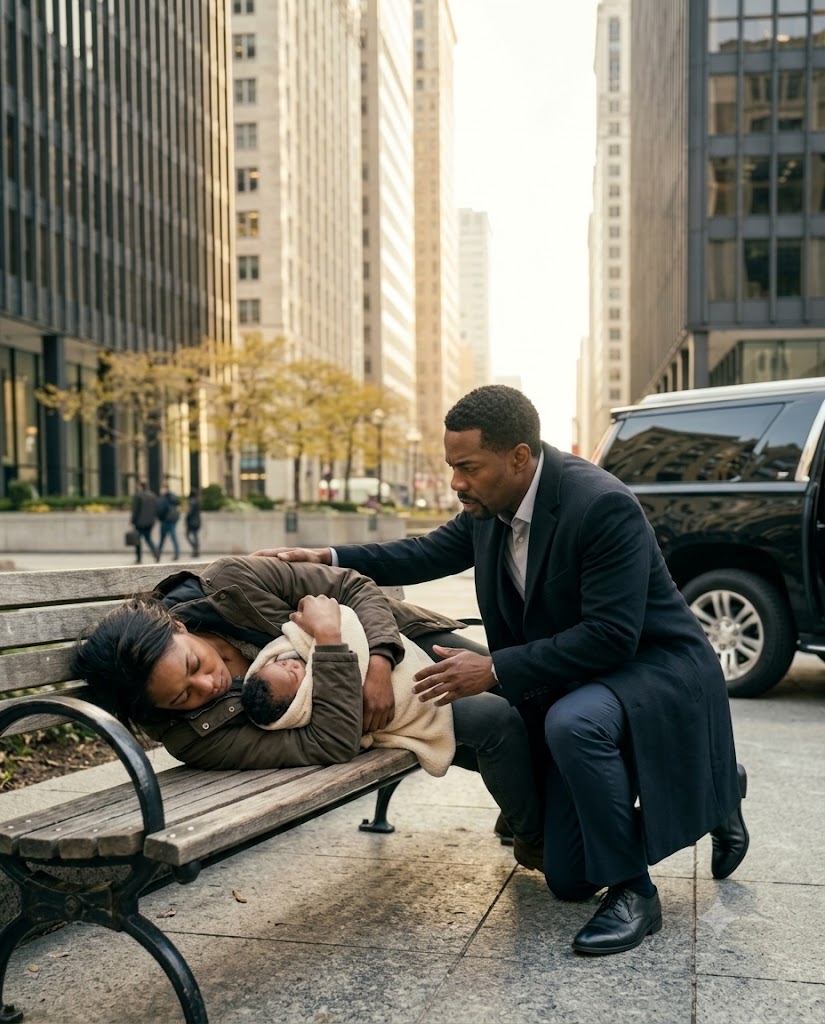
Late October in Chicago carries a particular kind of cold.
The kind that does not announce itself with wind or storm, but simply settles quietly into concrete and skin alike.
And at 11:47 that night, in a plaza most people only ever pass through on their way to somewhere warmer, a young woman named Denise Carter was arranging her coat over her 7-month-old daughter the way a person folds something they cannot afford to lose.
She tucked the fabric along the baby’s small shoulders and tested it with the back of her hand, checking for warmth the way she once checked bottles before bedtime.
Back when bedtime happened somewhere that had a roof and a door with her name on the lease.
The streetlights above her buzzed faintly, that dull electric hum you stop hearing after enough nights.
Though Denise had not been out here long enough to stop hearing anything yet.
Every sound still felt sharp.
Every shadow still felt like it belonged to someone.
She sat on a bench that had 20 minutes earlier held a stranger eating a sandwich.
And before that, two teenagers arguing about something that would not matter to either of them in a year.
Now it held Denise and her daughter Nia, whose name means purpose.
Though Denise had not planned that irony when she chose it.
She had simply liked the sound of it.
Purpose was not something she had been thinking much about lately.
Survival had crowded it out.
And if you had walked past her that night, you might not have looked twice.
Because that is the strange cruelty of a city like this one.
How easily a woman and her baby can disappear into a bench, into a coat, into a city that keeps moving because stopping has never once been required of it.
What we are about to tell you is not simply the story of one cold night.
It is the story of everything that had to happen quietly and cruelly for a woman like Denise Carter to end up on a bench in the first place.
And it is the story of what happened next.
Because at 11:47, as Denise adjusted the coat one final time and began almost without meaning to hum the same four notes her late husband used to hum to Nia before sleep, a car turned onto the street.
It was not loud.
That was the first strange thing about it.
Cars on that block usually announced themselves.
Engines straining, mufflers coughing, the ordinary noise of a city that cannot afford to be quiet.
This car made almost no sound at all, which somehow made it louder than anything else on the block.
The way silence in the wrong place always draws the eye faster than noise does.
It eased toward the curb the way expensive things ease into rooms they were built for.
Unhurried.
Certain of its welcome.
And Denise felt her body go still before her mind caught up to why.
She did not know yet who was inside.
Neither do you.
And we are going to ask you to sit with that not knowing for a moment, the same way Denise had to sit with it.
Because there is a question at the center of this story that matters more than any twist we could hand you early.
And it is simply this.
What would make a woman choose a park bench over every door she still technically had a key to somewhere in this city?
And what would make the richest man in that entire car choose, for reasons even he could not yet explain to himself, to stop?
We are not going to answer that yet.
What we will tell you is that the car did not immediately move again.
It idled at the curb the way a decision idles before it is made.
And inside, a hand rested on a door handle for three full seconds before pulling it.
Denise heard the click before she understood what it meant.
And by the time she looked up, all she could see in the wash of the street lamp was a single polished shoe touching down on wet pavement.
Careful.
Deliberate.
The kind of shoe that has never once had to walk anywhere it did not choose to walk.
She did not see a face.
Not yet.
What she saw was a stillness in the way that shoe waited, as if its owner were for the first time in a very long time unsure of what came next.
To understand how Denise Carter ended up on that bench, and why the sight of an unhurried car should have frightened her more than it should have given her hope, we have to go back three weeks.
To a Tuesday morning in a public school classroom on the South Side, where a piano missing one working key still managed somehow to sound almost in tune under her hands.
Denise taught music to second and third graders.
And if you had asked any of them what she was like, you would have heard some version of the same answer.
That Miss Carter kept snacks in her bottom drawer for the kids who came in without breakfast and never once made a show of it.
Sliding a granola bar across a desk the same way she might hand back a homework sheet.
As if feeding a hungry 7-year-old were simply part of the curriculum nobody had bothered to write down.
She had married young to a man named Marcus, a warehouse supervisor with a laugh that filled up a room and a habit of humming while he worked that Nia had apparently inherited before she was even born.
Their life together had never been wealthy.
Not by any definition the man in that black car would recognize.
But it had been, by Denise’s own account, enough.
Enough rent paid on time.
Enough groceries in the cart.
Enough love in a two-bedroom apartment that Marcus always swore they would grow into properly once things settled down.
Though things, in the particular way life often arranges itself for families like theirs, never quite got around to settling.
There was one evening seven months before Nia was born when Marcus mentioned something about a policy almost in passing.
The way people mention things that feel important to them but not urgent enough to explain in full.
Denise remembers it only because Nia had laughed for the very first time that same night.
A small hiccupping sound that swallowed every other conversation in the room.
And Denise, understandably, had let the comment about the policy pass without asking what he meant.
She would think about that moment many times in the months that followed.
Turning it over the way you turn over a coin looking for a mint mark you are not even sure exists.
Wondering what exactly her husband had been trying quietly to tell her.
Marcus died on a Thursday in March.
Not from violence.
Not from anything anyone could have prevented with more caution or better luck.
But from an aneurysm that gave no warning and asked no permission.
The kind of death that leaves the living feeling almost insulted by how ordinary the morning had seemed right up until it wasn’t.
Denise remembers holding Nia at the funeral.
Remembers the particular weight of a baby who does not yet understand grief but somehow absorbs it anyway through the tension in her mother’s arms.
She remembers Marcus’s mother, Yvonne, standing beside her in the church pew, one hand resting on Denise’s shoulder with a grip that was even then a fraction too firm to be only comfort.
Grief has a way of exposing which relationships were built on love and which were simply built on proximity to someone everyone loved.
And in the weeks after the funeral, Denise learned this distinction the hard way.
It began with paperwork.
The unglamorous machinery that grinds on underneath every tragedy.
And it was in that paperwork that Denise discovered something that knocked the air out of her more completely than the funeral itself had.
Eight months before Marcus died, his name had been quietly removed as the primary point of control on the very insurance policy he had once mentioned in passing.
Replaced through a set of documents Denise had never seen and never signed.
And the apartment lease, it turned out, had been co-signed by Yvonne from the very beginning.
A detail Denise had known in theory but never once expected to matter.
It mattered now.
Because Yvonne, grieving her only son in her own complicated way, decided that grief gave her the right to reclaim what she had in her mind only ever lent to her son’s marriage.
She arrived at the apartment on a gray Saturday with a locksmith already scheduled for the following Monday.
And when Denise asked her, gently at first and then with less patience as the conversation wore on, why she was doing this, Yvonne said the kind of thing that grief sometimes lets people say without fully understanding how permanently it will be remembered.
She told Denise that she had never really been family.
Only someone Marcus happened to love.
And that Nia, as her only living connection to her son, deserved stability that Denise, in Yvonne’s estimation, could no longer promise.
Denise did not scream.
She did not throw anything, though every part of her would later admit she wanted to.
She simply asked for time.
And Yvonne, in the particular cruelty of someone who believes she is protecting a memory rather than destroying a family, gave her three weeks.
Three weeks to find another home.
Three weeks to prove she could stand on her own in a city that has never once made that easy for a widow with a baby and a teacher’s salary that barely covered rent even with two incomes.
Denise spent the first of those weeks doing exactly what a reasonable, responsible woman is taught to do when wronged.
She found a lawyer.
The lawyer’s office smelled like burnt coffee and old carpet.
And the woman behind the desk, a public interest attorney named Patrice who had clearly seen a hundred stories like Denise’s, was kind in the specific exhausted way of someone who cares deeply but has learned not to promise outcomes she cannot control.
Patrice explained, as gently as the truth allowed, that without documentation proving Denise’s name belonged on that lease independent of Yvonne’s signature, and without the money to fight a drawn-out custody-adjacent battle over housing and inheritance, the system Denise was hoping would protect her would instead most likely exhaust her long before it ever ruled in her favor.
It was not malice on Patrice’s part.
It was math.
Denise left that office understanding for the first time fully that her fight was not only against one grieving mother-in-law but against a slower, colder machine that simply was not built with women like her in mind.
She tried other doors.
A private music school across town had a teaching position open.
Better pay.
Benefits.
The kind of stability that might have let her fight Yvonne on more equal footing.
And Denise interviewed for it in a blazer she had pressed twice to hide the wear at the collar.
She was good in that interview.
She knew she was good.
But the final question, asked almost as an afterthought, was about child care arrangements.
And when Denise explained honestly that she was between arrangements while dealing with a family situation, she watched the interviewer’s expression shift ever so slightly into the practiced sympathy of someone who has already decided the answer and simply hasn’t said it out loud yet.
She did not get the job.
Nobody told her explicitly why.
Though she suspected, and later confirmed through a mutual contact, that stability had been the deciding factor.
The same word Yvonne had used, now weaponized a second time by a different institution entirely.
With rent due and no lease of her own to point to, Denise made the kind of decision that people who have never had to make it tend to judge quickly, and people who have made it themselves tend never to speak of easily.
She sold her wedding ring.
The pawnbroker, an older man named Otis who had clearly done this exact transaction with a hundred grieving people before her, handled the ring with more gentleness than the moment strictly required.
Turning it under the light.
Quoting a number that both of them knew was less than it was worth and more than Denise had any right to expect given how quickly she needed the cash.
She did not cry in the shop.
She cried in the car afterward, alone with Nia asleep in the back seat.
The ring’s absence on her finger somehow louder than its presence had ever been.
Yvonne sent one final message before the three weeks were up.
A text Denise would read so many times the words eventually lost their shape and became simply a kind of ambient dread she carried in her chest.
Yvonne said she would be holding on to Nia’s crib and several other items from the apartment.
For when things are more stable.
A phrase that Denise understood immediately was not about furniture at all.
It was a warning.
It was Yvonne testing the water on a custody conversation neither of them had said out loud yet.
And Denise read it standing in the kitchen of the apartment she had three days left to vacate, feeling something in her chest tighten that had nothing to do with grief and everything to do with fear.
The shelter Denise had lined up as a backup plan filled its final bed the same week her three weeks ran out.
An intake worker explaining apologetically that demand had simply outpaced capacity that particular month, as if scarcity were weather rather than policy.
Denise stood in that lobby with Nia on her hip and her entire remaining life in two duffel bags at her feet.
And she did the math the way mothers in her position are forced to do it.
Quickly.
Without the luxury of panic.
Calculating which of the three remaining options in front of her was the least dangerous rather than which was good.
She chose the plaza.
Not because it was safe.
Because it was visible.
Well lit.
Close enough to the shelter that she could be first in line if a bed opened overnight.
And because Reggie Coombes, the night security guard who patrolled that block, had a reputation whispered among the handful of people who slept rough in that neighborhood for treating people like neighbors instead of problems.
Reggie noticed her on the second night, though he did not approach right away.
Choosing instead to simply exist nearby in the unobtrusive way of someone who understands that dignity matters even to people who have very little else left to protect.
He left a thermos near the bench the third night.
Filled with hot water and a small handful of tea bags.
And said nothing about it, continuing his rounds as though the thermos had simply appeared there on its own.
It was such a small thing.
It did not fix anything.
But Denise would later say that the thermos was the first moment in weeks she had felt like a person again instead of a problem waiting to be solved or ignored.
The fourth night was the worst one.
Nia, who had been fussy all evening, grew warm to the touch in a way that made Denise’s stomach drop the moment she pressed the back of her hand to the baby’s forehead.
The exact same gesture she used to test the warmth of a coat, now measuring the heat of a fever instead.
Denise counted the bus fare in her coat pocket twice.
Her hands shaking not from cold this time but from the particular terror unique to mothers without a car at two in the morning.
And made it eventually to an emergency room where a nurse, kind but visibly stretched thin across too many patients and too few hours, examined Nia, pronounced her stable, and handed Denise a pamphlet listing shelter resources Denise had already exhausted weeks earlier.
It was not cruelty.
It was exhaustion passed from one exhausted system to another exhausted woman.
The way exhaustion so often is.
Denise carried Nia back to the only place that had begun to feel, in the strangest and saddest way, like a known quantity.
And it was there, back on that bench, that she began humming again.
The same four notes Marcus used to hum before bedtime.
Notes she had not realized she’d memorized until grief forced her to reach for them.
She was still humming when the black car turned onto the street.
She was still humming when it eased, without hurry, toward the curb.
And she was still humming, quietly, protectively, one hand resting over Nia’s back, when the door opened and a single polished shoe touched down on the wet pavement, waiting there for three full seconds before its owner decided finally to stand.
The man who stepped out of that car was not, in the first several seconds, anyone Denise recognized.
And that in itself unsettled her more than a stranger’s face might have.
Because there is a particular kind of danger in not knowing who has stopped for you at two in the morning, and a particular kind of relief that comes only after you understand exactly why.
He did not rush toward her.
He did not call out.
He stood at the open car door for a long moment, one hand still resting on its frame, as though some part of him were still deciding whether stepping fully onto that sidewalk was a decision he was prepared to live with.
Denise would later learn that his name was Elijah Banks.
Though in that first moment, he was simply a shape in an expensive coat, backlit by street lamp, standing very still.
What Denise did not know, and what the world at large certainly did not know either, was that Elijah Banks was not having an ordinary night anymore than she was.
He had spent the earlier hours of that evening somewhere he rarely allowed himself to go.
A small private ceremony marking the anniversary of his wife’s death.
A woman named Karen, who had been gone now for six years.
Though Elijah still, out of some stubborn private habit, wore his watch on the wrong wrist.
The one she used to fasten it onto for him when his hands were full of something else.
He had told his driver, a patient man named Walt who had worked for him long enough to know when silence meant grief and when it meant business, to simply take the long way home.
Walt had not asked why.
Walt never did.
Elijah had built an empire out of shipping routes and logistics contracts most people never think about until a package arrives late.
And by every public measure, he was a man who got exactly what he wanted, ruthlessly and efficiently.
A reputation he had cultivated on purpose, because vulnerability in the rooms he occupied was treated as a weakness to be exploited rather than a truth to be honored.
Almost no one who worked for him had ever seen him hesitate.
But he was hesitating now.
Standing on a cracked sidewalk in a neighborhood his own company’s trucks rolled through every single day without him ever once looking out the window to see what those streets actually held.
And some part of him understood, dimly, that this hesitation itself meant something.
He almost got back in the car.
He would admit this later, plainly, without dressing it up into something more flattering than it was.
He had looked at the woman on the bench, at the small bundle wrapped so carefully against her chest, and some old practiced instinct in him had already begun composing the sentence he would say to Walt.
Something about how it wasn’t his responsibility.
How the city was full of people who needed help, and a man could not possibly stop for every one of them.
A sentence that had gotten him through a hundred similar moments over the years without ever once costing him a night’s sleep.
But before the sentence could fully form, Nia stirred against her mother’s chest, lifted one small hand out from beneath the coat, and reached.
The way infants do.
Toward the nearest warm shape in front of her, which happened in that particular second to be Elijah.
It was such a small gesture.
It meant nothing, biologically speaking, beyond the simple reflex of a baby responding to movement and light.
But Elijah Banks stood on that sidewalk and felt something crack open in his chest that he had spent years keeping carefully sealed.
Because the last time a small hand had reached toward him like that, unguarded and trusting, it had belonged to his own son, Malcolm, more than two decades earlier.
Before ambition and grief and a series of unspoken grievances had turned their relationship into something closer to a formality than a family.
Elijah had not spoken to Malcolm in three years.
Not one real conversation.
Just holidays acknowledged through assistants.
Birthdays marked with gifts too expensive to mean anything.
Silence dressed up as distance and distance dressed up as respect for boundaries neither of them had ever actually discussed out loud.
He walked toward the bench.
Denise watched him come.
Every muscle in her body tightening the particular way a body tightens when it has learned through hard experience that strangers approaching at that hour rarely bring good news.
She did not stand.
She did not retreat either.
She simply watched him.
Her hand resting protectively over Nia’s back.
Her spine straight in the exact way Patrice, her attorney, had once told her mattered more than people realized.
Because the world treats a woman who looks afraid very differently than it treats a woman who merely looks alert.
Elijah stopped a respectful distance away.
Close enough to speak without raising his voice.
Far enough that Denise did not feel crowded.
And for a moment, neither of them said anything at all.
When he finally spoke, his voice was quieter than Denise expected from a man dressed the way he was dressed, standing beside a car worth more than everything she currently owned combined.
He asked simply if she and the baby were all right.
And Denise, who had grown fluent over the past several weeks in the particular art of deflecting concern from strangers who usually wanted nothing more than to feel good about themselves for five minutes before driving away, told him they were fine.
Thank you.
In the flat, practiced tone of a woman closing a door before it could be pushed open further.
Elijah did not push.
He simply stood there a moment longer and then, almost to his own surprise, admitted that he was not entirely sure why he had stopped.
That something about the sight of her had made continuing to drive feel, for reasons he could not fully explain, impossible.
Denise studied him for a long moment, weighing something Elijah could not name.
And then she asked him directly why a man who clearly did not belong on this street was standing on it at nearly two in the morning.
It was not hostile, the question.
But it was not soft either.
And Elijah found himself answering more honestly than he had answered anyone in longer than he cared to admit.
Telling her in a few clipped sentences about the anniversary.
About the long way home.
About a habit of driving through parts of the city he owned businesses in but had never actually looked at closely.
Denise listened without softening visibly, filing the information away the way a person files away anything from a stranger whose intentions are still unproven.
Useful.
But not yet trustworthy.
He offered eventually to pay for a hotel room for the night, framing it as simply as he could.
No strings.
No expectation.
Just warmth and a locked door for a few hours.
It was, on its face, an easy thing to accept.
And any reasonable person watching from a distance might have wondered why Denise did not immediately say yes.
But Denise understood something Elijah, for all his wealth, did not yet grasp.
Which was that the plaza bench, uncomfortable and cold as it was, had become the one fixed point in an otherwise collapsing map.
The place where the shelter’s overnight intake counselor knew to find her if a bed opened before morning.
To leave the bench, even for one warm night, risked losing the only thread still connecting her to tomorrow’s possibility of something better.
She explained this to him plainly, without apology.
And Elijah, who had spent years surrounded by people who told him only what he wanted to hear, found himself genuinely struck by the clarity of her reasoning.
The way she had already calculated risks and trade-offs he had never once in his life been forced to consider.
He did not argue with her logic.
Instead, he asked what would actually help.
A question so simple and so rarely offered honestly that Denise, for the first time that night, felt something in her chest loosen slightly.
She told him she needed information more than charity.
Needed to know his name and where he worked before she trusted him with anything more than five minutes of conversation on a public bench at two in the morning.
He gave her both without hesitation.
And something about the ease of that honesty, the fact that he did not flinch or deflect the way people with something to hide often do, settled a small piece of Denise’s guarded instincts.
She asked Reggie, who had drifted closer once he noticed the black car, to walk with them to the vehicle.
A request Elijah did not push back against, understanding without needing it explained that this was not distrust so much as a woman refusing, even now, even here, to be careless with her own safety or her daughter’s.
Reggie walked the short distance beside them, quiet and watchful.
And only once Denise was settled in the back seat, Nia secure against her chest, did he step back onto the curb and nod once, satisfied, before returning to his rounds.
The ride to the hotel was mostly silent, though not an uncomfortable silence.
The kind two strangers share when neither feels obligated to fill it with small talk they don’t mean.
Denise watched the city slide past the window.
The same streets she had walked past countless times on foot now moving by at a speed that felt almost unreal.
And Elijah, seated across from her, found himself studying the careful way she held Nia.
The way even exhaustion had not softened her vigilance.
And he thought, though he did not say it aloud yet, that there was something in the shape of that vigilance he recognized from his own life.
Though he could not yet say exactly where.
It was Elijah’s assistant, a sharp and deeply loyal woman named Simone Baptiste, who first raised an eyebrow the following morning when Elijah asked her, almost offhandedly, to quietly look into the details of Denise Carter’s situation.
Framing it as due diligence.
The kind of careful verification a man in his position was accustomed to running before extending trust to anyone.
Simone had worked for Elijah long enough to know when a request was purely procedural and when it carried something heavier underneath it.
And this one, she noted privately, carried weight Elijah himself did not seem fully aware of yet.
She pulled together what she could within a day.
Court filings.
Public records.
The outline of a story that was, on its surface, tragically ordinary and underneath about to reveal itself as anything but.
What Simone found, and brought to Elijah two mornings later in a plain folder she sat carefully on his desk without ceremony, was the detail that would eventually reframe everything Denise herself believed about the collapse of her own life.
Buried in outdated insurance paperwork was a trust established quietly eight months before Marcus Carter’s death.
Naming Nia as sole beneficiary.
And listing a co-trustee neither Denise nor Yvonne had ever been told existed.
An old college friend of Marcus’s named Douglas Apprentice, who had drifted out of regular contact with the family years earlier but remained, on paper, legally bound to protect exactly the kind of future Denise had been fighting for blindly this entire time.
The reason Marcus Carter made a decision so significant without ever once mentioning it to the woman he loved most in the world begins quietly eleven months before his death.
In a routine physical he almost skipped because the warehouse was short-staffed that week and he did not want to leave his team scrambling over what he assumed would be nothing more than a formality.
It was not nothing.
The doctor found an irregularity in his heart.
A condition that was, in the specific and cruel language of medicine, manageable but unpredictable.
The kind of diagnosis that hands a person a future measured not in certainty but in probability.
Marcus sat in that office alone, having told Denise it was simply a routine checkup, and listened to a physician explain gently that he could live decades with proper care.
Or he could not, without any real warning at all.
He did not tell Denise.
This is the part of the story that people tend to judge quickly and understand slowly.
Because on its surface it looks like a betrayal.
A husband keeping something enormous from his wife.
And in some ways it was exactly that.
But Marcus, in the particular logic of a man raised to believe his job was to shoulder fear so the people he loved never had to carry it, decided that telling Denise would only give her something to grieve twice.
Once in anticipation.
And once for real.
And he could not bring himself to do that to a woman who was, at the time, newly pregnant and already carrying enough.
Instead, he began quietly preparing for a future he hoped never to need.
The way a person boards up windows before a storm they pray will change course.
He knew his mother.
This is the detail that matters most.
Because Marcus understood, in a way Denise herself did not yet fully see, that Yvonne’s grief, if it ever came to that, would not express itself as generosity toward her daughter-in-law.
But as a desperate, misguided grasp for control over whatever remained of her son.
He loved his mother.
He also knew her clearly enough to protect against her.
Which is its own complicated kind of love.
The sort that does not require blindness to remain real.
So eight months before he died, without telling Denise, without telling Yvonne, Marcus met with a lawyer recommended by an old college friend and established a trust in Nia’s name.
Structured deliberately so that no single relative, however well-intentioned or however wounded by grief, could ever gain full control over his daughter’s future.
He chose Douglas Apprentice as co-trustee specifically because Douglas had no entanglement with either side of the family.
No stake in old resentments.
Nothing to gain personally from favoring one party over another.
Only a legal obligation to protect Nia’s interests exactly as Marcus had outlined them.
It was, in its own quiet way, an act of extraordinary foresight from a man who believed he had years left to explain all of it properly.
To eventually sit Denise down and walk her through every document, every decision, every reason.
Once the fear of frightening her had faded and the whole arrangement could be framed as simple prudence rather than a confession of mortality.
He never got that conversation.
The aneurysm that killed him gave him no warning at all.
Arriving on an ordinary Thursday exactly the way his doctor had once said it might.
Without permission.
Without mercy.
Without the courtesy of letting him finish what he had started.
Douglas Apprentice, when Simone finally reached him by phone, was somewhere between stunned and ashamed.
Admitting immediately that he had heard about Marcus’s death through a mutual acquaintance months earlier and had assumed, incorrectly and with a guilt he clearly still carried, that the family’s attorney would have already contacted him about the trust.
He had not reached out himself, uncertain of his place in a grieving family he barely knew anymore.
And had let months slip by in the particular paralysis of a person who means to do the right thing and simply never finds what feels like the correct moment.
When Simone explained what had happened to Denise in the meantime, the bench, the shelter, the months of fighting a battle she never needed to fight because the money had been protected the entire time, Douglas was audibly shaken.
Repeating more than once that he should have called sooner.
That he had no excuse worth offering.
Elijah sat with all of this information for a long time before deciding how to bring it to Denise.
Understanding instinctively that a story this large, delivered carelessly, could feel less like liberation and more like another blow.
Another institution deciding things about her life without her presence in the room.
He asked Simone to arrange a meeting not at his office, which he suspected would feel intimidating and transactional, but at Patrice’s office instead.
The same public interest attorney who had already earned Denise’s trust weeks earlier.
Because Elijah understood, with a clarity that surprised even him, that this news needed to be delivered by someone Denise already believed was on her side.
Not by a billionaire who had known her for barely seventy-two hours.
Denise sat in Patrice’s small office on a Thursday afternoon, Nia asleep in a carrier at her feet, and listened as Patrice, working from documents Douglas had finally released, explained slowly and carefully that the insurance money Denise had believed lost, the policy she thought Marcus had simply let lapse or Yvonne had somehow stolen, had never actually been in danger at all.
That it sat protected in a trust bearing her daughter’s name.
Established by her husband months before his death, specifically to shield Nia’s future from exactly the kind of conflict that had unfolded.
Denise did not speak for nearly a full minute.
She simply sat there, one hand pressed over her mouth, understanding for the first time that every sleepless night, every argument with Yvonne, every rejected job application blamed quietly on instability, had all taken place while the money was never actually gone.
What broke something loose in her more than the money itself was the realization that Marcus had spent the last months of his life quietly protecting her without ever once letting her see the fear underneath it.
And she did not know, sitting in that office, whether to feel grateful or furious or simply hollowed out by grief she thought she had already fully processed months earlier.
Patrice, who had clearly guided other clients through this exact tangle of relief and anger before, let the silence sit without rushing to fill it.
Understanding that some news requires room before a person can respond to it out loud.
It was during this same period that Elijah found himself unable to stop thinking about the parallel he could not ignore.
Because the very mechanism Marcus had used to protect Nia from a distance, quietly, without confrontation, was structurally almost identical to a trust Elijah himself had set up for Malcolm years earlier.
Back when their relationship had first begun fraying.
A trust meant to ensure Malcolm’s future security regardless of whatever distance existed between father and son.
Elijah had told himself for three years that the trust was sufficient.
That providing for Malcolm financially satisfied whatever obligation remained between them.
And that the silence stretching between their actual conversations was simply the unfortunate but manageable cost of a relationship that had grown too complicated to easily repair.
Watching Denise, a woman who had lost nearly everything and still refused to let fear keep her from asking hard questions, from demanding honesty, from insisting on being seen as a full person rather than a problem to be managed, forced Elijah to confront something about himself he had spent three years successfully avoiding.
He had not protected Malcolm from a distance the way Marcus had protected Nia.
He had simply hidden from him.
Dressing avoidance up as respect.
Distance up as boundaries.
And calling the entire arrangement peace when it had never actually been anything but silence stretched thin enough to look, from the outside, like resolution.
He called Malcolm on a Sunday evening.
A call he had rehearsed in his mind so many times over three years that the actual moment of dialing felt almost unreal.
His thumb hovering over a name he had not pressed in longer than he cared to admit.
Malcolm answered on the fourth ring.
His voice carrying the particular weariness of someone who has learned not to expect much from a call that begins without warning.
And the conversation that followed was not smooth.
Was not the clean, cinematic reconciliation either man might once have imagined in weaker, more hopeful moments.
Malcolm was angry, and rightly so.
Naming specific instances of absence.
Birthdays acknowledged only through assistants.
A graduation Elijah had missed for a shipping contract he could no longer even remember the details of.
And Elijah did not defend himself against any of it.
Understanding, for perhaps the first time, that defense was not what this particular moment required.
He simply listened.
And when Malcolm finally ran out of grievances to list, exhausted by his own anger in the way people sometimes are, Elijah told him plainly that he was not calling to explain himself.
But to ask if there was any chance, any chance at all, that they could start having actual conversations again.
Not birthday calls.
Not holiday texts routed through Simone.
But real ones.
The kind that risked discomfort because the alternative, distance dressed as peace, had already cost them three years neither of them would ever get back.
Malcolm did not forgive him on that call.
Nobody watching honestly would have expected him to.
But he agreed quietly to meet in person the following week.
And for Elijah, who had spent three years believing a trust fund could substitute for presence, that single agreement felt heavier than any business deal he had closed in decades.
Denise, meanwhile, faced her own difficult conversation.
One she had been avoiding even after learning the money had never actually been at risk.
Because knowing Nia’s future was secure did not erase the wound Yvonne’s words had left.
The accusation that Denise had never truly been family.
Only someone Marcus happened to love.
She arranged to meet Yvonne.
Not in anger, though anger would have been understandable, but with a clarity she had been building slowly across weeks of hardship that had, in a strange way, sharpened rather than dulled her sense of who she wanted to be.
She told Yvonne plainly and without cruelty exactly what Marcus had done and why.
Watching the older woman’s face shift from confusion to something closer to devastation as the full shape of her son’s quiet foresight became clear.
Yvonne did not apologize immediately.
And Denise, to her own credit, did not demand that she do so on any particular timeline.
Instead, Denise offered something neither expected nor legally required.
A supervised, honest role in Nia’s life going forward.
Conditioned only on Yvonne’s willingness to be truthful about her own fear rather than continuing to disguise it as protection.
Yvonne broke down fully then.
Admitting, haltingly, that blaming Denise had always been easier than accepting that her son was simply gone.
That as long as there was a villain in the story, she did not have to sit alone with grief that had no one left to direct itself against.
It was not a clean resolution.
Grief rarely offers clean resolutions.
But it was, for the first time since the funeral, an honest one.
Denise returned to the plaza one final time before the last of the paperwork with Patrice and Douglas was finalized.
Not out of any particular sentimentality, but because she understood, in a way that felt important to her, that leaving that chapter of her life without properly thanking Reggie would have been its own kind of dishonesty.
She found him midway through his rounds, thermos in hand as always, and told him plainly what had happened.
Watching his face soften into something between pride and relief as she spoke.
Reggie waved off her thanks the way people who helped quietly and without expectation of recognition often do.
Though Denise noticed, and would remember for a long time afterward, the way his eyes stayed on her and Nia a moment longer than necessary before he simply nodded once and continued on his way.
Satisfied in the particular quiet manner of a man who had done exactly what he believed a person should do for a neighbor in need.
When Elijah offered, in the weeks that followed, to simply take care of everything for Denise going forward, covering an apartment, arranging ongoing support, smoothing every remaining rough edge of her transition with a kind of unlimited resource most people never get access to in a lifetime, Denise turned him down.
Not out of pride exactly, though pride was certainly part of it.
But out of a clear-eyed understanding of what she actually wanted.
Which was not charity but partnership.
Not rescue but respect.
She asked him instead to help her establish the Nia Carter Trust properly.
Formalized and structured to eventually support other mothers facing the exact collapse she had survived.
And to help her find real work.
Teaching.
The thing she was actually good at.
Rather than simply absorbing his money without purpose.
Elijah agreed immediately.
Understanding, with the same clarity that had first drawn him out of his car on that October night, that this was precisely the kind of request that deserved honoring exactly as asked.
Eight months later, in the particular brightness of a Chicago spring that felt almost deliberate in its contrast to the October cold where this story began, Denise stood in front of a piano at a community center on the South Side.
Teaching a room full of children the same four notes Marcus used to hum.
Funded in part now by the trust bearing her daughter’s name.
A trust that had grown to help other mothers she had met through the very shelter system that had once failed her.
Nia was walking now.
Unsteady but determined, the way toddlers always are.
And Elijah, who had become a recurring and increasingly ordinary presence in their lives rather than a distant benefactor, showed up that afternoon the way he now often did.
Not with grand gestures, but simply with time.
Sitting near the back of the room and listening to children butcher a scale with more patience than most of his former board meetings had ever received from him.
Malcolm was there, too.
Standing near the doorway with his own wife.
The reconciliation between father and son still imperfect, still occasionally strained, but real in a way three years of silence had never once managed to be.
A quiet, ongoing conversation rather than a single dramatic resolution.
Later that evening, walking Nia past the same plaza where this entire story had first begun, Denise found herself pausing at the same bench.
Now simply a bench again.
Ordinary.
Unremarkable.
No longer the last fixed point on a collapsing map, but simply a place she had once sat because she had nowhere else left to go.
She sat down for a moment, watching Nia toddle a few careful steps toward a pigeon that immediately lost interest and flew off.
And when another woman, unfamiliar, tired-looking, sat down at the opposite end of the bench a few minutes later, Denise did not think twice before reaching into her bag and offering her own thermos.
Warm water.
Tea bags tucked inside.
Exactly the way Reggie had once offered them to her.
Without ceremony or expectation.
The Nia Carter Trust, small in its first year, began with a single promise Denise had made to herself long before she ever had the resources to keep it.
That no mother in her position should have to choose between a shelter bed and a stranger’s kindness the way she once had.
Within eight months of its founding, the trust had quietly funded emergency housing for eleven families.
Most of them referred not through official channels, but through Reggie.
Who had, almost without anyone deciding it formally, become the trust’s unofficial eyes on the street.
The man who knew which bench, which doorway, which face needed a phone call made on their behalf before another cold night set in.
One of those eleven families belonged to a woman named Tamara Whitfield.
A widow herself, raising two boys on an income that never quite stretched far enough.
And when Denise first sat across from her in Patrice’s small office, the same office where Denise had once learned her own fortune had been protected all along, she recognized something in Tamara’s careful, guarded posture that she remembered intimately from her own reflection months earlier.
Denise did not offer Tamara charity wrapped in pity.
She offered her the same thing Elijah had eventually learned to offer.
Presence without condescension.
Resources without strings.
The simple dignity of being asked what she actually needed rather than being told what she should be grateful for.
Yvonne, for her part, did not transform overnight into the mother-in-law Denise had once hoped for in the earliest days of her marriage.
But Yvonne began showing up.
First hesitantly, then with more consistency, to small moments in Nia’s life.
A recital.
A Sunday dinner.
A quiet Saturday afternoon at the park.
And Denise, who had promised her only honesty in exchange for access, watched Yvonne slowly relearn how to be present without needing to control the terms of that presence.
It was not forgiveness exactly.
It was something slower and, in its own way, more durable than forgiveness tends to be.
Douglas Apprentice, still carrying the particular guilt of a man who had let months slip by in silence when a single phone call might have spared Denise so much of what followed, asked to remain involved with the trust beyond his original legal obligation.
And Denise, after some consideration, agreed.
He began handling the trust’s legal groundwork for every new family it took on.
Working, notably, without pay.
A quiet penance he never called by that name, but that everyone around him understood exactly for what it was.
Elijah’s relationship with Malcolm did not follow the arc of a single redemptive phone call either, though that call remained, for both of them, the hinge on which everything afterward turned.
There were setbacks.
There was one particularly difficult dinner, four months in, where old resentments resurfaced sharply enough that Malcolm left early and did not answer his father’s calls for nearly two weeks afterward.
Elijah, who might once have interpreted that silence as confirmation that the effort was not worth continuing, instead did something he had never done in three years of distance.
He simply waited.
Without pulling back.
Without retreating into the safety of assuming the relationship was beyond repair.
And when Malcolm finally called again, it was Elijah who apologized first.
Plainly.
Without excuses.
For whatever had gone wrong at that dinner, whether or not he was entirely certain it had been his fault.
By the following autumn, almost exactly one year after the night Elijah’s car first eased to a curb on a street he had never actually looked at closely before, Malcolm’s wife gave birth to a daughter.
And Elijah, standing in a hospital room holding his granddaughter for the first time, found himself thinking unexpectedly of a small hand reaching out from beneath a coat on a cold October night.
And of how that single unplanned gesture had quietly rerouted the rest of his life in ways no amount of money or ambition ever had.
Otis, the pawnbroker who had once handled Denise’s wedding ring with more gentleness than the transaction required, closed his shop two years later.
Retiring quietly after four decades behind that counter.
And Denise drove across town on his final afternoon of business simply to thank him.
Though he did not remember her specifically among the thousands of grieving, desperate faces that had crossed his counter over the years.
She did not need him to remember.
She only needed him to know that his gentleness, however routine it had felt to him, had mattered enormously to someone on one particular afternoon.
Reggie retired from his security post the following spring.
His knees finally giving out after decades of night rounds and weather that spared no one.
And a trust, at Denise’s insistence, created a modest pension for him that he initially refused with the same quiet stubbornness he had once shown refusing thanks for a thermos.
He accepted it eventually.
Not because he needed convincing of his own worth, but because Denise pointed out plainly that refusing help gracefully offered was its own kind of pride.
Denise did eventually remarry, several years later, to a man named Curtis.
A widower himself.
Gentle and unhurried in a way that never once asked her to forget Marcus or hurry past her grief on anyone else’s timeline.
Yvonne lived to see Nia start kindergarten.
Sitting proudly in the audience at a small school assembly.
No longer the woman who had once told Denise she was never truly family, but something closer now to what Marcus had always hoped she might eventually become.
Imperfect still.
But present.
And honest.
And finally at peace with a son she could no longer control, but had learned, slowly, simply to remember with love instead of grievance.
The plaza itself changed very little over the years, as plazas tend to do.
Indifferent to the private histories unfolding on their benches.
And that indifference, Denise came to understand, was not cruelty.
But simply the nature of public space.
Which holds no memory of its own and asks nothing of the people who pass through it beyond their willingness to notice one another while they can.
She kept walking past it.
Some years more often than others.
And she never stopped, even decades later, glancing toward that particular bench with something that was no longer grief exactly, but was not quite nothing either.
A kind of respectful acknowledgment of the woman she had once been.
And the night that had quietly decided who she would become instead.
And so the story that began with a cold October night, a bench, and a car that eased too quietly to the curb, closes not with a single dramatic ending, but with the ordinary accumulating weight of years lived well.
Of debts repaid not in money, but in presence.
Of a kindness that started with a thermos and a stranger’s hesitation, and rippled outward slowly into more lives than either Denise or Elijah could have imagined.
Impossible on that particular night.
When neither of them yet knew the other’s name.
And both of them, in their own private ways, were simply deciding whether to stop.









