A Billionaire Found a Homeless Pregnant Woman Alone at a Dump—His Next Decision Changed Hundreds of Lives
“Take this road. Just drive. Tell the board I’m fifteen minutes out — not one minute more.”
Daniel Eze sat in the back of the black SUV, jaw tight, phone pressed to his ear. The Lagos traffic bled past him in a smear of brake lights and hawkers.
“Yes, I’m looking at the numbers right now. We close this deal before noon today. Delaying it further is not an option.”
His assistant’s voice crackled through the speaker, something about a delayed convoy, a reporter asking questions. He wasn’t listening.
Some mad woman. Keep moving. That was the thought already forming in his chest — the familiar, efficient dismissal of anything that wasn’t the deal.
“Stop the car.”
The driver didn’t hear him at first. Daniel leaned forward. “Stop the car.”
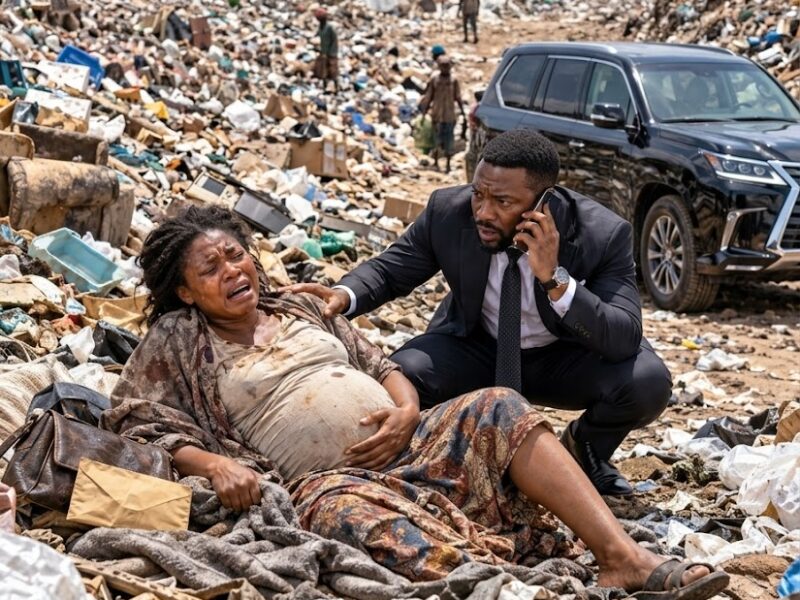
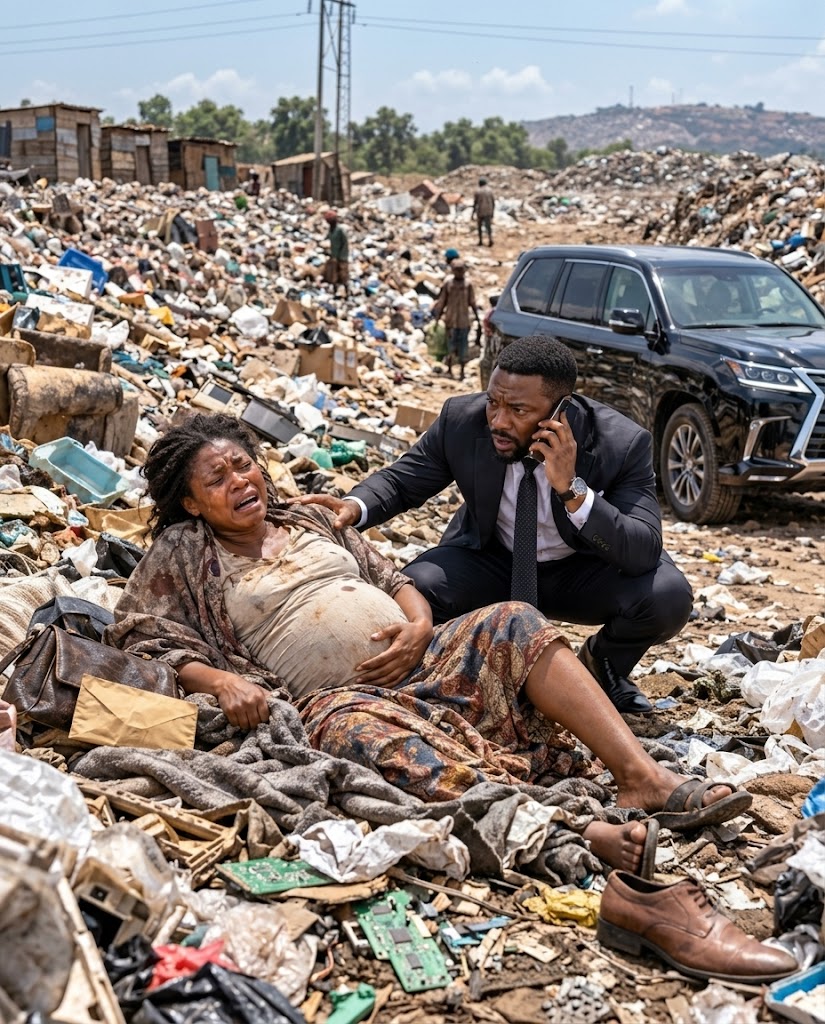
Through the windshield, at the edge of the refuse dump off the highway, a woman was on her knees in the mud. Pregnant. Alone. Her hand stretched toward the road like a question no one had answered in years.
“Help me, please.”
Daniel was out of the SUV before his bodyguard could protest. The smell hit him first — rot, smoke, something sweet and wrong. Then her eyes, unfocused, terrified, finding his.
“I’m here. Take my hand.”
“It hurts.”
“I’ve got you. You’re safe now.”
The words came out wrong. Too gentle. Unfamiliar in his own mouth, like a language he hadn’t spoken in a decade. Her grip closed around his fingers — and around a brown envelope she clutched to her chest like a child.
Even then, even reaching for him with the last of her strength, she did not let it go.
Daniel scooped her up — her, the envelope, all of it — and ran for the car.
The SUV swerved hard around a stalled bus, and the woman’s head knocked against the window. She barely felt it. The pain was coming in waves now, each one arriving before the last had fully left.
Somewhere beneath it, her mind kept sliding backward, away from the leather seat and the stranger’s cologne, into a kitchen that smelled of crayfish and onions. Too much salt. Chidi, leaning in the doorway in his work shirt, stealing a spoon from the pot before she could stop him.
That kitchen. That house in Ogodu — small but theirs, paid for in installments, tracked in a notebook he kept beneath the mattress like treasure.
Then came Kamsi’s laughter, sharp enough to hurt. The boy chasing a lizard across the compound wall, shrieking with a five-year-old’s joy before Chidi caught him mid-fall and swung him onto his shoulders.
Then nothing. A door closing somewhere inside her memory that she couldn’t make herself open.
Another contraction folded her forward. Daniel’s hand found her shoulder, awkward and unpracticed at comforting anyone.
“Almost there.”
She didn’t hear him. She was back in the front room years later, watching Chidi read a letter he wouldn’t let her see. His jaw had tightened in a way she’d never seen before.
“Someone I trusted,” he’d murmured. He never finished the sentence.
Whoever that person was, Chidi never said the name. Not once. Not through the bankruptcy. Not through Kamsi’s illness. Not through the night everything finally broke.
The car jolted to a stop outside the hospital gate. The woman’s eyes fluttered. Her lips moved. One word escaped.
Daniel went completely still — because the name she whispered was his.
Nurses swarmed the SUV before it had fully stopped, one already reaching inside to pull her toward the waiting stretcher. The moment the nurse’s fingers brushed the envelope, the woman came alive.
“No.”
She twisted away, curling around it with a strength that seemed to come from somewhere beyond her failing body.
“Nobody touch. Nobody.”
“Ma’am, we need to move you.”
“No.”
The scream cracked into a sob, her wild eyes suddenly fixed on Daniel with startling clarity.
“You,” she whispered. “You said you go keep it safe.”
He hadn’t said that. Not exactly. But Daniel found himself nodding anyway.
“Let her hold it until she’s on the bed,” he said, stepping between her and the nurse. “I’ll carry it after.”
It took another two minutes before she finally loosened her grip. Only when she was flat on the stretcher and Daniel’s hand had closed over the envelope in front of her did her fingers release — one at a time, reluctantly, as though she were letting go of a child.
The stretcher disappeared through the hospital doors. Daniel remained in the corridor holding the envelope.
It was old. The brown paper had faded almost gray at the corners, and a brittle rubber band held the flap shut. A narrow gap revealed a corner of paper. Handwriting, blue ink, slightly slanted.
The letters had been pressed hard into the page. The kind of handwriting produced by a man who was angry, frightened, or desperate.
Something about it made Daniel’s fingers tighten. A strange familiarity moved through him. He couldn’t explain it. He didn’t open the envelope — told himself it wasn’t his to open.
Instead, he slipped it into his jacket, against his chest. Only then did he realize his jaw had locked.
“Sir.”
Daniel looked up. A man in a gray administrator’s blazer approached, clipboard tucked beneath one arm. His expression was polite. Unhurried.
“Before the doctors can attend to her,” he said, “we’ll need a deposit.”
“How much?”
The administrator glanced at his clipboard as though the number required consultation. “Two hundred fifty thousand naira before she enters the ward.”
Through the glass behind him, Daniel could see the stretcher parked in the corridor. A nurse checking the woman’s pulse with the unhurried calm of someone who had learned not to rush for patients who couldn’t pay.
His phone buzzed. Then again. He didn’t look. He already knew it was his assistant, and he already knew what she’d say. He looked anyway.
*Board is asking questions. Investors called about the convoy delay. Please advise.*
A second message appeared from a number he didn’t recognize. *Sir, is it true you stopped for a woman at the dump? Punch newspapers.*
Something inside Daniel tightened. It had nothing to do with the envelope pressed against his ribs.
For one long, cold second, the thought came easily. *Give the man my card. Tell them to admit her. Get back in the car.*
It would be simple. His bodyguard would stay behind. Daniel could be at the boardroom table before anyone noticed he was gone. By evening, this could become nothing more than an embarrassing story he told no one.
He had done this before. He didn’t know yet that he had done this before — not consciously, but his body remembered the shape of the decision, the particular relief of turning away from something inconvenient.
“Oga.”
His driver’s voice was quiet, but it landed like a hand on Daniel’s shoulder.
“Some things,” the man said, eyes fixed on the hospital doors, “money can’t undo if we waste time.”
Daniel looked through the glass. The woman’s face was gray with sweat. Her eyes were half closed. One hand remained curled around the place where the envelope had been.
He reached into his wallet. The card landed on the administrator’s clipboard.
“Treat her now,” Daniel said. “Bill me for everything.” He paused. “I mean everything.”
The administrator’s eyebrows rose. Then he was already waving the nurses forward. The stretcher began moving.
Daniel watched as the woman disappeared toward the ward. Then, just before the doors closed, her hand shot out. Her fingers clamped around his wrist. Fierce, sudden, impossible for a woman that weak.
Daniel froze. Her eyes opened. They found his face, held it, and in a voice barely louder than a breath, she said one word.
“Chidi.”
—
Daniel stood outside the ward doors replaying one word. *Chidi.*
Common name, he told himself. Half the men in his father’s village answered to it. She was delirious, in pain. She could have said anything. It meant nothing.
But his hand — the one she’d gripped — still remembered the strength in her fingers. That wasn’t a random word. That was a name spoken *at* him.
A nurse pushed through the doors. For one brief second, Daniel saw inside — machines, raised voices, a blood pressure monitor screaming numbers he didn’t understand but recognized as bad.
“Her pressure is too high,” the nurse said, already moving. “We’re monitoring the baby’s heartbeat. It’s dropping.”
The door swung shut. Daniel began pacing. He never paced. He paid people to pace so he wouldn’t have to.
His phone had gone silent in his pocket. The board, the deal, the reporters — all of it had suddenly become a distant hum.
Then he remembered a narrow room in a university hostel. Two mattresses on the floor, a small fan turning uselessly against the heat. Chidi sat cross-legged, sketching a logo on a torn notebook page. *Ume Logistics.* He crossed it out, rewrote it, crossed it out again.
Daniel laughed. “When we blow, I’m buying my mother a house in Enugu,” Chidi had said.
“And I’m buying mine a whole village.”
They had laughed. They had believed it — both of them.
A doctor burst through the doors, mask pulled below his chin. His eyes found Daniel.
“Are you her husband? Family?”
“No, I just—”
“There is no one else here.” The doctor thrust a clipboard toward him. “We need consent for an emergency procedure. Now.”
Daniel’s hand moved before his mind caught up. He signed a name that wasn’t his to sign for. And in that moment, on paper, he became the only family she had left.
The doctor disappeared through the doors. Daniel stood alone. His hand went to his jacket. The envelope was still there.
He pulled it out. His thumb caught the brittle rubber band. For ten years, he had avoided one particular memory. Now, somehow, it was sitting inside a brown envelope against his chest.
Daniel snapped the rubber band.
The first page was a single sheet — typed, stamped, and bearing a signature Daniel recognized instantly because it was his own.
*I, Daniel Chuku Eze, promise before God and before my brother Chidi Ume that should either of us fall, the other will stand. Business will rise and fall. Brotherhood does not.*
Daniel stared at the words. He remembered signing it. A joke, almost. Two broke graduates in a hostel room, dramatizing their friendship with a document neither believed would ever matter.
Back then, failure was something that happened to other people.
He set the page aside. His hand was no longer steady.
The second page was handwritten. Chidi’s handwriting — unmistakable. The same slanted urgency Daniel had glimpsed through the envelope’s gap.
*Dan,*
*I have called you six times. Four missed, two you cut. I don’t write this because I want to shame you. I write because I have nowhere else to turn.*
*The bank has moved to seize the warehouse. If I lose it, I lose everything — the contracts, the staff, all of it. But that is not why I am begging you tonight.*
*Kamsi is sick. Not ordinary sick. The doctors are saying his heart. They are saying Lagos cannot manage it. They are saying we need India. They are saying I need money I do not have and cannot raise in the time he has left.*
*Daniel, you signed a paper with me once. I am calling it now. Please — please call me back.*
Daniel’s throat closed. He remembered — not vaguely. Precisely.
A call at eleven that night, which he had let ring because he was three days from closing the merger that would build Eze Group. A second call the next morning. Ninety seconds.
*Chidi, I hear you. Let me call you back.*
He never did. He remembered thinking that Chidi always made things sound more dramatic than they were.
Daniel turned to the final page. The handwriting was thinner now, shaking, the ink pressed unevenly into the paper as though the hand writing it kept losing its strength.
*To whoever finds this: if something happens to me, let my wife and son know that I tried everything. I did not give up. I only ran out of people who would answer.*
The paper slipped from Daniel’s fingers.
He didn’t cry loudly. There was no sound. His shoulders simply folded forward against the corridor wall as ten years of certainty about the man he believed himself to be collapsed around him.
The hallway smelled of antiseptic and, beneath it, faintly, the dump. The place where he had found Chidi’s widow fighting to bring another child into the world.
The ward doors suddenly slammed open. A nurse emerged, breathless.
“Sir.”
Daniel looked up.
“The baby is here. She’s breathing. She’s stable.”
Relief flashed across his face. Then he saw the nurse’s expression.
“But the mother—” She swallowed. “You need to come now.”
—
Daniel had not moved from the corridor in twenty minutes when he heard his own name — or rather, a sentence containing it — that made him stop.
“Once she’s stable, we move her to the general ward. Free up the room for paying clients.”
Two men in hospital blazers stood near the nurse’s station. Clipboards held low, their voices lowered to the particular murmur of people discussing an inconvenience rather than a person.
“The billionaire’s driver said nothing about long-term,” the older man continued. “He paid for the delivery. Once she’s discharged-ready, she’s not our responsibility. We’ll find her a bed downstairs or she can go.”
*Go where?*
The words rose in Daniel’s throat before he decided to speak them. The younger administrator noticed him first. He straightened. His smile arrived a half-second too late.
“Sir, everything is going well. The patient is—”
“She stays in private care.” Daniel’s voice was quiet. Quiet in a way that made both men go still. “Her and the child. Indefinitely. Whatever it costs.”
“Sir, if I may — the room is meant for—”
“I heard what the room is meant for.” Daniel didn’t raise his voice. He didn’t need to. “You will not move her. You will not discuss moving her. And you will not discuss her unless it is to tell me how she is doing.”
He walked away before either man could answer. Only then did he realize how much anger had been sitting beneath his silence. He had spent more emotion on two strangers in blazers than he’d spent on most board disagreements in a decade — and none of it was really about them.
He found himself standing at the nursery window. Beyond the glass, a nurse adjusted a tiny incubator. Inside lay a newborn girl, no bigger than his forearm, surrounded by wires and impossible smallness.
Daniel pressed his palm against the glass.
“Chidi,” he whispered. His reflection stared back at him. “I’m sorry, my brother.”
Down the hall, the woman’s eyes opened. Hazy, searching, she found a nurse adjusting her drip.
“Who?” Her voice was barely there. “Who paid for all this?”
The nurse smiled. “You’re a lucky woman. Chief Daniel Eze himself brought you in. He’s paying for everything.”
The woman stopped breathing for a moment. The name entered the room like a ghost.
Her eyes widened. *Daniel Eze.* Her husband’s former friend. The man Chidi had begged. The man whose silence had followed her family into ruin. The man whose name she had spent ten years trying not to remember.
Her face drained of what little color remained. And suddenly, the stranger who had carried her out of the refuse dump had a face she knew.
When the door opened, her voice was sharper than her body looked capable of producing.
“I told them I don’t want to see you.”
Daniel stopped just inside the room. The baby — Chidi’s granddaughter, though no one had said it aloud yet — lay swaddled in a cot beside the bed, small chest rising and falling in quick, determined breaths.
“I know,” he said. “I came anyway.”
“Because you always do what you want, isn’t it?” She didn’t look at him. Her eyes stayed fixed on the ceiling, jaw tight, hands folded over the blanket like she was holding herself together by force. “Even when it costs another man everything.”
“Rosie—”
“You don’t even remember, do you?” Now she turned, and the fury in her face had a decade behind it. “Calling my husband a liability on the phone to your own partners. He heard about it. Someone told him — somebody who was in that meeting. He came home that night and he didn’t talk to me for two days.”
Daniel felt the floor of his composure give way completely.
“I remember now,” he said quietly. “I didn’t until this afternoon. I found the envelope. I read his letters.”
Something moved behind her eyes. Not softening — not yet — but a flicker of surprise that he hadn’t lied.
“Kamsi,” Daniel said, and the name cost him something to say. “I know what happened. I know he needed money you didn’t have and time nobody gave you. I know I was the person Chidi called first, and I was too consumed by a merger to call him back.”
He stopped. Made himself continue.
“I’m not going to ask you to forgive me. I don’t think I’ve earned the right to ask you anything. I only came to say I know what I did — and I want to try to fix what can still be fixed.”
The woman laughed. Short. Broken. Nothing like a laugh at all.
“Fix what? My son is buried in Ebu. You cannot fix that.”
Her voice cracked open.
“Chidi—” She stopped. Her hands gripped the blanket. “You want to know what your silence did to my husband? After the company collapsed? After the bank took the warehouse? After he buried our son, he sat in that same parlor where he used to fix ceiling fans and hum highlife music. And he told me he was tired. He said it so calmly. I didn’t understand until the next morning.”
Her breath shook.
“He hanged himself, Daniel. In our own house. Because he could not carry one more failure. Because the one brother who promised to stand with him decided a port deal mattered more.”
The room went silent except for the baby’s small, steady breathing.
Daniel did not try to speak. There was nothing left to say that wouldn’t sound like an excuse dressed as grief.
The woman wiped her face with the back of her hand, exhausted now, emptied out.
“Leave,” she said. “Please. I want to sleep.”
He nodded and turned toward the door, the weight of everything he could never undo pressing down on him with each step.
“Kambili.”
The woman said it behind him so quietly he almost missed it. He stopped.
“That is her name,” she said. “It means *let me live for myself*.” A pause, heavy with everything unsaid. “I did not want to name her after loss. I wanted, for once, to name someone after a beginning.”
Daniel stood at the door a long moment, the name settling into him like a verdict. Then he stepped out and let it close behind him.
—
Daniel had barely stepped into his own foyer when he found his mother already seated in his living room — back straight, handbag on her lap like a woman waiting to receive an apology.
“Mommy.” He hadn’t expected her. He didn’t want her. Not tonight.
“Sit down.”
Chief Mrs. Ada Eze did not raise her voice. She never needed to.
“Do you know what is trending on Twitter this evening? A photograph of my son kneeling in a refuse dump, carrying some woman into his car like a market porter.”
“Her name is Ngozi.”
“I don’t care what her name is.” She set the handbag aside with the precision of a woman controlling her hands so they would not shake with something closer to fear than anger. “Do you understand what you have done? The board is asking questions. Reuters is asking questions. We are three signatures away from the biggest port deal this family has ever touched — and you have turned yourself into gossip over a woman from a dump.”
“She’s Chidi’s widow.”
The room went very still.
His mother’s face did not fall the way he expected. It closed instead — carefully, deliberately, like a door being locked from the inside.
“Chidi Ume,” Daniel said, watching her. “You remember him?”
“Of course I remember him. He called me ten years ago, begging. His son was dying. His company was collapsing.” Her voice was even. Too even. “And he called me because I signed a paper promising I’d stand by him no matter what.”
Daniel’s voice was low, dangerous in a way he rarely allowed himself. “And I didn’t call him back. And I’ve spent ten years telling myself I don’t remember why.”
“Daniel—”
“Did you know?”
Silence — long enough to answer the question on its own.
“I knew he called,” his mother said finally, evenly, as though reciting something rehearsed long ago. “I told you to focus on the merger. That whatever Chidi was going through, it was not your emergency to fix.”
Daniel felt the floor of his understanding shift a second time that week.
“You told me to ignore him.”
“I told you to protect what we were building.” For the first time, her composure cracked — just slightly, at the edges. “You think I enjoyed watching that boy struggle? I did what a mother does. I protected my son from a burden that was not his to carry.”
“His son died, Mommy.”
“Daniel—”
“He was five.” Daniel’s voice shook now, finally, after a decade of not letting it. “And Chidi hanged himself in his own parlor because nobody answered when he called.”
His mother flinched. The first real flinch Daniel had seen from her in his adult life. But she recovered fast — the way she always did.
“I did it to protect you,” she said, cold again. Final.
“You didn’t protect me.” Daniel stood. “You just taught me how to survive the same way you did — by pretending not to see people.”
He didn’t wait for her response. He walked out into the night air, chest tight, phone buzzing in his pocket before he’d even reached the car.
His driver’s name was on the screen. He answered.
“Oga.” The voice was tight, urgent. “The woman — she has discharged herself. Against the doctor’s advice. She took the baby and she don’t come out from the hospital. Nobody knows where she go.”
—
They found the village three hours later. The driver pushed the car faster than Daniel had ever seen him drive — both of them following nothing but a hunch and a cousin who’d mentioned seeing Chidi’s wife pass through a checkpoint that morning.
By the time they arrived, a crowd had already gathered under the ancient udara tree at the center of the compound. The kind of gathering that meant something serious was being decided.
Ngozi stood in the middle of it, Kambili wrapped against her chest, facing a man Daniel had never met but recognized instantly by the shape of his jaw.
Chidi’s jaw. Harder. Meaner.
“You have no right here.” Obiora’s voice carried easily across the compound — practiced, performed for the elders seated on wooden benches nearby. “You left this family. You disappeared for years with my brother’s money in the city. Now you come back with another man’s bastard child, and you want to claim land.”
“I did not leave,” Ngozi said, her voice shaking but not breaking. “I was thrown out by your own hands three weeks after we buried him.”
“Enough of this.” Obiora turned to the elders. “Elders, you all know custom. When a man dies without proper documentation, the family holds the land. Not the outsider wife. Not her—” his eyes flicked, contemptuous, to the baby, “—market children.”
Daniel stepped forward before he decided to.
The compound went quiet in the particular way a crowd goes quiet when a stranger of obvious wealth inserts himself into a matter that was not his.
“Chidi had documentation,” Daniel said.
Obiora’s composure flickered, just slightly. “And who are you to speak for my brother?”
“Someone who owed him a debt I only just discovered.”
Daniel reached into his jacket — the envelope worn soft now from being carried through a week that had rearranged his entire life — and withdrew the folded pages inside it.
“This is his will. Witnessed. Dated four years before his death. He names his wife and children as sole heirs to the land and the business assets. Not his brother.”
He handed the pages to the eldest man on the bench — a man with a walking stick worn smooth by decades of use, whose eyes moved slowly, deliberately, over Chidi’s handwriting.
“This is Chidi Ume’s hand,” the elder said finally, to the gathered crowd. Not a question. “I know this signature. I signed my own name beside his on a different matter, years ago.”
Obiora’s jaw tightened. “That paper is old. Things change.”
“A man’s word to his family does not expire,” the elder said, cutting him off with the quiet authority of someone rarely interrupted. “What you have done, Obiora — moving this woman from her husband’s compound, taking what was documented as hers — this is not custom. This is desecration of your brother’s memory.”
A murmur moved through the crowd. Not sympathy, exactly. But something shifting, recalibrating — the communal weight of judgment tipping.
Ngozi stood very still, Kambili stirring against her chest. And for the first time since Daniel had found her in the mud of the dump, she did not look alone.
Near the compound gate, unnoticed until now, a man lowered his phone slowly — having filmed all of it. The will. The elders’ ruling. Daniel’s face. And buried somewhere in the footage, the fragments of a name that would not stay quiet for long.
—
The headline was waiting on his phone before Daniel had even left the village checkpoint.
*Billionaire’s Buried Secret: Did Daniel Eze Cause His Friend’s Death?*
Beneath it, the video — already at half a million views — cut between Obiora’s humiliated face, the elders’ ruling, and spliced in, by someone with editing skill and no mercy, an old photograph of Daniel and Chidi as university roommates, grinning, arms slung over each other’s shoulders.
Someone had found it fast. Someone had wanted this story told a certain way.
By the time he reached Lagos, his phone would not stop ringing.
The boardroom, when he walked in, was colder than he expected. Twelve faces around a table that had once felt like the center of his life. His mother sat among them — not at the head, for once, but folded into a chair near the window, smaller than he’d ever seen her.
“The ministry has asked for a statement,” the chairman said without greeting. “The Port Authority is reviewing the partnership in light of recent developments. Daniel, we need a plan. PR is drafting a denial.”
“There’s no denial to draft.”
Daniel’s voice was steady in a way that surprised him. “Everything in that video is true.”
Silence dropped over the table like a dead weight.
“Then we need control of the narrative,” someone said. “A statement expressing regret. Emphasizing your charitable response.”
“I’m not doing a statement.” Daniel looked at his mother. She did not look away. “I’m doing a press conference today. And I’m telling the truth. All of it.”
“That will end the deal,” the chairman said.
“Maybe.” Daniel stood. “But I’ve already lost the thing that mattered more — and I didn’t even notice until this week.”
His mother’s voice, when it came, was smaller than he’d ever heard it. “Daniel.”
He turned.
“Say what you need to say,” she said. Something had shifted in her face. Not defeat, exactly. But the beginning of it. “I will not hide behind you anymore.”
—
The cameras outside Eze Group’s headquarters that evening outnumbered anything Daniel had seen at a single event in years.
He stood at the podium without notes, without his PR team beside him, without a single prepared line softened for public consumption.
“Ten years ago,” he began, “my closest friend called me for help. I was consumed by a merger, and I told myself his crisis could wait. It couldn’t. His son died. Months later, unable to carry what was left of his failure, he took his own life.”
A murmur rippled through the crowd of reporters. Cameras clicked in a frenzy.
“His widow, Ngozi, gave birth on a refuse dump last week because the man who should have stood by her family was too busy protecting an empire built partly on his silence.”
He paused. His hands, for the first time in a decade of public appearances, were shaking.
“I’m not here to ask for sympathy. I’m here because I once believed being powerful meant never needing anyone.”
His voice cracked audibly on live broadcast.
“I was wrong. Power without conscience is just a longer way to fall.”
The silence that followed was total. No questions shouted. No cameras clicking. Just a stunned, breathing quiet.
In a borrowed room across the city, Ngozi sat before a small television, Kambili asleep against her chest, and watched a man finally say out loud everything she had carried alone.
Her eyes filled — not with the grief she’d carried for a decade, but with something else entirely. Something she hadn’t let herself feel in years.
—
Six months after the press conference, the plaque outside a modest building in Yaba read: *The Chidi Ume Foundation — Emergency Medical Aid and Legal Support for Widows.*
Inside, Ngozi sat across a small table from a young woman half her age, a newborn on her lap and a bank statement trembling in her hands.
“They said if I do not sign the release, my husband’s family will take the shop,” the woman said. “I don’t know what release means. I did not go to school for law.”
“You don’t need to know it,” Ngozi said, sliding a folder across the table. “That’s what this foundation is for. Our lawyer will read every line before you sign anything. Nobody rushes you here.”
The woman’s shoulders dropped. Some old tension leaving her body. A relief Ngozi recognized — because she had once needed exactly that, and no one had given it to her.
Across town, Daniel stood in a boardroom that finally felt less like a fortress. The port deal had been renegotiated on terms neither side had expected. Investors, it turned out, wanted to be associated with a company that had survived scandal by telling the truth rather than burying it.
“The foundation’s numbers are strong,” his new operations head said. “Fourteen families assisted with emergency medical costs this quarter. Six inheritance cases resolved in favor of widows.”
Daniel nodded, said little. He had learned, slowly, that the version of himself who needed to be told he was doing well was not a version he wanted to keep feeding.
His mother had not fully returned to what she once was. Colder now in public. Quieter. A woman recalculating who she’d been for sixty years. She had, without announcement, begun quietly funding a scholarship in Kamsi’s name at his old primary school.
She had not asked Daniel to notice. He had noticed anyway.
Ngozi still did not call Daniel her friend. She called him, when pressed, “someone I am building something with.”
It was not forgiveness. It was not quite peace. It was a working truce between two people who understood that some debts are not repaid — only carried differently.
—
That evening, Daniel drove alone to Ebu, to a small cemetery he had avoided for ten years.
Chidi’s headstone was modest, weathered — a name and two dates and nothing else. No mention of the company he’d built, the son he’d buried, the wife he’d left behind to survive alone.
Daniel knelt and placed something against the stone. The envelope — framed now behind glass, the brittle rubber band preserved beside it like a relic.
“I kept my word,” he said quietly. “Late. But I kept it.”
He stood for a long moment, then walked back to his car, leaving the envelope behind in the fading light.
Miles away, in a small room lit by a single lamp, Ngozi sat with Kambili on her lap and the baby’s tiny hand closed around her finger. The exact gesture. The exact grip that another small hand had once made, years before, in a happier house, in a life that no longer existed.
Ngozi did not look away from it this time. She let herself remember. And for the first time, the memory did not only hurt.
Some debts can never be repaid in money — only in the choice to finally show up. And perhaps that is the hardest lesson Daniel ever learned.
Sometimes the people we abandon when they need us most are not asking for money. They are asking us to show up.
Because money can rebuild a house. It can replace a business. It can pay a hospital bill. But there are some things money can never bring back. A lost child. A broken family. A final conversation. A friend who called one last time and was never answered.
Daniel spent ten years believing that success meant protecting what he had built. But in the end, he discovered something far more important: an empire is worthless if you lose your humanity while building it.
Ngozi could never get Chidi back. She could never erase Kamsi’s death. Daniel could never undo the night he chose a merger over his brother. But he could choose differently from that day forward.
And sometimes redemption is not about changing the past. It is about refusing to repeat it.
So if someone you love is calling today, don’t assume you can call them tomorrow. If someone needs your help, don’t wait until their story becomes a tragedy before you decide they mattered.
Because sometimes the price of showing up is nothing. But the price of not showing up can last a lifetime.
And maybe that’s the real meaning of Kambili’s name. *Let me live for myself.* Not for the mistakes of those who came before her. Not for the pain of yesterday — but for the possibility of tomorrow.









