A Billionaire Disguised Himself as a Beggar Before 100 Women—The Only One Who Helped Refused His Reward
## Part 1
The rain hadn’t started yet, but the sky over the plaza carried its threat like a debt collector who hadn’t decided whether to knock. Gray and low, pressing down on the city like a lid on a pot that was already boiling. Chi-Chi didn’t notice any of it. She was looking at her phone, thumb scrolling, the light of it washing pale over a face done carefully that morning. Foundation two shades lighter than her neck. Lashes bought last week from a girl on Instagram who shipped them in from Atlanta. A bag on her shoulder that cost more than most people in this city made in three months. She didn’t see him until he was already in her path, already close enough that she could smell him—damp clothes, old sweat, something sour underneath.
“Please, I haven’t eaten. Anything you can.”
“Uh-uh.”
“Get away from me. I said move.”
“That’s enough for—”
“I said move. You people always begging, always disturbing person for road. Do I look like a bank to you?”
“I’m not asking for much. A dollar. Fifty cents.”
“Don’t you ever touch me. Look at your dirty self. Get out of my way now.”
“Disgusting,” she muttered, already walking, already back inside her phone. Behind her, the small crowd that had gathered did what crowds do. Some laughed. One kid lifted his phone to film the last of it, already composing the caption in his head. Nobody in the plaza crossed the six feet of pavement between themselves and the man now sitting where he’d fallen, saying nothing at all. He sat there long enough that it stopped being about the ground and started being about something underneath it.
The mansion swallowed sound the way old money always does. No creak of floorboards, no groan of pipes, just the hush of central air and marble underfoot. Kichio stood in the middle of his own dressing room, still in the torn shirt, still with the dirt drying on his hands. And the man in the mirror did not look like the man his staff had greeted at the gate twenty minutes ago with lowered eyes and careful silence.
His brother Chitty found him there. “You’re still in that.” Chitty said it the way you’d point out someone forgot their umbrella—mildly, missing the size of the thing entirely. “Ah, Kell, go and shower. You smell like the street.”
“I sat there for eleven minutes.” Kletchi didn’t turn around. “After she hit me. Eleven minutes on the ground in the middle of that plaza. Do you know how many people passed me?”
“Kichi—”
“None of them stopped. Not one. And you know what’s worse than that?”
Now he did turn. And whatever was on his face made Chidi go quiet.
“If I had stood up right then and told them who I was. If I had said, ‘My name is Kichi Obi. My family owns half the buildings on that street.’ Every single one of them would have come running. The same hand that slapped me would have been reaching for my arm, calling me fine boy, asking about my family. That’s not—” He stopped. “It’s exactly what would happen, and you know it.”
He peeled the shirt off, finally, dropped it on marble that had never held anything so poor.
“Amara left because she found out about the merger before I told her myself. And suddenly she needed six months to think about us. Muggoi cried when I ended things and then posted a car three weeks later that I never bought her. Everyone who has ever loved me has been loving the wrong thing, Chidi. And I don’t know anymore if there’s a version of me anyone would want without it.”
Chidi was quiet for a moment. “So what? You’re going to keep doing this—standing in gutters waiting for someone to prove you wrong?”
“Not here.” Kletchi looked down at his own hands, still filthy. And for the first time since the plaza, something in his face settled rather than broke. “The city already answered me today. Everyone here is performing for everyone else. The women, us, all of it—online and off. Nobody in this city is going to show me anything real because nobody here believes anything real is safe to show.”
“Then where?”
“My mother’s village. Where nobody knows the name Obi means anything unless someone tells them. Where a woman can’t research me, can’t recognize the car, can’t have already decided who I am before I open my mouth.” He walked toward the shower, paused at the door. “I want to find one person who would have picked me up off that ground today. Not because of what I could become to them after. Just because I was a man on the ground.”
“And if you don’t find her?”
Kletchi didn’t answer that. He closed the door instead, and standing alone under water hot enough to sting, he let himself—for exactly as long as the water ran—be a man who was slapped in the street and nobody came.
Mrs. Obi was in the garden when he found her, pruning shears in hand, cutting back a hibiscus that didn’t need cutting. She didn’t stop when he sat across from her. “Chitty called me before you even finished your shower,” she said. “Eleven minutes on the ground. He was frightened for you.”
“I’m fine.”
“You are not. And that is not an insult.” She set the shears down. Finally, she looked at him properly. “How many is this now?”
“Ninety-eight. Ninety-nine.”
He didn’t flinch from the number. “There was one in Enugu who almost stayed with me the whole walk back to where the car was hidden. Almost.”
“Almost.” Mrs. Obi repeated it quietly, the way you repeat a word that has cost you something before. “I remember. I sat in that car for four hours waiting to see if she would turn back for you. And when she didn’t, you didn’t speak to me for a week.”
“I want to try the village. Your mother’s village. Somewhere nobody has ever had reason to know what Obi means.”
She was quiet for a long moment, and when she spoke again, something in her voice had changed. Less mother managing a wounded son, more a woman admitting her own fear out loud. “Do you know why I let you keep doing this, Kletchi? Ninety-nine times. And I have never once told you to stop.”
“Why?”
“Because I am afraid of the same thing. I have gold at my ears and a name that opens doors. And even I do not always know when someone is kind to me—whether they would have been kind to a woman with nothing.”
She picked the shears back up, though she didn’t use them. “I will call ahead. Quietly. A driver, a place for you to be dropped where no one will ask questions. But Kletchi, if you find her this time and you hesitate again—the way you did in Enugu—that will not be her failure. It will be yours. And I will not protect you from that a second time.”
He nodded once and stood, and neither of them said anything else because there was nothing left in the sentence that needed finishing.
In the quiet village of Umuoka, nestled where the forest thins into farmland and the nearest road is a two-hour trek away, life moves the way it has for generations. Unhurried, unwatched, indifferent to whatever is happening in the cities beyond it. It is here, days before a stranger would arrive with dust on his feet and a secret behind his eyes, that a young woman named Lucy begins her morning the way she begins every morning—counting what little she has and hoping it will be enough.
The coins were wrong before Lucy even counted them. She had recounted them three times since dawn, and three times the number refused to change. Fifteen dollar notes, soft as cloth from handling, folded into a strip of fabric and tucked beneath a loose stone at the base of the hut wall. Not the stone Mangoi thought she used for hiding things. The real one, two feet to the left, where her grandmother’s eyes had never once wandered in eleven years of living in this room.
She counted a second bundle too, smaller, kept separate. This one she didn’t recount for accuracy. She recounted it because touching it steadied her hands. Bala the traitor took what she brought him without asking where it came from, which was exactly why she brought it to him and no one else. Copper wiring stripped from a collapsed transformer pole nobody had claimed in months. A length of good rope found coiled behind the abandoned mission building. Anything with a resale weight that wouldn’t be missed by someone with a name attached to it.
It isn’t stealing, she told herself, most mornings believing it. Nobody owns wreckage. But she had never once mentioned Bala’s name inside this hut. And she noticed every time she didn’t mention it—the small effort it took to keep her face the same as it was before.
Inside, Mangoi coughed. The wet, rattling kind that made Lucy’s hand go still over the money.
“Is it the fever again?” Lucy asked, not moving from the doorway, because if she moved closer, she would have to see her grandmother’s face. And her grandmother’s face today would tell her the truth about how many more weeks of medicine they could pretend to afford.
“It is nothing.” Mamongi said this the way she said everything now—like an apology for being alive. “Eat first. There is gari.”
“There is gari. Yesterday’s.” Lucy did not eat it. She told her grandmother she already ate at the stream. A lie so practiced it no longer felt like lying. Though it sat differently in her now, next to the other thing she wasn’t saying. The two silences keeping each other company where only one used to live.
She thought, not for the first time, about what would happen if Mangoi found the second bundle. Not anger. Her grandmother had never been a woman who reached for anger first. Worse than anger—the particular quiet of a woman deciding she would rather be sicker than owe her granddaughter’s dignity to scavenged copper and a traitor who asked no questions. Mangoi had survived on pride the way other people survived on food, and Lucy had learned to feed her that pride carefully, in portions, the way you’d feed a stubborn animal that will starve rather than eat from the wrong hand.
“You are quiet this morning,” Mangoi said, watching her over the rim of a cup that had more chips than glaze left on it.
“I am only tired.” Lucy pressed the loose stone back into place with the side of her foot. Casual, practiced, a motion so small it could be mistaken for nothing at all. “I’ll fetch water before the sun is high.”
Outside, the sky already carried that low, metal-gray look that meant rain by evening. Lucy stood a moment in the doorway, calabash balanced against her hip, and did the arithmetic she did every morning without meaning to. What the medicine cost. What Bala would pay for what she hadn’t found yet. How many mornings of pretending were left in her before pretending stopped being enough.
She did not know yet that somewhere on the road ahead of her, a stranger who had buried a truth of his own was about to test whether hers had made her hard or only careful.
The car stopped where the road stopped being a road—tarmac giving way to red earth. The kind that clings to tires and turns everything the color of rust.
“Ma said not past this point, sir.” The driver said it without quite meeting Kletchi’s eyes in the mirror, the way staff had learned to do when an Obi was about to become someone else. “There’s a bush path from here. Twenty minutes’ walk, maybe less.”
Kichi was already peeling off his watch, dropping it into the glove compartment like something with no more use to him than a coin from a currency he no longer traded in. The shirt came next, folded and set aside—not the good one, the one he’d arrived in. And from a duffel at his feet, he pulled out clothes chosen for exactly this. Worn thin at the collar, a size too loose, the kind of fabric that had already given up trying to look like anything.
“You wait here,” Kichi said, not a question.
“Every day, sir. Same time. Ma’s instructions.” The driver hesitated. “How will we know when—if you need to come back sooner—”
“You won’t know,” Kichi said. “That’s the arrangement.”
He walked the twenty minutes alone, and somewhere in the middle of it, dust rising around his ankles, sun already finding the back of his neck, something in his posture started to change without his deciding it should. City men and village men carried themselves differently. He’d learned that across ninety-nine attempts. It wasn’t the clothes that sold it. It was the shoulders. A man who had never had to hurry for anyone walked like he owned the ground. He had to remember with every step to walk like the ground was never his.
The village announced itself before he saw it. Smoke first, then the low murmur of a market finding its morning rhythm. A goat somewhere complaining about something only it understood. He passed the boundary stone without knowing yet what it would come to mean—just a slab of gray rock at the edge of the settlement, warm already under the climbing sun.
A group of children spotted him first. The way children spot anything unfamiliar—pure, uncomplicated curiosity, no calculation in it yet. One of them, a boy of maybe seven, actually smiled and lifted a hand in greeting before an older sister snatched it back down, murmuring something Kletchi didn’t catch, and steered the boy away with the particular briskness of someone who had been taught that strangers were by default a small emergency.
An old man mending a fishing net near the well looked up, held Kletchi’s eyes for a long moment—not unkind, but assessing, the look of someone who had seen every kind of traveler this road produced, and was quietly filing this one into a category—and then went back to his net without a word.
By midday, the sun had become an argument Kletchi was losing. He found shade against a compound wall on the village’s edge, slid down it until he was sitting, and let his head fall back against mud brick still cool from the night before. Ninety-nine times he’d done a version of this. Ninety-nine times the ache in his knees and the dryness climbing up his throat had felt, if not comfortable, at least familiar. He closed his eyes and didn’t open them again until a shadow fell over him. Small, hesitant, a child’s shadow. And a voice, young and uncertain, said the first words anyone in the village would speak directly to him.
“Are you going to die?”
The child was a girl, maybe eight, bare feet planted in the dust, a small clay bowl balanced in both hands like something she’d been trusted with and knew it.
“Are you going to die?” she asked again when he didn’t answer fast enough.
“Not today,” Kichi managed, and something about the honesty in his own voice surprised him.
She studied him a moment longer. The seriousness of a child who had clearly been told more than once that strangers on the road sometimes needed help and sometimes needed to be left alone, and she hadn’t yet learned which kind he was. Then she seemed to decide.
“Wait,” she said, and was gone before he could respond. Bare feet slapping dust, disappearing around the compound wall he was leaning on. She was back in under a minute, the bowl now half full of water, sloshing dangerously with the speed of her return. She crouched in front of him, held it out with both hands—the way the water itself was the important thing and not who was offering it—and he was already reaching for it, already feeling the ordinary human relief of a child’s uncomplicated kindness, when a voice cut across the yard like a slammed door.
“Didi.”
The girl froze mid-motion. A woman was crossing the compound fast, wrapper gathered in one fist to clear her ankles, face already arranged into the particular fury reserved for children caught doing something dangerous.
“What are you doing? Get away from him.”
The woman reached her daughter, pulled her back by the shoulder hard enough that water slopped over the bowl’s edge and darkened the dust.
“How many times have I told you? You don’t know these road people. You don’t know what sickness he’s carrying, what spirit is following him. Bring that bowl inside and wash your hands now.”
“He was only thirsty, Mama, I said—”
“Now.”
The girl threw one look back over her shoulder as she was steered away. Not fear. Kletchi noticed something closer to apology. An eight-year-old already learning the shape of a regret that wasn’t hers to carry. And then she was gone, swallowed by the compound, the bowl and its water going with her.
The woman lingered a moment longer at the gate—not to check on him, but to be sure he was watching her watch him. A silent instruction that the compound’s hospitality ended exactly at its wall. Then she too disappeared inside, and Kletchi was alone again, throat drier for having tasted, for three seconds, the idea of relief.
He didn’t blame the mother. That was the thought that surprised him most. Sitting back against the wall, watching the empty space where the girl had crouched. Fear wasn’t cruelty. A woman protecting her child from an unknown man on the road was doing something correct, something he might do himself in her position. It wasn’t malice that failed him just now. It was caution, ordinary and reasonable. The kind that had nothing to do with whether a person’s heart was good or small. But it meant ninety-nine had become ninety-nine and one almost. And the sun was still high, and the ache in his knees had started again to feel less like performance and more like fact.
By the time Lucy reached the junction, the sun had moved past its worst hour, and the compound wall where Kichi sat had long since given up its shade. He’d moved twice since the girl and her mother. Once to the boundary stone itself, where at least the gray rock threw a sliver of shadow. Once nearly all the way down, his body deciding things his mind was too dry to argue with.
The junction was busier than the quiet spot he’d chosen. Two women arguing over the price of pepper. A boy chasing a runaway goat. Which was maybe why no one else looked twice at the man slumped against the boundary stone. He could be anyone. The road produced men like him sometimes. And the village had learned, today especially, to walk past them the way you walk past a pothole—carefully, without comment.
But his hand moved just slightly, palm turning upward in the dirt. And something about the gesture stopped Lucy where the mother’s caution and the market women’s indifference did not.
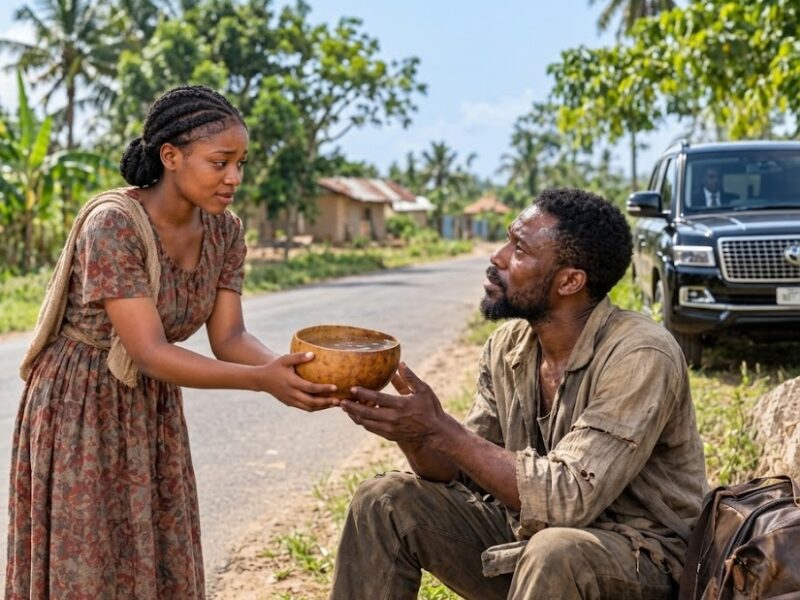
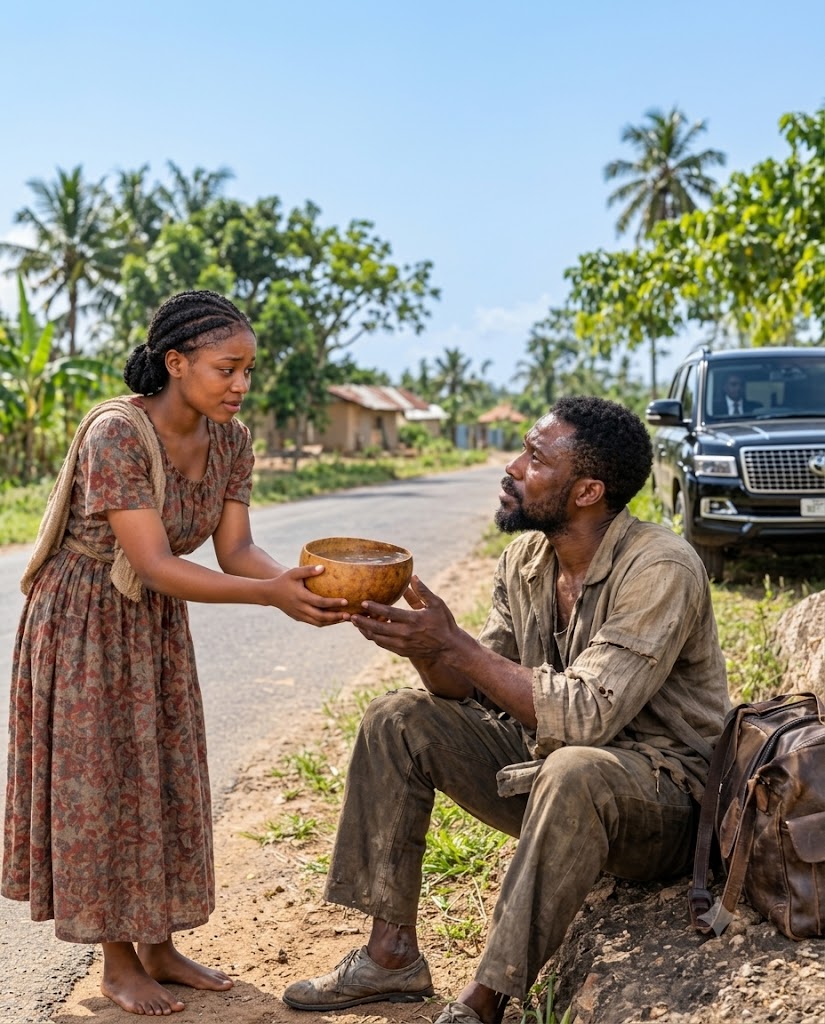
Up close, he was worse than the girl with the bowl had seen him hours ago. Lips cracked pale at the corners, skin gone the color of old ash under the sunburn. A few meters off, a black SUV sat with its engine ticking as it cooled, windows tinted, nobody visible inside. Odd. She noticed it the way you notice a bird that doesn’t belong to the season—and then she forgot it because the man’s lips were moving.
“Water,” he said. Barely a sound at all.
Two market women passed without slowing. “Mad person,” one muttered—not unkindly, just factually, the way you’d note that it looked like rain.
Lucy lowered the calabash from her head. She didn’t decide to help him so much as find that she was already kneeling. The way her body sometimes moved faster than her thinking when someone was suffering in front of her. The same instinct, she would realize much later, that sent her hand toward a stripped length of copper wire when no one was looking. Except this time there was nothing to hide and nothing to weigh.
She tilted the calabash to his mouth. He drank like a man who had already been refused once today and had stopped expecting a second chance. Both hands coming up to steady the vessel, and his fingers—she noticed, distantly—were clean underneath the dirt. Manicured, almost.
He looked at her over the rim of the calabash. Not the grateful, unfocused look of a girl with a bowl—kind, but young enough not to be remembered. He looked the way a man looks when he has been disappointed enough times today to recognize immediately that this was different.
“What is your name?” he asked, voice cracked but suddenly, strangely clear.
She was already rising, thinking of her grandmother, of how late she’d be, of the second bundle under the stone that still needed adding to before nightfall.
“Lucy,” she said, and hurried on, not noticing that he had not once, in all his weakness, looked away from her.
He drank more than she meant to give. She noticed it happening and didn’t stop it. Tipped the calabash further, watched nearly half of what she carried disappear into his cupped hands and down his cracked throat, doing the arithmetic in her head even as her hands kept moving. That’s the tea gone. That’s tonight’s tea gone into a stranger. And there’s no copper wire in the world that buys back an evening’s warmth for a woman with a cough that doesn’t sleep.
She didn’t take it back.
He finally lowered his hands, breathing like a man surfacing from water, and murmured something that might have been thank you, might have been nothing at all. She was already standing, already turning toward home, and she didn’t see what happened behind her.
He watched her go until she was small on the road. Somewhere behind him, faintly, he could still feel the shape of a child’s bowl being pulled away. An eight-year-old’s apologetic glance. A mother’s reasonable fear. And against all of it, unhesitating, a stranger who didn’t stop to calculate what kind of trouble he might be.
He allowed himself something he hadn’t let his face do all day. A smile. Private, almost embarrassed by its own relief. Before he pushed off the stone and walked, steadier now, toward the SUV. The door opened before he reached it. Inside, out of the sun, he took a phone from a compartment beneath the seat and dialed.
“It’s done,” he said quietly. “Tell my mother I found someone worth returning for.”
He did not say her name. He didn’t need to. After ninety-nine, he had already decided he wouldn’t forget this one.
That evening, Mangoi frowned at the half-empty calabash by the door. “Only this much? You went early.”
“I spilled some,” Lucy said, not looking up from the firewood she was arranging on the path. “It’s nothing.”
Mama Mangoi said nothing for a moment, watching her granddaughter’s back with the particular attention of someone who had raised a child and knew the shape of her lies—but also knew which lies were kindnesses. She let it go the way she had let so many small things go this year, choosing not to spend what strength she had on battles that didn’t need winning.
Lucy boiled what remained for the tea, measured it carefully into her grandmother’s cup, and pretended not to notice that there was none left for herself. Her hands were steady doing this. It was the easier of the two lies she was carrying tonight. Spilled water cost her nothing but thirst, and thirst she knew how to sit with.
It was later, after Mangoi’s breathing had gone slow and even on the mat, that Lucy slipped back outside. The night had that particular stillness. Village nights had no engine hum, no voices—just insects and the occasional shift of a goat settling somewhere close. She crouched at the base of the wall, fingers finding the loose stone without needing her eyes, and added what little she had left from the day. Not much. A handful of scavenged nails, straightened and cleaned, worth almost nothing to anyone but Bala—worth just enough to matter to her.
She sat back on her heels a moment, the stone not yet replaced, and let herself do the thing she didn’t allow in daylight. She counted in her head how far this bundle was from where it needed to be before the next round of medicine was due. The number that came back was smaller than she wanted and larger than nothing—which was, she had learned, usually the most a night like this would give her.
Somewhere behind her, inside, Mangoi coughed once in her sleep and went quiet again. Lucy pressed the stone back into place, brushed the dust from her knees, and didn’t examine too closely why tonight, of all nights, the weight of what she was hiding felt heavier than usual. As if some part of her had already sensed that a stranger’s eyes—cracked-lipped and too observant over the rim of a calabash—had seen something today that had nothing to do with water at all.
## Part 2
By the time Lucy reached the stream the next morning, the story had already arrived before her, the way stories do in a village smaller than its own gossip.
“There she is,” Mama Chidimma said, not lowering her voice at all, already positioned at the water’s edge as if she’d been waiting there since dawn for exactly this arrival. “The one giving away water to mad men on the road.”
The other women laughed. Not cruelly. Exactly. Which was somehow worse, because it meant they found her genuinely funny—a source of easy entertainment rather than malice.
“You poured it for him?” one of them asked, delighted. “With your own hand?”
“He was thirsty,” Lucy said, dipping her bucket, keeping her face still.
“Thirsty?” Mama Chidimma repeated the word like it was the punchline of a joke only she understood. “My dear, which man will marry a woman who cannot even save water for herself? You will give away everything and end up with nothing. And then who will you blame?”
It was Ephyoma who laughed loudest. Whose skin was oiled and unmarked by firewood smoke. Whose three suitors sent yam and goats to her father’s compound every planting season.
“Some of us think before we give,” Epha said, tilting her head with the particular sweetness she used like a blade. “But I suppose not everyone was raised to think of her own future.”
The women murmured agreement. Lucy said nothing. She had learned over years of practice that silence was armor—that if she did not flinch, the words eventually ran out of places to land. But something in Epha’s face lingered a moment too long on the subject. A flicker of irritation too large for a story this small, gone almost as soon as it surfaced. As though the beggar’s water had scratched at something Epha kept carefully hidden beneath her oiled skin and her suitors’ gifts.
She recovered fast enough that no one else seemed to notice, dipping her own bucket with exaggerated care. But Lucy, walking away a moment later, found herself turning the flicker over once, wondering—without quite knowing why—whether Epha’s sharpness this morning had more behind it than a story about a beggar.
Lucy walked home alone. Only once the women were well behind her. Only once the path bent and no one could see her face did the tears come. Quiet, furious at themselves, wiped away before they could finish falling. Not for the mockery itself. She’d had years of practice absorbing that. It was the smaller, harder thing underneath it. That giving the water away had felt, in the moment, like the one uncomplicated good thing she’d done in weeks. And now even that had been turned into something she had to defend.
She didn’t yet know that the defending was only beginning. Or that by evening, a black SUV would be waiting outside her hut with an explanation that would make Mama Chidimma’s mockery feel, in hindsight, like the gentlest thing anyone said to her that week.
She saw the SUV before she reached the compound, and everything in her stomach dropped through the earth at once. But not for the reason she would later tell herself it should have. Her first thought wasn’t the beggar on the road. It was Bala. It was the copper wire, the straightened nails, the loose stone with its two bundles. The thought arrived whole and terrible before she could stop it. Someone had finally asked whose hands had been emptying that transformer pole. And someone had finally answered them.
She thought of the traitor’s face—whether he’d give her name up easily or only under pressure. Whether under pressure was even a thing Bala would resist for a girl who’d never once been more to him than a supplier.
Her feet slowed without her permission. Her mind ran through excuses even faster than her feet could run through options. I found it. I didn’t know it was anyone’s. I only wanted to help my grandmother. Sentences assembling themselves for a conversation she was certain—with the particular dread of someone who had been hiding something for months—was finally about to happen.
It wasn’t until the driver stepped around and opened the rear door with a small practiced bow that her fear reorganized itself around something else entirely. Because what stepped out was not a policeman, not anyone from Bala’s world at all. A woman. Silver-gray wrap tied with the kind of precision that spoke of money. Gold at her ears catching the afternoon light. Moving toward Lucy’s doorway with the unhurried confidence of someone who had never once had to knock and wonder if she’d be led in.
For one disorienting second, Lucy’s fear didn’t know where to go. It had built an entire courtroom in her head for a crime this woman couldn’t possibly know about. And now that courtroom was still standing—evidence still laid out, defendant still braced—except the judge who’d arrived was asking about something else completely. And some small, exhausted part of Lucy almost laughed at how much dread she’d assembled for the wrong charge.
“Good afternoon.” The woman’s voice was gentle, but Lucy heard the questions folded inside the gentleness. “I am Mrs. Obi.”
Lucy’s mouth was already dry from the walk here, from the last two minutes alone. She thought of the beggar, the water, the way he’d studied her face too long. She thought he told them something.
“Ma,” Lucy said, greeting her properly, bowing slightly, despite a fear that hadn’t fully stood down—only shifted targets. “Please, whatever he said, I did not—”
“You are not in trouble.” Mrs. Obi said it quickly, watching Lucy’s face the way a woman reads a document for the second time to be sure of the first reading. “I only want to ask you about the young man you helped on the road days ago. Did he tell you who he was?”
The question landed strangely, too heavy for its size. And Lucy noticed, distantly, that relief and fresh alarm could occupy a person’s chest at the exact same moment without either one winning.
“No, ma. He only asked my name. I gave him water because he looked sick. I did not ask questions.”
Something shifted in Mrs. Obi’s expression. Not suspicion easing, but something closer to being moved. The corners of her composure softening in a way she seemed to catch herself doing.
“You didn’t ask questions,” she repeated quietly, almost to herself. “We have been looking for someone like you for a longer time than you know.”
Before Lucy could find words for that, a voice came from inside the hut—thin but carrying. “Who is at my door?”
Mrs. Obi’s head turned toward the sound with unmistakable respect. “May I greet your grandmother?”
Inside, Mangoi was propped on her mat, eyes sharp despite the fever that dulled the rest of her. She studied the visitor for a long moment—the wrap, the gold, the driver hovering outside—and asked the only question that mattered to her.
“Is my granddaughter in trouble?” She said it slowly. “For being kind?”
Mrs. Obi was quiet. Then she sat, uninvited, on the low stool beside the mat and looked at Lucy the way you look at someone you are about to change forever.
“The man she gave water to is my son,” she said. “He is not a beggar.”
The words sat in the small room like something spilled that no one could clean up. Lucy heard them. He is not a beggar. And for a moment, her mind refused to arrange them into meaning. She looked at Mrs. Obi’s face for the joke, the mistake, the sentence that would correct itself. It didn’t come.
“I don’t understand,” Lucy said, though some cold part of her was beginning to.
That was when the second visitor stepped into the doorway, ducking slightly under the low frame. And Lucy’s breath caught somewhere it had no business catching. He was clean now. Pressed shirt, good shoes, the kind of quiet expensive that didn’t need to announce itself. But it was the same face. The same eyes that had studied her too long over the rim of a calabash, memorizing her the way he’d promised himself he would.
“My name is Kichi Obi,” he said. And the voice was steadier than it had been on the road, but there was something underneath it that wasn’t steady at all. “My family owns OB Group Holdings. I wasn’t sick. I wasn’t a stranger passing through.”
Lucy’s hands had gone very still.
“You were never dying on that road,” she said slowly, working it out even as she said it. And something in her chest was turning to ice as fast as it was turning to fury. “You chose to look like that.”
“Ninety-nine times,” Mrs. Obi said quietly from the stool beside Mangoi. “Women who said they loved my son discovered, once they learned who he was, that they loved something else entirely. He stopped trusting his own eyes after that. So I began finding women—good women, from villages, from towns—and he would go to them first as no one. To see who they were before they knew there was anything to perform for.”
“Ninety-nine.” Lucy repeated the number like it was a stone she was testing the weight of. “You’ve been doing this ninety-nine times. And you needed a hundredth to believe a kind woman exists.”
“You’re the only one who didn’t hesitate,” Kletchi said. “I’ve sat by roadsides ninety-nine times, Lucy. Yesterday, before you, a little girl brought me water with both hands and her mother snatched it back before I could drink. Not out of cruelty—out of fear. And I understood the fear, and it still left me thirsty. The market women who walked past you called me a madman and kept walking. And I understood that, too. It costs nothing to keep walking. You are the only person in two days, in ninety-nine attempts, who knelt down and gave something away with nothing in it for you.”
“That’s not a compliment.” Her voice finally broke its containment, sharper than she expected it to come out. “Do you understand what you’re telling me? You watched a woman refuse a dying child water, and you filed it away as data. You let a scared mother’s fear become one more mark on a scoreboard, and you let my kindness become the winning number. I wasn’t being tested against ninety-nine other women, was I? I was being tested against a girl and a bowl of water. Against women at a stream who I’ve known my whole life. Against my own grandmother’s face if I’d come home and told her the truth about the tea that night. You didn’t just lie to me. You made every ordinary, human, understandable failure in this village into an exhibit for your case. And you decided in advance that I was going to be the only one who mattered.”
The room went very quiet. Mrs. Obi didn’t speak. Kletchi, for the first time since he stepped into the room dressed as himself, looked like the ragged man on the roadside again—stripped of something, unsure of his footing.
“You’re right,” he said finally. “I don’t have a way to make that fair. I’m not going to try.”
“Then what do you want?”
“A real chance.” He said it plainly, without the polish of a man used to getting what he asked for. “Not as the man who tested you. As the one who actually met you on that road. Before I knew what I’d find. Before I knew it would be you.”
Lucy looked at him for a long moment. At the clean shirt, the good shoes, the eyes that once looked at her like she was worth remembering. And said nothing at all.
He didn’t push for an answer. He inclined his head to Mama Mangoi, murmured something too quiet for Lucy to catch, and followed his mother back out to the waiting car. And it wasn’t until he was inside it, door closed, village receding through tinted glass, that the guest house in Enugu came back to him the way it always did. Not as a story he told, but as a room he was still standing in.
It had been attempt sixty-something. A name he didn’t let himself remember anymore because remembering it cost something. She’d found him collapsed near a market square, walked him half a mile to a guest house she knew, paid for the room herself with money she clearly didn’t have to spare, sat with him while the innkeeper’s wife brought soup she also hadn’t been asked to pay for. He remembered thinking, somewhere in the fog of the performance, This might be the one. This might finally be the one. And letting himself feel something dangerously close to relief.
He remembered waking at three in the morning to the sound of the room’s single drawer easing shut—too carefully to be innocent. She hadn’t taken much. There wasn’t much to take. He’d made sure of that. Ninety-nine times of careful preparation meant he never carried anything that mattered on the road itself. But she’d taken the little there was. His watch, hidden badly under a loose shirt. A scattering of folded dollars meant to look like all he had in the world. And when he’d stirred, when the floorboard gave him away, she hadn’t apologized. She’d looked at him with something worse than guilt. Calculation. Fast and sharp. The look of a woman recalculating whether the man waking up was a threat or still an opportunity—before she was gone through the window.
And he’d lain there afterward in the dark, working out with a strange numb clarity that the kindness earlier that evening and the theft at three in the morning had come from the exact same person. In the exact same night. And that he had no way of knowing, going forward, which version of anyone he might ever meet again.
“You never told her,” his mother said now, watching him from across the car. Having clearly followed exactly where his silence went. “The girl in the hut. About Enugu.”
“I didn’t need to justify ninety-nine tests to her. I needed her to understand what one of them cost me.” He looked out the window. Village thinning into farmland, thinning into road. “You want to know why the system got so careful, Mother? The driver waiting exactly here. The car never visible from the compound. No way for anyone to identify me until I choose it. It isn’t caution for caution’s sake. It’s because I learned in one guest house that a person can be capable of real kindness at nine and real theft at three in the morning. And neither one cancels the other out. I stopped believing kindness was a fixed thing you could measure once and trust forever. I started believing you have to keep checking.”
“And Lucy? Lucy didn’t know she was being checked.”
He closed his eyes. “That’s the part I can’t get past today. Not whether she passed. Whether I had any right, after Enugu, to still be the kind of man who puts anyone through this at all.”
Three days into the silence after the reveal. No SUV, no engine on the road. Just Lucy and the ordinary weight of fetching water and pretending nothing had cracked open underneath her life.
Bala sent word through his nephew that he wanted to see her. She went at dusk, when the market stalls were folding themselves away and no one had attention left to spend on who was walking where. Bala was exactly where he always was—crouched beside his cart of scavenged metal, weighing something in his palm that could be anything.
“There’s a man asking questions,” he said, without greeting her first, which was how she knew it was serious. “About the transformer pole. Whether anyone’s been taking from it. Whether anyone’s seen a girl around there.”
“What man?”
“Not one I know. Not police. Better dressed than police. Worse dressed than the kind of man who usually asks questions like that.” He finally looked up at her. “I didn’t give your name. I want that understood. But I also won’t lie for you to a stranger’s face if he comes back with more than a question.”
Her stomach turned the same slow, familiar direction it had turned the day the SUV appeared at her hut. Except this time there was no Mrs. Obi waiting at the end of it to say you’re not in trouble. This time the fear had nowhere honest to land.
“Who would even be asking?” she said, half to herself. And then the answer arrived, whole and unwelcome. Someone connected to the Obis. Doing exactly what Kletchi’s family does. Checking. Maybe Mrs. Obi’s people, quietly making sure the girl her son had chosen had nothing hidden that could embarrass them later. Maybe nothing to do with them at all. She didn’t know. And not knowing was its own kind of exhausting.
“I’ll stop,” she told Bala, and meant it more than she’d meant anything in weeks. “After tonight, whatever’s in the bundle now—that’s the last of it.”
Bala shrugged, unmoved. A man who had heard variations of that sentence from a dozen people over a dozen years. “Your business,” he said, and went back to weighing scrap in his palm.
Walking home, Lucy turned the choice over the way she’d turned over Epha’s flicker of jealousy at the stream. Except this one she couldn’t set down. If someone was already asking questions, the truth wasn’t a secret she got to keep on her own terms anymore. It was a countdown to being found out on someone else’s terms. And she knew, with the particular clarity dread sometimes provides, which of those two was worse. For her. For whatever this thing with Kletchi could become. For how his mother would look at her the second time if the first impression turned out to have an asterisk on it.
She thought about the six days of silence. The water Jerry can she didn’t know was coming. And she made a decision that had nothing to do with him yet and everything to do with the ground she was standing on if he came back. I tell him before anyone else can turn it into something uglier than it is.
She didn’t know yet that when he did come back—on the seventh day, on foot, Jerry can heavy in his hand—he’d be the one who spent six days building up the courage to ask for a real chance. And that her own courage, quietly, had been assembling itself toward a confession he didn’t yet know he needed to hear.
## Part 3
Six days passed and the black SUV did not return. Lucy told herself this was what she wanted. Space. Silence. Time to decide what she thought without a stranger’s face in front of her complicating the thinking. She went to the stream, endured the sideways looks, came home, boiled what little there was, sat with her grandmother in the evenings, and said nothing about OB Group Holdings. About a mother who looked at her like an answer to a prayer. About a man who let her believe he was dying.
She also said nothing about Bala, though that silence had started to feel less like protection and more like something she was simply carrying until she could set it down properly.
On the seventh day, there was a knock. But no engine. No driver’s door. Kletchi stood outside in an ordinary shirt, ordinary trousers, nothing on him that announced money. A jerry can of water sitting heavy in his hand.
“I walked,” he said before she could speak. “I didn’t want to arrive the way I arrived the first time or the second.”
Lucy stayed in the doorway, arms folded, saying nothing. And he took her silence for permission to keep going.
“I’m not asking you to forgive the test,” he said. “I’ve had six days to think about what I’d say, and I want to say it properly. I built a system to protect myself from being fooled. And somewhere in ninety-nine attempts, I stopped seeing the women in it as anything but—”
“I have to tell you something first.”
It came out faster than she planned. Cutting straight through the apology he’d clearly rehearsed. And she watched it land on his face as something between surprise and mild disorientation. A man derailed mid-performance for the first time in a long while.
“—before you finish that. Because if I let you finish, I’ll lose the nerve, and someone else might tell you before I do. And I’d rather it come from me.”
“Okay.” He set the jerry can down slowly, giving her the floor the way he’d clearly meant to keep it a moment ago.
“There’s a man in the village. Bala. I’ve been selling him things. Scrap metal, wire, whatever I find that nobody’s claimed. It’s not exactly stealing—I’ve told myself that so many times it almost feels true—but it isn’t exactly clean either. And I’ve been doing it for months to help pay for my grandmother’s medicine. And I never told her, and I never told you. And now someone’s been asking Bala questions about it. And I don’t know if that’s connected to your family or not, but I needed you to hear it from me before you heard it from anyone else.”
She said all of it in one breath. The way you rip a bandage rather than peel it. And then she stood there in the aftermath, watching his face for the same thing he’d been watching hers for on the road. The moment where a person decides what they’ve just heard actually means.
For a beat, something closed in his expression. It was small, almost nothing. A flicker of the same calculation he’d have run on any of the ninety-nine. An old reflex, asking: Is this the beginning of a story that ends with a hand in a drawer at three in the morning? And Lucy, watching closely, saw it happen and felt something in her chest go cold in anticipation of exactly the reaction she’d feared most.
But it passed almost as fast as it arrived. She watched him catch it. Watched him actually catch himself doing the thing. The way you’d catch your own hand reaching for a door you’d promised yourself you wouldn’t open again.
“I’m sorry,” he said. And it wasn’t in response to anything she’d done. “For a second there, I was doing exactly what I told my mother I was tired of doing. Treating a person’s honesty like evidence in a case I’m still building against someone who isn’t you. You just told me something you didn’t have to tell me. In the middle of me trying to apologize to you. Because you’d rather I hear the truth from your mouth than a stranger’s. That’s not the beginning of the Enugu story. That’s the opposite of it.”
“You know about Enugu.”
It was the first thing she’d said since her confession that wasn’t about Bala.
“I’ll tell you if you want to hear it. It’s part of why the system got so cold.” He picked the jerry can back up—less as an object now than something to hold on to. “But I’m not going to let my worst night with someone else decide what I think of your best one with me. You told me the truth before you had to. That’s the only thing about today I need to understand first.”
Something in Lucy’s shoulders, held tight since the moment Bala sent his nephew with a warning, finally loosened.
“I’m still angry about the test,” she said. Because that hadn’t gone anywhere, and she wasn’t willing to let one honest moment erase six days of real hurt.
“I know. I’m not asking you to not be.”
He held the jerry can out slightly. The same gesture as before—except now it wasn’t charity crossing a distance in one direction. It was closer to an even exchange. Two people setting something down between them instead of one person giving and the other receiving.
“You can sit. You can talk. That’s all I came to offer.”
She took the jerry can from him. Their hands didn’t touch, but it was close enough that she felt the deliberateness of it.
“You can sit,” she said. “You can talk. That’s all I’m offering back.”
It was enough. This time, for something in both of them to loosen at once.
The gathering hall smelled of jollof rice and fresh paint. Chairs arranged in a wide circle so that everyone could see everyone. Which was exactly why, when Obiora cleared his throat and stood, the whole room turned toward him at once.
“Before we go further,” he said, spreading his hands with the humility of a man who had rehearsed humility, “I feel it is only right, as her uncle, that this family knows the whole truth about my niece.”
Lucy’s stomach dropped. Beside her, Kletchi shifted, alert.
“It is not only that she went looking for a wealthy family to save her,” Obiora said. “It is worse than that. Ask her. Ask her yourself whether there is a man in this village named Bala, and whether she has spent months taking what does not belong to her and selling it to him in secret. Copper wire. Scrap metal. Things stripped from property that was never hers to strip.”
A murmur moved through the circle, faster and uglier than the murmur that had followed the water story.
“She only admitted it,” Ephyoma added, dabbing at eyes that were once again producing tears on command, “because your family’s people were already asking questions in the market. I heard it myself. She didn’t come to you with the truth, Kichi. She ran to you with it before you could catch her yourself. That is not honesty. That is a woman covering her tracks and calling it confession.”
Lucy felt the accusation land somewhere colder than the water-story mockery ever had. Because this one had a true thing buried inside the lie. And true things were so much harder to stand against than invented ones.
“I told him myself,” she said, and heard her own voice come out smaller than she wanted it to. “Before anyone accused me of anything, I went to him.”
“Did you go to him,” Obiora cut in, “or did Bala’s nephew warn you first that someone was asking questions, and you ran to confess only once you knew you’d already been caught?”
The room’s warmth curdled into something colder, faster than Lucy would have believed possible. Because now there was a sequence of events for people to argue about instead of a character to simply admire or dismiss. And sequences were the kind of thing that sounded, in a room full of relatives who wanted a reason to doubt her, exactly like guilt.
Lucy looked at Kletchi. Waited for him to say something.
This time, he didn’t hesitate.
“She told me herself. In my presence. Six days before tonight. Before either of you had said a single word about it.” His voice carried the particular steadiness of a man who had already once let silence answer for him and had decided he would not make that mistake twice. “I was the one standing there. I watched her interrupt her own apology to me—an apology I was owed for something far larger than scrap metal—so that she could tell me a truth I hadn’t asked for and had no way of already knowing. That is not a woman covering tracks. That is the opposite of everything either of you has done in this room tonight.”
Obiora’s composure flickered, just slightly, at meeting resistance where he’d clearly expected silence.
“Then perhaps Kichi has already been charmed into forgetting what he heard,” Ephyoma said quickly, recovering. “It would not be the first time a good man was made a fool of by—”
“Wait.”
Mangoi was being helped forward by a neighbor’s son, refusing the chair offered to her, standing instead on legs that shook with the effort. The room quieted out of old habit—the reflexive respect a compound gives its elders, even mid-scandal.
“I did not want to come here today,” she said, “because sickness makes an old woman slow, and I did not want to slow anyone down. But I heard what was said in this room. And I will not sit in silence while a true thing is bent into a lie in front of my granddaughter’s face.”
She looked at Obiora, and something in her gaze made him shift where he stood.
“You,” she said, “have something to explain. Because I did not come here with empty hands either.”
Obiora’s mouth opened. Some denial, half-formed. But Mama Mangoi was already turning to the neighbor’s son who had helped her into the room.
“Bring it,” she said.
The young man stepped forward, hands trembling slightly, holding out the phone Mrs. Obi’s household had gifted them weeks ago. A courtesy, nothing more. So Mama Mangoi could call for help if her illness worsened in the night. No one in that room—least of all Obiora—ever imagined it would carry anything but her voice.
“I could not walk fast enough to catch every word myself,” Mama Mangoi said. “So I asked him to stand near the wall and hold this. And to keep it running until I told him to stop.”
The recording began with static, then clarity.
Obiora’s voice. “She humiliated me in front of everyone.”
Ephyoma’s voice. “She humiliated both of us when she still had nothing. Imagine what she’ll do to us now.”
Obiora again. “If we bring up this business with the traitor, say she only told the Obi boy because she’d already been caught. Nobody will stop to ask when she actually confessed. They’ll only hear ‘caught.’ Quieter. As long as we say it before she can explain the timing herself. Once a story like that gets ahead of her, it doesn’t matter what’s true. It only matters what people heard first.”
The room did not move. Somewhere behind Lucy, a chair creaked as someone shifted their weight. And the sound seemed enormous in the silence. Because now the recording hadn’t just caught a plan to invent a lie. It had caught something worse. A plan to take a true, difficult, vulnerable thing Lucy had already done right—and deliberately twist its timing until doing right sounded exactly like getting caught.
Epha’s face had drained of every practiced softness she’d worn into the room. Obiora opened his mouth once more, and this time nothing came out at all. No explanation survives hearing your own scheme played back to the people you meant to fool. Especially not a scheme built on poisoning a truth instead of inventing a lie from nothing.
Mrs. Obi rose slowly from her seat. For a moment, Lucy thought she meant to speak—to deliver some formal rebuke to the two conspirators standing exposed in the middle of the circle. Instead, she crossed the room toward Mama Mangoi and, to the audible intake of breath from several relatives, lowered herself with some difficulty to one knee before the frail old woman.
“I let doubt sit in this room when it should never have been given a chair,” Mrs. Obi said. “Forgive me, Mama, for how close I came to letting a true thing be turned into a weapon against your granddaughter.”
Mama Mangoi’s hand found the younger woman’s shoulder, steadying more than accepting. “It is not doubt that wounds a person,” she said quietly. “It is standing alone in it. You have stood up now. That is enough.”
Around the room, something shifted. Not just relief, but a kind of collective shame settling where the earlier suspicion had been. Aunties and cousins who had, moments ago, let their faces go cold toward Lucy now found themselves unable to meet her eyes.
Lucy said nothing through all of it. The vindication should have felt larger than it did. She was still the woman who took things that weren’t hers. However small. However desperate the reason. That part was never a lie. And no recording erased it. What the recording erased was only the accusation that she’d hidden it out of cowardice. She told the truth before anyone forced her to. That much, at least, was now hers to keep without anyone else’s permission.
She looked at Kletchi. He hadn’t moved from where he stood when he spoke up for her. And something in his face told her he understood exactly what she was thinking before she said it.
“You didn’t hesitate this time,” she said. Quiet enough that it wasn’t for the room, though the room heard it anyway.
“No,” he said. “I told you Enugu wasn’t going to get to decide what I think of you. I meant it.”
It happened two weeks later. And it happened nowhere dramatic. Not in the gathering hall, not on the road, not in front of anyone who could turn it into a story the village would repeat at the stream. He was in the car with his mother on the way back from a visit to the village that had, by now, stopped needing an excuse. Mrs. Obi had the window down, one arm resting against the frame, watching the farmland slide past.
“You haven’t asked the driver to wait past his usual hour in weeks,” she said. Not quite a question.
“I’m not going to need him to.” Kichi said it plainly, the way he’d said the number ninety-nine to her in the garden months ago. No performance in it. Just a fact he was finally ready to hand over. “I want to end it. The whole system. Not because of Lucy—or not only because of her—because I’ve been sitting with something since that gathering hall and I don’t like what I found.”
“Tell me.”
“I stood there and I almost did to her what I did to the woman in Enugu. Decided, for half a second, that one hard truth meant the whole person was suspect. I caught myself that time. But I only caught myself because I’d already had ninety-nine chances to notice the pattern in myself. That’s not a system that’s protecting me from being fooled anymore, Mother. It’s a system that was slowly turning me into someone who couldn’t recognize honesty even when it was standing right in front of me, apologizing to me before I’d even finished my own apology to her.”
Mrs. Obi was quiet for a moment, watching him the way she’d watched him in the garden—gauging the size of something before she responded to it.
“Enugu was one night,” Kletchi continued. “One woman, one drawer, one earned reason to be careful. I turned it into a hundred experiments because it was easier to keep testing strangers than to sit with the actual, smaller, harder fact that I got hurt once. By one person. And I let that hurt write the terms for every woman after her. That’s not caution. That’s a wound running the whole operation and calling itself wisdom.”
“And if Lucy hadn’t passed?” his mother asked gently. Because she had to.
“If attempt one hundred had gone the way Enugu went, then I’d have needed to stop anyway.” He said it without hesitation and meant it, and heard himself mean it, which was its own kind of relief. “That’s the part I didn’t understand until now. I kept telling myself I’d stop once I found someone who proved the theory. That people can be trusted. That kindness is real and repeatable. But trust was never something a hundredth woman could prove to me. It was something I had to decide to extend again on my own. Whether or not the evidence ever fully cooperated. Lucy didn’t fix Enugu. She just happened to be standing there when I finally got tired of needing it fixed by someone else.”
Mrs. Obi reached over. Not to argue. Just to rest her hand briefly over his on the seat between them. The closest thing to approval she’d offered any decision of his in a long time.
“Then call the driver,” she said. “Tell him there’s no attempt one hundred and one.”
“There isn’t.”
Kilichi looked out at the road. At farmland becoming the outskirts of a city that once slapped him and called him disgusting—and never once made him doubt himself the way one quiet drawer closing in Enugu did.
Whatever happened with Lucy now happened because he chose to trust it. Not because a system approved her. He was done letting one wound decide who got to be believed. And that was how Kichi learned that love cannot be measured by tests, and trust cannot be built through suspicion. Lucy was never perfect. But when the truth was difficult, she chose honesty.
Sometimes the greatest proof of love is not passing a test. It is giving someone a reason to stop testing.









