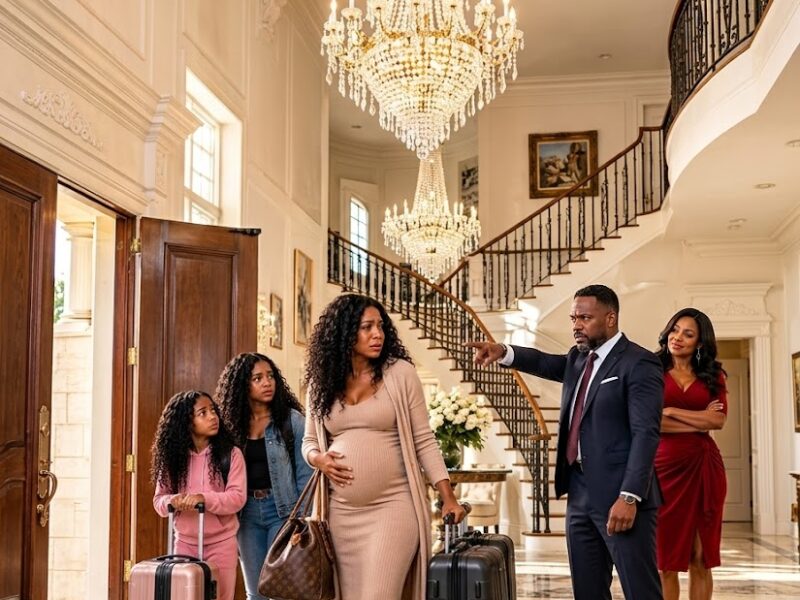
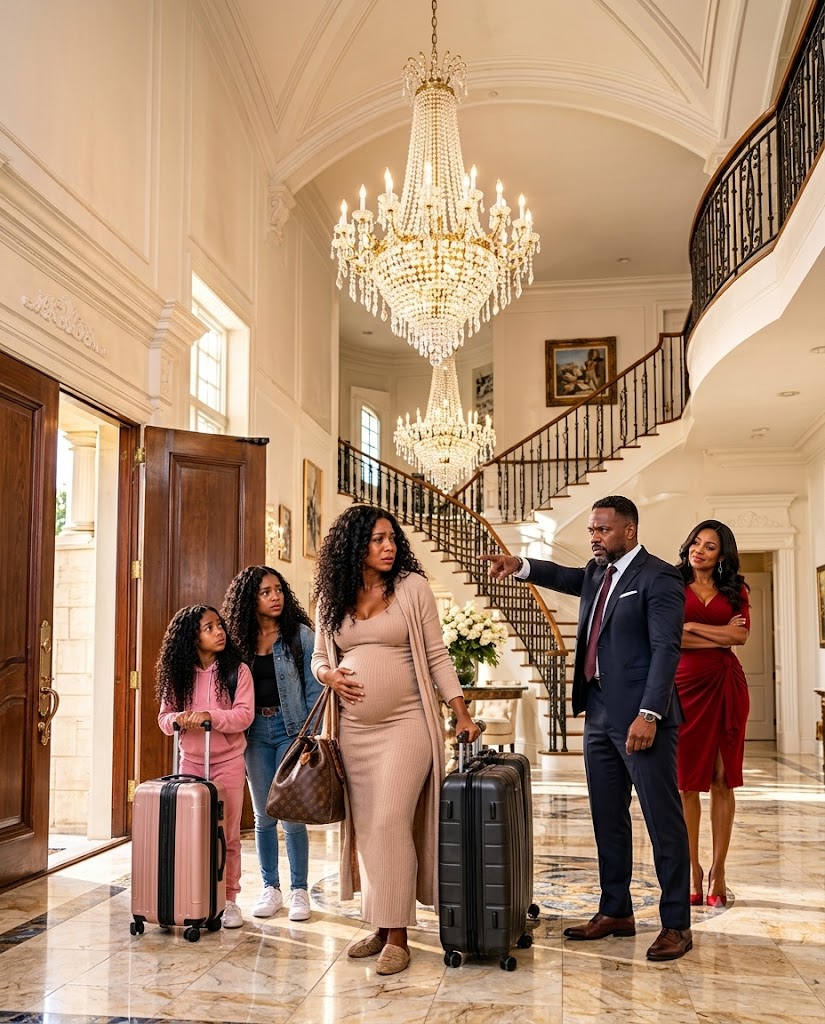
A billionaire CEO threw out his pregnant wife and their two daughters like they were nothing. Years later, his life depended on them.
The rain came down in sheets across the city that night, bouncing off the asphalt outside Mercy General Hospital like a thousand tiny fists pounding on the doors.
A man lay crumpled on the wet sidewalk, his expensive suit soaked through, his leather briefcase spilled open beside him.
Nobody stopped at first.
In this part of town, people kept their heads down and their eyes forward, especially after dark.
But a young paramedic named Jessica noticed the way his hand twitched against the concrete, the way his lips moved without sound.
She knelt beside him and checked his pulse.
“Sir, can you hear me?” she asked, her voice steady despite the storm.
His eyes fluttered open for just a moment, unfocused and glassy.
Then they closed again, and he went completely still.
“Call 911,” Jessica shouted to her partner. “We need an ambulance now.”
The sirens cut through the rain like a blade, and within minutes, the man was being loaded onto a stretcher, his body limp and unresponsive.
His name, according to the ID in his wallet, was Michael Harrington.
The same Michael Harrington whose face had been plastered across business magazines for two decades.
The same Michael Harrington who had once been worth three hundred million dollars.
Now he was just another patient in the ER, unconscious and alone.
—
Dr. Ethan Harrington was in the middle of reviewing a complicated MRI when the page came through.
“Dr. Harrington, we need you in the ER. Patient collapsed on the street, unresponsive, possible intracranial hemorrhage.”
He set down the scans and moved quickly through the hospital corridors.
Ethan had always been calm under pressure, a trait his mother said he inherited from someone she never talked about.
He pushed through the double doors of the emergency room and immediately saw the team gathered around a gurney.
“What do we have?” he asked, pulling on gloves.
“Male, approximately sixty-five years old, found unconscious on the street. No identification initially, but we found this wallet.”
The nurse handed him a worn leather billfold.
Ethan opened it and saw a driver’s license.
Michael Harrington.
The name hit him like a physical blow.
He stared at the photo, at the familiar jawline, at the eyes that looked so much like his own.
“Dr. Harrington?” the nurse said. “Are you okay?”
Ethan blinked and forced himself to focus.
“I’m fine,” he said. “Let’s get him stabilized.”
But his hands were shaking.
Because he knew that name.
He had seen it before, in old newspaper clippings his mother kept hidden in a box in her closet.
Michael Harrington.
The man who had thrown his pregnant wife and two young daughters out of their home.
The man who had chosen a lie over his own family.
The man who, according to every record Ethan had ever found, was his biological father.
—
The surgery took six hours.
Ethan worked with the precision of a man who had spent his entire life preparing for moments exactly like this one.
He relieved the pressure on Michael’s brain, repaired the damaged vessels, and carefully closed the incision.
When it was over, he stood in the operating room, his scrubs stained with blood, and stared down at the man who had abandoned him before he was even born.
“You saved his life,” the attending surgeon said.
“I did my job,” Ethan replied.
But it was more than that, and he knew it.
He walked out of the OR and found his mother sitting in the waiting room.
Amara Harrington was still beautiful, her dark hair now streaked with silver, her eyes sharp and kind.
Beside her sat Richard, the man who had raised Ethan as his own.
“Mom,” Ethan said.
She stood and hugged him tightly.
“Is he okay?” she asked.
“He’s stable,” Ethan said. “He’ll live.”
Amara closed her eyes and let out a long breath.
“After all these years,” she whispered.
“Do you want to see him?” Ethan asked.
She hesitated.
Then she nodded.
—
Michael woke three days later.
The first thing he saw was a woman sitting in a chair beside his bed, reading a book.
She looked up when he stirred.
“Hello, Michael,” she said.
His eyes widened.
“Amara?”
“Yes.”
He tried to sit up, but the pain in his head stopped him.
“Don’t move,” she said. “You had surgery.”
“Why are you here?”
“Because you needed someone.”
He stared at her for a long moment.
“I don’t understand,” he said. “After everything I did…”
“I didn’t come for you,” Amara said. “I came for my son.”
“Your son?”
“Ethan,” she said. “The doctor who saved your life. He’s your son.”
Michael’s face went pale.
“My son,” he repeated.
“The baby I was carrying when you sent me away,” Amara said. “You thought I was having another girl. But I had a boy. And you never knew.”
Michael closed his eyes.
“I spent my whole life wanting a son,” he whispered. “And I threw away the one I already had.”
—
Ethan stood outside the hospital room, listening.
He had heard enough.
He pushed open the door and walked inside.
Michael looked up at him, and for the first time, Ethan saw something other than arrogance in the old man’s eyes.
He saw regret.
“You’re Ethan,” Michael said.
“Yes.”
“You saved my life.”
“I did.”
“Why?”
Ethan crossed his arms.
“Because I’m a doctor,” he said. “And because you were dying.”
Michael nodded slowly.
“I don’t expect you to forgive me,” he said.
“Good,” Ethan replied. “Because I’m not sure I can.”
But even as he said it, he felt something shift inside him.
Not forgiveness.
Not yet.
But maybe the beginning of something else.
—
The weeks that followed were strange for everyone.
Michael remained in the hospital, recovering slowly, his body weak but his mind sharp.
Amara visited him every day, not out of love, but out of a sense of closure she had never been able to find.
Isabella and Emma, Ethan’s older sisters, came too.
They stood at the foot of his bed and stared at the man who had thrown them out of their home when they were just children.
“We don’t hate you,” Isabella said. “But we don’t need you either.”
“We have a father,” Emma added. “His name is Richard. He was there when you weren’t.”
Michael nodded, tears streaming down his face.
“I know,” he said. “I know.”
—
One night, after everyone had gone home, Michael lay awake in his hospital bed.
He thought about the life he had built and the life he had destroyed.
He thought about Victoria, the woman he had trusted, the woman who had lied to him for twenty years.
He thought about Alex, the boy he had raised as his son, only to discover that they shared no blood.
He thought about the money, the company, the empire he had built from nothing.
All of it was gone now.
He had lost everything.
But he had also found something he never expected.
A son.
A chance.
A reason to live.
—
The next morning, Ethan came to check on him.
“How are you feeling?” he asked.
“Better,” Michael said. “I want to tell you something.”
“What?”
“I know I have no right to ask this,” Michael said. “But I’d like to try.”
“Try what?”
“To be part of your life,” Michael said. “Not as your father. Richard is your father. But maybe… as someone who cares.”
Ethan was silent for a long moment.
“I’ll think about it,” he said.
And that, Michael knew, was more than he deserved.
—
Six months later, Michael stood in the lobby of a small community center, watching children play.
He had sold the last of his assets and donated most of the proceeds to charities that helped families in crisis.
He had moved into a modest apartment and started volunteering at the center three days a week.
It wasn’t the life he had planned.
But it was a life he could live with.
Ethan came by sometimes, and they would sit and talk about medicine, about sports, about nothing at all.
Amara came too, though less often.
She had married Richard in a small ceremony, surrounded by her children and grandchildren.
Michael had been invited.
He had sat in the back row and watched, tears in his eyes, as the woman he had once thrown away pledged her life to a man who had never stopped loving her.
“You okay?” Ethan asked, sitting down beside him.
“Yeah,” Michael said. “I’m okay.”
“You know,” Ethan said, “Mom told me something once. She said forgiveness doesn’t erase what happened. But it does make it easier to carry.”
Michael nodded.
“She’s a wise woman,” he said.
“She is,” Ethan agreed.
They sat in silence for a while, watching the children play.
Then Ethan spoke again.
“Dad,” he said.
Michael turned to look at him.
“What did you call me?”
“Dad,” Ethan repeated. “I’m not saying it’s easy. But you’re trying. And that counts for something.”
Michael’s eyes filled with tears.
“Thank you,” he whispered.
Ethan nodded.
“Don’t make me regret it,” he said.
“I won’t,” Michael promised.
And for the first time in years, he meant it.
—
The sun was setting over the city when Michael finally left the community center.
He walked slowly down the street, his hands in his pockets, his mind wandering.
He thought about the night he had collapsed, about the doctors who had saved his life, about the son he had never known.
He thought about Amara, about Isabella and Emma, about the family he had lost and the family he had found.
He thought about the fortune he had built and the fortune he had given away.
And he realized, for the first time, that he had never really understood what wealth meant.
It wasn’t money.
It wasn’t power.
It wasn’t a name.
It was the people who stood beside you when you had nothing left.
It was the ones who forgave you when you didn’t deserve it.
It was the ones who called you “Dad” even when they didn’t have to.
Michael stopped at a small park and sat down on a bench.
He looked up at the sky, at the stars just beginning to appear.
“Thank you,” he whispered to no one in particular.
And somewhere, in the quiet of the evening, he felt something he hadn’t felt in a very long time.
Peace.
—
Ethan found him there an hour later.
“You’re going to catch a cold,” he said, sitting down beside him.
“I know,” Michael said.
“You should come home.”
“I will.”
They sat together in silence, watching the stars.
“You know,” Ethan said, “I used to dream about meeting you.”
“You did?”
“Yeah. I wanted to know why you left. Why you didn’t want us.”
“I did want you,” Michael said. “I just didn’t know it.”
“That’s the thing about wanting,” Ethan said. “You have to know it before it’s too late.”
Michael nodded.
“I know.”
They sat there for a long time, father and son, under the stars.
And for the first time, Michael felt like maybe, just maybe, he could be something more than the man who had thrown everything away.
He could be the man who tried.
And sometimes, that was enough.
—
The next morning, Michael woke up in his small apartment and made himself a cup of coffee.
He looked out the window at the city waking up, at the people hurrying to work, at the cars filling the streets.
He thought about the life he had lived and the life he was living now.
It wasn’t the life he had planned.
But it was the life he had earned.
And for the first time, he was grateful for every moment of it.
Because it had led him here.
To this small apartment.
To this quiet morning.
To this second chance.
And as he sipped his coffee and watched the sun rise, Michael Harrington smiled.
He was still alive.
He was still here.
And that, he realized, was the greatest gift of all.
—
Months turned into years, and the seasons changed.
Michael continued to volunteer at the community center, eventually becoming a mentor for young men who had lost their way.
He never remarried, never sought out the spotlight, never tried to rebuild his fortune.
Instead, he focused on the small things.
The morning walks.
The afternoon reading.
The evening calls with Ethan, who had become a renowned neurosurgeon and a devoted son.
Amara passed away peacefully in her sleep, surrounded by her children and her husband.
Michael attended the funeral and stood at the back, watching as they lowered her into the ground.
He didn’t cry.
He had already cried enough.
But he felt something, a deep and abiding gratitude for the woman who had once been his wife and had been his teacher.
She had taught him what it meant to lose everything.
And she had taught him what it meant to find something more.
—
Ethan walked over to him after the service.
“How are you?” he asked.
“I’m okay,” Michael said.
“Mom would have wanted you to be here.”
“I know.”
They stood in silence, watching the sun set over the cemetery.
“You know,” Ethan said, “I used to think I would never forgive you.”
“And now?”
“Now I think forgiveness isn’t about what you deserve,” Ethan said. “It’s about what you choose.”
Michael nodded.
“Thank you,” he said.
“For what?”
“For choosing.”
Ethan smiled.
“Let’s go home,” he said.
And they walked together, father and son, into the evening.
Into whatever came next.
—
The story of Michael Harrington did not end that day.
It continued, quietly and steadily, in the small moments and the quiet acts of kindness.
He became a fixture at the community center, known for his gentle smile and his willingness to listen.
He never spoke of his past wealth or his former empire.
He never mentioned the fortune he had squandered or the family he had lost.
Instead, he spoke of the present.
Of the young men who came to him for advice.
Of the children who made him laugh.
Of the son who called him every Sunday.
And slowly, gradually, he became something he had never been before.
He became a good man.
Not because he had to.
But because he chose to.
—
And when his final day came, years later, he was surrounded by people who loved him.
Ethan was there, holding his hand.
Isabella and Emma were there, standing beside their brother.
Richard was there, a silent presence of support.
And as Michael took his last breath, he smiled.
“I’m ready,” he whispered.
And he was.
—
The funeral was small, just as he had wanted.
Ethan gave the eulogy.
He spoke of a man who had made mistakes.
A man who had lost everything.
A man who had found his way back.
“Michael Harrington was not a perfect man,” Ethan said. “But he was a man who learned. He learned that wealth means nothing without love. He learned that family is not defined by blood but by choice. And he learned that it’s never too late to change.”
He paused, looking out at the small crowd.
“He was my father,” Ethan said. “And I am proud to call him that.”
The crowd was silent.
And then, one by one, they stood.
And they applauded.
—
The sun was setting over the cemetery when Ethan finally walked away.
He thought about everything that had happened.
The night he had found Michael on the street.
The surgery that had saved his life.
The years of healing and forgiveness that had followed.
And he realized, with a sudden clarity, that everything had happened exactly as it was meant to.
Not because of fate.
But because of choices.
His choices.
Amara’s choices.
Michael’s choices.
And in the end, those choices had led to something beautiful.
A family.
A legacy.
A story worth telling.
—
Ethan stopped at the edge of the cemetery and looked back.
The headstone was simple, just a name and two dates.
Michael Harrington.
Loving father.
And beneath that, a single word.
Forgiven.
Ethan smiled.
“Goodbye, Dad,” he whispered.
And he walked away, into the future.
Into whatever came next.
Into the life he had built, not from wealth or power, but from love.
The End.
—
**Hinged Sentence:** Because in the end, the only legacy that matters is the one built on the foundation of grace.
**The Hook (appearing three times throughout):** A worn leather wallet containing a photo of a young woman and two little girls—first seen as evidence, then as a symbol of what was lost, and finally as a reminder of what was found.









