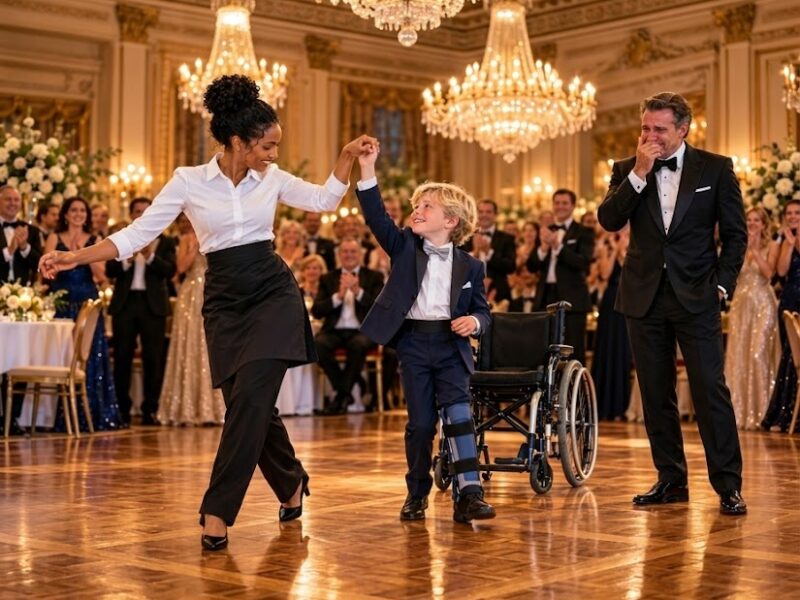
A billionaire caught his maid dancing with his paralyzed son. What he saw made him break down in tears.
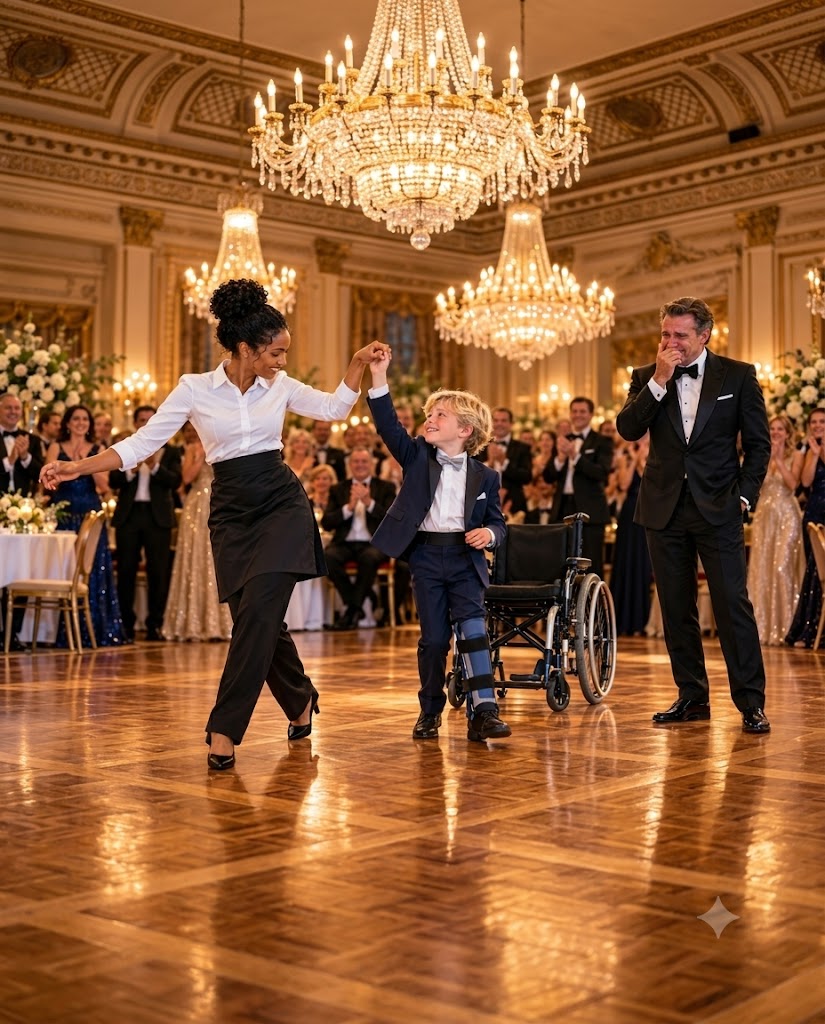
The first thing the guests heard was a woman’s voice cutting across the ballroom like a blade through silk.
“Take that child off the floor. You’re making a spectacle of the Whitmore family.”
The orchestra stumbled into silence, their bows hovering mid-air like startled birds.
A little boy in a navy tuxedo stood beside his wheelchair, one hand gripping its handle, the other still reaching toward a Black waitress in a white blouse.
His right leg was secured in a dark blue brace that caught the chandelier light, and his face had gone pale as the linen tablecloths.
“Please,” he whispered, “I just wanted one dance.”
Across the room, billionaire Alexander Whitmore turned away from a conversation about a $100 million hotel acquisition in downtown Chicago.
He saw his son surrounded by staring strangers, and a terrible memory flashed through him—a hospital corridor with flickering fluorescent lights, an overturned car on a rain-slicked highway, and a doctor explaining that Oliver might never walk without assistance again.
“Oliver,” Alexander called, his voice carrying the authority of a man who controlled a real estate empire stretching from Manhattan to California.
The boy flinched as if he expected to be scolded, his small shoulders drawing up toward his ears.
But the waitress didn’t move away from him.
She crouched to Oliver’s level, her white apron brushing the polished floor, and spoke softly enough that only he could hear.
“You haven’t done anything wrong. And if you still want to dance, I’m listening.”
Alexander was about to order her to stop, to return to her station, to remember her place in this glittering hierarchy of wealth and influence.
He didn’t know that the next few minutes would force him to confront a truth he had spent three years avoiding—that he had given his son everything money could buy, except the freedom to be a child.
—
Three hours earlier, the Grand Belmont Hotel on Fifth Avenue glittered like a palace from a forgotten fairy tale.
Crystal chandeliers reflected in the polished ballroom floor, casting prismatic rainbows across the white-draped tables.
Waiters circulated with silver trays of champagne and sparkling water, their footsteps silent on the imported Italian marble.
A string orchestra played near the windows, something gentle by Vivaldi, and donors congratulated one another on their generosity with the practiced warmth of people who knew exactly how much each contribution cost.
The Whitmore Foundation’s annual gala raised money for children’s hospitals and rehabilitation programs across the tri-state area.
Alexander Whitmore was its chairman and largest donor, a position he had held since his wife Caroline’s death three years ago.
At forty-six, he controlled a real estate empire that included forty-seven luxury properties, three shopping centers, and a stake in a professional sports team.
He could remember the price of every property he owned, the exact square footage of every building in his portfolio, yet lately he struggled to remember when he’d last had breakfast with his son.
Oliver, nine years old, sat at a table near the ballroom’s edge, far from the orchestra and even farther from the dance floor.
He had fair skin, messy blonde hair that refused to stay combed, and his mother’s clear blue eyes that seemed to see everything and judge nothing.
A dark blue brace supported his right leg, extending from mid-thigh to ankle, and his wheelchair waited beside him like a patient friend.
He could stand and take short, careful steps under the conditions approved by his rehabilitation team at Mount Sinai, but fatigue came quickly and unpredictably.
Some days were easier than others, and today had been a medium day—not terrible, but not the kind where he forgot about his leg entirely.
“Would you like to go upstairs?” asked Mrs. Patterson, his caregiver, a woman in her fifties with kind eyes and a practical bob haircut.
“We could watch the movie you saved. The one about the dinosaurs?”
Oliver shook his head, his eyes fixed on the dancing couples spinning across the floor.
A girl in a yellow dress twirled beneath her father’s raised arm, her laughter carrying across the room like wind chimes.
A boy about Oliver’s age attempted a clumsy bow, and his grandmother laughed so hard she nearly lost her balance, grabbing the edge of a table for support.
“Do you want to watch from closer?” Mrs. Patterson asked, already calculating the logistics of moving his wheelchair through the crowd.
“No, here is fine.”
He didn’t tell her that he wanted to be part of it, that watching from closer would only make the ache worse.
He had learned long ago that saying what he wanted often made grown-ups look worried, their faces folding into that particular expression that meant they were about to say no.
So he kept his wishes small and quiet, tucked away like his mother’s old records that sat in storage because his father couldn’t bear to hear them.
A few yards away, Amara Johnson balanced a tray of lemonade on her shoulder, moving through the crowd with the practiced grace of someone who had learned to navigate spaces that weren’t designed for her.
At twenty-eight, she had worked at the hotel for almost a year, ever since her life had taken a detour she hadn’t planned.
She wore her natural black hair in a neat high bun, secured with pins that had belonged to her grandmother, and kept a spare pair of comfortable shoes in her locker for the long nights.
Her shift had begun at noon, and she had another four hours to go before she could take the subway home to Brooklyn.
Her supervisor, Richard Collins, had addressed the staff before the event with his usual mixture of condescension and anxiety.
“No improvising tonight. No conversations with important guests unless they speak first.”
He had paused to adjust his tie, a nervous habit that betrayed his own insecurities despite his authoritarian tone.
“Mrs. Victoria Lanford is overseeing the event, and she notices everything. Everything.”
Amara needed the wages more than she needed Richard’s approval, but she nodded along with the other servers because she couldn’t afford to lose this job.
Her mother, Evelyn, was recovering from a stroke that had stolen the use of her left hand and most of her confidence.
Physical therapy and medications had consumed the family savings, the careful cushion her parents had built over thirty years of work.
Her younger brother, Daniel, was in his final year of engineering school at NYU, and Amara sent him money whenever she could, even when it meant eating rice and eggs for several nights in a row.
Once, a lifetime ago it seemed, she’d planned to become a dance teacher.
She’d studied dance education at Brooklyn College, volunteered in community programs across the borough, and dreamed of opening an affordable studio in a neighborhood where kids like her could learn to move without worrying about the cost.
Then her mother fell ill, and Amara left school one semester before graduation, trading her leotards for a server’s uniform and her dreams for a steady paycheck.
The dream hadn’t disappeared entirely.
It had simply been packed away beside her old dance shoes in the back of her closet, waiting for a day that might never come.
When Amara noticed Oliver tapping his fingers against the tablecloth, following the orchestra’s rhythm with a concentration that seemed almost professional, she stopped by his table.
The song was a waltz, something slow and sweeping that she remembered from her music history class.
“Would the gentleman like some lemonade?” she asked, pitching her voice to match the formality of his tuxedo.
Oliver looked up, startled that someone had noticed him, let alone spoken to him directly.
“I’m not a gentleman,” he said, his brow furrowing with the seriousness of a much older person.
Amara considered his navy tuxedo, the silver bow tie perfectly knotted, the small cufflinks shaped like sailboats.
“That bow tie says otherwise,” she replied, and was rewarded with a laugh that surprised them both.
It was a real laugh, not the polite one children learned to give adults, and it made his whole face change.
“I’m Oliver.”
“Amara, pleased to meet you.”
She gave a small theatrical bow, the kind she used to teach her youngest students, and Oliver copied it from his chair with exaggerated solemnity.
“Are you a dancer?” he asked, his eyes sharp and curious.
“What makes you think so?”
“You move like the music is following you. Like you’re not even thinking about it.”
Amara smiled, genuinely touched by the observation.
“That’s one of the nicest things anyone’s said to me.”
“My mom used to dance. She danced while cooking. Dad said she almost set a towel on fire once.”
His voice was matter-of-fact, but his fingers had stopped tapping, and Amara noticed the way his shoulders had drawn in slightly.
“That sounds exciting,” she said carefully.
“She died when I was six.”
The words hung in the air between them, simple and devastating.
Amara set her tray on a nearby stand, giving herself a moment to find the right response.
The wrong response would close him off; she had learned that from her own grief, from the months after her father’s heart attack when people said things like “he’s in a better place” and “God needed another angel.”
“I’m sorry, Oliver,” she said finally, and meant it.
He watched the musicians, his expression thoughtful rather than sad.
“After she died, Dad stopped playing music at home. He put all her records in boxes and took the piano away.”
“That must have been hard.”
“He says some things are too painful to remember.”
Amara nodded slowly, thinking of the way grief could make ordinary rooms feel unfamiliar, could turn familiar songs into landmines.
“Mom told me music belongs to everybody,” Oliver continued, his voice growing stronger. “Even people who can’t do everything other people do. She said that’s why she loved it so much.”
“Your mom sounds wise.”
“She was.”
He hesitated, his fingers finding the edge of the tablecloth and gripping it tightly.
“Do you think I could dance?”
It was such a simple question, and yet Amara could hear everything underneath it—the fear of being told no, the hope he was trying to keep small, the memory of every time someone had looked at his brace and decided what he couldn’t do.
“Yes,” she said, “but we’d have to find a way that feels right and safe for you.”
He glanced down at his brace, his jaw tightening.
“Kids at school say I look funny when I walk. They call me Robot Legs.”
“Some people say unkind things because they haven’t learned better. That’s about them, not about you.”
“What if everybody looks? What if they laugh?”
“They might,” Amara admitted, because lying would have felt like a betrayal of his trust. “But you get to decide whether their looking is more important than your happiness.”
Oliver thought about that for a long time, his small face scrunched in concentration.
Across the ballroom, Alexander was discussing a $75 million investment in a waterfront development when he saw his son smiling at a waitress.
It startled him more than any financial report could have, because he couldn’t remember the last time he’d seen Oliver smile like that—wide open, without any of the careful restraint that had become his default expression.
“Who’s that employee?” he asked an assistant who had materialized at his elbow.
“Amara Johnson, I believe. She’s been with the hotel about a year.”
Alexander started toward them, his intention vague but insistent, when his phone vibrated with an urgent message about the Chicago project.
A zoning issue, a threatened lawsuit, millions of dollars hanging in the balance.
He turned aside to answer, already formulating his response, and by the time he looked up again, the moment had passed.
Oliver watched his father turn away, the familiar disappointment settling in his chest like a stone.
“Dad’s always busy,” he said quietly.
Amara didn’t offer an easy excuse, didn’t say “I’m sure he wants to be here” or “he works hard for you.”
“Does he know you want to dance?” she asked instead.
“I don’t tell him stuff like that anymore.”
“Why not?”
“Because when I ask, he gets scared.”
At that moment, the orchestra began a slow waltz, something in three-four time that made Oliver’s fingers start tapping again.
Amara looked toward Mrs. Patterson, who had been watching the exchange with a careful, measuring expression.
“May I ask something? What movement is Oliver cleared to do?”
Mrs. Patterson explained that his rehabilitation team encouraged supervised standing and short walks with his brace, provided he wasn’t tired or in pain.
She could remain beside him, and the chair would stay within reach, and they had practiced this exact kind of movement dozens of times in physical therapy.
Then Amara said to Oliver, “We have choices. We can dance sitting down, or you can try a few steps and rest whenever you want.”
She paused, meeting his eyes with a seriousness that acknowledged his intelligence.
“You lead.”
Oliver blinked, the words taking a moment to register.
“I lead?”
“Of course. It’s your dance.”
He looked at Mrs. Patterson, who checked how he felt—his breathing, his color, the tension in his shoulders—and agreed to supervise.
“I’m not tired,” he said quickly, then caught himself. “I mean, I’m a little tired, but I really want to try.”
Mrs. Patterson positioned his chair at the edge of a clear section of floor, away from the main crowd of dancers.
Amara took his hand as he rose carefully, using the chair and his brace for support, his movements deliberate and practiced.
She did not pull him forward, did not try to guide him or correct his posture.
“First rule,” she said, “there’s no competition. Second rule, we stop whenever you say.”
She paused, and a small smile tugged at her mouth.
“Third rule, you have to smile at least once.”
Oliver grinned, the tension in his face dissolving.
“That’s easy.”
She showed him how to mark the beat with his shoulders and arms, simple movements that didn’t require his legs to do anything complicated.
He raised his left hand, and she followed it, mirroring his movement in a gentle turn.
He made a small pivot in place while keeping his support close, his brace catching the light with each careful motion.
The movement wasn’t elegant, not in the way the professional dancers made it look, but his eyes shone with something Amara recognized from her own early days of dancing—pure, uncomplicated joy.
“See?” Amara whispered, “you are leading.”
Then a sharp voice rang out across the ballroom, cutting through the music like a knife.
“What exactly is happening here?”
Victoria Langford approached in a silver gown that cost more than Amara made in a month, her diamonds flashing under the lights.
She was Caroline Whitmore’s older sister and the gala’s organizing chair, a woman who had transformed her grief into an armor of propriety and control.
Since Caroline’s death, Victoria had made herself the guardian of what she called the family’s dignity, though Alexander privately suspected she meant her own.
“Oliver, sit down this instant.”
The boy froze, his hand still raised, his face draining of color.
“And Victoria, I was just—”
“I can see what you were doing.”
She turned to Amara, her eyes sweeping over the white uniform with barely concealed disdain.
“Who gave you permission?”
“Mrs. Patterson is supervising,” Amara replied, keeping her voice even. “Oliver asked to dance and we’re keeping it within his abilities.”
Victoria looked toward the gathering guests, many of whom had stopped their conversations to watch.
“This is a formal event. People have donated considerable sums to be here. This is not a playground.”
Oliver lowered his head, his ears turning red.
“I’m sorry.”
Amara felt anger rise in her chest, hot and immediate, but she kept her voice calm and measured.
“He hasn’t done anything to apologize for.”
Victoria’s eyes narrowed dangerously.
“You work here, don’t you?”
“Yes, ma’am.”
“Then perhaps you should remember your place.”
Several guests looked away, embarrassed by the scene but unwilling to intervene.
A man near the bar pretended to check his phone, his face carefully blank.
Mrs. Patterson stepped forward, her professional composure fraying slightly.
“Victoria, Oliver’s therapist encouraged him to participate in activities he enjoys. This is part of his approved care plan.”
“I’m aware of his medical needs,” Victoria snapped. “I’ve helped this family for years, and I know what’s appropriate.”
Amara said, “I’m sure you care about him, but he’s enjoying himself and he’s being supervised.”
Victoria stepped closer, close enough that Amara could smell her perfume, something expensive and overwhelming.
“You have no understanding of what that child has endured. You have no idea what it’s like to watch him struggle, to worry every day that something terrible might happen.”
“You’re right. I don’t know all of it.”
Amara’s voice was quiet but steady, and she didn’t back away from Victoria’s stare.
“But I can see he’s being hurt right now.”
Oliver’s eyes filled with tears, and he looked from Amara to Victoria and back again.
“Please stop arguing,” he whispered. “I’ll sit down. I’ll be good.”
Victoria lifted her chin, triumphant.
“Take that child off the floor. You’re making a spectacle of the Whitmore family.”
The orchestra faltered, their bows pausing mid-stroke as the musicians looked uncertainly at one another.
Conversation stopped throughout the ballroom, hundreds of eyes turning toward the scene at the edge of the dance floor.
At that exact moment, Alexander reached the circle of guests, his phone still in his hand.
“What is going on?”
Victoria seized her opportunity with the practiced efficiency of someone who had spent decades navigating family politics.
“Alexander, this waitress encouraged Oliver to stand in front of everyone. I intervened before he injured himself.”
Alexander saw his son’s frightened expression, the tears on his cheeks, the way his small body seemed to fold in on itself.
He reacted from instinct, from the place that had been programmed by three years of fear and guilt and sleepless nights.
“Oliver, why are you out of your chair?”
The boy’s shoulders sank.
“I wanted to dance.”
“You know we have to be careful.”
Mrs. Patterson stepped forward, her voice firm despite the tension radiating through the room.
“Mr. Whitmore, he was following his approved mobility plan. I stayed beside him the whole time. His therapist has encouraged this kind of supervised activity.”
Alexander looked at Amara, his expression unreadable.
“And you thought this was a good idea?”
Amara’s pulse raced, but she met his gaze directly.
“I thought it was worth asking what Oliver wanted and checking what he could safely do.”
“This is my son,” Alexander said, his voice carrying a weight that made the surrounding guests flinch. “You don’t get to decide what’s safe for him.”
“You’re right, sir. That’s why I asked his caregiver.”
She paused, choosing her next words with care.
“But he deserves to be part of the conversation too.”
Victoria gave a short, triumphant laugh.
“There, you see? She thinks she knows better than the family. She thinks a waitress understands what’s best for Oliver better than we do.”
Alexander felt dozens of eyes on him, the weight of his employees and guests and donors all watching to see how he would handle this.
He hated public disorder, the messiness of emotions on display, the way chaos could erupt in the middle of his carefully ordered world.
He hated the possibility of another accident even more.
“Oliver, sit down, please.”
The boy obeyed without speaking, his face blank in a way that was somehow worse than tears.
Amara stepped back, her hands at her sides, the fight draining out of her.
Then Oliver looked up, and his voice carried across the suddenly quiet ballroom.
“Dad, did I do something bad?”
Alexander’s mouth opened, but no answer came.
“Because I was happy,” Oliver continued, his voice shaking but determined. “I was happy for the first time tonight. And now everybody’s acting like I broke something.”
The words landed harder than any accusation, harder than any business negotiation, harder than anything Alexander had faced in years.
He knelt down, bringing himself to his son’s level.
“No, buddy. You didn’t break anything.”
“Then why did you make me stop?”
Alexander glanced at the wheelchair, the brace, the ring of spectators with their careful faces and their judgmental eyes.
His mind returned to the hospital, to Caroline’s death and Oliver’s surgeries, to the helplessness he’d sworn never to feel again.
“Because I’m afraid you’ll get hurt,” he admitted.
Oliver wiped his face with the back of his hand.
“I know. You’re always afraid.”
A silence settled between them, heavy with all the things they had never said.
“You don’t let me ride my bike with my friends,” Oliver said, his voice small but clear. “You don’t come to therapy when I learn something new. And you took Mom’s records away.”
Alexander looked stunned.
“I thought hearing them made you sad.”
“They do sometimes.”
Oliver’s voice cracked.
“But I want to remember her. I want to dance to her favorite songs. I want to be happy about her, not just sad.”
Alexander remembered Caroline dancing barefoot in the kitchen while four-year-old Oliver stood on her shoes, his small hands gripping hers as she spun him around.
He had removed the piano after the funeral, put her records into storage, convinced himself that silence was kindness.
Now his son was telling him otherwise.
Amara spoke softly, her voice carrying only to Alexander.
“Mr. Whitmore, I know you want to protect him. But there may be a difference between protecting him from harm and protecting him from every possibility of disappointment.”
Alexander looked at her sharply, wanting to reject the words.
Yet he could see Oliver waiting for an answer, his blue eyes—Caroline’s eyes—fixed on his father’s face.
“Oliver,” he said at last, “would you still like to dance?”
The boy looked at him in disbelief, as if he hadn’t heard correctly.
“Really?”
“If Mrs. Patterson says you’re comfortable, and you promise to stop when you need to.”
Mrs. Patterson checked with Oliver again, asking about his pain level, his breathing, whether he felt dizzy or tired.
He said he felt well and wanted to continue.
Alexander rose and turned to the orchestra, who had been watching the scene with barely concealed fascination.
“Could you begin that waltz again?”
The conductor lifted his bow, and the first notes filled the room.
Amara offered Oliver her hand.
“Your decision, Mr. Whitmore.”
Oliver grinned, the joy flooding back into his face.
“I want to lead.”
He stood with care, his brace catching the light, his wheelchair staying beside him while Mrs. Patterson remained close.
He raised his arm, and Amara followed his movement in a gentle turn.
He marked the beat with his shoulders, his body finding the rhythm in whatever way it could.
When he needed a break, he sat and continued directing her with his hands, his fingers tracing patterns in the air.
Someone near the back began clapping in time, and another person joined, until the applause was a quiet pulse beneath the music.
Oliver laughed, then looked across the room.
“Dad, you’re supposed to dance, too.”
Alexander shook his head, half smiling.
“I’m terrible.”
“Mom said terrible dancers can still have fun.”
Alexander’s smile faded, and for a moment he felt the old grief rising like a wave.
Caroline had said exactly that, laughing as she tried to teach him a simple box step in their living room.
He stepped forward, took his son’s hand, and moved to the rhythm.
Awkwardly at first, his feet finding the wrong beat, his body stiff with self-consciousness.
Then with a little more freedom, his movements loosening as he stopped worrying about how he looked.
“You’re worse than me,” Oliver laughed. “Much worse.”
Alexander admitted it was true, and something in his chest loosened, a knot he hadn’t realized he’d been carrying.
The applause grew, and Alexander’s eyes filled with tears.
But he didn’t look away, didn’t turn from the memory of his wife or the reality of his son.
For the first time in years, he let the memory of Caroline bring him joy as well as grief.
When the music ended, Oliver hugged him.
“I missed you, Dad.”
Alexander held him close, his hand cupping the back of his son’s head.
“I missed you, too. I just didn’t know how to find my way back.”
Amara quietly returned to her service station, picking up her tray and checking the lemonade levels.
The guests surrounded Alexander with congratulations and observations, their voices overlapping in a chorus of approval.
He searched for the waitress, intending to thank her, but she was already carrying glasses toward the kitchen, her white uniform disappearing through the service door.
Not everyone was celebrating.
Victoria approached Richard Collins in the service corridor, her heels clicking against the tile floor.
“That employee undermined me in front of our donors.”
Richard shifted uneasily, his tie suddenly feeling too tight.
“The guests seemed moved by the moment. It was quite touching, actually.”
“That’s not the point.”
Victoria’s voice was ice.
“She challenged a member of the family and left her assigned section. Are there no standards here?”
Richard had spent fifteen years protecting his career by pleasing powerful people, and he knew which side his bread was buttered on.
“I’ll handle it.”
Amara was stacking clean glasses when he called her into his office, a small windowless room that smelled like coffee and anxiety.
“You’re being suspended pending a formal review.”
She stared at him, the words not quite making sense.
“For what?”
“Leaving your station, disrupting the event, and speaking improperly to a guest.”
“Mrs. Patterson approved the dance. Mr. Whitmore asked us to continue.”
“That doesn’t erase the earlier incident.”
“Sir, I was trying to help a child.”
Richard’s expression didn’t change.
“Your job was to serve drinks.”
Amara thought of her mother’s prescriptions, the rent that was due on the first, Daniel’s tuition that she had promised to help with.
She fought to keep her voice steady.
“May I at least submit a written explanation?”
Richard slid a form toward her.
“Human Resources can review it on Monday.”
She signed to acknowledge receipt, making sure it didn’t say she agreed with the allegations.
Then she took off her apron and folded it carefully, unwilling to give them the satisfaction of seeing her fall apart.
In the staff elevator, she finally began to cry, the tears coming hot and fast.
Outside, cold rain had begun to fall, slicking the sidewalks and turning the city lights into blurred watercolors.
She hurried toward the subway, wondering how to tell her mother she might have lost her job.
Upstairs, Oliver refused to leave until he could thank Amara.
Alexander asked his assistant to find her, and the man returned minutes later with news of the suspension.
“Suspended?” Alexander repeated, the word tasting wrong in his mouth. “Who authorized that?”
“Mr. Collins.”
Alexander summoned the manager, who arrived wearing a careful smile that didn’t reach his eyes.
“Mr. Whitmore, I hope your son enjoyed the evening.”
“He did. Why did you suspend the employee who danced with him?”
“She violated protocols, sir.”
“Was my son harmed?”
“No.”
“Did his caregiver object?”
“No.”
“Did you investigate what happened?”
Richard hesitated, his careful smile faltering.
“Mrs. Langford reported that—”
“I asked whether you investigated.”
“No, sir. Not fully.”
Alexander looked toward the ballroom, where donors were still talking about Oliver’s dance, their voices warm with admiration.
“Then you made a serious mistake. Preserve the statements of everyone involved. Human Resources will review this properly, and Ms. Johnson will be paid for the time she loses.”
Richard swallowed hard.
“Of course.”
“And if my sister-in-law pressured you, that will be part of the review, too.”
Alexander did not demand that the manager be fired on the spot.
He had spent too many years confusing power with judgment, reacting instead of thinking.
He wanted facts, not another impulsive decision.
When he returned to Oliver, the boy sat by a window holding a silver music box that had belonged to Caroline.
The box was shaped like a small piano, with delicate painted flowers on its lid.
“Did Amara get in trouble because of me?” Oliver asked.
“She was treated unfairly. I’m working to correct it.”
Oliver looked at him carefully, his eyes older than his years.
“You can’t just fix everything with money, Dad.”
Alexander sat beside him, the weight of the day settling into his bones.
“I know.”
“Do you?”
The question was so direct that Alexander almost smiled.
“I think I’m beginning to.”
Oliver opened the music box, and Caroline’s favorite waltz filled the room, thin and tinny but unmistakably beautiful.
“I want to learn to dance,” the boy said. “Properly, with someone who understands my leg.”
“We can ask your rehabilitation team to help us find a teacher.”
Alexander paused, an idea forming.
“And I want other kids to come, too. Kids who get left out.”
Alexander studied his son, who had heard investors propose entire companies with less conviction.
“Why?”
“Because I don’t want anybody to sit alone at a party thinking they don’t belong.”
Alexander put an arm around him, pulling him close.
“Then let’s see what we can build.”
—
The next morning, Amara was making oatmeal in the small kitchen of their Brooklyn apartment when her phone rang.
She nearly didn’t answer it, exhausted from a night of broken sleep and worried calculations.
“This is Thomas Reed, assistant to Alexander Whitmore. Mr. Whitmore would like to apologize personally. Would you be comfortable meeting him? You are under no obligation.”
Amara nearly dropped the spoon into the pot.
Her mother, Evelyn, looked up from the kitchen table, her left hand resting uselessly in her lap.
“Who is it?”
“The billionaire from last night.”
Evelyn raised an eyebrow.
“The one whose son you danced with?”
“Yes.”
“Well, don’t forget you’re a person, too. You don’t have to be afraid of his money.”
Amara smiled despite her nerves.
She agreed to meet at a quiet cafe near the hotel, not at Alexander’s private residence.
It felt easier to talk on neutral ground, where she wasn’t a servant and he wasn’t a master.
Alexander arrived without an entourage, wearing a dark sweater and looking tired in a way that seemed unfamiliar.
“Thank you for coming,” he said.
“Thank you for asking.”
He apologized for his reaction on the ballroom floor and explained that the suspension was under review.
Amara listened, then told him plainly that an apology wouldn’t pay the bills if the hotel quietly pushed her out.
“You’re right,” he said. “You should not suffer financially because you defended my son. The hotel will follow its employment procedures, and I’ll ensure the review is independent of Victoria.”
Amara studied him, looking for the catch.
“I appreciate that, but I don’t want special treatment. I want fair treatment.”
“Understood.”
He hesitated, turning his coffee cup in his hands.
“There’s something else. Oliver wants to learn to dance, and he thinks you should teach him.”
Amara laughed softly, surprised.
“He has a very generous opinion of my teaching.”
“Did you study dance?”
“Yes. Dance education. I left before finishing my degree when my mother became ill.”
“Would you consider returning?”
“I’d love to, but tuition doesn’t pay itself.”
Alexander nodded, and Amara was surprised by the restraint in his voice.
He wasn’t offering to buy her future, wasn’t pulling out his checkbook to solve the problem with money.
He was listening.
She told him about the community classes she’d once volunteered for, about children who couldn’t afford dance lessons, about students with disabilities who were often told a studio wasn’t equipped for them.
“Oliver isn’t the only child watching from the edge of a room,” she said.
Alexander was quiet for a long moment.
“Our foundation funds rehabilitation services,” he said, “but we haven’t supported much arts programming. What would an inclusive dance program actually need?”
Amara answered carefully, drawing on her education and her experience.
“Qualified adaptive dance instructors, consultation with therapists, accessible space, scholarships, and children and families helping make decisions, not just wealthy donors deciding what they need.”
“Would you help us explore it?”
“Explore it?”
“Not a promise to open a building tomorrow. A real proposal, budget, staffing, safety, demand. If it works, we fund a pilot.”
Amara felt an old, forgotten excitement stirring in her chest.
“I’d be interested,” she said, “but I won’t be the only person making decisions. I’m not a licensed therapist and I still have to finish my degree.”
“Then we’ll build a team.”
For the first time, Alexander saw her smile without caution.
—
Over the next month, the Whitmore Foundation assembled a small working group.
Amara joined as a paid community program consultant, a title that felt both foreign and exciting.
A pediatric physical therapist, an occupational therapist, two adaptive dance educators, and parents of disabled children participated.
Amara kept her hotel position while the employment review concluded, working double shifts to make up for the time she spent at meetings.
The hotel rescinded her suspension, paid her lost wages, and issued a formal apology.
Richard Collins received disciplinary action for failing to investigate fairly, though he kept his job.
Victoria was removed from decisions involving hotel employees, though she remained on the gala committee pending a separate review.
Alexander thought the new dance initiative would be welcomed immediately.
He was wrong.
At the foundation’s next board meeting, Victoria sat at the far end of the table with three trustees who shared her views.
“A dance program?” she said, her voice dripping with disdain. “Our donors expect medical outcomes, not entertainment.”
A trustee named Harold Price frowned at the proposal, his reading glasses perched on his nose.
“The operating costs are significant. How do we measure success?”
Amara, seated beside the program director, felt every eye turned toward her.
She had prepared for this, had rehearsed her answers, had practiced staying calm.
Still, the room reminded her of every place she’d ever felt she didn’t belong.
“We shouldn’t claim dance will cure a disability,” she began. “It won’t.”
She paused, letting the honesty of the statement settle over the room.
“Our goals are participation, confidence, social connection, and access to meaningful arts education. We can track attendance, family feedback, and whether children want to keep coming.”
Victoria leaned back in her chair.
“And what are your qualifications, Ms. Johnson?”
“I studied dance education and have experience in community classes. I’m completing my degree. The actual instruction will be led by qualified professionals with clinical consultation where needed.”
“So, you admit you’re not qualified to lead it.”
“I’m qualified to contribute to designing it. And I’m honest about what I don’t know.”
Harold looked up from the budget, his expression slightly less hostile.
“Have families expressed interest?”
Amara opened a folder, grateful for the hours of research she had done.
“We interviewed forty-two families through two local community organizations. Thirty-four said they had struggled to find accessible recreational arts programs. Twenty-nine said they’d consider a low-cost pilot if transportation and scheduling worked.”
“That’s not a scientific study,” Victoria said.
“No,” Amara agreed. “It’s preliminary community input. That’s why we’re proposing a twelve-week pilot before any permanent center.”
Alexander watched her, impressed by her composure.
She didn’t flatter the board or become defensive, didn’t apologize for her presence or her background.
She answered what she could and admitted what she couldn’t.
Still, the vote was close.
The trustees approved only a limited feasibility grant, not the pilot itself—$15,000 to study the question, not $150,000 to answer it.
Afterward, Alexander found Amara in the hallway.
“I’m sorry,” he said. “I thought they would understand.”
“They asked fair questions mixed with some unfair ones,” she replied. “We need better answers.”
“I could personally pay for the whole thing.”
“You could, but then what happens when you lose interest or when the next wealthy person disagrees?”
She met his eyes, her expression serious.
“If this program is going to last, it needs more than one man’s generosity.”
Alexander looked at her with new respect.
“What do you suggest?”
“We prove it can work.”
—
For six weeks, Amara and the team worked evenings and weekends, fitting meetings around her shifts and the therapists’ schedules.
They visited community centers in Brooklyn and Queens, interviewed families, and tested accessible spaces.
A local dance studio offered a room on Sunday afternoons, a generous gift from an owner who had once taught Amara as a child.
The therapists reviewed activities and individual participation plans, creating guidelines that prioritized safety without extinguishing joy.
Volunteers learned that asking children what they preferred was more useful than assuming they needed help.
The first trial session had only seven children.
One little girl, Sophie, used a wheelchair and refused to enter the studio.
Her mother said she’d had a bad experience at a school recital where the teacher had placed her behind everyone else, hidden from the audience.
Amara sat beside the doorway, not pushing or coaxing.
“You don’t have to come in,” she said. “You can watch or you can choose the music.”
Sophie studied her suspiciously.
“Can I choose anything?”
“Anything we can play.”
“Even a song about dinosaurs?”
“Especially a song about dinosaurs.”
Ten minutes later, Sophie was directing the entire group with the seriousness of an orchestra conductor, her wheelchair parked in the center of the room.
Oliver attended, too.
He tried to show another boy how to move his arms in time with the beat, his brace catching the light as he demonstrated.
When the boy said he was nervous, Oliver told him, “Nobody has to be perfect here. That’s the rule.”
Alexander watched from a folding chair, having skipped a meeting with a major investor to attend.
For once, he didn’t regret it.
But progress was not simple.
At the third session, Oliver became tired and frustrated.
He had hoped to take more steps than the week before, to show his father how much he had improved.
Instead, his leg felt stiff and heavy, and he needed to sit earlier than usual.
“I hate this,” he muttered, his voice thick with tears. “Everyone else is getting better.”
Amara sat beside him while his therapist checked in, assessing his pain level and his mood.
“Do you want to stop for today?” she asked.
“I want to be normal.”
Amara took a moment before answering, choosing her words with care.
“Oliver, I won’t tell you that frustration isn’t real. Some days are hard.”
She paused, meeting his eyes.
“But your body isn’t failing a test just because today is different from yesterday.”
He stared at the floor, his jaw tight.
“Dad gets sad when I can’t do something.”
Alexander, standing nearby, heard every word, and felt his heart crack.
Later that evening, after they had returned home and Oliver was in his pajamas, Alexander knocked on his bedroom door.
“Can we talk?”
Oliver shrugged, not meeting his eyes.
Alexander sat on the floor beside the bed, the way he used to when Oliver was small and afraid of the dark.
“I’ve been making you responsible for my feelings,” he said.
Oliver frowned.
“What does that mean?”
“When you struggle, I look frightened or disappointed. And then you think you’ve disappointed me. That’s not fair to you.”
Oliver’s eyes filled with tears.
“Sometimes I pretend I’m not tired because I don’t want you to worry.”
Alexander’s throat tightened, and he had to swallow before he could speak.
“You never have to pretend with me. I love you on the good days and the hard days, whether you walk ten steps or none.”
Oliver leaned into him, his small body warm and trusting.
“Even if I never dance standing up again?”
“Even then.”
For the first time, Alexander understood that acceptance wasn’t the opposite of hope.
It was the foundation that made hope safe.
—
As the trial continued, Amara faced difficulties of her own.
Her mother had a setback and needed additional rehabilitation appointments, which meant more time and more money.
Daniel offered to come home from school, but Amara insisted he finish his exams.
One evening, exhausted after a double shift and a difficult meeting with the program director, she told Evelyn she might withdraw from the foundation project.
“I’m always running somewhere,” she said, her voice flat with exhaustion. “The hotel, the studio, the hospital. I can’t do everything.”
Evelyn reached for her hand with her good one, her grip surprisingly strong.
“Then don’t do everything. Ask for help.”
“I don’t want people thinking I can’t manage.”
“Baby, I taught you to be strong. I didn’t mean you had to be alone.”
The next day, Amara asked the program director to redistribute tasks and adjust her hours.
A colleague took over scheduling, and a volunteer offered to handle transportation coordination.
Daniel arranged grocery deliveries through an app when he could, and a neighbor checked in on Evelyn during the day.
For the first time in years, Amara let other people share the weight.
Meanwhile, a short video of Oliver’s gala dance had spread online, filmed by a guest who had been moved by the moment.
Most viewers celebrated the scene, sharing it with captions like “Pure joy” and “This is what love looks like.”
A few mocked his movements or accused the foundation of using a disabled child for publicity, their comments cruel and dismissive.
Alexander wanted to respond angrily, to find the commenters and make them understand.
Amara advised him to ask Oliver first.
Oliver watched a few comments with his father, his expression unreadable, and then pushed the phone away.
“I don’t want people to think I’m brave just because I have a brace,” he said.
“What do you want them to know?” Alexander asked.
“That I like music and I want friends.”
Alexander put the phone away, and the foundation issued a short statement respecting Oliver’s privacy and describing the inclusive arts pilot without presenting him as a symbol or promising miraculous recovery.
When the twelve-week pilot ended, twenty-six children had participated.
Families asked for more sessions, and several offered to volunteer.
A local arts nonprofit proposed a partnership, and a community center agreed to provide accessible space at reduced cost.
At the next board meeting, Amara returned with a revised proposal.
This time, she brought evidence, not just a dream.
She showed the budget, staffing plan, safeguarding policies, accessibility assessment, and feedback from families.
She explained that the program would start small with independent evaluation and a clear plan for financial sustainability.
Harold Price studied the figures, his expression thoughtful rather than hostile.
“The costs are lower than before.”
“We learn from the trial,” Amara said, “and our community partners are sharing resources.”
Another trustee asked, “What happens if the initial demand drops?”
“We’ll review enrollment each quarter and adjust. No permanent building until the program demonstrates it can sustain one.”
Victoria folded her arms, her jaw tight.
“I still think we’re moving away from the foundation’s purpose.”
Alexander spoke for the first time, his voice calm but firm.
“Our purpose is to help children live fuller lives. Medical treatment matters. So does belonging.”
He paused, looking around the table at the trustees who had supported him for years.
“I used to believe that because I could pay for the best care, I understood everything my son needed. I was wrong. This proposal doesn’t ask us to abandon medicine. It asks us to remember the child beyond the diagnosis.”
The trustees voted.
Six in favor.
One against.
The pilot would become a two-year community partnership with dedicated funding, transparent oversight, and an advisory group that included disabled young people and parents.
Amara exhaled slowly.
She had expected to cry, but instead she felt something steadier.
Relief.
And responsibility.
Alexander shook her hand.
“You did it.”
“We did the groundwork,” she corrected gently. “Now we have to do the work.”
—
Over the following year, the program grew into the Caroline Whitmore Inclusive Dance Project.
It operated in a renovated community center in Brooklyn, not a luxury tower.
Amara became its community engagement coordinator while completing her degree, taking classes at night and on weekends.
Certified instructors taught classes, and therapists consulted on appropriate adaptations when needed.
The center offered scholarships and transportation support.
Its dance floor was designed for different kinds of movement, with smooth surfaces and wide doorways and seating areas for rest.
Children could participate seated, standing, with mobility devices, or with partners.
Nobody was required to perform.
Oliver became a regular student, though he still had difficult days.
Some sessions he danced standing with his brace and support.
Other days he danced from his chair.
His joy no longer depended on which version of movement he could manage.
Alexander changed too, slowly and imperfectly.
He still worked long hours, still traveled for business, still sometimes checked his phone at dinner.
But now Oliver would raise an eyebrow and say, “Dad, are you here or at work?”
And Alexander would put the phone away, sometimes with a sheepish smile.
They began playing Caroline’s records again, the old vinyl albums that had been in storage for years.
Sometimes they danced in the kitchen, awkward and laughing.
Sometimes they simply listened, letting the music fill the spaces that had been silent for too long.
One evening Oliver asked why Alexander had stopped dancing after Mom died.
“Because it hurt to remember her,” Alexander said.
“Does it still hurt?”
“Yes.”
“Then why do you dance now?”
Alexander looked at his son, at the blue eyes that were Caroline’s, at the small face that was entirely his own.
“Because remembering her can hurt and make me happy at the same time. I think I finally understand that.”
—
On the first anniversary of the gala, the community center held a small celebration.
There were no crystal chandeliers, no champagne towers, and no celebrity photographers.
Paper stars hung from the ceiling, cut out by the children themselves.
Parents arranged snacks on folding tables, and someone had brought a cake shaped like a piano.
Children practiced their favorite movements while a local quartet tuned its instruments.
Amara stood near the entrance, welcoming families.
Evelyn arrived using a cane with Daniel beside her, her recovery slow but steady.
Daniel had graduated and started his first engineering job, and he hugged his sister so tightly she laughed.
When he saw the packed studio, his eyes widened.
“Look what you helped make.”
Amara smiled, but shook her head.
“A lot of people made this happen.”
She looked across the room at Oliver, who was showing Sophie how to conduct the quartet with dramatic sweeps of his arms.
“Someone opened a door for me once,” she said. “I guess it was my turn.”
The celebration began with short performances.
Some children danced in groups, their movements synchronized and joyful.
Others chose to participate from their seats, swaying and clapping.
One boy decided at the last minute not to perform and helped announce the next song instead, his voice shaky but proud.
Nobody made him feel he’d failed.
Then Oliver rolled to the center of the floor, his wheelchair moving smoothly across the polished wood.
He wore a navy jacket and the same silver bow tie he’d worn at the gala, the one that had earned him the title of gentleman.
“Hi,” he said into the microphone, his voice carrying through the room. “I’m Oliver.”
He paused, looking out at the faces of his friends and their families.
“Last year I thought dancing was something I wasn’t allowed to do.”
He glanced toward his father, who stood near the back with his arms crossed, his eyes bright.
“I thought people would laugh, and sometimes they did. But Amara asked me what I wanted. Nobody had asked me that in a long time.”
He smiled at her, and she smiled back.
“Now I have friends who dance in all kinds of ways. And I learned that you can be nervous and still try something. You can also say no. Both okay.”
The room applauded, and Oliver lifted a hand for silence.
“I have one more thing.”
He turned to the musicians.
“Could you play my mom’s song?”
The first notes of Caroline’s Waltz filled the studio, simple and sweet.
Oliver looked at Amara.
“Would you dance with me?”
She walked forward, tears bright in her eyes.
“I would be honored.”
They began seated, mirroring each other’s arm movements, creating a dance that belonged entirely to them.
Then after checking in with his caregiver and deciding he felt comfortable, Oliver stood with his brace and support for a short passage.
Amara followed his lead, matching his pace, letting him guide the dance.
When he wanted to sit, they continued without interrupting the music.
He turned toward Alexander.
“Dad, come here.”
Alexander laughed nervously.
“You know I’m terrible.”
“I know. That’s why you need practice.”
The room laughed, and Alexander stepped onto the floor, taking his son’s hand.
He looked at Amara, then at the children gathered around them, their faces open and expectant.
For a moment he saw Caroline in his memory, smiling as she danced in their kitchen, her bare feet sliding across the tile.
He didn’t feel the old urge to push the memory away.
He simply let it be there, painful and beautiful at once.
Oliver raised his arm, and Alexander followed.
Then Sophie joined, rolling beside them to the rhythm.
Another child came forward with her mother.
A boy danced using his walker, his movements careful but joyful.
Soon the room was full of movement, each person choosing their own way to take part.
Alexander’s eyes filled with tears.
Oliver noticed.
“Are you sad, Dad?”
Alexander shook his head.
“A little. But mostly I’m happy.”
Oliver smiled.
“Me, too.”
When the song ended, Alexander knelt beside him.
“I owe you an apology,” he whispered.
“You already apologized.”
“I know. But I spent so long trying to make sure nothing bad happened to you that I forgot to help you enjoy the good things.”
Oliver put his arms around his father.
“You can keep helping me now.”
“I will.”
“And you have to come to my next dance class.”
Alexander laughed through his tears.
“I wouldn’t miss it.”
—
After the guests left, Amara stayed behind to stack chairs.
Alexander approached her while Oliver helped Daniel collect paper stars from the ceiling.
“I never properly thanked you,” he said.
“You’ve thanked me plenty.”
“Not for what matters most.”
Amara waited, a chair balanced on her hip.
“That night, you didn’t try to make my son into a story about overcoming his disability. You treated him like a boy who wanted to dance. I didn’t understand how important that was.”
Amara looked toward Oliver, who was laughing at something Daniel had said.
“He taught me something, too. I used to think my dream had ended because life got difficult. He reminded me that I could start again, even if it looked different from what I’d imagined.”
Alexander nodded.
“I used to measure my life in buildings, contracts, and numbers. Now I remember the evenings I get to spend with him.”
Amara smiled.
“Those are good things to count.”
Before leaving, Oliver called across the room.
“Amara, are you coming next week?”
“Of course.”
“And can I choose the music?”
“You can put in a request.”
He grinned.
“Dinosaurs.”
Everyone laughed.
—
Later, when Alexander and Oliver returned home, they found Caroline’s old music box on the living room table, where Oliver had left it that morning.
Oliver opened it, and the familiar waltz began.
“Dad,” he asked.
“Yes.”
“Do you think Mom would like the dance center?”
Alexander looked at the photograph of Caroline beside the piano, her smile frozen in time.
“I think she’d love seeing you happy.”
“Even when I dance sitting down?”
“Especially when you’re dancing the way you want.”
Oliver considered that.
“Then I think she’d like Amara, too.”
Alexander smiled.
“I’m certain she would.”
He sat beside his son and listened until the music stopped.
Then Oliver wound the little box again, and the waltz began once more.
There were still medical appointments ahead.
There would still be hard days, frustrating days, days when Oliver needed more help than he wanted.
Alexander could not buy away those realities.
Amara could not solve them with kindness.
The center could not promise to change every life.
But none of those limits made the joy in that room less real.
A year earlier, Oliver had sat at the edge of a ballroom believing he did not belong on the dance floor.
His father had watched the world through the narrow lens of fear.
And a waitress who was worried about losing her job had asked a simple question.
Would you like to dance?
It hadn’t cured anyone.
It hadn’t erased grief.
It hadn’t made the world suddenly fair.
It had done something quieter and more lasting.
It had made room for a boy’s voice.
It had reminded a father to listen.
And it had given a woman the courage to return to a dream she thought she’d lost.
Sometimes the most important change begins when someone stops deciding what another person cannot do and asks what they want to try.
And sometimes, when the music starts, the bravest thing in the room is simply letting someone else lead.
—
The Caroline Whitmore Inclusive Dance Project enrolled forty-seven children in its second year, with a waiting list of twenty-three more.
Amara finished her degree in dance education, graduating with honors, and the foundation promoted her to program director.
She hired two full-time instructors and a part-time therapist consultant, and the center began offering weekend workshops for families.
Oliver continued to dance, sometimes standing, sometimes sitting, always leading.
He made friends who understood that movement came in many forms, and he stopped worrying about what strangers might think.
Alexander sold one of his hotels and used the proceeds to establish an endowment for the program, ensuring it would survive beyond his lifetime.
He still worked too much, still missed dinners and school events, but he tried.
He tried because Oliver had taught him that trying was what mattered.
Victoria eventually resigned from the gala committee, citing “creative differences,” and moved to Florida.
Harold Price became one of the program’s most vocal supporters, his skepticism transformed into genuine enthusiasm.
And on the anniversary of Caroline’s death, Alexander and Oliver played her records and danced in the kitchen.
Oliver danced standing for the first song, his brace catching the light.
He danced sitting for the second, his arms moving through the air like birds.
Alexander danced terribly throughout, his feet finding all the wrong places.
And when the music ended, they sat together on the kitchen floor, breathing hard and laughing.
“Mom would have loved this,” Oliver said.
“I know,” Alexander replied.
“She would have danced with us.”
“She would have danced circles around us.”
Oliver grinned.
“Maybe that’s why she liked dancing. Because it didn’t matter if you were good. It only mattered if you tried.”
Alexander looked at his son, at the wisdom that had come from loss and love and the stubborn refusal to give up.
“You’re right,” he said.
“About what?”
“About everything.”
And they sat there in the kitchen, surrounded by memories and music and the quiet miracle of being together.
The world outside kept spinning, with its demands and its deadlines and its endless complications.
But in that small space, there was only this—a father and a son, learning to dance.
Learning to lead.
Learning to let go.
And that, perhaps, was enough.
That was more than enough.
That was everything.









