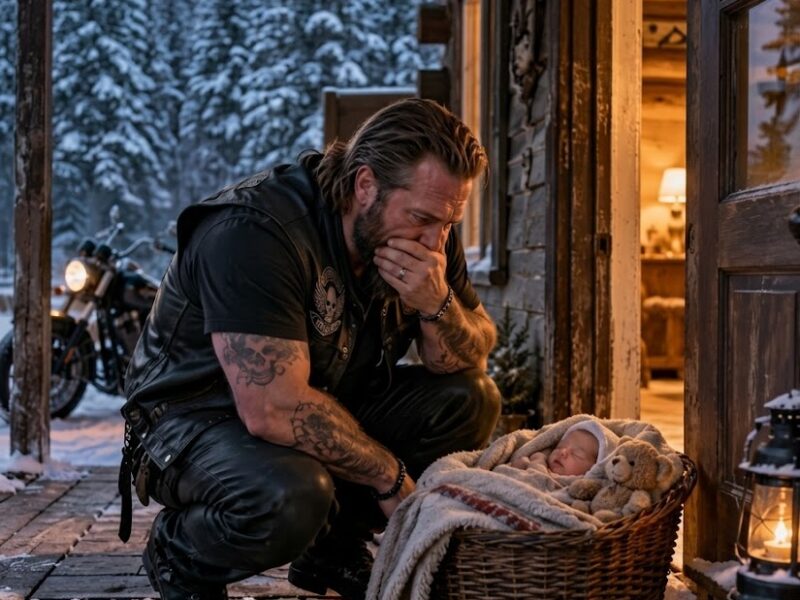
A Biker Found a Baby Outside His Door—Then He Saw His Own Name Stitched Into the Blanket
## Part 1
Jack Morrison didn’t hear a knock that night.
He heard a baby crying—barely a sound, more like a fragile breath being swallowed by the freezing wind outside his cabin in the Pine Barrens of southern New Jersey.
Jack killed the engine of his Harley and stared into the darkness.
Snow covered the narrow road behind him, and there wasn’t a single car in sight.
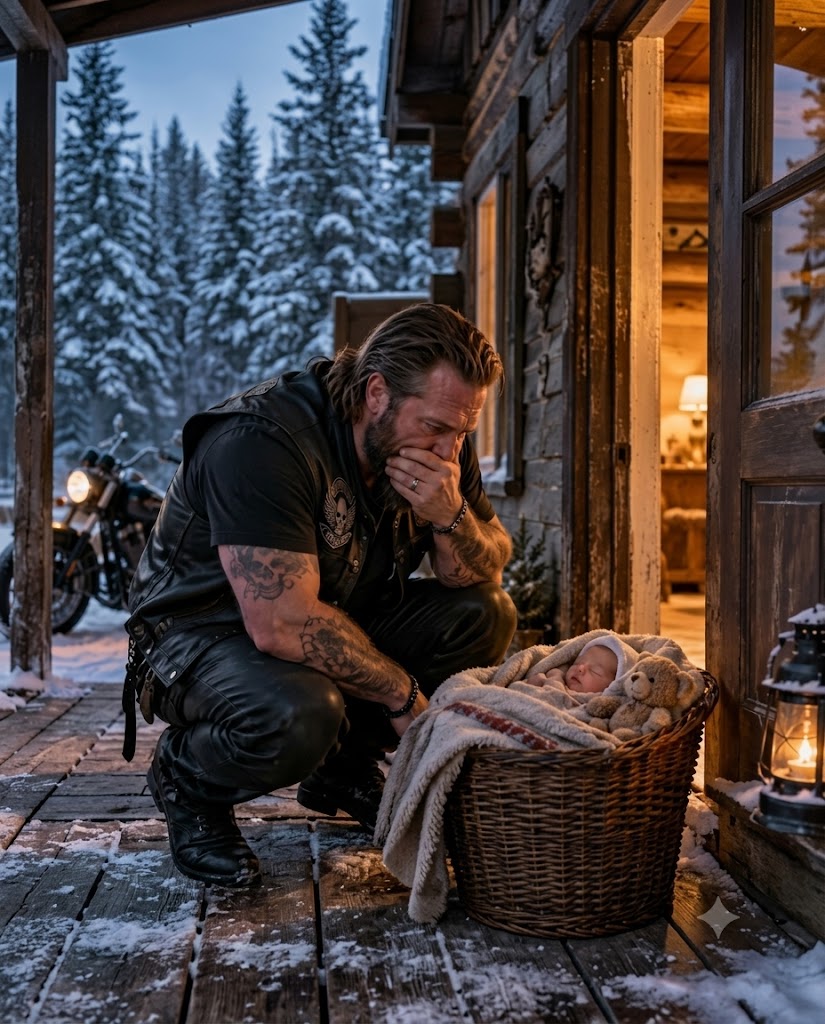
Then he noticed the basket.
It sat directly in front of his door, a small wicker thing that looked like it belonged in a catalog for people who had never spent a night alone.
Jack slowly climbed the wooden steps, his leather boots crunching against the snow.
Inside the basket, a newborn baby lay wrapped tightly in a gray blanket, his tiny face peaceful despite the cold.
“Hey, little one.”
Jack’s voice—usually rough enough to silence a bar—came out strangely gentle.
He looked around.
Nothing.
No footsteps, no note, no mother, only the wind.
Jack crouched beside the basket and carefully pulled back the edge of the blanket.
Then he froze.
Stitched into the fabric with faded red thread were two words.
Jack Morrison.
His full name.
Not Razer—not the name his brothers had called him for decades.
His real name.
Jack’s hand trembled.
Then he saw the sentence stitched underneath.
You promised you would come back.
Jack stopped breathing.
Nineteen years ago, only one person had ever said those words to him.
And Jack believed she was dead.
—
The baby was waiting on Jack Morrison’s doorstep, wrapped in a blanket with his name stitched across it.
Jack stood frozen beside his motorcycle, one gloved hand still resting on the cold chrome handlebar as the engine ticked softly behind him.
The porch light flickered against the wet wood, and the sharp smell of gasoline mixed with the clean bite of snow in the air.
He stared at the small wicker basket as if it had appeared there by magic.
Inside, a newborn boy slept beneath a gray blanket, his tiny fists tucked beneath his chin.
Jack slowly removed his gloves.
The leather creaked between his fingers.
“Hey, little man,” he whispered.
His voice sounded strange in the silence—too gentle for a man whose reputation had once made entire bars go quiet.
He crouched beside the basket and touched two fingers to the baby’s cheek.
Warm.
Alive.
Breathing steadily.
Jack immediately looked down the road.
Nothing moved between the dark trees.
No headlights, no footsteps, no woman running back in panic—just the faint hum of his Harley cooling behind him.
He reached for his phone, intending to call 911, then stopped when the baby stirred.
A thin cry escaped from beneath the blanket.
Jack’s hand hovered in the air.
“Easy, easy,” he leaned closer.
“I’ve got you.”
The words left his mouth before he could think about them.
He carefully lifted the basket and carried it inside.
—
The cabin smelled of motor oil, old leather, and coffee that had been sitting too long in a metal pot.
His boots left melted snow across the rough wooden floor.
He placed the basket beside the workbench, then turned on another lamp.
Warm amber lights spread across the room, revealing the contrast between the battered tools hanging on the wall and the impossibly small child lying among them.
Jack opened a cabinet and pulled out an old towel.
He had no crib, no baby formula, no diapers—nothing that belonged in a house with an infant.
For a man who could rebuild a motorcycle engine with his eyes half closed, he suddenly had no idea what to do with a seven-pound baby.
He grabbed his phone again and searched for the nearest 24-hour pharmacy.
Then the baby made another small sound.
Jack looked down.
The gray blanket had shifted.
Something red caught his eye.
He bent closer.
At first, he thought it was embroidery from an old pattern.
Then he recognized the letters.
J-A-C-K.
His fingers stopped above the fabric.
He pulled the blanket carefully toward the lamp.
The rest of the name came into view.
Jack Morrison.
Not Razer.
Not the nickname men from his old life had shouted across garages and parking lots.
Jack Morrison.
His full name.
Jack slowly straightened.
The room suddenly seemed much smaller.
He turned toward the locked front door, then back toward the baby.
“Who put you here?” he asked.
The baby only blinked up at him.
Jack ran his thumb over the faded stitching.
The thread was old, but the name had been sewn deliberately—one letter at a time.
Then he noticed another line beneath it, smaller, almost hidden in the fold.
Jack pulled the blanket flat.
Seven words stared back at him.
You promised you would come back.
His hand dropped to his side.
The coffee pot clicked as it cooled.
Somewhere inside the garage, a loose chain tapped against metal.
Jack did not move.
Nineteen years earlier, someone had said those exact words to him.
Someone whose voice he had spent nearly two decades trying not to remember.
He looked toward the window.
At the far end of the road, two faint headlights appeared between the trees.
They slowed.
No turn signal.
No headlights shining toward the cabin.
Then they disappeared behind the bend.
Jack looked down at the baby again.
For the first time that night, the question wasn’t who had left the child.
It was why they had chosen Jack Morrison’s door.
—
By sunrise, Jack had not slept.
He sat at the edge of his kitchen table with the baby resting in the crook of his left arm while the untouched coffee beside him went cold.
Pale morning light slipped through the blinds and laid narrow silver lines across the wooden floor.
The baby stirred beneath the gray blanket, his tiny fingers curling around the edge of Jack’s shirt.
Jack looked down at him, then at the names stitched into the fabric.
He had spent the night telling himself there had to be an explanation—some mistake, some stranger with the same name—but the letters were still there.
Jack Morrison.
He reached for his phone and called the county hospital.
“I found a newborn,” he said.
“He was left outside my house.”
The nurse asked whether he knew anything about the mother.
“No.”
“Does he have identification?”
Jack glanced at the blanket.
“Nothing except my name.”
There was a pause.
“Bring him in.”
Jack ended the call, but he didn’t move.
The baby made a soft clicking sound with his tongue.
Jack looked toward the hallway where his old leather jacket hung from a nail, then down at the child again.
For decades, that jacket had meant one thing to him—a life where nobody was allowed close enough to need him.
He stood, carried the baby into the small bedroom, and opened a closet that had remained untouched for years.
Inside was an old wooden box.
Dust coated its lid, and the hinges gave a dry squeak when Jack opened it.
He took out a faded photograph.
A younger Jack stood beside his sister Anna on the steps of their parents’ house.
She was twenty-three, smiling into the sunlight, while Jack wore the same hard expression he had carried into every fight and every bar afterward.
Beneath the photograph lay a brass key.
Jack closed his fingers around it.
“You always said I was afraid of staying,” he murmured.
The baby began to fuss.
Jack immediately put the photograph down and returned to the child.
He warmed a bottle, tested a drop against his wrist, and carefully fed him while sitting in the old rocking chair.
The chair creaked beneath Jack’s weight.
Somewhere outside, a truck passed along the road, its tires hissing over damp pavement.
The baby finished the bottle and fell asleep against Jack’s chest.
Jack remained perfectly still.
He looked down at the tiny face resting against his worn black shirt.
Then he noticed something he had never allowed himself to imagine.
The baby wasn’t asking him to explain the past.
He simply needed someone to stay.
Jack lowered his chin until it nearly touched the child’s blanket.
“You don’t know me,” he whispered.
“And I don’t know you.”
He paused.
“But you’re here.”
The words hung in the quiet room.
—
Jack carried the baby back to the kitchen and placed the carrier on the table.
Then he walked to the garage, opened a metal cabinet, and pulled out a battered duffel bag.
Inside were clothes, cash, an old first aid kit, and the documents he had kept for emergencies.
He added a clean shirt, diapers he had bought at the pharmacy that morning, and a folded towel.
Then he stopped beside his Harley.
The motorcycle stood beneath the fluorescent lights, chrome catching the pale glare, the familiar smell of oil and rubber filling the garage.
Jack placed one hand on the seat.
For years, whenever life became complicated, he rode away.
This time he picked up the baby carrier instead.
He carried the child back into the house, locked the garage, and slid the old brass key into his pocket.
Jack looked once toward the road where the black car had disappeared before dawn.
Then he looked at the sleeping child.
“We’re going to the hospital,” he said quietly.
“And after that, I’m finding out why someone trusted me with you.”
He picked up the carrier and walked through the front door, leaving his Harley behind for the first time in years.
The road could wait.
The baby couldn’t.
—
Jack carried the baby through the hospital doors, then stopped when the blanket slipped from his shoulder and revealed a loose red thread.
The automatic doors whispered shut behind him, trapping the warmth of the lobby around them.
Fluorescent lights hummed overhead, reflecting off the polished floor, while the sharp smell of disinfectant mixed with the faint sweetness of powdered formula from the bottle in Jack’s hand.
A nurse approached with a clipboard, but Jack kept his eyes on the child.
“He was left outside my house,” he said.
“I need him checked.”
Within minutes, the baby was examined, weighed, and wrapped in a fresh hospital blanket while Jack stood beside the bassinet, his black boots planted against the tile.
The baby was healthy—small, hungry, and very much alive.
When the nurse handed Jack a packet of forms, he stared at the empty spaces for several seconds.
“Father’s name?” she asked gently.
Jack looked through the glass at the baby.
“I don’t know.”
“Mother?”
“I don’t know that either.”
The nurse nodded and moved on, leaving Jack with a pen between his fingers.
He signed his own name wherever the form required an emergency contact.
Jack Morrison.
The same name stitched into the blanket.
—
Hours later, back at the cabin, Jack spread the gray blanket across his kitchen table.
Sunlight pushed through the dusty window, warming one corner of the fabric while the rest remained cool beneath his palm.
He had washed it carefully at the hospital, but the old stitching still felt rough against his fingertips.
The baby slept nearby in the carrier, one tiny hand resting beside his cheek.
Jack picked up the blanket to fold it.
His thumb caught on a seam.
He stopped.
The fabric had been stitched twice along one edge.
Not repaired—reinforced.
Jack fetched a small pocket knife from the workbench, slid the blunt edge beneath the thread, and carefully opened three inches of the seam.
A folded piece of paper slipped onto the table.
Jack stared at it.
He didn’t unfold it immediately.
The baby made a soft sound from the carrier.
Jack looked over, then opened the paper.
Six words were written in blue ink.
Ask Jack what happened at Miller’s Bridge.
The kitchen clock ticked loudly in the silence.
Jack lowered the paper.
His fingers tightened around its edge until it bent.
Miller’s Bridge.
He had not heard those words spoken in nineteen years.
He walked to the sink, turned on the faucet, and let cold water run over his hands.
The pipes rattled inside the wall.
He shut the water off and looked toward the photograph of Anna still sitting on the counter.
For the first time, the past was no longer something Jack could leave behind simply by refusing to speak about it.
The baby had brought it through the front door with him.
Jack folded the note and slipped it into his jacket pocket.
Then he walked to the garage and pulled open an old steel cabinet.
Dust lifted into the fluorescent light.
Inside sat a battered road map, a set of keys, and an old photograph Jack had not touched in years.
He took the photograph and returned to the kitchen.
The baby was awake now.
His eyes followed Jack across the room.
Jack placed the photograph beside the baby’s carrier.
It showed a wooden bridge beneath the summer sky with a younger Jack standing beside a woman whose face had been partly turned away from the camera.
Jack stared at the image for several seconds.
Then he picked up his phone and searched for the road to Miller’s Bridge.
The route appeared on the screen.
Forty-seven miles.
Jack grabbed his keys.
He looked at the baby, then at the note hidden inside his jacket.
“All right,” he said quietly.
“You brought me this far.”
He lifted the carrier from the table.
“Now I’m going to find out what happened there.”
And as Jack stepped toward the garage, his phone suddenly vibrated in his pocket.
He stopped.
The screen showed a number he had not seen in nineteen years.
The phone rang again, and Jack answered without taking his eyes off the baby.
“Hello.”
For several seconds, there was only static and the faint sound of someone breathing.
Then a woman spoke.
“Jack.”
His hand tightened around the phone.
The kitchen suddenly felt too quiet—the refrigerator humming behind him and the old wall clock ticking above the sink.
“Who is this?” he asked.
The woman didn’t answer right away.
“You still have the cabin?”
Jack looked toward the window.
“Who are you?”
A soft breath came through the speaker.
“You really don’t recognize my voice.”
Jack lowered himself into the chair beside the baby’s carrier.
The baby shifted beneath the hospital blanket, making a tiny rustling sound.
Jack stared at the floorboards.
“Emily.”
The line went silent.
Then came three words that seemed to pull nineteen years into the room.
“You left me.”
Jack closed his eyes.
—
He remembered Miller’s Bridge before he remembered anything else.
Not the note, not the blanket, not the phone—the bridge.
Nineteen years earlier, the same wooden boards had groaned beneath his boots while summer heat rose from the river below.
Emily had stood beside the railing wearing a faded blue jacket, her hands wrapped around a paper cup that had gone cold.
Jack had leaned against his motorcycle, helmet hanging from one hand, already knowing he was about to make a choice he would carry for the rest of his life.
“Come with me,” Emily had said.
The river moved slowly beneath the bridge, sunlight flashing across the water like broken glass.
“We can leave all of this behind.”
Jack had looked toward the road.
His club had called.
A brother needed him.
One ride, one obligation, one more promise to the men who had become his entire world.
Emily stepped closer.
“Jack, if you go tonight, don’t tell me you’ll come back unless you mean it.”
Jack had touched her shoulder.
The leather of his vest was warm from the sun, and the smell of gasoline clung to his clothes.
“I mean it.”
He had kissed her forehead and climbed onto the Harley.
The engine thundered beneath him.
Emily remained on the bridge as he rode away.
Jack had told himself he would return within days.
Days became weeks, then months.
When he finally came back, Emily was gone.
No note, no address, no explanation.
Jack searched until the search became another thing he stopped talking about.
Now, sitting beside the baby, he pressed the phone closer to his ear.
“Why are you calling me?”
Emily’s voice was quieter this time.
“Because you need to know why the baby is there.”
Jack stood so quickly the chair scraped across the floor.
The baby startled, his small cry cutting through the room.
Jack immediately lifted him, supporting his head against his chest.
“Is he yours?” Jack asked.
Emily hesitated.
“No.”
Jack looked down at the baby.
“Then who’s is he?”
Another silence.
“Jack, you need to listen to me. I didn’t leave him at your door because I wanted to punish you.”
Jack’s jaw tightened.
“Then why?”
Emily breathed into the phone.
“Because nineteen years ago, you promised you would come back.”
Jack looked at the gray blanket wrapped around the baby.
“I know.”
“No, Jack,” Emily whispered.
“You don’t. Not yet.”
The call ended before Jack could answer.
He stood motionless in the warm kitchen, the baby against his chest, the blanket pressed between them.
Then Jack made one decision.
He picked up his keys, secured the baby in the carrier, and headed for Miller’s Bridge.
This time, he would not leave before hearing the whole story.
—
## Part 2
The woman in the red coat lowered her eyes to the baby, then quietly stepped away from the bus station doors.
“Come with me,” she said.
“There’s someone you need to see.”
Jack tightened his grip on the carrier.
“You said I had to go alone.”
She looked at him for a long second.
“I was wrong.”
Outside, the station lights washed the wet pavement in pale white, and diesel fumes drifted from a bus idling at the curb.
Jack followed her across the parking lot, the baby sleeping beneath the gray blanket against the cold night air.
The woman stopped beside an older sedan and opened the passenger door.
“My name is Laura Bennett,” she said.
“Anna asked me to help you if this day ever came.”
Jack paused.
“You knew my sister?”
“For years.”
She glanced at the baby.
“And I knew she never wanted anyone to force you into being something you weren’t ready to become.”
Jack secured the carrier inside the back seat before getting behind the wheel.
The vinyl smelled faintly of coffee and old leather.
Laura climbed in beside him and gave him an address written on a folded piece of paper.
“Twelve miles east.”
Jack started the Harley instead.
“I’ll follow you.”
Laura nodded.
“That’s fine.”
The two vehicles left the station, their headlights sliding across the dark road.
Jack kept the baby in sight through the rearview mirror at every stop, the blanket rising and falling with each quiet breath.
When they reached a small farmhouse surrounded by bare trees, Laura parked beneath a porch light.
Jack stopped behind her, shut off the engine, and immediately lifted the baby from the carrier.
The baby stirred against his chest.
“Easy,” Jack whispered.
The farmhouse door opened before he reached it.
An older white man stood inside, one hand resting on a wooden cane.
Warm yellow lights spilled across the porch boards, and the smell of cedar and fresh coffee drifted through the doorway.
His name was Thomas Hale.
Jack knew him—not well, but enough to recognize the face from an old photograph Anna had once shown him.
Thomas looked at the baby, then at Jack.
“She brought you.”
Jack stepped inside.
“Who?”
Thomas glanced at Laura.
“Emily.”
Jack stopped.
The baby made a soft sound against his chest.
Thomas pointed toward a chair.
“Sit down.”
Jack remained standing.
“Where is she?”
“Alive.”
Jack’s fingers tightened around the carrier handle.
Thomas continued.
“But she doesn’t want you to find her yet.”
“Then why bring me here?”
Thomas reached into a drawer and removed a sealed envelope.
“Because Anna left instructions.”
Jack stared at the envelope but didn’t take it.
“What instructions?”
Thomas placed it on the table.
“She said that if a baby ever arrived at your door with your name on his blanket, you would need to hear the truth from someone who knew both you and Emily.”
Jack looked down at the baby.
The baby had opened his eyes, a soft amber lamp reflecting in them.
Jack touched the edge of the gray blanket.
“Then tell me.”
Thomas shook his head.
“Not tonight.”
Jack looked up sharply.
Thomas slid a photograph across the table.
It showed Emily standing outside a hospital holding a newborn wrapped in gray fabric.
The photograph was dated nineteen years after Jack remembered Miller’s Bridge.
Jack’s eyes stopped on the date.
He did the calculation silently.
The baby had been born only weeks earlier.
Thomas spoke carefully.
“Emily is the one who left him at your door.”
Jack stared at him.
“She was there.”
“Yes.”
“Why didn’t she come inside?”
Thomas looked toward the baby.
“Because she wanted the first choice to be yours.”
Jack lowered himself into the chair at last.
The wooden legs creaked against the floor.
“What choice?”
Thomas answered quietly.
“Whether you would keep him after learning he isn’t your biological son.”
Jack looked down at the baby.
The baby reached toward his shirt with one tiny hand.
Jack let him grab the fabric.
Laura stood near the window, saying nothing.
Outside, the wind moved through the trees, brushing branches against the glass.
Jack folded his hand around the baby’s.
“Then she should have trusted me.”
Thomas nodded.
“She did.”
He pushed the envelope closer.
“And now she wants you to meet her before she runs out of time.”
Jack picked up the envelope but did not open it.
Instead, he stood and lifted the baby higher against his chest.
“Take me to her.”
Thomas looked at Laura.
Laura nodded.
Jack walked toward the door with the baby in his arms.
And this time there was no mystery left about who had chosen his doorstep.
The woman who knew his name, his past, and the promise he had broken had chosen it herself.
Emily was waiting somewhere ahead.
—
Jack found Emily sitting beside a narrow window, the baby asleep against his chest while the soft ticking of a wall clock filled the small farmhouse room.
Warm lamp light rested across the wooden table, and the faint smell of cedar and coffee lingered in the quiet air.
Emily looked at the baby first.
Then she looked at Jack.
“You came.”
Jack pulled out the chair opposite her and sat down, keeping the baby close.
“You knew I would.”
Emily lowered her eyes.
“I hoped you would.”
For several seconds, neither spoke.
The baby shifted beneath the gray blanket, his tiny fingers curling around Jack’s shirt.
Emily watched the movement, then slowly reached across the table.
“Can I hold him?”
Jack hesitated only a moment before carefully placing the baby in her arms.
Emily drew him against her chest.
The room seemed to become smaller around them.
She pressed her cheek against his soft hair, breathing in the clean scent of baby soap.
“I wanted to bring him to you myself,” she whispered.
“Then why didn’t you?” Jack asked.
Emily looked toward the window.
“Because if I stood on your doorstep and told you he was mine, you might have believed you were only helping because you felt responsible for me.”
Jack said nothing.
Emily continued.
“I needed you to see him first—to choose him before anyone told you what you were supposed to do.”
She reached for the gray blanket and ran her fingertips across the faded red stitching.
“Anna understood that.”
Jack leaned forward.
“How?”
Emily gave a tired smile.
“Because she knew you better than you thought.”
She looked back at him.
“She knew you would spend your whole life running from the worst thing you ever did.”
Jack’s eyes dropped to the floor.
Emily didn’t push the subject.
Instead, she placed the baby back in his arms.
“He’s not your biological son.”
Jack nodded.
“I know. But that doesn’t mean he has to grow up without a father.”
Jack looked down at the baby.
“Why me?”
Emily’s answer came quietly.
“Because Anna told me about the man you were before you decided you didn’t deserve a family.”
Jack’s hand moved beneath the baby’s head, supporting him as he stirred.
“You said she knew.”
“She did.”
Emily stood and walked to a small cabinet.
The wooden floor creaked beneath her steps.
She returned with a thin folder and placed it on the table.
Inside were papers from the hospital, the baby’s birth certificate, and a document with Emily’s signature.
Jack looked through them without rushing.
There was no hidden inheritance, no secret bloodline, no surprise waiting on the next page.
Just a mother making a decision about her child.
“My health is getting worse,” Emily said.
“I don’t know how much time I have.”
Jack closed the folder.
“Then we’ll deal with that.”
Emily looked at him.
“There is one more thing.”
Jack waited.
“There are people who may try to claim control over the baby because of a trust I established for him.”
Jack glanced at the folder.
“They want the money.”
“They want control,” Emily corrected.
“The money belongs to the baby. I don’t want anyone using him to reach it.”
Jack stood and secured the baby against his shoulder.
“Then nobody gets near him.”
Emily shook her head.
“Don’t become the man you used to be.”
Jack looked toward the old leather jacket hanging near the door.
“I won’t.”
“Promise me.”
Jack looked down at the baby.
His tiny hand had closed around Jack’s finger.
“I promise.”
Emily nodded.
For the first time that night, she let herself smile.
“Then take him home.”
Jack picked up the gray blanket and wrapped it carefully around the baby.
Before he reached the door, Emily called his name.
“Jack.”
He turned.
“That blanket wasn’t meant to prove he was yours.”
Jack waited.
Emily touched her chest.
“It was meant to ask whether you would make him yours.”
Jack looked down at the stitched letters, then at the sleeping child in his arms.
He opened the door.
Cold air slipped through the hallway, carrying the distant sound of his motorcycle outside.
Jack stepped onto the porch, then stopped.
He turned back toward Emily.
“He is mine,” he said quietly.
“Not by blood. By choice.”
Emily nodded through shining eyes.
Jack walked toward the Harley with the baby held securely against him.
Behind him, Emily closed the door, knowing the choice she had hoped for had finally been made.
—
Jack drove through the darkness with the baby secured beside him, the baby’s soft breathing barely audible beneath the steady rumble of the Harley.
The dashboard clock glowed 9:42 p.m. while cold air slipped through a narrow gap in Jack’s jacket, and the smell of gasoline followed him from the road.
He kept one hand on the throttle and checked the carrier at every stoplight.
When they finally reached the address the woman in red had given him, Jack found a small rental house behind a row of bare trees.
One porch light flickered above the door.
He killed the engine.
For a moment, there was only the ticking of hot metal and the baby’s quiet breathing.
Jack lifted the carrier and walked to the porch.
Before he could knock, the door opened.
Emily stood there.
She looked older than the woman Jack remembered from the bridge—her brown hair streaked with gray, her shoulders wrapped in a faded cardigan.
She gripped the door frame with one hand.
The hallway behind her smelled of medicine and lavender soap, and a small lamp cast a soft yellow circle across the worn carpet.
Her eyes moved immediately to the baby.
“You brought him.”
Jack nodded.
“You left him at my door.”
Emily looked down.
“I did.”
Jack stepped inside.
The baby stirred, and Jack adjusted the blanket around him before looking back at her.
“Why?”
Emily slowly closed the door.
“Because I don’t have much time.”
Jack said nothing.
She walked toward a small table where several unopened envelopes lay beside a glass of water.
“The doctors don’t think I have long.”
Her fingers trembled slightly as she touched the rim of the glass.
“I wanted the baby somewhere safe before I couldn’t make that choice anymore.”
Jack placed the carrier on the couch.
“You could have called me.”
Emily gave a small, tired smile.
“Would you have answered?”
Jack looked away.
She didn’t press him.
Instead, she sat across from the baby and watched him sleep.
“He’s not yours, Jack.”
“I know. But Anna believed you could be his family.”
Jack pulled Anna’s letter from his jacket and placed it on the table.
Emily saw the handwriting and closed her eyes for a moment.
“She was right.”
Jack looked at the baby.
“What happens now?”
Emily reached into a drawer and removed a folder.
She set it beside him.
“There are people who know the baby exists. They believe his mother left something valuable behind, and they think he gives them a claim to it.”
Jack opened the folder but stopped before reading further.
“Money, property, a trust—things I never wanted him involved in.”
Jack closed the folder.
“Then he stays away from all of it.”
Emily looked at him.
“That’s why I chose you.”
Jack lifted the carrier and brought the baby closer.
“He doesn’t need money.”
Emily’s eyes stayed on the baby.
“No. He needs someone who won’t disappear.”
Jack looked at her.
The room was quiet except for the refrigerator cycling in the kitchen and the faint ticking of a clock on the wall.
Emily reached toward the baby but stopped before touching him.
“Can I?”
Jack nodded.
She placed two fingers gently against the baby’s hand.
The baby curled his fingers around hers.
Emily inhaled sharply and held still.
“He was born early,” she whispered.
“Every time I held him, I kept thinking about that night at Miller’s Bridge.”
Jack swallowed.
“So did I.”
Emily withdrew her hand.
“I didn’t leave him because I didn’t love him.”
Jack answered immediately.
“I know.”
She looked at him.
“Then why did you come?”
Jack glanced down at the baby.
“Because somebody left him at my door. And because his name was put beside mine.”
Emily nodded slowly.
“Then don’t let anyone convince you that you aren’t his family.”
Jack stood and lifted the carrier.
“I’m taking him home.”
Emily watched him reach for the door.
“Jack.”
He stopped.
“If you take him, you can’t give him back when it gets hard.”
Jack looked over his shoulder.
“I know.”
“Then make the decision now.”
Jack looked down at the sleeping child, then tightened his grip around the carrier handle.
“I’m not giving him back.”
Emily nodded, tears gathering but not falling.
Jack opened the door.
Behind him, Emily whispered, “Then he’s yours.”
Jack stepped onto the porch with the baby in his arms, unaware that someone across the street had just switched on a car’s headlights and was watching them leave.
—
## Part 3
The first car reached Jack’s cabin before he did, its headlights washing across the garage windows as he pulled the baby from the passenger seat of the Harley.
The porch boards creaked beneath his boots, and the warm smell of motor oil drifted through the open garage door.
The baby was half asleep, wrapped tightly in the gray blanket, his cheek pressed against Jack’s shoulder.
Jack carried him inside and locked the front door.
Then he heard an engine stop outside.
He looked through the window.
The same gray sedan from Emily’s street sat at the edge of the driveway.
A man stepped out wearing a dark gray coat, followed by another man who stayed near the vehicle.
Jack placed the baby in the crib and pulled the blanket gently beneath his chin.
“Stay right here, little man.”
He turned off the bedroom light, leaving only the soft amber glow from the hallway.
Then he walked into the garage and opened the main door.
The man in the gray coat stood beneath the security light.
“Jack Morrison. You know who I am.”
The man held up a folder.
“My name is Daniel Mercer. I represent the people managing the trust Emily established for the baby.”
Jack kept his hands visible.
“Then you can explain why you’re at my house after midnight.”
Daniel looked past him toward the cabin.
“We’re here because Emily’s arrangements have changed.”
Jack’s eyes narrowed.
“No, they haven’t.”
Daniel opened the folder.
“The trust gives certain relatives the right to challenge your guardianship.”
Jack didn’t take the papers.
“Emily already made her choice.”
“She can make a choice,” Daniel replied.
“But the court still has to approve it.”
The words hung between them.
Behind Jack, a fluorescent tube buzzed above the workbench, and somewhere in the cabin, the baby made a faint sound.
Jack turned his head for half a second.
Daniel heard it, too.
“Give us the baby tonight,” he said.
“We’ll handle everything through the court tomorrow.”
Jack looked back at him.
“No.”
Daniel’s expression hardened.
“You don’t want this fight.”
Jack stepped farther into the garage.
The concrete floor was cold beneath his boots while the overhead lights cast sharp reflections across the Harley’s chrome.
“I’m not fighting you.”
He pulled out his phone.
“I’m documenting you.”
Daniel paused.
Jack pressed one button.
“And I’m calling everyone who knows what Emily wanted.”
Within minutes, headlights began appearing beyond the trees.
One motorcycle arrived, then another, then several more.
Engines rumbled through the darkness, but nobody rushed forward.
Jack walked outside and raised his hand.
“Stay where you are.”
The riders stopped.
They knew exactly why he had called them—not to threaten Daniel, not to settle anything themselves.
To witness.
Jack faced Daniel again.
“You said this belongs in court. Fine. We’ll let the court decide.”
Daniel looked around at the silent riders.
“You think bringing them here helps you?”
“No,” Jack said.
“It helps keep everyone honest.”
He took Anna’s letter from his jacket and held it up.
“My sister knew Emily. Emily chose me. And the baby is asleep in my house because his mother trusted me to keep him safe.”
Daniel glanced at the letter.
“That doesn’t make you his father.”
Jack looked toward the cabin.
“No. It makes me the man who stayed.”
Daniel lowered the folder.
“If the court denies your guardianship—”
Jack answered without hesitation.
“Then I’ll stand there and fight for him the right way.”
A quiet engine ticked as it cooled nearby.
The riders remained silent.
Daniel studied Jack for several seconds, then closed the folder.
“You’ll receive the hearing notice in the morning.”
Jack nodded.
“I’ll be there.”
Daniel turned toward his car, but Jack stopped him.
“And Daniel.”
The man looked back.
“Nobody takes the baby tonight.”
Daniel gave a brief nod and walked away.
Jack closed the garage door and returned to the cabin.
The baby was awake, his small hands gripping the edge of the gray blanket.
Jack lifted him from the crib and held him against his chest.
The baby settled almost immediately.
Jack stood beside the window as the last headlights disappeared down the road.
For years, he had believed being a man meant never needing anyone.
Tonight, he had done something different.
He had asked his old brothers to stand beside him—not to fight, but to witness the promise he intended to keep.
And by sunrise, Jack would have to prove that staying wasn’t just something he said.
It was something he was prepared to do in front of a judge with the baby in his arms.
—
The judge looked at Jack, then at the sleeping baby beside him, and finally at the stack of documents on the courtroom table.
Jack sat perfectly still, one hand resting on the gray blanket covering the baby’s legs.
The courthouse was quiet except for the soft scrape of papers and the distant hum of an elevator somewhere beyond the wooden doors.
Three weeks had passed since Daniel Mercer first arrived at Jack’s garage, and those three weeks had changed everything.
Emily had signed her final guardianship instructions before her health deteriorated further.
Her attorney had submitted the documents confirming that she wanted Jack to care for the baby and that the trust was to remain protected for the child’s benefit.
Daniel had challenged the arrangement, but the court found no evidence that taking the baby from Jack would serve the child’s interests.
The judge adjusted his glasses and looked over the final page.
“Mr. Morrison, the court is prepared to recognize you as the baby’s legal guardian.”
Jack swallowed once.
He looked down at the baby.
The baby was awake now, staring up at him with wide blue eyes.
Jack touched one finger to his tiny hand.
“Thank you, Your Honor.”
The judge paused.
“This decision comes with responsibility. The baby’s trust remains protected, and any financial decisions involving it will require proper court oversight. Your role is to provide stability, safety, and care.”
Jack nodded.
“I understand.”
There was no celebration when he walked out of the courthouse.
No cheering crowd, no cameras—just cold sunlight across the stone steps and the sound of traffic moving through the street.
Laura stood beside her car, holding a folder against her chest.
“You did it,” she said.
Jack shook his head.
“Emily did.”
Laura smiled faintly.
“She would have said you finally kept one promise.”
Jack looked at the baby.
“I was late.”
Laura’s expression softened.
“But you stayed.”
—
That afternoon, Jack returned to the cabin.
The old garage no longer looked exactly the same.
A small crib stood beside the workbench.
Baby bottles sat on a shelf that once held motorcycle parts.
A folded stack of clean blankets rested on the old leather chair.
The Harley still occupied its usual place beneath the hanging lights, chrome shining beneath a thin layer of dust.
Jack placed the baby on the floor inside a soft playpen and started making dinner.
The sound of a baby laughing soon mixed with the clatter of tools and the low hum of the refrigerator.
For the first time in years, the garage didn’t feel like a place where Jack had gone to hide.
It felt like a home.
Emily’s condition worsened over the following weeks.
Jack visited her whenever he could, sometimes bringing the baby with him.
On her final afternoon, Emily held the baby against her chest while sunlight passed through the hospital blinds in narrow golden lines.
Her voice was barely above a whisper.
“Thank you for choosing him.”
Jack stood beside the bed.
“He chose me, too.”
Emily smiled.
“Then I made the right choice.”
She closed her eyes, the baby’s tiny fingers resting against her hand.
Two weeks later, Emily was gone.
Jack buried her beneath an old oak tree outside town with Laura, Thomas, and a few people who had known her standing nearby.
There were no speeches about perfect lives—only quiet memories, folded hands, and the sound of wind moving through the branches.
Months passed.
The baby grew stronger.
He learned to crawl across the garage floor, pulling himself up against the Harley whenever Jack wasn’t looking.
Jack learned how to warm bottles with one hand while tightening a motorcycle chain with the other.
He learned that some nights meant two hours of sleep and some mornings began before sunrise.
He learned that fatherhood wasn’t about knowing exactly what to do.
It was about staying when you didn’t.
—
Years later, the boy stood beside the same old workbench, now tall enough to see over it.
The gray blanket was folded carefully inside a wooden box on the shelf.
“Dad?” the boy asked.
Jack looked up from the motorcycle engine.
“Yeah.”
The boy pointed toward the box.
“Why does my blanket have your name on it?”
Jack wiped his hands on a shop towel and walked over.
He opened the box and lifted the blanket carefully.
The red stitching had faded, but the words were still visible.
Jack Morrison.
The boy looked at him.
“Was I really yours?”
Jack smiled and knelt beside him.
“Not because of blood.”
He touched the letters with his thumb.
“Someone put my name there because she believed I could be the man you needed.”
The boy thought about that for a moment.
“And were you?”
Jack looked toward the old Harley, then back at his son.
“I’m still trying.”
The boy wrapped his arms around him.
Jack held him tightly, the rough leather of his jacket pressing against the boy’s soft sweatshirt.
Outside, the garage door stood open to the afternoon sun.
Years ago, Jack had believed family was something he had lost forever.
Now he understood something different.
Family wasn’t always the person whose blood ran through your veins.
Sometimes it was the person who left a baby at your door and trusted you to stay.
And sometimes the greatest second chance in a man’s life arrived wrapped in a gray blanket with his name stitched across it.
—
## Part 4
The letter arrived on a Tuesday, tucked between a power bill and a catalog for motorcycle parts Jack never ordered.
He spotted the handwriting before he even opened it—the same precise cursive he hadn’t seen in nearly two decades.
For a long moment, Jack just stood in his kitchen, holding the envelope like it might burn him.
The baby—now a boy of six—was at the table, carefully coloring a picture of a motorcycle with more enthusiasm than accuracy.
“Dad? You okay?”
Jack blinked.
“Yeah, buddy. Just mail.”
He slipped the envelope into his jacket pocket and didn’t open it until after dinner, after homework, after the boy was asleep in his bed with the gray blanket tucked under his chin.
Then Jack sat at the kitchen table, turned on the small lamp, and slid his thumb beneath the flap.
The letter was two pages, written in Emily’s hand, dated three weeks before she died.
Jack—if you’re reading this, then you kept your promise. You stayed. I knew you would. I knew because I saw the way you looked at him that first night, even when you didn’t believe it yourself.
There’s something I never told you. Something you need to know now.
The baby isn’t mine. Not by blood. I was his guardian—a friend of his mother’s. She died in a car accident when he was three days old. Before she died, she made me promise to find him a family. A real one. The kind that doesn’t run.
She gave me a name. Jack Morrison.
Jack stopped reading.
His hands were trembling.
He set the letter down, stood up, and walked to the window.
Outside, the snow was starting again—soft, quiet, the same kind of snow that had fallen the night the baby arrived.
He thought about Anna. About Miller’s Bridge. About the promise he had broken and the promise he had kept.
Then he went back to the table and finished the letter.
She gave me your name because you were her brother, Jack. Her half-brother. Your father had another family before he met your mother. You never knew. She never got the chance to tell you.
The boy is your nephew. Your blood. And I knew—I knew if I told you that first, you would have taken him out of obligation. Not love. So I didn’t tell you. I let you choose him for who he was, not for what he was.
I hope you can forgive me.
I hope you can forgive yourself.
Emily
Jack read the letter three more times.
Then he folded it carefully, placed it in the wooden box beside the gray blanket, and walked to the boy’s bedroom door.
He stood there for a long time, watching his son sleep.
His nephew.
His family.
—
## Part 5
The years passed faster than Jack expected.
One summer, when the boy was twelve, they rode together for the first time—Jack on the Harley, the boy on a smaller bike Jack had rebuilt from scrap.
They took the old road to Miller’s Bridge and stopped in the middle.
The boy looked over the railing at the river below.
“This is where you met my mom?” he asked.
Jack nodded.
“This is where I made a promise I didn’t keep.”
The boy was quiet for a moment.
“But you kept it later.”
Jack looked at him.
“Yeah. I did.”
They stood there until the sun started to set, then rode home side by side.
That night, Jack opened the wooden box again.
The gray blanket was still there, faded and soft, the red stitching barely visible.
He touched the letters with his thumb—J-A-C-K—and thought about all the things he had never said.
Then he closed the box and went to the kitchen, where his son was already setting the table for dinner.
—
## Part 6
When the boy was eighteen, he came home from school with a folder in his hands and a question in his eyes.
“I found something,” he said.
Jack looked up from the motorcycle he was repairing.
“What’s that?”
The boy sat down at the workbench and opened the folder.
Inside were papers—old ones, yellowed at the edges—and a photograph of a woman Jack had never seen before.
“Her name was Sarah,” the boy said.
“She was my mother.”
Jack set down his wrench.
“How did you find this?”
“Laura gave it to me. She said I was old enough now.”
Jack looked at the photograph.
The woman had dark hair and kind eyes—the same eyes as the boy.
“She was your half-sister,” Jack said quietly.
“I know.”
The boy looked at him.
“Why didn’t you ever tell me?”
Jack sat down across from him.
“Because I wanted you to choose me for who I was—not because of blood. Not because you had to.”
The boy nodded slowly.
“That’s what Emily wrote in her letter.”
Jack frowned.
“Letter?”
The boy reached into the folder and pulled out a second piece of paper—one Jack had never seen before.
It was a letter from Emily to the boy, written on the same day she had written Jack’s.
I know you will read this when you’re older. I know you will have questions. But I want you to know something: Jack Morrison is your father. Not because he had to be. Because he chose to be. Every day. Every time he stayed. Every time he got up in the middle of the night. Every time he put you before himself. That is what makes a father. Not blood. Not paperwork. Choice.
The boy looked up at Jack.
“I know.”
Jack’s eyes were wet.
“I’m sorry I didn’t tell you.”
The boy shook his head.
“You didn’t have to. I always knew.”
He stood up and walked around the workbench.
Then he hugged Jack—not the way a child hugs a parent, but the way a man hugs another man.
“Thank you,” he said.
“For what?”
“For staying.”
—
## Part 7
The boy left for college that fall.
Jack drove him to the airport on the Harley, the boy’s duffel bag strapped to the back.
They didn’t say much on the way—there wasn’t much left to say that hadn’t already been said.
At the gate, the boy turned to Jack.
“I’ll come back.”
Jack nodded.
“I know.”
“And I’ll call.”
“Every week?”
“Every week.”
Jack pulled him into a rough hug.
“You better.”
The boy laughed, then walked through the gate and disappeared into the crowd.
Jack stood there for a long time, watching the place where his son had been.
Then he walked back to the Harley, started the engine, and rode home alone.
—
The cabin was quiet that night.
Too quiet.
Jack sat at the kitchen table with a cup of coffee and the wooden box in front of him.
He opened it and took out the gray blanket.
The red stitching was almost gone now—just faint traces of thread where the letters had been.
But Jack didn’t need to read them.
He remembered.
He wrapped the blanket around his shoulders, even though it was too small, and sat there in the dark.
For the first time in years, he let himself cry.
Not because he was sad.
Because he was grateful.
—
## Part 8
The boy came home for Thanksgiving.
He brought a friend—a girl with dark hair and a quiet smile.
Jack liked her immediately.
They ate dinner at the old kitchen table, the three of them, and talked about school and work and the motorcycle Jack was rebuilding.
After dinner, the boy’s friend went to the living room to call her parents.
The boy stayed at the table with Jack.
“Can I ask you something?”
Jack nodded.
“Why did you keep me?”
Jack looked at him.
“Because you needed someone.”
“But why you?”
Jack thought about it.
“Because someone believed I could be the man you needed. And I decided to prove her right.”
The boy smiled.
“You did.”
Jack shook his head.
“I’m still trying.”
The boy reached across the table and took Jack’s hand.
“You don’t have to try anymore. You already are.”
—
## Part 9
The boy graduated from college four years later.
Jack sat in the audience, wearing a suit he had borrowed from Thomas Hale, and watched his son walk across the stage.
When the boy’s name was called, Jack stood up and clapped louder than anyone else.
The boy found him in the crowd and grinned.
After the ceremony, they went out for dinner—just the two of them.
The boy ordered a steak, and Jack ordered a burger, and they talked about the future.
“I want to be a lawyer,” the boy said.
Jack raised his eyebrows.
“Why?”
“Because I want to help kids like me. Kids who need someone to fight for them.”
Jack nodded.
“That’s a good reason.”
The boy looked at him.
“I learned it from you.”
Jack didn’t say anything.
He just smiled and took a bite of his burger.
—
## Part 10
Years later, when Jack was old and gray and the Harley had long since been retired to the back of the garage, he sat on the porch with the gray blanket wrapped around his shoulders.
The boy—now a man—sat beside him.
They didn’t talk much anymore.
They didn’t need to.
The man looked at the blanket.
“You still have it.”
Jack nodded.
“I’ll always have it.”
The man was quiet for a moment.
“Do you ever wonder what would have happened if you hadn’t been home that night?”
Jack thought about it.
“Sometimes.”
“And?”
Jack looked at the setting sun.
“I think I would have spent the rest of my life wondering who left that baby at my door.”
The man smiled.
“And now?”
Jack looked at him.
“Now I know.”
They sat there until the stars came out, the two of them, wrapped in silence and memory and the faded gray blanket that had started it all.
—
## Part 11
Jack Morrison died on a Tuesday, peacefully, in his sleep.
He was eighty-three years old.
The man—his son—found him the next morning, still wrapped in the gray blanket.
He didn’t cry.
Not then.
He waited until after the funeral, after the friends and neighbors had gone home, after the casseroles had been eaten and the condolences had been spoken.
Then he sat alone in the old cabin, the gray blanket in his lap, and let himself remember.
He remembered the way Jack had held him that first night.
The way Jack had learned to warm bottles and change diapers.
The way Jack had taught him to ride a motorcycle.
The way Jack had stood in front of a judge and promised to stay.
He remembered everything.
And then he cried.
Not because he was sad.
Because he was grateful.
—
## Part 12
The man kept the cabin.
He kept the Harley, too—not to ride, but to remember.
He kept the wooden box with the gray blanket and the photographs and the letters.
And every year, on the anniversary of the night he arrived, he sat on the porch and looked at the road.
He thought about the woman who had left him there.
He thought about the promise she had made Jack keep.
He thought about the man who had chosen him.
And he thought about the words stitched into the blanket.
Jack Morrison.
You promised you would come back.
He had.
Not to the bridge.
Not to Emily.
But to him.
Jack Morrison had come back—not for the past, but for the future.
And that was the greatest promise of all.
—
## Part 13
The man had a son of his own, years later.
He named him Jack.
And when Jack was old enough to ask, he told him the story.
He told him about the biker who found a baby at his door.
He told him about the gray blanket with the name stitched across it.
He told him about the promise that had been kept, not in words, but in years.
And when he finished, his son looked at him and asked:
“Did he love you?”
The man smiled.
“He stayed.”
“That’s not an answer.”
“It’s the only answer that matters.”
—
## Part 14
The gray blanket hung on the wall of the cabin now, framed behind glass.
The red stitching had faded to almost nothing, but the words were still there.
Jack Morrison.
You promised you would come back.
The man stood in front of it, his own son beside him.
“Who was Jack Morrison?” the boy asked.
The man looked at the blanket.
“He was my father.”
“But not your real father.”
The man shook his head.
“He was my real father. He just wasn’t my blood.”
The boy thought about that.
“How does that work?”
The man knelt beside him.
“It works because he chose me. Every day. For the rest of his life.”
The boy looked at the blanket.
“Will you choose me?”
The man pulled him into a hug.
“Every day.”
—
## Part 15
The road to Miller’s Bridge was still there.
The man drove it sometimes, when he needed to think.
The bridge was old now—wooden planks weathered and gray—but it still stood.
He would park at the edge and walk to the middle, where Jack had once stood with Emily.
He would look down at the river and think about all the things that had happened since that night.
The baby.
The blanket.
The promise.
And he would think about Jack Morrison—the man who had been afraid of staying, and had stayed anyway.
He would think about the choice Jack had made, not once, but every day.
And he would understand, finally, what it meant to be a father.
—
## Part 16
The man wrote a letter to his own son, years later.
He wrote it on the same kind of paper Emily had used, and he folded it carefully, and he tucked it into the same wooden box.
Dear Jack,
If you’re reading this, then I’m gone. But I want you to know something.
The greatest gift I ever received wasn’t money or property or any of the things people think matter.
It was a man who chose me.
He didn’t have to. He could have called the police and walked away. He could have given me to someone else. He could have done a thousand things that would have been easier.
But he didn’t.
He stayed.
And that made all the difference.
So if you ever wonder whether you’re enough—whether you’re worthy of love—remember this: a man named Jack Morrison chose you. Not because of blood. Not because of obligation. Because of love.
And that is the only thing that has ever mattered.
Love,
Dad
—
## Part 17
The man died at ninety-one, surrounded by family.
His son was there, and his grandson, and the gray blanket was draped over his bed.
When he closed his eyes for the last time, he smiled.
Because he knew something no one else in the room knew.
He knew that somewhere, on the other side, a biker was waiting for him.
A biker with rough hands and a gentle voice.
A biker who had promised to come back.
And he had.
—
## Part 18
The grandson inherited the cabin.
He found the wooden box in the closet, and he opened it, and he read the letters.
He read Emily’s letter to Jack.
He read Jack’s letter to his son.
He read the letter his own father had written to him.
And then he unfolded the gray blanket and looked at the stitching.
Jack Morrison.
You promised you would come back.
He didn’t understand it all—not yet.
But he would.
Someday.
Because the story wasn’t over.
It never was.
—
## Part 19
The grandson rode a motorcycle.
He had never met Jack Morrison, but he felt like he knew him.
He had heard the stories—the ones his father told him and the ones his grandfather had told his father.
He knew about the bridge.
He knew about the promise.
He knew about the baby.
And one day, when he was riding through the Pine Barrens of southern New Jersey, he found himself on a narrow road he didn’t recognize.
He followed it until he reached a small cabin.
The porch light was on.
A Harley was parked in the garage.
And on the doorstep, there was a basket.
Inside, a baby was crying.
The grandson—whose name was also Jack—stopped his motorcycle and stared.
Then he climbed the steps, his boots crunching against the snow.
He looked inside the basket.
The baby was wrapped in a gray blanket.
And stitched across it, in faded red thread, were two words.
Jack Morrison.
The grandson froze.
Then he saw the sentence underneath.
You promised you would come back.
He didn’t know what it meant.
Not yet.
But he would.
Because the story wasn’t over.
It never was.
—
## Part 20
Jack Morrison—the first Jack Morrison—had spent nineteen years believing he had failed the promise he once made at Miller’s Bridge.
He never realized the promise had been waiting for him at his door all along.
And now, decades later, the promise was waiting at another door.
For another Jack.
For another chance.
For another story.
Because some promises don’t end.
They just find new people to keep them.
And sometimes the greatest second chance in a man’s life arrives wrapped in a gray blanket with his name stitched across it.
Just like it did for Jack Morrison.
Just like it would for the next Jack.
Just like it would for the one after that.
Because that’s how family works.
Not by blood.
By choice.
Every single time.
—
If this story touched you, take a moment to like, share, and subscribe for more emotional biker stories.
And if you want to see another story where an unlikely act of kindness changes a biker’s life, watch the next video.









