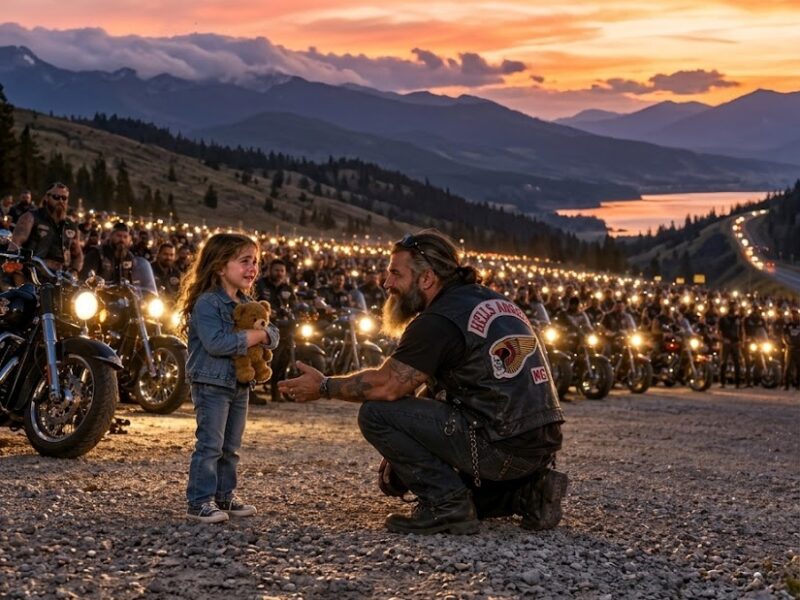
A 6-Year-Old Girl Was Found Alone on a Dark Highway—Then 400 Hells Angels Lit Up the Road to Bring Her Home
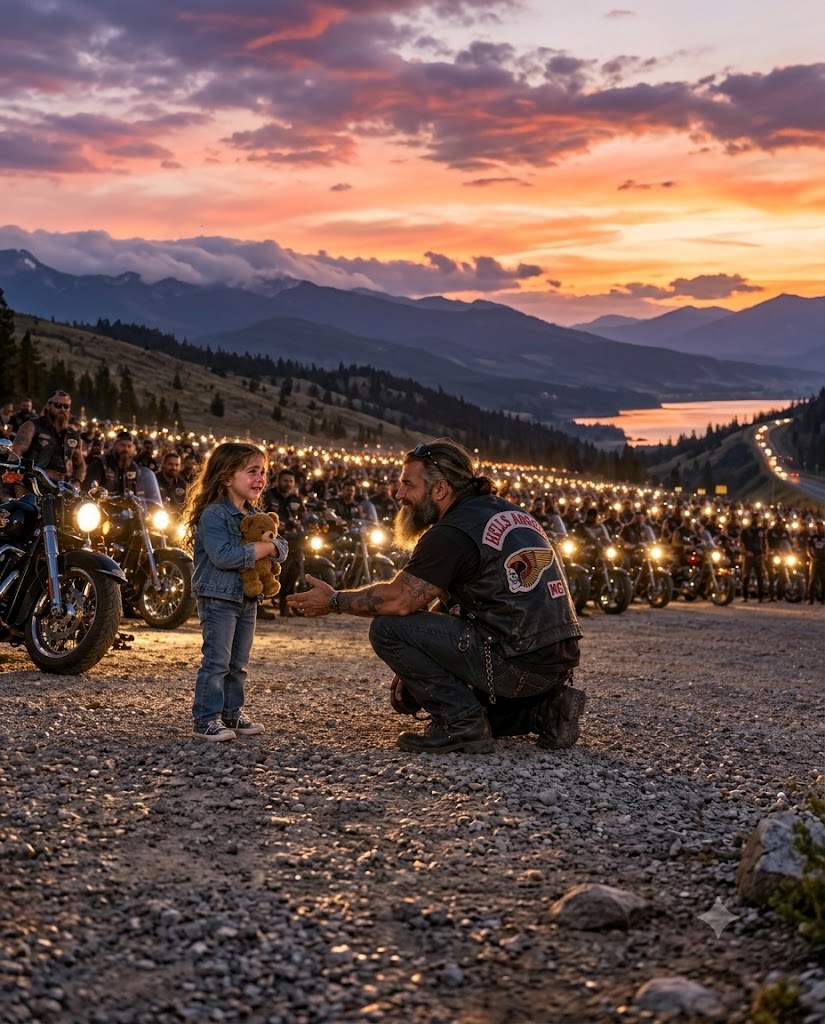
The little girl was 6 years old, and for two hours, she had been folded into the dark at the bottom of a steel pipe holding a one-eared bear, silent.
Then the ground began to shake.
Four hundred engines. Four hundred riders in cracked black leather, scarred knuckles, gray beards, tattoos crawling out of their collars, winged skulls stitched across their backs.
Every person on that hillside had already decided what they were: the danger, not the rescue.
A deputy had decided it. A truck driver had decided it. Her own mother had decided it.
The temperature was falling toward 45, and the last of the light was gone.
Then one man in that leather got down on his knees in the dust, and what he did next is the reason nobody on that hill spoke for 18 minutes.
The truck began to scream at 5:12 on a Friday afternoon in September, and Piper Lawson, who was 6 years old and had never heard a machine make a sound like that, decided it was about to explode.
Until then, it had been an ordinary day.
Her mother had picked her up from kindergarten at Chelan Elementary, and the two of them had driven south to Wenatchee for the paycheck from the diner where Kayla Lawson worked the breakfast shift.
Now they were headed home on US Highway 97A, climbing the long grade of the Navarre Coulee in a blue Ford Ranger with a cracked dashboard and 187,000 miles on the odometer.
The hills on both sides were the color of toast—sagebrush, bitterbrush, bare basalt—and high above the road a scatter of ponderosa pines.
Then the needle on the temperature gauge swung into the red and white steam rolled out from under the hood.
Kayla did everything right.
She coasted over the crest of the grade and into the gravel pullout where tourists stopped to photograph the lake far below them like a strip of dark blue ribbon.
She popped the hood, and when she came back to the window her face had gone tight in a way Piper had learned to read.
A hose had split. Her phone showed no bars because the coulee swallowed the signal, and the nearest help was the corner market just under a mile ahead.
“I can’t take you with me, baby,” Kayla said. “There’s no sidewalk and the trucks come too fast.”
She crouched and put her hands on both of Piper’s shoulders.
“I need you to stay right here. Keep the doors locked. Keep Biscuit with you. If anybody you don’t know talks to you, you don’t open the door and you don’t go with them. You hide. Do you understand me?”
Piper nodded. She understood hiding. Hiding was the one thing her mother had taught her more carefully than her letters.
She was small for six, with long brown hair that waved in every direction and a faded denim jacket. Her black canvas sneakers had white rubber toes.
Under one arm, she held a brown teddy bear named Biscuit, who was missing most of an ear and did not like to be set down.
Her mother kissed the top of her head, checked the lock twice from the outside, and walked away down the shoulder with her arms folded against the wind.
At 5:20, she disappeared around the first bend.
For 14 minutes, Piper did exactly what she had been told. She watched the hood. It hissed. It ticked. Somewhere deep inside it, something gurgled like a bathtub drain.
A semi-truck thundered past close enough to rock the Ranger on its springs, and the hiss rose to a whistle, and then came a loud pop from under the metal, and a fresh cloud of steam boiled against the windshield.
Piper had seen enough cartoons to know what came next.
At 5:34, she unlatched the door and ran.
She did not run toward the road because the road was where the trucks were. She ran the other way, down the back slope, where a dry wash cut a pale, crooked line through the sagebrush.
She ran until her chest hurt, and the roar of the highway thinned to a murmur, and when she finally turned around, she could not see the truck or the road or anything she recognized.
There was only the wash, the brush, and the light turning gold.
Biscuit was still tucked under her arm. She held him tighter.
At that same hour, 30 miles south, in a gravel lot beside the Columbia River in Wenatchee, 400 men and women stood beside their motorcycles.
They had come from Spokane and Seattle, from Boise and Missoula, to carry the ashes of a friend named Lester “Tiny” Sumner to the water at the foot of Lake Chelan, where he had asked to be left.
On the back of every black leather vest rode the winged death’s head of the Hells Angels.
A woman pushing a stroller along the riverfront path turned around and went the other way. Conrad Fairchild noticed her do it. He noticed most things.
He was 62 years old, tall and heavy through the shoulders, with a gray beard that reached the middle of his chest and a gray ponytail pulled back under a pair of sunglasses he wore pushed up on his head.
A faded cross was inked on his right forearm. A steel watch was strapped tight to his left wrist, and his boots were cracked at the toes and had walked more miles than most cars.
He rode sweep, the last position in the column, which meant his job was to watch the road behind 400 motorcycles and catch whatever the others missed.
He simply looked at the ground, always, the way other men look at faces.
At 6:20, the engines started, and the sound rolled up the river valley like weather.
Thirty miles north, the evening had already gone wrong.
Kayla Lawson had come back at 5:56 in Nadine Cooper’s minivan, a jug of coolant in her lap, and found her truck empty with the passenger door hanging open.
Nadine had called 911 from the market’s landline.
A truck driver named Bert Fowler, who hauled apples to a warehouse in Chelan, had phoned in that he’d seen a little girl in a denim jacket beside the guardrail around 20 to 6 carrying a bear. By the time he turned around, she was gone.
Deputy Jared Styles arrived at 6:21. By 7:00, he had a dozen volunteers from Chelan County Search and Rescue working the slopes, an old man running the radio from a trailer at the edge of the pullout, and no child.
The temperature was falling toward 45. The county’s only tracking dog was on a lost hiker call near a plane 2 hours away.
Kayla stood at the edge of the gravel, staring at the empty slope when she felt it.
First it was a hum low in the ground, then a rumble, then a roar rising over the crest of the grade from the south, and 400 headlights came over the hill in a line so long she could not see where it ended.
She had spent her whole life crossing the street to avoid that sound.
She turned and she ran straight to the deputy and she hid behind him.
Deputy Jared Styles was 33 years old, and for 11 of those years, he had heard the same warning from older men at the sheriff’s office: when a club like that rolls into your county, you stop being a deputy and start being a referee.
He had never really believed it. He believed it now, standing in a gravel pullout at 2 minutes past 7 with 400 motorcycles stretched down the highway behind him and every headlight pointed at his chest.
Kayla’s fingers dug into his sleeve.
“Please don’t let them near my daughter,” she whispered.
“Nobody’s going near her, Mom.” Styles stepped forward, one hand resting on his belt, and raised the other. “Gentlemen, this is an active scene. I need you to turn around and keep moving north.”
The man who answered him was around 60, built like a door with a white-streaked beard and a voice like gravel shaken in a bucket.
Stanley Penrose swung off his motorcycle without hurry and kept both hands where the deputy could see them.
“Deputy, nobody here wants trouble. We saw your lights from a mile back. What’s happened?”
“A six-year-old girl is missing.”
Something moved through the column behind Penrose. The way wind moves through wheat.
Engines coughed and died in clusters, then in dozens, until the roar had sunk to a murmur of ticking metal and the thin sound of wind in the sagebrush.
A road captain named Vic Ransom, lean and sunburned, walked up beside the president.
“How long?” he asked.
“90 minutes,” Styles said. “And I’ve got a search organized. I know what you’re about to offer. I’m declining it.”
“We haven’t offered anything yet,” Penrose said mildly.
“You were about to.” Styles heard his own voice come out harder than he intended. “Last year, a club this size came through Entiat for a funeral run, and it took three agencies to untangle the traffic. I have 11 trained volunteers on that slope. I do not need 400 more people walking over everything.”
Nobody argued. That surprised him.
Penrose only nodded slowly, as though the deputy had said something reasonable, and stepped back toward his bike.
A few feet away, Bert Fowler stood beside his apple truck with his arms crossed.
“Good call, deputy,” he muttered loud enough to carry. “Last thing that girl needs is that crowd.”
Styles caught the look on Vic Ransom’s face and could not read it. It was not anger. It was something closer to patience—the kind that comes from being told no a thousand times by people who never bothered to ask a question.
Behind the riders, ordinary traffic had begun to back up on the highway. Drivers slowing to stare through their windshields at the leather, the chrome, the patches, the beards. A man in a pickup lifted his phone and began to film.
Neither of them noticed Conrad Fairchild walking up the shoulder from the very end of the column.
It had taken him four minutes to cover the distance, and he had spent all four of them looking down.
He stopped at the edge of the pullout, 30 feet from the Ranger, and did not take another step.
He stood there with his sunglasses pushed up and his hands loose at his sides, staring at the packed gravel and the pale dust around the truck’s open passenger door.
Styles noticed him the way you notice a thunderhead.
“Sir, back with your group.”
“Yes, sir. One question for the mother and then I’ll go.” Conrad’s voice was low and unhurried. “Ma’am, what shoes is she wearing and what size?”
Kayla stared at him. Fear and suspicion warred on her face and fear won.
“Black canvas sneakers,” she said. “White rubber toes. Size 11, little kids. And her bear Biscuit. He’s brown. He’s missing an ear. Why?”
“Because she ran,” Conrad said. “She didn’t wander off. She ran.”
The deputy’s jaw tightened. “How could you possibly know that?”
“There’s a print by the right front wheel about 7 inches long with a diamond tread. The toe is dug in deeper than the heel. The next one is almost three feet on. A six-year-old doesn’t stride like that unless she’s moving as fast as she can.”
He pointed with two fingers, not stepping.
“She went out the passenger side away from the road toward the slope. She wasn’t running to something. She was getting away from something. I’d look hard at that truck.”
“The steam,” Kayla whispered. “The hood was steaming. She—she thinks things explode.”
Styles looked at the dust, then at the man, and something flickered across his face that was not quite doubt and not quite respect. It was gone before it settled.
“Sir, I appreciate the observation, but I don’t know you. I don’t know what’s under that vest, and I’m not going to find out with a child missing. Step back behind the line.”
“I understand.”
Conrad did exactly that. He did not argue. He did not look hurt. And he did not stop looking at the ground.
Styles found that harder to watch than an argument would have been.
Styles stalked over to the trailer.
“Clarence, who is that guy?”
“Couldn’t tell you, Jared.” The old man’s eyes stayed on the gravel. “But I’d keep an eye on him.”
“That’s what I’m doing.”
“I meant for his sake,” Clarence said, not yours.
At the edge of the pullout, in the open back of a white trailer with a radio cabled to a car battery, the old man in the canvas hat had watched the whole exchange.
Clarence Odum was 81, a retired apple grower with knuckles like walnuts, and he had run the radio for Chelan County Search and Rescue for 44 years.
He lifted the microphone, said nothing into it, and set it back down. He was watching the biker’s feet.
At 7:14, the sun touched the ridge, and the hills turned the color of a burning coal.
The volunteers worked the slope below the pullout in a ragged line, calling Piper’s name in every pitch of voice, boots crunching through the brush. Every shout ended in silence.
Beside the Ranger, Kayla sat on the bumper and rocked, and the wind carried the smell of sage and cold stone across the gravel, and the air began to bite.
Conrad walked back to Penrose and spoke so quietly that only the president and Vic Ransom could hear.
“Stan, how many men do you trust with a key and a kickstand?”
“All of them.”
“Then tell them to stay on their bikes, hands near the keys. We’ve got maybe 20 minutes of light and I’m going to need every headlight we’ve got.”
By 7:20, the slope below the pullout looked like a field after a county fair.
Eleven volunteers in orange vests, three deputies who had come over from Manson, and a pair of orchard workers who had stopped their pickup to ask how to help had spread out in a line and swept the upper bowl twice, shoulder to shoulder, calling Piper’s name until their voices went ragged.
They were good people doing everything they had been trained to do, and with every step they erased a little more of the only map the child had left.
Conrad watched from the edge of the lot with his hands closed into fists.
He had seen this before—on rocky desert washes at dawn with 50 agents tramping a trail that three had tried to preserve. It was like watching someone rub out a letter before anyone could read it.
The sky had gone from orange to a deep wine color. The wind smelled of sage and cold stone, and the temperature had slid to 50.
Clarence’s radio crackled with word that the tracking dog was still 90 minutes out.
Ninety minutes was a long time for a six-year-old in a denim jacket.
“Look at that one,” Bert Fowler said to nobody in particular, nodding toward Conrad. “Just standing there like a buzzard. They’ve got no business being here.”
A woman in a minivan that had slowed to look rolled up her window and locked her doors.
Down the line of motorcycles, a young rider named Brock Hadley, 27, with a tight braid down his back, heard it and started forward. Vic Ransom caught him by the vest and shook his head once.
Nobody said a word.
Conrad felt a hand on his arm.
Kayla Lawson stood beside him, wrapped in a borrowed blanket, her eyes swollen, her voice scoured down to a whisper.
“You said she ran. You looked at the ground and you knew.” She swallowed. “Can you find her?”
He should have said yes. Everything in him wanted to say yes.
Instead, for a long moment, Conrad said nothing, and what rose in him was not the dust on this slope but a different dust—red and fine, in a place called the Altar Valley, a long way south. A small shoe print. Then another. Then a last one, followed by nothing.
He had not cut sign for anyone since the day he turned in his badge.
His right hand, hidden against the leather of his vest, had begun to tremble, and he pressed it flat against his ribs until it stopped.
“Ma’am, I’ll try,” he said at last. “That’s all I can honestly promise. It’s been a few years.”
An old man’s voice answered from behind him.
“A few years since what?”
Clarence Odum had come out of the trailer with a steel thermos under his arm. He moved slowly, but his pale eyes had the sharpness of a hawk that had never been fooled by anything.
He poured coffee into the cap and held it out, and Conrad took it because refusing would have been rude.
“I’ve run this radio 44 years,” Clarence said. “I’ve worked with maybe three men who could really read the ground. One taught me. One’s buried. And you’ve been standing there for 20 minutes looking at that slope like it owes you money.”
He paused. “Who taught you?”
“A Border Patrol sign cutter named Delmar Higgins in Ajo, Arizona. My first year in the green uniform.” Conrad’s voice was quiet. “I wore it 27 years. Tucson sector. They had me teaching tracking at the end.”
Clarence’s eyebrows rose.
“Sign cutting. You drag a road at night and read it in the morning. Drag a dirt road until it’s smooth as a bed sheet,” Conrad said. “By dawn, anyone who crossed it has written their name on it. You learn to read a whole night of strangers in one pass.”
“And your friends here don’t know.”
“Nobody asked.”
Conrad turned the cup in his hands. “The last child I tracked, I was 19 hours late.”
Clarence did not offer comfort. He let the sentence sit between them in the cold air.
“This one’s been gone 2 hours,” he said finally. “She’s got a jacket and a bear. Nineteen isn’t two.”
Then he limped back to the trailer, picked up the microphone, and keyed it.
“Neil, it’s Clarence. I’ve got a man here asking to cut sign on this bowl before we lose the light. Border Patrol, 27 years, tracking instructor. He’s the real thing.”
The radio hissed. Sergeant Neil Tilly’s voice came back tired and clipped from the sheriff’s substation in Chelan.
“Does he have a patch on his back, Clarence?”
“He does. I’d still hand him my own granddaughter.”
A pause. “Put Styles on.”
Deputy Styles took the microphone with a face the color of paper. He listened. He said, “Yes, Sergeant,” three times, the last one very quietly.
Then he keyed his shoulder mic and told the search line to come off the slope and stand still.
A retired schoolteacher in an orange vest asked what everyone was thinking.
“Jared, are we taking direction from a biker now?”
“We’re taking direction from Sergeant Tilly,” Styles said, and his jaw worked. “Pull back to the road.”
The volunteers filed up the slope in silence. A few glanced at the biker as they passed, and the glances were not friendly, and one of them lingered long enough to say what its owner thought.
Conrad nodded to each of them anyway.
Styles walked straight to where Conrad stood.
“15 minutes,” he said. “You walk beside me, not ahead. Every step goes where I say.”
“That’s fair,” Conrad said. “But I need to ask for something first.”
He turned to Stanley Penrose, who had waited 10 feet away with his arms folded and a look on his face that said he would have bet the club’s treasury on exactly this.
“Stan, I need every bike on this road turned sideways to the slope. Lights on, low beam, nose pointed down across the bowl, 10 feet apart along the lip and around the shoulder as far as the line goes. Engines off, keys on, nobody talks.”
Penrose did not blink. “400 bikes. Why?”
Conrad looked out at the silt going gray in the last of the dusk.
“Because a footprint is only a shadow,” he said. “The sun’s nearly gone. I need to give the ground a new one.”
Penrose turned and raised one hand, and the order went down the column, mouth to ear, rider to rider, faster than any radio.
Kickstands clanked. Engines that had been idling coughed to silence. 400 motorcycles swung sideways across the shoulder and the lip of the bowl in a slow, creaking arc, chrome catching the last red light, and 400 men and women settled onto their seats with their hands resting on their keys.
Brock Hadley, who had wanted to fight a stranger 10 minutes earlier, was the first to get his bike into position. He did not look at Bert Fowler. He did not need to.
At 7:38 on that Friday evening in September, 400 engines fell silent, and in the silence, 400 headlights came on.
Deputy Jared Styles had never seen anything like it.
They stretched along the lip of the bowl and around the long curve of the highway shoulder, each one pointed down and across the slope, each beam laid low against the earth like a hand pressed flat on a table. The dusk went white.
The pale silt, which a minute earlier had looked like a smooth gray blanket, broke into thousands of tiny landscapes. Every pebble trailing a long black shadow, every dent and ridge and print etched sharp as handwriting.
Behind him, someone let out a breath. It might have been Kayla. It might have been Clarence.
“Look at that,” Conrad said, almost to himself.
He lowered himself onto his hands and knees at the edge of the gravel, bringing his eyes within a foot of the ground. Styles crouched beside him, flashlight dark in his hand, feeling foolish and then feeling something else.
“What am I looking at?”
“Light from straight above flattens everything. Light from the side makes the dirt tell the truth.” Conrad’s voice had changed. It was slower, quieter, absorbed. “In the spring of 1988, I was a 24-year-old paratrooper with the 82nd Airborne, flown to the Honduran border hills for Operation Golden Pheasant. A sergeant from Alabama told me the best hour to read the ground is the hour nobody wants to work—when the sun is low enough that every mark casts a shadow. I never forgot it.”
He pointed. “There. The first one is hers.”
Styles looked. At first he saw only dust. Then, like a face hidden in a puzzle, the print rose out of the ground. Small, round-toed, the diamond tread of a canvas sneaker as distinct as a thumbprint on glass.
Beyond it another, and another, running down the slope in a ragged, unmistakable line.
He had stood on this exact ground for an hour and seen nothing.
Above them, the line of motorcycles stood like a wall of lit windows. Nobody moved. Brock Hadley sat rigid with both hands locked on his handlebars, and beside him, Vic Ransom had taken off his cap.
Along the far curve of the highway, cars had stopped, and their drivers stood out on the shoulder in the cold, watching 400 strangers hold a single light.
They went down together, one step at a time.
Conrad moved with his head bowed and his eyes sweeping in short arcs, never walking in the line itself but beside it. Every few yards he stopped and pointed and said something quiet.
“Heels barely touching. She’s running on her toes. Here she slows—look how the stride shortens. She’s tiring there. She stopped and turned in a circle. She didn’t know which way to go.”
Styles found himself nodding. He found himself saying, “Yes.” Then he found himself saying, “Sir,” and not meaning it as an order.
Halfway down the bowl, the trail made a sudden mess in the silt. A left knee, two small palms spread wide, a scrape where a body had slid. A tuft of brown fur lay pressed into the dust.
Conrad touched nothing.
“She fell here,” he said. “Got up. Look—she never let go of the bear. The prints on her left side are lighter because that arm is carrying something.”
Styles felt his throat close.
At 7:46 they reached the bottom of the bowl where the dry wash gathered into a rocky channel and dove beneath the highway through a corrugated steel pipe 40 inches across. Tumbleweeds and fallen brush had piled against its mouth in a dark mat.
The prints led straight toward it.
Styles stopped.
“I checked that pipe at 6:52,” he said. “I put my light in it. There’s nothing in there but weeds. 80 feet of nothing.”
“A print’s gone in, deputy.”
Conrad knelt at the edge of the matted brush, and in the white light the small sneaker marks showed plainly, pressed into the silt and vanishing beneath the weeds.
“They don’t come out. Is there a way up to the other end?”
“North side of the highway.” Styles keyed his radio. Ninety seconds later, a volunteer’s voice came back, crackling.
“No tracks on the exit apron. Nothing disturbed—just smooth sand.”
Conrad let out a long breath.
“She’s still in there.”
“That’s impossible.” Styles’s voice wavered. “I called her name down that pipe. Every one of us did. If she were in there, she’d have answered.”
“No, she wouldn’t.” Conrad turned and looked at him with something close to gentleness. “Think about what her mother told her tonight, deputy. Stay put. Don’t open the door for anyone. If a stranger talks to you, hide. For two hours, every voice on this hill has been a stranger. A man in a uniform. A dozen people in orange vests. She’s not lost anymore. She’s hiding from the rescue.”
Styles stood very still. The color left his face slowly, like water draining from a basin.
“I walked right up to her,” he said. “I shined a light in her face.”
“You did what you were trained to do, and you did it right. It was just the wrong voice.”
Conrad stood. “We need the right one. Is her mother close?”
Kayla came down the slope behind them in the borrowed blanket, ignoring every order, and she stood at the mouth of the pipe with her hands pressed over her mouth.
Conrad crouched beside her and spoke in a murmur meant for no one else.
“Don’t call her name loud. Talk like you’re at the kitchen table. Tell her who it is. Tell her it’s safe. Then wait however long it takes. Don’t beg.”
Kayla knelt in the silt. In the long white light, with 400 bikers sitting motionless on the lip above her and the highway humming overhead, she put her face close to the weeds and said in a voice cracked down to almost nothing:
“Piper, baby, it’s Mama.”
Nothing.
A truck rumbled across the road above them, and the whole pipe boomed like a drum.
“The truck didn’t blow up,” Kayla said. “It was just a hose. I should have told you what was happening. I’m so sorry. I’m right here, baby. I’m not going anywhere.”
Nothing.
Then a sound so small that Conrad thought for a moment he had imagined it. A scuff of fabric, a sniffle, a whisper from deep in the dark.
“Is it going to explode?”
Kayla laughed and sobbed, and the two became the same sound.
“No, baby. It’s not going to explode.”
“Mama, I did what you said. I hid.”
“You did exactly what I said. You did it perfectly. You can come out now.”
The weeds shuddered. A small brown shape pushed through first, tipped sideways, one ear chewed to a stump, and then a pair of black sneakers, and then a face streaked gray with dust and tears, blinking against the glare.
Piper Lawson crawled out of the dark at 7:56 into the arms of her mother.
And the sound that rose from the slope above her—from 400 people who had not said a word in 18 minutes—was not a cheer. It was one long, shaking exhale.
Medics from Chelan Fire and Rescue checked Piper under the white glare of the headlights, wrapped her in a silver blanket, and found nothing worse than scratches, a chill, and a girl too frightened to drink anything for two hours.
They wanted her at Lake Chelan Community Hospital anyway, as a precaution.
While they filled out the forms, Clarence Odum limped across the gravel to where Deputy Styles stood alone beside his truck, staring at nothing.
“You did right by that child,” Clarence said. “Looking in that pipe. Calling her name. Everything by the book.”
“I looked her in the eye and walked away.” Styles’s voice was flat. “A man I tried to send home found her in nine minutes.”
Clarence unscrewed his thermos and took his time.
“Son, I’ve run this radio 44 years. I’ve pulled children out of cornfields and mine shafts and the river. And here is what I’ve learned: nobody ever found a lost child with an opinion. They found her with a good pair of eyes and the patience to use them. A vest tells you who a man rides with. It doesn’t tell you what he carries in his head.”
He tipped his hat toward the big man standing beside his motorcycle with a paper cup in his hand.
“That fellow spent 27 years carrying other people’s children out of the desert. Judging him by the leather is like judging a surgeon by his car.”
Styles took off his ball cap, which he had not removed for any reason since 6 that morning, and turned it in both hands.
Then he walked across the gravel between the rows of motorcycles, and the riders fell silent as he passed.
He stopped in front of Conrad Fairchild and held out his hand.
“Mr. Fairchild, I told you to step back. I was wrong, and I want you to know that I know it.” He swallowed. “Sergeant Tilly is going to want you to show the department how you did that. All of us. Would you be willing?”
Conrad took the hand and held it. “I’d be glad to.”
A small voice said, “Mister.”
Piper stood in the gravel with the silver blanket slipping off one shoulder. Her denim jacket was filthy. Her hair stood out in wild waves, and tear tracks had cut clean lines through the dust on her cheeks. Biscuit was crushed against her chest.
Conrad lowered himself onto one knee slowly, the way you approach something that might startle, and held out one big tattooed hand, palm up, without reaching.
“Biscuit wants to say thank you,” Piper said. Her chin trembled. She pushed the bear toward him.
Conrad took one brown paw between two scarred fingers and gently shook it.
“Tell Biscuit he’s a brave soldier,” he said, and his voice was not steady. “He stayed with you the whole time.”
“He stayed the whole time,” Piper agreed.
And then she began to cry again quietly, the way tired children do, and her mother folded her up in both arms.
Kayla looked at him over her daughter’s head.
“I have crossed the street to avoid men like you my whole life.”
“Most people do, Mom.”
“I’d have crossed two in your place. How did you know to look down?”
He was quiet for a while. Behind him, 400 headlights burned steadily in the dusk.
“Sixteen years ago, near Casa Grande, Arizona, a girl about Piper’s age got separated from a group crossing the desert in July,” he said. “I picked up her trail 19 hours after she was left behind. I followed it as fast as a man can follow anything. I found her too late. I walked to the shelter in Nogales myself to tell her mother, and neither of us could speak the other’s language, and we just stood there holding each other’s hands.”
He looked at his own palm, open on his knee.
“I haven’t cut sign for anyone since I turned in my badge. Tonight, I couldn’t stand there and watch the ground get erased one more time.”
Kayla pressed her free hand against her mouth. She did not say anything. She reached out and put that hand over his.
The ambulance pulled away at 8:40, lights turning silently up the grade.
Conrad stayed crouched in the gravel a while afterward, the cold working into his knees, the steel watch ticking at his wrist. For the first time in 16 years, his right hand was perfectly steady.
The club stood on the shoulder for a long moment, and nobody seemed to know what to say.
Finally, Stanley Penrose looked at his watch. “We’re late for Tiny.”
“He’d have waited,” Vic Ransom said.
At Lake Chelan Community Hospital, a nurse found Piper’s temperature normal and her appetite enormous. She ate two cartons of apple juice and half a grilled cheese sandwich while holding Biscuit upright in her lap so he could watch.
“Mama,” she said between bites. “Who were the loud people?”
Kayla took a while to answer.
“They were friends, baby,” she said finally. “Friends we hadn’t met yet.”
At 10:15 that night, under a half moon at Don Morse Memorial Park, at the foot of Lake Chelan, 400 riders stood along the water in the dark.
Off duty, with his cap in his hand, Jared Styles stood at the very back beside an old man in a canvas hat.
Stanley Penrose spoke for less than a minute.
“Tiny never met a stray he didn’t feed,” he said, and his voice carried across the black water. “I think he’d have liked tonight.”
Then he tipped the steel box, and a pale ribbon of ash drifted out over the lake and was gone.
Neither Styles nor Clarence said anything for a long time.
At 11:40, back at the substation in Chelan, Styles sat down to write his report and stared at the blank field marked “Persons Assisting.”
Then he typed, one slow letter at a time: Conrad Fairchild, retired US Border Patrol agent.
And below it, because it was also true: 400 riders.
On Monday morning at 6:00, Nadine Cooper unlocked the front door of the Coulee Corner Market and flipped the sign to Open.
The sun was just clearing the hills. Frost silvered the gravel of the lot, a produce truck idled at the curb, and the coffee machine gurgled in the corner the way it had every morning for 19 years.
Inside a plastic bag on the counter, where Kayla had left it on Sunday afternoon, was a drawing in crayon: a long row of gold circles marching across the page, a brown bear with one ear, and a very tall man with a gray beard and a gray ponytail.
Nadine took it out of the bag and taped it to the wall beside the register where every customer would see it. She smoothed the corner with her thumb twice to make sure it would not curl.
The bell over the door jingled. A stranger came in out of the cold—a broad man in a black leather vest—and he nodded to her and headed for the coffee.
Nadine, who had locked the register drawer the last time a motorcycle club came through town, left it open this time.
She set a cup on the counter, reached for the pot, and said, “Cream’s on your left, hon.”









