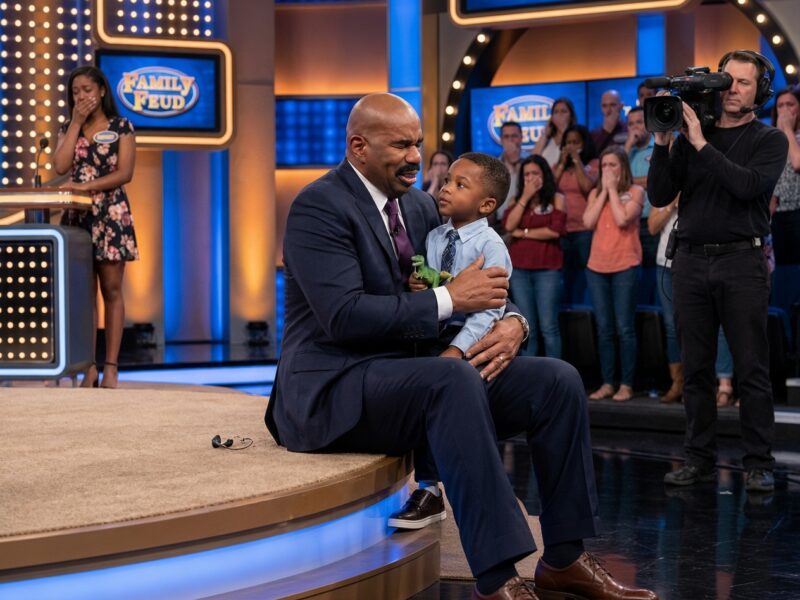
A 5-year-old said four words that stopped Steve Harvey cold — and the entire studio went silent.
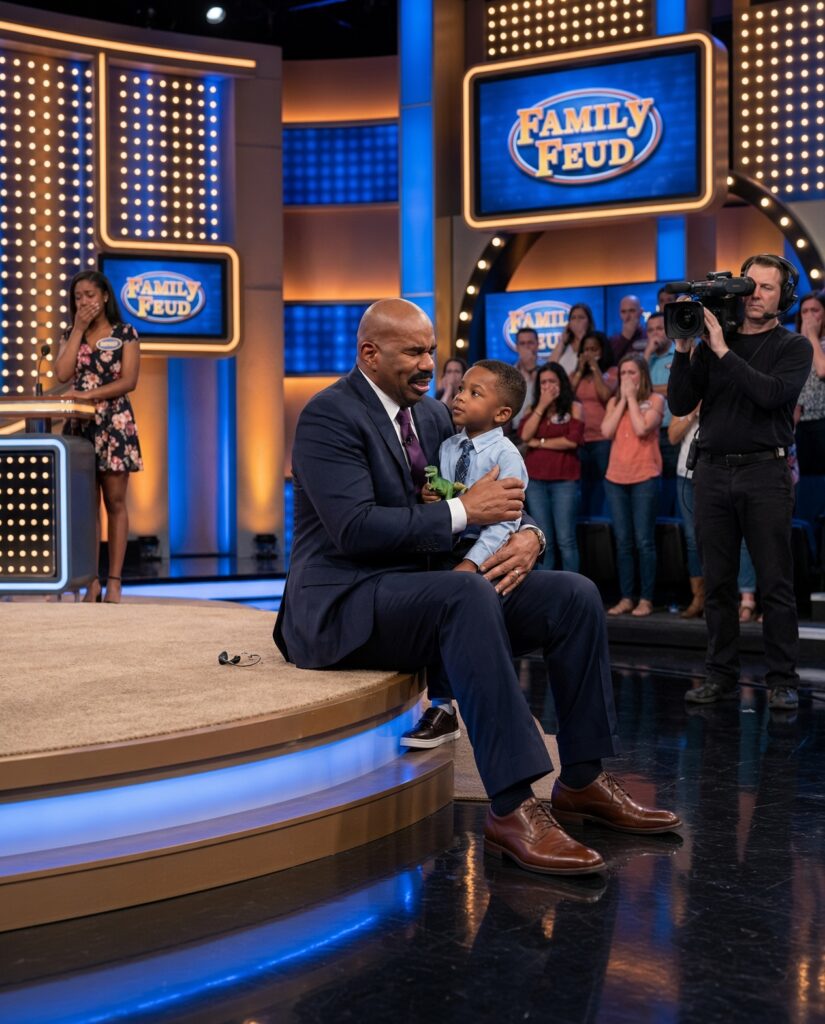
Every camera in the studio locked onto the 5-year-old boy who had just walked away from his family, crossed the entire Family Feud stage alone, and climbed into Steve Harvey’s lap.
Nobody called him over. Nobody told him to move.
Elijah Price, 5 years old, 41 pounds, wearing a clip-on tie his grandmother had fastened that morning, walked past the podium, past the buzzer, past 200 gasping audience members, sat down on Steve Harvey’s knee, looked up at him, and said six words into a microphone that was still live.
Steve Harvey didn’t laugh. He didn’t speak.
He closed his eyes, wrapped both arms around the boy, and didn’t move for 31 seconds. The producers counted. The floor director counted.
The entire control room watched on monitors while the host of Family Feud sat perfectly still on national television, holding a child he’d met 9 minutes ago. And not a single person in that building told him to stop.
What Elijah said was so quiet the audio team had to amplify it in post-production. When they did, it broke the internet.
But what happened in the 4 hours after the cameras stopped recording broke something deeper. Something in Steve Harvey that he said 8 months later, he still hasn’t been able to put back together.
It was May 3rd, 2024, a Friday, and the Atlanta air was already thick with summer.
The Price family arrived at the studio in a rented minivan that Denise Price’s coworker had paid for because Denise didn’t have a credit card, which meant she couldn’t rent one herself.
Denise was 33. She worked the overnight shift at a distribution warehouse in Mobile, Alabama, loading boxes from 11 at night to 7 in the morning, five nights a week.
With her were her mother Shirley, her younger brother Terrence, her cousin Ivet, and Elijah, who was holding a plastic dinosaur in one hand and his mother’s finger in the other.
Across the bracket, the Nguyen family from Houston. Three generations matching green polo shirts, a family group chat with 400 messages of strategy notes, rehearsing their celebration dance near the entrance.
Denise watched them through the green room window. She straightened Elijah’s clip-on tie. Shirley rubbed Denise’s shoulders. Terrence cracked his knuckles.
Nobody in the Price family had ever been on television before, but nobody in that studio knew what was about to happen.
Denise Price had been raising Elijah alone since the day he was born. Elijah’s father, Marcus, had been 24 and working construction when Denise told him she was pregnant.
He stayed for the first trimester. He painted the nursery a pale blue. He assembled the crib from a box, cursing at the instructions for two hours while Denise sat on the floor laughing.
Then one morning in Denise’s seventh month, Marcus drove to a job site in Pascagoula, Mississippi, and a scaffolding beam that hadn’t been properly secured fell 37 feet and struck him across the back. He was pronounced dead at the scene.
Denise was 28 years old, 7 months pregnant, and suddenly building a life for a child who would never meet the man who painted his walls blue.
She didn’t fall apart. She couldn’t afford to.
She delivered Elijah 8 weeks later, went back to work 11 days after that because her job offered no paid maternity leave, and built a system.
Shirley watched Elijah from 11 at night to 7 in the morning while Denise worked. Denise slept from 8 to 2 in the afternoon. From 2:00 to bedtime, she was Elijah’s whole world. Parks, library, story times, grocery shopping with Elijah riding in the cart, singing songs he made up.
It worked. It was exhausting and invisible and held together with caffeine and stubbornness, but it worked.
Then Shirley had a stroke. It happened in January of 2024, a Sunday afternoon. Shirley was sitting at the kitchen table cutting coupons when the left side of her face dropped and she couldn’t lift her arm.
Terrence found her 14 minutes later. The stroke was moderate. Shirley survived, but her left side was weakened. Her speech was slurred for weeks, and her doctor said she could not care for a child unsupervised.
In one afternoon, Denise lost her child care, which meant she lost her ability to work nights, which meant she lost her income, which meant the system she had built with her bare hands over 5 years collapsed like a house with one wall removed.
She applied for subsidized child care through the state. Waitlisted. Estimated wait: 7 months.
She applied for a daycare voucher through a local nonprofit. Denied. She made $11 too much per hour to qualify.
She asked her warehouse supervisor if she could switch to a day shift. No openings. She asked if she could bring Elijah to work. Absolutely not.
Denise burned through her savings in six weeks. She sold her car, the car Marcus had bought two months before he died, the car she’d kept for 5 years because the passenger seat still smelled faintly like his cologne when the sun hit it right, for $3,100, which covered two months of rent and groceries.
She started walking to the corner store with Elijah on her hip because she couldn’t afford gas for a car she no longer owned. And that wasn’t even the part that made Steve cry.
Elijah knew things. 5-year-olds know things that adults forget they know.
He knew his mother’s hands shook when she opened envelopes from the mailbox. He knew she stopped buying the orange juice he liked and started buying the store brand that tasted like water. He knew that when she said, “Mama’s just tired,” it meant something worse than tired.
He knew that the blue walls in his room had been painted by someone important because his grandmother had told him once that his daddy painted those walls.
And every night, Elijah put his hand on the wall before bed and whispered, “Night, daddy.”
He didn’t know what death meant. Not really. He knew his father was in heaven, which he understood as a place far away that you couldn’t drive to.
One night, Denise was sitting on the kitchen floor at midnight, the apartment quiet, sorting a pile of bills into two stacks: the ones she could partially pay and the ones she couldn’t pay at all. And she heard a small voice behind her.
Elijah was standing in the hallway in his dinosaur pajamas. “Mama,” he said, “did daddy leave because of me? Did I do something wrong?”
Denise’s vision went white. She grabbed him and held him so tight he squeaked. She told him no. No, no, a thousand times no. Daddy didn’t leave. Daddy was taken. Daddy loved him more than everything.
She rocked him on that kitchen floor until he fell asleep in her arms. Then she carried him to bed, put her hand on the blue wall next to his, and cried without making a sound because she had learned how to do that. Cry silently, the way single mothers learn to cry. So the walls hear it, but the children don’t.
The real story hadn’t even started yet.
The Family Feud application was Ivet’s doing. She submitted it without telling Denise, filmed the audition video at a barbecue using her phone propped against a ketchup bottle, and when the callback came, she told Denise it was a free trip to Atlanta with a chance to win money.
Denise said she couldn’t go. Ivet said the rental van was already booked. Denise said she had nothing to wear. Shirley, still recovering, her left hand still weak, spent 3 days altering a dress she’d worn to church in 1997 so it would fit Denise.
Terrence bought Elijah the clip-on tie at a dollar store. The Price family packed sandwiches, loaded into the rented minivan at 4 in the morning, and drove 7 hours to Atlanta. Elijah fell asleep against the window holding his plastic dinosaur and didn’t wake up until they pulled into the studio parking lot.
The game was fast. The Nguyen family was disciplined, strategic, and quick on the buzzer. The Price family was chaotic and loud and wrong about half their answers.
But Terrence had a gift for guessing the number one answer at impossible moments. And Denise played with a ferocity that startled even Steve, slapping the buzzer so hard during the third round that it slid 6 inches across the podium.
Steve laughed. The audience laughed. Elijah, sitting on Shirley’s lap in the family section, clapped and shouted, “That’s my mama!” every time Denise scored.
The Prices won by four points. They made it to Fast Money. Denise and Terrence played. Terrence went first and scored 137 points. Denise needed 63 more.
Steve read the questions. Denise answered fast, almost too fast. Answers tumbling out like she’d been holding them in for years. The board flipped. 148. 161. 179. 188.
Steve paused. The studio fell completely silent. The last answer flipped. 194. Six points short.
Denise stood at the podium and pressed both palms flat against the surface and bowed her head and her shoulders moved once hard like a single wave passing through her body. She didn’t make a sound.
Steve watched her. The audience was silent. Steve would later call what happened next the most important moment he’d experienced in his entire career on television.
Elijah climbed down from Shirley’s lap. Nobody stopped him. Shirley tried to grab his arm, but he was already moving.
He walked across the stage, past the cameras, past the host’s mark, past the podium where his mother stood, and he walked directly to Steve Harvey. Not to his mother. To Steve.
He lifted both arms the way children do when they want to be picked up. Steve looked down at him. Steve looked at Denise. Steve looked back at Elijah.
Then he bent down, lifted the boy onto his knee, and sat on the edge of the stage. Elijah put one small hand on Steve’s tie. It was silk, dark purple, and with the other hand, he held his plastic dinosaur against Steve’s chest, the way you’d offer someone a gift.
Then Elijah said six words. “You can be my daddy, too.”
The studio fell completely silent. 200 audience members, 43 crew members, 14 cameras, no sound.
Steve Harvey closed his eyes, his jaw tightened, his arms tightened around Elijah. He didn’t speak. He didn’t move. 31 seconds passed.
A cameraman named Jerome, who had been with the show for 11 years, lowered his camera to his side and stood motionless, tears running into his beard. The audio engineer in the booth was crying. The floor director was crying.
Steve’s producer said into the earpiece, “Steve, we need to—” And Steve didn’t respond because he had already pulled the earpiece out and placed it on the stage beside him 8 seconds earlier.
When Steve opened his eyes, he looked at Elijah and said very quietly, so quietly the boom mic barely caught it, “You already have one. He painted your walls.”
Elijah blinked. “How do you know about the walls?”
Steve smiled. The kind of smile that breaks in the middle. “Because daddies always leave something behind.”
Steve stood up with Elijah still in his arms and walked to Denise. He put his free hand on her shoulder. “You didn’t lose tonight,” he said. “You didn’t lose six points. You raised a boy who walked across a stage full of strangers and offered a grown man his dinosaur because he thought that man looked sad.”
“You know what that means? That means you already won. That means Marcus already won. The walls are still blue, Denise.”
Denise’s knees buckled. Terrence caught her. Shirley was rocking in her chair, eyes closed, lips moving in prayer. Ivet had both hands over her mouth.
Steve held Elijah on one arm and addressed the audience with the other hand raised. “Let me tell you something,” he said, and his voice was raw now, stripped down, no performance left in it.
“Nobody helped me at my lowest. I was sleeping in my car. I was broke. I was broken. And I made a promise to God. If he got me out of that car, I would spend the rest of my life helping people who were where I was.”
“I’m looking at this woman and I’m looking at this boy and I’m telling you, God didn’t bring them here for $20,000. He brought them here for this moment.”
But Steve wasn’t done. He pulled his phone from his pocket. He called Patricia Williams, the executive director of the National Association of Child Care Resource and Referral Agencies, live on speaker on stage.
“I have a single mother from Mobile, Alabama,” Steve said. “She lost her child care when her mother had a stroke. She lost her job. She lost her car. She’s been denied by every system designed to help her. I need a solution by Monday morning.”
Patricia said she would personally connect Denise with an emergency child care placement in Mobile and expedite her subsidized care application. The audience erupted.
Shirley lifted her weak left hand into the air, the hand the stroke had taken from her, and held it there, trembling while tears streamed down her face.
But Steve wasn’t done. He awarded the full $20,000 to the Price family. Then he turned to the Nguyen family. Lisa Nguyen, the family matriarch, was already standing at center stage. She hadn’t been called.
She was holding an envelope. She opened it and pulled out a check, a personal check from the Nguyen family made out that morning before the taping in the amount of $5,000, payable to whoever needed it most.
“We brought this from home,” Lisa said. “Every taping, every game show, somebody needs it more than we do. Today, it’s you.”
She handed the check to Denise. Denise looked at the check, looked at Lisa, and pulled her into an embrace so tight that Elijah, still in Steve’s arms, reached out one hand to touch both women’s heads.
Steve watched the two families holding each other and said, “Both families won today. The Nguyens are coming back next month, first round. Because the world needs more people who bring checks to game shows.”
The studio fell completely silent for a breath. And then the applause started. Not the game show applause, not the cued applause, but the kind that comes from a room full of people who just witnessed something they know they’ll tell their children about.
Steve looked into the nearest camera. “Everyone watching at home, there is a single mother in your neighborhood who hasn’t slept a full night in years. There is a child in your life who is carrying a question they’re too afraid to ask.”
“You don’t need to be on a stage. You don’t need a microphone. You just need to show up, knock on a door, drop off a meal, sit on a kitchen floor next to someone at midnight. That’s what changes the world. Not this show, not this stage. You.”
The video was uploaded that evening. It reached 18 million views by midnight. By the following Friday, 97 million. Within two months, it had surpassed 410 million views, making it the single most watched clip in Family Feud’s 50-year history.
The hashtag #YouCanBeMyDaddyToo trended for 19 days in 84 countries. Over 12,000 people posted videos of themselves giving their children’s old toys to strangers.
406 letters arrived at the studio addressed to Elijah Price. A coalition of child care advocacy organizations cited the clip in a congressional hearing on subsidized care funding. Three separate GoFundMe campaigns raised a combined $2.9 million in Denise’s name within the first two weeks.
Denise was back at work within 10 days. The emergency child care placement came through on Monday, exactly as promised. By July, Elijah was enrolled in a full-time pre-K program three blocks from their apartment.
By October, Denise had been promoted to shift supervisor at the warehouse, a day shift, the one she’d been requesting for 8 months, the one that opened up 2 weeks after the episode aired because her district manager saw the clip and called her personally.
By December, Denise had saved enough for a deposit on a used Honda Civic. She drove it home, parked it in the same spot where Marcus’s car used to sit, and sat in the driver’s seat for a long time with the engine off, her hands on the wheel, her eyes on the blue apartment door.
Elijah was in the back seat, holding his plastic dinosaur, the same one he’d pressed against Steve Harvey’s chest. He leaned forward and put his small hand on the back of his mother’s seat.
“Mama,” he said, “is Steve Harvey gonna be at our house for Christmas?”
Denise laughed. It was the first real laugh she’d let out in months, the kind that came from somewhere deep and unguarded. “No, baby. He’s not coming for Christmas.”
“But he’s still my daddy, too, right?”
Denise turned around and looked at her son. His clip-on tie was gone, lost somewhere between the studio and the parking lot, but his eyes were the same eyes that had looked up at Steve Harvey and offered him a dinosaur.
“Yeah,” she said. “He’s still your daddy, too.”
She started the engine. The Civic hummed, a little rough, a little old, but it ran. She pulled out of the parking spot and drove toward the apartment, toward the blue walls, toward the life she had rebuilt from the ground up.
And somewhere in Atlanta, Steve Harvey was sitting in his dressing room, still in his purple silk tie, staring at the wall, trying to figure out how a 5-year-old boy had just done in 31 seconds what he’d been trying to do for 30 years.
He couldn’t explain it. He didn’t try.
He just sat there, holding the memory of a plastic dinosaur pressed against his chest, and let himself cry.









