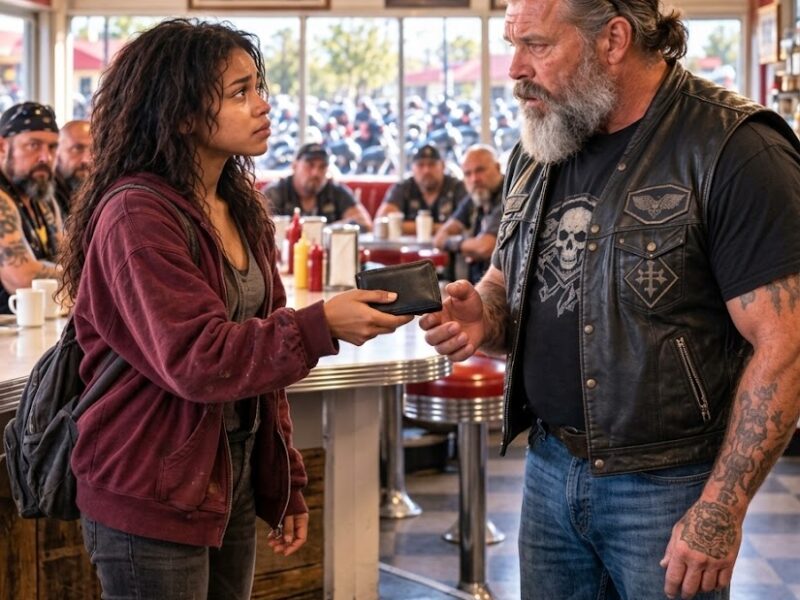
A 20-year-old homeless girl found a Hell’s Angel’s wallet on the street — and when she returned it, 500 bikers showed up to change her life.
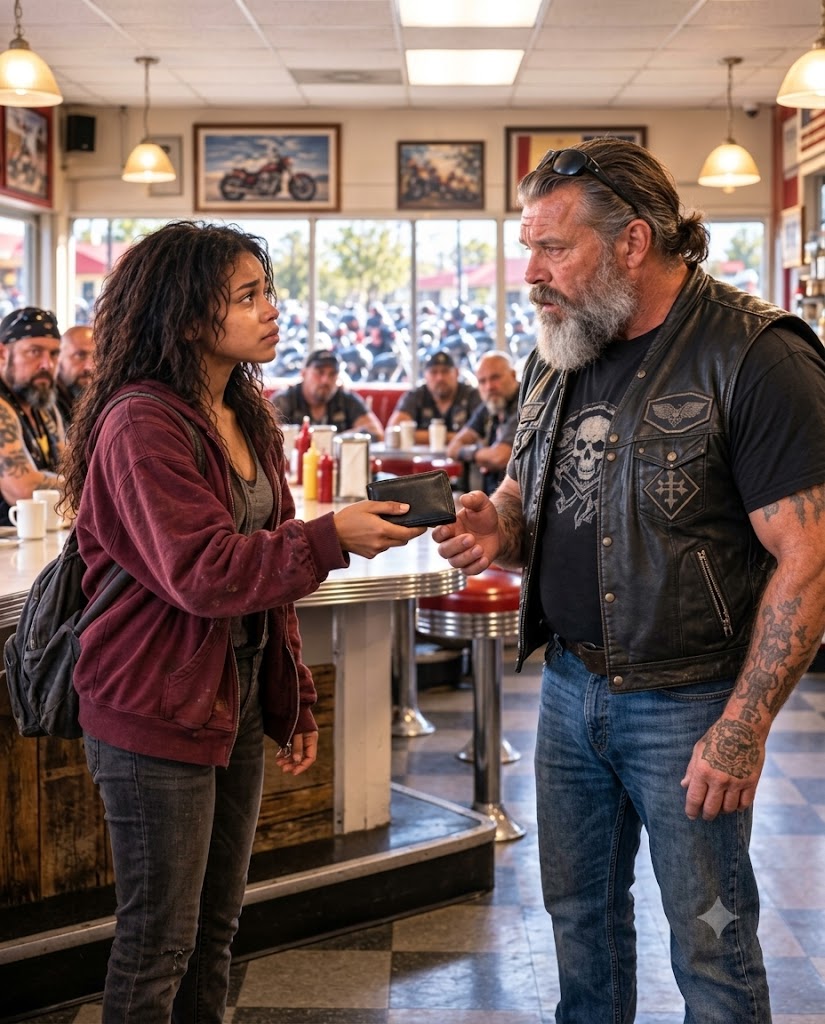
Leah Carter pulled $1,180 from a stranger’s wallet while her last bus idled ten feet away.
She stared at the bills in her hand, then at the open bus doors.
Twenty years old, no apartment, no family waiting for her.
And after tonight, exactly twenty-nine days left at the youth shelter before her placement expired.
In her jacket pocket were four crumpled dollars and some change.
That was everything she owned until payday from a job she didn’t have yet.
Her phone showed three percent battery.
She still needed breakfast tomorrow, bus fare, laundry money, a working phone long enough for an employer to call her back.
And now, somehow, more than a thousand dollars had landed in her hands.
Leah looked around the station.
A tired man was studying the route map.
A woman pushed a stroller toward the crosswalk.
Nobody was watching her.
Nobody even knew the wallet existed.
She slipped a hundred-dollar bill halfway out.
Just one, she thought.
One bill could keep her phone on.
One bill could buy food for days.
Whoever carried this much cash probably wouldn’t even notice.
The thought came easily.
That scared her more than the money did.
Leah pushed the bill back into place.
Then she counted everything once, carefully.
$1,180.
Credit cards.
A driver’s license.
Thomas Reynolds, fifty-three, and an address across town.
Behind the license was a faded receipt from Miller’s Diner, timestamped less than half an hour earlier.
And tucked inside a narrow pocket was an old photograph.
A broad white man with a gray-streaked beard stood beside a Harley, one arm around a teenage girl.
He wore a black leather vest covered in motorcycle patches.
The girl was laughing at something outside the frame.
Leah turned the photo over.
Four words were written in blue ink.
Dad, don’t lose this one.
Leah read it twice.
Something about the handwriting made her stop thinking about the cash.
The bus driver called out that he was leaving.
Leah looked up.
This was the last route that would get her near the shelter before the doors locked at nine.
If she missed it, she had no money for a rideshare.
No one she could call.
No backup plan.
She closed the wallet and hurried toward the bus.
Three steps, two, then she stopped.
The driver raised a hand, asking without words if she was getting on.
Leah looked down at Thomas Reynolds’s photo again.
She imagined waking up tomorrow without her own ID, without her cards, without the one picture someone had told her not to lose.
The doors began to close.
Leah could still make it.
She could climb aboard, turn the wallet in somewhere tomorrow, and nobody could blame her.
Instead, she stepped back.
The bus pulled away.
Its red taillights disappeared around the corner, taking Leah’s safest way home with it.
For a moment, she just stood there, the stranger’s wallet pressed against her chest, wondering whether doing the right thing had just cost her a place to sleep.
Then she remembered the diner receipt.
Miller’s was only a few blocks away.
If Thomas Reynolds had been there thirty minutes ago, somebody might know where he went.
Leah started walking.
She had no idea yet that the man behind that photograph was a Hells Angel, or that returning his wallet would eventually bring nearly five hundred bikers into her life.
—
Leah reached Miller’s Diner with nine minutes of battery left on her phone and no idea how she was getting back to the shelter.
The place was still busy, bright with fluorescent light and the smell of coffee, grilled onions, and fryer oil.
She stepped inside holding the wallet tight against her jacket.
A waitress behind the counter looked at Leah, then at the wallet in her hand.
Leah showed her the driver’s license.
“Do you know this man?”
The waitress squinted at the photo, then nodded.
“Tom Reynolds. He was here maybe twenty minutes ago. Came in with some riders.”
Leah felt a small rush of relief.
“Do you know where he went?”
The waitress shook her head but pointed to a business card tucked beside the register.
“He left that last week. Electrical work. Same number he always uses.”
Leah looked at her phone.
Two percent.
She called.
One ring.
Two.
Three.
A deep voice answered.
“Reynolds.”
Leah swallowed.
“Mr. Reynolds. I think I found your wallet.”
Silence.
Then the voice changed.
Sharper.
“Where are you?”
“Miller’s Diner.”
Another pause.
“Stay there.”
The line went dead.
Fifteen minutes later, the sound reached the windows before the motorcycles did.
Several engines rolled into the parking lot, low and heavy, then shut off one by one.
Leah watched through the glass as three men crossed toward the entrance.
The man in the center matched the license photo.
White-gray beard, broad shoulders, black leather vest.
The same man from the photograph.
A few customers glanced over and quickly looked away.
Leah stood.
Tom Reynolds saw the wallet in her hand and walked straight to her.
“You Leah?”
“Yes.”
She held it out.
He opened it immediately.
Cards, license, cash.
Then his fingers stopped at the photograph.
His face softened for half a second.
Leah noticed.
Tom counted the money.
Every dollar was there.
He looked up.
“You take anything?”
Leah met his eyes.
“No.”
Tom pulled two hundred-dollar bills from the wallet and held them toward her.
“Take this.”
Leah did not move.
“No. Thank you.”
Tom frowned.
“You found over a thousand dollars and brought it back. Take it.”
Leah shook her head.
“I returned your wallet. I did not sell it back to you.”
One of the bikers behind him looked down, hiding a smile.
Tom stared at Leah differently now.
Not at her worn sneakers, not at the frayed cuff of her jacket.
At her.
“You walked here?”
“Yes.”
“Where are you headed?”
Leah checked the clock behind the counter.
Her stomach tightened.
“A youth shelter on Grand Avenue.”
Tom looked at the time.
“They close at nine.”
Leah nodded.
“And you missed your bus bringing this back?”
She said nothing.
She did not need to.
Tom turned to the waitress.
“Can you call her a cab?”
Leah immediately shook her head.
“I cannot pay for that.”
Tom reached for his wallet, then stopped himself.
“This is not a reward. This is the ride you missed returning something that belonged to me.”
Leah hesitated, then agreed.
When the cab arrived, she opened the door and heard Tom call her name.
She turned.
He was holding the old photograph between two fingers.
“There was something in this wallet worth more than the cash.”
Leah waited for him to explain.
He did not.
He only looked at the picture, then back at her.
“I owe you more than a ride home.”
The cab door closed.
And as Leah pulled away, Tom Reynolds was already reaching for his phone.
—
The next morning, Helen Brooks called Leah into the shelter office before breakfast was over.
Leah entered expecting another reminder about paperwork, curfew, or the twenty-nine-day clock hanging over her bed.
Instead, Helen held out a yellow sticky note.
“Someone called for you, Leah. Read the name.”
Thomas Reynolds.
Her stomach tightened.
“How did he get this number?”
“He did not get anything from me,” Helen said.
“He called the main desk, said you returned something important, and asked me to give you a message. That is all.”
Leah looked at the note again.
Tom wanted to buy her lunch.
Public place.
No pressure.
She could say no.
Leah almost did.
By noon, she was sitting across from him in a small cafe six blocks from the shelter.
Tom had traded his leather vest for a dark work jacket, but he still looked like the kind of man people noticed when he entered a room.
He ordered coffee.
Leah ordered the cheapest sandwich on the menu.
Then Tom placed a white envelope on the table.
“This is for you.”
Leah did not touch it.
“What is it?”
“Enough to make the next few weeks easier.”
She opened the flap just far enough to see cash, then pushed it back across the table.
“No.”
Tom frowned.
“Leah, you do not even know how much is in there.”
“That is why I am saying no.”
“You are living in a shelter.”
Her eyes hardened.
“I know where I live.”
Tom leaned back.
For a moment, neither of them spoke.
The cafe noise filled the space between them.
Cups clinking, a blender running behind the counter, someone laughing near the window.
Tom lowered his voice.
“I am trying to thank you.”
“Then say thank you.”
He stared at her, surprised.
Leah looked down at her sandwich.
“I do not want to owe you.”
Something in Tom’s expression changed.
Not anger.
Confusion.
“You think accepting help means you owe somebody?”
“Sometimes it does.”
Tom did not argue.
That mattered.
After a moment, he asked how she had ended up at the shelter.
Leah almost told him it was none of his business.
Then she looked at the envelope between them and decided he needed to understand why money was not the whole problem.
Six months earlier, she had shared an apartment with a coworker from a grocery store.
Her roommate moved away.
The rent went up.
Leah tried sleeping on a friend’s couch while saving for another place.
Then her phone service was shut off.
She missed a schedule change.
Then another.
The store let her go.
Without a job, she could not qualify for an apartment.
Without an address, reliable phone service, or steady transportation, every new application became harder.
“Nothing dramatic happened,” Leah said quietly.
“Things just kept getting smaller until there was nowhere left to stand.”
Tom looked at her for a long time.
“So, what do you need?”
Leah opened her mouth, then stopped.
Nobody had asked it that way before.
Not what happened to you.
Not what can I give you.
What do you need?
Tom slid the envelope back into his jacket.
“Forget the money.”
Leah looked up.
“Tell me what is actually keeping you from getting out of that place.”
For the first time since she found his wallet, Leah did not see a biker trying to repay a debt.
She saw a man willing to listen, and that made her answer far more dangerous than asking for cash.
—
Leah looked at Tom for a few seconds, then folded her hands around the paper cup in front of her.
“What is keeping me from getting out?” she repeated.
Tom nodded.
“Yes.”
She could have listed everything.
The phone, transportation, the gap in her work history, the shelter deadline.
Instead, Tom spoke first.
“I can put you in a motel for a couple of months.”
Leah blinked.
“What?”
“A decent place. Nothing fancy. Somewhere safe. I know the manager at one off Route 17. I can cover the room while you get back on your feet.”
He said it like he had finally found the right answer.
Leah’s shoulders stiffened.
Tom noticed but kept going.
“Then I can call a few people, maybe find you some work. We can get you clothes, a phone, whatever you need.”
Leah stared at him.
The words were generous.
That was what made them harder to reject.
“Tom, you do not have to worry about paying me back.”
“Tom.”
He stopped.
Leah pushed her untouched sandwich wrapper aside.
“You keep telling me what you can give me.”
His expression tightened with confusion.
“I thought that was what we were talking about.”
“No, we were talking about what is keeping me stuck.”
“That is what I am trying to fix.”
Leah shook her head.
“You are trying to fix me.”
The sentence landed between them.
Tom sat very still.
Leah took a breath.
She did not want to sound ungrateful.
She also did not want to disappear inside someone else’s idea of rescue.
“A motel room for sixty days sounds great,” she said.
“Then what happens on day sixty-one?”
Tom opened his mouth.
Nothing came out.
“And if you call somebody and tell them to give me a job because I returned your wallet, what happens when they look at me and see your favor instead of my work?”
Tom looked down at the table.
Leah continued, softer now.
“I do not need somebody to take over my life. I need a way back into it.”
The cafe seemed quieter somehow.
Tom rubbed one hand over his beard, then leaned back.
“I got this wrong.”
Leah had expected an argument.
Instead, he said, “You are right.”
That surprised her more than the envelope had.
He reached for it, tucked it inside his jacket, and left it there.
“So, let me ask again.”
Leah waited.
“What are you trying to build?”
Her eyes moved toward the window.
Across the street, people came out of a pharmacy carrying bags, checking phones, heading toward parked cars.
Ordinary things.
Things she used to do without thinking.
“A normal life,” she said.
Tom did not laugh.
“What does normal mean to you?”
“A job I earned. A place with my name on the lease. A phone that stays on. Enough savings that one bad week does not erase everything.”
She paused.
“And a key. A key to somewhere I do not have to ask permission to enter.”
Tom nodded slowly.
For the first time, he was not offering anything.
He was listening.
“All right,” he said.
“Then what is standing between you and that?”
Leah counted on her fingers.
“A reliable phone number. Transportation. An address I can use for applications. And somebody willing to interview me without deciding what I am before I sit down.”
Tom studied the list.
No thousand-dollar solution.
No dramatic rescue.
Just small locked doors.
He reached for his phone, then stopped before touching it.
“If I can open one door,” he asked, “which one?”
Leah answered without hesitation.
“Get me an interview. Not a job. An interview.”
Tom picked up the phone.
This time he did not offer money.
He searched his contacts, found a name, and looked at Leah before pressing call.
“Carlos Mendoza,” he said.
“Runs a warehouse on the south side. He owes me nothing, which is exactly why I trust him.”
Leah felt her pulse rise.
Tom put the phone to his ear.
After two rings, someone answered.
“Carlos, it is Tom Reynolds. I am not asking you to hire anyone. I am asking you to meet someone.”
Carlos did not sound impressed.
“Tom, if this is one of those favors where you want me to hire somebody because you feel bad for them, the answer is no.”
Tom glanced at Leah.
“Good. I am not asking you to hire her. I am asking you to give her thirty minutes.”
There was a pause.
“What kind of experience?”
Leah leaned closer.
“Grocery inventory, stocking, receiving deliveries, basic register work.”
Tom repeated it.
Carlos sighed.
“Tomorrow. Ten-thirty in the morning. If she is late, I am done.”
Leah felt her stomach tighten.
“I will be there.”
Tom smiled.
But Leah pointed at him before he could speak.
“That is all you do.”
“I know.”
“No calling him afterward.”
“I know.”
“No telling him I saved your life.”
Tom almost laughed.
“You returned my wallet.”
“Exactly.”
—
The next morning, Helen helped Leah print a clean copy of her resume using the shelter office computer.
The shelter allowed residents to use its mailing address for job applications, and Helen found an unused prepaid phone from a local assistance program.
It was not new.
The screen had a scratch across one corner.
Leah held it like it was something expensive.
“This number stays active as long as you check in every month,” Helen said.
“Use it.”
A transportation nonprofit connected to the shelter added a two-week bus pass.
Three small problems, three small answers.
None of them looked dramatic.
To Leah, they felt enormous.
She arrived at Mendoza Supply twenty-two minutes early.
The warehouse sat behind a row of auto shops on the south side.
All gray concrete, loading doors, and forklifts moving between pallets.
Carlos Mendoza met her in a small office with a glass wall facing the floor.
He was compact, serious, and looked like a man who could spot an excuse before someone finished making it.
He read her resume without smiling.
“You worked at Bellwood Market for almost two years.”
“Yes.”
“Then nothing for six months.”
Leah knew this question was coming.
She had practiced three different answers.
One made the gap sound vague.
One made it sound like bad luck.
One made it sound like somebody else’s fault.
She used none of them.
“I lost my housing, then my phone service. I missed a schedule change, then another shift. I lost the job. I have been staying at a transitional shelter while I get stable again.”
Carlos looked up.
“You telling me that in an interview?”
“You asked. Most people would hide it.”
Leah held his gaze.
“If I lie about six months, you will wonder what else I lie about.”
Carlos leaned back.
“Why should I hire you?”
Leah felt every answer she had rehearsed disappear.
“You should not.”
His eyebrows lifted.
“Not yet. Give me two days. Paid trial shifts. Watch how I work, then decide.”
Carlos looked through the glass toward the warehouse floor.
“Tom put you up to that.”
“Tom got me in the room. The rest is mine.”
For the first time, Carlos smiled.
Barely.
“Tomorrow, seven in the morning. Steel-toe shoes if you have them.”
“I do not.”
“We have loaners.”
Leah stood, thanked him, and left before her hands started shaking.
—
The next morning, she showed up at 6:42.
The work was simple on paper and harder in practice.
Scan, count, label, move, check again.
By noon, her back ached and her feet hurt inside borrowed boots half a size too big.
She did not complain.
Near the loading desk, two employees were talking while they sorted packing slips.
One of them glanced at Leah and lowered his voice just enough to pretend he was not trying to be heard.
“That the girl Reynolds sent over?”
The other man nodded.
“Yeah. Tom’s charity hire.”
Leah froze for half a second.
Then she looked down at the scanner in her hand.
She had wanted a fair chance.
Now she had one, but she also had a new problem.
Everyone around her seemed ready to decide why she was there before she had finished her first shift.
Leah kept her eyes on the scanner and forced herself to keep moving.
She wanted to turn around.
She wanted to tell them exactly why she was there.
Instead, she scanned the next box, checked the label, and carried on.
If they wanted to believe she was somebody’s charity case, arguing would not change that.
Work might.
By mid-afternoon, Carlos moved her to inventory counts in aisle six.
It was repetitive.
Numbers, labels, locations, then numbers again.
Leah liked that.
Numbers did not care where she slept.
They were either right or wrong.
She was halfway through a pallet of electrical supplies when she entered the wrong quantity into the handheld system.
Forty-eight units became eighty-four.
She did not notice until ten minutes later, when the system flagged a mismatch against the receiving sheet.
Her stomach dropped.
She checked again.
Same mistake.
For one second, she thought about saying nothing.
Someone else might catch it later.
Maybe nobody would know it was hers.
Then she remembered Carlos asking why he should trust her.
Leah put the scanner down and walked straight to his office.
“I made a mistake.”
Carlos looked up from his computer.
“What kind?”
“Inventory count in aisle six. I entered eighty-four instead of forty-eight. It is already in the system.”
“Can you fix it?”
“I think so.”
“You think?”
Leah took a breath.
“Yes. I can fix it.”
Carlos nodded toward the warehouse.
“Then fix it.”
That was all.
No speech, no disappointment, no second-chance performance.
Leah went back, pulled the receiving records, recounted every carton, corrected the entry, and asked a supervisor to verify it before closing the task.
It took nearly forty minutes.
When she finished, the employee who had called her a charity hire was standing nearby.
He looked at the corrected screen, then at her.
“Most new people would have tried to hide that.”
Leah shrugged.
“Then it would still be wrong.”
The man gave a small nod and walked away.
—
The next morning, Leah arrived at 6:40.
Her shoulders still hurt from the first day.
The borrowed boots still pinched her heels.
She worked anyway.
By late afternoon, Carlos called her into the office.
A single sheet of paper sat on his desk.
Leah stayed standing.
“Sit down,” he said.
She did.
Carlos slid the paper toward her.
“Full time. Thirty-six hours guaranteed. More if business picks up. Benefits after ninety days.”
Leah stared at the words for several seconds.
She did not move.
“This is a job offer.”
Carlos leaned back.
“No, it is a menu.”
Leah looked up.
He almost smiled.
“Yes. It is a job offer.”
Her throat tightened.
“Because Tom asked.”
Carlos shook his head.
“Tom got you through the door. You stayed because you showed up early, learned fast, and told me about a mistake before anybody else found it.”
Leah signed before her hands could start shaking.
That evening, she carried the offer letter back to the shelter like it was made of glass.
Helen read it twice, then hugged her.
Leah laughed for the first time in days.
“I did it.”
“You did.”
Then Helen’s expression changed.
She reached into a folder and placed another paper on the desk.
Leah’s smile faded.
Twenty-three days remained in her shelter placement.
The job solved one problem, but not the next one.
Most apartments wanted a deposit, the first month’s rent, an application fee, and proof of steady income.
Leah had a job offer.
She did not yet have enough paystubs.
She did not have savings, and she did not have enough time.
Helen tapped the paper gently.
“You are closer than you were last week.”
Leah stared at the deadline.
“Closer is not the same as housed.”
What Leah did not know was that Tom had already told someone else about the one person who returned his wallet when keeping it would have been easier.
And that conversation was about to become much bigger than either of them expected.
—
Tom made the call the next morning from the back room of his electrical shop.
He called Ray Foster, a longtime rider who organized the largest annual charity run in the county.
Ray listened quietly while Tom explained Leah’s situation.
He did not dramatize it.
He did not call her helpless.
He told Ray about the wallet, the cash, the photograph, the interview, the job offer.
Then he told him about the twenty-three-day deadline.
Ray was silent for a moment.
“What are you asking me to do?”
Tom looked through the shop window at two motorcycles parked outside.
“Not for her. For people like her.”
That answer changed the conversation.
Ray had spent years raising money for veterans, food banks, and children’s hospitals.
He knew how fast one emergency could destroy a family living paycheck to paycheck.
What he had never thought much about was the gap between getting a job and becoming stable enough to keep it.
Deposit money, bus fare, work clothes, identification fees, a phone.
Small things that could decide whether somebody moved forward or fell backward.
“We could build this into the ride,” Ray said.
“A housing bridge fund.”
Tom nodded even though Ray could not see him.
“Exactly.”
Then Ray asked the question Tom had learned to respect.
“Does Leah want her story used?”
Tom did not answer for her.
That afternoon, he asked.
Leah sat across from him in the shelter common room, still wearing her warehouse badge.
“They want to raise money because of me.”
“Not exactly. Because of what your situation exposed.”
Leah frowned.
Tom explained the idea.
The fund would help young adults moving out of temporary housing cover practical costs that normal assistance programs often missed.
No cash handouts in parking lots.
No giant checks with someone’s name on them.
Applications, receipts, clear rules.
Leah listened until he finished.
“And you want to tell them I am homeless?”
“Only if you say yes.”
She looked down at her hands.
“I do not want people staring at me like I am some sad story.”
“Then they do not get your name.”
Leah thought for a long time.
Finally, she said, “You can tell them what happened. But do not make it about saving me.”
Tom smiled.
“Ray said the same thing.”
“Who is Ray?”
“The man who is about to make a lot of phone calls.”
—
Over the next two weeks, the plan grew quietly.
Rider groups registered.
Local shops donated gift certificates for raffles.
A tire company offered matching funds.
A credit union agreed to waive account fees for approved participants.
Nobody told Leah how large it had become.
She was too busy working.
Her first paycheck arrived.
Small after taxes, but real.
She folded the paystub into the same folder as her job offer.
Then another piece fell into place.
With Helen’s help, she found a studio apartment she could afford on her wages.
It was only four hundred square feet.
One room, one tiny kitchen, one window facing a brick wall.
Leah loved it immediately.
Then the leasing agent listed the move-in costs.
Security deposit, first month’s rent, application fee.
More than Leah had saved.
She had twelve days left at the shelter.
“I am close,” she told Helen.
“I am still short.”
Helen glanced at the calendar but did not answer.
—
Saturday morning, Tom picked Leah up near the shelter and told her Ray wanted her to stop by the county fairgrounds.
Leah expected a small fundraiser.
Maybe thirty riders.
Maybe fifty.
They turned onto the access road, and Leah heard the sound before she saw anything.
Engines.
Dozens at first, then more.
Rows of motorcycles stretched across the fairgrounds, chrome flashing under the morning sun.
Volunteers moved between registration tables.
Clubs from three neighboring counties had shown up.
Leah stared through the windshield.
“Tom, how many people are here?”
He looked toward the entrance as another long line of riders rolled in.
“They stopped counting at four hundred seventy.”
Leah turned to him, stunned.
Tom smiled.
“And registration is still open.”
By noon, the registration board showed five hundred riders, and Leah still could not understand how one lost wallet had led to all of this.
She stood near the edge of the fairgrounds while motorcycles filled row after row of marked spaces.
Some riders wore club patches.
Others wore plain riding jackets.
Families walked between food tents.
Volunteers sold raffle tickets.
Local businesses had set up donation tables.
Nobody surrounded Leah.
Nobody pushed a microphone into her hands.
Nobody treated her like a spectacle.
Ray Foster found her beside Tom and held out his hand.
“You must be Leah.”
She shook it.
“Tom said you did not want this turned into a rescue story.”
“I do not.”
Ray nodded toward a banner stretched across the registration tent.
It read: Youth Housing Bridge Fund.
“Good. Because it is not.”
The money raised that day would help young adults leaving temporary housing cover security deposits, transportation passes, identification fees, work clothes, and other expenses that often stood between employment and stability.
Leah looked at Tom.
“You did all this?”
Tom shook his head.
“I made one phone call.”
Ray laughed.
“Then I made about eighty.”
By the end of the ride, registration fees, raffle sales, business donations, and matching funds had created enough money to support more than one person.
That mattered to Leah.
She did not want five hundred strangers handing her cash.
She wanted the next person behind her to have a bridge, too.
—
Three days later, Helen helped her complete an application to the new fund.
Leah submitted her job offer, her first paystub, her budget, and the lease information for the studio she had found.
She waited two days, then four.
On the sixth day, Helen called her into the office.
An envelope sat on the desk.
Leah opened it slowly.
Approved: security deposit assistance.
Approved: application fee.
Her own paycheck would cover the first month’s rent.
Leah read the letter again.
“This is mine.”
Helen smiled.
“The apartment will be when you sign for it.”
Eight days before her shelter placement ended, Leah stood inside a four-hundred-square-foot studio with bare walls, a tiny kitchen, and one narrow window facing a brick building.
The leasing agent placed a key in her palm.
Leah closed her fingers around it.
For months, every door in her life had belonged to somebody else.
This one opened because she turned the key.
She did not cry until she was alone.
—
Four months later, the studio looked different.
A secondhand couch sat against one wall.
Two mismatched chairs surrounded a small table.
Leah had kept her job, picked up extra hours, and built a savings account that was still small but growing.
One evening, she invited Tom over for dinner.
He arrived carrying no envelope, no gift card, no offer to fix anything.
Just the old black wallet.
After they ate, Tom placed it on the table.
“There is something I never told you.”
He opened the narrow pocket and removed the faded photograph Leah had seen that first night.
The teenage girl beside the motorcycle was smiling into the camera.
“Her name was Emily,” Tom said.
“My daughter.”
Leah looked at him.
His voice stayed steady, but quieter.
“She died after a short illness six years ago.”
“That wallet was the last birthday gift she ever bought me. And that was the last picture we took together.”
Leah turned the photograph over.
Dad, don’t lose this one.
Suddenly, the words felt heavier.
Tom gave a small, sad smile.
“The cash could have been replaced. The cards could have been replaced. That picture could not.”
Leah stared at the wallet between them.
For months, she had believed Tom helped her because she had returned his money.
Now she understood that was never the reason.
“You thought you gave me back a wallet,” Tom said.
“What you really gave me back was something I thought I had lost twice.”
Leah reached across the table and placed the photograph carefully in his hand.
Neither of them spoke for a moment.
Then Tom looked around the little apartment at the work schedule pinned to the wall, the groceries in the kitchen, and the key resting beside Leah’s purse.
“Looks like you built it.”
Leah smiled.
“I am still building.”
And for the first time, Tom told her about an idea the riders were already discussing for the following year.
One that would put Leah on the other side of the table, helping someone who was standing where she once stood.
—
One year later, Leah Carter stood behind a folding table at the same county fairgrounds where she had once watched five hundred motorcycles roll in and wondered why strangers cared what happened to her.
This time, her name was printed on a volunteer badge.
Under it were three words: Housing Bridge Mentor.
Her life was still simple.
The studio apartment was still small.
The couch was still secondhand.
She still checked prices at the grocery store before putting anything in her cart.
But she was no longer counting the days until someone told her she had to leave.
Carlos had promoted her to inventory coordinator after she proved she could manage receiving schedules, train new employees, and solve problems without making excuses.
She had started taking evening classes at the community college, two nights a week, studying logistics and operations.
Her savings account was not impressive to anyone else.
To Leah, it meant freedom.
A flat tire would no longer become a crisis.
A missed shift would not mean losing everything.
Tom arrived just before noon carrying two cups of coffee.
His beard had gone a little grayer.
Leah took one cup and smiled.
“You are late.”
“I am retired enough to ignore clocks.”
“You work more than I do.”
“That is different.”
She laughed.
Their relationship had settled into something neither of them had planned.
He never called her his project.
She never called him her rescuer.
Some weeks they barely spoke.
Other weeks he came by for dinner and complained about her cheap coffee.
It felt less like debt and more like family.
Near the registration tent, another young woman stood alone.
She looked about nineteen.
A backpack hung from one shoulder, packed so full the zipper strained.
She stared at the sign listing rental deposit help, bus passes, work clothing, identification assistance, and job referrals.
Then she started to walk away.
Leah stepped from behind the table.
“Hey. You looking for something?”
The young woman stopped.
“No.”
Her voice was guarded.
Leah recognized that tone immediately.
“All right.”
She started to turn back.
The girl glanced at the table again.
“I just do not want charity.”
Leah froze for half a second.
She could almost see herself sitting across from Tom in that cafe, pushing an envelope back toward him.
She pulled out a chair.
“Good.”
The girl frowned.
“Good.”
Leah nodded.
“Sit down.”
Slowly, the girl did.
“My name is Maya,” she said.
Leah sat across from her.
“I am Leah. Are you going to ask why I am homeless?”
“Not first.”
Maya looked confused.
Leah smiled.
“Tell me what you are trying to build.”
—
Across the fairgrounds, Tom heard the question.
He stopped walking.
For a moment, he said nothing.
Then he looked toward Ray Foster, who was standing beside him, and smiled.
Ray followed his eyes to Leah and Maya.
“Looks like the program is working.”
Tom shook his head.
“The program helps. She is the part that matters.”
The engines started up for the afternoon ride, hundreds of them, deep and steady, but Leah barely noticed.
She was listening to Maya explain that she had a part-time job, no reliable transportation, and nowhere stable to sleep.
Leah did not interrupt.
She did not promise to fix everything.
She took out a blank form and asked the next useful question.
That was the real ending.
Leah never became famous.
She never became rich.
Nobody handed her a perfect life.
She returned something that was not hers, accepted help without surrendering her dignity, worked for every step that followed, and then used what she learned to make the road easier for someone else.
Maybe that is the lesson here.
Respect can matter as much as generosity.
And love is not always grand or dramatic.
Sometimes it is simply seeing another person clearly, listening before acting, and opening one door without demanding control of what happens next.
I believe the strongest kind of help does not make someone smaller.
It reminds them of their own strength.
What do you think mattered most in Leah’s story?
Her honesty, Tom’s willingness to listen, or the community that showed up behind them?
Share your thoughts in the comments.
And if stories like this are worth carrying forward, subscribe and stay with us for the next one.









