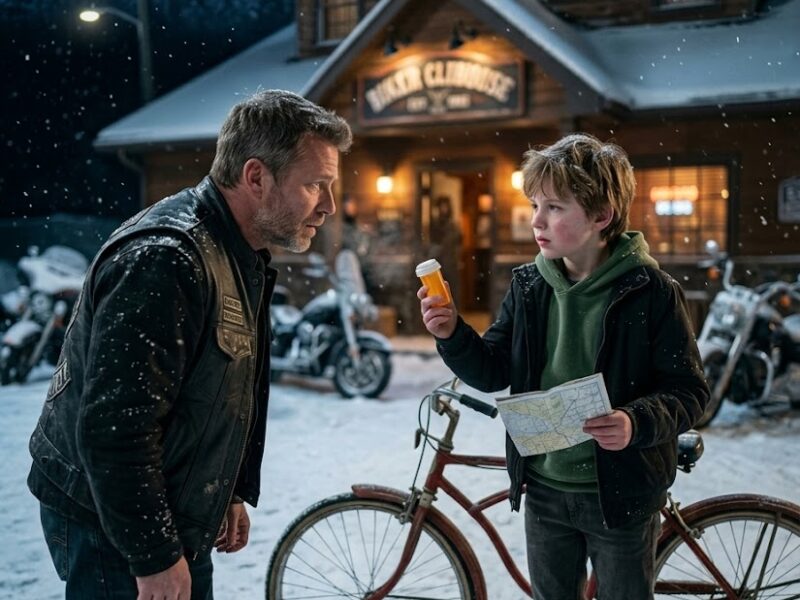
A 12-year-old ran up to a group of bikers and begged, “Please help my dad stay awake.” They didn’t ask questions. They acted fast.
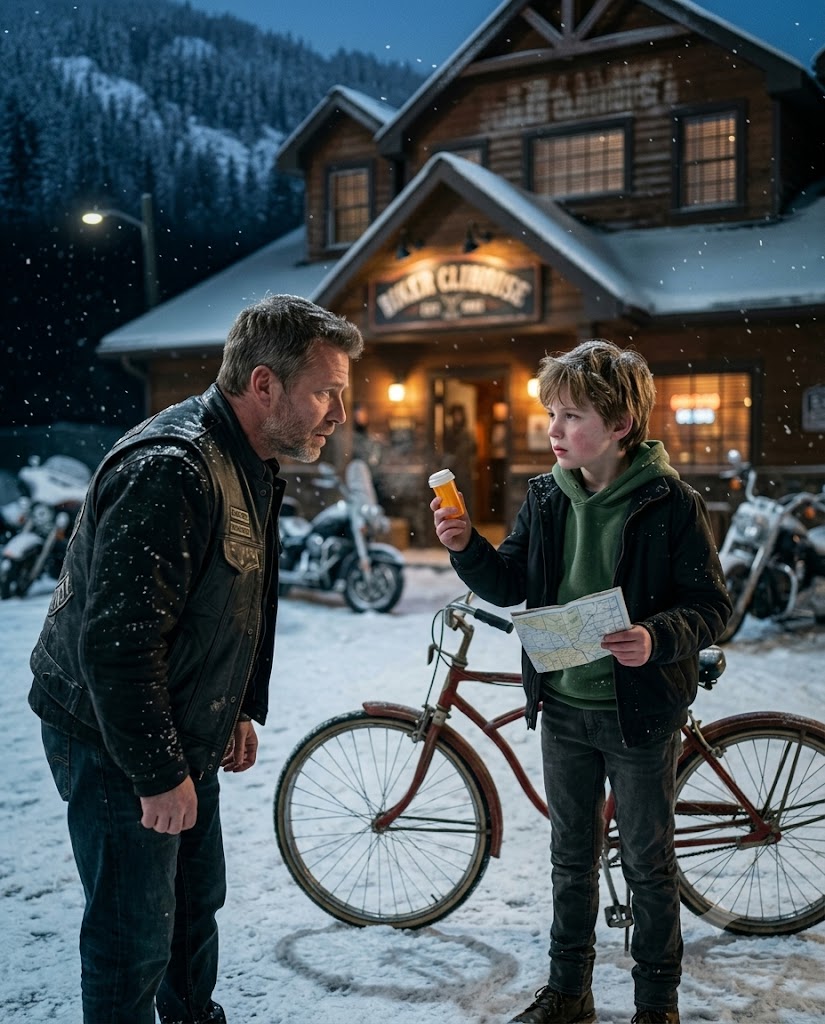
The streetlights on Maple Avenue had been dead for two weeks, and nobody from the city seemed to care enough to fix them.
Kenny Davies knew every crack in the sidewalk by heart now, had memorized which potholes to avoid even in complete darkness.
His BMX rattled beneath him as he pedaled harder, the sound of loose spokes mixing with his own ragged breathing.
It was 11:47 at night—way past curfew, way past reasonable.
But reasonable had left their house the same day his dad’s pink slip arrived.
The Iron Saints clubhouse sat at the corner of Fifth and Hammond like a brick fortress, windows glowing amber, the rumble of voices and classic rock bleeding through the walls.
Kenny had passed this building a hundred times on the way to school, always on the other side of the street, always with his dad’s voice in his head.
Stay clear of those guys, Ken. They’re not bad, but they’re not our people.
Tonight, they were his only people.
Kenny’s front tire hit the curb outside the clubhouse and he nearly lost his balance.
His hands were shaking—had been shaking since he’d found the bottle in the bathroom cabinet.
The orange prescription container with his dad’s name on it, supposed to last thirty days, emptied in three.
He’d stood there for twenty minutes just holding it, trying to do the math that didn’t add up.
His dad had been locked in his bedroom for three days, said he had the flu, but Kenny heard him pacing at 4:00 a.m.
Heard him crying through the walls on Tuesday.
Heard nothing at all on Wednesday, and that silence was worse than any sound.
The clubhouse door swung open and a mountain of a man stepped out, leather vest creaking, gray beard braided down to his chest.
He stopped mid-stride when he saw Kenny still straddling his bike under the busted streetlight.
“Kid, you lost?”
Kenny’s throat closed up.
He’d rehearsed this moment in his head the entire ride over, but now that he was here, every word felt stuck behind his teeth.
He reached into his pocket and pulled out two things: the empty pill bottle and a piece of notebook paper with a hand-drawn map.
The biker—his vest patch read DUTCH—descended the steps slowly, boots heavy on concrete.
He didn’t grab the items, just looked at them, then at Kenny’s face.
“What’s going on?”
“My dad.” Kenny’s voice cracked. He cleared his throat, tried again. “He’s not—he’s not doing good, and I don’t know what to do anymore.”
Dutch knelt down to his level, and Kenny could see the scars on his knuckles, the faded navy anchor tattoo on his forearm.
This close, he didn’t look scary.
He looked tired and concerned.
“Where’s your mom, son?”
“She died when I was six. Cancer.”
Dutch’s jaw tightened, his eyes softening at the edges.
He took the map, unfolded it carefully.
It was crude but detailed—their street, their house marked with an X, even the broken fence in the backyard.
“Two blocks down,” Kenny continued, words tumbling out now like a dam had broken. “He lost his job at the mill three months ago. He keeps saying he’s fine, but he’s not fine. He doesn’t eat. He doesn’t sleep. He just stays in his room, and I found these pills and there’s bills everywhere and—”
He stopped, gasping.
“I sleep on the floor outside his door now, just to make sure I can still hear him breathing.”
The door opened again and more bikers filed out, drawn by the commotion.
A guy with a gray ponytail, another covered in tattoos with arms like tree trunks, a woman with silver rings on every finger.
They formed a semicircle, but none of them crowded Kenny.
They just listened.
“Does your old man know you’re here?” Dutch asked quietly.
Kenny shook his head.
“He told me to go to bed at 9:00. I waited till he locked his door again. Then I snuck out the window.”
He looked up at the circle of weathered faces, at the leather and the scars and the years of hard living etched into every line.
“He’s hurting himself.”
The woman spoke now, voice gravelly but gentle. “Not—not like cutting or anything, but yeah. He’s hurting himself. He’s disappearing and I can’t—”
Kenny’s voice broke completely.
“I can’t lose him, too.”
The silence settled heavy and sacred.
Grown men and women who’d seen combat, addiction, loss—recognizing darkness in a twelve-year-old’s eyes.
Dutch stood up, turned to his crew.
“Reuben, grab your thermos. Pullman, you’re on second shift. Crank, call ahead. I want a rotation schedule locked in.”
“Wait.” Kenny wiped his eyes with his sleeve. “What are you doing?”
Dutch looked down at him, and warmth finally broke through the weathered lines of his face.
“We’re keeping your dad awake, son. That’s what you asked for, right?”
Kenny nodded, unable to speak.
“Then gear up,” Dutch said, handing the map to Reuben. “We roll in ten.”
—
Reuben’s Harley rumbled to a stop two houses down from the Davies place, quiet as a beast that size could manage at 1:15 in the morning.
He killed the engine, let the silence settle back over the neighborhood like a blanket.
From his saddlebag, he pulled out a battered camping chair, a thermos the size of a fire extinguisher, and a paperback so worn the cover had fallen off months ago.
Kenny had beaten him there—bike ditched in the bushes, already sitting on his own porch steps like a sentry.
The kid jumped up when Reuben approached.
“He’s still in there,” Kenny whispered. “Lights off. But I heard him moving around twenty minutes ago.”
Reuben nodded, unfolded the chair with a metallic scrape that seemed loud enough to wake the whole block.
He settled into it with a grunt, unscrewed the thermos cap, and poured coffee that smelled like it could strip paint.
“Go inside, kid. School tomorrow.”
“But—”
“Go inside. I got this.”
Kenny hesitated, then pulled out a piece of paper from his back pocket—the inside lid of a toolbox, Reuben realized—lined with names written in Sharpie.
Kenny clicked his pen and wrote *Reuben, 1:15 a.m.* in careful letters.
“What’s that?” Reuben asked.
“My schedule. So I know who’s here. So it’s—” Kenny struggled for the word. “Official.”
The kid disappeared through the front door, and Reuben heard the soft click of a lock.
He took a sip of coffee, opened his book to a dog-eared page, and waited.
Forty-three minutes later, the porch light blazed on like an interrogation lamp.
The door swung open hard enough to bounce off the rubber stopper.
Mike Davies stood there in boxers and an old Metallica shirt, hair sticking up in seventeen directions, eyes wild with confusion and a rawness he couldn’t hide.
“What the hell are you doing on my porch?”
Reuben looked up from his book, completely unbothered.
“Reading. Coffee’s fresh if you want some.”
“I don’t want coffee. I want to know why there’s a stranger camped outside my house at 2:00 in the morning.”
“Not a stranger. Name’s Reuben, and I’m here because your kid asked me to be.”
That stopped Mike cold.
His face cycled through confusion, anger, embarrassment, landing somewhere near devastation.
“Kenny did what?”
“Rode his bike down to our clubhouse around midnight. Polite kid, good head on his shoulders.” Reuben poured a second cup without asking, set it on the porch railing. “Said you could use some company.”
“I don’t need—” Mike’s voice cracked. He tried again. “I don’t need a babysitter.”
“Good. I’m a terrible babysitter. Kids hate me.” Reuben turned a page. “But I make decent company for guys who can’t sleep. Figured we could both be insomniacs together. More efficient that way.”
Mike stood there, hands still on the doorknob, every muscle tensed for a fight that Reuben wasn’t giving him.
The older man just kept reading, occasionally sipping his coffee, as if sitting on a stranger’s porch at 2:00 a.m. was the most natural thing in the world.
Mike’s shoulders dropped, the fight draining out of him.
He stepped outside, pulled the door mostly closed behind him, and dropped into the other camping chair that had materialized from somewhere.
The coffee cup found its way into his hands without him quite remembering reaching for it.
They sat in silence long enough for the street to empty completely.
Reuben didn’t rush it.
“I know what this looks like,” Mike said eventually, voice barely above a whisper. “I know what Kenny must have told you.”
“He didn’t tell me much. Just that you’re drowning and he’s scared.”
Mike flinched like he’d been slapped.
“He said that?”
“Didn’t have to. It’s written all over him. Kid’s got eyes like someone waiting for the next shoe to drop.” Reuben finally closed his book. “I’ve seen that look before. Wore it myself once upon a time.”
“Yeah?” Mike’s laugh was bitter. “You lose everything, too?”
“Lost my daughter for two years. She stopped calling after I chose Jack Daniels over her college graduation. Lost my job, my apartment. Damn near lost my bike.”
Reuben stared out at the empty street.
“Thing about rock bottom is it’s got a basement, and that basement’s got a sub-basement. You can always dig deeper if you’re committed.”
Mike was quiet for a long moment.
“What stopped you?”
“Honestly? Got tired. Tired of being tired. Tired of hurting.” Reuben refilled both their cups. “And one day, this crusty old biker named Dutch asked me if I was done yet. Not done living—done dying. Because apparently I was doing it real slow and it was bumming everybody out.”
Despite everything, the corner of Mike’s mouth twitched upward before falling again.
They sat until the coffee ran out and the sky started turning that particular shade of purple that meant sunrise was negotiating with the horizon.
A truck rumbled past—the newspaper delivery.
A dog barked three streets over.
Just as the sky began to bruise purple with dawn, another Harley rolled up.
Pullman—tall and lean as a rail spike, with a box of donuts balanced on his handlebars like a circus act.
“Shift change,” he announced cheerfully, too loud for the hour. “Reuben, Dutch wants you back at the clubhouse. Mike, I brought glazed and chocolate. Your call.”
Mike looked between them, confused.
“Shift change? Every three hours,” Pullman explained, setting up his own chair. “We figured nobody should have to stay awake alone. Bad for morale.”
Inside, Kenny’s bedroom curtain moved.
Reuben caught the motion, saw the kid’s silhouette against the dawn light, saw him pull out that toolbox lid and add another name.
Mike saw it, too.
For weeks, he’d been invisible in his own house—a ghost haunting rooms Kenny tried to fill with normalcy.
Now strangers were documenting his existence like it mattered.
He stood up slowly, legs stiff from sitting, and turned to Reuben.
“You didn’t have to do this.”
“You’re right. We didn’t have to.” Reuben started folding his chair. “We wanted to. Big difference.”
As Reuben’s engine faded into the morning, Mike looked at Pullman—this new stranger settling in with donuts and coffee like he’d been invited to a garden party.
“How long are you guys planning on doing this?”
Pullman bit into a glazed donut, chewed thoughtfully.
“How long you planning on needing us?”
Mike didn’t have an answer for that, so he took a chocolate donut and sat back down.
And for the first time in three months, he watched the sunrise with someone other than his demons.
—
A week into the porch shifts, Mike Davies finally said the words out loud.
It was Snake’s shift—a wiry guy with burn scars up his left arm and a voice like gravel in a blender.
They’d been sitting in companionable silence for an hour when Mike just blurted it out.
“I stood in the garage with a rope two Tuesdays ago. Had it over the beam and everything.”
Snake didn’t drop his cigarette. Didn’t gasp. Just nodded once and said, “What stopped you?”
“Kenny walked in asking about his math homework. Quadratic equations or some—” Mike’s laugh was hollow. “I told him I’d help him after dinner. Took the rope down after he left.”
“You tell anyone at the VA about this?”
Mike shook his head.
Snake pulled out his phone, made a call.
Twenty minutes later, Dutch arrived with paperwork for a VA-supported rehab program two towns over—thirty-day inpatient.
They’d already made calls, pulled strings, got him a bed.
“We’ll cover what insurance doesn’t,” Dutch said simply. “And Kenny stays with Reuben’s sister. She’s got two boys his age.”
Mike wanted to argue, wanted to say he couldn’t afford it, couldn’t leave.
Couldn’t face whatever waited inside those walls.
But when he looked through the window and saw his son’s face—twelve years old and carrying the weight of keeping him alive—the refusal died in his throat.
He checked in three days later.
—
The first week was hell distilled into a building that smelled like disinfectant and broken promises.
Withdrawal came in waves.
First the sweats that soaked through three sets of sheets.
Then the shakes that made his hands useless.
Then the nightmares that felt more real than the ceiling he stared at for hours.
Group therapy was worse—sitting in a circle with strangers, expected to excavate his pain and display it like a science project.
He said nothing for five days straight.
Sunday arrived, and with it came Kenny and Pullman.
They found Mike in the common room staring at a TV he wasn’t watching.
Kenny carried something wrapped in a trash bag.
“Hey, Dad.”
The kid’s voice was smaller than usual. Uncertain.
Mike tried to smile. Probably looked like a grimace.
“Hey, buddy. You doing okay?”
“Yeah. Reuben’s sister makes really good lasagna.”
Kenny sat down, pulled the trash bag open.
“I brought you something.”
It was the toolbox—the old red Craftsman that had once been his father’s, its dents and rust earned over decades of real work.
Mike felt his throat tighten.
That box had followed his father through layoffs and loss and ended up in Mike’s hands the day they buried him.
Now Kenny was holding it like an offering.
“I don’t—you didn’t have to—”
“Open it.”
Mike lifted the lid, and his breath caught.
The inside was covered in writing.
Names, dates, times—all in Kenny’s careful handwriting.
*Reuben, 1:15 a.m. Told Dad about Vietnam.*
*Pullman, 5:30 a.m. Brought donuts. Made Dad laugh.*
*Snake, 11 p.m. Just listened.*
Weeks of documentation.
A cartography of care mapped in Sharpie on metal.
At the bottom, in larger letters: *People Who Stayed.*
Mike’s vision blurred.
Pullman looked away, suddenly fascinated by a water stain on the ceiling.
Kenny just sat there, waiting.
“This is—” Mike couldn’t finish the sentence.
“I wanted you to remember,” Kenny said quietly. “When it gets hard in here, I wanted you to remember you’re not alone.”
Dr. Reeves stood in the doorway.
She’d been watching.
“May I?” she asked, gesturing to the toolbox.
Mike nodded, not trusting his voice.
She studied the inside of the lid for a long moment, then pulled out her phone and took a picture.
“In fifteen years, I’ve never seen anything like this. A child mapping his father’s survival in real time.” She said it softly. “Mr. Davies, do you mind if I share this with your therapy group tomorrow?”
—
The next day, Mike brought the toolbox to group.
Didn’t say much, just passed it around.
Let the others read Kenny’s chronicle.
A woman named Patricia cried.
A guy named Jerome asked if he could borrow the idea for his own kids.
Mike’s voice cut through the group silence.
“My kid is twelve, and he’s been more of a man than I’ve been in months. He went looking for help when I was too proud and too broken to ask for it myself.”
His voice cracked.
“He drew a map to our house and handed it to strangers because he was that desperate to keep me alive.”
The floodgates opened.
Stories poured out—the job loss, the isolation, the bills, the weight of being a single parent, the shame of falling apart when Kenny needed him most.
The rope in the garage.
The pills.
The hours he’d spent trying to calculate exactly how much nothing weighed.
Dr. Reeves let him talk until he had no words left.
—
Back at the clubhouse, Kenny was learning to weld.
Pullman stood beside him, mask down, guiding his hands as sparks flew like tiny fireworks.
They were working on a sign: *Davies & Son Metal Works.*
“You really think we’ll open a shop?” Kenny asked, killing the torch.
“Your old man’s one of the best fabricators I’ve ever seen. And you’ve got steady hands.” Pullman lifted his mask. “Yeah, kid. I think you will.”
Dutch appeared with a leather vest—smaller than the others, clearly custom-made.
A patch on the back read: *Iron Saint, Second Generation.*
“You earned this,” Dutch said, holding it out. “Not because you asked for help—because you stayed. You kept showing up. Kept checking names off that list. Kept believing when belief was the hardest thing to hold on to.”
Kenny took the vest with shaking hands.
It fit perfectly.
That night, he added another line to the toolbox lid, in letters bigger than the rest:
*Don’t fix engines. Fix what engines keep running.*
When Pullman saw it later, he had to step outside for a minute.
Said something about allergies.
Nobody believed him.
—
Three months and change after Kenny’s midnight ride, Mike Davies walked out of rehab with a duffel bag that weighed less than when he’d arrived and a sobriety chip that weighed more than everything else combined.
Pullman and Kenny waited in the parking lot, leaning against a truck that had been waxed within an inch of its life.
Kenny stood straighter than Mike remembered, wearing that leather vest like armor.
When their eyes met, the world paused.
Then Kenny ran.
Mike dropped the duffel bag and caught his son mid-leap, holding on like he’d just been thrown a life preserver in open ocean.
They didn’t say anything.
Some conversations happened in the spaces between words.
He smelled like institutional soap and something medicinal, but underneath it, he smelled like himself again.
Kenny held tighter.
“You good?” Kenny finally asked, voice muffled against Mike’s shoulder.
“Getting there. One day at a time, right?”
Mike pulled back, looked at the vest.
“Iron Saint, huh?”
“That’s official. Dutch says I earned it.”
Kenny glowed with it.
“Yeah,” Mike said softly. “You did.”
—
The barbecue spilled across three driveways like a small festival.
The Iron Saints had pulled out all the stops—two grills smoking, a cooler the size of a compact car filled with drinks, kids running through sprinklers while old-timers argued about carburetors and politics.
Mike stood at the edge of it all, overwhelmed by the sheer volume of people who’d shown up for a guy they barely knew three months ago.
Reuben appeared at his elbow, thrust a burger into his hand.
“Eat. You look like a strong wind could relocate you.”
“I don’t know what to say to all these people.”
“Start with thank you. Work your way up from there.”
Mrs. Chun from two houses down approached with a Tupperware container.
“I heard you were coming home. Made you some dumplings—pork and chive.”
Mike took them, throat tight.
“You didn’t have to.”
“I know I didn’t have to. Wanted to.” She patted his arm. “Welcome back, Mike.”
The pattern repeated.
Neighbors he’d avoided out of shame, bringing food and small talk and carefully not mentioning the porch shifts they’d all witnessed.
The conspiracy of kindness that had kept him tethered to the world.
Dutch finally climbed onto a picnic table, whistled sharp enough to shatter glass.
The crowd settled.
“We’re not big on speeches,” Dutch started. “But Mike wanted to say something.”
Mike opened his mouth to protest, but Kenny’s hand was at his back, and Dutch’s expectant look left no room for escape.
He cleared his throat twice.
“I’m not good at this.”
His voice cracked. He started again.
“Three months ago, I was in a place where I couldn’t see tomorrow. Couldn’t see past the next hour, the next minute. I’d convinced myself that Kenny would be better off without me.”
Kenny’s hand found his, squeezed hard.
“Then my kid did something I still can’t believe. He got on his bike in the middle of the night and asked strangers to keep me alive.”
Mike looked at the Iron Saints scattered through the crowd.
“You could have called social services. Could have told a twelve-year-old it wasn’t your problem. But you didn’t.”
Reuben raised his beer can.
Snake nodded.
Pullman wiped his eyes and pretended he wasn’t.
“I didn’t get better because someone fixed me. Nobody can fix another person.” Mike’s voice strengthened. “I got better because people stayed. Because Reuben sat on my porch at 2:00 a.m. and told me about his daughter. Because Pullman brought donuts and bad jokes. Because all of you refused to let me disappear.”
He turned to Kenny.
“And because this kid right here loved me enough to know when to ask for help. That took more courage than I’ve ever had.”
Dutch stepped forward, holding something wrapped in cloth.
“Kenny, front and center.”
The kid looked confused but obeyed.
Dutch unwrapped the package.
The official Iron Saint patch—the one Kenny had been wearing—now mounted and framed, with a small placard beneath it.
“You earned this three months ago,” Dutch said. “But tonight, we make it permanent. You’re pack now. That means something.”
Kenny accepted the frame, tried to speak.
Couldn’t.
Just nodded hard, tears streaming freely.
—
Later, after the crowd thinned and the grills cooled, Mike and Kenny sat on their porch—the same porch that had held vigil.
Kenny pulled out the toolbox lid, now laminated and pristine, and added one final entry in metallic silver ink:
*Don’t fix engines. Fix what engines keep running.*
“What does that mean?” Mike asked.
“Pullman said engines are just metal. They don’t matter unless they’re moving something important.”
Kenny held up the lid, tilted it so the streetlight caught the words.
“We’re what’s important. You, me, all of them. The engine’s just the excuse to keep going.”
Mike pulled his son close.
“When did you get so smart?”
“Had good teachers.”
—
By early spring, a handwritten sign appeared in the clubhouse window:
*PORCH WATCH*
*No judgment. Just presence.*
*Sign up inside.*
The list filled before the ink dried.
A single mom struggling after her divorce.
A vet having nightmares.
An elderly man whose wife had just passed.
People who needed someone to just exist in their space and refused to let them vanish.
The Iron Saints added it to their regular rotation, alongside toy drives and highway cleanups.
Reuben’s daughter called him from Colorado.
Said she’d been reading about a motorcycle club doing mental health outreach.
Asked if that was him.
“Yeah, baby. That’s us.”
“I’m proud of you, Dad.”
His knees buckled.
He found the nearest chair and let the words sink in.
—
Davies & Son Metal Works opened in a rented garage bay on Hammond Street, four blocks from the clubhouse.
The sign Pullman and Kenny welded hung crooked above the door.
Inside, Mike taught welding classes on weekends.
Kenny handled the bookkeeping—turned out the kid was good with numbers.
On the wall, in a place of honor, hung a photograph.
It was pulled from clubhouse security footage, taken months earlier.
Grainy black and white.
A skinny twelve-year-old on a BMX bike, caught just before stepping through a door and changing everything.
Beneath it, a metal placard Kenny had made himself:
*Sometimes saving a life starts with five words.*
*”Keep my dad awake.”*
—
Because heroes don’t always arrive on roaring chrome and thunder.
Sometimes they show up on a kid’s bicycle at midnight, carrying nothing but hope, a hand-drawn map, and the kind of courage that only comes from loving someone enough to refuse to let them go.
And sometimes staying alive isn’t about grand gestures or dramatic interventions.
Sometimes it’s about sitting on a porch at 2:00 a.m. with a stranger who refuses to be a stranger anymore.
Sometimes it’s about one more sunrise.
One more cup of coffee.
One more day worth staying for.
Mike Davies didn’t just survive.
He rebuilt his life, one porch conversation at a time.
And Kenny?
Kenny learned that courage isn’t fearless.
It’s showing up anyway.
—
The toolbox lid hung in the shop now, framed in steel Kenny had welded himself.
New names had been added over the months—other kids, other families, other porches.
The Iron Saints had become something none of them expected: a lifeline.
Dutch kept a binder in the clubhouse, thick with schedules and names and phone numbers.
“Porch Watch” had expanded to three neighborhoods.
Reuben trained new volunteers.
Pullman brought donuts to every shift change.
Snake still didn’t talk much, but he always showed up.
And Kenny?
Kenny rode his bike to the clubhouse every Tuesday after school.
Not because he needed help anymore.
Because he wanted to help.
There was a new kid on Maple Avenue—a girl with worried eyes and a backpack full of secrets.
Kenny recognized the look.
He knew what it meant.
So one night, when the streetlights were still broken and the city still didn’t care, he knocked on her door.
“Hey,” he said. “I know a place.”
She looked at him like he was speaking a foreign language.
“What kind of place?”
“A place where people stay.”
He pulled out a piece of paper—a new map, hand-drawn, careful.
“This is where we go when we can’t do it alone.”
She took the map with shaking hands.
“Does it work?”
Kenny smiled.
“Yeah. It works.”
Because he knew something the rest of the world was still learning.
That showing up is the hardest thing.
And the most important.
That staying is a choice you make every single day.
And that sometimes, the smallest act of courage—a kid on a bike, a map in his pocket, five words spoken to strangers—can change everything.
—
Mike Davies kept the sobriety chip in his pocket.
He touched it sometimes, when the old darkness crept close.
A reminder of where he’d been.
And where he was going.
Kenny kept the vest.
Wore it to school sometimes, even though it wasn’t technically allowed.
The principal never said anything.
Everyone knew the story by now.
Everyone knew what the Iron Saints had done.
And everyone knew that sometimes, the people you’re supposed to stay away from are the ones who save you.
—
The porch on Maple Avenue still had two camping chairs.
They stayed there, rain or shine.
A reminder.
An invitation.
A promise.
Because you never knew who might show up at midnight.
You never knew who might need a place to sit.
You never knew who might need someone to stay awake with them.
So the chairs stayed.
And the porch light stayed on.
And the Davies family—father and son—kept showing up.
For each other.
For their neighbors.
For anyone who needed to know they weren’t alone.
—
*What would you do if someone you cared about was slipping away?*
*Would you have the courage to ask for help?*
*Would you have the courage to stay?*
—
Because sometimes saving a life starts with five words.
“Keep my dad awake.”
And sometimes it starts with five more:
“I’ll stay with you.”
—
*The End*









