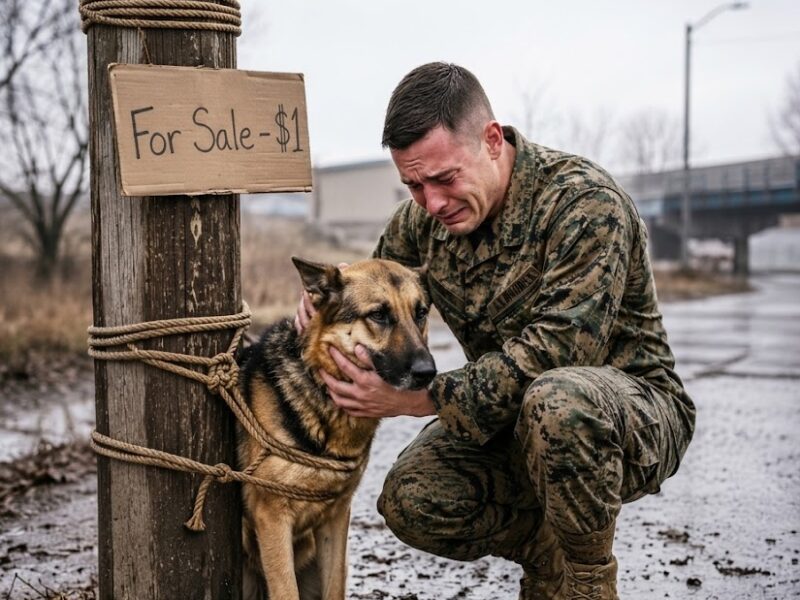
1) A Marine bought a broken K9 for $1. Then he looked at the dog’s tag—and realized it was his partner missing for 4 years
## Part 1
Cold December rain drifted across the outskirts of Jacksonville, North Carolina, turning the roadside ditches silver and the pine trees dark beneath a low winter sky.
Christmas lights already hung from storefront roofs, but the afternoon carried none of the warmth they promised.
The whole county seemed caught between rain, mud, and the long gray weight of evening.
Staff Sergeant Ryan Mercer drove north from Camp Lejeune with one hand resting loosely on the steering wheel of his dark pickup.
At thirty-six, Ryan was built like a man who had spent most of his adult life carrying more weight than anyone could see.
He stood just over six feet, broad through the shoulders, with closely cropped dark hair, a square jaw, and deep-set hazel eyes that rarely gave strangers much to work with.
Years in the Marine Corps had given him an economical way of moving.
He never wasted a step, rarely raised his voice, and had a habit of studying doors, windows, and faces before deciding where he belonged in a room.
People sometimes mistook his silence for coldness.
It wasn’t.
Four years earlier, Ryan had returned from an overseas deployment with injuries that healed faster than the guilt did.
Since then, he had become careful with people, careful with memories, and especially careful with anything that reminded him of the partner he had lost.
He was supposed to be at his younger sister Megan’s house by five for an early Christmas dinner.
Instead, traffic slowed almost to a stop near a farmers market built around an old feed store off Highway 24.
Pickup trucks crowded the gravel shoulder.
Families moved between canvas stalls selling honey, handmade wreaths, smoked meat, and jars of preserves.
A temporary sign promised “Last Weekend Before Christmas” in crooked red letters.
Ryan glanced at the clock.
He could have kept going.
Then an elderly man in a farm truck backed halfway into the road, forcing Ryan to pull onto the muddy shoulder.
Ryan muttered something under his breath, parked, and decided he might as well grab the apple butter Megan liked.
That decision changed everything.
He walked between the stalls with his camouflage utility jacket zipped against the rain.
Children hurried past carrying paper cups of cider.
Somewhere nearby, someone had hung brass bells from a tent frame, and the wind kept moving them gently.
Ryan had almost reached the feed store when he noticed the dog.
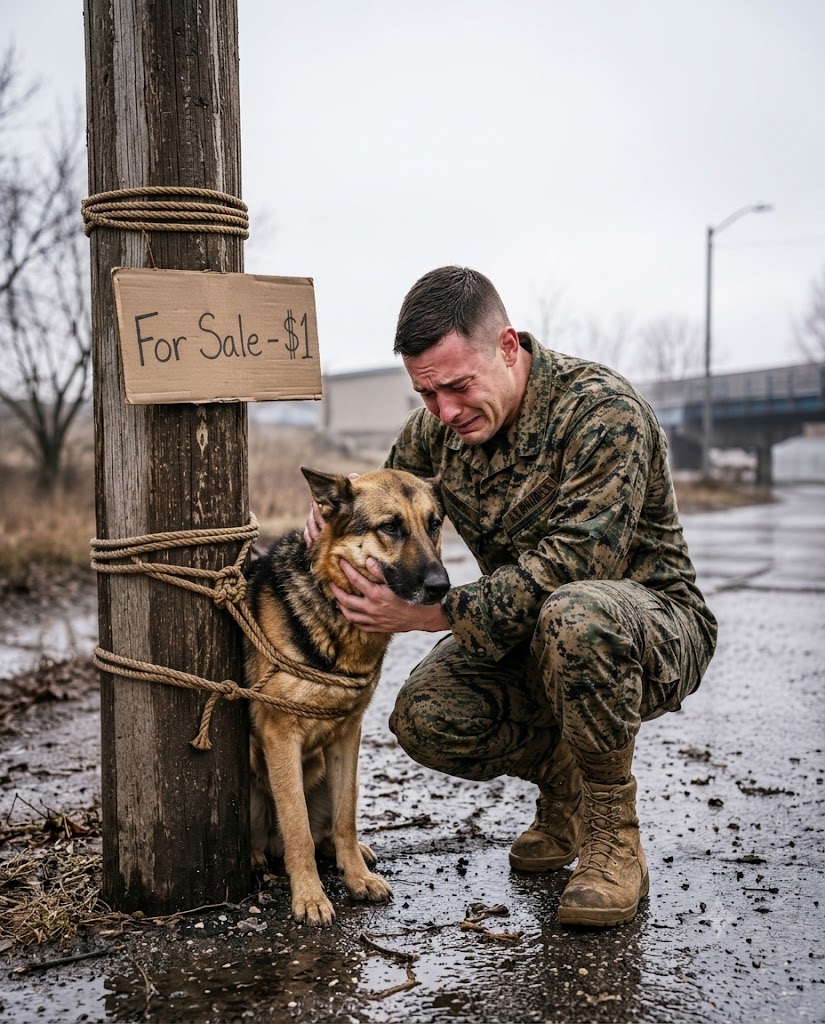
Behind the main building, away from the brighter stalls, a German Shepherd stood beside an old wooden utility post.
A piece of cardboard had been nailed above him.
Written across it in thick black marker were four words and a price: “For Sale, $1.”
Ryan stopped.
The shepherd was older, maybe nine, perhaps ten.
His once-heavy black and tan coat had been dulled by weather and age, and rain had flattened the fur along his back.
He was thinner than a working shepherd should have been, though not dangerously so.
One hind leg seemed stiff, forcing him to place his weight carefully.
His left ear bent slightly near the top instead of standing straight.
But the dog did not bark.
He simply watched the passing crowd with a strange, patient stillness.
Ryan looked toward the feed store.
Nobody seemed interested.
He took two steps closer.
The shepherd lifted his head.
Ryan stopped breathing.
There was a pale mark beneath the dog’s right eye, small, almost invisible beneath the wet fur.
Ryan knew that mark.
He knew the bent ear.
He knew the way the dog’s eyes moved first to his hands, then his shoulders, then back to his face, as if reading him.
“No,” Ryan whispered.
The dog remained still.
Ryan’s heart began beating harder.
Memories came without permission.
Dust, heat, a transport aircraft, a younger version of himself sitting on the floor beside a German Shepherd who refused to sleep anywhere except with one paw resting across Ryan’s boot.
Then the final deployment, the evacuation, a report placed in Ryan’s hands days later.
K-9 Atlas, deceased.
Ryan had never been allowed to bring him home.
He had spent four years believing there was nothing left to bring home.
The shepherd took one uncertain step forward.
Ryan stared at him.
There was one way to know.
A command Ryan had developed during training because Atlas had a habit of drifting several inches too far forward when excited.
It wasn’t an official command.
It wasn’t written in any manual.
It belonged only to them.
Ryan swallowed.
“Atlas.”
The dog’s ears twitched.
Ryan’s voice nearly failed him.
“Center.”
For half a second, nothing happened.
Then the old German Shepherd moved slowly, carefully.
He stepped toward Ryan, turned, and settled against Ryan’s left leg in the exact position he had taken hundreds of times before.
Shoulder aligned with knee, head tilted upward, waiting.
Ryan’s knees nearly gave out.
“Oh God.”
He crouched.
Atlas looked directly into his face.
Ryan placed both hands around the dog’s head, touching the bent ear as if the smallest pressure might make everything disappear.
“It’s you.”
Atlas pressed forward.
That was all it took.
Ryan bowed his head against the dog’s forehead, and tears came before he could stop them.
For four years, he had imagined Atlas in a hundred different memories, running beside him, sleeping under his bunk, waiting beside a vehicle.
But never this.
Never alive.
Never standing in North Carolina beneath a one-dollar sign.
A little girl several yards away had stopped watching.
She looked about seven, small and freckled, wearing a purple raincoat two sizes too large and yellow rubber boots.
She had been holding a paper bag of homemade dog treats while her mother shopped nearby.
The girl hesitated, then walked over, placed one biscuit on the ground beside Atlas, and quietly returned to her mother without saying anything.
Atlas sniffed it, but kept his attention on Ryan.
“That your dog?”
Ryan looked up.
The man approaching from the feed store was Earl Mason.
Earl was sixty-one, heavy around the middle with a white beard trimmed short and weathered hands that looked permanently stained by soil and machine grease.
He owned Mason Feed and Hardware and had the blunt, unsentimental manner of someone who had spent forty years dealing with livestock, broken equipment, and customers who always wanted credit until Friday.
He wasn’t cruel.
He was simply a man who had learned to treat problems practically.
“Where did you get him?” Ryan asked.
Earl pulled the brim of his brown cap lower against the drizzle.
“Driver left him here maybe fourteen months ago. Said he’d come back in a few days.”
“He didn’t?”
“Never saw him again.”
Ryan stood slowly.
“What was the driver’s name?”
“Didn’t give me one worth remembering.”
Earl glanced toward Atlas.
“I fed the dog. Tried finding somebody who wanted an older shepherd. Folks want puppies, young dogs, something they figure they can train.”
Ryan looked at the cardboard sign.
“One dollar.”
Earl shrugged.
“People stop when they see a price. They don’t stop when something says free.”
Ryan reached into his wallet.
Before he could pull out the bill, a gravelly voice came from behind him.
“Son.”
An elderly man stood near a produce stall.
His name was Walter Briggs, seventy-two, a Vietnam-era Marine veteran who sold carved wooden ornaments at the market every December.
Walter was lean and slightly stooped with white hair combed straight back and an old corps pin fixed to his canvas jacket.
Years had softened his hearing, but not his ability to recognize military habits.
He had been watching Atlas.
More specifically, he had been watching where Atlas sat.
Walter nodded toward the dog.
“That dog remembers his marine.”
Ryan couldn’t answer.
He pulled a one-dollar bill from his wallet and handed it to Earl.
Earl accepted it without ceremony.
“Guess he’s yours?”
“No,” Ryan said quietly, looking down at Atlas.
“He already was.”
Ryan loosened the weathered lead from the post.
Atlas didn’t move away.
Instead, the old shepherd leaned his shoulder against Ryan’s leg.
Ryan reached up and removed the cardboard sign.
Earl raised an eyebrow.
“You keeping that?”
“Yeah.”
Ryan folded it carefully and carried it beneath one arm.
As they crossed the muddy lot, Earl called after him.
“Marine.”
Ryan turned.
“The man who dropped him off. I don’t remember his face much. But I remember the van.”
Ryan waited.
“Black cargo van,” Earl said. “Had some kind of silver shield painted on the door.”
Ryan nodded absently.
His attention was already back on Atlas.
At the pickup, Ryan opened the passenger door.
Atlas tried to climb in, hesitated when his hind leg stiffened, then looked up at him with something close to embarrassment.
“Easy, partner.”
Ryan lifted him carefully onto the seat.
Atlas settled immediately, as though a pickup beside Ryan was the most ordinary place in the world.
Ryan reached to adjust the dog’s old collar.
His fingers stopped.
Beneath the damp fur along Atlas’s neck was a small rectangular patch where the hair grew differently.
The skin underneath carried an old, clean-edged mark.
Ryan brushed the fur aside.
His expression changed.
He had seen enough working dogs to recognize where identification equipment was normally placed.
Someone had altered something there.
Removed it, perhaps.
Ryan looked at Atlas.
The dog watched him silently.
Four years ago, official paperwork said Atlas had died.
Now Atlas was sitting alive in Ryan’s truck.
And somewhere between those two truths, someone had apparently made sure the dog could no longer be easily identified.
Ryan closed the passenger door.
For the first time since recognizing Atlas, happiness was no longer the only thing he felt.
Something else had entered with it.
A question.
And Ryan Mercer had never been particularly good at leaving questions unanswered.
Rain followed Ryan Mercer all the way into Jacksonville, sliding across the windshield in thin silver lines while Atlas lay curled on the passenger seat beside him.
The old German Shepherd had barely moved since leaving the market.
Every few minutes, though, he opened his eyes and looked toward Ryan as if checking that the man beside him was still there.
Ryan kept glancing back.
Four years of grief had taught him not to trust impossible things, and Atlas, sitting inside his truck, felt more impossible with every mile.
Carolina Pines Animal Clinic stood near the edge of town in a low brick building bordered by wet magnolia trees and a narrow parking lot shining beneath the gray afternoon sky.
A wooden sign near the entrance showed a painted paw print beneath the clinic’s name.
Ryan parked beneath the awning, came around to the passenger side, and opened the door.
Atlas tried to jump down by himself, but his hind legs stiffened before he could commit.
“Not today, partner.”
Ryan slipped one arm beneath the shepherd’s chest and helped him carefully to the pavement.
Atlas accepted the assistance without resistance, though the look he gave Ryan suggested he had not forgotten how independent he used to be.
The woman who met them inside was Grace Holloway.
Grace was thirty-four, medium height, and slender, with reddish-brown hair gathered into a loose knot and soft green eyes behind narrow rectangular glasses.
She wore navy scrubs beneath a gray cardigan, and there was something steady about the way she moved, never rushed, even when the clinic was busy.
Years of working with frightened animals had taught her that calm could travel from one living thing to another.
Her husband had died two years earlier in a highway rescue accident, and since then, Grace had become quieter outside work, but more patient inside it.
She had learned that fear often hid behind anger, silence, or stubbornness, whether it belonged to an animal or a person.
She looked first at Atlas, then at Ryan’s uniform.
“What happened?”
“I found him.”
Grace glanced at the shepherd’s bent ear and weathered coat.
“Today?”
Ryan nodded.
“About an hour ago.”
She opened the exam room door.
“Let’s get him somewhere warm.”
Atlas hesitated at the threshold.
Grace noticed immediately and stepped aside rather than reaching for him.
“No pressure,” she said.
“He can decide.”
Ryan looked down.
“Come on, Atlas.”
The dog entered.
Grace raised her eyes.
“Atlas.”
Ryan closed the door behind them.
“That’s his name.”
“You know him?”
Ryan did not answer right away.
Grace seemed to understand that the answer was larger than the question, so she did not push.
The examination took nearly forty minutes.
Grace worked slowly, talking in a low voice, while Atlas watched every movement.
She checked his joints, listened to his heart, examined his teeth, and ran careful hands through his coat.
Ryan remained near the table, one hand resting beside Atlas’s shoulder whenever the dog became tense.
“Nothing here says emergency,” Grace finally said.
“That’s the good news.”
Ryan let out a breath he had not realized he was holding.
“The rest? He’s older, probably nine, maybe a little more. He’s underweight, but not dangerously. There’s arthritis in the hips, and his left hind leg has an old ligament injury. It healed, but not perfectly. He’ll need a proper diet, medication for inflammation, and time.”
She paused before adding, “A lot of time.”
Ryan looked at Atlas.
“I have that.”
Grace studied him briefly, perhaps measuring whether he meant it.
Then she smiled faintly.
“Good.”
She moved a handheld scanner along Atlas’s shoulders.
Nothing.
Again.
Still nothing.
“That’s strange.”
“What?”
“Most working dogs are chipped.”
“He was.”
Grace looked at him.
Ryan finally said it.
“He was my military canine.”
For the first time, Grace’s professional composure shifted.
“Was.”
Ryan stared at Atlas.
“I was told he died four years ago.”
The room became very still.
Grace lowered the scanner.
“Ryan, he didn’t.”
Atlas rested his head against Ryan’s forearm.
Grace did not offer sympathy.
She seemed to recognize that sympathy was not what he needed yet.
Instead, she said, “Then let’s find out what we can.”
She examined the area beneath Atlas’s neck more carefully.
The rectangular patch Ryan had noticed at the market was faint, but under the examination light, Grace could see where the skin and hair pattern had changed.
“Something happened here,” she said.
“I can’t tell you exactly what from appearance alone, but this isn’t where I’d expect a simple injury.”
Ryan’s jaw tightened.
“Could someone have removed identification?”
“Possibly. Or damaged it. I don’t want to guess.”
That answer earned her Ryan’s trust faster than reassurance would have.
Grace scanned again from a different angle, moving slowly toward Atlas’s shoulder blade.
The device beeped.
She stopped.
“Wait.”
Ryan straightened.
Grace passed the scanner across the same spot.
Another beep.
A partial number appeared on the display.
“There’s still something there.”
She copied the digits onto a notepad and walked to the computer.
Ryan stayed beside Atlas as she searched an older registry system used by military and law enforcement veterinary networks.
The spinning icon on the screen seemed to take forever.
Then a record appeared.
Grace’s face changed first.
Ryan saw it and stepped closer.
On the screen, beneath a faded identification photograph of a younger German Shepherd, was a line of block text.
Atlas. MWD A417.
Ryan gripped the edge of the counter.
Below that: Status: Deceased.
The date was four years earlier, the same day Ryan had been evacuated from the overseas operation.
Ryan read it twice, then a third time.
Atlas was lying six feet away, alive, breathing, watching him.
“Who entered that?” Ryan asked.
Grace scrolled down.
“I don’t have access to the original reporting officer from this portal.”
“Somebody had to.”
“Yes.”
Ryan’s eyes remained fixed on the word deceased.
Four years of mourning reduced to one clean administrative line.
Grace found another field farther down.
“There’s a transfer notation.”
Ryan looked over.
A code appeared beside Atlas’s medical transport history.
PKTR-17.
“What is that?”
Grace shook her head.
“Not medical. Looks like a transport reference.”
Before Ryan could ask more, the exam room door opened halfway.
A boy stood there.
Grace turned.
“Noah.”
Noah Holloway was ten years old, slight for his age, with pale brown hair that fell over his forehead and the same green eyes as his mother.
He carried a school backpack almost as large as his torso and wore a navy sweatshirt with a faded rocket on the front.
Noah had once been loud, curious, and fearless around nearly everything.
After his father’s death, he became more cautious, especially around unfamiliar animals and sudden movement.
Grace never forced him to get over it.
She had learned grief did not move according to adult schedules.
Noah noticed Atlas.
He stopped immediately.
The shepherd raised his head.
Noah stepped backward.
“Mom?”
“It’s okay.”
Grace said his name is Atlas.
“Is he friendly?”
Ryan looked at Atlas.
“He used to be.”
Grace gave him a quick glance.
Ryan corrected himself.
“He still is. He’s just had a long day.”
Noah remained near the doorway.
Atlas watched him for several seconds.
Then, instead of approaching, the German Shepherd slowly lowered himself onto the floor.
He turned his head away.
Noah stared.
Ryan noticed the change.
Atlas had done the same thing years ago around nervous young Marines who were unfamiliar with working dogs.
Make himself smaller.
Remove pressure.
Wait.
Noah took one step into the room, then another.
Atlas did not move.
“You don’t have to touch him,” Grace said.
“I know.”
Noah moved closer until he was several feet away.
Atlas’s tail tapped the floor once.
Noah’s expression softened.
“His ear is crooked.”
Ryan almost smiled.
“It always has been.”
Noah crouched, still keeping distance.
“Does it bother him?”
“No.”
“Looks kind of cool.”
This time, Ryan did smile.
Atlas glanced toward the boy, then put his head back down.
It was not friendship yet, but it was permission.
Later, Grace printed the basic records Ryan was legally allowed to take and wrote the transport code at the top.
“Start with this,” she said.
“PKTR-17. If Atlas was transferred after the incident, somebody somewhere attached that code to him.”
Ryan folded the paper and placed it in his jacket.
Grace handed him medication instructions and a simple feeding schedule.
“No long walks yet. Warm place to sleep. Keep him from jumping if you can.”
Ryan looked toward Atlas.
“That’ll be the hard part.”
Grace smiled.
“Working dogs retire from the job before they retire from believing they have one.”
By the time Ryan reached his father’s house outside Jacksonville, darkness had settled between the pine trees.
The house was a modest single-story place with faded white siding, a deep porch, and an old brick chimney that leaned just enough to worry everyone except Ryan.
His father, Thomas Mercer, had built most of the interior himself before heart trouble took him three years earlier.
Since then, Ryan had lived there alone whenever duty kept him stateside.
His younger sister, Megan, had spent the last year telling him to sell it.
Megan Mercer was thirty-one, five-six with dark hair cut to her shoulders and the same stubborn jaw as Ryan.
Unlike her brother, she filled silence rather than living inside it.
She worked as an elementary school counselor, laughed easily with children, and worried professionally about everyone, which meant Ryan had never stood a chance.
She was waiting on the porch when his truck arrived.
“You missed dinner.”
Ryan stepped out.
“Sorry.”
“You’ve been ignoring your phone for—”
Then she saw Atlas climbing carefully from the passenger seat.
Megan stopped speaking.
Ryan walked around the hood.
Her face went pale.
“No.”
He nodded.
Megan covered her mouth.
“Ryan, that’s not—”
“It is.”
For once, Megan Mercer had nothing to say.
Atlas walked slowly toward the porch.
He sniffed the bottom step, then the railing, then the door.
Ryan opened it.
The old shepherd entered the house and paused in the living room.
The fireplace was burning.
Atlas crossed the rug, turned once beside the hearth, and lowered himself onto the same patch of floor where he had slept during Ryan’s visits home years earlier.
Megan began crying before Ryan did.
“He remembers.”
Ryan stood in the doorway staring at the dog.
“Yeah.”
Megan looked around the quiet house.
“You still won’t sell it, will you?”
Ryan shook his head.
“No.”
This time she did not argue.
For the first time since their father died, the house did not feel like a place Ryan was preserving for someone who would never return.
Something had returned.
Near midnight, after Megan left, Ryan sat at his father’s old desk with Atlas sleeping beside him.
He typed PKTR-17 into several archived databases.
Eventually, an old business listing appeared.
Patriot K9 Transit and Recovery.
Ryan leaned closer.
The company had once handled transportation and recovery logistics for military and law enforcement working dogs.
He opened an archived version of its old website.
A logo filled the screen.
A silver shield.
Atlas’s head came up immediately.
The dog rose, his body stiffened, eyes fixed on the laptop, and a low, uneasy growl formed in his chest.
Ryan looked from Atlas to the screen.
Then he remembered Earl Mason standing in the rain.
Black cargo van.
Silver shield on the door.
Ryan stared at the logo again.
Four years ago, Atlas had been declared dead.
Tonight, for the first time, Ryan had found the name of something that might explain how a dead dog had come home.
—
## Part 2
By morning, the silver shield on Ryan Mercer’s laptop had become the only thing he could think about.
Patriot K9 Transit and Recovery had once presented itself as a respectable logistics contractor, moving military and law enforcement working dogs between bases, veterinary facilities, retirement programs, and handlers across the country.
Archived photographs showed clean transport vans, uniformed employees, and German Shepherds sitting calmly beside American flags.
But the company’s public history ended abruptly three years earlier when several federal contracts disappeared, and its website stopped being updated.
Its last registered address led to a warehouse complex near New River Industrial Park, less than twenty-five minutes from Ryan’s house.
Ryan wrote the address on a yellow legal pad but did not drive there.
Four years in the Marines had taught him the difference between instinct and evidence, and he knew that walking onto private property because a dog had reacted to a logo would accomplish nothing except create problems.
Instead, he called the Onslow County Sheriff’s Office and asked for Deputy Sarah Bennett, a name Megan had mentioned more than once when talking about reliable people in the county.
Sarah arrived at Ryan’s house shortly after noon.
She was thirty-two, tall and athletic with dark auburn hair pulled into a practical ponytail and sharp brown eyes that seemed to notice small inconsistencies before other people finished speaking.
She had spent eight years in law enforcement and had a reputation for being polite without being easily persuaded.
Three years earlier, she had worked a missing property case that fell apart because witnesses exaggerated what they thought they had seen.
Since then, Sarah had become almost stubborn about separating suspicion from proof.
Ryan showed her Atlas’s records, the PKTR-17 transport code, and the archived Patriot K9 website.
Sarah studied everything in silence.
“So, the dog was declared dead four years ago,” she said.
“Yes.”
“And you physically identified him yesterday.”
“I didn’t need the chip to identify him.”
Sarah glanced toward the living room where Atlas was sleeping beside the fireplace.
“I believe that you believe it’s him.”
Ryan’s expression tightened.
Sarah raised one hand.
“That’s not an insult. It’s how I have to look at it until records back you up.”
Ryan nodded once.
She examined the transport code again.
“Could be an administrative error. Wrong status. Duplicate dog number. Bad data migration.”
“Could be.”
“But you don’t think it is?”
“No.”
Sarah looked toward Atlas.
“Neither do I, apparently.”
She photographed the paperwork and promised to check county business records, contract filings, and any transportation documentation she could lawfully access.
“Don’t go to the warehouse,” she said before leaving.
“I wasn’t planning to.”
“Good.”
She paused at the door.
“People who say that usually are.”
For the first time that morning, Ryan almost smiled.
Over the next several days, life tried to behave normally.
Atlas did not.
Large diesel engines changed him.
Whenever a delivery truck passed behind the Mercer property, Atlas would raise his head immediately.
If the engine slowed, he stood.
If it stopped nearby, he moved toward the nearest window and watched until it disappeared.
Ryan began noticing the pattern.
One night, shortly after eleven, Atlas rose from beside the fireplace so quickly that his water bowl rattled against the floor.
He moved to the back door.
Ryan followed.
“What is it?”
Atlas stared at the handle.
Ryan opened the door and the shepherd stepped onto the porch.
Cold air rolled through the yard.
Beyond the fence, a narrow service road curved through the trees toward several older industrial lots.
Headlights appeared between the pines.
A black cargo van rolled slowly past.
Ryan barely had time to register it before Atlas became rigid beside him.
The van crossed beneath a streetlight.
A silver shield was painted on the driver’s door.
Ryan stepped toward the fence.
The vehicle continued without stopping and disappeared around the bend.
Atlas remained staring after it.
Ryan looked down at him.
“Yeah,” he said quietly.
“I saw it, too.”
The next afternoon, Ryan took Atlas back to Carolina Pines for a scheduled weight check.
Grace Holloway seemed pleased by the small improvement in the dog’s appetite, but Ryan quickly realized the clinic was not the only thing occupying her attention.
A stack of folders covered the corner of her desk.
On top was a handwritten title: Pinehaven Animal Shelter Emergency Funding Plan.
“Pinehaven?” Ryan asked.
Grace sighed.
“It’s a small rescue outside town. Twenty-two kennels, mostly dogs nobody else has room for. They’re running out of money.”
She explained that Pinehaven had lost a major donor and might have to reduce operations by spring.
Grace had been trying to develop a community program that could attract grants and local support.
Her idea was simple.
Pair carefully evaluated retired working dogs with veterans, first responders, and children who were struggling with anxiety or grief.
Not as formal therapy animals unless certified, but as a supervised reading and companionship program.
“You’re thinking about Atlas,” Ryan said.
Grace looked guilty for approximately half a second.
“I was thinking about what I saw with Noah.”
“No.”
“You haven’t even heard the whole idea.”
“I’m not putting him on posters.”
“I didn’t say posters.”
“I’m not becoming one of those stories where somebody points a camera at a marine and asks him to explain how a dog fixed his life.”
Grace folded her arms.
“Good, because I wouldn’t ask you to.”
Ryan looked at her.
“I want dogs to have somewhere useful to go when everyone else decides their useful years are over,” she said.
“That’s different.”
Ryan had no immediate answer.
From the waiting area came Noah’s voice.
He was sitting cross-legged on the floor with an illustrated adventure book open across his knees.
Atlas lay several feet away, eyes half closed.
Noah had started doing this after school.
He still did not know Atlas had been a military canine.
Grace and Ryan had agreed there was no reason to burden him with the mystery yet.
To Noah, Atlas was simply the old dog with the funny ear.
Today he was reading about a boy crossing the ocean in a homemade boat.
“You can’t sleep yet,” Noah told Atlas.
“This is the good part.”
Atlas opened one eye.
Noah continued reading.
Five minutes later, the German Shepherd had moved close enough that his chin rested beside Noah’s sneaker.
Grace watched them through the doorway.
“He reads louder when Atlas is here,” she said.
Ryan looked at the boy.
“He used to hate reading out loud. He used to hate anyone hearing him make mistakes.”
Ryan understood that better than he wanted to admit.
Before leaving, Grace handed Ryan a small bag of joint supplements and did not mention Pinehaven again, but Ryan took one of the shelter brochures from her desk when she wasn’t looking.
Two days later, Sarah called.
“Come by the office.”
Her tone made Ryan leave immediately.
She met him in a small records room at the sheriff’s station.
Several printed spreadsheets lay across the table.
“I found Patriot K9’s old county filings,” she said.
“Then I cross-referenced what I could with transport records.”
Ryan sat.
Sarah pointed to a column.
“Thirty-seven working dogs passed through the company over six years. Atlas, he’s here.”
She slid the page toward him.
“Nine were later listed as deceased. Five disappear from the records after retirement. Four were transferred to organizations I can’t verify ever existed at the listed addresses.”
Ryan stared at the numbers.
“That’s eighteen dogs.”
“It’s eighteen records with problems,” Sarah corrected.
“Don’t jump farther than the evidence.”
“But Atlas is one of the nine.”
“Yes.”
That single word changed the room.
Sarah sat across from him.
“I also found a former employee. His name was Calvin Reed.”
Calvin agreed to meet them at a diner near the edge of town the following evening.
He was fifty-six, narrow-shouldered and weathered with thinning gray hair, a tobacco-brown work jacket, and hands that shook slightly whenever he touched his coffee cup.
He had spent most of his adult life driving commercial trucks and spoke with the cautious manner of someone who had learned that jobs could disappear faster than reputations recovered.
“I only worked for Patriot K9 eleven months,” Calvin said.
“Why’d you leave?” Sarah asked.
Calvin stared into his coffee.
“Because paperwork stopped matching what I saw.”
Ryan leaned forward.
“What does that mean?”
Calvin glanced around the diner before answering.
“Some transport sheets said deceased animal. Some said remains being transferred. But I’d walk past loading and hear dogs moving in the kennels.”
Sarah’s expression stayed controlled.
“Did you report it to a supervisor? What happened?”
“They told me drivers weren’t paid to audit paperwork.”
He rubbed his thumb along the edge of the cup.
“Most runs were normal. Veterinary transfers, retirements, police dogs going home to handlers. But some trucks left after midnight. No logos on the paperwork. Same vans, though.”
“Silver shield?” Ryan asked.
Calvin’s eyes lifted.
“You’ve seen one?”
Ryan said nothing.
Calvin leaned back.
“Then they’re not as gone as I thought.”
Sarah immediately caught the wording.
“They?”
Calvin shook his head.
“I’m telling you what I saw years ago. That’s all.”
He stood as if the conversation had already lasted too long.
Then he hesitated.
“One more thing.”
From inside his jacket, Calvin removed an old envelope.
“I took pictures before I quit. Thought someday somebody might ask.”
He placed a faded photograph on the table.
It showed the open rear of a transport truck.
Several secured kennels stood in two rows.
The image was grainy.
Taken from a distance.
Ryan picked it up.
His eyes moved across the dogs, then stopped.
Third kennel from the left.
A German Shepherd stood facing the camera, black and tan coat, broad muzzle, and one unmistakable left ear bending near the top.
Ryan turned the photograph over.
A date had been printed along the bottom edge.
He read it once, then again.
Seven months after Atlas had officially died.
Ryan looked at Calvin.
Calvin’s voice was quiet.
“Looks like your dog was alive a lot longer than somebody wanted you to know.”
Ryan said nothing.
He only held the photograph tighter, staring at the shepherd behind the kennel door.
Four years of uncertainty had just become something else.
Proof.
Rain had been falling over Jacksonville since late afternoon, cold enough to turn every parking lot into black glass beneath the streetlights.
By seven, the wind had strengthened, pushing sheets of water across the pine-lined roads and drowning the last traces of daylight.
Ryan Mercer was sitting at his father’s kitchen table with Calvin Reed’s photograph beneath the yellow lamp when his phone began to ring.
Grace Holloway’s name filled the screen.
Ryan answered immediately.
“Grace.”
Her breathing was uneven.
“Noah’s missing.”
Ryan stood so quickly that Atlas lifted his head from beside the fireplace.
“What happened?”
“He didn’t come home after school. I thought he was at the library. The school thought I’d picked him up.”
Grace stopped, trying to steady herself.
“His backpack was found near the bus stop.”
Ryan was already reaching for his jacket.
“Have you called 911?”
“She’s here. I’ll be there in ten minutes.”
Grace’s house stood on a quiet residential street near the edge of Jacksonville, a narrow two-story home with pale siding and a porch that Noah’s father had built before he died.
Police cruisers were already parked outside when Ryan arrived.
Deputy Sarah Bennett stood beneath the porch light speaking into her radio while Grace waited in the doorway, pale and visibly fighting panic.
Grace usually carried herself with the calm control of someone who spent her days reassuring frightened animals and worried owners.
Tonight, that steadiness was gone.
Her reddish-brown hair had been pulled into a careless ponytail.
Her glasses were spotted with rain.
She had wrapped herself in the first coat she could find.
She looked less like the composed veterinary nurse Ryan knew and more like a mother counting every minute her child remained outside in the cold.
Sarah met Ryan at the walkway.
“We’ve got units checking the school route, library, parks, and his friends’ houses.”
“Anything from cameras?”
“Not yet.”
Ryan looked past her.
“Atlas can try.”
Sarah hesitated only briefly.
“Use something Noah wore recently.”
Grace disappeared into the house and returned carrying a blue hooded jacket Noah had left over the back of the couch that morning.
She crouched beside Atlas.
“Please,” she whispered, though she seemed to know the dog could not understand the word the way she meant it.
Ryan let Atlas smell the jacket.
The German Shepherd inhaled several times, then lifted his head, his bent left ear angled toward the street.
Despite his age and stiff hind leg, something in his posture changed.
For a few seconds, the tired dog Ryan had carried from a one-dollar sign disappeared, and the working canine beneath the years came back.
“Find Noah,” Ryan said.
Atlas moved.
The search led away from the school district instead of toward it.
That bothered Sarah immediately.
“He usually walks the opposite direction.”
Ryan followed Atlas along the wet shoulder.
“Then tonight he didn’t.”
The trail crossed a drainage path, passed behind a closed auto shop, and eventually reached an older service road bordering New River Industrial Park.
Ryan recognized the area from the Patriot K9 records.
The company’s former warehouse lay deeper inside the industrial complex, though Atlas was not heading directly toward it.
Sarah called additional units toward their location but kept them spread out.
There was still no evidence Noah had been taken, and she refused to turn a missing child search into assumptions before they knew what had happened.
Atlas stopped near a rusted fence.
Beyond it stood several abandoned kennel buildings, almost swallowed by weeds and pine growth.
Their chain-link runs were empty, their roofs dark with rain.
Behind them, separated from the main structures, was an old maintenance shed with one dim battery lantern glowing through a cracked window.
Atlas pulled toward it.
Ryan’s heart tightened.
“Noah.”
Movement inside.
Ryan reached the shed first and opened the door.
Two boys were sitting against the far wall.
Noah looked soaked, frightened, and exhausted, but unharmed.
Beside him was another boy Ryan had never seen before.
Grace arrived moments later with Sarah and nearly stumbled when she saw her son.
She crossed the room and wrapped both arms around Noah without speaking.
Noah buried his face against her shoulder.
“I wasn’t taken,” he said quickly.
“Mom, I wasn’t.”
Grace pulled back enough to look at him.
“Then where were you?”
Noah looked toward the other boy.
“I was helping Eli.”
Eli Parker was twelve, though his narrow shoulders and oversized gray sweatshirt made him appear younger.
He had sandy blonde hair that had grown too long around his ears, a pale face, and cautious blue eyes that rarely remained on an adult for more than a second.
Unlike Noah, whose fear usually made him quiet, Eli had the guarded manner of a child who had learned to listen before deciding what was safe to say.
He carried no school backpack, only a small canvas duffel rested beside his shoes.
Sarah crouched several feet away rather than approaching.
“Hi, Eli. I’m Deputy Bennett.”
The boy nodded.
“Do you know where your parents are?”
“My mom’s gone.”
Sarah kept her voice neutral.
“And your dad?”
Eli stared at the floor.
“Derek.”
“Where’s Derek?”
“Working.”
Noah interrupted.
“He drives trucks.”
Grace looked at Ryan.
Ryan felt Atlas settle beside his leg.
Sarah asked, “Can you tell me what happened tonight?”
Eli looked at Noah first.
Noah nodded as if giving permission.
“My dad told me to stay in the trailer,” Eli said.
“But people came. He started arguing with them.”
“What people?”
“The ones from the warehouse.”
Ryan felt the room narrow around the word.
Eli’s father, Derek Parker, was forty-one, a long-haul driver with a lean frame, dark hair beginning to gray at the temples, and the weary posture of a man who spent more nights behind a steering wheel than in a bed.
According to Eli, Derek had once been patient and easygoing, the kind of father who stopped at roadside attractions just because his son pointed at them.
Since taking transport work around Jacksonville, however, he had grown withdrawn.
He slept poorly, checked the road whenever headlights approached their trailer, and had started telling Eli not to ask about certain jobs.
“He works for Patriot?” Ryan asked.
Eli shrugged.
“Not exactly. He says the company closed, but some of the same people still use the buildings.”
Sarah’s expression sharpened.
“What was your dad arguing about?”
“I don’t know everything. He told them he wouldn’t move any more dogs until they fixed the paperwork.”
Ryan glanced at Sarah.
Eli continued carefully.
“Sometimes Dad drives at night. He takes dogs places.”
“What kind of dogs?” Grace asked.
“Big ones. Shepherds. Some black dogs. Some with numbers in their ears or marks on their collars.”
Atlas raised his head.
Eli noticed him for the first time.
His eyes widened.
“That one.”
Ryan knelt slightly.
“You’ve seen Atlas?”
“I don’t know his name,” Eli studied the bent ear.
“But I’ve seen dogs like him.”
Sarah kept the conversation slow.
“What happens to them?”
Eli hesitated.
“They get new collars.”
Ryan’s jaw tightened.
“What happened to the old ones?”
“I don’t know. Dad didn’t like it. He said names weren’t supposed to disappear.”
Nobody spoke for several seconds.
Outside, rain drummed against the metal roof.
Eli explained that his father had occasionally taken him along on daytime deliveries when child care fell through.
The boy had seen working dogs arrive with identification tags, transport paperwork, and faded unit markings.
Later, some left with different collars and different names.
Derek had told him never to repeat what he saw.
Some dogs went to private security companies.
Others were mentioned in connection with small private sales held away from the main warehouse.
Eli did not know who attended them.
He only knew his father called them auctions when he thought Eli was asleep.
Then Eli mentioned a name.
“Mr. Hail.”
Ryan looked at Sarah.
“Victor Hail.”
Eli nodded.
Victor Hail was fifty-eight.
According to the archived corporate photographs Ryan had found, he was a tall, silver-haired man with a carefully trimmed beard and the polished appearance of someone who preferred boardrooms to loading docks.
In Patriot K9’s old promotional material, Hail always wore pressed shirts, expensive watches, and an easy public smile.
Former employees described him differently: charming when things went his way, dismissive when questioned, and deeply protective of the company’s reputation.
He had founded Patriot K9 Transit and Recovery after years in private logistics and had remained its public face until the company disappeared.
“Does Hail still come here?” Sarah asked.
“Sometimes.”
“How do you know his SUV?”
“What about it?”
“Black. He parks behind the warehouse.”
Ryan exchanged another glance with Sarah.
The picture was becoming larger, but Sarah did not let him run ahead of the facts.
“Why did you leave the trailer tonight, Eli?”
The boy’s hands tightened around the sleeves of his sweatshirt.
“They were arguing about me.”
Grace’s expression changed.
Eli quickly added, “I don’t think they were going to do anything. I just heard my name and got scared.”
Ryan softened his tone.
“So you ran.”
Eli nodded.
“I went toward the old kennels because I know this shed and Noah.”
Eli looked at him.
“He saw me behind the school fence earlier. I told him not to follow.”
Noah stared at the floor.
Grace turned to her son.
“You followed him all the way here.”
“I thought he needed help.”
“You could have told a teacher. You could have called me.”
Noah’s voice became small.
“I know.”
Grace closed her eyes briefly.
Then Noah said something that made her stop.
“Nobody helped Dad when he was scared.”
The words landed harder than shouting would have.
Noah’s father, Daniel Holloway, had worked as a county rescue technician.
Two years earlier, he had died after responding to a highway emergency during severe weather.
Noah had never seen the accident.
But in a child’s mind, details did not matter as much as the final fact.
His father had gone somewhere dangerous, and Noah had not been able to bring him home.
Grace sat beside him.
“Noah, I couldn’t help Dad,” he whispered.
“I thought maybe I could help Eli.”
Grace gathered him close again.
Ryan turned away.
He understood too well.
Four years ago, someone had handed him a report saying Atlas was gone, and Ryan had spent every day since wondering what he should have done differently.
Grace looked at him over Noah’s shoulder.
The recognition between them required no explanation.
Later, after Sarah arranged for Eli to remain somewhere safe while deputies tried to locate Derek, Ryan stood outside beneath the shed awning.
Atlas sat beside him, watching the rain.
Grace joined him.
“You were right about the company,” she said.
Ryan shook his head.
“Being right doesn’t help those dogs.”
“No.”
He stared toward the dark kennel buildings.
“For four years, I thought I wanted to know who took Atlas from me. And now—”
Ryan did not answer.
Grace looked down at the shepherd.
“Maybe Atlas didn’t come back so you could chase the past. Maybe he came back so you could finally stop living inside it.”
Ryan’s eyes stayed on Atlas.
The old dog had already found Noah.
Maybe the question was no longer what had happened to one dog.
Maybe it was how many were still waiting.
A few minutes later, Eli approached them with Sarah.
“I forgot something,” he said.
He reached inside the pocket of his sweatshirt and removed a small metal tag attached to a broken ring.
“My dad gave me this last week. Told me if anything happened, keep it somewhere nobody would throw it away.”
Ryan held out his hand.
Eli placed the tag in his palm.
Ryan turned it toward the light.
The engraving was faded, but unmistakable.
MWD Atlas A417.
Ryan stopped breathing.
Beside him, Atlas lifted his head, and for the first time in four years, Ryan was holding the identification tag that should never have left his partner’s collar.
—
## Part 3
The metal tag stayed on Ryan Mercer’s kitchen table until sunrise.
MWD Atlas A417.
He had turned it over so many times during the night that the worn edges had begun to feel familiar beneath his thumb.
Atlas slept beside the fireplace, his breathing slow and steady, unaware that a piece of his former life had finally returned to the house with him.
For Ryan, however, the tag changed everything.
Calvin Reed’s photograph had proven Atlas was alive seven months after his reported death.
Eli Parker’s tag proved someone had preserved the dog’s real identity long after the official system erased it.
By nine that morning, Deputy Sarah Bennett had taken both pieces of evidence into custody and contacted investigators outside the county.
She knew the case had moved beyond a local records discrepancy.
By afternoon, two additional agencies were reviewing the material: a federal investigative team familiar with government contracting and a military investigator assigned to working dog logistics.
Special Agent Daniel Reeves arrived first.
Reeves was forty-five, medium height and broad through the chest with closely shaved black hair and a calm face that revealed almost nothing when he listened.
He had spent nearly two decades investigating contract fraud and had developed a habit of letting people talk until their own details became more useful than his questions.
Beside him was Major Clare Donnelly, forty, an Army veterinary logistics officer temporarily assisting the inquiry.
Clare was tall, lean, and precise, with dark blonde hair pinned neatly behind her head and the patient seriousness of someone who had spent years dealing with military systems, where one wrong number could separate an animal from the handler waiting for it.
They met Ryan and Sarah in a conference room at the sheriff’s office.
Clare placed Atlas’s original service number beside the recovered tag.
“These match,” she said.
Ryan nodded.
“I know.”
“You know. Now we can prove it.”
That distinction mattered.
The investigation moved quickly after that.
Derek Parker came forward the same afternoon.
Ryan recognized him immediately from Eli’s description.
Derek was forty-one, tall but noticeably thinner than he should have been, with dark hair threaded with gray and tired blue eyes set deep beneath a lined forehead.
His work jacket smelled faintly of diesel and rain.
He looked like a man who had spent too many nights wondering whether the next phone call would be the one that changed his son’s life.
Years earlier, Derek had been easygoing and sociable.
Long-haul driving had made him quieter, and the work he had taken around the old Patriot K9 network had turned that quiet into caution.
He carried a battered laptop bag.
Inside were copies of transport logs.
“I started saving them six months ago,” Derek said.
“Not because I was trying to play hero.”
Sarah sat across from him.
“Then why?”
“Because Eli was with me one night when I realized the paperwork didn’t match the dogs.”
Derek looked toward Ryan.
“I figured if things went wrong, I needed something showing I wasn’t the one changing names.”
The records filled several gaps.
Patriot K9 Transit and Recovery had officially closed three years earlier, but portions of its old transport network had continued operating through subcontractors and private buyers.
Victor Hail’s name rarely appeared directly.
Instead, initials, route authorizations, and payment references linked back to accounts once controlled by Patriot K9.
Major Donnelly eventually found the piece Ryan had waited four years to see: the original recovery report.
Atlas had not died during the overseas incident.
Another military recovery team had found him alive after Ryan had already been evacuated for medical treatment.
Atlas had been injured and temporarily transferred through a veterinary holding facility.
Once stable enough to travel, his return was assigned to a contractor assisting with working dog transportation.
That contractor was Patriot K9 Transit and Recovery.
Ryan stared at the page.
“So why was I told he was dead?”
Reeves’ expression tightened.
“Because a later status entry replaced the recovery status.”
“Who changed it?”
Daniel Reeves slid another document toward him: an authorization record.
At the bottom was Victor Hail’s electronic approval.
Ryan did not touch it.
Reeves continued, “We believe Hail discovered that highly trained dogs could be transferred privately for substantial amounts of money. Once an animal was marked deceased or otherwise removed from the normal retirement chain, fewer people were expecting it to arrive anywhere.”
Ryan looked through the glass wall toward the hallway where Atlas was resting beside Sarah’s desk.
“Atlas became inventory.”
Nobody corrected him.
The record suggested Atlas had passed through several private owners over the next few years.
Some wanted trained protection dogs.
Others simply passed him along when his age and physical limitations became more apparent.
Eventually, his paperwork became so incomplete that he was little more than an unnamed shepherd riding with a contract driver.
That driver had abandoned him at Earl Mason’s feed store.
One dollar.
Ryan closed his eyes for a moment.
Four years of Atlas’s life had been reduced to missing records, temporary owners, and fading identification.
But Ryan did not ask who he could confront.
Instead, he asked Clare, “How many others?”
She looked at him.
“We don’t know yet.”
That answer brought Grace’s words back to him.
Maybe Atlas didn’t come back so you could chase the past. Maybe he came back so you could finally stop living inside it.
Ryan looked at the files.
“Then let’s find them.”
Two days later, investigators obtained legal authority to search the old Patriot K9 warehouse and associated kennel buildings near New River Industrial Park.
Ryan was not part of the enforcement team.
Sarah made that clear before they left.
“You’re there as a witness,” she told him.
“You identify Atlas-related material if we find it. You do not become an investigator because you’re angry.”
“I’m not angry.”
Sarah gave him a long look.
Ryan glanced at Atlas.
“Not the way I was.”
Atlas had been permitted to accompany him because his reactions and service identity could help confirm certain areas and materials, but Ryan kept him on lead.
The shepherd moved slowly through the familiar property, his nose working, his attention shifting between doors and corridors.
Victor Hail was inside.
In person, Hail looked almost exactly like his old corporate photographs, only older.
He was fifty-eight, tall, silver-haired, and still carefully groomed despite the early morning search.
He wore an expensive charcoal coat over a pressed shirt and carried himself with the polished confidence of a man accustomed to persuading people that whatever happened around him was someone else’s responsibility.
His charm had once helped build Patriot K9.
His greatest weakness, former employees had said, was that he eventually began believing his own explanations.
When investigators identified themselves, Hail remained composed for several minutes.
Then he realized Derek’s records were already in evidence.
His confidence changed.
He moved toward the rear kennel corridor, apparently hoping to leave through another exterior entrance before officers reached that side of the property.
Ryan happened to be standing near the end of the passage.
Atlas saw Hail.
The shepherd stopped.
Hail stopped, too.
For one second, neither moved.
Ryan felt the lead tighten slightly, but Atlas did not lunge, bark, or advance.
Instead, the old German Shepherd stepped in front of Ryan, his body settled into the same protective position he had taken years earlier.
Hail stared at him.
Recognition passed across his face before he could hide it.
Ryan saw it.
“So you remember him?” Ryan said.
Hail’s jaw tightened.
“You don’t know what you’re talking about.”
Ryan looked down at Atlas.
“Four years ago, somebody decided his life was worth less than a line on a shipping form.”
Then he looked back at Hail.
“Turns out they were wrong.”
Sarah and the federal agents reached the corridor moments later.
Victor Hail was taken into custody without further incident.
The search continued.
Near the back of the warehouse, Atlas became restless beside a plain metal service door.
He sniffed along the bottom, stepped away, then returned and scratched gently at it.
Ryan noticed.
Sarah.
Investigators checked the area and opened the secured door.
Behind it was a second kennel room.
Six dogs looked back at them.
Three German Shepherds.
Three Belgian Malinois.
All were older working dogs, ranging roughly from seven to ten years of age.
Some carried faded identification markings.
Others wore recently replaced collars with no names attached.
They appeared tired and uncertain but responsive when the veterinary personnel entered.
Ryan stood in the doorway.
He did not see six unwanted dogs.
He saw six handlers somewhere who might have been told a story.
Six sets of records that might contain a lie.
Atlas walked as far as Ryan allowed him and stood quietly.
One gray-muzzled Belgian Malinois rose from the back kennel.
Then another shepherd stood.
Within moments, all six dogs were watching Atlas.
Ryan swallowed.
“You did it again, partner.”
Atlas looked up at him.
For once, Ryan did not mean that Atlas had saved him.
He meant everyone else.
Derek’s copied ledgers became central evidence in the investigation because he cooperated fully and helped investigators identify routes, buyer codes, and dates.
Arrangements were made to keep him and Eli somewhere secure while the case developed.
Eli was reunited with his father, and Sarah later told Ryan that the first thing the boy asked was whether the dogs from the warehouse were safe.
“They are,” Ryan said.
That evening, Ryan returned home with Atlas.
The house was quiet.
Rain had finally stopped, and pale moonlight rested across the porch.
On the kitchen table was an envelope Major Donnelly had given him before he left.
Inside was the complete military recovery report.
Ryan sat beneath his father’s old lamp and read every page.
The operation, his evacuation, the secondary search team, Atlas’s discovery, the veterinary transfer.
Then the sentence he had been denied for four years.
K-9 Atlas recovered alive.
Ryan stopped.
Atlas lay beside his chair.
Ryan read the sentence again, his eyes filled, but there was no anger in him now.
For four years, he had believed that somewhere in the confusion of that final mission, he had left his partner behind to die.
The truth was different.
Atlas had survived.
Ryan had not abandoned him.
Someone else had taken their reunion away.
Ryan lowered one hand.
Atlas placed his head beneath it, and for the first time in four years, one of the oldest burdens Ryan Mercer carried finally became light enough to put down.
—
## Part 4
Spring came slowly to Jacksonville that year.
First the rain softened, then the pine trees brightened, and finally the morning stopped carrying the sharp edge of winter.
By April, yellow wildflowers had begun appearing along the county roads, and the porch at the Mercer house no longer felt like a place built only to keep weather out.
It had become somewhere people stayed.
Three months had passed since the search of the old Patriot K9 facility.
Victor Hail and several former associates were formally charged after investigators completed the first stage of the case.
The process was not dramatic.
There were no cheering crowds outside a courthouse and no single moment that erased what had happened.
There were hearings, evidence reviews, interviews, legal filings, and long chains of paperwork.
Ryan had learned enough about systems to understand that justice usually arrived less like thunder and more like a door finally closing one careful inch at a time.
The six dogs found behind the warehouse were transferred into veterinary care while officials worked through their histories.
Two were eventually identified by former handlers who had spent years believing they would never see their partners again.
Another entered a specialized retirement program for older working dogs.
Three remained under supervised foster care while appropriate homes were evaluated.
Ryan followed every update.
He never asked for names to be made public.
He only wanted to know whether they were safe.
Atlas’s status was finally corrected as well.
The military record that had once carried a single cold word—deceased—was amended.
Recovered. Retired. Placed with former handler.
Ryan printed the updated page once, then he put it away.
He did not frame it.
He did not need the government to tell him what he could already see every morning beside the fireplace.
Atlas was home.
Ryan had also made a decision of his own.
Instead of requesting another assignment that might send him away for long stretches, he accepted a training position at Camp Lejeune.
It meant fewer unpredictable deployments and more time helping younger Marines prepare for the work he had spent most of his adult life doing.
Megan Mercer laughed when he told her.
“So you’re becoming responsible now?”
Ryan looked at her across the kitchen.
“I’ve always been responsible.”
Megan, still thirty-one and still incapable of letting her older brother win an argument easily, raised an eyebrow.
“You bought a dog for a dollar and accidentally uncovered a federal investigation.”
“Technically, I didn’t uncover all of it.”
“That is somehow not helping your case.”
The change suited Ryan more than he expected.
For years he had thought stability meant standing still.
Now he began to understand it could mean choosing what deserved to stay.
Grace Holloway became part of that stability without either of them ever naming it too quickly.
There were no grand declarations, no sudden promises.
Grace had lived through enough loss to distrust anything that arrived with too much certainty, and Ryan had spent too many years holding people at a careful distance to pretend he could change overnight.
Instead, it happened through ordinary things.
Ryan replaced a loose section of fence behind Grace’s house one Saturday morning while Noah handed him screws and gave unrequested engineering advice.
Grace started leaving an extra coffee cup on the porch when Ryan dropped Atlas off for a clinic visit.
Sometimes Ryan stayed for dinner.
Sometimes Grace brought food to the Mercer house because, as she repeatedly told him, coffee is not a meal.
He began driving Noah to school occasionally when Grace had early appointments.
Noah stopped asking permission before sitting beside Ryan at the kitchen table, and Atlas, who had once watched every doorway as if expecting someone to take him somewhere else, began falling asleep before visitors even removed their coats.
Noah changed, too.
At ten years old, he was still slight, brown-haired, thoughtful, and sometimes quieter than children his age.
But the hesitation that once followed him everywhere had started loosening.
He continued reading to Atlas.
At first, it happened only at Grace’s clinic.
Then Noah asked if other children could do it.
“Some kids hate reading when people listen,” he explained one afternoon.
Ryan was sitting nearby repairing an old leash clip.
Noah continued.
“Atlas doesn’t care if you mess up.”
Ryan looked over at the shepherd sleeping beneath the window.
“He’s a tough critic.”
Noah smiled.
“No, he’s not.”
Grace heard the conversation.
A week later, the idea had a name: Paws and Pages.
The program started small.
Four children, two rescue dogs, one folding rug in a quiet room at Pinehaven Animal Shelter.
Pinehaven itself looked different from the place Grace had worried might close only months earlier.
Once Atlas’s story became known locally, donations began arriving.
Some came from military families.
Some came from retired police officers.
Others came from people who simply heard about an old German Shepherd once listed for a dollar and decided they wanted to help another dog avoid the same ending.
The shelter was managed by Linda Carver, a fifty-eight-year-old woman with short silver hair, sun-browned arms, and the permanent practical expression of someone who had spent fifteen years cleaning kennels before sunrise.
Linda was direct, economical with praise, and deeply suspicious of sentimental ideas that did not come with budgets.
When Grace proposed Paws and Pages, Linda read the plan twice.
Then she said, “If the kids clean up their snack wrappers, they can stay.”
That was approval.
Atlas became the first retired working dog to participate.
Every Tuesday and Thursday afternoon, he lay on a thick mat while children read beside him.
Some read quickly, some whispered.
One little boy spent nearly ten minutes trying to finish a single page.
Atlas waited for all of them.
Noah often sat nearby, helping the younger children choose books.
For Ryan, the scene was difficult to describe.
Atlas had once searched roads, vehicles, and fields beside Marines.
Then somebody had reduced him to bad paperwork and a one-dollar sign.
Now the old shepherd’s most important job seemed to be sleeping beneath a child’s hand while she sounded out unfamiliar words.
Grace noticed Ryan watching one afternoon.
“Still think I was trying to turn you into a poster?”
Ryan folded his arms.
“Maybe a little.”
She smiled.
“You’re impossible.”
“So I’ve been told.”
Pinehaven’s new funding allowed another project to move forward.
Behind the main shelter, an unused section of land was cleared for a separate retirement area for former police and military dogs.
Ryan, Grace, Megan, Sarah Bennett, and dozens of volunteers spent several weekends working on it.
Sarah was still tall, sharp-eyed, and methodical, but away from uniform, she was surprisingly bad at assembling kennel gates.
Ryan watched her install the same latch backward twice.
“Need help?”
“No.”
“You sure, Mercer?”
“I have arrested people with less irritation than you are currently causing me.”
Megan laughed from across the yard.
The new wing included six quieter kennels, shaded exercise space, heated sleeping areas, and a small consultation room where former handlers could visit dogs before adoption or retirement placement decisions.
Linda wanted to name it after Ryan.
Ryan refused immediately.
“Absolutely not.”
“Atlas?”
Then he looked toward the old shepherd resting beneath a pine tree.
“No.”
Grace folded her arms.
“You know, you’re eventually going to have to let somebody put a name on the building.”
Ryan thought about the six dogs behind the warehouse, then about Atlas.
“Second Watch.”
Linda looked at him.
Ryan continued.
“The Second Watch Canine Wing.”
“Why?”
He looked around at the new kennels.
“Some warriors just need another watch.”
No one argued.
By late spring, the sign was hanging over the entrance: Second Watch K9 Wing.
Eli Parker saw it before almost anyone else.
Derek had continued cooperating with investigators, and he and Eli were rebuilding their lives away from the old transport network.
They returned to Jacksonville one weekend to visit.
Eli looked healthier.
His sandy hair had been cut shorter, and some of the guardedness had left his face.
Derek still carried fatigue in his posture, but he no longer looked over his shoulder every time a vehicle entered the parking lot.
Noah showed Eli Paws and Pages.
Eli pretended the program was for younger kids.
Twenty minutes later, Ryan found both boys sitting beside Atlas with the same adventure book open between them.
He said nothing.
Some victories did not need witnesses.
On a warm Sunday afternoon in May, Ryan sat on the porch of his father’s house with a cup of coffee resting on the arm of his chair.
The old place had changed.
Not much physically.
The same faded siding remained.
The same brick chimney leaned slightly.
The same pine trees stood beyond the fence.
But Grace was in the kitchen carrying plates toward the outdoor table.
Noah lay on the porch boards reading aloud from a library book.
Atlas slept beside him.
Two stainless steel dog bowls sat near the open doorway, one filled with water, the other waiting for dinner.
Megan had once asked Ryan why he refused to sell the house.
Now she had stopped asking.
Noah finished a page and looked up.
His attention moved to something hanging on the porch wall.
A simple wooden frame.
Inside it was a stained piece of cardboard.
The letters were still visible: For Sale, $1.
“Ryan?”
“Yeah.”
“Why do you keep that?”
Ryan followed his gaze.
For a moment, the farmers market came back to him.
Cold rain, mud beneath his boots, a bent ear beneath a one-dollar sign.
They looked at Atlas.
“Because someday I might forget how little the world thought he was worth.”
Noah frowned.
“You wouldn’t forget.”
Ryan reached down and rubbed the fur behind Atlas’s bent ear.
“And I never want to make that mistake.”
Atlas opened his eyes.
He lifted his head slowly and placed it across Ryan’s boot.
Grace stepped onto the porch carrying the last plate.
She looked at Ryan, then at Noah, then at Atlas.
Nobody said anything.
They didn’t need to.
Beyond the fence, wind moved softly through the pines.
Somewhere farther down the road, children were riding bicycles beneath the evening sun.
Atlas closed his eyes again.
No rope, no kennel, no missing name, no record insisting he was gone.
Only an old German Shepherd resting beside the marine he had remembered for four long years.
And this time, there was nowhere else he had to go.
Atlas was home.
You know what stays with me most about Atlas’s story?
It wasn’t the one-dollar sign or the moment Ryan discovered his canine was still alive.
It was that after four years, Atlas still remembered exactly where he belonged.
When Ryan whispered, “Atlas, center,” the old dog stepped beside his marine as if no time had passed.
Atlas never knew his records said deceased.
He only knew the man he trusted had finally returned, and Ryan finally learned he had never abandoned him.
Their reunion went on to help six other retired canines, give Eli and Derek a second chance, help Noah find courage, and save Pinehaven.
Maybe God brings some things back, not to keep us trapped in the past, but to help us heal from it.
Atlas came home to Ryan, but in the end, he helped Ryan find his way home, too.
Tonight, I pray God protects your family, comforts the parts of your heart that still carry old losses, and reminds you that being forgotten by the world never means you have lost your worth.
If Atlas’s story touched your heart, write amen in the comments.
And if you believe in loyalty, faith, second chances, and giving old warriors one more watch, subscribe and stay with us.
But Atlas was not the last K-9 whose past refused to stay buried.
Wait until you hear about the retired Marine who discovered an aging German Shepherd alone inside an abandoned police cruiser during a freezing midnight storm.
The dog would not leave the vehicle no matter who tried to guide him away.
Then the marine noticed an old handler badge hidden beneath the seat and realized the canine was not waiting to be rescued.
He was guarding the final clue to a disappearance nobody had solved in three years.
What they found next changed everything the town believed about that missing officer.
Subscribe now, because this next story is one you will not want to miss.









