12 Year Old Girl Paid for Her Own Chemo by Mowing Lawns — Steve Harvey Did Something Unforgettable
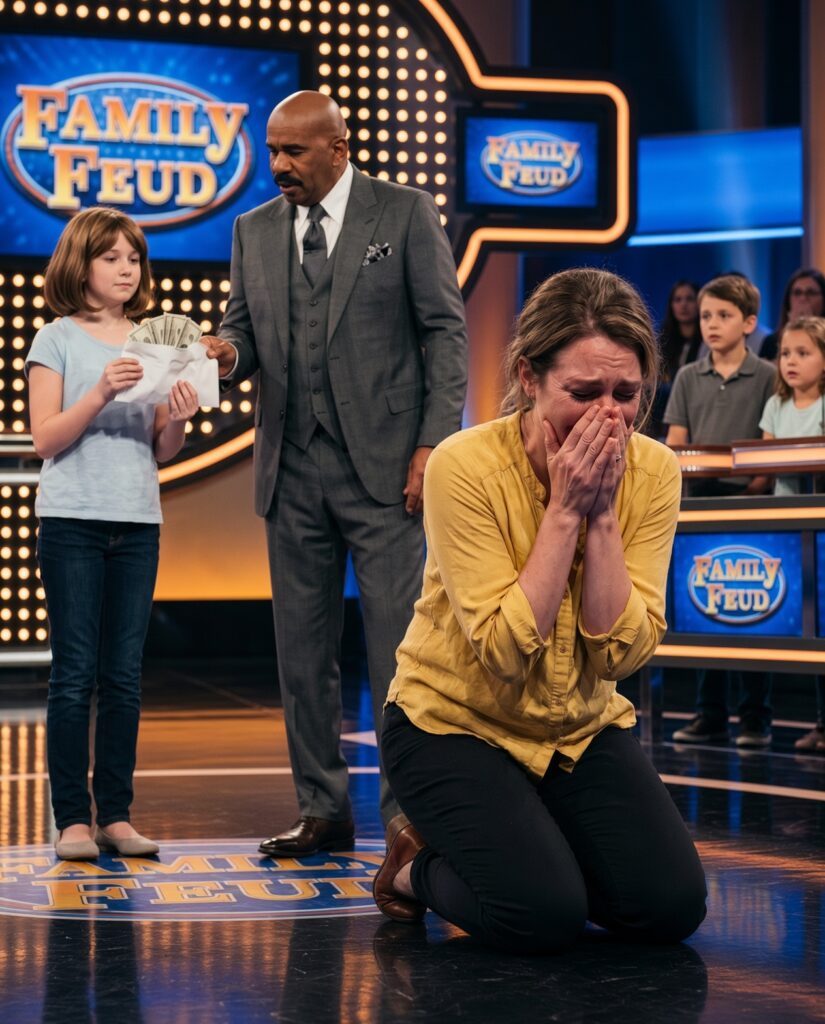
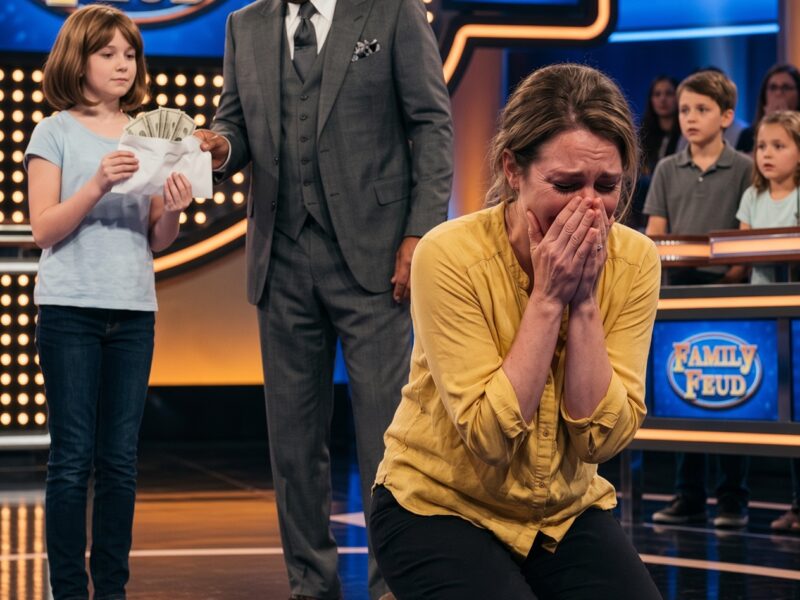
The cameras were already rolling when 12-year-old Lily Walker stepped off her family’s mark and walked 30 feet across the polished Family Feud stage.
Her sneakers made almost no sound on the slick floor, but 9 million people would later swear they heard every step.
In her hand was a wrinkled white envelope, folded twice, soft at the corners from being carried against her body for 36 hours straight.
Inside that envelope was $1,847 in crumpled 10s and 20s — every single dollar she had earned mowing 218 lawns over 14 months to pay for her own leukemia treatment.
Her mother, Sarah Walker, lunged forward from the buzzer, her hand outstretched to stop her, but it was already too late.
Lily looked up at Steve Harvey, her eyes serious behind the soft brown wig that hid where her hair used to be, and said the seven words that would shut down production for 43 straight minutes.
“I think this should cover this month.”
The studio froze.
It was March 11th, 2025, a Tuesday afternoon in Atlanta, Georgia — the kind of mild, bright Southern day where the parking lot shimmered and nobody inside the studio had any idea they were about to witness something that would trend worldwide for nine straight days.
The Walker family from Pikeville, Kentucky, had been called up against the Henderson family from Mobile, Alabama.
Sarah Walker, 38, stood at the buzzer in a borrowed yellow blouse, her hands shaking.
Her two youngest, 10-year-old Caleb and 7-year-old May, stood behind her on the family side, their eyes wide at the lights and the cameras and the man with the mustache who kept telling them to smile.
Lily, the oldest, had been positioned third in the line.
She was supposed to stay quiet and let her mother do most of the talking.
The producers had been told that Lily was in her maintenance phase, that long stretches of standing made her tired, that she might need to sit on the carpeted step they had placed behind the buzzer.
Lily had not sat down once.
She had been on her feet for 11 minutes, the wig itching at her temples, the envelope folded twice in the pocket of her best jeans — the ones her grandmother had hemmed for her three nights ago.
Sarah did not know about the envelope.
Nobody did.
But the real story hadn’t even started yet.
Lily Walker had been diagnosed with acute lymphoblastic leukemia on January 4th, 2024 — three days after her 11th birthday.
She had been complaining for two months about feeling tired, about her legs aching, about needing to sit down during recess while the other kids ran.
Her pediatrician at the Pike County Family Clinic had told Sarah it was probably a vitamin deficiency, that Lily was just growing too fast, that kids these days don’t get enough iron.
Sarah pushed for blood work anyway.
She had that feeling — the one mothers get when something is wrong and nobody will say it out loud.
The results came back on a Wednesday afternoon.
The pediatrician called Sarah at the diner where she worked the lunch shift and told her to get to UK Children’s Hospital in Lexington that evening.
Don’t pack, just drive.
Lily’s father, Tom Walker, had been at the hospital for the diagnosis.
He had held Sarah’s hand when Dr. Reeves drew the chart on the whiteboard, when she explained the protocols, when she said the survival rate was 90% for kids Lily’s age but the treatment would take two and a half years.
Tom had nodded.
He had said all the right things.
He had told Lily he loved her more than the moon and the stars.
And then six weeks later, on a Saturday morning in February, Tom Walker packed two suitcases into his truck while Sarah was driving Lily home from her third spinal tap, and he left.
He left a note on the kitchen table — four sentences.
He could not handle it.
He was sorry.
He would send money when he could.
He never did.
Sarah Walker became that day a single mother of three children, one of them with cancer.
She did not tell the kids what the note said.
She told them their daddy had to go take care of his sick mother in Tennessee and that he would be back when he could.
Lily, who was 11 and not stupid, knew, but she did not say anything because Caleb and May believed it, and she did not want to be the one to take that away from them.
The bills started arriving in March.
Sarah had health insurance through the diner — a high deductible plan that the manager had told her was the best they could afford.
The deductible was $9,400 a year.
The co-pays for the chemotherapy infusions were $480 per session.
The genetic testing required before they could start her on the targeted therapy was deemed not medically necessary by the insurance reviewer.
Appeal denied.
The pediatric oncology specialist at UK was deemed in network for office visits but not for the actual chemotherapy administration.
Appeal denied.
The home nursing care that came twice a week to monitor Lily’s port was out of network.
Appeal denied.
The cranial radiation prep was deemed experimental for her staging.
Appeal denied.
Sarah filed 19 appeals in the first year.
She lost 17 of them.
She picked up extra shifts, then a second job at a gas station from 9:00 p.m. to 1:00 a.m., three nights a week.
She lost weight.
She started keeping a thermos of black coffee on her nightstand because she did not have time to brew it in the morning.
She sold her grandmother’s pearl earrings, then the engagement ring Tom had not asked her to return, then the truck Tom had left in the driveway, then a stamp collection that had been her own father’s.
By December 2024, the medical debt was $43,200.
The mortgage on the little white farmhouse on Route 46 was three months behind.
The propane tank was empty.
They were heating the house with the wood stove and the oven left on with the door open.
What Sarah had not told a single soul — not her sister Karen, not Pastor Hicks at First Baptist, not Dr. Reeves — was that she had started selling her plasma twice a week at a clinic in Hazard, an hour each way.
The clinic paid $80 a visit, $640 a month, if she went every Tuesday and Friday.
It was the only reason they had not lost the house yet.
She told her sister she was teaching a Sunday school class at a different church.
She told her kids she was at a continuing education workshop.
She lied to all of them.
The audience thought that was the peak.
They were wrong.
What Sarah did not know was that Lily — quiet, observant 11-year-old Lily — had figured everything out.
She had read the EOB statements Sarah left on the kitchen counter.
She had seen the foreclosure warning notice that had come in October.
She had heard her mother cry into the kitchen sink at 4:00 a.m. when Sarah thought everyone was asleep.
She had even, one Friday afternoon, walked the two miles to the diner to surprise her mother with a homemade card and seen Sarah leaving with a small bandage in the crook of her arm and asked herself why.
In November 2024, two months after her 12th birthday, Lily wheeled her grandfather’s old Toro lawn mower out of the shed.
The pull cord, the half tank of gas, the little can of two-stroke oil he had labeled in his own handwriting before he died.
Lily Walker mowed her first lawn — Mrs. Hajes, across the street — for $15.
She mowed her second lawn that same afternoon for $12.
By the end of November, she had mowed 31 lawns.
By December, even when her platelets dropped and her chemo nurse told her to rest, she pushed the mower around her own backyard just to keep her arms strong for the next round of customers.
Her port itched under the strap of her tank top.
Her balance was unsteady on the slopes.
She kept going.
She kept a small black notebook with the name of every customer, the date, and the amount earned.
By February 2025, the notebook had 184 entries.
Sarah did not know about the lawn-mowing money for three months.
She found out on a Sunday in February 2025 when she came home early from the gas station and found Lily counting cash on her bedroom floor with a calculator.
Sarah dropped to her knees in the doorway.
She asked Lily, in a voice she did not recognize, what she was doing.
Lily looked up at her mother and said the sentence Sarah would replay in her head every single day for the rest of her life.
“Mama, I can mow more lawns. We don’t have to sell the house.”
Sarah crawled across the floor and pulled her daughter into her chest and rocked her and apologized for things Lily did not know she should be apologized to for.
Lily, who had been holding it together for 14 months, finally cried.
Two weeks after that night, the Family Feud producers called.
Sarah had filled out the application six months earlier as a Hail Mary, half believing they would never call.
They had called.
The grand prize was $20,000.
Lily had brought the envelope on the airplane.
She had brought it through TSA in Cincinnati, where the agent had asked her what was inside, and she had told him plainly that it was money for her chemo.
The agent had let her through with a tight nod and turned his face away from the scanner.
She had brought the envelope into the green room, into the makeup chair, onto the stage.
The producer had not noticed it in her pocket.
Sarah had not noticed it.
Caleb and May had not noticed it.
Lily had been carrying it for 36 hours.
Steve would later call what happened next the most important moment of his career.
The Hendersons were up.
Steve called for the next round.
Sarah stepped to the buzzer.
The question went up on the board, and Lily moved.
She walked off her family’s line.
The cameraman caught her in his frame and tried to follow.
The floor manager waved his hands at her.
“Wait, wait.”
But she did not stop.
She crossed 30 feet of polished stage.
The audience saw her and went quiet.
Sarah turned, saw her, and reached out.
Too late.
Lily walked up to Steve Harvey.
She tugged on his sleeve.
The studio fell completely silent.
She pulled the envelope from her pocket.
She held it up.
Her hand was shaking, but only a little.
“Mr. Steve, can you hold this for me?”
Steve looked down at her.
He looked at the envelope.
He looked at the wig.
He looked at Sarah, who had gone white at the buzzer.
“What’s in this, baby?”
“$1,847. I think it should cover this month.”
Steve did not move for a full eight seconds.
The cameras kept rolling.
The producer in the booth started pressing buttons.
The floor manager waved frantically.
“Cut to commercial.”
Steve held up one finger toward the booth.
“Don’t you cut. You don’t cut nothing.”
Production froze.
Steve lowered himself slowly to one knee.
His suit pants pulled tight.
His knee made a sound that the boom mic caught.
He took the envelope from Lily’s hand.
He set it down gently on the carpeted step she had refused to sit on.
“What’s your name, baby?”
“Lily. Lily Walker.”
“Lily, how old are you?”
“12.”
“Lily, why are you giving me this money?”
Lily looked over at her mother, then back at Steve.
“Because Mama can’t keep working three jobs, and the bills come every month, and I can mow more lawns. I’m strong enough.”
The studio fell silent again.
Steve looked up at the cameras.
His eyes were wet.
He did not wipe them.
“How many lawns have you mowed, baby?”
“218.”
“218 lawns with cancer.”
“I’m in maintenance phase, sir. I’m not as sick as I was.”
Steve put his face in his hands.
The audience could hear him breathing through the boom mic.
Somewhere behind camera 3, a sound technician was openly crying into his headset.
The lighting director on the catwalk above had taken off her glasses and was wiping her eyes.
When Steve looked up again, he reached out and took both of Lily’s hands.
“Lily, I want to tell you something. Can you sit down with me right here?”
He sat down on the studio floor in his $3,000 suit.
Just sat down.
Lily sat down across from him, her thin legs folded under her.
“Lily, when I was a young man, I was in a very bad place. I was sleeping in a 1976 Ford Tempo for three years. I ate out of trash cans. I showered in gas station bathrooms. And nobody — not a single person — helped me. I was invisible to the whole world.”
Lily nodded slowly.
“And one night in that car, I made a promise to God. I promised that if he got me out of that car, I would spend the rest of my life helping the people that the world wasn’t paying attention to. That promise is the only reason I’m sitting here today. That promise is the only reason this stage exists.”
He squeezed her hands.
“Lily, today I am keeping that promise to you right now.”
But Steve wasn’t done.
He turned his head toward the wings.
“Get me Dolly Parton on the phone. Now.”
The producer in the wings opened his mouth.
Steve repeated himself.
“Now. Get her now.”
Within four minutes, Dolly Parton’s voice came through the studio speakers — soft, Kentucky warm.
Steve explained Lily in 90 seconds.
Lily Walker, 12 years old, Pikeville.
218 lawns, the wig, the envelope, the mother selling plasma.
Dolly Parton’s voice broke audibly through the speakers.
“Steve, honey, I’m a mountain girl. I know that town. I know that hospital. Tell that baby every penny of her treatment today and tomorrow and every day after is paid. I’m calling UK Children’s tonight. The mortgage, the plasma clinic bill, whatever else. Tell that mama she can put her needles down.”
The audience exploded.
Sarah collapsed forward onto her knees behind the buzzer.
The Henderson family was crying.
The grandfather, a 68-year-old retired coal miner from Mobile, was openly sobbing into his hands.
But Steve wasn’t done.
He turned to the camera, to 9 million live viewers.
“I need everybody watching this right now to listen to me. This child mowed 218 lawns to pay for her own chemotherapy while she was getting chemotherapy. We have failed her. America has failed her, and we are going to fix that tonight.”
He looked back down at Lily, who was still sitting cross-legged on the floor.
“Lily, you don’t owe a dime.”
Five words.
“We’re starting a foundation tonight. The Lily Walker Foundation. For every kid in this country fighting cancer whose family can’t afford it. I’m putting in the first $2 million tonight, live on this floor.”
He turned to the Henderson family at their podium.
The grandfather, James Henderson, stepped forward to his microphone.
His voice was rough with crying.
“Steve, whatever we win here today, give it to that little girl. We don’t need it. And son, I’ll match a $1,000 from my pension every single month for the rest of my life.”
But Steve wasn’t done.
He told the producers to award both families the full $20,000 prize.
He told them he would cover both checks personally.
The producers, who had stopped trying to control the moment 30 minutes earlier, just nodded.
He told them to keep the cameras rolling for as long as Lily wanted to sit on that stage — something that had never happened in 14 years of Family Feud tapings.
The clip aired on Family Feud’s social media that evening.
Within 12 hours, it had been viewed 71 million times.
Within four days, 312 million times.
The hashtag #218Lawns trended worldwide for nine straight days.
Dolly Parton kept her promise the next morning.
She wired $267,000 to UK Children’s Hospital, paid off every cent of medical debt, paid off the mortgage on the farmhouse on Route 46, and quietly set up a college trust for all three Walker children.
She also called Sarah personally three days later and talked to her for two hours about being a single mother in Eastern Kentucky, about plasma clinics, about the things mountain women carry that nobody ever asks about.
The Lily Walker Foundation launched on March 21st, 2025.
Its motto, embroidered on every piece of foundation merchandise, was simply: 218 lawns.
By the end of its first six months, it had paid for the cancer treatment of 1,847 American children — one child for every dollar in Lily’s envelope, by deliberate design.
Steve Harvey personally donated $4.2 million in the first year.
Dolly Parton matched it.
LeBron James added $1 million.
A widow in El Paso sent a check for $14 with a note that said: “This is what I can give. My granddaughter died at 12. Use it for somebody else’s 12-year-old.”
Lily Walker finished her chemotherapy on July 9th, 2025.
Her oncologist, Dr. Reeves, called her cancer-free in remission.
The whole pediatric oncology floor at UK Children’s threw a party.
Lily rang the end-of-treatment bell three times instead of the customary one because she said she felt like it.
Her hair, six weeks regrown, was a soft brown halo.
Steve Harvey flew up from Atlanta to be there.
He brought the envelope with him.
He had not spent the money.
He had had it framed in glass, still folded the way she had folded it, every wrinkled 10 and 20 visible behind the matting.
He had carried that frame on the plane in his lap.
In August 2025, Steve gave an interview to 60 Minutes.
The reporter asked him what the most important moment of his career had been.
Steve did not hesitate.
“A 12-year-old girl with cancer walked across my stage to pay her own medical bills with money she’d earned mowing lawns. That girl reminded me what it means to be a man. That girl made me ashamed of every time I’d ever complained about anything in my life.”
In October 2025, Sarah Walker quit both her jobs.
The foundation hired her full-time as a regional family advocate.
Her job was to drive across eastern Kentucky and West Virginia and Tennessee, find the families who were drowning, and walk them through the foundation’s intake process.
She made $72,000 a year.
She had real health insurance for the first time in her adult life.
She bought herself a pair of pearl earrings to replace her grandmother’s.
She wore them every Sunday at First Baptist, where Pastor Hicks made a point of mentioning her every week in his prayers.
In December 2025, Lily Walker started seventh grade after a year and a half of homeschooling.
Her teacher, Mr. Briggs, called Sarah from the school parking lot to tell her that Lily had stayed after class to help two girls in the hallway who had been crying about a math test.
Lily had told them: “Whatever you’re scared of, it’s smaller than you are. I promise.”
In January 2026, on Lily’s 13th birthday, Steve Harvey rolled a brand-new commercial-grade lawn mower into the studio on live television.
He told the cameras the foundation was launching a youth program.
Kids ages 11 to 16 in low-income communities across America could earn cancer treatment credit hours by mowing lawns under foundation supervision.
The mower he rolled out was the very first one.
Painted on the side in white block letters were the words: 218 lawns.
In Steve Harvey’s office, on the wall behind his desk, in the building where Family Feud is taped, there is a single framed envelope.
It is white.
It is wrinkled.
The flap is folded twice.
Inside, behind the glass, are $1,847 in crumpled 10s and 20s, exactly the way they were arranged when a 12-year-old girl pressed them into his hand on March 11th, 2025.
Steve has not spent a single dollar of it.
He never will.
Sometimes late at night, after the last taping is done and the studio is empty, he sits at his desk and looks at the frame.
He does not say anything.
He just looks.
Sometimes the bravest thing a child can do is not need saving.
Sometimes the strongest among us are the ones who never stopped trying to save themselves.
And sometimes a wrinkled envelope of crumpled bills is worth more than every dollar in a billionaire’s checkbook — because of where it came from, what it cost, and the small hand that carried it across 30 feet of stage to remind the rest of us what dignity looks like.
Somewhere right now, a child you don’t know is doing something brave that nobody is watching.
Be the one who notices.









