Why This 19th-Century Painter’s Satin Gets Mistaken for AI
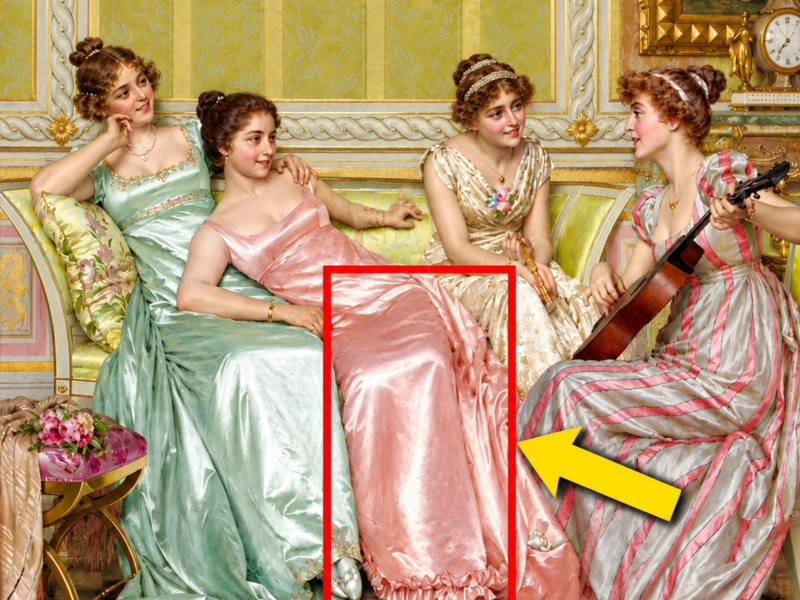
She has pulled back the curtain and she is listening at the door, which she definitely should not be doing. But set that aside for a moment and look at the dress. Pink satin pools around her feet in heavy folds, and in places it is so glossy you would swear it was wet. You can almost hear it rustle.
Now remember that none of it is fabric. It is oil paint, pushed around a canvas by a man in Italy well over a hundred years ago, with no computer to clean it up afterward. Post one of these online today and somebody in the replies will almost certainly call it AI.
It is not. The painter was Vittorio Reggianini, and he did this again and again, in picture after picture. In nearly all of those dresses he does one thing, a single stripe of paint, that makes the whole difference between shining silk and a tea towel. Most people look straight at it and never notice what color it is.
Reggianini was born in Modena, in the north of Italy, in the 1850s. Nobody even agrees on the exact year, which says a lot about how little attention the art world has paid him. He trained at the art academy in Modena, did well enough that it later made him a professor there, and at some point moved to Florence.
It was a smart move. Florence was full of wealthy collectors from across Europe and America, and they wanted exactly what he was selling. What he was selling was a fantasy.
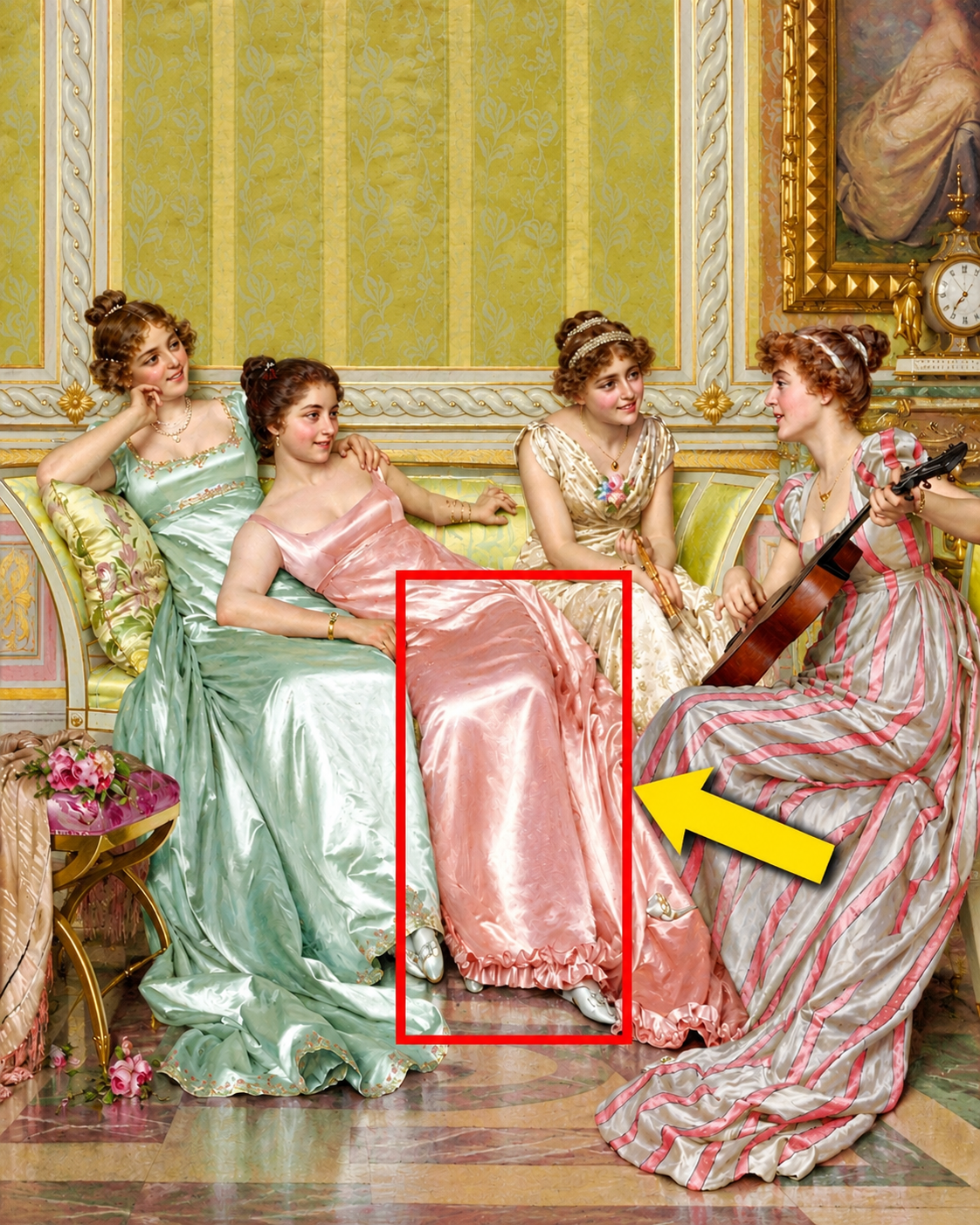
Look closely at most of the dresses. High waists, little puffed sleeves, long columns of fabric down to the floor. That is the fashion of Napoleon’s era, the turn of the 1800s, and by the time Reggianini painted them those gowns had been out of style for the best part of a century. It was dress-up, basically.
He belonged to a whole crowd known as the costume painters. One of the big dealers who sell his work today has an even better name for his corner of it: “The Silk and Satins School.”
Most of these canvases are little soap operas. In An Illicit Letter, two girls read a letter together while a third keeps lookout at the curtain. In Music Scene, the girl at the harpsichord has nodded off completely while her friend is busy being flirted with. In A Shocking Announcement, someone has actually fainted. A chair lies knocked over, her maid is fanning her and looking suspiciously cheerful about it, and the man who presumably caused all this is strolling out the door.
The men do not come out of these very well. In The Recital, an older gentleman belts out a song at the harpsichord with his head thrown back, while most of the women behind him try not to laugh. One of them is hiding behind her fan.
In Flirtation, a guy in a gold suit is trying his luck, and she is holding him off with both hands, laughing. In Admiration, a young man gazes at a girl like a lovesick puppy while three of her friends watch the whole thing from across the room.
But nobody looks at these for the plot. You look at them for the fabric. Satin is one of the hardest things there is to paint, and it comes down to how it is made.
A plain cotton shirt is woven over and under, over and under, so light hitting it scatters and the surface looks matte. Satin cheats. Its threads float over four or more others before dipping under, so the surface is mostly long, smooth runs of thread lying side by side. Light does not scatter off that nearly as much. It bounces.
If it is silk, whose fibers are shaped a bit like tiny triangular prisms, it shimmers as well. What you have, in effect, is a mirror made of thread, folded a hundred different ways. That is why a satin dress never looks quite the same twice. Move an inch and the whole thing changes.
That is a nightmare to paint. On a cotton dress, the light fades gently from bright to dark across a fold. On satin it can flip from deep shadow to a blaze of light in the width of a finger, then straight back again. Get it slightly wrong and you do not get silk. You get a shower curtain.
Reggianini was not the first to crack it. Back in the 1650s, a Dutch painter named Gerard ter Borch became famous for exactly this. The few people who wrote about him at the time said nothing about what his pictures meant, but they always praised his textures.
His Gallant Conversation, now in the Rijksmuseum in Amsterdam, shows a woman standing with her back to the viewer in a white satin dress. The museum’s own description calls the satin “phenomenal.” Reggianini picked up that tradition a couple of hundred years later and, to be fair, ran a long way with it.
Then there are the rooms. Gilt mirrors, marble, painted walls, and satin on the sofas, the chairs and the curtains. He is showing off, and he knows it.
Then look at the colors he dresses his sitters in. Sugary pinks, pale mint greens, soft powder blue, the odd flash of buttery yellow. None of those is an easy color to make shine. Pink especially goes chalky the second you get it wrong, and he keeps coming back to it.
Once you have seen a few of his paintings, you start spotting the props. A snarling wolf-skin rug, or something very like one, head and teeth still attached, turns up in seven of the paintings reviewed here. The same tan-and-white greyhound in a red collar appears twice. What looks like the same pink-and-white striped dress keeps reappearing on different women.
He even painted the same flirting couple twice. Same pose, same pink dress, same cello. He just changed the man’s suit and moved them to a different room.
To see just how hard the fabric really is, consider that in 2012 two Cornell University computer scientists, Piti Irawan and Steve Marschner, published a study on how light reflects off woven cloth. They measured real fabrics, built a mathematical model of how light glints off individual fibers, then checked it against high-resolution video of the real thing. All of that, just so a computer could draw a convincing bit of cloth.
They were not the last. Researchers were still publishing new papers on rendering woven fabric in 2025. Reggianini had brushes, oil paint and a pair of eyes. No lab, no measuring equipment. Presumably just some poor model standing very still in a satin dress, wishing he would hurry up.
And still, most people have never heard of him. His paintings turn up with dealers and at auction for serious money. One of them, The Way of the World, has been offered by a London dealer for sixty-five thousand pounds. Yet you would struggle to find him in the big art history books beside the names everybody knows.
That is a shame, because the thing he was quietly brilliant at is the thing almost everyone else gets wrong.
So go back to that first painting, the girl listening at the door. Look at the shadows first. Deep and warm, almost coral down in the folds. Then the middle tones, that soft, sugary pink. Then find the brightest stripe, the bit that actually makes it look like satin.
It is not pink. It is almost pure white, the color of the light in the room. That is what shiny fabric really does: the shine takes the color of the light, not the color of the cloth.
The easy mistake, the one that turns silk into a tea towel, is painting that highlight as just a lighter pink. Reggianini rarely does. He keeps the pink down in the shadows and gives the shine back to the light.
It took computers decades to catch up. He just looked.









