The Final Countdown (1980) – 21 Weird Facts You Didn’t Know About!
A modern nuclear supercarrier sails into a storm in 1980 and comes out the day before Pearl Harbor. That is The Final Countdown. Behind the camera, the story is just as strange: jet blasts, real missions, hidden faces, and a Navy lawsuit.
Start with the moment the crew learned what they were really dealing with. The very first setup to film an F-14 Tomcat taking off happened at Naval Station Norfolk in Virginia, with the camera placed close behind the jet to capture the raw power of the launch. Then the engines spooled up. The blast picked up both the camera and its operator and sent them tumbling down the runway like loose paper.
You would think one lesson would be enough. It was not. On the first attempt to film a takeoff aboard the USS Nimitz, it happened again, and the camera and operator were thrown off the deck, stopped only by a safety net below. From then on, everyone understood that in this movie the real special effects could actually hurt you.
The Japanese Zero fighters looked like they flew straight out of 1941. In a way, they flew straight out of 1970. The three Zeros in the film were replicas originally built for Tora! Tora! Tora!, the epic Pearl Harbor movie made a decade earlier. Under the paint, they were modified North American T-6 Texan trainers, flown by pilots from the Confederate Air Force, known today as the Commemorative Air Force.
Pitting propeller planes against F-14 Tomcats was reportedly the first time such a mismatched dogfight had been put on film. The jets were so much faster that the Navy pilots had to fight their own machines just to stay behind the slow, twisting Zeros without overshooting them.
One of those dogfights almost turned real. In one scene, an F-14 dives beneath a Zero and streaks upward right in front of it. On screen, it looks spectacular. In the cockpits, it was terrifying.
The jet blast hit the two Zeros so violently that the control yokes were wrenched out of the pilots’ hands, and both planes tumbled out of control. The lead pilot’s headset and wristwatch were ripped off and sucked out through his open canopy, and the Tomcat crews suddenly could not reach him on the radio. For a few long moments, nobody knew if he was all right. By pure chance, the two Zeros spun away from each other instead of colliding.
The movie’s ship also had a real secret mission behind it, one audiences in the summer of 1980 knew but many fans have since forgotten. The Final Countdown hit theaters on August 1, 1980, and the Nimitz had just come home from one of the most dramatic missions in its history. That April, eight Navy helicopters had lifted off its deck for Operation Eagle Claw, the daring attempt to rescue American hostages held in Tehran.
The mission ended in tragedy in the Iranian desert, where eight American servicemen lost their lives. So when moviegoers watched this carrier race toward an impossible decision on screen, they were looking at a ship that had faced a very real one only months earlier. Fiction and history were sailing side by side.
In Hollywood, it is usually the famous parent who opens doors for the kid. The Final Countdown flipped that story. The driving force behind the film was producer Peter Douglas, Kirk Douglas’s son, born in November 1955 and just 23 when cameras rolled in 1979. He had a limited budget and a promising script.
That script convinced the Department of Defense to offer full cooperation on one condition: the filming schedule had to bend around the Navy’s own safety and readiness needs. The production company was the Bryna Company, which Kirk had named after his mother. Peter did not stay behind the camera, either. Look closely and you will spot him on screen as the quartermaster, on the same ship as his legendary father.
Kirk Douglas did not need to imagine what serving in a world war felt like. After the real attack on Pearl Harbor, he joined the United States Navy and served as a communications officer aboard an anti-submarine patrol ship, the PC-1139. His service ended after he was injured in an accidental depth charge explosion, and he was medically discharged in 1944.
Think about that. More than three decades later, the young officer from a small patrol ship stepped onto the bridge of one of the most powerful warships ever built, in a story that asked him whether to stop the very attack that had pulled him into the war. His performance earned a Saturn Award nomination for best actor.
Charles Durning plays Senator Samuel Chapman, a politician from 1941 who never gets to see the war that is coming. The irony is heavy, because Durning saw that war up close. As a young soldier, he landed in Normandy on D-Day, was wounded more than once, and by his own account survived the Malmedy massacre during the Battle of the Bulge. He was awarded the Silver Star and three Purple Hearts, and for decades he rarely spoke about any of it.
So when you watch Chapman demand to warn Pearl Harbor, furious that no one will act, remember who is playing him: a man who knew exactly what that coming storm would cost. Fans from the 1980s remember the performance vividly, and today it hits even harder.
Martin Sheen had been through hell before he stepped aboard the Nimitz as civilian analyst Warren Lasky. During the brutal shoot of Apocalypse Now in the Philippines, Sheen suffered a heart attack in 1977, at only 36. That film finally reached theaters in 1979, so The Final Countdown arrived right after one of the most punishing productions in movie history.
Notice how he plays Lasky: quiet, watchful, the outsider who sees the truth before anyone else wants to admit it. He goes from Captain Willard, the soldier sent up the river, to the one man on a warship who never wears a uniform.
Then there is the twist most viewers never notice. This movie about the Pacific was mostly filmed on the other side of America. Principal photography took place at Naval Air Station Key West, Naval Station Norfolk, and in the waters off the Florida Keys, across two five-week periods in 1979. The production wanted it to be a good representation of the U.S. Navy.
Those famous scenes of Pearl Harbor itself are mostly stock footage. Exterior scenes were shot on the Nimitz while at sea, and many interiors were filmed while the carrier sat in dry dock. Many real members of the Nimitz crew served as extras, a few even had speaking lines, and 48 of them appear as actors in the final credits. Somewhere, a few retired sailors can honestly say they starred opposite Kirk Douglas.
One of the most gripping landings in the film was not planned at all. During filming, a real emergency unfolded when an A-7 Corsair lost its landing hook, the hook that normally catches the arresting wires on the deck. When the film crew learned an emergency landing was coming, they raced to set up their cameras. The plane came down safely, stopped by the carrier’s emergency gear, and the production captured every second.
That real recovery made it into the final film, and critics noticed. The New York Times review singled the moment out as proof that life on the Nimitz does not always run smoothly. In a time-travel movie full of fantasy, one of the most nail-biting scenes was simply the truth.
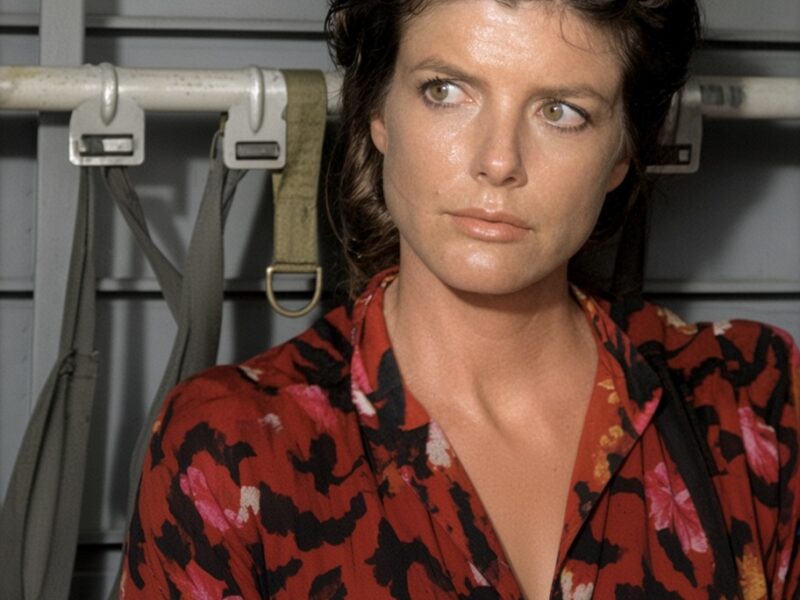
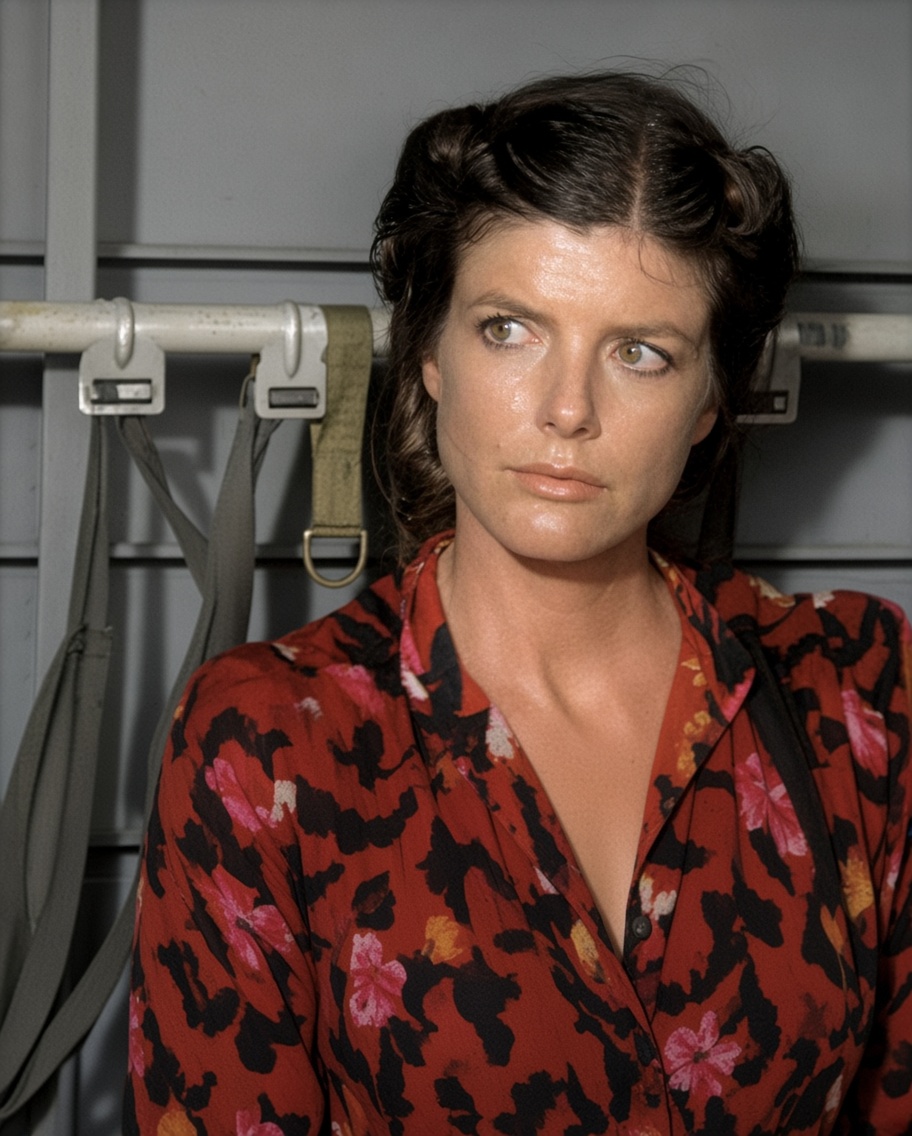
Not every moment between the Navy pilots and Hollywood was friendly. According to F-14 crews of Fighter Squadron 84, the famous Jolly Rogers, some of the aviators asked to meet Katharine Ross at her hotel, and she said no. The pilots answered in the most fighter-pilot way imaginable.
During the next day’s filming, one Tomcat crew held up a sign in the cockpit with a very rude message addressed to her. The shot made it into the dailies, the raw footage reviewed by the filmmakers, and Ross reportedly saw it and was furious. It is a reminder that the production was not working with actors in costumes. It was working with real, young, cocky Navy aviators with a sense of humor all their own.
Here is a name you might not expect in the credits of a big Navy movie: Lloyd Kaufman, the co-founder of Troma Entertainment, the cult studio behind The Toxic Avenger. On The Final Countdown, he served as associate producer and unit production manager, and by his own account it was a rough ride. He was frustrated by unnecessary costs and unreasonable demands that slowed the shoot.
Tension grew so strong that several crew members were fired and replaced during location shooting. Kaufman also left a small fingerprint on screen, playing a lieutenant commander named Kaufman. He later said the experience pushed him further toward independent filmmaking, and the rest became trash-movie history.
That swirling, crackling vortex that swallows the Nimitz was designed by Maurice Binder, the title designer behind the iconic James Bond gunbarrel opening. According to a United Artists press release, Binder built the time storm using exploding laser beams and vortexes. In 1980, there was no digital magic to lean on, so every flash and swirl had to be created with light, optics, and patience.
The result looked like nothing audiences had seen on a warship before, a storm made of pure light. The same mind that pointed a gun barrel at audiences for decades also sent an entire aircraft carrier back to 1941.
The movie is also full of famous faces hiding in plain sight. The Japanese pilot taken prisoner aboard the Nimitz is played by Soon-Tek Oh, a Korean-American actor whose voice a new generation later heard as Fa Zhou, Mulan’s father, in Disney’s Mulan. The ship’s executive officer, Commander Dan Thurman, is played by Ron O’Neal, star of the 1972 classic Superfly, trading the flashy street hero for a crisp navy uniform.
Behind the scenes, one of the sound effects editors was Mark Mangini, who went on to win Academy Awards for Mad Max: Fury Road and Dune. While the F-14s stole the spotlight, a quiet lineup of future legends was on the same ship.
Rewatch the first half hour and you will notice how cleverly the film drops its clues. A radio operator picks up an old code he once learned in training, one no longer used. Then the radio plays nothing but old Jack Benny broadcasts. Next, a reconnaissance jet photographs Pearl Harbor, and there, sitting peacefully in the harbor, is the USS Arizona, fully intact, the same battleship that would be lost the very next morning.
The crew compares the photos with archival images from Commander Owens’s history manuscript, and they match almost perfectly. According to production notes, the film’s working title was The Last Countdown. Each clue tightens the knot until the impossible becomes the only explanation left.
The film ends with a stunning reveal: the mysterious Mr. Tiedeman is really an older Commander Owens, now married to Laurel Scott. But the official novelization went somewhere even stranger. The book was written by Martin Caidin, author of Cyborg, the novel that inspired The Six Million Dollar Man, and it was released the same month as the film.
It mostly follows the movie closely, then comes the ending. In the novel, Lasky goes home with Tiedeman and Laurel, and it is revealed that the time-travel storm had an extraterrestrial origin. That is it, with no further explanation. So if you ever wondered what force really pulled the Nimitz back to 1941, there is an official answer, and it is out of this world.
Near the end of the film, Owens flies the senator and Laurel to a remote Hawaiian island to keep them away from the battle, an island commonly identified as Niihau. Here is why that is chilling. On December 7, 1941, during the real attack, a damaged Japanese Zero crash-landed on Niihau, and its pilot, Shigenori Nishikaichi, was cut off from all news of the war.
What followed became known as the Niihau incident. Within days, the pilot found weapons and terrorized the islanders, until a local couple, Ben and Ella Kanahele, fought back and ended the standoff. A captured Zero pilot grabbing a weapon is exactly what happens aboard the Nimitz, so real history had already written part of this story.
When the film came out, many critics were not impressed. Roger Ebert gave it two out of four stars, feeling the story did not make much sense and that the aircraft carrier was the most interesting thing in it. Later that year, Gene Siskel and Ebert picked it as one of their Dogs of the Year on Sneak Previews. Their biggest complaint was that the film builds toward a massive battle and then never delivers it.
Audiences did not care. The movie was a box-office success, and in Germany it was such a hit that it won the Golden Screen, a German box-office award. It became a cult favorite, caught on TV on rainy weekends, exactly the way the critics never expected.
The Navy was so proud of the film that it sponsored the premiere, and the poster even appeared in Navy recruiting offices shortly after release. Then came the bill. The producers had agreed to pay the Navy $4,125 for every hour of flying done by Navy aircraft, but according to the government’s complaint, the flight time had been badly underreported.
A retired Navy commander was accused of reporting 32.5 hours of flying when the real total was about 200. In 1985, the government filed a civil lawsuit, and in 1986 the production companies agreed to pay $400,000 to settle. The F-14s were stars, and like most stars, they did not come cheap.
The film begins with the Nimitz leaving Pearl Harbor, and decades later the real ship made one last visit there. Commissioned in 1975, the Nimitz became the oldest aircraft carrier in active service in the world. Toward the end of 2025, on its way home from its final deployment, it called at Pearl Harbor one more time.
The ship that once sailed back in time to the day before the attack returned to that same harbor nearly half a century after the film, as it headed toward retirement. Because of its nuclear reactors, it cannot simply become a museum. In a way, the movie is the Nimitz’s time capsule, a young carrier frozen in 1980, sailing into the storm every time someone presses play.
And now the bonus, the secret teased all along. In one scene, a Zero fires on an F-14 flown by Lieutenant Commander Richard Fox Farrell. To get behind the slow, low-flying Zero, Farrell had to pull his Tomcat into a steep, screaming recovery that ended just 100 feet above the ocean.
When Farrell’s wife later saw that footage in the daily rushes, the story goes, she screamed. The sound editor then took her real scream and mixed it into the high-pitched whine of the F-14’s afterburner, so in the final film, when that Tomcat howls out of its dive, part of what you hear is the real terror of a pilot’s wife.
This one is hard to verify, and over the years the moment has grown into an urban legend, often described as Farrell’s death plunge. Believers say the scream is in the film. Skeptics say it is too good a story to take on faith.
Over four decades later, The Final Countdown still asks a question that gives us chills: if you could stop history, would you? It is a film where a real supercarrier, real pilots, and real veterans brought an impossible story to life. Critics doubted it. Audiences never forgot it.
Which moment from this movie still gives you chills?