El Cid (1961) – 21 Weird Facts You Didn’t Know About!
A dead knight rides into battle and an army flees in terror. They called him the purest knight of all, but off camera, things got even stranger. From rewritten love scenes to a rented army, here is the story behind El Cid.
Start with a man who never appeared in the credits, yet whose shadow hung over every frame. In the late 1950s, producer Samuel Bronston built his own movie studio near Madrid, and to stay on good terms with Spain’s government, he chose a subject its ruler adored. Francisco Franco admired El Cid and even compared himself to the legendary knight.
Doors swung open that would have stayed locked for almost anyone else. The production was allowed to film scenes inside the Royal Palace of Madrid itself, and Bronston sat in on regular meetings with Spain’s tourism ministry, which was busy selling the country to the world. This was never just a movie. It was a love letter, a diplomatic handshake, and a giant travel advertisement wrapped in chain mail.
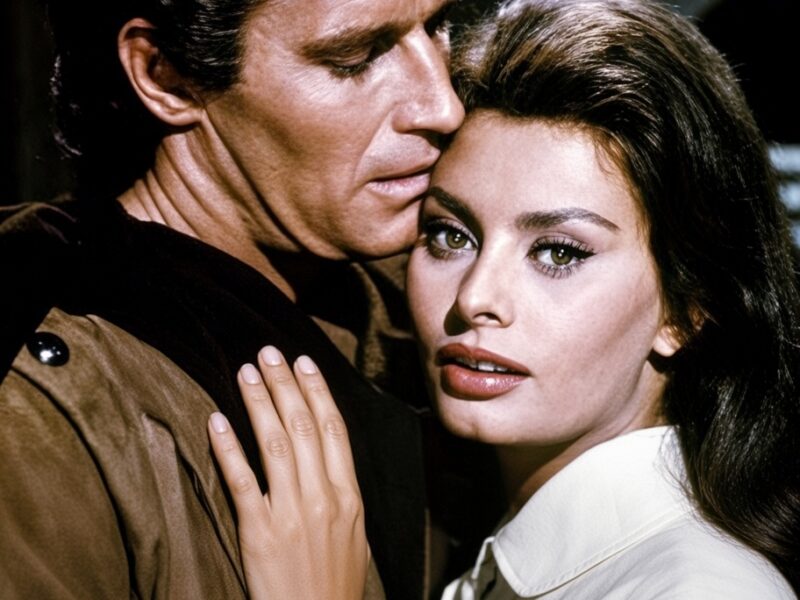
Here is one that sounds made up but is not. Just two days before filming began, Sophia Loren read the latest script and hated her dialogue. She recommended a blacklisted writer, Ben Barzman, to fix it. Barzman rebuilt the story, but Loren felt it still lacked romance, so another blacklisted writer, Bernard Gordon, was quietly hired to write the love scenes.
By his own account, Gordon wrote about four of them, and once Loren read them, she was ready to do the picture. The strangest part is that Loren had screenwriter Basilio Franchina translate her English lines into Italian and then back into simpler English she felt comfortable speaking. Some of the most romantic words in the epic took a round trip through Italy before they reached the screen.
Look closely at all that gleaming armor, because a lot of it was never metal. The production ordered an arsenal that would make a medieval king jealous. A factory in Toledo, a city famous for its steel, spent eight months making around 7,000 swords, scimitars, and lances, while a Madrid prop maker crafted 40,000 arrows, more than 5,700 shields, and 500 saddles.
The twist is that the 650 suits of chainmail were not forged from iron rings. They were woven from hemp and coated with metallic varnish to make them shine. When knights clash under the Spanish sun, many of them are essentially wearing painted rope, and on camera it looked like the real thing. Even Variety’s critics singled out the chainmail as impressive.
Sophia Loren was not the only star circling the role. At first, she was not even available, and French actress Jeanne Moreau was briefly considered as a replacement. According to one report at the time, Ava Gardner was also approached but backed out, feeling that Charlton Heston’s part was bigger than hers.
Then director Anthony Mann made a suggestion of his own: his wife, Spanish star Sara Montiel. Heston and Bronston both said no. In the end, Loren became free, but only for about 10 to 12 weeks, so her scenes were shot first, racing against the clock. Once the early footage came in, her part was considerably expanded, and the woman who almost was not in the movie became its beating heart.
Every legend needs a villain, and this one almost came with a very famous voice. Orson Welles was first approached to play Ben Yusuf, the fearsome Almoravid warlord, but he had a condition. He wanted a double to perform his scenes on set while he simply dubbed his lines afterward. Bronston refused, and the role went to Herbert Lom.
The irony is that for much of the film, Lom’s face is hidden behind a dark veil, leaving his eyes to do most of the acting. In a strange way, Welles’s idea almost made sense, since you barely see the villain’s face anyway. Lom, though, brought a cold, hypnotic menace no double could fake. A few years later, audiences would know him as the twitching Chief Inspector Dreyfus in the Pink Panther films.
Those massive armies charging across the screen were not just extras in costumes. For the Battle of Valencia, the production leased 1,700 trained infantrymen from the Spanish army, plus 500 mounted riders from Madrid’s municipal honor guard. Real soldiers and real horsemen marched in formation as if it were the 11th century.
Time magazine reported around 7,000 extras in total, along with dozens of oversized medieval war machines. Fans who saw it in 1961 on that enormous Super Technirama screen still talk about the sheer weight of it.
Why was Valencia not filmed in Valencia? By 1960, the real city had become far too modern. The production moved north to Peñíscola, a fortress town perched on a rock above the Mediterranean. But even Peñíscola had modern buildings, so for three months hundreds of production workers built city walls to hide anything that did not belong in the 11th century.
They also constructed 15 war machines and siege towers based on historical artwork, and 35 boats were decorated with battlements to become Ben Yusuf’s invading fleet. Today, tourists stroll the very beach where those Moorish ships landed and where El Cid made his final ride. Anyone who has visited Peñíscola has walked straight into the movie’s most iconic moment.
The screenplay has a story worthy of its own movie. It was originally credited to Frederick M. Frank and Philip Yordan, but when Ben Barzman arrived, he found the existing draft unusable. With cameras about to roll, he got hold of Pierre Corneille’s 17th-century play Le Cid from the library of the French Embassy in Madrid and used it as the foundation for a new screenplay.
Years later, Mann claimed that not one line of the shooting script came from Yordan. So why was Barzman’s name not on screen? He was blacklisted, one of the writers pushed out of Hollywood during the Red Scare. His credit was not added until 1999, 38 years after the premiere.
Believe it or not, the film almost had a twin. In 1956, reports said two other El Cid movies were in development, one set to star Anthony Quinn. By 1960, the rivalry was still alive, and Spanish producer Cesáreo González and his company Aspa Films filed an infringement claim against Bronston, arguing the projects were too similar. That fight nearly delayed the start of filming.
Bronston turned his rivals into partners. Aspa Films came on board along with Robert Haggiag’s Italian company Dear Film, making the project an American, Italian, and Spanish co-production. It was a classic Bronston move, and funnily enough, it is exactly what El Cid himself does with the emirs in the movie.
Bronston also wanted authenticity, so he went straight to the top. The historical consultant was Ramón Menéndez Pidal, Spain’s leading authority on El Cid and the Middle Ages, who was already in his 90s in 1960. Charlton Heston took his homework seriously, reading the medieval epic poem the Cantar de mio Cid and arranging to meet the great scholar in person.
There is an odd twist. In his autobiography, Heston wrote that he had met Juan Menéndez Pidal, who was Ramón’s brother and had died back in 1915. It was an honest mix-up, but a strange one given how memorable that meeting must have been. Composer Miklós Rózsa also met Ramón Menéndez Pidal before writing a single note.
Remember the birds of prey in the film? They had a remarkable helper. The production brought in Félix Rodríguez de la Fuente, a young naturalist who assisted with the raptors and other birds. Falconry was part of noble life in medieval Spain, and fittingly, the love theme carries a bird in its title, The Falcon and the Dove.
Spanish viewers smile at that name for a reason. In the 1970s, Rodríguez de la Fuente became one of the most beloved television figures in Spain, a kind of Spanish David Attenborough, whose nature series made him a household name. Long before he taught a country about wolves and eagles, he was quietly helping bring Heston’s medieval world to life.
The music is legendary, but it almost sounded completely different. Because this was an Italian co-production, Italian composer Mario Nascimbene was hired first. Then Bronston made an unusual demand: he wanted the score adapted from Jules Massenet’s opera Le Cid. Nascimbene refused, so Bronston turned to Miklós Rózsa, the Oscar-winning composer of Ben-Hur.
Rózsa was available because he had walked away from MGM’s Mutiny on the Bounty after reading the script and being appalled. He spent a month studying medieval Spanish music, drawing on sources like the Cantigas de Santa María and the Llibre Vermell of Montserrat. The Italian financiers still insisted Nascimbene be credited, and Rózsa agreed, as long as the credit appeared only on Italian prints and Nascimbene claimed no royalties.
Rózsa’s story does not end on a happy note. He recorded well over two hours of music in Rome over just 10 days. During post-production, more than 23 minutes were cut because the music was competing with the clash of swords and the thunder of hooves. He appealed to have it restored and lost.
He also disliked that lyricist Paul Francis Webster was hired to put words to his love theme, and after the premiere he was so frustrated that he canceled the publicity tour for the score. The music still earned Oscar nominations for best score and for best song, though it lost both. Decades later, many film music lovers consider it one of his greatest achievements.
Anthony Mann saw his sweeping medieval epic differently from most. In one interview, he called it a Spanish Western, which makes sense, since he had made his name with tough, brooding Westerns starring James Stewart, like Winchester ’73 and The Naked Spur. He also had something to prove. A couple of years earlier, he had started as the director of Spartacus until he was replaced and Stanley Kubrick took over.
El Cid became his chance to show he could command a true epic. Heston was not fully convinced. In his autobiography, he mused that the film might have been better under William Wyler, his Ben-Hur director, and that Ben-Hur might have worked better under Mann. Heston once floated the idea to Wyler himself, who apparently did not think much of it.
Mann was not the only legend behind the camera. Second unit director Yakima Canutt, the stunt genius behind the chariot race in Ben-Hur, was in charge of filming the battle sequences. At Peñíscola, sparks flew. Mann wanted to shoot the Battle of Valencia himself, so the two men worked around each other.
Mann filmed the big master shots, and with the sequence nearly finished, Canutt spent three days capturing extra action shots that were cut into Mann’s footage. Heston did not hide whose side he was on. In his autobiography, he found Canutt more competent and efficient. Two masters, one beach, and a lot of tension, yet the final result looks seamless.
The trial by combat for the city of Calahorra was the very last sequence filmed, in April 1961 near Belmonte Castle. To prepare, Heston and British actor Christopher Rhodes trained for a full month with weapons master Enzo Musumeci Greco, and Canutt directed the scene.
The shoot took five days, which added up to 31 hours of combat before editing. The crew shot around 21,000 meters of film, roughly 69,000 feet, and about 330 meters made the final cut. For every minute of swordplay you see, more than an hour was filmed.
Look at Rodrigo in the second half of the movie, with the gray-flecked beard and the scar across his face. It was Heston’s own idea to show the 10 years of war his character had lived through. Next to him, Chimene looks exactly the same.
According to Heston, Sophia Loren refused to wear aging makeup for the second half. In his published journals, he wrote that he wished they had persuaded her, because it looked odd for him to appear as a graying, battle-scarred veteran while she stayed unchanged. To be fair, Loren was only in her mid-20s, and audiences certainly did not complain. A decade passes for him, and for her, not a single day.
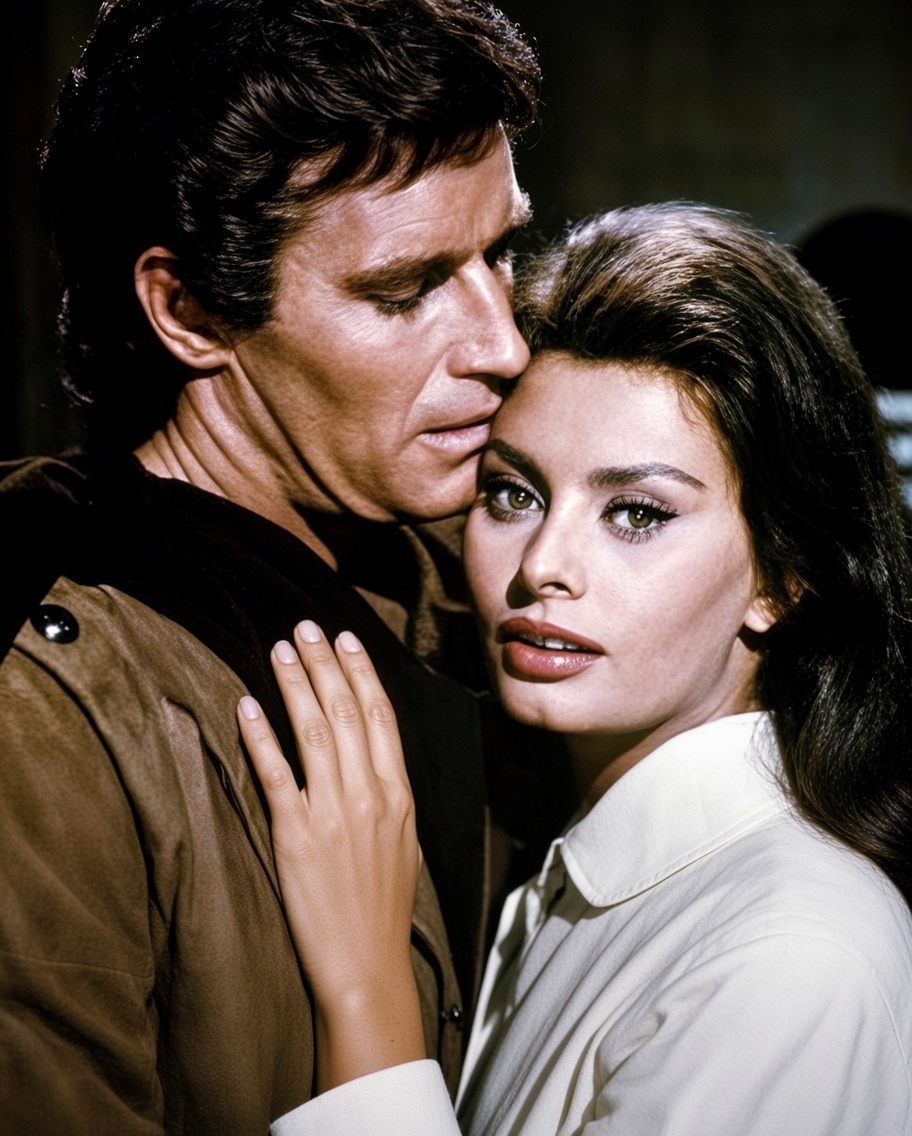
On screen, they are one of cinema’s great tragic couples. Off screen, it was far less romantic. Heston and Loren reportedly got off on the wrong foot early, and things never fully recovered. According to Heston biographer Mark Elliott, Loren made him genuinely angry. Other accounts claim Heston wanted a stand-in for close-ups that showed only Loren’s face, and that Mann struggled to get him to look at her during their love scenes.
Some of that tension may show, since in the scenes where Chimene hates Rodrigo, the chill feels painfully real. There is a human note too. Years later, Heston reportedly admitted he regretted how he had treated her, calling his own behavior unprofessional and unfair, a rare confession from a man who usually played heroes. As with most set feuds, the accounts differ, and neither star ever told the whole story.
Who paid for all this splendor? A big part of the answer lies with one of America’s richest families. Bronston did not rely on a major studio. He pre-sold his films and raised money from private investors, most notably Pierre S. du Pont III, an executive at the chemical giant DuPont.
For a while, it worked brilliantly. El Cid grossed around $26.5 million in the US and Canada, and Bronston even received a special merit Golden Globe. But the empire was built on sand. After later epics struggled, his company filed for bankruptcy in 1964, owing du Pont roughly $5.6 million. Du Pont later resigned from the family company amid the fallout, and years of lawsuits followed.
Then there was a fight that did not happen in Spain but in Manhattan. Loren’s contract promised her second-star billing above the title, on the same line and in the same size as Heston’s name. But when the film opened in New York, an illuminated sign at Broadway and 47th Street, near Times Square, showed her name underneath Heston’s, not beside it.
Loren went to court. She sued Bronston, distributor Allied Artists, and the theater chain, and the leading lady of the season’s biggest epic found herself suing over where her name sat on a sign. The case was eventually settled out of court, but it became one of Hollywood’s most famous billing disputes.
Everyone remembers the ending. El Cid dies, but his body is strapped to his horse Babieca and leads one last charge, terrifying Ben Yusuf’s army. That scene comes from an old legend. Historians believe the real Rodrigo died in Valencia in 1099, most likely not on a battlefield, but the legend gets even stranger.
According to medieval tradition, his embalmed body was taken to the monastery of San Pedro de Cardeña, near Burgos, where it sat upright in a chair in full view for about 10 years. Then one day, a man reached out to pluck the dead hero’s beard. Before he could touch it, the corpse’s hand gripped the sword Tizona and drew it a few inches from its scabbard, and the man fainted from terror.
The movie’s ending, in other words, is not the wildest part of the legend. It is the tamest. Historians treat the tale as folklore, while believers in the old tradition prefer to let it stand.
El Cid was more than a movie. It was a rented army, an arsenal of painted rope, a backstage feud, a Broadway lawsuit, and a legend that refused to die. In 1993, Martin Scorsese supervised its restoration and hailed it as one of the greatest epics ever made. More than 60 years later, that final ride along the beach still gives people goosebumps.
Which moment still gives you chills?