They Cleaned This Painting and Found a Fingerprint
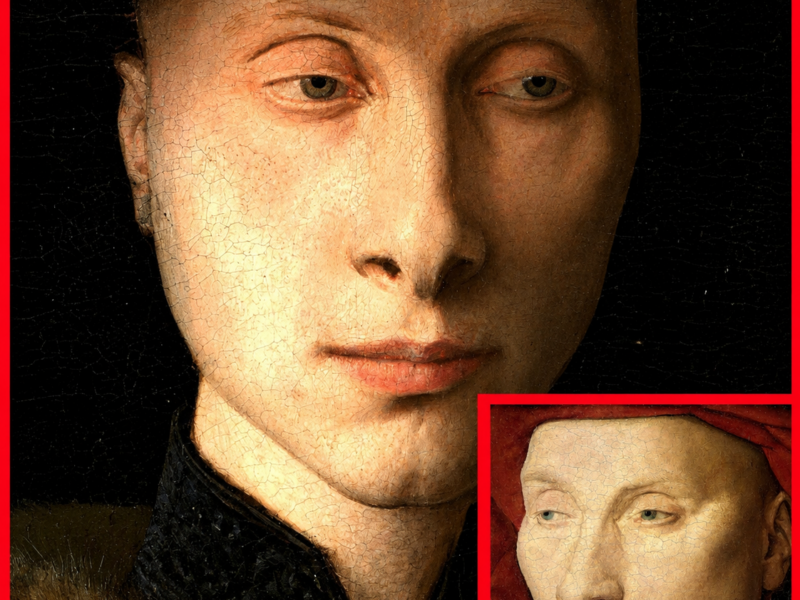
You know this face? It belongs to the husband in the Arnolfini portrait, the painting people look up more than any other on the National Gallery’s website. Now look at him again, in a different city.
In Berlin, there is a second portrait of the same man, a few years older and on his own. It is painted on a piece of oak smaller than a sheet of writing paper. Almost nobody stops in front of it, because it looks dull.
The surface is flat and muddy. For a long time, the explanation was easy: 600 years of yellowed varnish. In November 2021, conservators in Berlin began taking that varnish off.
The painting stayed dull. Whatever was graying, it sat underneath the varnish, directly on the paint. When a laboratory finally named it, the name came from chemistry rather than from art.
Removing it took most of a year and could never be finished. When the green of his robe came back, it carried a mark that had been covered since the 1430s. That mark is the reason this story exists.
Before the mark, the panel itself, because it has almost nothing written on it. The museum calls it Portrait of a Man in a Red Chaperon, and it hangs in the Gemäldegalerie in Berlin. Jan van Eyck painted it around 1435 to 1438, in oil on oak, about 30 centimeters tall.
That is the whole label, because the painting carries no name, no date, and no signature. Berlin bought it in 1886 at the sale of a dealer’s collection. For a long time, it was taken for a portrait of the painter himself.
Then somebody set it beside the London double portrait. The nose settles it: a long straight bridge, a heavy tip, and the same narrow face on either side. This is the Arnolfini husband, painted by the same hand a few years later.
The museum says he is generally taken to be Giovanni Arnolfini, a merchant from Lucca. Then it adds a sentence most captions leave out: there is no final certainty about that name.
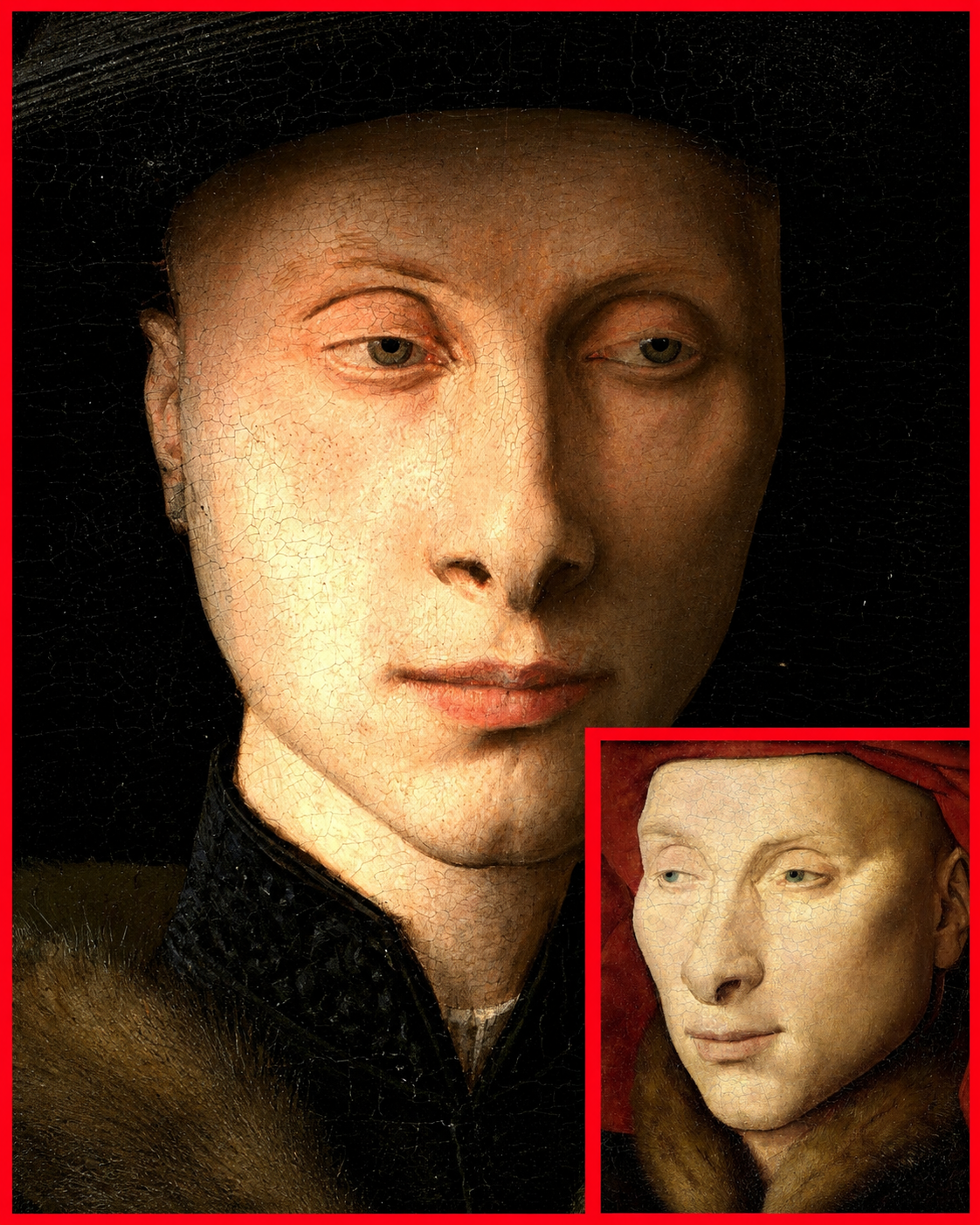
With the name open, start with what on the panel is certain, and the first of those things is the red hat. It is a chaperon, which began as a plain woolen hood worn the ordinary way. The hood went over the head, a short cape covered the neck and shoulders, and a long tail hung down the back.
You can see that version on a pilgrim in the Duke of Berry’s book of hours, standing beside a courtier in the fashionable one. Fashion then turned the hood upside down. The face opening was rolled into a thick ring and set on the crown of the head, the cape was folded on top, and the tail was wound round to keep it all in place.
Philip the Good, Duke of Burgundy, wore his that way in black. The man in Berlin wears his in deep red, with the folds stacked so carefully that the museum calls it intricately folded. Van Eyck painted every crease.
The rest of the panel is quieter and just as exact under a microscope. The fur edging on the green gown separates into single hairs, each one a brush stroke too small for the eye. His eyelashes are there too, pale and fine, with dark patches of old retouching on the lid where somebody later filled a hole in the paint.
In his hand is a small folded paper with writing on it. Magnified, the writing never turns into letters, because Van Eyck painted the look of words and then stopped. So the one object in the picture that could name him was built to say nothing.
Even the background has changed. It looks soft gray now, and he painted it black. A black that now looks gray is time’s doing, and so are most of this panel’s problems.
That matters because few painters ever worked with more control than Jan van Eyck. He was court painter to Philip the Good from 1425. In 1428, the Duke sent him to Lisbon to paint a princess he was thinking of marrying, and the likeness came home before the bride did.
About 20 of his paintings survive, and he signed almost all of them, which almost no painter of his time did. His name went on the frame with the year, and sometimes the day of the month. The frame of a goldsmith called Jan de Leeuw, in Vienna, spells part of the sitter’s name with a small painted lion.
The London portrait many people take for Van Eyck himself is dated to the day. Its frame reads, “Jan van Eyck made me on the 21st of October, 1433.” He painted the backs of his panels as well, in imitation of veined stone, so the object looked finished from every side.
The Berlin panel still has traces of that stone finish on its reverse. What it has lost is its frame, which was carved partly in one piece with the panel. Somewhere in 600 years, the frame went, and it took the name and the date with it.
Without them, this sitter has already been two different people. The one thing that stays fixed is stranger than either name. Van Eyck painted the same man twice, in 1434 and again within four years.
The National Gallery calls that “unprecedented” for anyone who was not a ruler. Painting a merchant twice was unusual because painting a merchant at all was new. Before Van Eyck, a portrait was a thing rulers had, and it showed rank rather than a face you could pick out in a street.
He widened it. He painted a goldsmith, his own wife, and men whose clothes were good without being rich, which is exactly how the museum describes the man in red. His gown is dark green with a plain fur edge, and he wears no chain and no jewel.
Now put him beside the other Van Eyck in the same Berlin collection, Baudouin de Lannoy. De Lannoy was a knight of the Golden Fleece, and he sits in brocade with the collar of the order across his chest. Then look at the wood.
When the tree rings in both panels were counted and dated, the two boards came from the same oak. The knight and the townsman were painted on pieces of one tree.
After that, the panel’s story is mostly damage. Directly after the Second World War, conservators found thin flakes of paint lifting off the white preparation underneath. The lifting has not stopped.
Every flake that fell from the green robe was patched by a later restorer, and the patches have darkened, which is why the robe looks blotched. In the 1970s, someone tried to clear the cloudiness, and the cloudiness came back.
So the team took a sample instead. A sliver cut down through every layer, mounted and lit with ultraviolet, shows at least 11 of them. The bottom three are green paint and the fourth is a green glaze, and those four are Van Eyck.
The other seven are coatings and varnishes that later centuries put on top of him. In the middle of that stack sat a gray band that would not dissolve, and nobody in the building could say what it was.
The answer came from the Rathgen Research Laboratory in Berlin, and it was a word from chemistry: oxalate. It is a crust of very hard crystals that forms when metal in the paint meets oxalic acid. The acid comes from damp, from mold and bacteria, and from dirt left to sit.
In plain terms, the painting had spent part of its life somewhere wet, and the crust had grown on it the way scale grows inside a kettle. It covered the whole panel, but it was thickest over the green robe, and the reason is the paint itself. Van Eyck’s green contains copper, and copper is the metal the crystals form from.
The picture had been covered by a crust that its own paint helped to make. Taking it off should have been impossible, because oxalate does not dissolve and this layer lay directly on the original paint with nothing in between. So the conservators ruled out removing all of it.
One small fact made a partial removal possible. The crystals had formed inside the layer of old dirt, and dirt swells slightly when it is damp. Under the microscope, in tiny mechanical steps, most of the crust came away.
The green underneath had been hidden since before the first varnish went on. It is deep, it is built in layers, and in one place the glaze carries a fingerprint. The lines are curved and almost parallel, pressed into the wet color and left there.
The glaze on this robe was dabbed on with a finger, and the finger left its print. Whose finger it was is the first thing you want to know. The honest answer has two parts.
The museum’s conservator attributes it to Jan van Eyck, and the reasoning is sound. The print sits inside the original glaze, so it belongs to whoever laid that glaze down. Traces like it turn up in only a few of his paintings.
The second part is that there is no known fingerprint of Van Eyck to compare it with, and a workshop had other hands in it. So the fact is narrower, and still remarkable. A man who lettered his frames in Greek and painted the backs of his panels finished this robe with his fingertip, or so the museum argues.
When the panel went back on show, Berlin built an exhibition around looking closely. A projection from Brussels showed his paintings at a magnification your eyes cannot reach. Beside the real panels, the museum handed visitors magnifying glasses.
The name, meanwhile, is still open. Berlin says the Arnolfini identification is nowhere near as certain as people assume. If the London man is not an Arnolfini, this one is not either.
The two of them will share a wall for the first time. The National Gallery is gathering every surviving portrait Van Eyck painted, from November 21, 2026, to April 11, 2027. This panel will hang beside the Arnolfini portrait.
Six hundred years on, we can see the ridges of the painter’s fingertip and still cannot say the sitter’s name. What else have you walked past because it looked dull? Look closer.