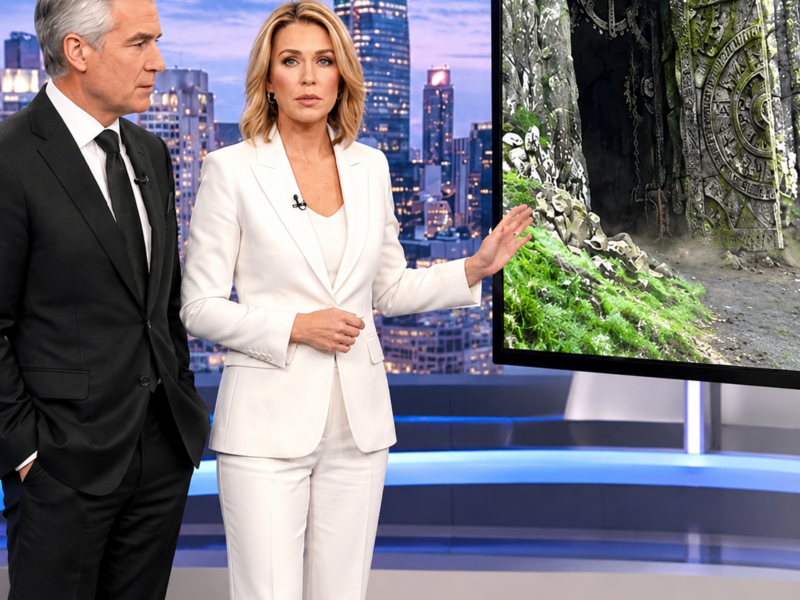
What They Captured Inside the Moving Stone Door Is So Terrifying, Even Scientists Wanted It Gone!
The Giant’s Causeway, on the coast of Northern Ireland, is one of the UK’s outstanding natural features. Its steep cliffs and deep bays form a UNESCO World Heritage Site. Now a story circulating online claims something has been hiding inside that stone.
At the beginning, there was almost nothing to go on. Just a brief, shaky clip recorded by chance, lasting no more than a few seconds. It was not taken by a researcher or a filmmaker, but by someone passing through, unaware of what the camera had picked up.
When the footage surfaced, it triggered confusion more than belief. Some specialists insisted it was a natural illusion, a trick of shifting light and uneven surfaces. Others were not so sure.
Behind the scenes, the account goes, discussions grew tense and access to the location was quietly restricted. Barriers appeared without announcement, and a once-open stretch of cliff was suddenly off-limits to the public. Official statements downplayed everything, but the evidence, according to the story, did not disappear.
The person who recorded the clip is said to have kept multiple copies, stored far from each other just in case. Meanwhile, a small group of scientists who studied the site before being removed reportedly held on to their findings in secret. And when the final report was written, claiming there was nothing unusual at all, not everyone agreed to put their name on it.
Now, the story says, recording equipment footage from inside a sealed chamber has surfaced. Not the drone clip, not the radar images, but cameras that archaeologists supposedly threaded through a narrow fracture in the basalt before the site was locked down. What those cameras allegedly captured in the darkness behind that wall is the reason the tale refuses to die.
It begins on an ordinary Tuesday evening last autumn, with a man named Kieran Doyle. He was 34, an electrician from Dublin, with no interest in archaeology, no connection to any university, and no agenda beyond getting a decent sunset clip for his Instagram feed.
Doyle had driven three hours north to the Antrim coast because the forecast promised clear skies over the Giant’s Causeway. That famous stretch of coastline has roughly 40,000 interlocking hexagonal basalt columns rising from the sea like the floor of some impossible cathedral. UNESCO designated it a World Heritage Site in 1986.
Geologists say it formed about 60 million years ago, when superheated lava flooded the Antrim Plateau, cooled, and contracted into those eerily precise pillars. Local legend says a giant named Finn McCool built them as a bridge to Scotland.
Doyle had been there before. He had flown his consumer drone along this coastline dozens of times, and the routine never changed: fly out, grab footage, pick the best frame, post it, drive home. He expected nothing different.
His drone was recording a wide panoramic sweep of the cliff face when, the story says, something moved. A massive slab of basalt, roughly the size of a transit van and weighing an estimated 20 tons, swung outward from the cliff like a door on a hinge. The movement was slow, smooth, almost mechanical, and behind it was total darkness.
For exactly 11 seconds, the interior was exposed to open air. Then the slab slid back into place with a precision that left no crack, no gap, and no visible seam. Doyle reportedly sat in his car afterward, rewatching the clip six times and trying to convince himself the light had played a trick through the lens.
It had not, he concluded. The shadow behind the slab shifted consistently in every replay. He uploaded the footage that night, and by morning his phone was vibrating non-stop with geologists, journalists, conspiracy channels, and university researchers, all asking the same question: was it real?
One of the calls came from Dr. Sarah Brennan, a senior geologist at Queen’s University Belfast with more than 15 years of fieldwork on the Antrim basalt formations. Brennan does not follow viral videos. When colleagues shared Doyle’s clip, her first instinct was to ignore the email.
She watched it a second time, then a third. On the fourth viewing, the account says, she called Doyle directly and told him his footage either broke every known rule of basalt geology or was the most advanced fabrication she had ever witnessed.
Here is why she could not let it go. In all her years scanning that coastline with ground-penetrating radar, she had never found a hollow space inside those cliffs. Not a cavity, not a crack, not a gap. By every measurement ever recorded, the formations were completely solid volcanic rock.
No geological survey had uncovered anything. No ancient text mentioned a hidden chamber, and no version of the Finn McCool myth even hinted at one.
She was at the site by sunrise the next morning. Brennan set up her radar at the exact coordinates from Doyle’s footage, in gray weather with the Atlantic wind blowing sideways. She calibrated the sensors, aimed the antenna at the cliff face, started the scan, and waited.
When the image appeared, she stopped moving. Her field assistant later said he thought the equipment had failed, because she simply did not respond. She stood staring at the screen for nearly two full minutes without writing a note or adjusting a dial.
The radar, according to the story, showed a massive hollow chamber inside rock that geologists had always labeled solid basalt. It was roughly 12 feet deep and 26 feet wide, sealed behind volcanic stone with no entrance or exit that any instrument had ever found. That alone would have been the discovery of her career.
But what the scan showed inside turned the chamber into a side note: seven figures standing upright in complete darkness. Each was between 7 and 8 feet tall, arranged in a precise formation, spaced exactly four and a half feet apart. All of them faced the same direction, toward the stone door, toward the way out.
Here is where the claim runs into the geology. Basalt is not sedimentary rock, and it does not build up slowly around objects the way limestone does. It is cooled lava, liquid at temperatures above 2,000 degrees Fahrenheit when it formed.
The only way those figures could be inside, the story argues, is if they were already standing in that position while the lava was still molten. That would mean they have been sealed in the cliff since the eruption that formed the Causeway about 60 million years ago. Humans would not exist for another 59.7 million years.
The next morning, Dr. Ian Gallagher arrived from Belfast with higher-resolution equipment. Gallagher focuses on subsurface imaging. He has mapped underground river systems across northern Europe and carried out deep crust surveys for the Irish government, and he has spent decades studying such images without once being unsettled.
Twenty minutes into his scan, his hands were shaking enough that he had to place his tablet on a rock and step away. He walked in a small circle rubbing the back of his neck before returning to the screen.
The sharper data, the account says, showed what the first scan had not. The seven figures were not solid stone. They were hollow, thin outer shells around empty interiors, like husks or cocoons.
Something had either once filled the space inside each one, or something still did. The shell material could not be identified. Whatever it was should not have survived contact with molten lava, since nothing organic survives those temperatures and nothing synthetic should either.
Within 48 hours, government agencies were reportedly informed. An environmental assessment team arrived and released a public statement almost immediately: the drone footage was a trick of light reflecting off wet basalt, no chamber existed, no anomalies had been found, and the area was completely normal. That is the official line, and it is the one a skeptic would point to.
But their own lead consultant, Brennan, the person they had hired to verify the site, is said to have refused to sign. She read the draft twice and pushed it back across the table without picking up a pen. Colleagues present say she opened her laptop one last time, reviewed the raw data, turned pale, closed the screen, and resigned the following week.
Her letter was four sentences long. The last read, “I have seen enough.”
Steel barriers and yellow safety signs went up around that section of cliff. The official explanation was coastal erosion and a falling-rock hazard, the kind of ordinary explanation nobody asks follow-up questions about.
Before the team was ordered to leave, the story claims, a small group managed to do something nobody outside the investigation has known until now. They got cameras inside, though not through the stone door, which had not opened again since Doyle’s footage. Gallagher’s scans had identified a thin fracture in the basalt about 14 feet from the sealed entrance, a natural flaw barely wide enough to thread a fiber-optic cable through.
The team fed a miniaturized camera on a flexible endoscopic cable through the gap. It was industrial-grade equipment of the kind used to inspect nuclear reactor vessels and deep-sea pipeline joints, with resolution high enough to read text at arm’s length in total darkness, infrared for zero-light environments, and a microphone sensitive enough to detect vibrations through stone.
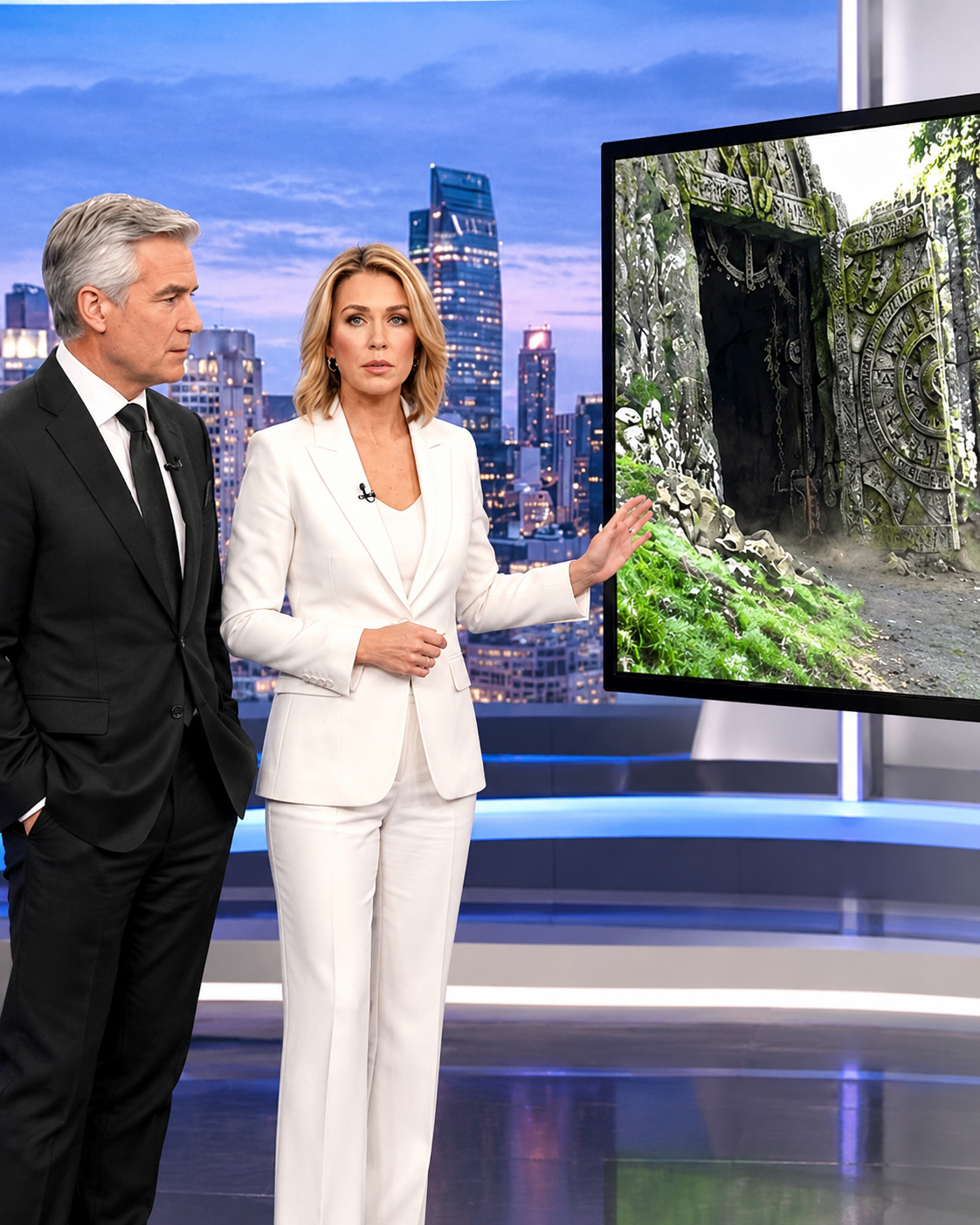
The cable took nearly three hours to thread. Twice it caught on interior irregularities and had to be backed out and redirected. On the third attempt, just past 2:00 a.m., the camera tip broke into open space and the feed went live on a monitor in the equipment tent.
The first thing it captured was scale. The chamber was larger than the radar had suggested, with a ceiling nearly four feet higher than predicted. The walls were not rough basalt but unnaturally smooth, as if the surface had been refined or had formed under conditions that match no known volcanic cooling process.
Then the camera panned left, and the infrared found the figures. There were six, standing where the most recent scan had placed them, upright and motionless, each 7 to 8 feet tall. They were no longer in the original formation, but grouped together and noticeably closer to the stone door than they had been four days earlier.
The thermal overlay showed them in shades of orange and red against the cold blue of the surrounding rock. They were warm, the account says, with surface temperatures between 98 and 100 degrees Fahrenheit, in a sealed chamber surrounded by freezing Atlantic stone.
The shapes were humanoid but not human. The limbs were longer than any human skeleton would produce, and the heads slightly oversized for the torso. The casings looked textured, not skin-like and not mineral, something between organic and crystalline that the team’s material specialist reportedly said she had never seen in any geological or biological sample.
Then the microphone picked up something. The team had expected silence in a space locked shut for 60 million years. Instead, it recorded a low-frequency rhythmic pulse, repeating every 4.7 seconds, steady and never changing.
One senior researcher, choosing his words with extreme care, later said on record that the pattern matched a slow resting heartbeat. It was not coming from one figure but from all six, synchronized, as if whatever was inside each hollow shell was running on the same timing.
There was a second signal beneath the first, higher-pitched and intermittent, not rhythmic like the heartbeat but structured and patterned, in sequences matching no known natural acoustic phenomenon. One audio engineer who reviewed the recording independently called it tonal, almost musical, like something communicating in a range humans are not built to consciously detect.
The original radar scan had detected seven figures. The second scan, four days later, detected six. The camera footage confirmed it: six figures stood in the chamber, and the space where the seventh had been was empty.
There was no debris, no dust, no disturbance in the surrounding stone, and no crack, tunnel, or fracture leading anywhere. The basalt around the empty position was as smooth and intact as the rest of the walls. The seventh figure, if the story is to be believed, had left without opening the door, without breaking the rock, and without leaving a single physical trace.
The remaining six did not react. They did not scatter or move away from the empty spot. They simply continued their slow, steady drift toward the sealed entrance, as if the seventh leaving was expected, as if it was only the first to go.
The last scan before the equipment was removed showed all six still moving, still pulsing, still warm. The one nearest the door was only a few feet from the entrance, and its pulse was clearly stronger than the week before, louder and faster, as if it could sense how close it was to the way out.
Brennan, despite resigning, reportedly spent months compiling everything: the thermal data, the heartbeat recordings, the positional shifts, the camera footage, and the audio analysis. She wrote a formal paper, had it reviewed by two trusted colleagues who confirmed her methods were sound, and submitted it to Ireland’s Geological Review Board. The board rejected it immediately.
A colleague on that board then contacted her privately, the story says, through a burner phone. He told her the real reason had nothing to do with her science. The issue was containment: if the public learned that biological heat signatures, synchronized pulses, and structured acoustic patterns had been recorded inside 60-million-year-old basalt, it would break the foundation of what we think we know about the history of life on this planet.
In April, all monitoring equipment was quietly removed. The researchers were told to stay silent or risk their careers. The footage, audio, and thermal data exist, the story insists, in multiple copies on encrypted drives in places no agency can reach without warrants it would have to justify publicly.
Here is the other side, and it is a large one. None of this has been independently verified in the account itself. There is no published paper, no released footage, and no on-the-record confirmation from any named institution, and the official position remains that the clip was a trick of light and that nothing unusual lies behind the cliff. Skeptics point out that the story’s own physical claims, including living warmth inside rock that was once molten lava, are exactly the kind that demand the strongest proof.
Believers answer that this is precisely what a cover-up would look like. If the account is accurate, the footage shows six entities sealed in volcanic rock since before mammals existed, giving off body heat, pulsing in synchronized rhythm, producing structured sound, and moving slowly toward a stone door that has already opened once on camera.
They have been there for 60 million years, held formation, patient and still, and now, in our lifetime, they are heading for the exit. More than a million tourists visit the Giant’s Causeway every year. Families walk across those black stones with their children, take selfies, and listen to guides retell the legend of Finn McCool.
According to the story, they have no idea that just 39 feet behind the rock beneath their feet, six entities are giving off body heat into frozen stone, producing sounds that resemble communication, and inching toward a door that has already opened once.
The question said to keep every researcher who touched the case awake is not about the six still inside. It is about the one that already left. Seven were there, and now six remain. One vanished without opening the door, breaking the stone, or leaving a single grain of displaced dust.
So where is it now? Moving through unexplored cave systems beneath the Irish seabed? Hidden inside another cliff face nobody has thought to scan? Beneath a city, or inside a mountain? The remaining six did not react when it disappeared. They kept moving toward the door, patiently, steadily, as if waiting for their turn.
We have spent our entire existence believing we were the first intelligent things to walk this planet. If the story is true, those six figures suggest otherwise: something was here long before us, sealed in stone, giving off warmth, pulsing with a rhythm that sounds like breathing, and producing sounds that may be language, while every civilization we ever built rose and fell on the surface above.
According to the account, the six are still behind that stone door right now. Their pulses are getting stronger, their heat signatures are rising, and they are feet from the exit, with the seventh already out there somewhere.
Or it is a viral tale that outran the evidence. Which do you believe? Do you think those six are still behind that door, or have more already gotten out? Tell me what you think in the comments, and if you want to know the moment new footage appears from inside that chamber, subscribe and turn on notifications, because this one is far from over.