How Did Sanmartino Carve The Veiled Christ 273 Years Ago?
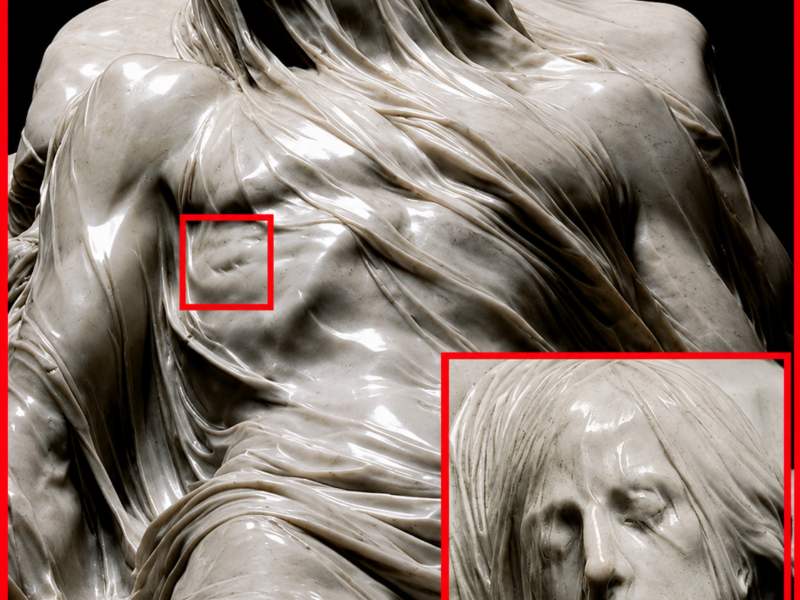
Look closely at the face under the cloth. You can see the eyelids through it, the line of the nose, and a vein raised on the forehead. The cloth looks thin enough to lift away with two fingers.
For more than 250 years, visitors to this chapel in Naples have repeated a story about it. The story says the shroud was once real fabric, laid over a body and turned to stone. The man it blames is the prince who owned the chapel, a famous experimenter with an alchemist’s reputation.
It is a good story, and you can feel how much people want it to be true. The chapel’s own museum admits the legend is slow to die. In 2017, National Geographic’s Italian edition reported what an archivist had traced in the old bank records of Naples: a payment for this statue, signed by the prince himself.
So which made this veil, a chisel or a chemist?
This is the Veiled Christ, the Cristo Velato, carved by Giuseppe Sanmartino and dated 1753. It lies at the center of the Cappella Sansevero, the family chapel of the princes of Sansevero. The figure is life-size, a dead Christ stretched out on a mattress with his head raised on cushions.
One shroud covers him from the forehead to the feet. The body, the mattress, and the shroud are all white marble. Along the shroud’s edge, the sculptor carved a decorated border, fine enough to read as stitching.
Through the veil, you can still find the nail wounds in the hands and feet, and the sunken side. At his feet lie the instruments of the Passion, among them the crown of thorns and the nails. Every inch of that cloth raises the same question about who made it, and how.
Start at the face. The veil presses tight against the nose, the lips, and the closed eyes, so you read each feature through it. Now look along the sides of the body. There, the cloth lifts away and settles into folds that touch nothing at all.
One surface of stone is showing you two things at once, a body and a cloth resting over it. That double reading is the whole effect. And in 2022, vision scientists set out to measure it.
Flip Phillips and Roland Fleming published their study in the journal PNAS. They used a different veiled marble, Giovanni Strazza’s Veiled Virgin, carved about a century after this one. That bust is kept by the Presentation Sisters in St. John’s, Newfoundland.
Volunteers painted over a picture of it, marking where the veil touched the face and where it floated free. Their answers agreed with each other closely. Scientists have a name for what happens when your eye pulls one shape apart into body and cloth: shape scission.
Next, the scientists draped real cloth over unfamiliar shapes and scanned both layers in three dimensions. People’s judgments matched the real gaps between cloth and object.
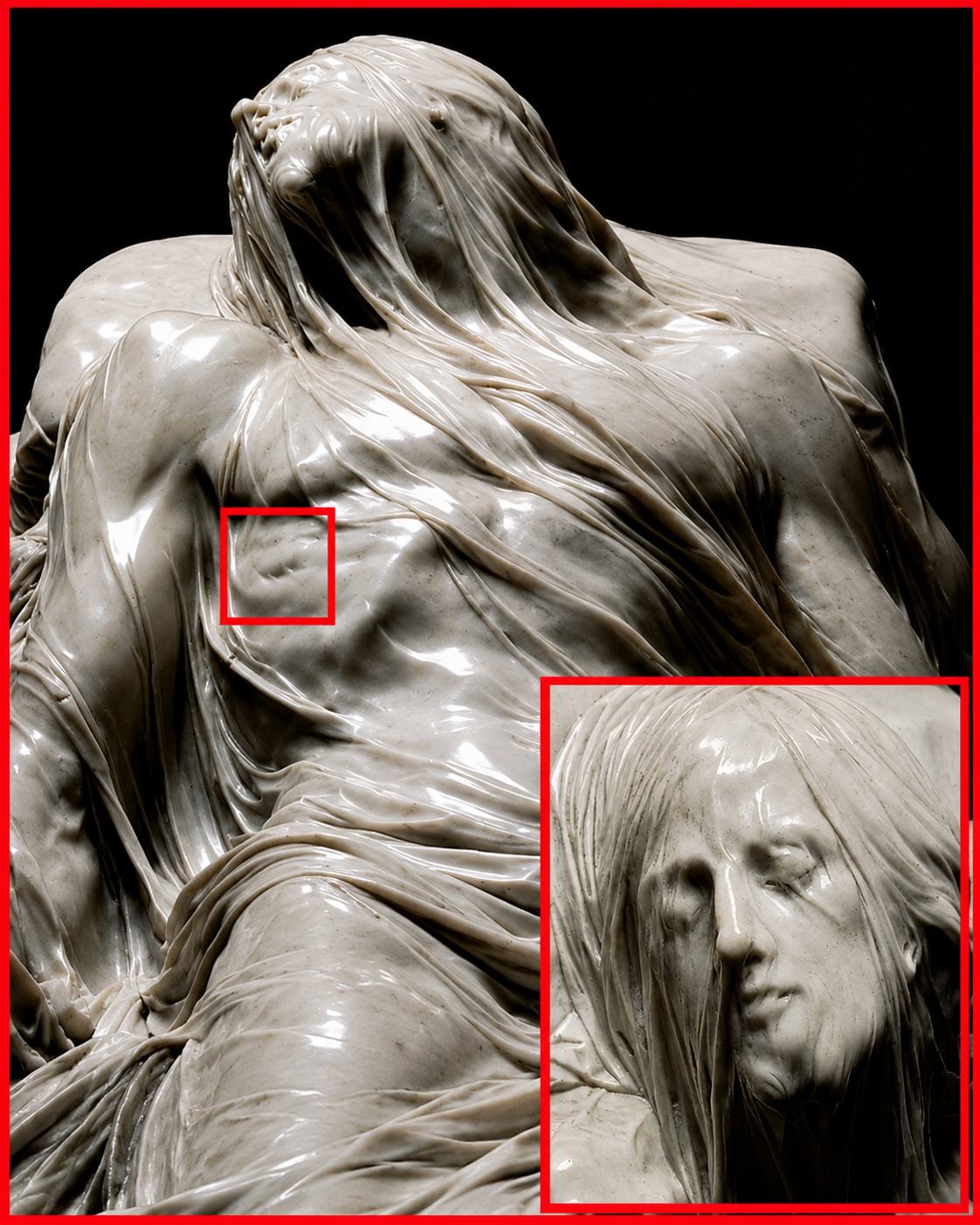
The psychologist James Todd offered one possible explanation in the same journal, in June 2020. Cloth that hangs free can only bend in one direction at a time. Where it rests on a body, it picks up the body’s rounder curve, the kind that bends two ways at once.
Todd called his idea speculative, and nobody in that study measured this statue. But if he is right, the carver had to switch between those two kinds of surface inch by inch, across a whole body. That is the skill so many visitors refuse to credit to a chisel.
Sanmartino was the prince’s second choice for this commission. The first was Antonio Corradini, a Venetian sculptor already famous across Europe for veiled figures. He had served the Emperor Charles VI in Vienna before the prince brought him to Naples.
In 1752, Corradini finished Modesty for this same chapel, a veiled woman raised in memory of the prince’s mother. He also made a small terracotta model of the dead Christ, and it survives in the Museo di San Martino in Naples. That same year, he died before he could carve the marble.
A plaque the prince put up in the chapel records that Corradini died while still planning the rest of its decoration. The commission passed to a Neapolitan sculptor in his early 30s, trained in the workshops of his own city. The chapel’s museum says he paid little heed to Corradini’s model.
Picture how that sequence looked from the outside. One of Europe’s most celebrated carvers of veils dies with only a clay sketch finished. Within a year, a younger local man has a veiled Christ in marble that people travel to see.
If you already suspected the patron of strange experiments, that sequence would look like evidence. Could a young local sculptor really carve what the master did not live to carve?
To see why the doubt stuck to the patron, meet Raimondo di Sangro, the seventh prince of Sansevero. His biographer, Gian Giuseppe Origlia, printed a list of the prince’s inventions in 1754. It includes a carriage that could float on water, artificial gemstones, and wax and silk made from plants.
There is also a gun that could fire with either gunpowder or compressed air, and a stage that folded away. Origlia was writing while this statue was brand new, so the list shows how Naples saw its maker.
The prince also wrote letters to the French physicist Jean-Antoine Nollet and to Giovanni Giraldi in Florence. Those letters announced the discovery he was proudest of, a light he claimed would never go out. A man who said that in public could be credited with almost anything.
His chapel gave the rumor even more to work with. Corradini’s Modesty stands there, a woman seen through a carved veil. The prince raised it for his mother, Cecilia Gaetani, who died in 1710 before he was a year old.
Close by is Disillusion by Francesco Queirolo, where a man struggles free of a fishing net carved in marble. That monument honors the prince’s father, Antonio, and its net hangs away from the body in open loops of stone. The prince paid for a stone veil, a stone net, and this stone shroud, all inside one small room.
Even the praise for this statue drifted into legend. Antonio Canova, the greatest sculptor of the next generation, is said to have wished he had carved it. The story claims he would have given ten years of his life for it.
The chapel’s own museum tells that story as legend, and no letter or diary of Canova’s has turned up to record it. So the legend had a famous experimenter, a young sculptor, and a room full of stone fabric. Everything now rests on the one person who paid for the veil, and on what he told his bank.
In 18th-century Naples, a payment through one of the city’s public banks was made with a paper called a fede di credito. It worked much like a check, and the person paying wrote the reason for the payment on it. The banks copied those reasons into their books, which is why a line written in 1752 can still be read.
Their records now sit in the historical archive of the Banco di Napoli, which holds the books of eight of those old public banks. In 2023, that archive was entered on UNESCO’s Memory of the World Register. Edoardo Nappi, an archivist there since 1963, traced two of those reasons to this statue.
The first is dated December 16, 1752, through the Spirito Santo Bank. Fifty ducats go to the magnificent Giuseppe Sanmartino on account, and the order is signed by Raimondo di Sangro. The stated reason: “a statue of our Lord dead, covered by a veil also of marble.”
The statue is still unfinished, and in the prince’s own hand, the veil is already marble. The second payment is dated February 13, 1754, through the Banco della Pietra. Thirty ducats complete the agreed price of 500 ducats, so that first advance had been one-tenth of the whole.
This time, the statue is carved, “covered by a shroud of transparent veil of the same marble.” The veil was never cloth. It was cut from the same block as the body beneath it, and the payments for it say so twice.
The prince said it again in his letters to Nollet and Giraldi, describing the shroud as made from the same block as the statue. Origlia’s biography of 1754 calls it a transparent veil of the same marble. Whatever started the legend, the prince’s own papers contradict it, and every document we have from the statue’s own time points to the chisel.
So the paper settles how the veil was made, and it leaves open why the story outlived the paper. We do not know when the rumor began, or whether the prince ever heard it. We do know what he wanted from this chapel: its museum says his aim here and elsewhere was to inspire wonder.
He wrote that this veil was made with such art that it left the most skilled observers amazed. The same man announced a light that would never go out, and he liked his secrets kept. On this one marvel, he wrote the plain fact into a bank’s books.
The chisel the legend doubted went on to 40 more years of work in Naples, until Sanmartino died there in 1793. Two and a half centuries on, a sculptor of about 33 still makes your eyes read stone as cloth.
If you had carved something this good and people gave the credit to magic, would you correct them? Look closer.