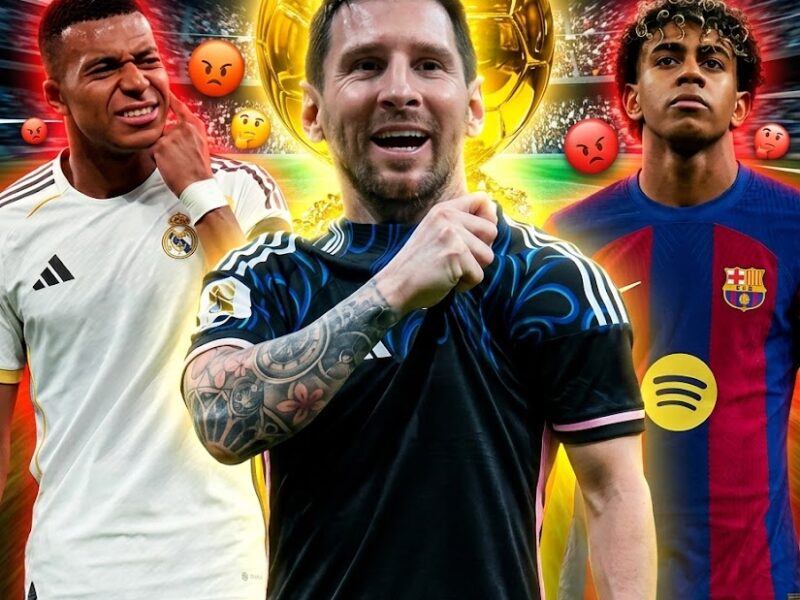
Why Is Europe So Afraid of Messi Winning a 9th Ballon d’Or? The UEFA Conspiracy, the Silent War With Mbappé and Yamal, and the World Cup Stat Nobody Wants to Talk About
There is a version of this story where everyone just agrees Lionel Messi had one of the greatest seasons of his life at thirty-nine years old and the conversation ends there.
That version does not exist.
Instead, in the weeks leading up to the 2026 Ballon d’Or ceremony, something has been happening that has almost nothing to do with what happens on a soccer field, and everything to do with who controls the microphone, who owns the magazine, and who gets to decide what “greatness” is allowed to look like this year.
Messi is thirty-nine years old and he is, once again, one of the five finalists for the single most prestigious individual award in the sport.
No player has ever been in that position at that age.
And instead of that fact being treated as a celebration, it has quietly turned into something closer to a small war, fought not with goals and assists, but with interviews, magazine covers, voting rules, and a very convenient business partnership that a lot of people would rather you not think too hard about.
So let’s think about it.
A Ceremony That Already Feels Different Before a Single Vote Is Announced
Start with the basics, because the basics matter here more than usual.
The Ballon d’Or has always belonged to France Football, the magazine born in Paris in 1956 that invented the entire concept of ranking the best player on the planet.
For nearly seventy years, that meant the ceremony lived in France, run by French journalists, published by a French magazine, decided by a process France controlled from top to bottom.
That changed in 2024, when France Football entered into a partnership with UEFA to co-organize the award.
On the surface, it sounds like a technical, boring business arrangement. Two organizations sharing costs, sharing a stage, sharing a spotlight.
Underneath the surface, it is something a little more uncomfortable to say out loud: the governing body of European club competition is now sitting at the table where the sport’s most important individual prize gets decided.
And this year, for the first time in the award’s seventy-year history, the ceremony is not even happening in France at all.
It is moving to London, England, on October 26, timed to the award’s seventieth anniversary, with organizers framing the venue as a tribute to Stanley Matthews, the legendary English winger who became the first-ever Ballon d’Or winner back in 1956.
That is a lovely piece of symbolism.
It is also, whether intentional or not, a very literal changing of the geography, moving the ceremony out of the country that invented the award and into the backyard of the confederation that now co-owns it.
None of this proves anything on its own. Business partnerships shift venues for all kinds of reasons, and nobody is accusing UEFA of literally rigging ballots.
But it is the kind of detail that becomes very relevant the moment you notice who tends to win these awards, and who tends to get left out in the cold.
The Five Names on the Cover, and the One That Doesn’t Quite Fit
L’Équipe, the French sports daily that shares a parent company with France Football, put out its own cover recently highlighting this year’s group of contenders.
Five names appeared: Lamine Yamal, Kylian Mbappé, Ousmane Dembélé, Harry Kane, and Messi.
Four of those five play in Europe’s biggest leagues, for clubs that live and breathe UEFA competition every single season.
The fifth is a thirty-nine-year-old playing in Major League Soccer, a competition that much of the European football establishment still treats as a retirement league, a place where legends go to collect a paycheck and pose for sponsor photos rather than compete at the highest level.
That framing has never really applied to Messi, but it has always been convenient for people who wanted an excuse to write him off.
And it is worth pausing here to remember something specific about L’Équipe: this is the same outlet that, according to widespread reporting and fan memory from his years in Paris, was frequently harsh in its coverage and match ratings of Messi during his time at PSG, often marking him down even after strong performances, in a period when comparisons to a certain French teammate were a near-daily obsession in the French sports press.
Even under that kind of scrutiny, playing in a league and a media environment that was not exactly rolling out the red carpet for him, Messi still won the Ballon d’Or during his PSG years.
Which tells you something important going into this year’s vote: the numbers, in the end, tend to be difficult to argue with, no matter how unfriendly the coverage gets.
So what actually earned him a nomination this time, in a season most people assumed belonged entirely to a younger generation?
The Case Nobody Can Actually Argue With: The Numbers
Strip away every storyline, every rivalry, every conspiracy theory for a second, and look at what Messi actually did on the field.
At the 2026 World Cup, he scored eight goals and added four assists, numbers that put him at the very center of Argentina’s tournament and among the most productive players in the entire competition.
He was, by a significant portion of statistical models and press coverage, the best individual player at the World Cup, full stop.
Away from the international stage, with Inter Miami, he added silverware at club level too, lifting the Leagues Cup in 2025 and following it up with the Campeones Cup in 2026.
If the Ballon d’Or were purely a mathematical exercise, a spreadsheet of goals, assists, and trophies, this conversation would already be over.
Messi would be comfortably inside the top tier of candidates, the debate would be about where exactly he ranks, and nobody would be writing thousands of words about magazine politics and confederation partnerships.
But somewhere in the last few weeks, the entire tone of this race changed, and it changed in a very specific, very telling way.
When the Ballon d’Or Stopped Being About Stats and Started Being About Microphones
Here is the uncomfortable pattern that a lot of people have noticed, and it is hard to unsee once you spot it.
Two of the other finalists have spent recent weeks doing something Messi has never really done in his entire career: actively campaigning for the award in public, through interviews clearly designed to plant a narrative before a single ballot gets counted.
Mbappé was asked directly if he considers himself the best player in the world right now. His answer, paraphrased from his own comments, essentially amounted to: of course it’s me, and everyone is entitled to their own opinion about it.
Lamine Yamal went even further, suggesting that if anyone deserves to be called the best in the world today, it is realistically down to two names, himself and Mbappé, and that this season, in his own view, he was the one who had earned the trophy through what he won on the pitch.
Notice how differently the two approached it. Mbappé’s version was calculated, built around raw production and status. Yamal’s version threw diplomacy out the window entirely and made the case for himself in the first person, no hedging, no false modesty.
And through all of that noise, Messi said absolutely nothing.
He did not need to.
Because while some players are out there proclaiming their own greatness into a microphone, Messi has spent two decades building something that does the talking for him: the people around him.
The People Who Didn’t Have To Speak Up, But Did Anyway
David Beckham, part-owner of Inter Miami, put it about as plainly as an owner can put something about his own player without sounding like he is just talking his book.
According to Beckham’s public comments, it is no accident that Messi is back in this conversation, that he was arguably the single best player at the World Cup, that nobody else at thirty-nine years old is doing what he is doing at that level, and that, in Beckham’s own words, he believes Messi should win it.
A former professional, commenting separately, was even blunter about it, essentially saying the football world should simply give him the trophy and be done with the debate.
A current Inter Miami teammate offered a more clear-eyed, insider’s version of the same idea: yes, Messi proved himself again at the World Cup, but the real issue is who actually casts these votes, because the voting bloc always tilts toward Europe, toward the Champions League, toward the Premier League, toward the leagues that dominate the sport’s media coverage.
That sentiment lines up almost exactly with something Casemiro said publicly not long after this year’s Champions League final, when he pointed out that the voting always looks toward Europe, that football outside the continent tends to get looked down on by the people who actually decide these awards.
An Argentine manager summed up the entire debate in a single sentence: in a World Cup year, for him personally, there is no real argument, because nobody else did what Messi did at thirty-nine.
Diego Simeone, in a press conference, made a version of the same point, before adding the one line that quietly explains the entire structural problem: he is not the one who actually votes.
Look at how consistent that chain of voices is. A club owner. A head coach. A former player. A current teammate. None of them had any obligation to say a single word about this. None of them stood to gain anything concrete from praising a rival’s teammate, a competitor, a legend from a different generation.
They said it anyway, and they all landed on roughly the same conclusion, which is not something friendship alone produces. It is what twenty years of undeniable greatness produces, the kind of respect that survives even among people who are technically supposed to be his opponents.
And that dynamic creates a very specific kind of problem for anyone hoping to move past Messi in the sport’s official record books, because it is a much harder thing to argue against the players and coaches who actually share a locker room or a touchline with him than it is to argue against a wave of nostalgic fans on social media.
There is also a broader contrast worth sitting with here, one that has nothing to do with this particular award. Compare Messi’s public posture to Cristiano Ronaldo’s, a player who has never had any hesitation calling himself the best in the world, in his own words, on the record, repeatedly, across his entire career.
Messi has essentially never done that. He lets other people say it. It is simply not who he is, and it never has been.
The Uncomfortable Question Underneath All of This
So here is where this gets genuinely interesting, and genuinely a little uncomfortable, because the honest question is not whether Messi still has the level to compete for this award.
The honest question is why his mere presence on that shortlist seems to bother such a large chunk of the sport’s power structure.
There is an entire wing of the football industry that badly wants to turn the page. They need new faces to sell, a new rivalry to market, a new generation that has been patiently waiting its turn and, from a commercial standpoint, is more than ready to take over.
And directly in the middle of that plan, at thirty-nine years old, is a player who refuses to fully step aside.
Not because he is clinging to past glory out of stubbornness, but because, according to the actual results on the field this year, the next generation has not yet fully closed the gap the marketing department already tried to declare closed.
That creates a genuinely strange contradiction in how these awards tend to get discussed publicly.
When a young player has one outstanding season, the instinct across most of the sport’s media is to declare that the torch has officially passed, that the future has arrived, that the crown needs a new owner immediately.
But when Messi, in the tournament that matters most, on the biggest stage the sport offers, shows that those same successors are not quite there yet, the standard of judgment tends to quietly shift underneath him.
Suddenly it is not about numbers anymore. It is not about who was best in the biggest matches. It becomes about protecting a storyline, about sustaining the idea of a changing of the guard regardless of what actually happened on the field this particular season.
The Trap Nobody Else Has to Deal With
Here is the part of this whole situation that should bother you regardless of which player you personally support.
Messi is being measured by a standard that simply does not apply to any other finalist on that list.
If he wins his ninth Ballon d’Or, expect a wave of commentary suggesting it was really about historical weight, about legacy voting, about a farewell gift rather than a genuine assessment of this season.
If he does not win it, expect an equally loud wave of commentary treating the loss as proof that his time has officially ended, that this was the final confirmation everyone was waiting for.
There is no version of this outcome where the coverage simply says: here is what he did this year, on the field, and here is how it compares to everyone else.
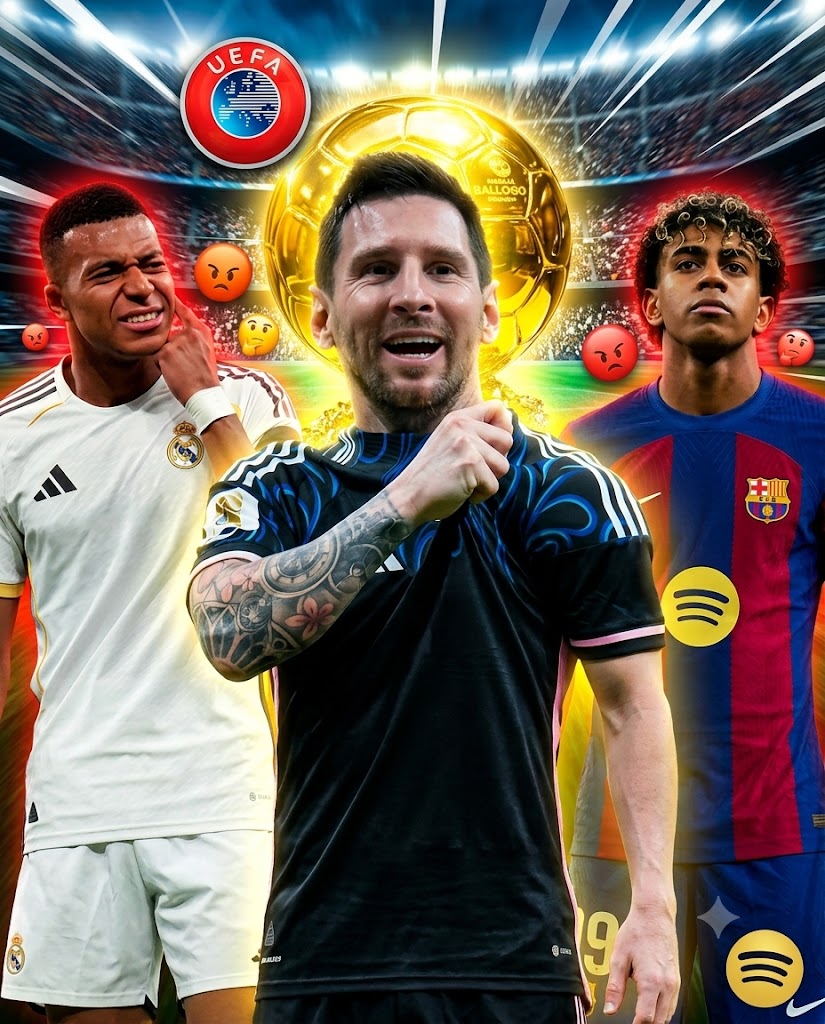
To be fair, this is not an argument that Messi automatically deserves the trophy purely because he is Messi. He has earned this nomination through what he has actually produced this season, and that matters on its own.
But it is also true that historical weight and legacy have always been legitimate factors in this award’s history, sometimes explicitly used as tiebreakers when the statistical case between finalists is genuinely close.
And this year, by most honest accounts, that race looks like it is going to be tight.
A Complication Nobody Can Fully Explain Away
The uncomfortable part for anyone trying to build a case against Messi this year is that his production is simply too significant to dismiss outright.
Whatever the final vote total ends up being, the voting body cannot fully pretend that his World Cup did not happen, that his numbers were not real, that Inter Miami’s trophies did not count for something.
Which is precisely why rewarding him now would carry an uncomfortable implication for the sport’s power brokers: it would mean publicly admitting that, even at the tail end of his career, the new generation still has not been able to fully surpass him where it matters most.
That is not a comfortable thing for an industry that has spent years trying to sell the idea that the sport has already moved on.
The World Cup Stat Everyone Conveniently Forgets
Now here is the detail that tends to get buried underneath all the magazine covers and interview soundbites, and it deserves far more attention than it usually gets.
At the 2026 World Cup, by the count of a significant portion of the sports press and independent statistical outlets, Messi was the best individual player in the entire tournament.
Eight goals. Four assists. Carrying his national team on his back all the way to the final.
And yet the World Cup’s own individual honor, the Golden Ball, went to Rodri instead, a decision that rewarded the narrative of a collective, system-driven champion over the player who had, by a large portion of measurable standards, been the single best performer of the tournament.
Even after that decision, the debate over who actually deserved it never really went away, and there is a real argument to be made that awarding the World Cup’s top individual honor to someone other than its most statistically dominant player was, at minimum, a genuinely debatable call.
Whatever your personal view on that particular decision, the larger point stands: even when the award was taken out of his hands entirely, the conversation around who actually was the best player never stopped following Messi around.
Two Camps, One Argument
At this point, the debate essentially splits into two camps, and it is worth laying them out plainly rather than pretending this is complicated.
One camp believes the sport needs new icons, new faces to build the next commercial era around, and that keeping Messi at the top of these conversations effectively blocks a generation that the industry feels is overdue for full legitimacy.
The other camp believes the Ballon d’Or exists to reward the single best season an individual actually had, not the player who fits most conveniently into next year’s advertising campaign or broadcast marketing push.
Asking a legendary player to simply step aside to make room for someone else, in any sport, at any level, has never been how greatness actually works.
The throne in this sport has never been inherited. It has always been earned, on the field, by actually surpassing the person sitting on it.
And if the players positioned to inherit that throne still cannot get past a thirty-nine-year-old, the uncomfortable truth is that the problem does not belong to the thirty-nine-year-old.
The MLS Excuse, and Why It Deserves More Scrutiny
There is one more argument worth addressing directly, because it comes up constantly in these discussions and it rarely gets challenged the way it should.
A significant portion of the pushback against Messi’s candidacy centers on the fact that he currently plays in Major League Soccer, a competition that, fairly or not, still carries a reputation in much of Europe as a lesser league, a place for aging stars to wind down rather than compete at an elite level.
It is a real, fair point that MLS does not currently match the competitive depth of Europe’s top divisions on a week to week basis.
But there is a legitimate counterargument buried inside that criticism that rarely gets a fair hearing: take any of this year’s other finalists, Yamal, Kane, Mbappé, and drop them into that same environment, into that same league, into that same team structure, and see how their production actually holds up under a completely different tactical and competitive context.
Because the honest truth, whether MLS purists want to admit it or not, is that when Messi is not on the field for Inter Miami, the entire operation of that team changes in ways that are hard to ignore.
That is its own kind of double standard, one that rarely gets applied evenly across different leagues and different players when convenient narratives are on the line.
Where This Leaves Us Heading Into October 26
So where does all of this actually leave the 2026 Ballon d’Or race, with the ceremony now just weeks away and voting reportedly already closed or close to closing?
The honest, unglamorous answer is that nobody outside the small circle of people counting these ballots actually knows the outcome yet, and anyone claiming certainty in either direction is guessing.
What can be said with more confidence is this: the structural incentives lined up around this year’s ceremony, the UEFA co-organization, the shift in venue away from France for the very first time in the award’s history, the composition of the voting journalists themselves, all of it tilts in a direction that does not obviously favor a player competing outside Europe’s major leagues.
It is also worth remembering, specifically, that one of the national voting journalists selected through this UEFA-linked process reportedly works for a Real Madrid-aligned Spanish outlet, a detail that, on its own, does not prove anything corrupt, but does not exactly inspire confidence that this particular ballot was heading toward Messi either.
None of that guarantees anything about the final result. Voting bodies have surprised people before, and individual journalists do not always vote the way their institutional affiliations might suggest.
But it does explain why so much of the conversation around this year’s award has shifted away from pure footballing merit and toward questions of structure, ownership, and influence.
The Bigger Picture Worth Remembering
Strip away every bit of politics, every magazine cover, every calculated interview answer, and what remains is still pretty simple.
A thirty-nine-year-old took his national team to a World Cup and was, by a meaningful measure, the best player in the entire tournament.
He won trophies at club level in a league that most of Europe still underestimates.
He did all of this without saying a single self-serving word about deserving anything, letting owners, teammates, coaches, and even rivals make the case for him instead.
Whether or not that adds up to a ninth Ballon d’Or on October 26 in London is genuinely still an open question, one shaped as much by boardroom politics as by anything that happened on a football field this year.
But the fact that this argument even needs to be made, the fact that his continued excellence has become something the sport’s power structure seems almost uncomfortable with rather than eager to celebrate, tells you something real about where the business of football is right now, separate entirely from the sport itself.
Messi does not need this trophy to validate what he has already built across two decades at the top of the game.
But the way this particular vote unfolds, and the reasoning the voting body eventually offers for whatever decision they land on, will say something lasting about whether this award still exists to honor the best season a player actually had, or whether it has quietly become something else entirely.
That is the conversation worth having in the coming weeks, regardless of which name ends up on the trophy come the night of the ceremony.









