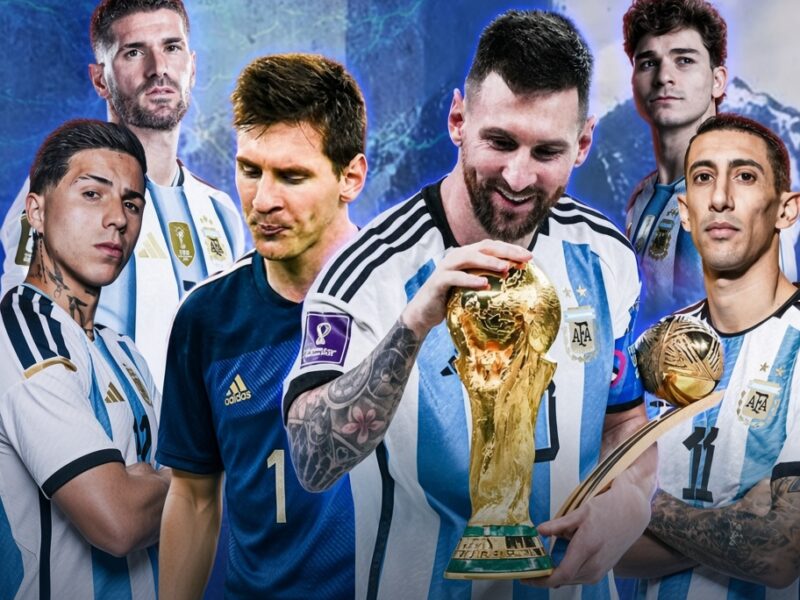
Why Argentina’s Players Would Die for Messi: The Untold Story of Childhood Fans Who Became His Bodyguards
“I’m ready to die for him.”
That is not a line from a movie, and it is not a fan screaming from the stands.
It is how Argentina’s players talk about Lionel Messi, and they mean every word.
So what is it about this one man that makes grown professionals, World Cup winners, talk like soldiers pledging loyalty to a general?
The answer has less to do with trophies than you might think.
It starts with a simple fact about age.
They were born too late to see Diego Maradona play.
But they were born just in time to grow up during the very best years of Lionel Messi.
That one detail may be the most special thing about this Argentina generation.
Before they became Messi’s teammates, a lot of them were simply Messi fans.
Julian Alvarez is the most famous example.
As a little boy, he once got the chance to take a photo with Messi.
He could not possibly have imagined that years later he would stand beside his idol at a World Cup, helping write history in Qatar.
Enzo Fernández belongs to the same generation.
When Argentina lost the 2016 Copa América and Messi announced he was walking away from the national team, Enzo was still a teenager.
He sat down and wrote a emotional letter, begging his hero to change his mind.
Years later, that same teenager was standing right behind Messi in Argentina’s lineup.
That is what makes this team different.
For the older generation, Messi was an extraordinary teammate.
For Alvarez, Enzo, and so many of the younger players, Messi was part of their childhood.
They watched Leo dance past defenders on a screen.
They watched him collect Ballon d’Or after Ballon d’Or.
They celebrated his moments of genius, and they felt the sting of every defeat he suffered in an Argentina shirt.
Then one day, they were no longer watching from the outside.
They walked onto the pitch and stood next to the man they used to cheer for.
And once they did, the roles began to change.
By then, Messi had crossed to the other side of the hill in his career.
He no longer needed to run the most, press the hardest, or do everything himself.
Younger legs were ready to do that for him.
Rodrigo De Paul ran tirelessly through the midfield.
Alvarez pressed from the front.
Enzo and Alexis Mac Allister fought for loose balls and kept possession moving.
Together they built a system that let Messi save his energy for the moments that decide games.
You could say, only half joking, that Argentina had a personal security detail for Messi.
But this sacrifice did not come simply from the fact that he was the biggest star on the team.
It came from admiration.
When you were once a kid staring at Messi through a television screen, you understand exactly what the man beside you means to Argentine football.
So the 2022 World Cup was never just about Messi chasing the one trophy he was missing.
For many of his teammates, it was a mission.
They wanted to help their childhood idol finish the story they had dreamed about since they were boys.
They were too late to play alongside Maradona.
They were just in time to see Messi at his peak, and just in time to carry him to the World Cup in the final chapters of his career.
From boys standing outside, watching Messi, they became the men running next to him.
Maybe that explains why he receives this kind of devotion.
Before they ever fought beside him, they loved the game because of him.
De Paul once said that in the Argentina squad, Messi is the one person nobody can touch.
And here is the strange part.
The untouchable man is also the one who asks for the least in the locker room.
Away from the training pitch, Messi is not the eight-time Ballon d’Or winner.
He is just Leo, the big brother of the group.
Start with the card games.
At the 2022 World Cup in Qatar, the whole squad ran its own tournament of truco, the folk card game Argentines love.
Teams of three each paid a $300 entry fee, and the winning team took home $3,600.
Messi drew his team from the hat like everybody else.
He sat at a table with Leandro Paredes and De Paul, and in the very first round they had to face a tough opponent.
Even more remarkable, head coach Lionel Scaloni and federation president Claudio Tapia joined in too.
At that table there were no players, no coaches, and no executives.
There were only Argentines who were far from home.
Even on the night before the World Cup final against France, Messi has said everything felt like any other day.
The group sat together, talked, drank mate, and played cards.
Two years later, at the 2024 Copa América, the card tradition was still alive.
Messi and De Paul teamed up and won the squad’s truco tournament, and De Paul happily showed off on social media that they were the kings of the table.
Alongside the cards came the mate.
It is the traditional tea that the whole group passes from hand to hand, all sharing a single cup.
And after the 2026 World Cup, the girlfriend of defender Marcos Senesi revealed a small gesture that says a lot.
Messi had given every teammate a mate carrying bag with that player’s name on it.
That humility shows up in how he leads, too.
Messi rarely talks much.
But when he does, he talks about his teammates first.
Before the 2021 Copa América final, he gave a speech that was later shown in a Netflix documentary.
He did not mention himself once.
He reminded the group that they had gone 45 days without seeing their families.
He pointed out that goalkeeper Dibu Martínez had just become a father and had not even held his child yet.
Dibu later said those words almost made him cry.
Then, in the 2024 Copa América final, an injury forced Messi off the field.
He handed the captain’s armband to Ángel Di María.
And when the trophy was finally lifted, Messi called over Di María and Nicolás Otamendi, the teammates from his own generation who had walked through so many defeats beside him, and made sure they lifted it with him.
De Paul once told FIFA that when you start spending time with Messi, you see how genuine he is.
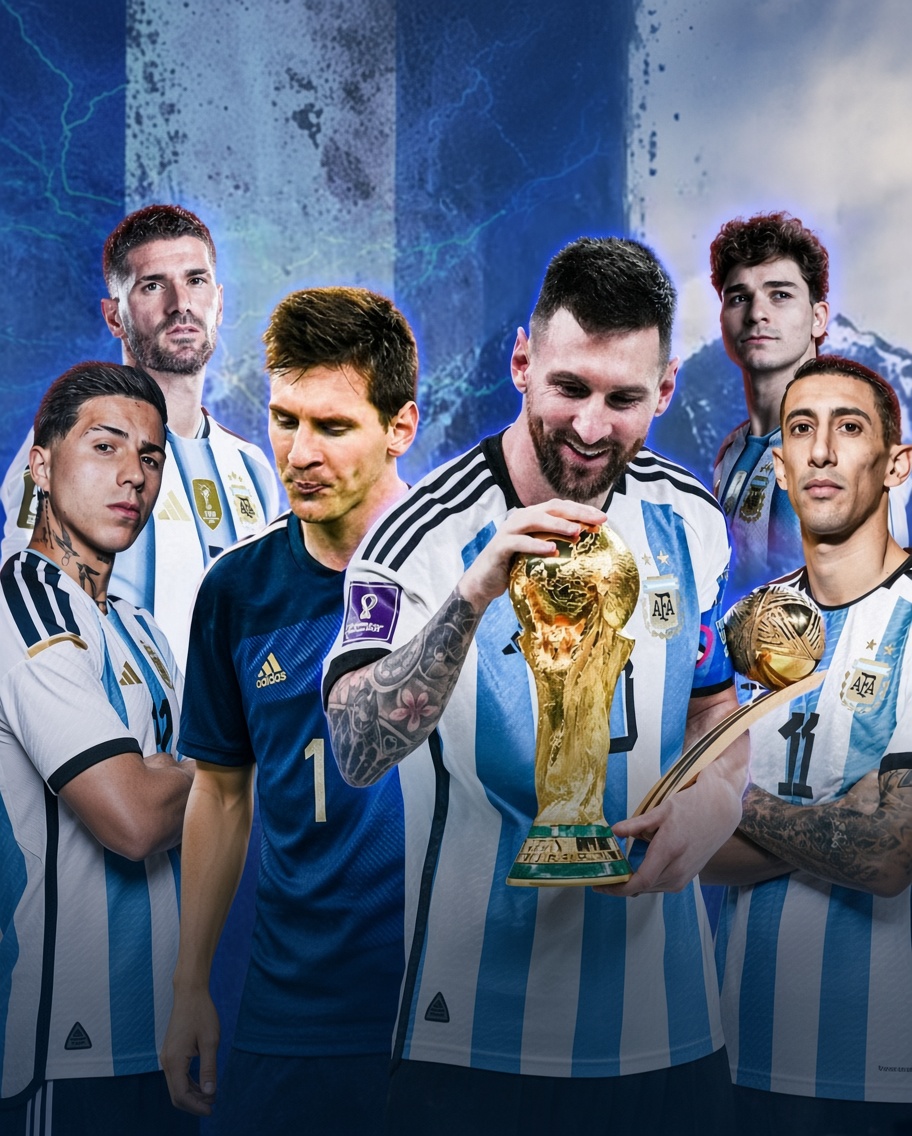
He added that if Messi asked you to go into battle for him, you would do it.
That might be the secret.
Messi never demands sacrifice from his teammates.
But precisely because he never demands it, they offer it freely.
Before they won with him, they watched him lose, again and again, on the long search for the treasure that Argentina wanted so badly.
He always gave everything he had, for the colors on his chest.
The current generation was not in the dressing room for the tragedies of his early and middle international years.
But they lived through those years as Argentines.
Three summers in a row, the national team lost a final.
The 2014 World Cup, the 2015 Copa América, and the 2016 Copa América Centenario.
After the loss to Chile in 2016, Messi cried and announced his retirement from the national team at age 29.
He returned about two months later.
In those years, the conversation back home kept circling around what Messi still lacked to be fully accepted.
And that is exactly the point where the psychology of the next generation flipped.
In the past, the pressure was on Messi.
He had to bring the cup home.
But when De Paul, Paredes, or Lautaro Martínez joined the team, they saw it from the opposite angle.
Here was a player who had given everything and came back after every failure.
He was judged again and again, and he still pulled on the shirt and gave Argentina whatever he had left.
So what was left for everyone else to do for him?
Dibu Martínez said it almost bluntly after the 2021 Copa América.
In an interview, he explained that the message inside the group was to give everything for the number 10, even joking that they would leave their lives behind for him.
When asked about winning at the Maracanã, Dibu answered that he was happier for Messi than for himself.
He told TyC Sports that he had wanted Messi to win that title even before he wanted it for himself.
De Paul explained a deeper layer after the 2024 Copa América, when Messi left the final injured and in tears against Colombia.
He said the whole team watched that image on the screen and told each other, we do this for him.
He also talked about the 2022 World Cup, where Messi tried one more time every four years even though failure was always possible.
When you live next to that kind of pressure, De Paul said, you cannot help but feel for him.
And here is the part that matters most.
That feeling did not vanish once Messi had won everything.
At the 2026 World Cup, after a victory, Messi himself admitted that he thanked his teammates because of them he got to play one more World Cup.
He knew they were giving a little extra, and that they did it from the heart.
So the sacrifice for Messi was never born from orders or worship.
It was built from shared memory and respect for a decent man.
They saw him fall.
They saw him come back.
And they understood the cost of trying again and again.
There was a time when people demanded that Messi pay Argentina a debt, after he had been so successful with Barcelona.
This generation chose something else.
They chose to repay Messi, and to win with him what he deserved.
Now think about this for a moment.
If your team had a player who scored eight goals and set up four more at a single World Cup, would it really be a sacrifice for everyone to do a little more for him?
For Argentina, the answer may lie in the results.
When people talk about Messi and teammates like De Paul, Paredes, or Dibu Martínez, they usually focus on emotion.
There is good reason for that.
After the comeback against Egypt at the 2026 World Cup, Paredes said the whole team wanted to stay beside Messi until the end, so that his last game would never come.
But behind the emotion, there is also a clear logic.
Put Messi in the best possible conditions, and he creates the difference.
Argentina gets goals, assists, and chances to win in return.
The 2026 World Cup was the final proof.
At 39, Messi finished the tournament with eight goals and four assists.
That means he was involved in 12 of Argentina’s 19 goals on the road to the final, a share of 63 percent.
Only Kylian Mbappé stood ahead of him in the race for the Golden Boot.
A player who directly takes part in nearly two-thirds of his team’s goals creates enough value to convince teammates that their extra effort will come back on the scoreboard.
De Paul put it in simpler words.
After Argentina beat Algeria 3-0 in the group stage, he admitted the scoreline looked wide because “we have the number 10.”
It is a short sentence, but it hits the nature of the thing.
His teammates understand that Messi can turn collective effort into something concrete.
They do their part, and Messi is often the one who turns that part into a goal or a decisive pass.
Of course, it is not always like that.
And of course, plenty of times other players stepped up and carried the load.
But Leo’s influence was still clear.
Before he said goodbye to the national team on August 31, 2026, Messi had scored 125 goals in 207 matches for Argentina.
At the last World Cup, even as he closed in on 40, he was still the soul of a team that reached the final, with brilliant moments in hard fights that looked like he had climbed into a time machine and returned to his early twenties.
Those numbers make the debate a little less emotional.
Argentina placed so much faith in Messi because that faith kept producing a competitive edge until his very last days in the shirt.
So maybe sacrifice for Messi should be understood in a more balanced way.
De Paul, Paredes, Lautaro, and the others could give their captain protection, affection, and a little extra effort.
But it was never a one-way street.
When they gave Messi more chances to decide matches, Messi was also bringing them closer to the prize.
In Argentina, affection made them want to do more for Messi.
The numbers explain why that choice could lead to victory.
There is one more detail worth noticing in the final chapter of Messi’s career with Argentina.
He knew exactly what his teammates were doing for him.
And instead of treating it as something he was owed, Messi said out loud, more than once, that their sacrifice was what kept him on the biggest stage.
Around his latest birthday, one of his teammates said, Messi thanked the entire group.
Thanks to them, he said, he got to play in another World Cup.
He said he understood his teammates were pushing a little harder so he could keep playing.
And more importantly, he said they did it from the heart.
It was not polite small talk.
It showed that Messi saw the work the people around him were quietly carrying.
A few days later, after the 3-2 comeback win over Egypt, he got even more specific.
He admitted there were moments when he did not have the legs to run as much as before, and his teammates had to put in extra effort to cover for it.
Messi called that a sacrifice, and then immediately steered the story away from himself.
He said he was proud to compete next to those players, and happy to belong to this group.
In that same match, after he missed a penalty, what haunted him most was the feeling that he had let the team down.
That detail says a lot about how deeply Messi values his teammates’ dedication.
He knew others were doing extra for him, but that gratitude came with a feeling that he had to repay it.
It was a two-way relationship, not a story where the whole team revolves around one man.
The 2026 World Cup also had another moment.
After his hat trick against Algeria, Messi broke down in tears.
He explained that he had been through some hard days because of his father’s illness.
He pointed to the support of the entire Argentina delegation and his teammates, the people who stood by him and gave him strength until he could steady himself again.
Then came August 31, 2026, when Messi announced his decision to leave the national team after 21 years.
Even in the way he closed the journey, the group stayed at the center.
In his farewell letter, Messi thanked the coaches, teammates, and staff who had traveled with him.
He also said he would keep cheering for Argentina from afar.
Maybe this is the quieter part of the Messi and Argentina story.
His teammates were willing to do more for him, and Messi understood exactly what he was receiving.
He once said they proved their love with words and actions.
And on the day he walked away, Messi still spoke of them as an inseparable part of his own journey.









