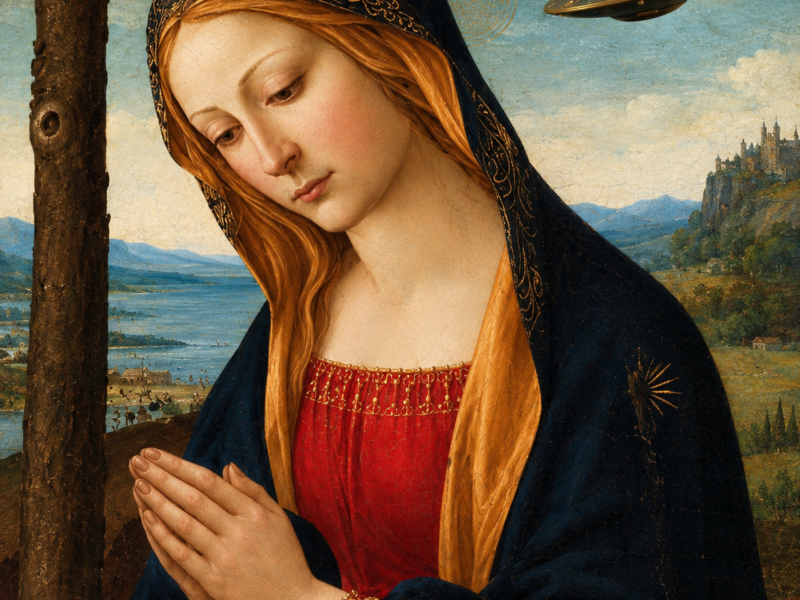
Why Are There UFO in This 1486 Painting?
Picture a 15th-century painting with a strange object hanging in the sky. Is it a UFO? Down below, a man with a dog stands and looks up at it. Look closely at the left side, and several more mysterious objects seem to float in the air.
Here is another painting from the same period. An unidentified object hangs in the sky and sends out a thin beam of light, almost like a laser.
And here is a medieval fresco of the crucifixion of Christ. In its corners are objects that look like spacecraft with pilots inside.
Examples like these turn up in all kinds of artworks from the past. Did our ancestors actually witness something they could not explain? Or is something else going on?
The most interesting part is that these supposed UFOs were only noticed after science fiction emerged. As soon as literature began talking about spaceships, people started finding them everywhere, even in places no one had ever noticed them before.
One of the most popular paintings among UFO enthusiasts is Madonna and Child with St. John, in the Palazzo Vecchio in Florence. It shows a familiar biblical scene and dates to the late 15th century, though its exact author remains unknown.
On the right side, above Mary’s shoulder, is a strange-shaped object resembling a flying craft. Look to the left, and three more similar objects appear. At first glance, it really does seem inexplicable, even extraterrestrial.
Art historians read it differently. This is a scene known as the Annunciation to the Shepherds, a subject familiar to artists of the 15th century. The objects are clouds from which an angel appears to announce the birth of Christ, and the man gazing at the sky with his hand raised to his forehead is one of the shepherds witnessing the event.
The episode comes from the Gospel of Luke. An angel announces the birth of the savior, and then a heavenly host appears before the shepherds.
In a work by Vincenzo Foppa, for example, the Annunciation to the Shepherds sits in the background of a nativity scene. An angel emerges from a cloud lit by golden rays, and below, a shepherd raises his hand to his forehead and gazes into the heavenly glow, just as in the other painting.
Similar depictions appear in dozens of nativity paintings. In nearly all of them, the angel is easy to recognize, and one of the shepherds almost always shields his eyes against the glory of the Lord described in the Gospel.
But what about the strange floating objects on the other side of the painting? To UFO enthusiasts, they look like unidentified craft or mysterious devices. In Christian art, they carry a completely different meaning.
They are stars, and they represent Mary’s perpetual virginity before the birth of Jesus, during childbirth, and after it. In paintings, three stars are usually placed on the Virgin’s veil, on her shoulders and forehead. Sometimes artists replace the stars with three rays of light, but the meaning stays the same: Mary’s lasting purity.
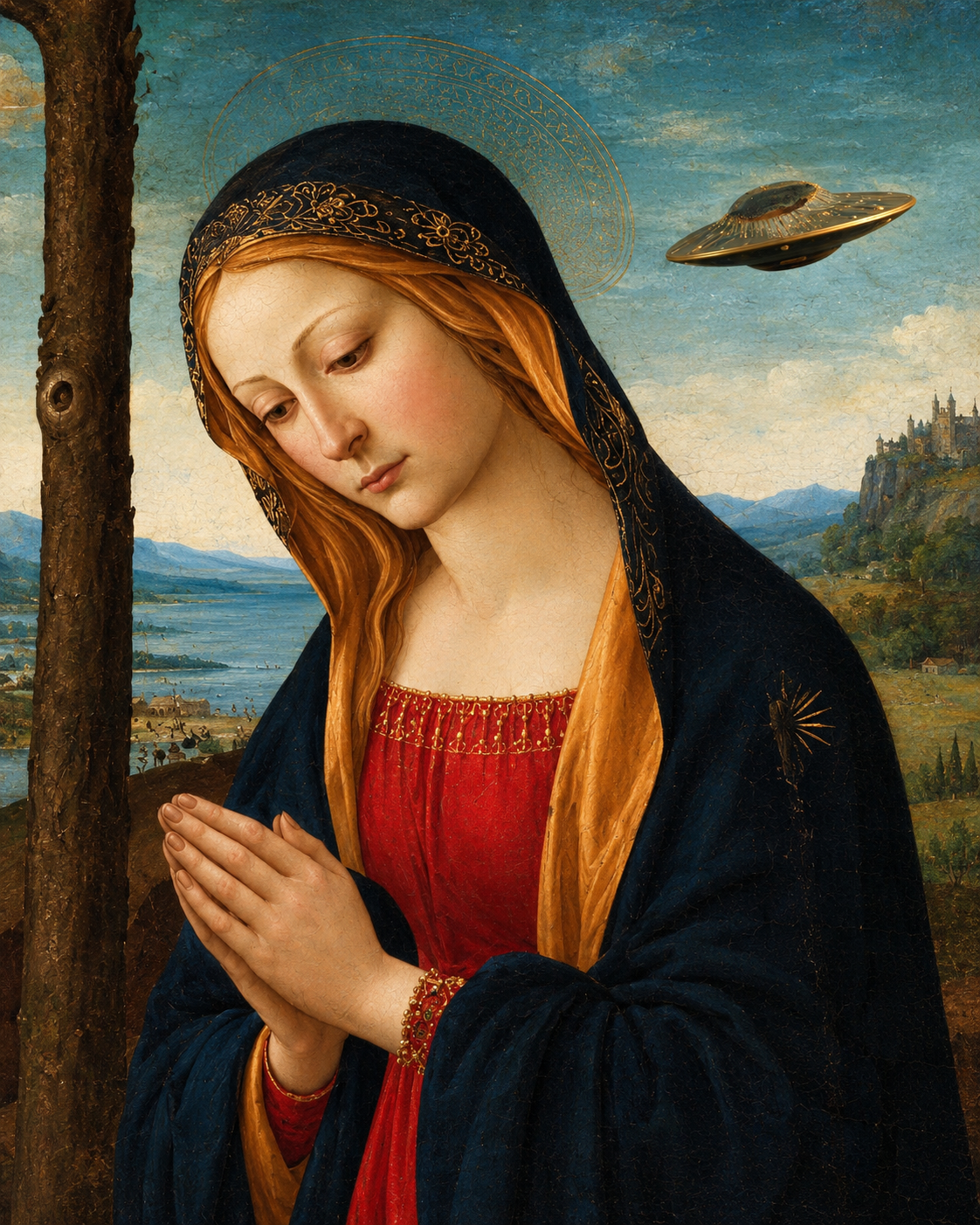
Sandro Botticelli’s Madonna of the Book shows the same device. According to art historians, these symbols belonged to an established iconographic tradition rather than being coded messages, which is what some UFO theorists suggest.
Another painting often cited by conspiracy theorists is Carlo Crivelli’s Annunciation with Saint Emidius, painted in 1486. It draws UFO enthusiasts because of the unusual object hovering above the city. Some see a flying saucer, and they see the beam of light as something resembling a laser.
The painting is remarkable for its detail. Crivelli rendered every element with care: the architecture of the city, the ornaments, the patterns on the clothing, the interior objects, and even the smallest features of the surroundings. It is not merely a religious scene but an entire world where every detail matters.
That is exactly what fuels the theory. In a painting this detailed, believers argue, an inexplicable object in the sky could not have appeared by accident.
The scene unfolds on a city street, with the Virgin Mary’s house filling the right side. This is one of the most famous subjects in Christian art, the Annunciation. Mary kneels humbly before a lectern on which the gospel lies open.
The laser-like beam aimed at her head is, in the traditional reading, a ray of light bringing her the news that she will give birth to Jesus. The artist placed a dove inside the beam, and in Christian iconography the dove represents the Holy Spirit, who is present at the Annunciation in the gospel.
The craft from which the beam emerges is no mystery either, say art historians. It is a circular formation of clouds holding two rings of tiny angels. Such heavenly spheres and angelic hosts were common devices in medieval art, and clouds, radiance, and angels helped artists convey God’s presence and his descent into the earthly realm.
Fra Angelico’s Annunciation also features a ray of light with a dove, and similar compositions appear in the works of many other masters.
Then there is the crucifixion fresco. In 1964, a Yugoslav student named Alexander Paunović noticed unusual details in a medieval fresco of The Crucifixion of Christ at the Visoki Dečani Monastery in Kosovo. On either side of the cross are two objects strikingly similar to space capsules.
The timing was perfect. In the 1960s, humanity was gripped by space fever as the Soviet Union and the United States raced to explore the cosmos. Against that backdrop, a fresco with figures that resembled astronauts became a sensation far beyond Yugoslavia.
The figure inside the object on the right seems to be piloting a craft. One arm is stretched forward as if gripping a steering wheel, while the figure looks back, apparently checking whether it is being pursued. Inside the second object, another figure seems to gesture that it will catch up anyway, pressing a finger against what looks like a control panel.
At first glance, it looks like a space chase painted centuries before aviation. Scholars of Byzantine iconography see something else. Similar depictions appear in other crucifixion scenes, which means they are not unique but part of an established artistic motif that predates the space age.
The mysterious objects, they say, symbolize the sun and the moon. In medieval Christian art, both were often shown as human figures or faces inside celestial discs, and placing them on either side of the cross emphasized the cosmic significance of the event. The crucifixion was understood not just as a historical event but as one that affected the whole world.
The sun was usually placed to the right of the cross and the moon to the left, sometimes as male and female figures with distinctive attributes. What looks like spacecraft with pilots today is part of the visual language of medieval art. The artist was not predicting space travel but using symbols familiar to the people of his time.
Another painting frequently cited by UFO theorists is the Miracle of the Snow, from the 15th century. The sky is filled with dozens of circular discs, as if a fleet of spacecraft hovered over the city. A crowd has gathered below, while Jesus Christ and the Virgin Mary sit on a cloud above them, watching. In the foreground, the Pope marks out a plot of snow-covered ground.
The scene looks unusual, but it is based on an old legend. According to tradition, on the night of August 4 to 5, 352, during the hot Roman summer, the Virgin Mary appeared in a dream to Pope Liberius and a wealthy Roman patrician named John. She told them to build a church in her honor on the spot that would be covered with snow the next morning.
When they woke, snow had indeed fallen on the Esquiline Hill despite the August heat. Pope Liberius went to the site and marked the outline of the future church in the snow. That is the moment in the painting, and the Basilica of Santa Maria Maggiore was later built there.
So what are the dozens of discs in the sky? The answer, according to art historians, lies in the conventions of 15th-century painting. In medieval and early Renaissance art, natural phenomena were often stylized, and clouds could take simplified forms.
Here they serve a narrative purpose. Snow falls from them as if emerging from white medallions, which is the very miracle the painting was made to show. The artist needed to show where the snow came from, and he did it in a way that would have been clear to viewers of his time.
The author, Masolino, was also working in an era when new principles of spatial representation were just gaining popularity. Perspective opened new possibilities, and many artists experimented with it eagerly, eager to show their skill. His other works show how carefully he approached it, trying to make his world more convincing.
The unusual clouds, in this reading, are not an attempt to portray something unknown. They are a device typical of the period, used to tell the story of a divine sign.
Why, then, are so many people willing to believe that flying saucers appear in medieval paintings? The main culprit, say skeptics, is time itself. It changes languages, and the language of painting is no exception.
A symbol that any churchgoer in the 15th century would have recognized can become a mystery a few centuries later. To modern viewers, some details look unfamiliar and may even resemble science fiction, but their meaning becomes clear in the symbolic language of the era.
Believers in the UFO reading are not convinced, and the debate over these images continues online and in art circles. But the conventional view is that old paintings seem remarkably modern not because they hold secret knowledge of the future, but because we view them through the lens of our own time.









