Why Are There Dinosaurs in This 1562 Painting?
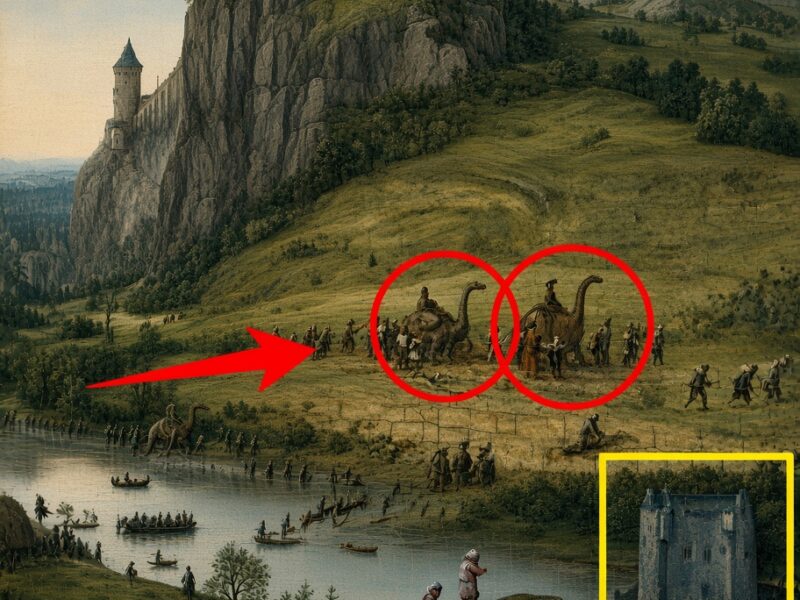
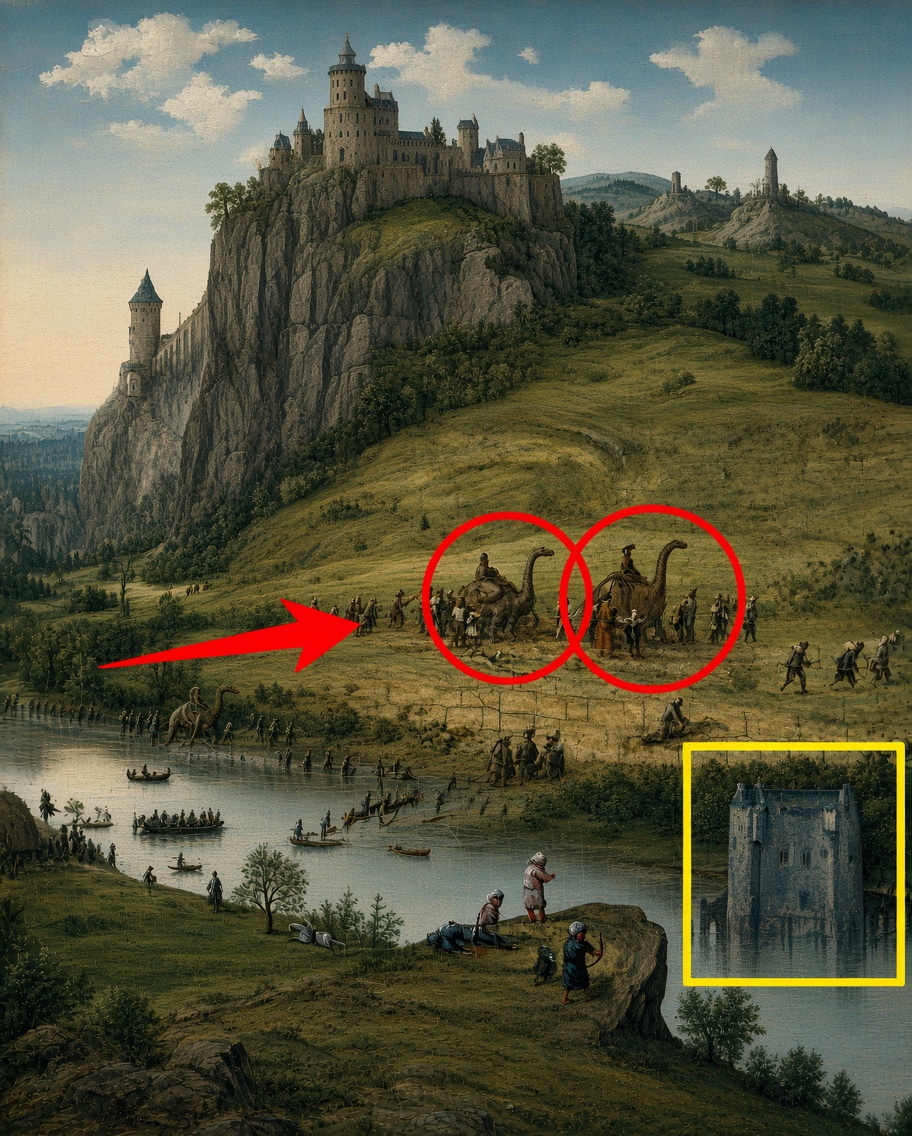
Here is a painting from 1562, and something in it looks very wrong. What are those animals? Small heads, long necks, massive bodies. To some viewers, they look just like sauropods.
There is one problem. The word dinosaur would not appear for another 280 years, when British anatomist Richard Owen coined it in 1842. So how did dinosaur-like creatures end up in a 16th-century work of art?
To find out, it helps to understand what is actually happening in the painting. It is more fascinating than the theory.
The work is The Suicide of Saul, painted by Pieter Bruegel the Elder. It is quite small, measuring roughly 33 by 55 centimeters, yet it is incredibly detailed.
King Saul is losing a battle against the Philistines. Bruegel himself left a clue about where to find the story, pointing to Saul, chapter 31, which refers to the First Book of Samuel. Open that chapter, and everything falls into place.
Saul was once God’s chosen one: tall, handsome, and beloved by his people. He became the first king of Israel. Over the years, though, he increasingly went against the will of the Almighty, and his fortune turned. God rejected Saul and withdrew his support.
Now his army faces the Philistines on Mount Gilboa. It is the king’s final battle, and it is lost. His sons have already been killed, and the Philistines are closing in from every side, their army resembling an enormous dark river of spears.
In the corner of the painting, on a rocky ledge, Saul finally appears. He asks his armor bearer to kill him, afraid that his enemies will capture him alive and humiliate him. The armor bearer refuses, unable to raise his hand against his master.
So Saul takes his own sword, plants it in the ground, and falls upon the blade. When the armor bearer sees this, he does the same and falls beside his king.
Meanwhile, the enemy is already approaching from below. The soldier at the front raises his hand and points toward the king, signaling the others. They do not yet realize they are too late.
Why, then, is the king pushed into a corner? The painting is called The Suicide of Saul, after all. If Bruegel had wanted to stress Saul’s tragedy, he could have placed him in the center and given him light, gesture, and drama. He did the opposite.
Art historians still debate the choice. Some read it as punishment for pride. Saul, once seen by everyone, has almost vanished from the picture, erased by the world just as he once disregarded the will of God.
Others believe the real protagonist is not the king at all, but the landscape. Notice where your eyes go. They do not linger on Saul, and you might not spot him at first. Instead, your gaze travels across slopes and valleys, farther and farther into the distance, where people become tiny figures.
In that reading, Bruegel is reminding us that the world does not revolve around a single hero. The king’s tragedy becomes one small part of a vast scene of war, flight, and destruction.
Now look toward the horizon. Cities are burning in the distance, which continues the story of chapter 31. When the Israelites learned that their king and his sons were dead, they abandoned their cities and fled.
Refugees are leaving on foot and on horseback. Some cross the river in boats, and others ride camels. Those camels are the so-called dinosaurs, with their small heads, long necks, and massive bodies.
The theory’s supporters point to two things. The animals look noticeably larger than the horses, and the shape of their necks and heads resembles that of sauropods.
But Bruegel was painting camels. Camels are mentioned frequently in the Bible as transportation in the Middle East, and, aiming for historical authenticity, he included these exotic animals to underline the setting.
The catch is that he had probably never seen a camel in his life. There were no camels in the 16th-century Netherlands, and he never traveled to the Middle East.
That is how camels often appeared in medieval art: awkward and elongated. Artists of the era regularly painted exotic animals they had never seen, relying on verbal accounts and written descriptions. And could you draw an animal from a description alone?
In 1515, Albrecht Dürer, one of the greatest printmakers of the Northern Renaissance, made an engraving of an Indian rhinoceros. It became a sensation and shaped how Europeans imagined rhinoceroses for the next 200 years.
The problem, as you might guess, was that Dürer had never seen one alive. He worked from a written description. His engraving gave the animal an extra horn on its back, plated armor instead of skin, and rivets, as if the creature had been assembled from metal.
For two centuries, Europeans believed that was what a rhinoceros looked like, and copies of the engraving even turned up in scientific works. Dürer was not trying to deceive anyone. He drew what he had never had the chance to see, a common problem in an age when hardly anyone had seen exotic animals firsthand.
There is another interesting detail. Pieter Bruegel the Elder founded an entire dynasty of artists. His son, Pieter Bruegel the Younger, painted The Adoration of the Magi, basing his composition on his father’s work and reinterpreting it in his own style. He often copied his father’s paintings.
That version features camels, too, and they are depicted accurately, with recognizable humps and proper proportions. An elephant stands nearby. The younger Bruegel had presumably never seen camels either, yet he painted them correctly.
That suggests people in the 16th-century Netherlands did know what the animal looked like. And if the son could do it, why couldn’t his father, one of the most talented artists of his time? Is something else going on?
The answer, according to the standard explanation, lies in the size. The entire painting measures just 33 by 55 centimeters, and each camel is less than a centimeter long. Try drawing a hump, legs, a neck, and a head in an area smaller than your fingernail. You would need a brush with a single hair.
Bruegel was an extraordinary master of tiny detail, but even his skill had physical limits. When an image is this small, details must be sacrificed for the overall composition, and what mattered here was the movement of the refugees, not the anatomy of every animal.
A few brushstrokes turn a camel into a silhouette: a thin neck, a small head, a heavy body. Then the brain starts to recognize familiar shapes and fill in what is missing from what it already knows. We project dinosaurs onto Bruegel’s tiny figures, and then we can no longer unsee them.
The lesson is that before believing a sensational theory, it is worth digging a little deeper. Science tends to offer answers more interesting than any fantasy, and the explanation here is simple. Bruegel did not possess secret knowledge of dinosaurs. He was a talented artist of his time.
Nearly five centuries separate us from Bruegel, and in that time we have learned so much about the world that we now view old paintings through the lens of modern knowledge. Those who favor the dinosaur reading may not be convinced, but the dinosaurs did not appear in 1562. They appeared much later, and they live not on the wooden panel but in our minds.









