
What Ottomans Did To Christian Nuns Was Worse Than Death
The bells of the convent rang for the last time.
High in the hills of Thessaly, where olive trees shivered in the autumn wind, a small band of nuns gathered in their fading chapel. They prayed beneath cracked frescoes, among saints whose faces had been scraped away by age and sorrow.
On the horizon, fire shimmered. Ottoman banners were already visible, red cloth fluttering like sparks across the mountains. The women knew exactly what that meant. No riders came from the nearby towns, and no soldiers remained to guard them. There was only the stillness before conquest.
Their abbess, Sister Eleni of Lissa, stood before the altar holding a silver crucifix that had survived a century of storms. If they breached the walls, she whispered, the sisters should keep their vows inside their hearts, where no one could take them.
The story, as it has been told for generations, says she was wrong. When the empire’s armies reached the gates, vows, prayers and sanctity meant nothing against what history tried to erase.
The first stones of the convent collapsed before sundown. The hymns that once filled its halls were drowned out by iron and screams. The Ottomans, the account says, didn’t waste arrows on holy places. They shattered the gates with cannon fire, both a warning and a declaration.
To them, a convent wasn’t sacred ground. It was a symbol of defiance, proof that the cross still dared to rise in conquered soil.
Inside, the sisters hid their relics: silver chalices, embroidered icons and fragments of saints’ bones beneath the chapel floor. They believed that if their bodies were lost, their faith might still endure. But the soldiers weren’t after treasure. They wanted evidence that they had crushed not just an enemy’s armies but his god.
By nightfall, the surviving nuns were herded into the courtyard. Torchlight turned their white robes into shifting gold and shadow. They were told they would be taken before the pasha, a promise few were said to live to see fulfilled.
What followed became legend, so grim that even church chroniclers are said to have avoided the details. By dawn, the convent was ash. Smoke drifted from the refectory where the women had once shared bread and silence, and Ottoman flags flew from the bell tower to signal nearby units that resistance was over.
Yet in that courtyard, something unexpected happened. The soldiers waiting for screams heard singing instead.
Bound with rope, the surviving sisters began to chant a hymn not of despair but of defiance. It was the Agnus Dei, the Lamb of God who takes away the sins of the world. Their voices trembled but never broke.
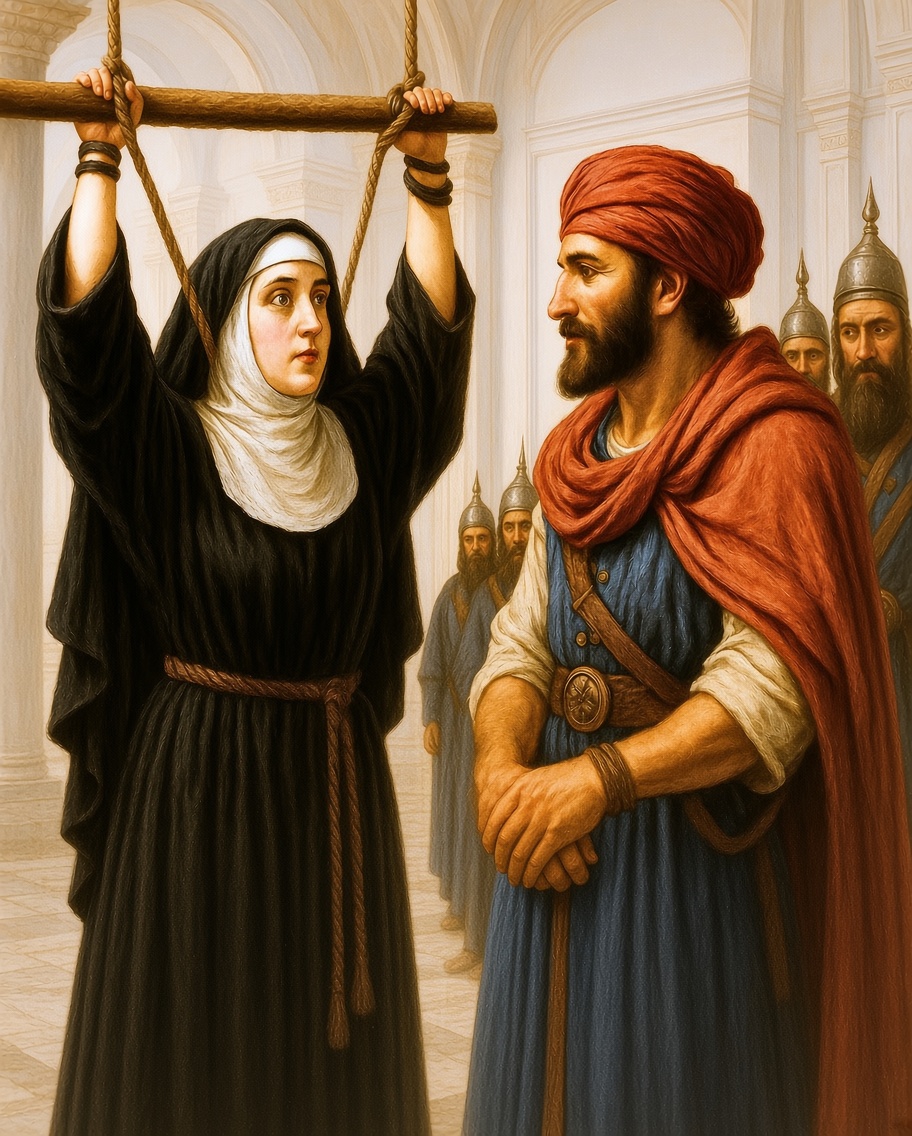
The Ottoman captain, unsure whether to laugh or silence them, ordered the abbess dragged forward. Eleni still clutched the silver cross rescued from the altar. He promised mercy. If she renounced her god and accepted the conqueror’s faith, her sisters would live.
Her reply sealed her fate: “I have already given my life. What else can you take?”
The captain hesitated, perhaps moved, and turned away, leaving her to his men. What happened next was never written in full. Even Ottoman records, which glorified victory, described it only as discipline for those who refused reason. Yet in later European letters her name resurfaced: Eleni of Lissa, the nun who would not kneel.
By midday the convent’s bells were melted down for coin, and the rooftop cross was shipped east as a trophy. Rumors soon spread through nearby villages. They said that when the wind swept through the ruins at night, one could still hear women’s voices, not crying but praying.
The smoke had barely cleared when the march began. What remained of the order, 22 women in torn habits, was driven south toward the coast with their ankles bound, watched by Ottoman horsemen. They weren’t prisoners of war so much as symbols of conquest, proof that even sacred walls could fall.
The journey was merciless. The sun scorched the road, and the sisters, who had never stepped beyond their cloister, stumbled from thirst and exhaustion. When one fell, another lifted her veil so the soldiers wouldn’t trample it, a last act of dignity in a world stripped of mercy.
Their abbess was gone, but her last words were said to endure among them: “If you cannot hold the cross, hold each other.”
After seven days of walking, the captives reached the port of Volos. Ottoman galleys waited there, ships built not for comfort but for control. The women were herded aboard and shackled to wooden benches where criminals and slaves had once sat. As the sails caught the wind, the shores of Greece faded, and with them everything the sisters had ever known.
The ship’s overseer, a man named Yusef Agha in the telling, kept meticulous records of cargo, spices, coins, textiles and religious captives. According to the story, it was this ledger, discovered centuries later in the archives of Istanbul, that confirmed a tale once dismissed as legend.
The voyage to Constantinople lasted 12 days. Storms lashed the deck, salt stung their wounds and hunger hollowed their faces. What broke them most, the account says, wasn’t pain. It was silence. No one spoke to them except to bark commands, and they drifted like ghosts between sky and sea.
At night the youngest, Sister Magdalena, whispered psalms under her breath. Her voice was barely audible over the waves, but even the chained prisoners around her, Greeks, Serbs and Italians, turned their heads to listen. For a moment, the sea seemed to still.
When the ship entered the Bosphorus, the sisters saw the skyline of Constantinople rise before them, its domes and minarets glowing like blades in the dawn. The city had long been called the city of the world’s desire. Now it would become their cage.
From the docks they were paraded through narrow streets lined with merchants, soldiers and slaves. Locals paused to stare, because Christian nuns among captives were a rarity even in an empire built on conquest. They were led past the ancient walls toward the imperial district, where their fates would be sealed.
In the shadow of Hagia Sophia, once the great cathedral of Christendom, they were forced to kneel. As the muezzin’s call echoed from the minarets, one sister whispered, “We are home, but it is no longer ours.”
Before dawn they were taken into a marble courtyard ringed by towering columns. It was not a dungeon. It was the Divan, the Imperial Council, where the sultan’s will ruled above all. Here, captives were judged not by kings or priests but by the empire itself.
At the center of the hall sat the grand vizier, a man whose expression betrayed nothing. To his left, scribes waited with ink and parchment, ready to record names, ages and intended uses, entries said to survive in registers stained by wax and time.
The sisters stood in torn habits with their eyes lowered. Through translators they were told the sultan had granted mercy on one condition. Those who accepted conversion would receive new names, food and a life within the palace. Those who refused would face “the discipline of faith,” a phrase that could mean imprisonment or disappearance.
None spoke. Sister Magdalena trembled. She had seen what happened to other captives brought before the vizier, Greeks, Armenians and Slavs, all swallowed by the empire’s silence.
Before the guards could drag her forward, one of the elders, Sister Theodora in some tellings, stepped out of line. She addressed the vizier not as a captive but as someone who had lived long enough to watch empires rise and decay. “You may rename us,” she said, “but you cannot rewrite the prayers we carry.”
The interpreter hesitated, unsure whether to translate. When he did, the vizier’s face stayed unreadable. His reply was cold: “Prayers fade when the tongue forgets how to speak them.”
With a motion of his hand, the sisters were dismissed, not to execution but to the lower chambers of Topkapi Palace, where unclassified captives were kept. Some would call it mercy. Others would later call it something far worse.
They were given a different kind of prison, one disguised as service. Beneath the palace gardens lay a labyrinth of stone halls sealed from the sun, each chamber with a thin slit of light barely enough to tell night from day. The nuns were stripped of their habits, dressed in rough garments and told they would now clean floors, sew garments and feed fires for the upper chambers.
It was meant to break them, to turn holiness into servitude. But the captors, the story says, underestimated them. These were women who had already lived under vows of silence and denial. Hunger, cold and solitude were nothing new. For them, suffering was not punishment but devotion made real.
At night they prayed in secret. One carved a cross into the clay wall with her fingernail. Another traced verses in the dust beneath her straw bed. They began counting days by the rhythm of the muezzin’s call, not out of conversion but as a defiant clock for a faith that refused to die.
Soon whispers spread among the servants. There were stories of the silent sisters, foreign women buried beneath the palace who never spoke and never begged. Some called them cursed. Others called them saints.
Days bled into months. Their hands blistered from washing linens, polishing brass and tending fires that gave heat to others but none to them. Their names were forbidden. Each woman was given a number, a mark of ownership. The empire believed time and hunger would bend even the strongest faith.
Then came the next stage, a test disguised as mercy. First there was kindness. Food, oil and silks were sent to their quarters. Learned men from the palace came to speak gently, offering rest, peace and small freedoms. One imam told them that their God and his were not enemies and that if they took the Ottoman tongue they would be free.
They understood what that freedom meant: erasing the memory of who they were. To forget was the one sin they could not commit. Sister Magdalena, once frail, began to emerge as their strength. She whispered fragments of scripture remembered from the convent, half-forgotten verses reshaped into prayers that kept them alive.
When persuasion failed, the account says, the masks came off. The torches were doused and the food was cut in half. There were no more kind visits, only silence and darkness. One by one they were taken to a narrow room where scribes waited and told to repeat a single phrase of submission. Those who did were allowed to live within the palace walls. Those who refused disappeared.
It wasn’t one grand act of cruelty, the story insists, but a slow, methodical breaking of the soul. Faith wasn’t torn away by force. It was worn down by hunger, waiting and a quiet voice asking why anyone would suffer for a god who doesn’t answer.
A few gave in. Two sisters from Corfu, twins, finally whispered the words. They were dressed in silk and taken away, and were never seen again. For those who remained, each disappearance hardened their resolve.
The elder who had once stood before the grand vizier grew thin and pale. When guards demanded her name, she smiled faintly. “Call me silence,” she said. Her defiance spread, and from then on none of the sisters spoke to their captors again. When questioned, they answered only with stillness, and in that stillness they reclaimed the one thing the empire thought it had taken: control.
Official records mention them only in passing, as foreign captives, unresponsive and unproductive. To the Ottomans they were failed conversions. To the story’s tellers, they became living proof that faith could survive where walls and chains could not.
By the time spring returned to the palace gardens above, only 11 of the original 22 were still alive. The guards called them ghosts in rags. Servants whispered of something stranger: that deep in the night, faint voices could be heard beneath the palace, chanting in a language no one remembered but everyone feared. It was the same hymn they had sung as their convent burned.
In those forgotten corridors, where no sunlight reached, the survivors found an old sealed archway buried in dust and stone. At first it was merely a hiding place. Slowly it became something sacred. They used broken pottery as candle holders and a scrap of linen as an altar cloth, and they fashioned a crude cross from a shard of shattered mirror.
In this secret chapel they gathered each night after the palace slept. There were no hymns and no sermons, only whispers. Each woman knelt and shared a memory: a home, a church bell, the warmth of bread before dawn. These memories became their new psalms, small offerings to a god who still listened in the dark.
A Venetian prisoner is said to have written about strange voices echoing beneath the harem, women singing in Latin to a god not of that empire. For centuries, the story goes, historians dismissed such reports as superstition, until archaeologists beneath Topkapi uncovered a small chamber lined with Christian carvings. There were crosses scratched into the stone and a Latin phrase half erased by time, lux in tenebris lucet, the light shines in the darkness.
That small discovery, the account says, changed everything. It proved these women hadn’t simply vanished. They had left a mark, a silent revolt etched into the walls.
Inside the hidden chapel, Sister Magdalena, now the center of their faith, began marking the walls with charcoal. Names couldn’t be written openly, so she devised symbols: a bird for each sister still alive, a small flame for those who had been lost. Whenever a bird failed to appear, it meant another had disappeared.
The guards never uncovered the chapel, but they began to notice subtle changes in their captives. Despite hunger, cold and confinement, the women moved with a quiet, almost unnatural calm. The overseers labeled it madness. The scribes watching them, the story says, recorded something else: a strength not of this world.
Their secret worship continued for months, perhaps years. The empire tried to erase every trace of their existence, but the chapel became their ultimate act of defiance, carried out not with weapons or protest but with a faith that refused to die.
By the time a new sultan rose to power, only a handful of the sisters remained, worn, aged and almost forgotten. Yet beneath the palace their secret chapel endured, silent and hidden.
By 1482, in the story’s chronology, the palace had changed hands again. A new, young and ambitious sultan took the throne with orders to purge any trace of weakness from his predecessors. Every servant, concubine and laborer was recorded meticulously, except one group. In the Topkapi archives, under columns of names, there was reportedly a blank space where 21 entries should have been.
The ledger, the account says, read only: unfit for service, disposed. There were no dates, no burial records, nothing. History erased them not with fire but with withheld ink. And yet, the account argues, the silence itself became proof, because only something shameful is hidden so carefully.
Centuries later, an Ottoman courtier’s diary reportedly surfaced in the archives of Bursa, mentioning foreign women who had refused to submit and disappeared beneath the palace foundations. Another letter, said to have been intercepted by Venetian spies in 1484, spoke of nuns who wouldn’t bow to the sultan’s will. Together, the story says, these fragments reveal a truth the empire tried to bury: the deliberate erasure of women who had become spiritual symbols of resistance.
The last record of Sister Magdalena allegedly comes from decades later, written by an Italian pilgrim. He recounted a tale whispered by a palace servant about a woman who sang to her god until the guards sealed the room. Her name was unknown, but the faint hymn he described survived the stone itself.
Tales of the vanished sisters became whispered rumors among slaves and servants. On certain full-moon nights, the lower halls were said to grow cold and the air to smell faintly of incense, though no fire burned. A French diplomat writing in 1712 reportedly noted that among the older palace attendants persisted a forbidden story of Christian women who had sung themselves into heaven. He dismissed it as myth.
Historians approach all of this with caution. No surviving source the account names has been independently identified, and the ledger, the diary, the intercepted letter and the chamber at Topkapi are described without catalog numbers, dates of discovery or the names of the archaeologists said to have found them. Some of the details also sit awkwardly with the historical record. Topkapi was only newly built in the period the story describes, and the account’s timeline of sultans and conquests is loose. Many scholars therefore treat the tale as legend or historical fiction rather than documented history.
Supporters of the story reply that captives’ experiences were rarely recorded by the empires that took them, that gaps in the archives are themselves a pattern, and that oral traditions often preserve what ledgers leave out. It is also well documented that Christian women were among those taken captive in Ottoman conquests, as in many conflicts of the era, and that those stories have been told and retold for centuries in forms that blur memory and legend.
Whether the sisters of Thessaly existed as described or stand in for countless unnamed women, the story endures. The chapel, as the account tells it, lies in ruins now, but the carvings remain, faded prayers etched into the walls and a whisper of women who refuse to be forgotten.









