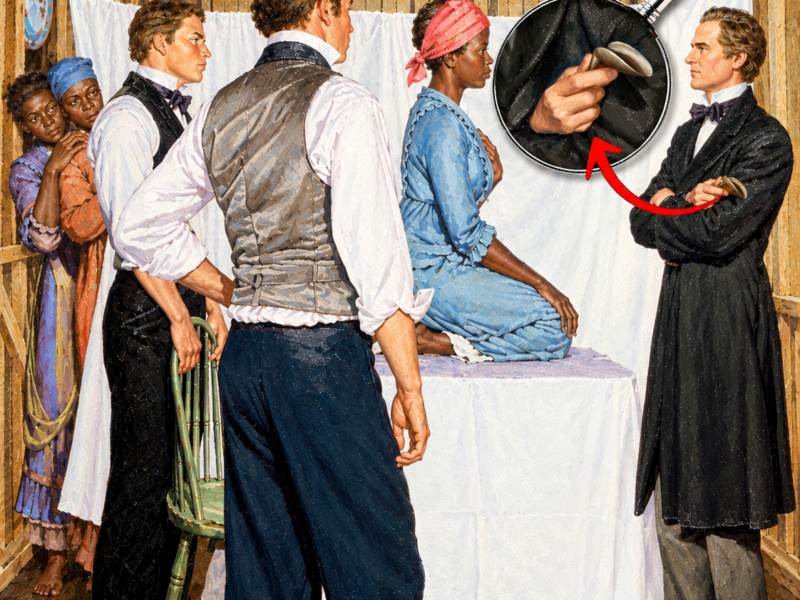
What Is He Holding? The Chilling Answer!
At first glance, the painting seems to show a momentous and respectable scene from medical history. But behind its calm, professional facade hides one of the darkest and most disturbing stories in the history of modern science.
It isn’t disturbing because of deformed creatures or terrifying landscapes. What unsettles viewers is the context it conceals.
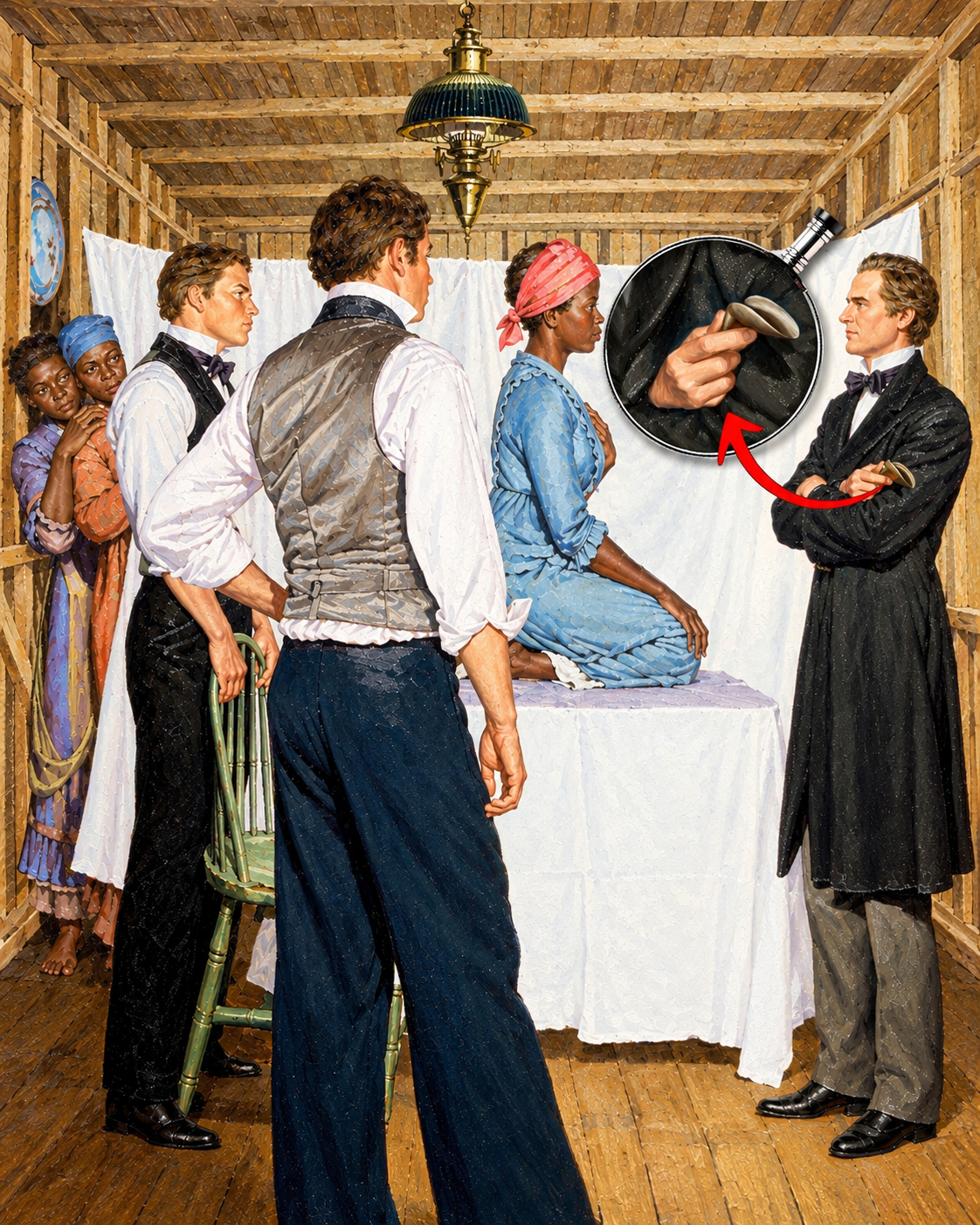
The work is called J. Marion Sims: Gynecologic Surgeon. It was painted by American artist Robert Thom around 1952, and it is held today in the collection of Michigan Medicine at the University of Michigan.
It’s easy to fall into the trap of reading it as a simple historical tribute. A doctor stands confidently on the right side of the room. A patient kneels on an examination table in the center. Two other men stand nearby, apparently ready to assist, and two young women peek out from behind a white curtain on the left.
It looks like a standard portrait of a nineteenth-century medical breakthrough. To understand why it is so unsettling, you need to know who the man with his arms crossed really is.
He is Dr. James Marion Sims, known for more than a century as the father of modern gynecology. Sims earned that title by inventing surgical techniques and instruments, including the modern speculum, that transformed women’s health and cured devastating complications of childbirth.
But what the history books overlooked for decades, and what this painting tries to sanitize, is exactly how he perfected those techniques.
The young woman kneeling on the table is named Lucy. The two women behind the curtain are believed to be Anarcha and Betsey. They were not ordinary patients who came to a clinic seeking help. They were enslaved Black women.
Between 1844 and 1849, in a crude backyard hospital in Montgomery, Alabama, Sims performed dozens of experimental surgeries on them, without any anesthesia. Early forms of anesthesia were becoming available at the time, but Sims believed his experimental procedures did not warrant it.
He operated on Anarcha alone thirty times before declaring his technique a success.
Defenders of Sims have long argued that he was a man of his era, working at the edge of medicine when anesthesia was new and untested, and that his methods ultimately spared countless women from lives of suffering. Critics answer that the women had no power to refuse, that enslaved patients cannot meaningfully consent, and that a good outcome for later generations doesn’t excuse how the research was done.
Go back to the painting with that knowledge, and every detail takes on a different meaning. Look at Sims’s posture. Oddly, he is not shown in the middle of a procedure, covered in blood or sweat. He stands comfortably, with the bearing of a ruler.
He wears a stark black coat that contrasts deliberately with the rustic wooden walls of the shed. His arms are folded across his chest. In his hand, he holds a silver instrument, his newly invented speculum, almost like a symbol of absolute authority.
So that’s the answer to the question in the headline. And he isn’t looking at Lucy with the empathy of a healer. Many viewers read it as the calculating gaze of someone observing an object.
Then there is Lucy herself. Thom painted her kneeling on the table, clutching the collar of her dress. Her posture suggests a mixture of apprehension and forced submission.
The two medical apprentices stand to the left, observing her openly. The detail shows the absolute lack of privacy and dignity these women were afforded. They were placed on display, completely vulnerable, for the education and ambition of white men.
But the painting leaves out something even more remarkable. When Sims’s medical apprentices grew tired of his constant, unsuccessful experiments and abandoned him, he did not stop. Instead, he trained the enslaved women themselves to assist him.
While recovering from agonizing surgeries, they were forced to act as his surgical nurses. They ran his hospital, cared for one another, and, in the view of many modern historians, helped co-create the breakthroughs for which Sims took all the credit.
Yet in the painting, they are relegated to the shadows behind a white sheet, peeking out as if they were merely curious bystanders rather than the true heroines of the advance.
Thom was commissioned by a major pharmaceutical company to paint the image in the 1950s as a celebration of medical progress. His intention was to immortalize a hero. Inadvertently, he left us the only known visual representation of Lucy, Anarcha, and Betsey.
The painting forces an uncomfortable question. How should we view the medical advances we benefit from today, knowing they were built on the suffering and exploitation of people who were entirely erased from the narrative?
Some argue that art like this belongs on display precisely as a reminder of that history. Others feel a celebratory portrait of this kind shouldn’t hang without a hard look at what it leaves out.









