What Happens When an Amish Wife Locks the Bedroom Door, I Never Did It Again
The Night I Locked the Door
The little iron latch struck the plate with a sound so sharp that I felt it in my teeth.
It was nearly ten o’clock, and the bedroom smelled of cold soap and the damp wool of the dress I had hung beside the stove earlier that evening. My husband was on the other side of the door. I had just locked it against him.
In our house, that was something I had never done. And by morning, I would understand why I could not go on living as though a closed door was the same thing as a cruel heart.
My name is Katie. I grew up among Old Order Amish families, where the doors inside a home usually stood open and where there were more unspoken expectations than a young woman could count. I tell these stories because I know how different a quiet house can look from the outside and feel from the inside.
If you have ever needed a little space from someone you love, I hope you will tell me in the comments how you found the words for it. I wish I had found mine before I reached for that latch.
I need to begin before that night, because otherwise the door sounds like the whole story. It wasn’t. The door was the last small thing in a long line of smaller things.
The Ordinary House We Built
We had been married a little more than a year. We lived in a plain white farmhouse set back from a gravel road, with a vegetable garden on the south side and a wash line stretched between two maples. Our bedroom was upstairs beneath a sloped ceiling. In summer, it held the heat until midnight. In winter, you could wake with your nose cold outside the blankets.
There was a washstand in the corner, a narrow chest, and a wooden chair that held the day’s clothes when we were too tired to fold them. When I first moved there, I loved how ordinary it all was. I loved learning the sounds of another home. The creak in the third stair. The uneven click of the back screen door. The way the kettle began with a soft whistle before it grew impatient.
I thought that becoming a wife meant learning those noises until I belonged among them. Some parts of that were beautiful. Other parts I mistook for duties simply because no one spoke about them directly.
My husband, whom I will call Daniel here, was not a man who raised his voice often. In the daylight, he was careful with tools, quick to help at a barn-raising, and patient with a stubborn horse. People praised his steadiness. I did, too.
But in our first year of marriage, we discovered that two people could be quiet for entirely different reasons.
Daniel grew quiet when he believed he had been wronged. I grew quiet when I was afraid of making things worse. From the outside, those two silences could look peaceful. Inside the kitchen, they left us sitting on opposite sides of the table with a whole evening between us.
The Weight of Small Things
That October had been wet and tiresome. The lane was full of ruts. Laundry stayed damp too long. Canning was nearly finished, but apples still crowded the cellar steps in two-bushel baskets. Every morning, I rose before six to stir the stove, warm water, and see what needed doing before breakfast.
We were not the only family working hard. Everyone around us was busy. That made it difficult for me to admit that I was tired in a way another night’s sleep would not mend. I was tired of agreeing before I had considered a question. I was tired of saying that a thing was all right when it was not.
I had started giving answers that kept the room calm rather than answers I could stand behind. This was not something Daniel had asked me to do in so many words. It was a habit I had carried into marriage, a habit that became stronger whenever our wishes collided.
I did not know how much resentment a person could store inside the sentence, “It’s fine.”
The Supper Table
On the day of the locked door, we went to supper at a neighboring family’s home after helping with their autumn work. There were twelve people at the table, and the windows had fogged from the boiling potatoes. I can still picture the blue-rimmed serving bowl moving from hand to hand, and the last square of bread left on a platter.
Someone asked about our plans for the winter. Daniel answered for us. He said we would take on an additional piece of work for a relative, which meant several more evenings away from home. It was sensible work. There would be money from it, and it was kind to help.
I had not known he had agreed to it.
No one at the table noticed anything. I passed the butter. I asked for more coffee for the older women. I smiled at a small joke about the mud. What I wanted to say was that we had discussed how tired we both were, and I had hoped for one season in which we might spend more time together. But I was not going to start that conversation with twelve people listening.
I told myself we could speak after we got home.
The Ride Home
We left just after eight. The horse moved slowly through the soft spots in the lane, and the wheels made a dragging sound as they pulled free. The trees along the road looked black against a thin strip of sky.
Daniel talked about the job, about how many days it might take, and about getting the materials before the ground froze. I watched the dark fields pass. Once he asked whether I was cold. I said no.
It was such a small lie. I was cold, and I did not want him to think I was angry, though I was angry. I did not know how to be one thing out loud without revealing the other.
The Argument
At home, I carried the covered dish inside and set it on the table. Daniel went out to settle the horse. By the time he came back, I had changed into an old work dress and washed the plates we had taken along. The tin basin made a hollow note every time I dropped a spoon into it.
He came through the doorway with mud on the edge of his boots and began explaining again why the work would be good for us. That word stayed with me. Us. It was the word he used for a decision I had heard about at someone else’s table.
I asked why he had not talked with me before saying yes. He looked surprised, as though the question had come from the wrong direction. He said there had been no reason to worry me with the details because he knew the answer would have been yes.
I told him that perhaps it would have been, but I wanted to be asked. He replied that we were discussing a few evenings’ labor, not moving to another state.
I can understand now that he heard an accusation in my voice. At the time, all I heard was that he had already decided my opinion did not matter.
We were both too proud to say what we really meant. He began listing the reasons the arrangement was practical. I began listing the other evenings he had been away. The conversation moved backward through months, collecting old disappointments the way a skirt hem collects burrs.
Nothing we said was entirely untrue. That made it worse. Each of us could defend every sentence and still fail to understand the other.
The Breaking Point
I remember the clock striking nine. I remember setting a clean cup on the shelf much harder than was needed. Daniel told me I was making a large problem from a small matter. I said that I would rather he told me plainly when my thoughts were unwanted. He said he had never said that.
He was right. He hadn’t used those words. Yet the feeling had been sitting with me for months. It is possible to be right about the words and still wrong about what they have done.
He wanted to keep talking until the matter was settled. I wanted the conversation to stop before I said something ugly. I tried to explain that I needed to be alone for a while. Daniel said that married people should not turn their backs on each other when things were difficult.
I agreed with that in principle, which made it harder to say that a little distance was not the same as abandonment.
He followed as far as the foot of the stairs, still trying to finish his point. I went up, holding the rail because my hands were shaking. There was nothing grand about my decision. I did not climb the stairs planning to make a statement. I wanted ten quiet minutes. I wanted a room where I could hear my own thoughts without answering another question.
The Latch
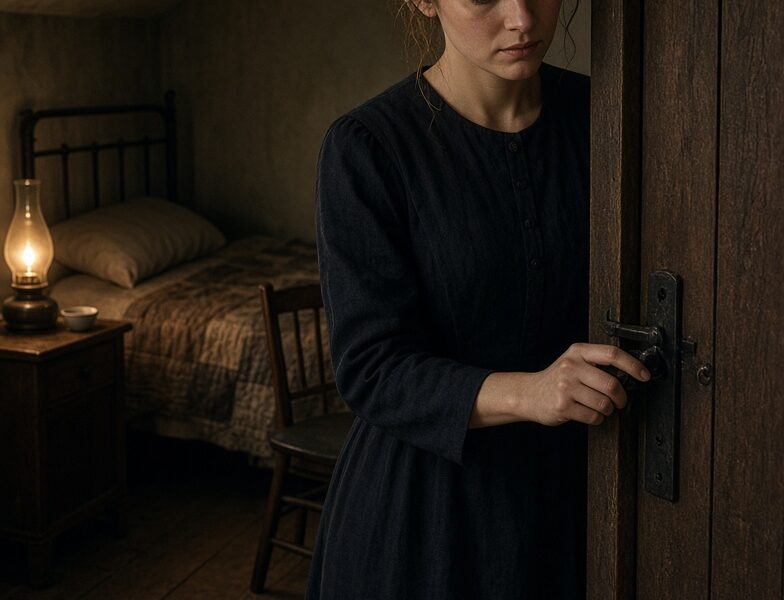
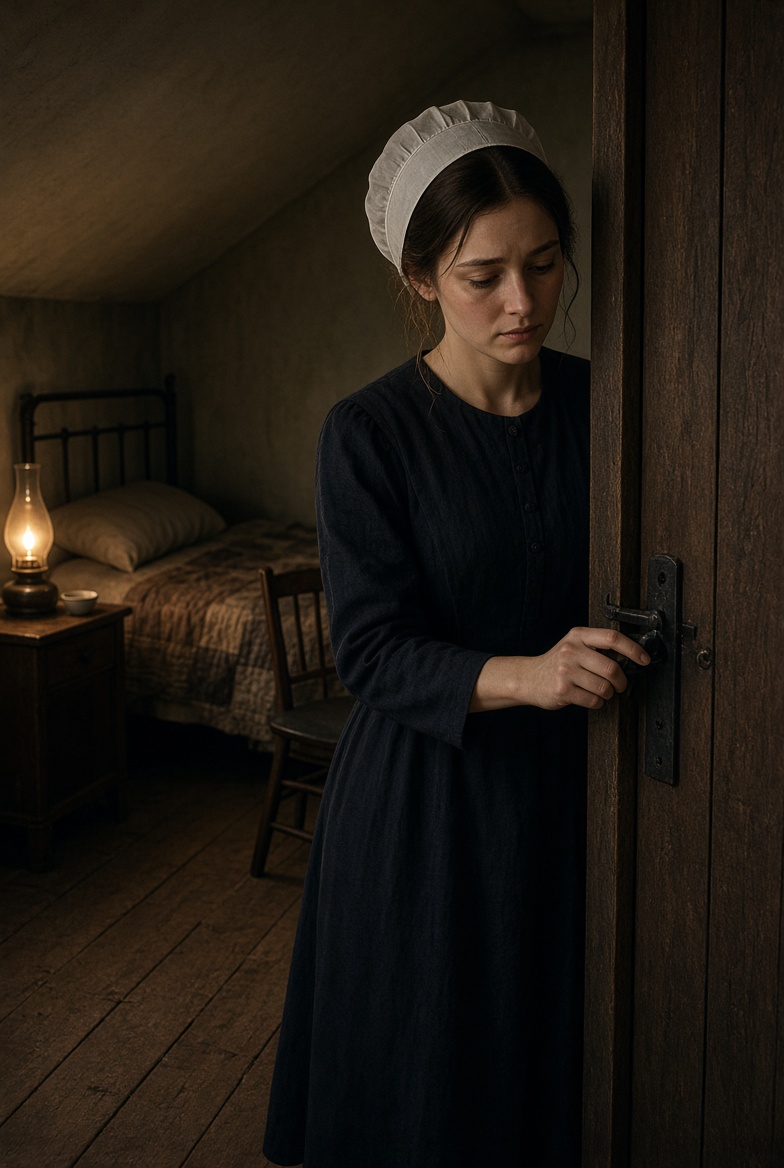
When I went into the bedroom, the lamp on the washstand was turned low. I set it higher, shut the door, and stood facing the narrow brass latch that had been there since before we married. I had used it when changing clothes if visitors were staying. I had never used it with Daniel in the house.
I slid it across.
At once, the silence felt different. It did not feel like peace. It felt like the stillness after a plate falls, when you know it has broken but have not yet looked down.
Daniel reached the landing and tried the handle. He did not force it. He said my name once in disbelief. Then he asked me to open the door so we could talk like husband and wife.
I sat on the edge of the bed staring at the pale seam along the floorboards. I could see the lamp light slipping through it. I had wanted the argument to end, yet I had brought it upstairs with us.
I told him I needed a few minutes. He asked how many. I did not know. He said he had never expected his own wife to lock him out of his bedroom.
The shame in that sentence was immediate. I imagined explaining the moment to our families, though no one else was there. I imagined their questions. Was I trying to punish him? Had he frightened me? Had I forgotten that we had promised to share a life?
I was afraid that one closed door would be taken as proof of an unloving heart. But underneath that fear was another one. If I opened it immediately, would we go straight back to speaking in the same hurtful circles? I had spent so many months offering quick peace that lasted only until the next disagreement. For the first time, I wanted to know whether I could take a breath before making things right.
I did not know how to ask for that without feeling disobedient to an expectation I had never actually examined.
The Waiting
Daniel stood outside a little longer. Then the steps creaked beneath him as he went back downstairs. I listened for the back door, but I heard only the chair being drawn away from the kitchen table. He was staying in the house. That relieved me, then made me feel foolish for being relieved.
I took off my apron, folded it twice, and put it on the chair. My fingers were awkward with the strings. The smallest tasks seemed to require more care than usual.
For a while, I rehearsed speeches in my head. In one, I told him every time I had felt overlooked. In another, I apologized for everything, even for wanting to be consulted. Neither speech was true enough. My anger had a fair part in it, and an unfair part. His surprise had a fair part in it, too. He had known me as someone who rarely objected. Now I was asking him to notice a line I had never clearly drawn.
It would have been easier to call him the whole problem, or myself the whole problem. Neither would have helped us when the next decision came.
I thought about my mother that night, not because I wanted to tell her what had happened, but because I remembered a sentence she had said when I was younger, after two of us girls had argued over the sewing machine.
“Quiet is only peace when nobody is afraid to speak.”
At the time, I thought she meant we should stop sulking. Sitting alone in my bedroom, I heard something else in it. I had been so eager to make our home a quiet one that I had stopped speaking honestly inside it.
The Sounds Below
About twenty minutes after I slid the latch, I heard Daniel go to the stove. A lid rattled. Water was poured. I wondered if he was making himself tea or simply putting the kettle away.
There is something almost unbearable about listening to familiar household sounds while you are estranged from the person making them. You know exactly what each sound means, yet you do not know what the person is thinking. The floor seemed wider than it had that morning. Our house had not changed. We had.
I got up and put my hand on the latch. I did not move it yet. I practiced the words under my breath. I am willing to talk, but not to win. I need you to ask me. I need to answer more honestly.
I could not say whether either of us was ready to hear that, but I was tired of being alone with speeches I never delivered.
Opening the Door
I pulled the latch back and opened the door. The landing was empty. Downstairs, the lamp was burning beside Daniel at the kitchen table. His shoulders were bent, and there was a cup before him that he had not touched.
When I came in, he looked up. We were both embarrassed. Neither of us rushed to fill the room with words. I sat across from him, where I had sat during a hundred ordinary breakfasts. Between us lay the worn marks in the tabletop left by plates, elbows, and years of use.
I told him I was sorry for locking him out without explaining what I needed. I did not apologize for needing space. Those were two different things, and I had never separated them before.
I said that when he answered for both of us at the supper table, I felt as though I had become a person whose agreement was assumed instead of requested. I said I had made that easy by agreeing too quickly on other days.
He listened without interrupting for longer than I expected.
His Side of the Story
Then Daniel said something that unsettled me more than another argument would have. He said he really had believed I would be pleased about the extra work, because every time he had brought up helping that relative, I had told him it sounded fine.
I could remember saying it. I could remember thinking it wasn’t quite fine.
He had been careless in deciding without me, but I had also been careless with the truth I was offering him. He could not honor feelings I kept hiding and then blamed him for missing.
We did not solve our marriage that night. I dislike stories in which one tearful conversation repairs a habit built over a year. We were tired and the room had gone cold.
The Agreement
We agreed to speak to the relative together the next day so I could hear the full arrangement and tell Daniel what I thought without an audience. We also agreed on something simpler. When an argument became too heated, either of us could say we needed a short break. The person asking would say when they meant to return. The other would not follow them room to room.
It sounds almost embarrassingly ordinary now. At twenty, it seemed like a new way to live.
That night, Daniel took the chair from beside the stove and carried it back to its place. I washed the unused cup. We climbed the stairs without holding hands. People like the ending to be beautiful, but that would not be an honest picture. We were not tender yet. We were simply willing to keep trying.
In the bedroom, I noticed that the latch had left a faint fresh line against the metal plate. It had worked exactly as it was made to work, and still I had used it to say something I had not known how to say aloud.
What I Am Not Saying
I did not lock that door against Daniel again. I want to be careful with that sentence because a person listening might hear a lesson I do not mean to give.
I am not saying a wife should never lock a door or that anyone must admit another person into a room when they feel unsafe. A locked door can be necessary protection. If someone is frightened or threatened, safety matters more than anyone’s pride or reputation.
My own night was different. Daniel had not tried to break the door or hurt me. I was trying to escape a conversation and the latch was the only language I could find in the moment.
What changed was not that I gave up the right to close a door. What changed was that I learned to say why I was closing it, and that my husband learned to let me have the time I asked for.
Some evenings afterward, one of us would step onto the porch or sit in the kitchen alone for a little while. We made room for quiet that did not have to frighten either of us. We did not always do it gracefully. Once I asked for fifteen minutes and came back still angry. Once Daniel said he needed a walk and returned wanting to settle everything at once. We had to practice.
The Next Morning
The next morning after the locked door, the world was insultingly ordinary. The rooster called before sunrise. There were ashes to empty, bread to slice, and a strip of mud across the porch that I had been meaning to scrub for three days.
I had expected to feel that the house had changed forever. Instead, the stove needed tending. That was the mercy of it. We did the work in front of us, and when the dishes were done, we sat down to talk again before starting anything else.
We wrote out the evenings the extra work would require on the back of an old envelope. Three in the first week, two in the next, and perhaps more if the weather turned. Seeing them in a row helped me explain why I was worried. I had hoped we would finish some repairs around our own place before winter. Daniel had not realized how much those unfinished jobs weighed on me.
He said he would ask whether the work could be spread differently. I said there were some evenings I could manage alone without resentment as long as they were evenings I had helped choose.
Neither of us got exactly what we first wanted. It was better than that. We had finally made a decision that belonged to both of us.
What Memory Keeps
When I recall that season, I can see the bushel baskets of apples more clearly than I can remember the final arrangement for the work. That is often how memory behaves. It keeps the small picture that holds the feeling.
I remember taking an apple from the basket after our talk and cutting away a bruised place. I remember giving Daniel half without thinking about it. It was not a grand reconciliation. It was just a sign that I no longer wanted him to be across the room from me all the time.
Growing up Amish, I heard a great deal about patience, humility, and keeping peace in a home. Those are good things when they are practiced with kindness. But I had made a mistake in what I thought peace required.
I believed that if I felt hurt, I should swallow it until I felt nothing. I believed that a complaint made me ungrateful and a request made me difficult. Then, when the feelings became too large, I expected a single action to explain them. I locked a door and hoped he would understand everything I had never told him.
What I Learned
I know some marriages carry heavier dangers than the one I am describing. I cannot tell another woman what choice she should make from a story about my kitchen, my staircase, and my husband. I can only tell you what I learned there.
Silence may keep a room orderly, but it does not always make a relationship kind. It is possible to speak calmly and still be firm. It is possible to love someone and ask them to wait. And it is possible to admit that the way you handled a difficult moment was unhelpful without pretending your need was wrong.
For a long time, I was ashamed when I remembered the little click of that latch. I thought it meant I had failed at being the gentle wife I had hoped to become. Now, I hear it differently. It was the sound of a young woman who knew something had to change but did not yet know how to begin.
I would not choose the same action today under those same circumstances. I would say, “I love you, and I cannot talk well while I am this upset. I need half an hour. I will come back.”
Those words do not fix everything, but they leave the other person a way to find you again.
The Smaller Disagreement
There is one more thing I remember. A few weeks later, when we had a smaller disagreement about a visit we were planning, I felt the familiar heat rise in my face. I almost said it was fine.
Daniel noticed before I could speak and asked what I actually wanted. I told him. He was not pleased with my answer at first, and I was not pleased with his. But we kept talking.
That was the first evening I understood that marriage was not proving that two people never disagreed. It was learning how to disagree without making one another disappear.
So, when you hear me say that I never locked the bedroom door again, please hear that whole of it. I did not promise to surrender my privacy. I learned that I could ask for it plainly and expect that request to be respected. I learned that being gentle does not mean being silent, and being heard does not mean getting every answer you wanted.
Most of all, I learned that the peace worth keeping is the kind where both people are allowed to have a voice.
A Note Before You Go
Before I go, I also want to share that my new book, The Ninth Day, is out now. It is book one of The Katie Journals, and if you would like to spend more time with the stories and thoughts I carry from Amish life, you can find it through the link in the description.
Thank you for listening to this one. If you would like more stories told plainly from my life, I would be glad to have you subscribe. And tell me in the comments: when you need a little quiet after an argument, what helps you return to the conversation with a kinder heart?
End of Post









