What Happened to the Stars of the Original Alien Invasion Miniseries, From a Future Horror Icon Hiding in Plain Sight to the Actor Who Died at Just 49
They arrived in enormous ships, smiling, polite, and wearing human faces.
They promised friendship, peace, and a better future.
And millions of television viewers believed them, right up until the moment the mask slipped.
Behind those friendly faces were secrets, betrayal, a desperate human resistance, and one of the most unforgettable alien nightmares in the history of television.
That series was V, and more than 40 years later, the real stories of its cast are every bit as striking as the story they told.
There are major Hollywood reinventions that nobody saw coming.
There are quiet disappearances from the public eye, and beloved veterans who are no longer with us.
And there is one actor whose life ended at only 49, just a short time after this miniseries brought him to a brand-new audience.
Even stranger, one of the gentlest aliens on the show would go on to become one of horror cinema’s most terrifying villains.
So what happened to the people who first fought the visitors, and the people who welcomed them?
This is V, then and now, in 2026.
Mike Donovan was the cameraman who went looking for the truth.
What he found was far more terrifying than anything he expected, because the friendly visitors from another world were hiding something horrifying beneath their human faces.
Marc Singer played Donovan, and he was 35 during filming.
Donovan gave V the perspective of an ordinary professional who is slowly pulled into an extraordinary war.
He begins with a camera rather than a weapon, which matters, because his first instinct is to witness, document, and understand.
But the deeper he moves into the visitors’ world, the harder neutrality becomes.
Singer gave Donovan a rugged confidence without making him invulnerable.
He could take risks, challenge authority, and push into dangerous situations, yet the character’s strength came from realizing that evidence alone is useless if everyone is too frightened or manipulated to believe it.
His connection with Martin became especially important, because it proved that the conflict was not simply humans against visitors.
There were divisions inside the alien ranks, too, and Donovan had to learn whom to trust in a world where appearances had become meaningless.
In 2026, Marc Singer is 78.
Beyond V, he became strongly associated with fantasy and genre entertainment, particularly through The Beastmaster, while continuing to work across television and film.
Mike Donovan remains one of his defining roles because Singer made curiosity look dangerous.
Donovan survives not because he begins as the bravest man in the story, but because once he sees the truth, he can no longer pretend he did not.
Juliet Parish was the young woman who proved that leadership does not always begin with certainty.
Sometimes it begins because everyone else is waiting for someone to act.
Faye Grant played Julie, and she was 25 during filming.
Julie became one of the emotional foundations of the human resistance.
She enters the story from a medical and scientific world, exactly the kind of world the visitors deliberately turn society against.
As scientists are blamed, isolated, and increasingly treated as enemies, Julie is forced to recognize how quickly fear can become political control.
Grant played her with intelligence and vulnerability rather than instant heroic confidence.
Julie is frightened because the situation is frightening, and the power of the character comes from what she does anyway.
She organizes, questions, protects, and gradually becomes someone other people look toward when circumstances turn unbearable.
Her relationship with Donovan added another layer of tension, because the two were fighting the same enemy from different instincts.
Mike pushes toward danger in search of truth, while Julie must think about what keeps an entire resistance alive after the truth has been found.
In 2026, Faye Grant is 69.
She continued working in television, film, and theater after V, but Julie Parish remained a role permanently connected to her screen identity.
Julie endures because Grant made resistance feel human before it became heroic.
She is not fearless.
She is someone who discovers that fear stops being an excuse when the people around you are depending on your next decision.
Willie was a visitor who quietly complicated the easiest interpretation of the invasion, the idea that every alien wearing a human face must be the enemy.
Robert Englund played him, and he was 35 during filming.
Willie stands apart because his gentleness feels almost radical inside a story built around deception.
He is awkward, hesitant, and far less comfortable with cruelty than many of the visitors around him.
Englund gave him a softness that would later feel almost astonishing to audiences who came to associate the actor with one of horror cinema’s most terrifying villains.
Willie’s importance lies in the possibility he represents.
The visitors are not one mind.
Some accept the regime, some benefit from it, some enforce it, and others understand that what their leaders are doing is wrong.
His growing sympathy toward humanity gives the story moral complexity, because resistance becomes a matter of conscience rather than species.
His unfamiliarity with human behavior can create humor, but beneath that humor is danger, since every act of kindness risks exposing him as someone whose loyalties are changing.
In 2026, Robert Englund is 79.
One year after V, his career changed forever when he became Freddy Krueger in A Nightmare on Elm Street, creating one of horror’s most recognizable villains.
That makes Willie especially fascinating in retrospect.
Before audiences feared Englund’s burned face and razor glove, they knew him as one of V’s gentlest aliens.
Willie reminds viewers that appearances can deceive in both directions.
The frightening face may hide humanity, and the friendly one may hide a monster.
John, the supreme commander of the visitors, was the public face of an invasion designed to look like salvation.
Richard Herd played him, and he was 50 during filming.
John embodies the polished political machinery behind the visitors’ arrival.
He speaks with authority, projects calm, and presents his people as advanced guests, eager to cooperate with humanity.
That performance is crucial, because V is not primarily interested in aliens attacking cities with obvious force.
Its horror begins when people willingly applaud their own manipulation.
Herd gave John the composed presence necessary to make that deception believable.
He looked like someone television audiences inside the story would trust.
His position also made him a useful contrast with Diana.
John represents formal command and public image, while Diana embodies a more personal hunger for control.
Herd’s authoritative voice and disciplined stillness made the Supreme Commander feel institutional rather than impulsive, and that made him more unsettling.
He does not appear to be improvising evil.
He represents a system.
Richard Herd passed away in 2020 at the age of 87.
Across his long career, he became one of television’s most dependable character actors, later appearing in projects including Seinfeld and Star Trek: Voyager.
John remains memorable because Herd made leadership itself suspicious.
His greatest weapon is the human desire to believe a confident leader who promises that everything is under control.
Robert Maxwell was the scientist whose family discovers that knowledge can become dangerous when a frightened society is taught to hate the people who possess it.
Michael Durrell played Robert, and he was 39 during filming.
Robert sits near the heart of V’s political allegory.
The visitors do not immediately announce that they intend to crush humanity.
Instead, they identify scientists as suspicious, encourage fear around them, and allow ordinary people to participate in exclusion.
Robert’s family becomes vulnerable not because he has done anything wrong, but because society has been given permission to treat expertise as guilt.
Durrell gave him the anxiety of a father trying to think rationally in circumstances becoming less rational by the hour.
Protecting his family means making choices that no scientist can solve through evidence alone.
His daughter Robin’s involvement with Brian creates an especially painful complication, because the danger is no longer outside the household.
The visitors’ influence has reached into the family emotionally.
In 2026, Michael Durrell is 82.
He continued a substantial television career after V, becoming a familiar supporting presence across American drama and procedural television.
Robert Maxwell remains significant because the character makes the invasion personal before the resistance becomes an army.
The danger begins at home, with a father watching the rules of ordinary society change around his children and realizing that being innocent may no longer protect any of them.
Robin Maxwell was the young woman whose fascination with the visitors shows how effectively an occupying force can manipulate people who do not yet understand the danger.
Blair Tefkin played Robin, and she was 23 during filming.
Robin is caught between teenage curiosity, romantic excitement, and a family increasingly terrified by what the visitors represent.
Her attraction to Brian is important because V understands that conquest does not happen only through politics and weapons.
It happens through emotion.
Brian appears desirable, mysterious, and connected to an extraordinary new world.
From Robin’s perspective, resisting that attraction can seem like another example of frightened adults telling her what she is allowed to feel.
Tefkin gave Robin enough youthful confidence to make those decisions believable rather than simply foolish.
She wants to make choices for herself at precisely the moment when she is least equipped to understand who is shaping those choices.
The visitors do not need to drag everyone aboard their ships.
Sometimes humans approach willingly, because they have been shown exactly the image they wanted to see.
In 2026, Blair Tefkin is 66.
Her later career continued across acting, music, and creative work, though Robin remained permanently linked to one of V’s most disturbing human-alien storylines.
Robin endures because she shows how vulnerability can look like freedom from the inside.
She believes she is choosing Brian for herself, while the audience understands that she is entering a relationship shaped by information she has never been given.
Brian was the visitor who turned romance into another weapon of occupation.
Peter Nelson played him, and he was 23 during filming.
Brian appears through Robin Maxwell’s eyes as attractive, exciting, and connected to the almost magical arrival of beings from another world.
That surface matters, because V repeatedly shows that the visitors succeed by understanding what humans want to see.
Brian does not approach Robin looking like an invader.
He approaches her as possibility.
The relationship becomes one of the most intimate examples of the larger deception.
While leaders such as John manipulate entire populations through public messages, Brian enters a single family through attraction.
His connection with Robin is disturbing because she cannot give informed trust when the person standing in front of her is literally hiding what he is.
Nelson played that surface confidence well enough for viewers to understand why Robin might ignore the warnings around her.
In 2026, Peter Nelson is 66.
His career continued through film and television after V, and Brian remained one of his most recognizable genre roles for fans of the miniseries.
The character endures because he turns V’s central metaphor into something painfully personal.
An occupation does not always enter through the front door carrying a weapon.
Sometimes it enters when somebody is invited inside.
Daniel Bernstein was the young man who discovered that collaboration could make him feel powerful after a lifetime of feeling ordinary.
David Packer played Daniel, and he was 20 during filming.
Daniel is one of V’s most uncomfortable human characters, because no alien mind control is required to explain his choices.
He sees the visitors rising, sees which side appears powerful, and decides that proximity to that power can elevate him.
That makes him crucial to the story’s political warning.
Oppression does not survive only because the oppressors are strong.
It survives because some ordinary people decide that cooperation offers them status, safety, or authority over others.
Packer gave Daniel the insecurity necessary to make that transformation believable.
He is not frightening because he begins as a monster, but because his resentment and his desire to matter are recognizable.
His relationship with his grandfather Abraham becomes especially painful, because Abraham understands where this kind of persecution can lead.
He has lived through hatred before, and Daniel represents the generation convinced that history does not apply to them until they begin repeating it.
In 2026, David Packer is 64.
He continued working across film and television after V, but Daniel Bernstein remained a particularly memorable example of a young man seduced by authority.
Daniel endures because the character answers one of the darkest questions in V.
Why would humans help invaders persecute other humans?
The answer is uncomfortable because it requires no science fiction at all.
Sometimes people collaborate simply because power finally makes them feel important.
Eleanor Dupres was the sophisticated woman who saw the visitors not first as a threat but as access to influence, prestige, and a world she wanted to be close to.
Neva Patterson played Eleanor, and she was 63 during filming.
Eleanor brings another form of collaboration into V.
Daniel is drawn toward the visitors by insecurity and a youthful hunger for status, but Eleanor’s motivations feel more established and socially confident.
She understands power, recognizes where it appears to be moving, and positions herself accordingly.
That makes her relationship to Mike Donovan especially painful, because the invasion divides not only societies but families.
Donovan risks himself trying to expose what the visitors really are, while Eleanor is willing to live comfortably beside the new order.
Patterson gave the character enough elegance that the choice does not feel impulsive.
Eleanor believes she knows how the world works, which is exactly why she can rationalize accommodation.
V repeatedly asks what people will surrender if the surrender happens gradually enough and comes wrapped in respectability, and Eleanor embodies that question beautifully.
Neva Patterson passed away in 2010 at the age of 90.
She had built a long career across film, television, and theater before joining V, bringing veteran authority to a role surrounded by younger characters.
Eleanor remains memorable because Patterson made collaboration look civilized.
There is no screaming villain, only someone intelligent convincing herself that standing beside power is simply practical.
Elias Taylor was the man whose rough edges turned out to be exactly the kind of courage the resistance would eventually need.
Michael Wright played Elias, and he was 27 during filming.
Elias brings street-level energy into a story filled with scientists, journalists, political figures, and alien commanders.
He does not enter with Juliet Parish’s scientific background or Donovan’s access to the visitors through the media.
His strengths come from a different life, built on instinct, adaptability, skepticism, and an understanding that official respectability does not automatically mean safety.
Wright gave Elias a restless intensity that fit a character learning where he belongs within a crisis larger than anything he expected.
His family relationships also matter, because the Taylors represent another household forced to decide what resistance actually requires.
Ben approaches the crisis through medicine and responsibility, and Caleb brings an older generation’s perspective.
Elias has to find his own place between anger and useful action.
That transformation gives the resistance a broader identity, because it is not built only by people society already calls respectable.
In 2026, Michael Wright is 70.
He continued building a distinctive screen career after V, later becoming especially recognizable through projects such as The Five Heartbeats and other film and television work.
Elias remains memorable because Wright made courage feel rough rather than polished.
He does not look like the person a government poster would select as the ideal hero, and that is exactly why he matters.
When institutions fail, resistance often depends on people who have learned not to trust institutions in the first place.
Dr. Ben Taylor was the physician whose instinct to heal placed him naturally against a regime built on deception and control.
Richard Lawson played Ben, and he was 36 during filming.
Ben represents the kind of professional the visitors’ campaign needs to neutralize: educated, respected, and capable of questioning what the public is being told.
His medical background connects him closely to the broader persecution of scientists, while his family relationships make the political crisis deeply personal.
Lawson gave Ben an adult steadiness that contrasts with Elias’s more volatile energy.
He is accustomed to responsibility, which means resistance becomes another burden he cannot simply ignore once he understands the scale of what is happening.
The Taylors also help V show that no family experiences occupation in exactly the same way.
Different generations and personalities respond with fear, anger, caution, or defiance, until circumstances eventually force choices.
Ben’s strength lies in his willingness to keep caring for people when the surrounding culture is being encouraged to divide them into acceptable and unacceptable groups.
In 2026, Richard Lawson is 79.
After V, he continued a long career across film and television and remained a familiar presence through decades of American screen work.
Ben endures because Lawson gave the resistance something it desperately needed, which was competence without ego.
He does not fight because resistance makes him important.
He fights because his profession and his conscience have trained him to recognize what happens when human life becomes secondary to ideology.
In V, healing itself becomes a form of rebellion.
Caleb Taylor was the older man watching another generation confront a crisis that threatened to divide families, communities, and ordinary life.
Jason Bernard played Caleb, and he was 45 during filming.
Caleb brings generational weight into the Taylor household.
He belongs to an age group old enough to know that public order can collapse faster than younger people assume.
Yet the threat facing them is unlike anything anyone has literally seen before.
Bernard gave Caleb a grounded authority that helped keep the science fiction premise emotionally connected to recognizable family experience.
The visitors may arrive in enormous ships, but the decisions they force are intimate.
Whom do you trust, whom do you protect, and when do you speak?
What happens if silence becomes cooperation?
Caleb’s presence beside Ben and Elias allows those questions to move across generations, with one son approaching danger through professional responsibility, another through a rougher instinct for survival, and Caleb watching both men find their place.
Jason Bernard passed away in 1996 at the age of 58.
He left behind a substantial body of television and film work, becoming one of those dependable performers capable of giving authority and warmth to supporting roles across many genres.
Caleb remains meaningful because Bernard made the invasion feel less like an abstract battle between humans and aliens and more like another historical moment that families must somehow survive together.
The visitors have technology humanity has never seen.
Caleb’s strength comes from something older, the knowledge that people facing fear still have to decide what kind of people they are going to become.
Abraham Bernstein was the Holocaust survivor who recognized the shape of persecution before many people around him were willing to admit what they were seeing.
Leonardo Cimino played Abraham, and he was 65 during filming.
Abraham is one of V’s most important moral voices, because the miniseries does not hide the historical warning beneath its science fiction.
He has already lived in a world where neighbors were taught to fear a targeted group, where propaganda made cruelty sound reasonable, and where ordinary cooperation helped oppression become possible.
When the visitors begin isolating scientists and encouraging suspicion, Abraham understands that history is not repeating itself in identical clothing, but the pattern is familiar.
Cimino gave the character dignity, sorrow, and the terrible frustration of someone who knows that experience does not guarantee the next generation will listen.
His relationship with Daniel makes that warning especially painful.
Daniel is seduced by exactly the kind of authoritarian belonging Abraham knows can become catastrophic, and the conflict is not academic.
It is happening inside his own family.
Leonardo Cimino passed away in 2012 at the age of 94.
His long acting career included film, stage, and television, often bringing gravitas to characters marked by history and experience.
Abraham endures because Cimino gave V its clearest warning without turning the character into a speech.
He knows what can happen when people decide persecution is somebody else’s problem, and the tragedy is watching those around him learn that lesson again.
Martin was the visitor who gave Mike Donovan the most dangerous gift possible under occupation.
He gave him proof that the enemy was not united.
Frank Ashmore played Martin, and he was 37 during filming.
Martin becomes essential because he exposes the reality behind the visitors’ human disguises and reveals that resistance exists within their own species.
That changes the entire moral structure of V.
Humanity is not fighting biology.
It is fighting an authoritarian system.
Martin understands what his leaders are doing and chooses to oppose them, even though doing so places him at enormous personal risk.
Ashmore played him with restraint, which suits a character who must survive through secrecy.
Trusting Donovan is itself an act of rebellion, and every piece of information he shares could expose him to Diana and the visitor command structure.
Martin cannot simply declare himself.
He has to remain close enough to the regime to be useful while internally rejecting what it represents.
In 2026, Frank Ashmore is 81.
His connection with V became a major part of his genre legacy, and Martin remained particularly beloved because he offered evidence that conscience could survive even inside the invading force.
Martin endures because Ashmore made betrayal and loyalty depend entirely on perspective.
To Diana, he is a traitor, and to Donovan, he is an ally.
To the audience, he proves something crucial: being born among oppressors does not require becoming one.
Steven was the visitor whose authority represented the harder edge of the occupation, the enforcement behind the friendly speeches.
Andrew Prine played him, and he was 47 during filming.
Steven gave the alien command structure another experienced and threatening presence.
Where John represents polished leadership and Diana brings ambition, manipulation, and scientific cruelty, Steven belongs closer to the machinery required to maintain control once persuasion is no longer enough.
Prine had the kind of weathered screen authority that could make a character dangerous before he did very much at all.
That quality fits V perfectly, because the visitors depend on hierarchy.
Someone gives the reassuring public statement, and someone else makes sure resistance has consequences.
Steven helps remind viewers that propaganda and force are not separate strategies.
They support one another, and people are encouraged to cooperate willingly while the regime remains ready for the moment willingness disappears.
Andrew Prine passed away in 2022 at the age of 86.
His career stretched across decades of American film and television, particularly westerns, dramas, and genre productions where his distinctive presence made him instantly recognizable.
Steven remains a strong supporting figure in V because Prine made institutional menace feel experienced.
He is not a young zealot discovering power.
He looks like someone who already knows how power is maintained, and that makes the visitors’ supposedly peaceful mission feel even less convincing.
Christine Walsh was the television journalist whose career placed her at the dangerous intersection between information and propaganda.
Jenny Sullivan played Christine, and she was 36 during filming.
Christine matters because V understands that controlling the story can be almost as important as controlling the streets.
The visitors arrive in front of cameras, speak directly to the public, and carefully construct an image of friendship.
Journalists therefore become essential both to the deception and to the possibility of exposing it.
Christine’s proximity to power gives her visibility, but visibility can become another form of captivity when the people controlling access also control what may be said.
Sullivan gave the character enough professionalism to make the tension believable.
A journalist may recognize that something is wrong while still facing institutional pressure, personal risk, and the seductive prestige of being close to the biggest story on Earth.
Christine’s journey reflects one of V’s strongest themes.
Collaboration is not always immediate or obvious, and sometimes compromise arrives one small decision at a time until the person making those decisions suddenly realizes how far they have traveled.
In 2026, Jenny Sullivan is 79.
Her career continued across television, film, and theater beyond V.
Christine remains particularly interesting because the role sits at the center of the miniseries’ concern with media and public perception.
She reminds viewers that truth can be lost without anyone literally destroying it.
Sometimes all that is required is enough pressure to make people stop saying it.
Lynn Bernstein was the mother watching her family become divided by the visitors at exactly the moment the outside world was becoming dangerous enough to make family unity essential.
Bonnie Bartlett played Lynn, and she was 53 during filming.
Lynn belongs to one of V’s most painful domestic storylines.
The Bernsteins do not experience the occupation as an abstract political event.
Abraham recognizes the historical warning, Daniel becomes attracted to visitor power, and the family is forced to watch ideology enter the home and reshape relationships that existed long before the spaceships arrived.
Bartlett brought maternal concern and adult realism to that tension.
Lynn is not dealing merely with a rebellious young man.
She is watching Daniel move toward a system that threatens people he should understand are his own.
That creates a kind of fear more complicated than simple physical danger.
How does a parent respond when a child chooses values that place the family itself at risk?
In 2026, Bonnie Bartlett is 97.
Her extraordinary career continued through decades of American television, and she later became especially celebrated for her Emmy-winning work on St. Elsewhere.
Lynn remains a significant early part of that long screen history because Bartlett gave the political story a mother’s perspective.
The visitors threaten cities and institutions, but the damage that hurts most often begins at the dinner table, when somebody you love starts believing the people telling him to fear his own neighbors.
Kathleen Maxwell was the mother trying to hold her family together while the world outside increasingly treated her husband’s profession as evidence of guilt.
Penelope Windust played Kathleen, and she was 37 during filming.
Kathleen helps ground the Maxwell storyline in the emotional cost of persecution.
Robert may understand intellectually why scientists are being targeted, but a family still has to decide where to go, whom to trust, and how to protect children who do not fully grasp the scale of the danger.
Windust brought the character a quiet anxiety appropriate to someone whose normal assumptions are disappearing.
The home should be safe, authorities should protect innocent people, and neighbors should recognize one another as neighbors.
V dismantles those expectations quickly.
Robin’s growing involvement with Brian makes the situation even more difficult, because the threat is no longer external.
Their daughter sees attraction where her parents see manipulation, and Kathleen stands between protecting her child physically and realizing she cannot completely control what the child believes.
Penelope Windust passed away in 2022 at the age of 76.
Her acting career included extensive television and stage work, with Kathleen representing one of the human faces through which V makes its political horror intimate.
Kathleen endures because the character shows what resistance looks like before anyone has joined a formal underground.
It begins with parents making frightened decisions at home, trying to keep a family together while the society around them is being taught that families like theirs no longer deserve protection.
Sancho Gomez was one of the ordinary human faces that helped make V’s occupied world feel broader than the central resistance leaders and visitor command.
Rafael Campos played Sancho, and he was 47 during filming.
Sancho belongs to the social landscape being transformed by the aliens’ arrival.
Characters like him matter because authoritarian change does not affect only politicians, scientists, soldiers, or television personalities.
It reaches workers, neighbors, families, and people simply trying to continue their lives while the rules around them shift.
Campos had spent decades bringing emotional authenticity to supporting roles, and that experience gave even smaller characters a sense of history beyond whatever the immediate scene required.
In V, that kind of presence is valuable, because the miniseries depends on viewers believing an entire society is being reorganized, not merely the lives of a handful of heroes.
Rafael Campos passed away in 1985 at only 49, a short time after V brought him to another generation of television viewers.
His career had already stretched across major film and television work, including memorable performances dating back to the 1950s.
Sancho may not be the role most closely associated with him, but his appearance now carries an added sadness because so little time remained afterward.
Among a cast where several performers lived into their 80s and 90s, his story stands out as one of the earliest endings.
His presence in V remains a reminder that even the smaller faces inside a classic production carry entire lives beyond the frame.
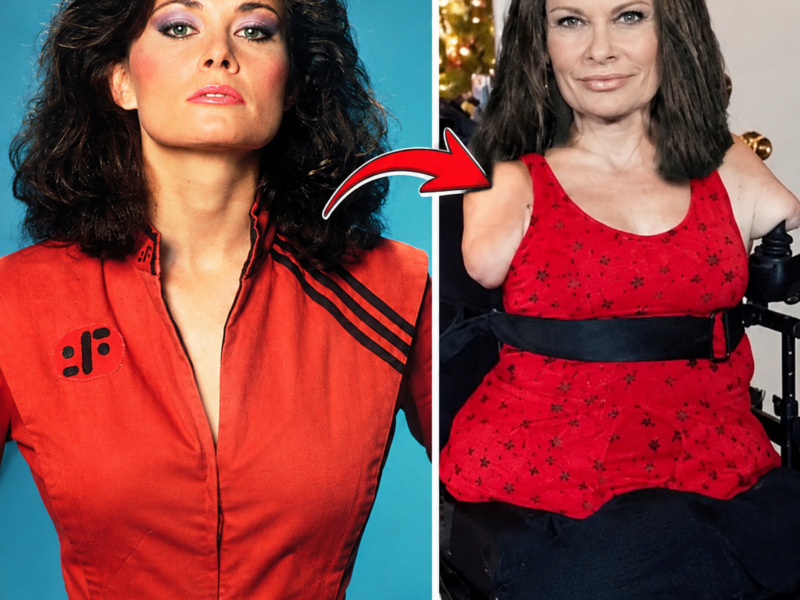
And now we come to the beautiful face that taught viewers never to trust the smile of a visitor.
Diana was played by Jane Badler, who was 29 during filming.
She became one of V’s most unforgettable creations because she combines elegance, intelligence, cruelty, and absolute confidence in the superiority of her own species.
She does not need to shout to be threatening.
Badler understood that control becomes more frightening when it arrives calmly.
Diana can appear sophisticated and almost reassuring while participating in something monstrous, and that contrast is central to the entire premise of V.
The visitors conquer through image before they conquer through force.
They look human, speak of friendship, and present themselves as saviors, and Diana represents what waits behind that performance.
Her rivalry with other visitors also reveals that the alien hierarchy contains ambition, jealousy, and political struggle of its own.
She is not merely carrying out orders.
She wants power, which makes her unpredictable even to those supposedly on her side.
Badler’s expressions do much of the work, since a measured smile, a cold stare, or a moment of satisfaction can suggest more danger than an elaborate threat.
In 2026, Jane Badler is 72.
Her connection to V followed her for decades, and she later embraced the character’s cult legacy while also continuing work in acting and music.
Diana endures because Badler made villainy glamorous without making it harmless.
The character became the perfect embodiment of V’s central warning.
Evil does not always arrive looking frightening.
Sometimes it arrives perfectly dressed, smiling for the cameras, and assuring everyone that there is nothing to fear.
The mother ships eventually left the sky, but V never really disappeared.
Its visitors frightened audiences because the story understood that invasion could begin with applause, propaganda, collaboration, and friendly faces long before anyone saw the reptile underneath.
Mike Donovan searched for the truth.
Julie Parish turned fear into resistance, Diana proved how seductive power could look, and Martin showed that conscience could survive inside the enemy.
Abraham Bernstein reminded everyone that history becomes dangerous when people convince themselves it cannot happen again.
Richard Herd, Neva Patterson, Jason Bernard, Leonardo Cimino, Andrew Prine, Penelope Windust, and Rafael Campos are sadly gone.
Marc Singer, Faye Grant, Jane Badler, Robert Englund, Michael Durrell, Bonnie Bartlett, Frank Ashmore, and others remain connected to one of science fiction television’s most unforgettable warnings.
Which V character stayed with you the most?
Donovan, Julie, Diana, Willie, or someone else?
And which cast story surprised you the most?
Tell us in the comments, and share this with someone who still remembers the day the ships appeared.









